Eat fast, you’re not as good as the guy up there.

A recent article over at BBC explored the “then and now” of servants in the UK – who had them, how they lived, and what has become of the domestic landscape today.

The article pointed out that downstairs was a microcosm of upstairs, with domestics mirroring the social hierarchy of those whom they served.

According to Dr Lucy Delap, director of studies in history at Cambridge University, “There would be a strict order of coming in to eat and strict rules about where different ranks of servants sit, and you might also have rules such as no speaking unless you were addressed by one of the senior servants. The senior servants had a great deal of power, so the butler for example in some households would put down his knife and fork, and everyone else had to fit in whether you had finished or not. So servants had to learn to be fast eaters.”

Upon reading this, I had a flashback and had to hunt up my copy of The Cooking of Vienna’s Empire by Time/Life.
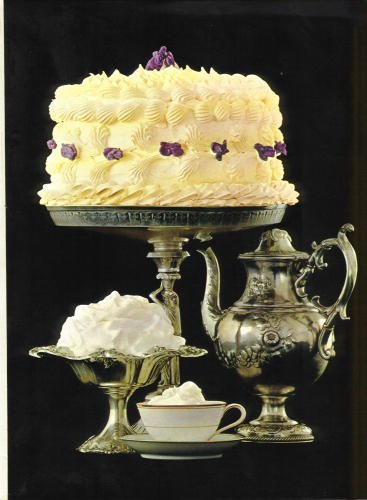
These are wonderful books, as much about the history and culture of the various regions they deal with as about the recipes. Having spent two years in Austria and much time working in the countries of the former Yugoslavia, this book is a treasured friend, and I recalled this paragraph about Emperor Franz Josef I:
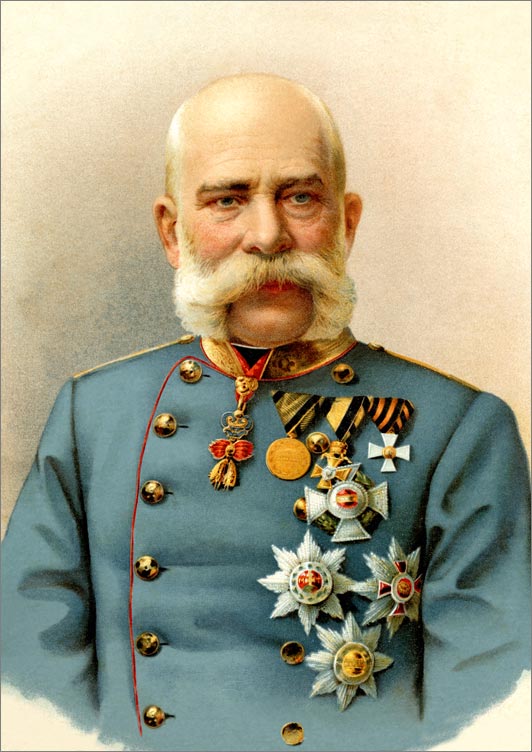
“Since the Kaiser was up so early, everybody around him had to get up too, which was not pleasant for the young officers who had gone to bed perhaps only a couple of hours earlier. By noon, the guard officers were starved and praying they wouldn’t be asked to sit down at the Emperor’s table. It must have been an ordeal to do so. Court etiquette demanded that the Emperor be served first and that no one continue eating after His Majesty had put down his fork. Unfortunately the Kaiser ate very quickly. By the time the large silver platters got to the hungry young officers, the Emperor had put down his fork and knife, and the poor fellows had just one tantalizing look at the lovely dishes – or maybe even a brief taste of the excellent Kaiserschmarrn – before their plates were removed.”

The BBC article makes numerous references to one’s “station in life.”

In the America that I grew up in starting in the 50’s, the concept of class distinction was far from the minds of most people; the underlying ideal was that anyone can become anything, and all men are indeed created equal. Looking at today’s society, however, it would seem that in many ways, we are a nation of servants in the homes of the super-rich for whom we toil. Class distinctions exist in my country as truly as they existed in Victorian England – the only difference is that British society accepted such as the natural order of things, and to a certain extent still does, while we cling to a largely imaginary egalitarian view of society.

Before I go any further, I want to be clear that everything is relative; despite the fact that I belong to a large group of people for whom economic terror is a stark reality, a poor family in the favelas of Rio or anyone living on the streets of Mumbai would laugh in my face if I were to tell them that I was feeling endangered.

What’s more important is the underlying social phenomenon of what divides people into classes and why so many think that’s just fine.

The Us/Them Mentality

From where I sit, the concept of ingroup affiliation appears to lie at the root of most social conflicts. The Arbinger Institute has published two powerful treatises on the tendency of humans to betray their better nature, and the hoop-jumping and back-bending we go through to justify that betrayal. From a corporate standpoint, this tendency is analyzed in Leadership and Self-Deception, but on a personal level, The Anatomy of Peace takes a hard look at what keeps people apart, and what’s necessary to bring them together.

When we treat others like objects rather than people, it’s all the easier to put them beneath us: beneath our notice, beneath our dignity, and beneath our need to be involved in their lives. What I see in politics today is the wholesale write-off of entire segments of our population by both parties: they are draining our resources, they are controlling our lives, they are destroying the constitution, they… you get the picture. It’s always easier to blame an outgroup (i.e. the other side of the aisle, women, men, gays, evangelicals – in short, anyone who is not us) than it is to take personal responsibility for one’s choices in life. It’s comforting and it’s easy to see people as obstacles, vehicles or irrelevancies.

As discussed in a previous post, I quoted Carl Sagan’s analysis of the famous “Pale Blue Dot” photo, and I repeat a piece of that here: “The Earth is a very small stage in a vast cosmic arena. Think of the rivers of blood spilled by all those generals and emperors so that in glory and triumph they could become the momentary masters of a fraction of a dot. Think of the endless cruelties visited by the inhabitants of one corner of this pixel on the scarcely distinguishable inhabitants of some other corner. How frequent their misunderstandings, how eager they are to kill one another, how fervent their hatreds. Our posturings, our imagined self-importance, the delusion that we have some privileged position in the universe, are challenged by this point of pale light.” As humans, as members of the same race floating in the same raft on the same ocean, it would truly pay us to remember how insignificant we are in comparison with the mind-blowing vastness of the universe.

In every way possible, my 500-year plan is to promote the concept of a world that works for all humanity. The title of this blog reflects R. Buckminster Fuller’s dream of making the world work, “for 100% of humanity, in the shortest possible time, through spontaneous cooperation, without ecological offense or the disadvantage of anyone.” If we are ever to attain such a blessed state, we can not remain in the condition described by Lewis Thomas in The Lives of a Cell – “For total greed, rapacity, heartlessness, and irresponsibility there is nothing to match a nation. Nations, by law, are solitary, self-centered, withdrawn into themselves. There is no such thing as affection between nations, and certainly no nation ever loved another. They bawl insults from their doorsteps, defecate into whole oceans, snatch all the food, survive by detestation, take joy in the bad luck of others, celebrate the death of others, live for the death of others.” No, we must transcend that.

As individuals, families, groups, societies, and nations, we must overcome the urge to treat others as objects and tools and things to be used to achieve our own personal ends, but rather see one another as other people, with hopes, needs, cares, and fears as real to us as our own. I refuse to believe that such a world is an unreachable utopia, an impractical dream. As long as I have breath, I will work for it.

The Old Wolf has spoken.

Next time I’ll stick to pizza

Another Old Wolf failed enterprise:

Posted this on Facebook the other day.

  1. Yes, it’s a Photoshop that I created just for giggles.
  2. My favorite comment was “There was no way that place was gonna stay in business once Hjálmar’s Hákarl Hut opened across the street.”
  3. Visit my Banquet from Hell

Since we’re on the subject of Photoshops:

This is extra funny if you speak Hebrew.

And now for some real restaurants:

There have been several of these around the country. There is currently one in Bluffton, SC.

I swear I saw one in Utah around 30 years ago. Sadly , it didn’t last. I’d eat there for sure.

Piliçmatik (“Chickenmatic”) is a Turkish restaurant franchise – they specialize in roasted chickens.

And now, a plug:

The One World Cafe is a nonprofit community kitchen аnd foundation which began іn Salt Lake City, Utah in 2003. Іts motto іs “a hand up, nоt а hand out.” The concept began when owner Denise Cerreta had an epiphany to serve food, let people choose their own portions and let them price those portions themselves. In 2012, Ms. Cerreta made the hard decision to close the Salt Lake location and dedicate her time to replicating the concept around the nation. Learn more here. But I’m sorry they left Salt Lake; they had great food, and an even better philosophy.

The Old Wolf has spoken.

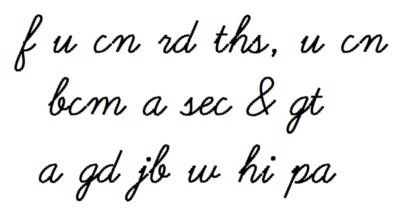
f u cn rd ths (If you can read this…)

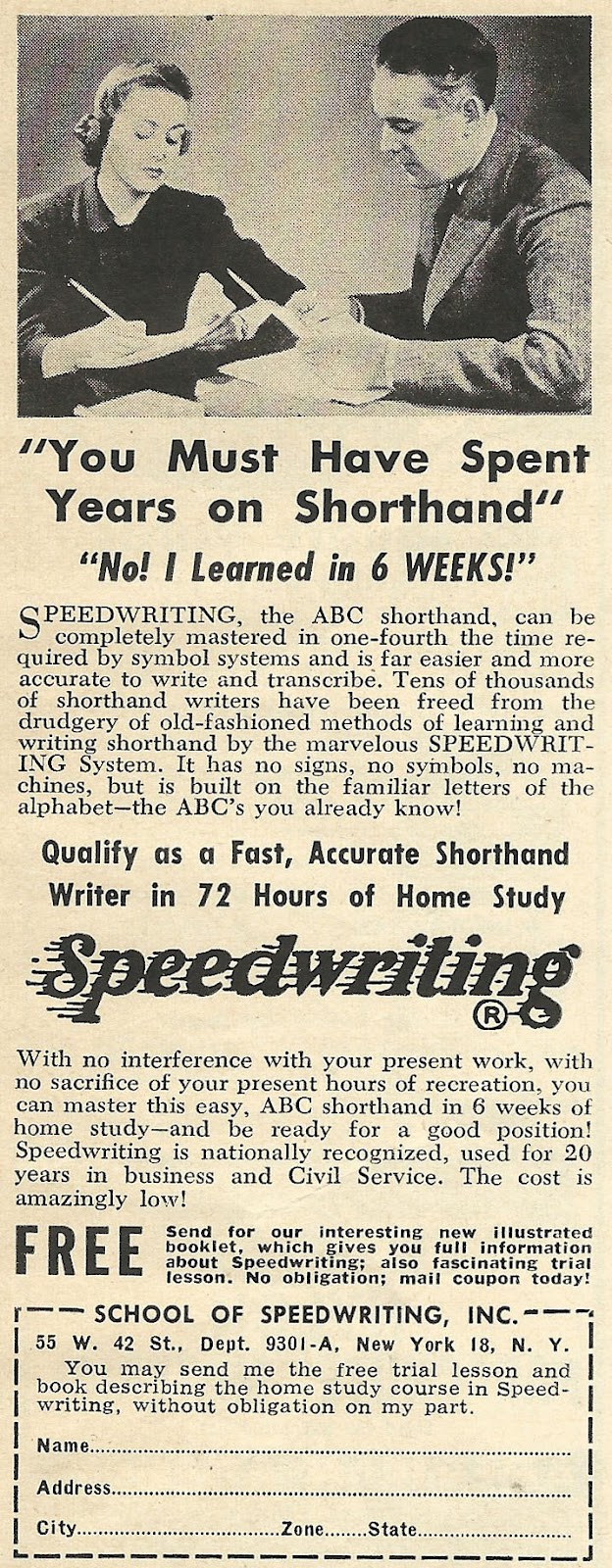
So intoned the billboards on the NYC subways for years. The School of Speedwriting wanted to make sure people knew that Gregg shorthand was not the only way to go, and while I never had the opportunity to learn either, it seems to make perfect sense to me. My ex was a whiz at shorthand, and she could take dictation like a court reporter – but all those squiggles! Worse than Arabic, if you ask me.

Of course, it’s based on being able to recognize words without the vowels. Since 2003,  this has been going around the internet in various forms, the latest one with the header “Only Smart People Can Read This”:

It is doubtful that any real research has been done on this phenomenon at Cambridge, but the underlying principle makes sense – experienced readers don’t decode, but rather they read words as entire units. This is useful to understand as I teach Japanese students the mysteries of English spelling. They get so wrapped up in “i before e” that they forget to learn new words in the same way that they learn their own kanji – as units.

To the untrained eye, each of these Japanese characters looks very much the same, 人, 大, 木, 本, 天, 火, 米, 犬, 水, 氷, 入, yet a Japanese person recognizes each without even thinking of it – a single jot can make the difference between big and dog, or between person and enter.

We do the same thing ourselves – and when presented with a block of text with mixed up letters (or missing vowels), our minds do what they do best – they look for things that look close to something recognizable, and usually come up with an accurate match almost instantly, unless of course you booted up a Unix system running “Fortune” and got “f u cn rd ths, itn tyg h myxbl cd…” – the Semitic peoples (Jews and Arabs) have been doing this for thousands of years – like anything, you just get used to it.

Nowadays, young people use this to their advantage when sending txt msgs (text messages): R u there? K. ttyl. (Are you there? OK. Talk to you later.) If things keep going the way they are, we may all be doing speedwriting whether we like it or not.

Th Ld Wlf hs Spkn.

Cigarettes, grammar, failed marketing, and everything.

Back in the day, tobacco companies could advertise, and advertise they did. Everywhere. Subways, buses, magazines, radio, television, courtesy packs on airplanes, you name it. The more powerful ads drove the more powerful brands. The Marlboro man was everywhere:

Rugged, strong, and healthy – notice the absence of the Surgeon General’s warning on this example from the 60’s.

But in those days, tobacco execs would go on national television and swear that tobacco wasn’t harmful, even to pregnant women (many of whom actually preferred smaller babies)…

… which babies were also used to hawk tobacco products.

Of course, now we know more than we did then:

But this is now, and that was then.

Two of the more popular cigarette campaigns actually capitalized on bad grammar:

This slogan was routinely held up by prescriptive grammarians as an example of abominable usage: “like,” they said, is a preposition governing nouns and noun phrases, and should never be used as a conjunction introducing an adverbial clause. “Winston tastes good as a cigarette should,” intoned the English teachers, was the only acceptable form. Naturally, the ad execs picked up on the furor and capitalized on it:

Not to be left out of the action, MAD magazine put this on the back of their January 1971 issue, which shows that many folks were quite aware of the dangers of smoking, thank you, even while the Tobacco execs were perjuring themselves on the national scene.

In fact, “In December 1952 [Reader’s Digest] published “Cancer by the Carton“, a series of articles that linked smoking with lung cancer. This first brought the dangers of smoking to public attention which, up to then, had ignored the health threats.” (Wikipedia) An interesting article summarizing the history of tobacco and health concerns can be found at CNN Interactive.

Popular stars shilled for tobacco on a regular basis – it seems so bizarre to watch Granny Clampett and Jane Hathaway discussing the merits of Winston, but it’s amusing to see how they worked the grammar issue in at the end in a Madison Avenue “double whammy”.

The Flintstones got into the act as well:

I confess with some shame that tobacco contributed to putting bread in my mouth for some time; mother functioned as a spokeswoman for Camel cigarettes for a year.

But when it came to using bad grammar, Winston was hardly the only offender – Tareyton’s campaign confused nominative and oblique to good effect in their highly successful slogan, “Us Tareyton smokers would rather fight than switch.”[1]

Despite the peccadillo – it seems that cigarette ads thrived on controversy – this particular advertising campaign was wildly successful in the 60’s, and pushed Tareyton’s popularity close to the top of the charts.

But not all products, even those from the makers of successful brands, were an instant hit.

Back in 1966, when I was 15, I was on one of my semi-regular visits to my mom’s brother in Salt Lake. We took a trip up to Idaho to see some additional relatives, and I remember spending some time in a tobacco warehouse, helping to run cartons of cigarettes through the tax-stamp machine. (Had the government gotten wind of our little diversion, the owner could have been shut down, but oversight was lax and attorneys less numerous in those days.) While I was working there that day, I noticed something unusual – a carton of Tennyson cigarettes, which I had never before heard of.

Now, the more astute among my readers will be asking themselves, “What does a 15-year-old know from tobacco?” As it happens, even at that tender age I was somewhat of a tobacco connoisseur. I had started smoking in high school, finding that it was a gateway to a certain level of acceptance, for as little as that was worth. And I parlayed my small bit of social coin into a minor fortune by becoming a user of odd and revolting brands.2 (In Connecticut, the legal age for tobacco was 16, but even before that I had no end of “friends” who would procure for me in exchange for a small consideration.)

Strong and with a different flavor than American standards.

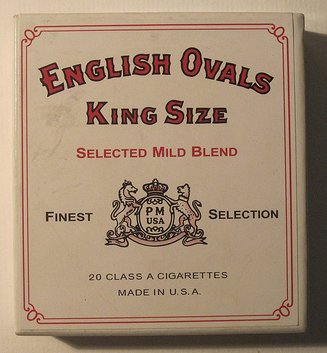
Oval cigarettes. Cute gimmick, but nothing special otherwise.

Absolutely foul. If I had these, I was guaranteed nobody would bum off me.

Tasted just about like smoking a cow pie. Or so I imagine.

Had kind of a fruity taste, unlike anything else I had ever smoked. Meh. However, Lark’s claim to fame was their commercial, the 1960’s version of Google Street View – the Lark truck would run around different places with a TV camera on the back, blaring the William Tell Overture, and asking people, “Show Us Your Lark Pack!” I saw this truck run down 1st Avenue in Manhattan one day; even if I had had a pack of Larks on me, I decided that discretion would have been the better part of fame, since I was still underage in New York.

[Edit: I had a copy of the commercial in question here, which I had posted at YouTube. Even though it was listed as public domain under a Creative Commons license, it appears that the brand is still owned by Trademarks LLC. The video was removed at YouTube, but for some odd reason still played here. In light of some communication with the above-mentioned company, I have removed the video. Unless it is taken down elsewhere, however, you can still see it here (3rd one on the list).

Now, since we’re on the subject of advertising in general as well, I nominate Salem cigarettes for the most insidious commercial ever devised. As a linguist who has studied close to 20 languages over the course of my life (although I don’t claim to speak them all), I can tell you that anything you produce will remain in your memory much longer than anything you hear. When learning a language, speaking is much more powerful than listening; they are different skills, yes, but the first cements things in your memory a lot longer than just hearing them, even multiple times. The following ad is much like getting up at 3:00 AM in the home of a musician, and playing only the first five notes of “Shave and a haircut” on the grand piano. It’s a guarantee that an irritated and foggy victim will stumble down the stairs to finish the “two bits” part before being able to go back to sleep.[3]

Unfortunately, despite these commercials being ancient, many of them have been taken down on copyright grounds. But go here and advance to 6:40, and you’ll get one of the ads that I’m referring to. Unless you are some kind of superhuman being, you will finish the line, and you will sing the brand name in your head. There is no escape.

There were others. I knew every brand on the market, and some that weren’t. I even rolled my own for a while, although not very skillfully, but when I couldn’t get these, I’d smoke anything I could get my hands on. My mother smoked Carltons (why bother, I wondered?) and when I’d cadge hers, I ripped the filter off; ultimately I settled on Luckies as my brand of choice. And of course, in the process, I became a 3-pack-a-day man by the time I was 18. The end of that story is that I quit, cold turkey, that year and never looked back – but my lungs paid a lifetime price.

So that brings us back to Tennyson, and by now I think you’ll understand why it caught my eye. A brand I didn’t know about? Intriguing! But in those days, there was no Internet, and such arcane knowledge was not to be found anywhere. Only later, thanks to the miracle of the Intertubez, was I able to dig up a bit of history, but even today what’s out there is pretty sparse.

In 1966, Tennyson launched a fairly comprehensive media blitz to publicize their new brand. I’m not sure why Tareyton simply didn’t choose to introduce a menthol version of their already-famous brand.[4]

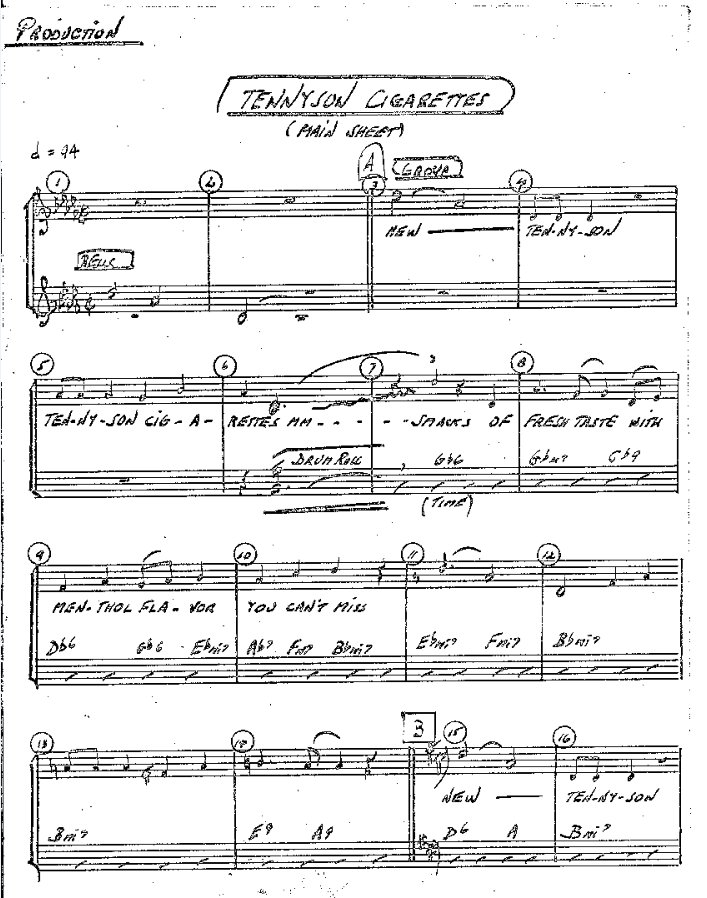
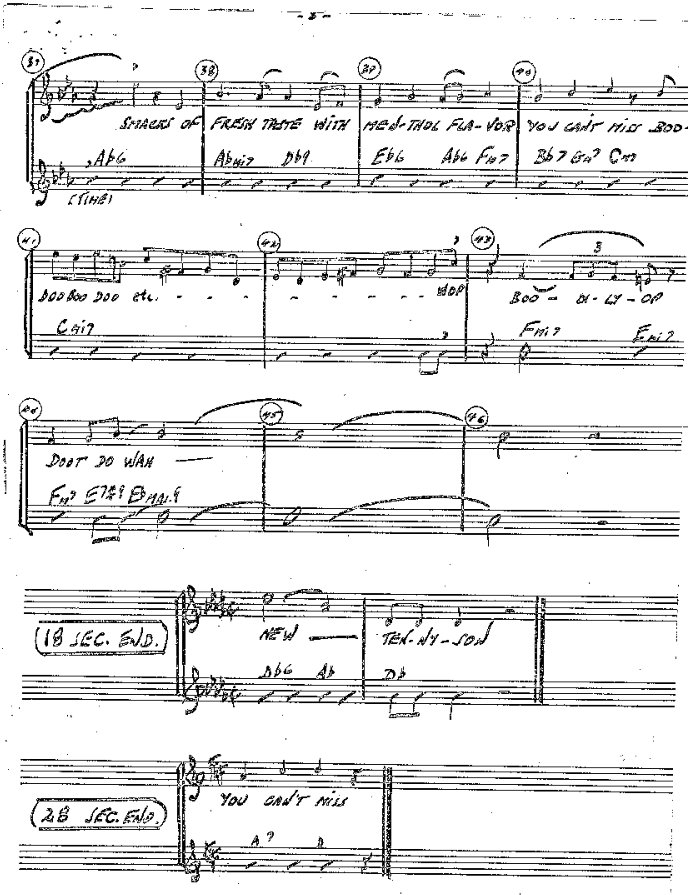
I even remember the jingle. I began to wonder later if I had imagined it, but fortunately the original sheet music which was submitted to the legal process was conserved:


So I’m not senile after all. I may be crazy, but that’s different. As a final bit of curiosity, I also found this:

Same package, same font, same look as Tareyton – but nary a whit of information to be found about what these are, or when or where they were sold. Possibly a European version of Tareyton? One clue:

This has been a bit of a ramble, but I got a good bunch of things out that I won’t have to worry about later (‘Now where did I archive that?’)

The Old Wolf has rambled.


1 In case you’re wondering, it should be “We Tareyton smokers.”

2 Plus ça change, plus ça reste la même chose. Visit The Old Wolf’s Banquet from Hell.

3 Brooke McEldowney, both a very gifted musician and a supremely talented artist who does the webcomics 9 Chickweed Lane and Pibgorn, riffed on this twice. In the first one, Edda and her mother Juliette engaged in this very exercise here; the second, where poor Seth is tormented by his ballet company, is here.

4 As it happens, such a thing exists, even though I only found out about it later as I was researching the topic. Never once did I see these in stores.

Payson Canyon in Autumn

… or almost autumn. But at 7,000 feet, leaves turn a lot faster than they do down in the lowlands.

The place was absolutely crawling with deer. We lost track of how many we saw.

As pretty as these colors are, they are already fading – I should have done this three weeks ago for maximum effect.

The hazy sky behind the trees was the result of a cold front coming down from Idaho where a number of fires are still burning. It was 57 degrees up here last evening.

A patch of deciduous color amidst the scrub and pines.

We stopped at Box Lake (more of a puddle, really – the Goodwoman of the House is from Maine, and she knows what real lakes look like). Had dinner on some rocks while enjoying the view. You can see how low the water level is, the drought is affecting all of our reservoirs.

Someone had built a home worthy of Scuppers the Sailor Dog.

(One of my favorite books as a child, I was tickled to find a copy again later.)

On the way down, a final burst of color in a parking area.

Many small groups of deer, in twos (mothers with children), threes, and fives – but no greater clusters than that. It was getting dark and we had to drive slowly because they were crossing the road frequently.

A lovely drive.

The Old Wolf has spoken.

How I learned to read

I was born in 1951. This book came out in 1952. I may have been given Dick and Jane in school, but this is the book I remember learning to read from. I have never lost my love of it, and all the ones that followed. The complete Peanuts series has been coming out from Fantagraphic Books since 2004, and the series of 25 volumes should be complete by 2016. By that time I may just be able to afford them. They’re not cheap, but they are lovely. I’ve already collected the complete Calvin and Hobbes and the complete Far Side, and having a complete Peanuts collection has long been one of my dreams. Schulz was a master.

The Old Wolf has spoken.

Street preacher, New York City, 1960

Found at Frog Blog

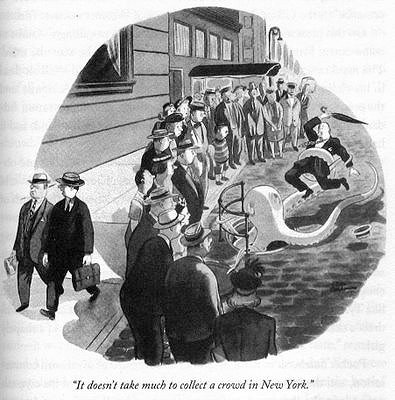
This put me in mind of the Charles Addams cartoon which shows a bunch of people clustered around a giant octopus emerging from a manhole and grabbing a passer-by. Two guys walking behind the crowd who can’t see what’s going on say “It doesn’t take much to collect a crowd in New York.”

It’s true, too. Times Square was the scene of a dramatic self-immolation at 2 P.M. on Saturday, July 18, 1970, when Hin Chi Yeung poured two cans of gasoline on himself and struck a match. I sadly happened across this event just after he had been extinguished; apparently he was getting poor grades and was distraught at the prospect of shaming his family who had sacrificed much to get him here to study. The crowds were insane. It was surreal – I thought someone had set fire to a department store mannequin at first, never thinking it might have been a real person.

On another note: See those “Cooled by Refrigeration” signs on the marquee back there? That was a huge draw in New York. “All around, people looking half dead, Walking on the sidewalk, hotter than a match head” is an accurate description of summer in New York, and for 50¢ you could pop into a theatre, sit down, watch the newsreel, the short, the cartoon, and the feature presentation… and then do it again and again for as long as you pleased. It was a cheap way to get out of the heat. Back then it was no big deal if you were late to a show… you just waited for the next round to start and caught what you had missed. Those were the days.