
Electrician J. W. Dalhouse works on a locomotive at Shaffers Crossing in Roanoke, Virginia, March 19, 1955
Photo by Conway Link
Electrician J. W. Dalhouse works on a locomotive at Shaffers Crossing in Roanoke, Virginia, March 19, 1955
Photo by Conway Link
by Ogden Nash
Silhouettes by Janet Laura Scott and Paula Rees Good
Published in 200 Best Poems for Boys and Girls, Whitman Publishing Company, 1938
Belinda lived in a little white house,
With a little black kitten and a little gray mouse,
And a little yellow dog and a little red wagon,
And a realio, trulio, little pet dragon.

Now the name of the little black kitten was Ink,
And the little gray mouse, she called her Blink,
And the little yellow dog was sharp as Mustard,
But the dragon was a coward, and she called him Custard.
Custard the dragon had big sharp teeth,
And spikes on top of him and scales underneath,
Mouth like a fireplace, chimney for a nose,
And realio, trulio, daggers on his toes.
Belinda was as brave as a barrel full of bears,
And Ink and Blink chased lions down the stairs,
Mustard was as brave as a tiger in a rage,
But Custard cried for a nice safe cage.
Belinda tickled him, she tickled him unmerciful,
Ink, Blink and Mustard, they rudely called him Percival,
They all sat laughing in the little red wagon
At the realio, trulio, cowardly dragon.
Belinda giggled till she shook the house,
And Blink said Week!, which is giggling for a mouse,
Ink and Mustard rudely asked his age,
When Custard cried for a nice safe cage.

Suddenly, suddenly they heard a nasty sound,
And Mustard growled, and they all looked around.
Meowch! cried Ink, and Ooh! cried Belinda,
For there was a pirate, climbing in the winda.
Pistol in his left hand, pistol in his right,
And he held in his teeth a cutlass bright,
His beard was black, one leg was wood;
It was clear that the pirate meant no good.
Belinda paled, and she cried, Help! Help!
But Mustard fled with a terrified yelp,
Ink trickled down to the bottom of the household,
And little mouse Blink strategically mouseholed.
But up jumped Custard, snorting like an engine,
Clashed his tail like irons in a dungeon,
With a clatter and a clank and a jangling squirm
He went at the pirate like a robin at a worm.
The pirate gaped at Belinda’s dragon,
And gulped some grog from his pocket flagon,
He fired two bullets but they didn’t hit,
And Custard gobbled him, every bit.

Belinda embraced him, Mustard licked him,
No one mourned for his pirate victim
Ink and Blink in glee did gyrate
Around the dragon that ate the pyrate.
Belinda still lives in her little white house,
With her little black kitten and her little gray mouse,
And her little yellow dog and her little red wagon,
And her realio, trulio, little pet dragon.
Belinda is as brave as a barrel full of bears,
And Ink and Blink chase lions down the stairs,
Mustard is as brave as a tiger in a rage,
But Custard keeps crying for a nice safe cage.

Photo by Hal Morey. Found by Jan-Edward Vogels
The combination of black and white with perfect timing, New York City, Grand Central Station, and the Depression Era create a perfect storm of photographic wonderfulness.
The Old Wolf has Spoken.
Posting Stevenson’s The Lamplighter reminded me that there are numerous other poems which stick in my memory from early childhood. When my mother passed away at the age of 94 in 2011, I found on her shelves a crumbling copy of Two Hundred Best Poems for Boys and Girls, compiled by Marjorie Barrows and published in 1930 and 1938. Printed on very non-durable paper, most of the book fell to dust when I tried to read it – but I immediately recognized it as a book that I loved from my earliest days. I was fortunately able to find an intact copy on Abebooks – it’s also yellowed and fragile, but complete. Just for fun, I thought I’d share some of my favorite youth poetry here, as the muse moves me, because it’s one thing that gave me a love of words and language from an early age.
Beatrice Curtis Brown
Jonathan Bing takes off his hat
Whenever he meets a Tabby-cat;
Jonathan Bing bows down to his toes
Whenver he passes a sheep he knows.
Oh, search from Paris to old Japan,
There’s none so courtly as Jonathan!
I’ve seen him murmer a “how-d’you-do”
To a tired forsaken dancing-shoe;
I’ve seen him lend his handkerchief
To a watering can that had come to grief;
I’ve seen him pat, without disdain,
An orphan goldfish who had a pain,
And he even lights a fire, I’m told,
To warm the air when the weather’s cold.
So what does it matter if people say
That he eats his peas in a vulgar way,
Or opens his mouth, to yawn, so wide
That twenty chickens could roost inside?
Oh, search from Paris to old Japan,
There’s none so courtly as Jonathan!
The Old Wolf has quoted.
by James Montgomery Flagg
The old comics were unbeatable for their pith and sophistication. Nat ran in Judge between 1903 and 1907.
Never get involved in a family squabble…
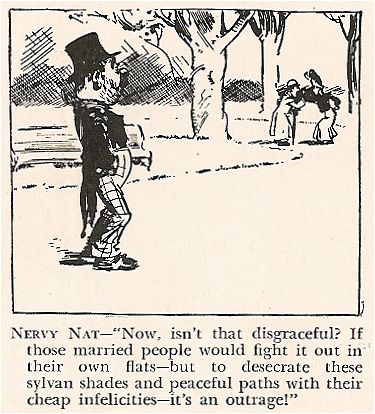
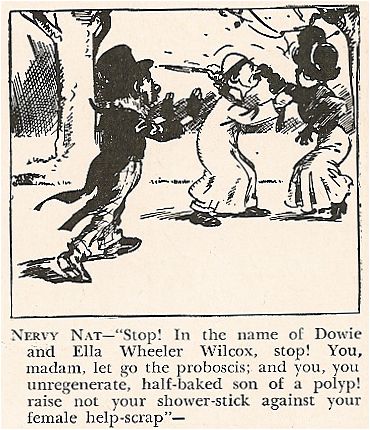

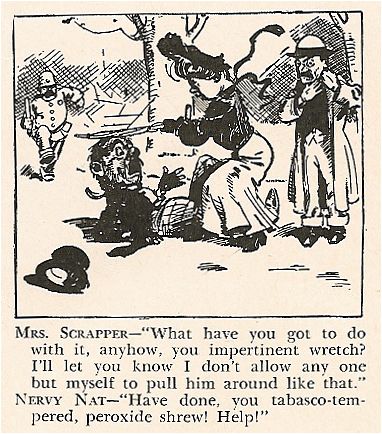
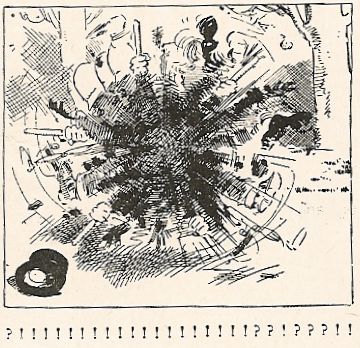

The Old Wolf has chuckled…
A buddy of mine over at Facebook posted this picture which made me laugh out loud – really, I’ve sworn not to say “LoL” unless I really did:

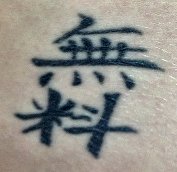
But that got me thinking, because so many people in this country (and probably others) get Chinese/Japanese characters tattooed in various places on their bodies, thinking their tats mean “bravery” or “samurai” or “golden lovebird” or “Tadgh Ó Suilleabhain”, only to find out when they bump into a native speaker that it really means something else again, or nothing at all.
An example from the wonderful website “Hanzi Smatter,” dedicated to identifying bad tats and what they mean (or don’t):
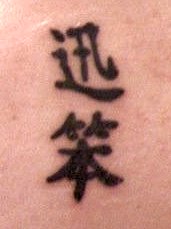
The customer wanted a tat that said “Fast and Furious”, but what they got was “Fast Foolish”

This one, on the other hand, is full of sound and fury, signifying nothing. It’s based on a gibberish asian font which was deciphered by Alan Siegrist, a professional Japanese-English translator and member of both Japan Association of Translators (JAT) and American Translators Association (ATA); with Alan’s help, tian (writer of Hanzi Smatter) compiled this chart, which has been widely circulated around tattoo parlors:
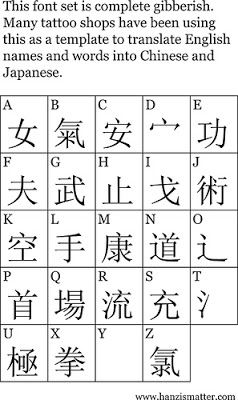
(note this website, which is currently selling this chart along with some other character sheets for $64.99).
The very clever user DavidR created this website, where you can generate your own garbage tattoo text for your amusement. But for the love of Mogg’s holy grandfather, don’t use it! (Note: At this writing, only the “to nonsense” function works – the other direction throws a DB error.)
If you’re still not quite sure what’s going on, have a look at these pictures, which give you an idea of what a native speaker might see if they looked at your sic tat:

This girl thought her tattoo says “Lord of the Dance”

She was hoping for “Grace Under Pressure”

“You mean, it doesn’t say ‘passion’?”

“But you swore this meant ‘Hot Stuff’!”
So why does this happen with far-too-common frequency? First of all, we can’t heap coals on the head of the average tattoo artist, no more of whom are total idiots than you would find in the average business establishment (law firms excepted). The answer appears to lie in the fact that kanjis (or hanzi) look cool to many non-Asians, but take a gruntload of specialized education to understand properly – and that would hold true even if you didn’t speak the language but were simply trying to understand the general concept of ideographic writing, and what it would take to incorporate that into your artwork in a professional way. But the fact remains that when you extract the vast majority of well-meaning and honest tattoo artists out there,
So what’s a body to do? Here are some helpful hints:
is not a good thing to use if you want “freedom,” because it means “free”, as in “no charge” – it’s also poorly drawn.
The Old Wolf has spoken.
Edit: This did not age well. Donald Trump is orders of magnitude worse than Berlusconi ever was.
Berlusconi is at it again. Americans pay very little attention to the politics of other countries [1], but this guy is a train wreck of the first water. “Douchebag” is an insult to all the douchebags in the world. It makes me realize it’s time to dust off this old bit of genius, and I’m only sorry I can’t give the proper attribution to the author.
Ode to Berlusconi
| L’onorevole Berlusconi si puo’ definire un por- tento di abilita’, oltre che un uomo politi- co di prim’ordine. Meriterebbe di essere de- cantato con rime sacre come ad altri è gia’ capitato. Meriterebbe un monumento di ster- minata mole marmorea che fungesse da e- co indistruttibile nei secoli, in modo che il fe- lice e caro nome di questo grande comunica- tore potesse tramandarsi in eterno. Stron- catore di malgoverni e uomo tutto d’n pez- zo come nessun altro, il cavaliere ci incu- te rispetto e ammirazione. Di Berlsconi si par- la in lungo e in largo e ci condurrà fino alla mi- tica era di benessere con la sua onesta faccia e seria. Tutti noi cittadini dell’europa unita scor- giamo in lui l’uomo del destino e perciò lo sor- reggeremo con tutte le nostre forze nel mu- tevole clamore delle folle, alzando un applau- so a Lui e al suo Governo! |
Prime Minister Berlusconi can be defined as a marvel of ability, and in addition, a first-class politician. As has been done for others in the past, he deserves to be extolled with sacred rhymes. He is worthy of a marble monument of immense size which would serve as an indestructible echo through the centuries, so that the beloved name of this great communicator might be known throughout eternity. A man who crushes misgovernment, a man of impeccable character like no other, this knight arouses within us feelings of respect and admiration. Berlusconi is spoken of far and wide, and with his honest and serious face, he will lead us into that mythical era of prosperity. All citizens of a united Europe see him as a man of destiny, and as a result we support him with all our energy amidst the ever-changing clamor of the crowds, raising plaudits to him and his government! |
|
Now… |
|
| L’onorevole Berlusconi si puo’ definire un por- co di prim’ordine. Meriterebbe di essere de- capitato. Meriterebbe un monumento di ster- co indistruttibile nei secoli, in modo che il fe- tore potesse tramandarsi in eterno. Stron- zo come nessun altro, il cavaliere ci incu- la in lungo e in largo e ci condurrà fino alla mi- seria. Tutti noi cittadini dell’europa unita scor- reggeremo con tutte le nostre forze nel mu- so a Lui e al suo Governo! |
Prime Minister Berlusconi is a first-class pig. He deserves to be beheaded. He is worthy of a monument of dung, indestructible throughout the centuries, so his stench might be passed down through eternity. A turd like no other, he buggers us far and wide and will lead us into misery. With all our energy, we citizens of a united Europe will fart in the face of Berlusconi and his government. |
The Old Wolf has spoken.
[1] Why should I care? I care because half my family is from Italy, and a big percentage of my relatives still live there. They deserve better than this festering heap of camel ejecta.

Dollars and Cents around the World
Pursuant to my previous post about hyperinflation and thinking of Greek lepta, I remembered that I had this list of units and fractions tucked away, and decided to share it for no good reason. Many of these currencies are historically obsolete, having been revalued multiple times or abandoned, but it’s interesting to see what was used.
Afghanistan 1 afghani = 100 pul
Albania 1 lek = 100 qindar (plural=qindarka)

Algeria 1 dinar = 100 centimes (santimat)
Andorra 1 diner = 100 centims
Angola 1 kwanza = 100 lwei
Argentina 1 peso = 100 centavos [still valid?]
Armenia 1 dram = 100 lum
Aruba 1 florin = 100 cents
Australia 1 dollar = 100 cents
Austria 1 Schilling = 100 Groschen
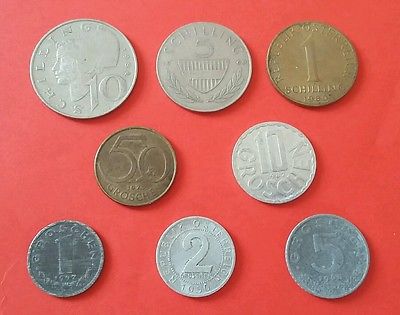
In Villach in 1975 there was a dry-goods store that had a once-a-year “1-groschen sale” – for a 1-groschen coin, you could get a yard of cloth. By this time, the 1-groschen coin was rare enough that the store came out ahead.
Azerbaijan 1 manat = 100 qapik
Bahamas 1 dollar = 100 cents
Bahrain 1 dinar = 1000 fils
Bangladesh 1 taka = 100 poisha
Barbados 1 dollar = 100 cents
Belarus 1 rubel = 100 kapeek
Belgium 1 franc = 100 centimes
Belize 1 dollar = 100 cents
Benin CFA franc
Bermuda 1 dollar = 100 cents
Bhutan 1 ngultrum = 100 chhertum
Bolivia 1 boliviano = 100 centavos
Botswana 1 thebe = 100 pula
Bosnia-Herzegovina Dinar/Deutsche Mark [?]
Brazil 1 real = 100 centavos [still valid?]
British Virgin Islands 1 dollar = 100 cents
Brunei 1 dollar = 100 sen
Bulgaria 1 lev (plural leva) = 100 stotinki (singular: stotinka)

Burundi CFA franc
Cambodia 1 riel = 100 sen [still valid?]
Cameroon CFA franc
Canada 1 dollar = 100 cents
Cape Verde 1 escudo = 100 centavos
Cayman Islands 1 dollar = 100 cents
Central African Republic CFA franc
Chad CFA franc
Chile 1 peso = 100 centavos
China (PRC) 1 yuan = 10 jiao = 100 fen
China (Taiwan) 1 New Taiwan Dollar (yuan) = 10 chiao = 100 cents (fen)
Colombia 1 peso = 100 centavos
Comoros Franc
Congo CFA franc
Cook Islands 1 dollar = 100 cents (tene)
Costa Rica 1 colon = 100 centimos
Croatia 1 kuna = 100 lipa

2003 Croatian 20 Lipa coin
Cuba 1 peso = 100 centavos
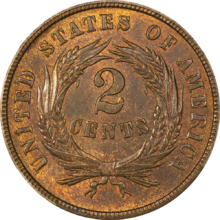
Cyprus 1 pound = 100 cents
Czech Republic 1 korun = 100 haleru
Denmark 1 krone (plural: kroner) = 100 ore
Djibouti Franc
Dominican Republic 1 peso = 100 centavos
East Caribbean States 1 dollar = 100 cents
Ecuador 1 sucre = 100 centavos
Egypt 1 pound (ginayh) = 100 piastres (qirsh) = 1000 milliemes (millimat)
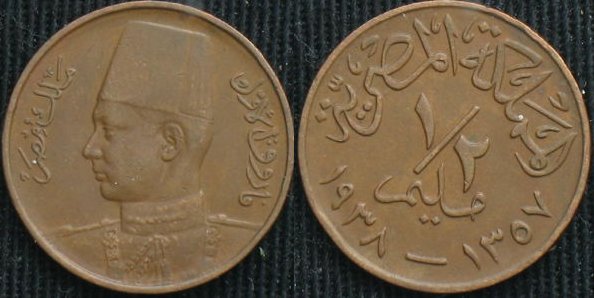
1/2 Millieme, Egypt, 1938
El Salvador 1 colon = 100 centavos
Equatorial Guinea CFA franc (franco)
Eritrea Dollar
Estonia 1 kroon = 100 senti
Ethiopia 1 birr = 100 santeems [still valid?]
Falkland Islands 1 pound = 100 pence
Fiji 1 dollar = 100 cents
Finland 1 markka = 100 pennia
France 1 franc = 100 centimes
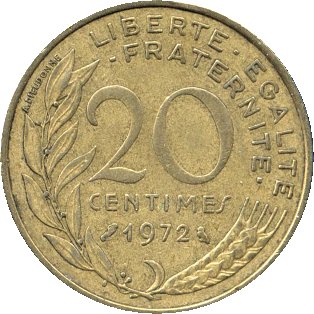
In France, there were about 5 Francs to a dollar for the longest time. This 20-centime piece would have been worth about a nickel.
French Polynesia CFP franc
Gabon CFA franc
Gambia 1 dalasi = 100 bututs
Georgia Lari
Germany 1 Mark = 100 Pfennig
Ghana 1 cedi = 100 pesewas
Gibraltar 1 pound = 100 pence
Great Britain 1 pound = 100 pence

Not to mention quids, bobs, mags, tanners, joeys, threepenny bits, florins, half-crowns, and all the rest of that nightmarish system. That’ll be two and six ha’penny, thanks.
Greece 1 drachma = 100 lepta (singular: lepton)
Guatemala 1 quetzal = 100 centavos
Guernsey 1 pound = 100 pence
Guinea franc guineen
Guinea-Bissau 1 peso = 100 centavos
Guyana 1 dollar = 100 cents
Haiti 1 gourde = 100 centimes
Honduras 1 lempira = 100 centavos
Hong Kong 1 dollar = 100 cents
Hungary 1 forint = 100 filler
Iceland 1 krona (pl. kronur) = 100 aurar (singular: eyrir)
India 1 rupee = 100 paisa
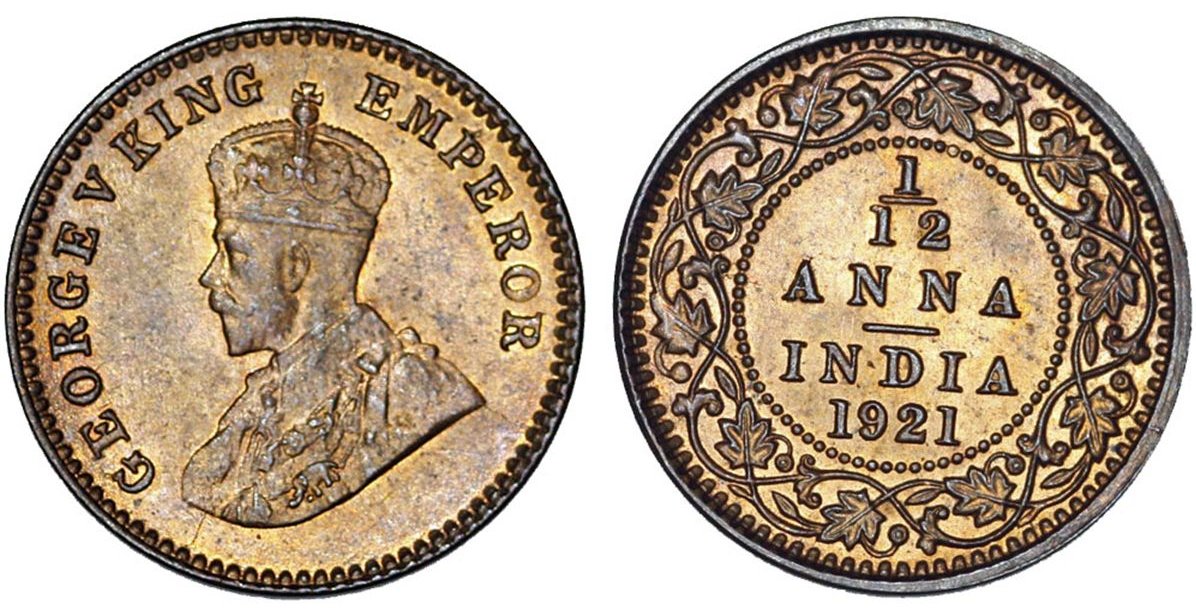
1 rupee had 16 annas, an anna had 4 pice, and 1 paise had 3 pies. This little coin was therefore worth 1 pie, or 1/192 of a rupee.
Indonesia Rupiah
Iran Rial
Iraq 1 dinar = 1000 fils
Ireland 1 punt = 100 pence
Isle of Man 1 pound = 100 pence
Israel 1 sheqel (plural: sheqalim) = 100 agorot (singular: agora)
Italy Lira
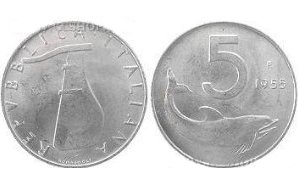
The 5-lira coin was still in use in Naples in 1970. It was becoming more scarce, and the 10-lira coin was most commonly seen, but they were still around. In those days, a “normale” (standard shot of espresso) cost 50 lire or about 8 cents, so collect 10 of these and you could get a cup of coffee.
Jamaica 1 dollar = 100 cents
Japan 1 Yen = 100 Sen = 1000 Rin

Japan 1-sen coin, 1944
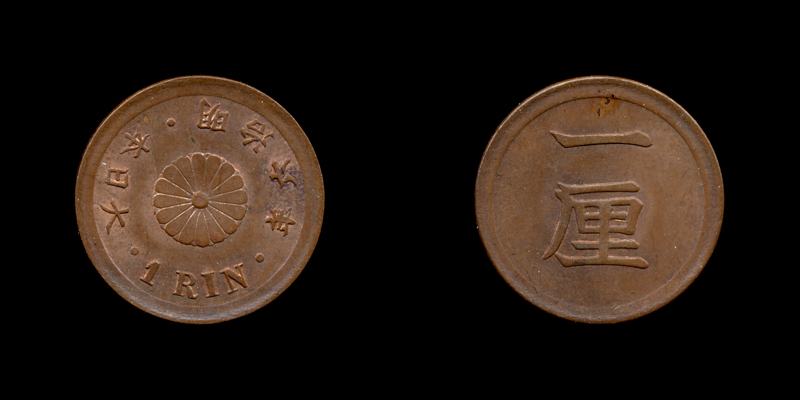
Japanese 1-Rin coin
The rin was discontinued after 1892, and the sen was demonetized in 1953.
Jersey 1 pound = 100 pence
Jordan 1 dinar = 10 dirhams = 1000 fils
Kazakhstan 1 som = 100 tyin
Kenya 1 shilling = 100 cents
Kiribati 1 dollar = 100 cents
Korea (ROK & DPRK) Won
Kuwait 1 dinar = 1000 fils
Kyrgyzstan
Laos 1 kip = 100 att
Latvia 1 lats = 100 santimu (singular: santims)
Lebanon 1 livre (lirah) = 100 piastres (qurush)
Lesotho 1 loti (plural: maloti) = 100 lisente (singular: sente)
Liberia 1 dollar = 100 cents
Libya 1 dinar = 1000 dirhams
Liechtenstein 1 franc = 100 rappen
Lithuania 1 litas = 100 centu (singular: centas)
Luxembourg 1 franc = 100 centimes
Macao 1 pataca = 100 avos
Macedonia (FYROM) 1 dinar = 100 deni
Madagascar Ariary [still valid?]
Malawi 1 kwacha = 100 tambala
Malaysia 1 ringgit (dollar) = 100 sen
Maldive Islands 1 rufiyaa = 100 laari
Mali Franc
Malta, Republic of 1 pound = 100 cents = 1000 mils
Malta, Order of 1 scudo = 12 tari = 240 grani
Mauritania 1 ouguiya = 5 khoum
Mauritius 1 rupee = 100 cents
Mexico 1 peso = 100 centavos
Moldova 1 leu (plural lei) = 100 bani
Moldova-Trans-Dniestria [ethnic Russian secession zone] Rouble
Monaco 1 franc = 100 centimes
Mongolia 1 tugrik = 100 mongo
Morocco 1 dirham = 100 santimat
Mozambique 1 metical = 100 centavos
Myanmar 1 kyat = 100 pyas
Nepal 1 rupee = 100 paisa
Netherlands 1 gulden = 100 cents
Netherlands Antilles 1 gulden = 100 cents
New Caledonia CFP franc
New Zealand 1 dollar = 100 cents
Nicaragua 1 cordoba = 100 centavos
Nigeria 1 naira = 100 kobo
Norway 1 krone (pl. kroner) = 100 ore
Oman 1 rial = 1000 baiza
Pakistan 1 rupee = 100 paisa
Panama 1 balboa = 100 centesimos
Papua New Guinea 1 kina = 100 toea
Paraguay 1 guarani = 100 centimos
Peru 1 sol = 100 centavos [still valid?]
Philippines 1 piso = 100 sentimo
Poland 1 zloty = 100 groszy
Portugal 1 escudo = 100 centavos
Qatar 1 riyal = 100 dirhem
Romania 1 leu (plural lei) = 100 bani

Russia 1 rouble = 100 kopeks
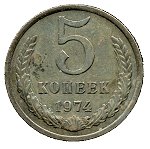
Russia – 5 kopeks, 1974
Rwanda Franc
St. Helena & Ascension 1 pound = 100 pence
St. Thomas & Prince 1 dobra = 100 centimos
San Marino Lira
Saudi Arabia 1 ghirsh = 5 halala (riyal?)
Senegal Franc
Seychelles 1 rupee = 100 cents
Sierra Leone 1 leone = 100 cents
Singapore 1 dollar = 100 cents
Slovakia 1 korun (pl. koruny) = 100 haleru
Slovenia 1 tolar (pl. tolarjev) = 100 stotinov
Solomon Islands 1 dollar = 100 cents
Somalia 1 shilin = 100 senti
Somaliland Somaliland shilling
South Africa 1 rand = 100 cents
Spain 1 peseta = 100 centimos
Sri Lanka 1 rupee = 100 cents
Sudan 1 pound (ginayh) = 1000 millim
Surinam 1 gulden = 100 cent
Swaziland 1 lilangeni (pl: emalangeni) = 100 cents
Sweden 1 krona (pl: kronor) = 100 ore
Switzerland 1 franc = 100 rappen or 100 centimes or 100 centesimi
Syria 1 pound (lirah) = 100 piastres (qirsh)
Tajikistan Manat [?]
Tanzania 1 shilingi = 100 senti
Thailand 1 baht = 100 satang
Tonga 1 pa’anga = 100 seniti
Trinidad & Tobago 1 dollar = 100 cents
Tunisia 1 dinar = 1000 millim
Turkey 1 lira = 100 kurus
Turkmenistan 1 manat = 100 tennesi
Tuvalu 1 dollar = 100 cents
Uganda 1 shilling = 100 cents
Ukraine Karbovanetz (coupons)
United Arab Emirates 1 dinar = 100 fils
USA 1 dollar = 100 cents
Uruguay 1 peso = 100 centesimos
Uzbekistan 1 sum = 100 tiyin

With 1000 Uzbeki som being worth $0.60 (as of 2013), the 1-tiyin coin was reported to be the “most worthless coin in the world,” with a value of 1/1999¢. Given constant fluctuations in world currencies, and constant devaluations, this honor will probably not last.
Vanuatu Vatu
Vatican City Lira
Venezuela 1 bolivar = 100 centimos
Vietnam Dong
West African States [currency union of former French colonies] CFA franc
Western Samoa 1 tala = 100 sene
Yemen ? [since reunification in 1990??]
Yugoslavia Dinar/Deutsche Mark [since 1994]

Former Yugoslavia – 1 Dinar, 1963. The earlier dinar was equal to 100 para.
Zaire Zaire
Zambia 1 kwacha = 100 ngwee
Zimbabwe 1 dollar = 100 cents
The Old Wolf’s Two Penn’orth.
When I was little, my mother (who served as a Red Cross worker during World War II) used to tell me stories of people in Weimar Germany taking wheelbarrows full of money to the store to buy a loaf of bread. “Haha,” I thought, “that’s a good one,” being too young to really get the concept.
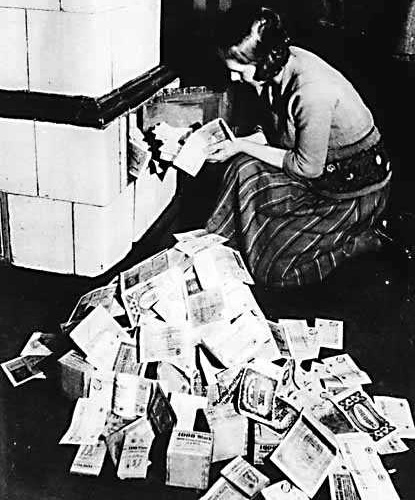
German woman burning banknotes, which burned longer than the wood that they would buy.
Then I grew up and traveled to Serbia, where I discovered that hyperinflation is not relegated to the furnaces of history.

This is the 500 billion Dinar note that was printed at the end of Serbia’s period of hyperinflation (I also have a 50,000,000,000 Dinar note as well) and I thought these were quite unique. [1] Until I heard about what happened in Zimbabwe.
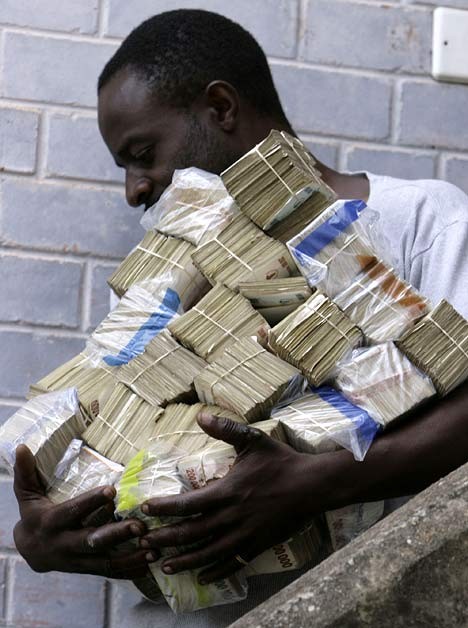
Off to buy a pack of gum
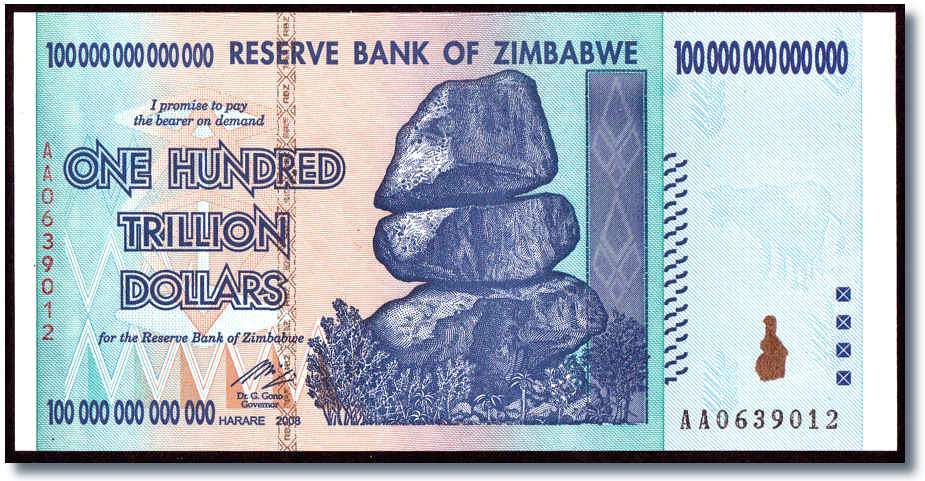
Even this didn’t help the situation; From Wikipedia, “The Zimbabwean dollar is no longer in active use after it was officially suspended by the government due to hyperinflation. The United States dollar ($), South African rand (R), Botswana pula (P), Pound sterling (£) and Euro (€) are now used instead. The United States dollar has been adopted as the official currency for all government transactions.”
But none of these monsters can touch what happened in Hungary in 1946:

This is the 100 quintillion pengő note, the largest banknote ever issued for public circulation. That’s 100,000,000,000,000,000,000, or 1020 pengő, which is a lot of pengő no matter how you slice them.
One rather interesting side-effect of inflation in Greece (before they gave up the Drachma in favor of the Euro) was that 5, 10 and 20 lepta coins became so worthless that it was cheaper to use them as washers than to go to the store and buy them.
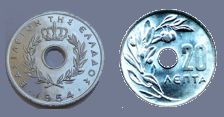
Prices keep going up here in the USA in the early years of the 21st century, but I’m grateful we’ve never experienced this sort of madness here. Well, almost never.

Just enough for 3 gallons of gas. [2]
The Old Wolf has spoken.
[1] This one is still unique to me, because I have one.
[2] The $100,000 dollar note was never circulated – it was used only for transactions between Federal Reserve banks.
A few of my favorite food-related health cartoons.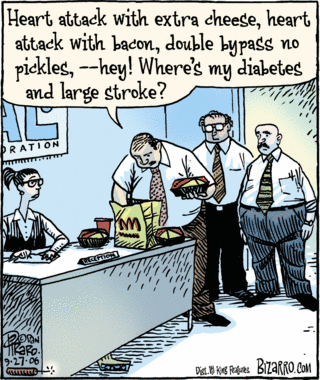
Bizarro © Dan Piraro

©Tribune Media Services

Bizarro © Dan Piraro
“Laws, like sausages, cease to inspire respect in proportion as we know how they are made.”
– John Godfrey Saxe

Retail © Norm Feuti
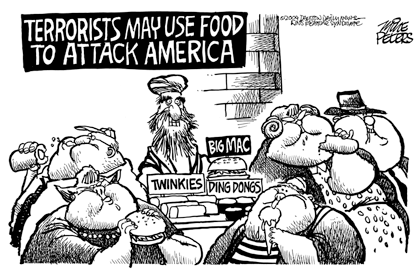
©Mike Peters
The Old Wolf has *burp* spoken
 Playing in the World Game