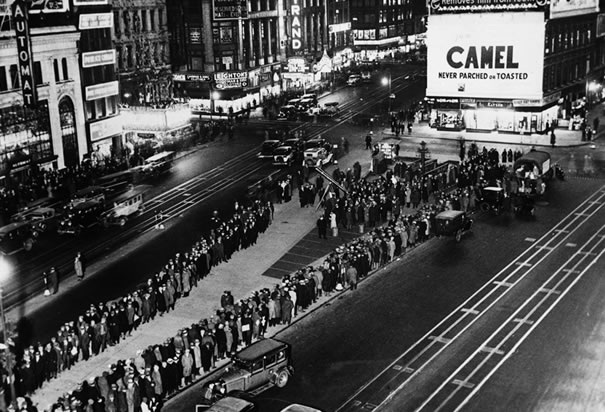
Times Square Breadlines

unemployed-in-line-for-rations


Notice the Automat sign on the left, lovingly mentioned here.

Things may not be as bad now as they were then… or then again, they may. We don’t have breadlines but we have food banks, and most of them are straining under the load. Too many people are out of work, too many are underemployed, and too many have simply given up.

Our country deserves better.

The Old Wolf has spoken.

London in Color – 1927

This beautiful video was taken by an early British pioneer of film named Claude Frisse-Greene, who made a series of travelogues using the colour process his father William – a noted cinematographer – was experimenting with. It’s like a beautifully dusty old postcard you’d find in a junk store, but moving. (Found at Vimeo).

Music by Jonquil and Yann Tiersen.


This is “moving” in more than one way; I was quite touched to contemplate these scenes.


The Old Wolf has spoken.

The Grapes of Wrath

fruchte-des-zorns

Joad Family Album, 1938 (Horace Bristol)

In the winter of 1937-38, photographer Horace Bristol and writer John Steinbeck teamed up for a Life magazine assignment and for nearly two months traveled California interviewing migrant workers of the Great Central Valley. Before finishing the project, however, Steinbeck withdrew—deciding to utilize the research for his novel The Grapes of Wrath instead of an article for Life.  When Steinbeck’s book was published in 1939, Life ran an article featuring the photographs taken by Bristol. Rather than using the real names of those photographed, Life used the fictional names of Steinbeck’s characters with captions featuring excerpts from The Grapes of Wrath—thus creating a photo album for the fictional Joad family that has since been mistaken for reality.

Found at Glaserei.

Roseasharn


Horace Bristol: Rose of Sharon

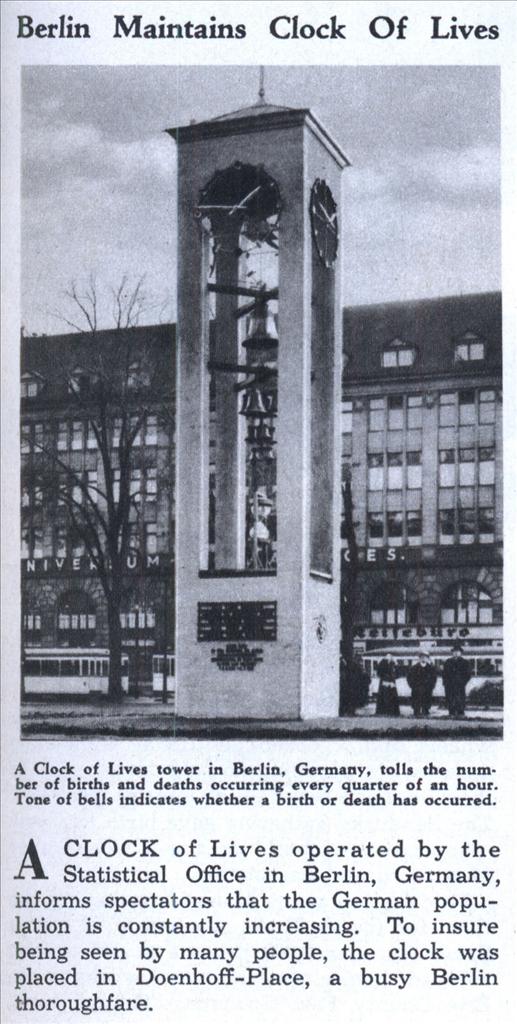
The Berlin Clock of Lives, 1935

“A CLOCK of Lives operated by the Statistical Office in Berlin, Germany, informs spectators that the German population is constantly increasing. To insure being seen by many people, the clock was placed in Dönhoffplatz, a busy Berlin thoroughfare. The clock tolls the number of births and deaths occurring every quarter of an hour. The tone of the bells indicates whether a birth or a death has occurred.”

die-berliner-lebensuhr-1936

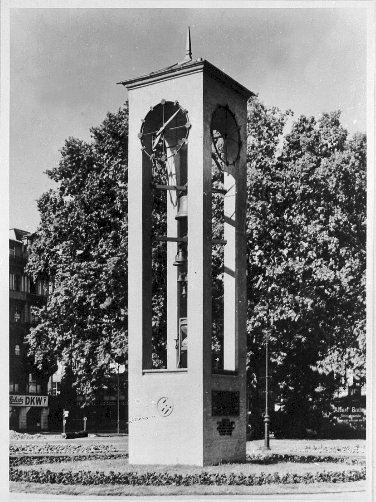
Another view of the Clock of Lives:

uhr

The clock, more properly called the Wilhelm-Lach Tower, was built in 1935. The small bell tower had the following inscription:

Every five minutes, nine children are born in the German Reich – every five minutes, seven men die. This tower is dedicated to the memory of the first National Socialist Mayor in the Central District, P[arty] M[ember] Wilh[elm] Lach, Born 9 June 1801- Died 6 July 1935″

According to the German Wikipedia site, the buildings around the square were heavily damaged during the war, and were largely razed and rebuilt. It is assumed that the clock tower met its demise around the same period.

uhr2


A photo of the clock memorial taken in 1935.

Berlin no longer has a population clock, but it has a pretty sick world time clock in Alexanderplatz:

tumblr_lykq7l8NVj1r8zlldo1_500


Der Alte Wolf hat gesprochen.

The Incredible Singing Clock

From the July, 1934 issue of Moderm Mechanix:

Singing Clock

Educated Clock Sings, Talks, and Plays the Pipe Organ

A CRIPPLED inventor of Akron, Ohio, has recently completed what he believes is the world’s most wonderful clock. The remarkable instrument gives the comparative time in 27 different cities. In addition, it sings, talks and plays a reedless pipe organ every hour.

Every day the clock commemorates the death of America’s martyrs. At the hour of Lincoln’s funeral it recites the Gettysburg address. The time of President McKinley’s burial is marked by a playing of the old hymn, “Lead, Kindly Light.” At the hour of President Garfield’s interment, the remarkable timepiece plays “Gates Ajar.”

Valued at $50,000, the educated clock was built by 70-year-old Marvin Shearer after ten years of painstaking work. The clock contains 5000 pieces of wood, a mass of electrical control wires several miles in length, and is twice the height of an ordinary man.

The inventor’s granddaughter made two comments on the original page; I have reproduced them here in slightly edited form.

There were actually TWO clocks.

Marvin Shearer was my grandfather. I have searched everywhere for one of his clocks. I did trace the “Electric Wonder” to the Hotel Lobby of the Ritz in New York City but when it was remodeled, they got rid of the clock. No one there has been there long enough to know what happened to it. If anyone ever locates one of them PLEASE e-mail me at donnaleecotter16 [at] gmail [dot] com.

Here is what I know of his works:

Marvin carved a clock that was eight feet wide and thirteen feet high. It was called the ELECTRIC WONDER. He started this clock in 1927,  and completed it in 1931. He also carved a second smaller clock, and perhaps a third.

There is an article in “The New York Times” dated April 7, 1909, about a “Wonderful Clock Made by Cripple”.

Another article I found was in The “Omaha World Herald” dated November 15, 1903, titled, “Queer Clock That Tells Many Things an Ohio Man Works on for Three and a Half Years”.

The Electric Wonder

This exhibit took 15 months to design. It contains 7172 pieces of wood from 32 different countries, from all parts of the world.

It has nearly 1½ miles of electric wire, 17 clock dials, and gives time in all parts of the world.

It shows important events of United States History from 1492 to 1934.

Our Navy of 47 ships pass by according to their classification.

It tells the weather conditions 24 hours in advance. It plays a reedless pipe organ, the only one of its kind in the world.

It shows and gives the Funeral Marches of our assassinated Presidents.

It shows the goddess of Liberty or eternal light in memory of American soldiers who lost their lives while in service for their country. It has chimes, harps, electrical cascade, electrical railway, an airship and a dirigible. Also, Indian history and arrowheads of the lone Indians from the battlefield of Custer’s Last Fight.

The Electric Wonder is 13 feet high, weighs 3800 lbs. has 168 electric lights and took 19,000 hours or nearly 7 years to build.

It has been endorsed by leading electricians and engineers of today. It is a merit to its maker as well as mankind.

I repeat the plea of the inventor’s granddaughter – if anyone has any clue as to the ultimate fate of this or other of Shearer’s works, please contact her. This is an astonishing achievement.

The Old Wolf has spoken.

Hospital Charges Explained

Redditor “badengineer” gives a compelling and clear explanation of what’s going on with wildly-fluctuating hospital charges. Not a lot of mainstream folks read Reddit, so I thought this was worth cross-posting over here.


I work for a top tier academic medical center as a corporate strategist, so I’m at least aware of how the various hospitals in my state are doing, how pricing works and what the market dynamics are. There are a few things that should be pointed out….

First, you’re right. The charge rate certainly doesn’t correlate to quality metrics.

The charge rate listed in the data (available as an 11MB excel file at CMS.gov) has nothing to do with anything. It’s not a real price. It doesn’t correlate to the price anyone pays except for the extremely rare millionaire who doesn’t have insurance. Medicare doesn’t pay it, 95% of uninsured people can’t pay it, insurance companies don’t pay it.

It’s primarily a negotiating trick, with some accounting tricks thrown in for good measure.

People need to understand how pricing works, because it’s the cancer at the heart of healthcare.

At any given hospital, there are a hundred different prices for any given procedure. Medicare and Medicaid pay all hospitals the same amount for Procedure X. Most hospitals lose 20% (or more) on that Medicare price and make it up on the private companies.

Every single private health insurance company pays a different price, very often 150% of what Medicare is paying. Each plan negotiates prices all on its own, in secret. They have no idea what other insurance companies pay. It’s in no one’s interest to share that price. It hurts hospitals’ future negotiations if their lowest negotiated price is public and it hurts payers negotiations if it gets out that they overpay some hospitals.

The hospital says “X costs us $50K, Y costs $60K, $Z costs $20K.”

The insurance company they’re negotiating with says “we normally pay $25K, $35K and $9K for those procedures. How about we give you 50% of your charge rate?”

The hospital says “OK”.

As a result, at a single hospital there can literally be 100 plans paying different prices for your gall bladder removal. Multiply that by 3,000 hospitals in the country. There are maybe 3,000,000 different prices for that surgery out there. All completely secret. You can imagine how that might create problems.

So basically, this charge rate is nothing more than a bit of insight into a hospital’s chosen negotiating tactics. They either price high and discount a lot, or price low and discount a little.

Uninsured people are screwed no matter what. If you’re uninsured and land in the hospital, you’re likely going bankrupt. It’s almost irrelevant whether it’s a $200K bill or a $100K bill. You’re going bankrupt. You might think this pricing was designed to extract money from that uninsured population, but hospitals get so little money from them that most don’t think about trying to squeeze them more using this charge rate. A vast majority of that care is just written off.

If the charge rate doesn’t correlate to real prices, it definitely doesn’t correlate to quality. There’s very often an inverse relationship between cost and quality to begin with. Medical errors are expensive and the places that reduce them save a ton of cash in lawsuits, readmissions (in cases where they’re penalized for them), etc. For example, we’re an awesome hospital you’ve heard of, but some organ transplants cost 35% less at the best-of-the-best place, because they do it so frickin’ well. That’s real cost. Not fake charge book cost. Usually, the better the care, the cheaper it is.

The odd thing about this story is that it isn’t new. Dartmouth Health Atlas has been publishing similar data for decades. It’s great to see it being covered, because it’s insane and a clear symptom of a deeper problem, but I was surprised to see it on the front page of the Times.

And every time I write something about this, I have to add: neither insurance companies nor hospitals are (on the whole) getting particularly rich off of this. As crazy as it sounds, this is not the result of unusual greed or a morally corrupt industry. It’s a historical artifact more than anything. Non-profit hospitals (which is almost all of them) earn an average of 2.5% operating margin and that’s shrinking. I dunno about for-profit hospitals, but they’re still not raking it in like people think they are. Health insurance plans earn more like 3.5% on average. If you chart the most profitable sectors of the economy, that puts them pretty far down the list. Drug companies, in comparison, are deep into double digit margins.

Of course, that’s relatively small profit on a truly mind-boggling amount of money (17% of the american economy) so it has a gigantic effect. It also tends to concentrate a lot of pain on people who can’t afford to pay it.

Anyway, that low profit margin gets at why no one breaks out and tries to be more transparent. A tiny downtick in your reimbursement rates will sink you. As our contracting guy says, last time our main payer got slightly miffed and decided to throw some business across town, we laid off 500 people the next year.

This is just how the system works. It’s not a conspiracy. It’s a perfect example of how a a bad system forces a bunch of rational actors to do absolutely batshit crazy things. Everyone could stand to earn and do a lot more if things were rationalized and we did away with this system of invisible prices. That’s the tragedy of the commons for you.

All hospitals and insurers are forced to play this game. Whether that’s a big 100-facility for-profit chain, a gigantic charity-oriented catholic system, an academic research center or your community hospital. This is how money moves in the system. Any real fix stands to hurt so many players that it’s pretty unlikely we’ll see change from a political standpoint. I’m kind of hoping the whole thing just collapses under it’s own weight and something better can arise from the ashes.


The system seems beyond fixing to me, but for the sake of our conscience we must continue looking for solutions, because what we have now is an immoral cesspool.

The Old Wolf has spoken.
Übercrappy and Filth

Abercrombie CEO Mark Jeffries still only wants ‘thin, beautiful’ customers. There’s only one problem.

fitch


Gacked from Reddit

This kind of corporate douchebaggery is, unfortunately, legal… but it certainly doesn’t make for a responsible corporate image. But A&F has a long, long tradition of being shallow and exclusive; I present for your gratuitous enjoyment a cartoon by Al Frueh, published in The New Yorker in 1926 (click for a larger version)

Abercrombie and Fitch


I remember buying one of A&F’s lighter-fluid-fueled hand warmers in their NYC shop as a kid, because it looked cool:

Handwarmer


It’s basically just a slow-burning lighter, but it worked great. Aside from that, I don’t think I’ve ever purchased anything from them over the subsequent 50 years. But then, I’m not one of the “beautiful people,” so that’s OK according to them.

The Old Wolf has spoken.