
Edit: Added an article about Garrity at the end.
Every time I see an article posted about bad police behavior, someone chimes in about the officer being given “paid vacation” for his or her transgression.
It is not “paid vacation.”
Below a comment from redditor /u/thatsnotminesir, a police officer who gave a comprehensive explanation of what “administrative leave” really means, at least in his department – and it sounds like this is how it should work.
The myth I see the most of reddit is that when officers get in trouble, they just get “paid vacation.”
When an accusation of misconduct comes up, especially criminal misconduct, the officer is placed on Administrative Leave with pay. This is NOT the punishment. This is to get them off the streets while the investigation is being conducted, while at the same time, not punishing them (financially at least) until the accusations are investigated and proven.
When an accusation of Police Misconduct is investigated, there are TWO separate investigations. One is an Administrative Investigation, the other is a Criminal Investigation. They have to be separate because of Garrity.
Garrity is like the evil twin of Miranda for government employees, mostly police. After the Garrity admonitions are read to us, we MUST answer all questions, and MUST answer them truthfully. If we refuse to answer, or lie, we can be fired just for lying or refusing to answer.
That completely violates our 5th Amendment Right against self incrimination. Because of that, nothing said after Garrity can be used against us in criminal court. It can only be used in administrative actions against our employment.
Therefore, two separate investigations are conducted. An Administrative Investigation where they read us Garrity, and a Criminal Investigation where they read us Miranda. Nothing found in the administrative investigation can be used against us in the criminal, but things found in the criminal CAN be used against us in the administrative. So the criminal is usually done first, then the administrative afterwards.
Because the administrative is usually done after the criminal, that’s why it often takes time for the firing to happen, because the firing won’t happen until after the Administrative. While that seem strange to the laymen, if the Administrative was done first, and officer could say “Yeah I stole the money” under Garrity and it couldn’t be used against him in court. But if the criminal is done first, and he says “Yeah I stole the money” after Miranda, it can be used to prosecute him AND to fire him.
Once the two investigations are complete, THEN the punishment is handed down if the charges are sustained. Media articles don’t always follow up on the case, so all people read in papers is “officer got in trouble, is on paid leave.” Administrative Leave is just the beginning, not the end of the story.
Even then, the Administrative Leave isn’t fun. The take your badge and gun and you are basically on house arrest between the hours of 8am and 5pm on weekdays. You cannot leave your home without permission of your superiors, even it its just to go down the street to the bank or grocery store. You must be available to come into the office immediately at any time for questioning, polygraphs, or anything else involved in the investigation. Drink a beer? That’s consuming alcohol on duty, you’re fired. So even when officers are cleared of the charges and put back on the street, Admin. Leave still isn’t “paid vacation.”
EDIT: I did not realize the wiki explained garrity, but gave such a poor example of the admonitions, leading to some confusion. Here is a much better example.[3]
EDIT:#2 I changed the Garrity wiki link because the wiki had a very poor example of the warnings, which led to a lot of confusion. Plus the change has a lot of links to more information on garrity for those wanting to learn more about it.[4]
Here’s the original wiki[5] for those who wonder what I changed.
This was an eye-opener for me. Anyone who has watched cop shows knows about Miranda rights, but I had never heard of Garrity. The post was a good education – forever after, I will never wince the same way I used to when a news article mentions administrative leave.
There are a lot of stories in the media this year about police misconduct. That may be a good thing, but a lot of it seems like clickbait, low-hanging fruit for getting eyeballs on ads. It would be critical for our nation for every police department in the country to weed out its rotten apples and bad actors, but even if this were to happen, the number actually purged would be very small in comparison to the majority of men and women who entered law enforcement for better motives.
Let’s not forget what Jon Stewart recently said:
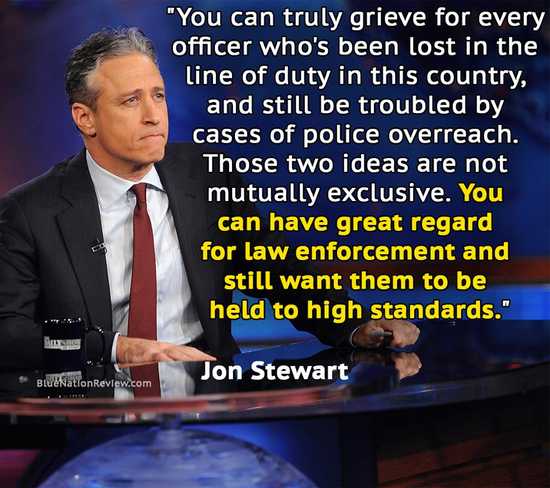
“You can truly grieve for every officer who’s been lost in the line of duty in this country and still be troubled by cases of police overreach. Those two ideas are not mutually exclusive.”
More information about Garrity
The Garrity rights, Garrity rule or Garrity warning is a protection that is utilized by many law enforcement officers each year. Simply, Garrity is an invocation that may be made by an officer being questioned regarding actions that may result in criminal prosecution.
The Garrity Warning
This article is geared toward law enforcement, but the Garrity Warning is also available for other employees of state and local government organizations.
The Garrity Warning is often misunderstood as it is inconsistently applied throughout the country. In some states it may be read to the employee before questioning begins. In other states, the employee must invoke his or her Garrity Rights.
Simply, our Constitution protects everyone from having to criminally incriminate themselves. We cannot be forced to testify against ourselves.
By invoking the Garrity, the officer is invoking his or her right against self incrimination. Any statements made after invoking Garrity, may only be used for department investigation purposes and not for criminal prosecution purposes.
The Garrity Rule stems from the court case Garrity v. New Jersey, 385 U.S. 493 (1967), which was decided in 1966 by the United States Supreme Court. It was a traffic ticket fixing case of all things.
Officers were advised that they had to answer questions subjecting them to criminal prosecution or lose their jobs. The Court held that this was Unconstitutional.
Technically, there are two prongs once Garrity has been triggered.
First, if an officer is compelled to answer questions as a condition of employment, the officer’s answers and the fruits of those answers may not be used against the officer in a subsequent criminal prosecution. Second, the department becomes limited as to what they may ask. Such questions must be specifically, narrowly, and directly tailored to the officer’s job.
Thus, the basic thrust of the Garrity Rights is that a department member may be compelled to give statements under threat of discipline or discharge but those statements may not be used in the criminal prosecution of the individual officer. This means that the Garrity Rule only protects a department member from criminal prosecution based upon statements he or she might make under threat of discipline or discharge.
Also, the Garrity Rule is not automatically triggered simply because questioning is taking place. The officer must announce that he or she wants the protections under Garrity. The above statement should be prepared in writing, and the officer should obtain a copy of it. If a written statement is being taken from an officer, the officer should insist that the Garrity Warning actually be typed in the statement. Consult your attorney and union delegate for the laws regarding Garrity in your state before providing any statement.
In New Jersey, the Garrity Warning is actually covered in the New Jersey Attorney General Guideline on Internal Affairs. Simply, if an officer being questioned invokes his Garrity Rights, the agency can contact the county prosecutor. The county prosecutor can elect to grant use immunity which will prohibit any part of the officer’s statement from being used against him or her in a criminal proceeding. But, if use immunity is granted, the officer is required to answer the questions.
Below is an excerpt from the Guideline:
If the subject officer states that he refuses to answer any questions on the grounds that he may incriminate himself in a criminal matter, even though the investigators do not perceive a criminal violation, the department should discontinue the interview and contact the county prosecutor.
If the department wants to continue its administrative interview, and the county prosecutor agrees to grant use immunity, the department shall advise the subject officer, in writing, that he or she has been granted use immunity in the event his or her answers implicate him or her in a criminal offense. The officer must then answer the questions specifically related to the performance of his or her official duties, but no answer given by him or her, nor evidence derived from the answer, may be used against the officer in a criminal proceeding. At this point, if the officer refuses to answer, he or she is subject to disciplinary charges for that refusal which can result in dismissal from the agency.
It is, of course, always recommended to seek advice from an attorney qualified in the field before answering any formal questions.
Below is the actual Garrity Warning:
1. I am being questioned as part of an investigation by this agency into potential violations of department rules and regulations, or for my fitness for duty. This investigation concerns
______________________________________________________________________________
______________________________________________________________________________
2. I have invoked my Miranda rights on the grounds that I might incriminate myself in a criminal matter.
3. I have been granted use immunity. No answer given by me, nor evidence derived from the answer, may be used against me in any criminal proceeding, except for perjury or false swearing.
4. I understand that I must now answer questions specifically, directly and narrowly related to the performance of my official duties or my fitness for office.
5. If I refuse to answer, I may be subject to discipline for that refusal which can result in my dismissal from this agency.
6. Anything I say may be used against me in any subsequent department charges.
7. I have the right to consult with a representative of my collective bargaining unit, or another representative of my choice, and have him or her present during the interview.
Assistant Prosecutor/Deputy Attorney General Authorizing: __________________________
Signature:________________________________
Date:_______________ Time:_____________
Location:_________________________________
Witnessed by: ______________________________
______________________________
These are sometimes referred to as the Garrity rights.
-NJLawman.com
The Old Wolf has spoken.
 Playing in the World Game
Reblogged this on Coyoty's Words.