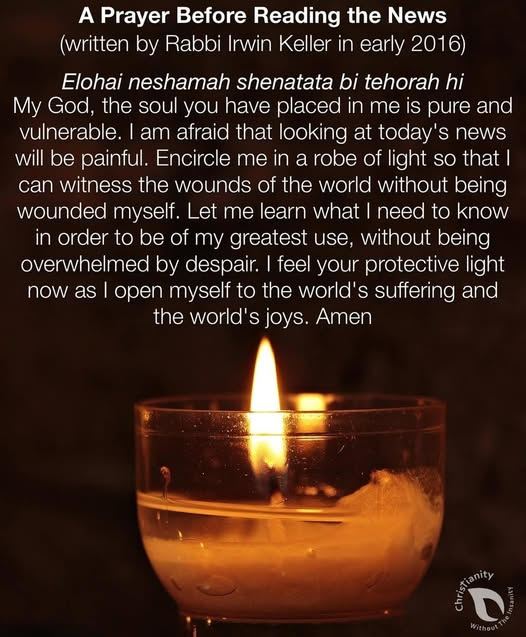
I found this beautiful and comforting. “Elohai neshamah shenatata bi tehorah hi” is the beginning of a traditional prayer recited upon awakening – it translates roughly as “God, the soul You have given me is pure.”
For some background, the full Hebrew prayer is below, found here:
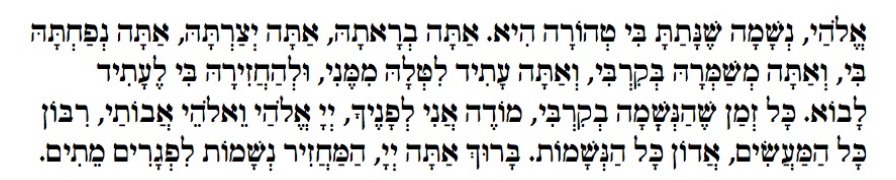
| Elohai n’shamah shenatata bi t’horah hi. | My God, the soul You have given me is pure. |
| Atah v’rataH, | For You created it, |
| atah y’tzartaH, | You formed it, |
| atah n’fachtaH bi, | You made it live within me [breathed it into me]. |
| v’atah m’shamraH b’kirbi, | And you watch over / preserve it within me, |
| v’atah atid lit’laH mimeni ul’hachaziraH bi leatid lavo. | and/but one day, You will take it from me and restore it in the time to come. |
| Kol z’man shah-n’shamah b’kirbi | As long as the soul is within me, |
| modeh/modah ani l’fanecha¹ | I will give thanks to Your face/presence |
| Adonai elohai veilohei avotai, | My Lord God of Gods of the generations before me, |
| she’atah hu ribbon kol ha-ma’asim, | to You who are the power of good deeds, |
| mosheil b’chol ha-b’riot, | the Ruler of all creatures, |
| adon kol ha-n’shamot. | the Master Craftsman of every soul. |
| Baruch atah Adonai, ha-machazir n’shamot ha-meitim. | Blessed are You God, giving souls to the dead. |
It is interesting to me that this prayer by Rabbi Keller reflects a core plot point in The Chosen, the seminal novel by Chaim Potok. In it, one of the protagonists is raised by his father, a rabbi, in silence (i.e. without non-essential communication or fatherly affection). The father later goes on to explain:
“Ah, what a price to pay…. The years when he was a child and I loved him and talked with him and held him under my tallis when I prayed…. ‘Why do you cry, Father?’ he asked me once under the tallis. ‘Because people are suffering,’ I told him. He could not understand. Ah, what it is to be a mind without a soul, what ugliness it is…. Those were the years he learned to trust me and love me…. And when he was older, the years I drew myself away from him. ‘Why have you stopped answering my questions, Father?’ he asked me once. ‘You are old enough to look into your own soul for the answers,’ I told him. He laughed once and said, “That man is such an ignoramus, Father.’ I was angry. ‘Look into his soul,’ I said. ‘Stand inside his soul and see the world through his eyes. You will know the pain he feels because of his ignorance, and you will not laugh.’ He was bewildered and hurt. The nightmares he began to have…. But he learned to find answers for himself. He suffered and learned to listen to the suffering of others. In the silence between us, he began to hear the world crying.“
This novel, and this passage in particular, always touched me deeply. I was moved to hear the sentiment expressed in a modern prayer for peace, but also for compassion and compassionate action.
The Old Wolf has spoken.
Footnotes:
¹ This line reflects the prayer Modeh/Moda ani, which is recited upon awakening and before getting out of bed. “As this prayer does not include any of the names of God, observant Jews may recite it before washing their hands.” In Talmudic times, Jews traditionally recited Elohai Neshamah upon waking. The prayer was later moved to the morning synagogue services. (Wikipedia)
 Playing in the World Game