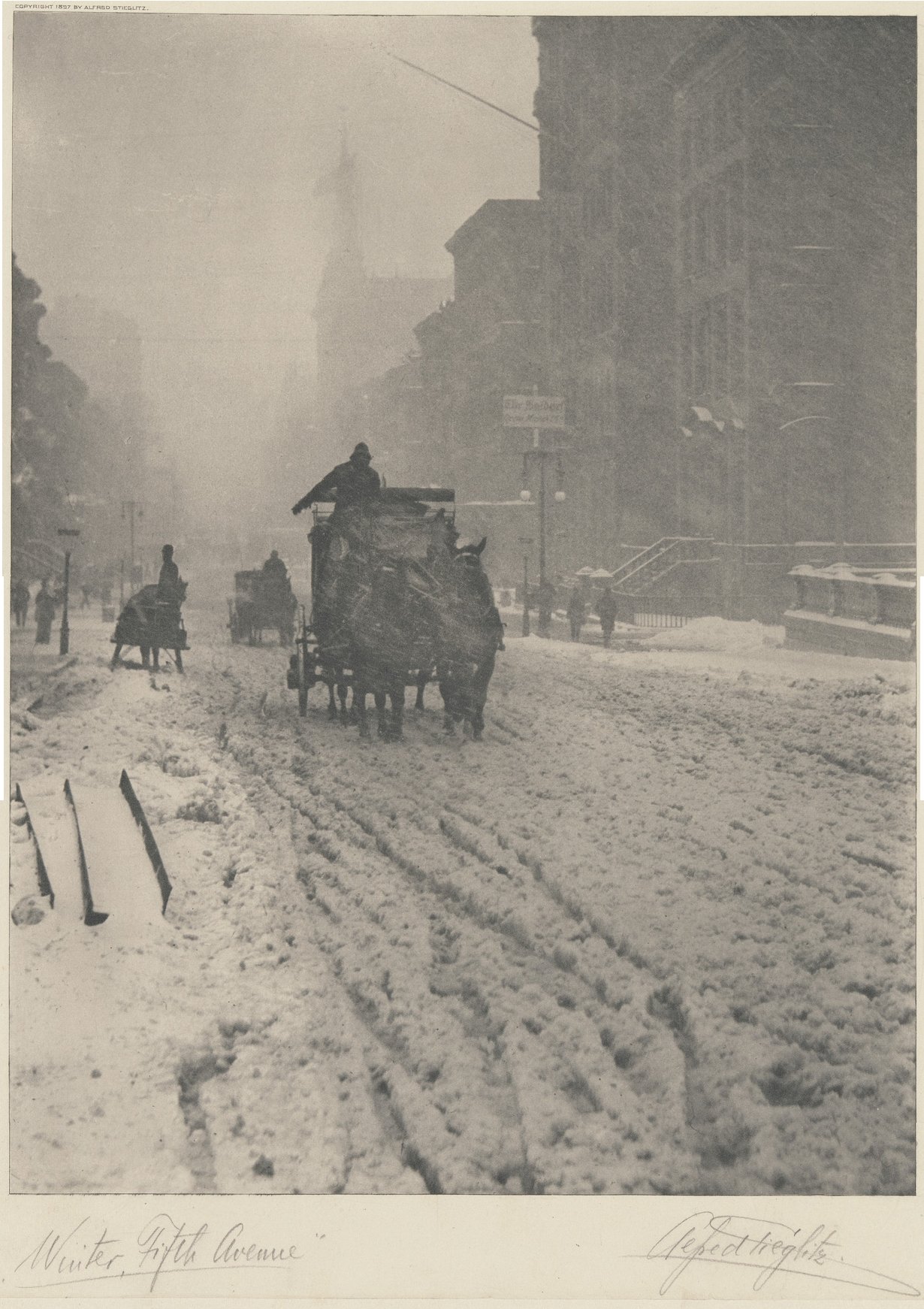
Alfred Stieglitz @ The Metropolitan Museum of Art
Alfred Stieglitz @ The Metropolitan Museum of Art
Severe hailstorm leaves massive damage in Mississippi.

Heavily damaged home.

Tennis-ball sized hailstones.
Yeehaw.
The Old Wuf has done spoke.

The postage appears to be French. The image appears to be strange.
We all make jokes about heartless landlords foreclosing on widows and orphans… you can probably see the same image I do in your mind’s eye, even without help.

But for the love of Mogg’s holy grandmother, who would victimize the Girl Scouts?

Recent news articles show a distressing trend in our society to prey on the easiest and weakest victims. Last Saturday, a Utah man (with an accomplice driving his getway car) robbed a girl scout troop of their cash; in Oregon, some bottom-feeder placed a hoax order for 500 cases of cookies with another troop[1]; in Seattle this month, vandals trashed a garage full of Girl Scout cookies; and in South Carolina, a man was charged with taking 450 boxes of cookies from a warehouse.
All these people may think they’re smart and clever; they may be desperate for drugs; they may be irritated by some imagined social agenda; who knows? It doesn’t matter – they are douchebags, wastes of human cytoplasm, lower than the scum I would scrape off the soles of my shoes. And the universe will pay them back, because wickedness never was happiness. In their hearts, they are already miserable.
The point here is not to focus on the negative in society, because that will always be with us. The point is, it’s time for people of good will in the world to step up their game. I heartily support the affirmation of Sarah Miller, director of communication for Girls Scouts of Oregon and Washington, when she said, “For every one person that has bad intentions, there are hundreds more with good intentions and good hearts that are here to help you.” There are more of us than there are of them, but it’s time to do more. Evil is rising, and we need to move out of our comfort zones to make a difference on a daily basis, and not just when the news reports a need. Edmund Burke (or someone else)[2] once said, “The only thing necessary for the triumph of evil is that good men do nothing.” And it’s true. Evil will flourish if unopposed, and scurries for dark corners when people of good will confront it.
This in no way implies that people are not already reaching out and doing good at every possible opportunity; many are[3]. A great place to read about good things happening in the world is The Good News Network; certainly a more uplifting option than the mainstream news outlets which are only interested in one thing – generating advertising revenue, which they do by pushing visual impact, drama, and blood-pressure-raising sound bytes rather than solid content. As I mentioned elsewhere, one of my favorite film quotes ever is when Secretary Rittenhouse tells Jenny Lerner in “Deep Impact,” “Look, I know you’re just a reporter… but you used to be a person, right?”
Let’s all step up our game. Let’s bring our first-string efforts to making this world a better place, a place that works for 100% of humanity. Let’s all do something every day to lift, strengthen, heal, and brighten. Only if we do this can we stem the rising tide of darkness and ignorance.
The Old Wolf has spoken.
[EDIT: As of 3/19/2013, one suspect in the cash robbery has been arrested and the other identified. Updates as they happen.]
[EDIT: On 3/21/2013, the prime suspect turned himself in.]
[EDIT: On 3/23/2103, City Hall offered the girls another chance to sell cookies; community members have donated enough to make up for their lost cash as well.]

[1] Good Samaritans in Oregon have stepped up to help these girls – last Saturday they sold about half of their excess inventory, and will probably sell the rest next week.
[2] That’s an unusual attribution, but there’s a significant controversy about who said it first. A masterful summary of the quote and its history is found at The Quote Investigator.
[3] For example.
Deliciousness like this cannot be hid under a bushel, but rather must be set atop a hill for all to see.

An architectural project, a secret garden of music and healing, dwells in an unlikely space between London’s Great Ormond Street Hospital and a neighboring building. It looks like Animusic crossed with the Pompidou museum in Paris, sounds like the Swingles on magic mushrooms and accompanied by a chorus of angels; and feels as though Agatha Heterodyne had landed on Pandora and tried to recreate the world of Alice in Wonderland.
Click through for the project’s website; a writeup on Neatorama; and a sample of the lullaby itself, which can only be heard locally at special listening pods or by tuning in to the secret radio station.
The Old Wolf has listened, slack-jawed, and tried to speak worthily.
With thanks to Colin Nelson for permission to spread this little bit of whimsy and delightful writing around. So here, for your gratuitous reading pleasure, is an account of an intriguing discovery. Original post here.
——————————————————————————–
Archaeological Find
In the County of Meath in Eastern Ireland lies the Boyne Valley. An area that has fascinated scholars and archaeologists for centuries. There you find Brú na Bóinne, the Palace of Boyne. There you find Dowth, Newgrange and Knowth; Dozens of burial tunnels criss-cross the area. They were built about 3200BC making them older than the Pyramids or Stonehenge.
Richard Watkins of Stanford University was part of a team that was investigating Tunnel 22 that runs north-south through Newgrange. About 122 metres down the tunnel, he discovered what appeared to be an ancient cave-in. After 3 days careful work, Watkins and his team discovered that the rocks concealed the entrance to a roughly circular chamber about four metres in diameter.
There were clear signs that this was not a burial chamber but had been inhabited at one time. There were the remains of a fire below a gap in the ceiling that was once, presumably, a primitive chimney and source of light. There were the tattered rags that may have been bedding or clothing and some artefacts (one of which was a knife dated about the eighth century AD).
An examination of the chamber provided evidence that the occupant was connected with a monastery near Drogheda on the River Mattock that pre-dated Mellifont Abbey built on the same site by some 200 years. Records discovered at the abbey site indicated a monk called Muireadhach was entrusted with a “Pagan relic so foul it must be forever banished from the world of the living.”
This reference led Watkins to re-examine the chamber, whereupon he found a hiding place cunningly carved into the chamber wall and hidden behind a close-fitting stone. There was a solid mass about one metre by one metre by 0.5 metre behind the stone, and great care had to be taken in order not to cause any undue damage.
The mass was packaged up and sent to Truro University where Professor John Dean led the team that was to analyse and preserve the find.
It was discovered that the outer part of the mass consisted of about five goat skins; each had to be removed separately. Within was an ancient book. The cover was made of wood and fastened with metal clasps. The pages were fastened to the covers with cords that had only survived because of the protection of the goatskins and the atmosphere of the cavern.
At last, the team could see the first few pages of the book. They contained drawings, now faded, but were once rich in colour. Alongside these drawings were the spidery writings of the scribe in an ancient version of Gaelic (it pre-dated the use of Roman letters).
The search was on for someone who could translate the book. That search ended in Adelaide, Australia with Bryan Tewkes. Tewkes had done extensive research on Pre-Roman Civilisations of the British Isles. It was he that finally identified the book that had filled the ancient monks with so much horror:
“Irish Dancing Part 2: The Hand & Arm Movements”
The Old Wolf and Mad Jack have spoken.
Reblogged from Tarin Firepelt at Livejournal. Because it’s awesome.
Back in my youth I spent many years in Boy Scouts. I am an Eagle Scout, for those who don’t know, and I can’t tell you how many life lessons I learned in this wonderful organization. Stuff I certainly didn’t learn in public school.
As I watch what is going on in Congress right now I think back to these days. In my scout troop, we went camping one weekend of every month, regardless of the weather. Our scout master correctly knew that these camping trips were the main vehicle in which scouts were taught leadership, and bad weather made it even better a teaching experience. Of the 3 times that temperatures dropped below freezing in Florida during the 4 years I lived there, 2 of those times I was on a camping trip. But I am digressing from the point I want to talk about.
Scout troops are broken up into smaller units called patrols. We had about 40 boys in our troop that were broken up into 5 patrols of 8 boys each. Each patrol is led by one of the middle ranked scouts, the patrol leader, who organizes the young scouts in the camping trips, and helps teach skill awards and other basic scout principles.
One of the responsibilities of a patrol is the planning and organization of the meals on the camping trip. Our trips began Friday after school, and went to mid day on Sunday. So we had to plan for Friday dinner, Saturday breakfast, lunch and dinner, and Sunday breakfast plus a snack for lunch as we rode back to civilization. To pay for this each scout donated $5 in 1980’s money, so we can say about $10 in modern coin.
During the patrol meeting before the campout, the scouts would decide what they were going to eat, covering the 4 food groups in each meal, and realizing the limitations of the cooking apparel and campfire. Roles would be assigned to each boy, covering Cook/Assistant Cook, Fire Tender, Wood and Water Supplier, and the much hated KP. These would be varied so people could gain the experience needed for their skill award and merit badge check lists.
Finally, and the point of this post, the scouts would meet at the grocery store where they would purchase the food. Notice I say the scouts. Mom or Dad would drive them to the grocery store to meet, and usually wait outside for us, but it was the SCOUTS that did all the purchasing.
I think back to one of the trips we made when I was patrol leader. We had 6 scouts going on the trip I think I was the oldest in the patrol at the time at around age 13 or 14. When we showed up at the Grocery store we had $30 with which to feed 6 kids over 5 meals and a snack. Following the lead of something I had learned from an earlier patrol leader, I let the scouts go down the aisle, grabbing all the things needed for the trip, making certain they let me know the price of everything they were getting so I could tally it on my clip board. We finished the walk through and when we got up to the front for check out I held up the clip board.
We had a $70 dollar cart of groceries and only $30 bucks worth of cash.
The scouts eyes bugged out. Keep in mind we are talking 10-14 year olds here who for the most part had never done any grocery shopping beyond tossing cereal and cookies in the cart while tagging along with mom on the family trips. Once it was made clear that we couldn’t take more money the hard reality of trimming that cart down began.
Out went all the cookies and twinkies. Proportions were cut. The cart was divided into the 4 food groups as we still had to meet our basic rules for scouts as per the cooking and camping skill awards. Scouts were introduced to the price difference between name brands and generics, and then that little “price per unit” number came into play as scouts realized that 2 big cans equalled 5 smaller cans and was cheaper by the ounce to boot. Desserts were removed from breakfast and lunches so we had the luxury of sweets for dinner. Haggling ensued between the scouts as we decided and compromised on menu changes on the spot.
And in a half an hour we managed to get that $70 dollar cart down to $30 so we could meet our budget.
The camping trip came around that weekend and we had our meals. And we didn’t starve. I was a hyperactive 14 year old, running around in the woods like a lunatic and I didn’t starve. We were mostly teenagers, and you know how teenagers eat. We didn’t starve. As a matter of fact I remember a lot of good nights, sitting around the campfire, bloated on the food we ate, toasting marshmallows to make the smores we had managed to squeak in the budget during the grocery run. We had bought our food, cooked our food, cleaned up after ourselves, and the average age in my patrol was 12.
This life lesson has stayed with me to this day. I remember the lean years of college when I was trying to stretch my $25/week budget to cover food gas and leisure. I remember how I would look at the price per oz on the generic brand vegetables and buy the bigger cans rather than the smaller and proportion them into zip lock bags at home. I remember buying bottle sodas rather then cans, because if I returned the bottles I would get 10 cents back on each, cutting the price per oz of the soda by a third. I am blessed to be beyond that stage now, but this frugality has allowed be to “Be Prepared”, for the hard times the country is suffering now.
As a 12 year old, I learned how to convert a $70 dollar cart of groceries into something that could support a $30 budget. Its a shame the majority of our current leaders didn’t go to scouts. If they did we wouldn’t be running the deficit we have now.
The Old Wolf has spoken. Thanks, Tarin.
Sharing this because I can’t hit the “like” button over at YouTube more than once. This is parody at its very best, combined with some real social relevance, all wrapped up in a delightful execution.

No, this is not dead Cthulhu rising from R’lyeh, although that’s what it looks like. It’s merely Mercury Thiocyanate being heated.
Chemistry can be H.P. Lovecraft.

There is so much truth in this. It requires no further comment.
The Old Wolf has spoken.


