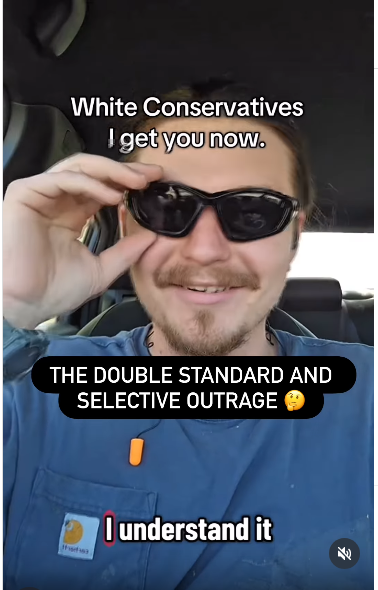
This amazingly on-target video was created by Instagram user @somethingblackmade. It’s fairly long, so if you prefer to read instead of watching, here’s a full transcript of what he says.
It’s a challenge to the alt-right to really think about what they’re saying when they call for the death of anyone who disrespects the murder of Charlie Kirk.
Note: I do not condone political violence of any sort against any person. Civil disobedience, resisting, and protesting are not political violence.
White Conservatives, I get you now.
The double standard and selective outrage.
I understand it, now I get it.
Y’all can’t stand the mirror that’s been put in front of your face.
All of the [censored] that y’all have been serving for the last few decades now against minority communities, y’all can’t stand having to look at it when it affects you.
See that’s the thing, I finally get it. It took me a lot of time because I’m thinking, “Why are people reacting so violently to this?” And it reminds me of the very first event that I had when I was escaping the alt-right pipeline and changing my mindset of that; [it] was that anger and violence. Because here’s the thing, here’s the thing you really don’t understand because you refuse to put yourself in other people’s shoes and actually be empathetic to other people’s situations.
How do y’all think the Black community has felt for the last five years¹ since George Floyd has died? All the memes y’all shared about that? How do you think they felt about all the memes about Breanna Taylor – you know, the woman who was gunned down in her sleep during a no-knock raid?
How do you think the Latino community has felt with y’all cheering Trump for his deportation efforts and buying merch for Alligator Alcatraz and egging it on that human suffering is a great thing for this country?
How do you think that the gay community felt with all the jokes y’all made about the Pulse nightclub shooting a few years back in Orlando that killed 50+ people in like a predominantly gay club? You are truly experiencing for the first time how it tastes.
The hatred you have been spilling out of your guts for years finally comes back at you and that’s the thing you don’t like.
But you know what the funny thing about all of it is? Where’s the black community calling for war with how you’ve treated them? Where’s the Latino community going up in arms and calling for war – and no, fighting off ICE and protesting, that is not war, that is civil disobedience – and that is our First Amendment right. But calling for the death of innocent civilians because they make jokes about a dead man who spent his entire political career actively making these communities worse with his rhetoric, and their situations worse, where’s their calls for war?
See, you’re just now kind of coming out of the illusion that your hatred and bigotry, that you claim is “free speech,” is free of consequences from the actions of what you just said because you only ever say it online, because when you do say it to someone’s face you almost always outnumber them five to one; you almost always catch people in situations where they are at a disadvantage, so when you say these things you’re protected.
But now with Charlie and his situation you’re having to come to reality for the first time of the vile and awful things that you believe in, and you don’t like it. You’re having to eat that. You’re having to stare that in the face. And what’s your first response? To be violent and angry to innocent people. Because you scream that “everyone’s entitled to their opinion.” You love dark humor but the second you see people making jokes about Charlie Kirk being gone, “Oh, that’s too far!” Oh, that’s too far?
The Hallowe’en costumes of George Floyd being strangled to death? Let’s not even glaze over the fact that I’m seeing a bunch of posts saying “Congratulations George Floyd for being five years sober.” Because he’s dead. But now you want us to care. You’re now noticing just how little actual emotion, like how little actual empathy and sympathy exist amongst your own ranks. Because the funniest thing about this entire situation is the fact that it was one of your own that killed him.
It was a 22-year-old white kid from Utah who came from a conservative GOP family that love Trump, and he was a registered Republican. [Fact Check: the shooter himself was not affiliated with either party, and did not participate in the last two elections, but his family did glorify firearms.]
So if you really, really, really think you want war or bloodshed with innocent people, how about you look in a mirror, and won’t you sit there for a few days and actually digest and break down your beliefs? Because I’m sure it’s screaming at you from the inside. I remember feeling that a long when I was younger and in the alt-right. When there’s this interior voice that is screaming at the things you are saying and doing are wrong, but you don’t care because it’s getting you brownie points with the people around you because you’ve surrounded yourself with hateful people.
How about you actually – actually think – for a few days on your politics and your beliefs. Because at the moment, y’all are disgusting. Y’all call us disgusting for celebrating Charlie Kirk’s death, well, we think you’re disgusting because really Charlie Kirk is no different than any child that has been shot in school for the last [censored] two decades. [Emphasis mine]
The things we have been trying to prevent, the things we’ve been trying to stop, the pain that these incidents cause families, how about you think about which side you’ve been fighting on that for a while.
Charlie Kirk was a human being with a family and friends and loved ones, and they are understandably sad and angry and outraged about their loss. I have nothing but condolences for them. But it must be remembered that Charlie Kirk preached, publicly and repeatedly, some terrible things. Things that a true follower of Christ would never espouse, things that a compassionate person would repudiate entirely, and in the end, those things came back to bite him.
MAGA have found a martyr for their cause, and they will politicize his death to the utter hilt… but God forbid any liberal should do the same. The sad fact remains that if there is political violence in this country, the vast, vast majority of it has been perpetrated by the right wing of the Republican Party. And you wonder why?
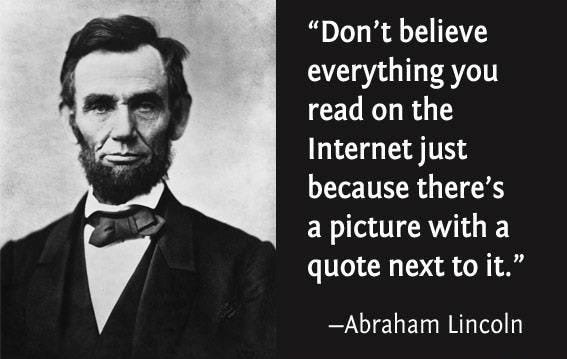
A number of lists of these great “quotes” have been circulating ever since the days of fax machines, even before “forwards from Grandma.” They’re funny and great to read, but is there any truth to any of them? Let’s explore.
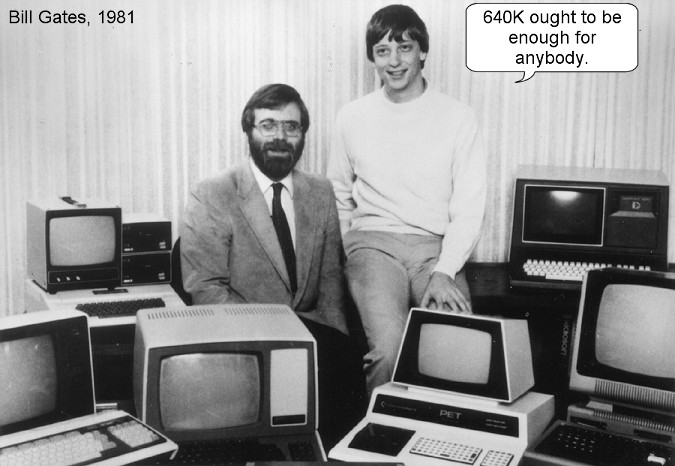
The most famous one that I know of has been thoroughly debunked:
“640K ought to be enough for anybody.” – Bill Gates
An analysis at Quote Investigator ended with “Since Gates has denied the quotation and the evidence is not compelling I would not attribute it to him at this time. Thanks for this difficult interesting question.“
During the early days of computing, programs were often written in Assembly Language, producing very tight code that could run in minimal spaces. The original Wang v.2 word processor was designed to run on workstations with 32K of memory, even though later workstations had a standard 64K.
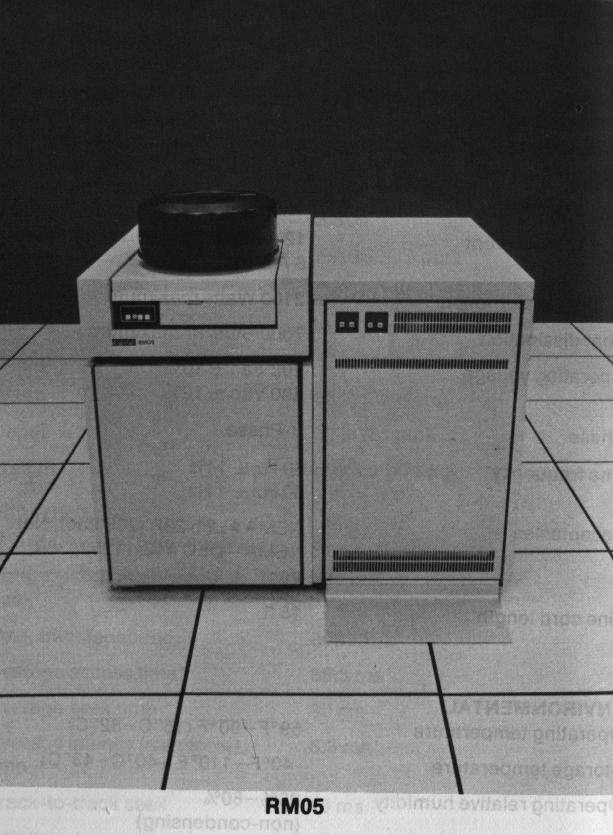
Wang OIS 64K Workstation
If you want apocrypha, here’s a good one. This story was told to me by a Wang Laboratories internal employee, and I can’t verify its authenticity, but having worked with Wang software and hardware for around 10 years back in the ’80s and ’90s, I would be willing to bet a steak dinner that it is true.
The Wang Word Processor, version 2, was – as mentioned above – written in Assembly language. The source code was kept on these 300MB swappable disk packs which at the time were very convenient for changing storage media.
300 MB Disk Pack
Disk Drive for use with removable packs
As the tale goes, somehow an entire rack of those disk packs got knocked over, destroying both the source code (in Assembly Language) and the backups for that impressively small and fast piece of software. It was for this reason that WP+, the next generation word processor from Wang, was entirely re-written in a slower, larger, higher level language. It emulated many features of the original and added others, but it was cumbersome and inelegant by comparison. Again, I can’t verify this 100%, but it came to me from what I consider a reliable source.
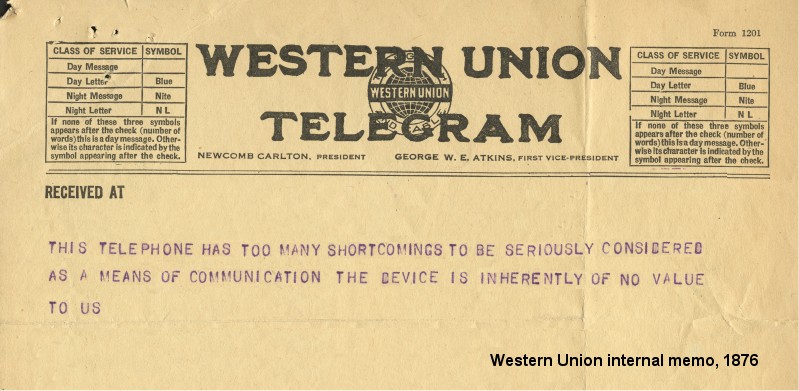
Western Union’s opinion of the telephone
Facsimile Telegram
This ‘telephone’ has too many shortcomings to be seriously considered as a means of communication. The device is inherently of no value to us.” — Purported Western Union internal memo, 1876.
Telegrams were pretty much the way to get a message from one place to another rapidly. Prior to the development of the electric telegraph system designed by Samuel Morse, optical telegraphy which used visual signals seen at a distance was one of the earliest methods of long-distance communication.
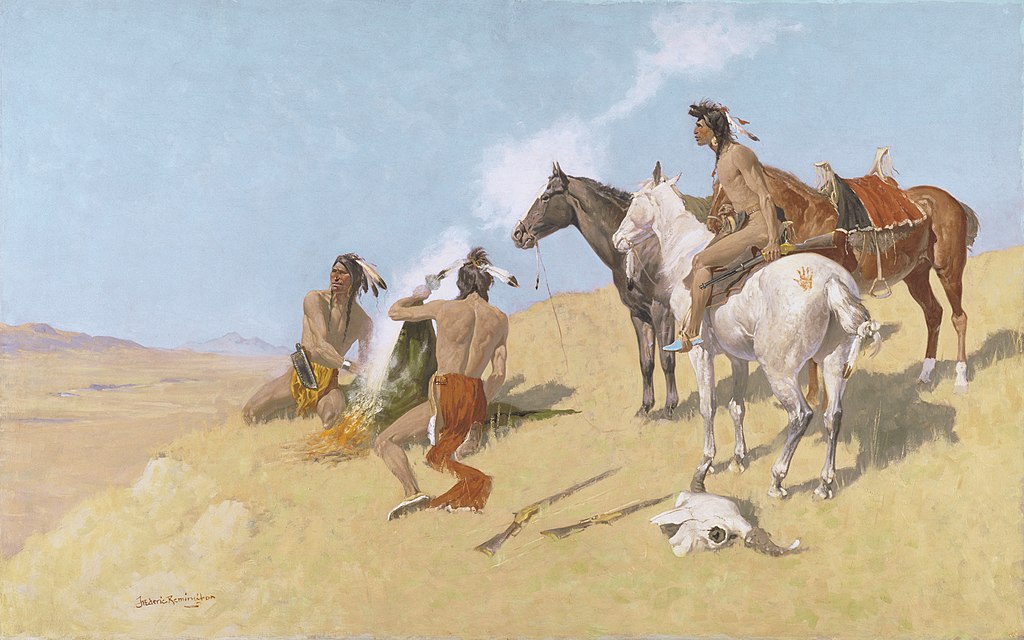
Wikipedia reports that “The smoke signal is one of the oldest forms of long-distance communication. It is a form of visual communication used over a long distance. In general smoke signals are used to transmit news, signal danger, or to gather people to a common area.” The use of smoke signals by the indigenous peoples of North America are probably the most familiar to Americans thanks to the popularization of western history in published and broadcast media.
Frederic S. Remington (1861-1909); The Smoke Signal; 1905; Oil on canvas; Amon Carter Museum of American Art, Fort Worth, Texas; 1961.250
This method of communication has been the basis for much humor as well:
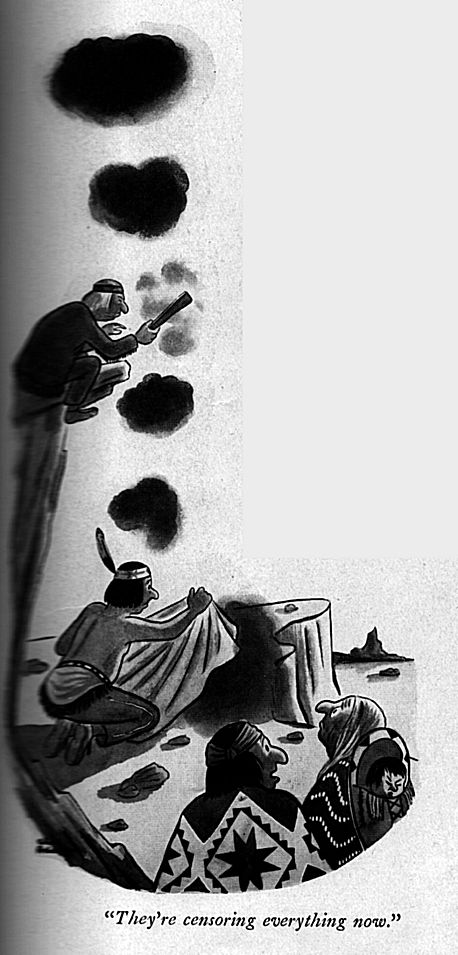
Charles Addams, The New Yorker
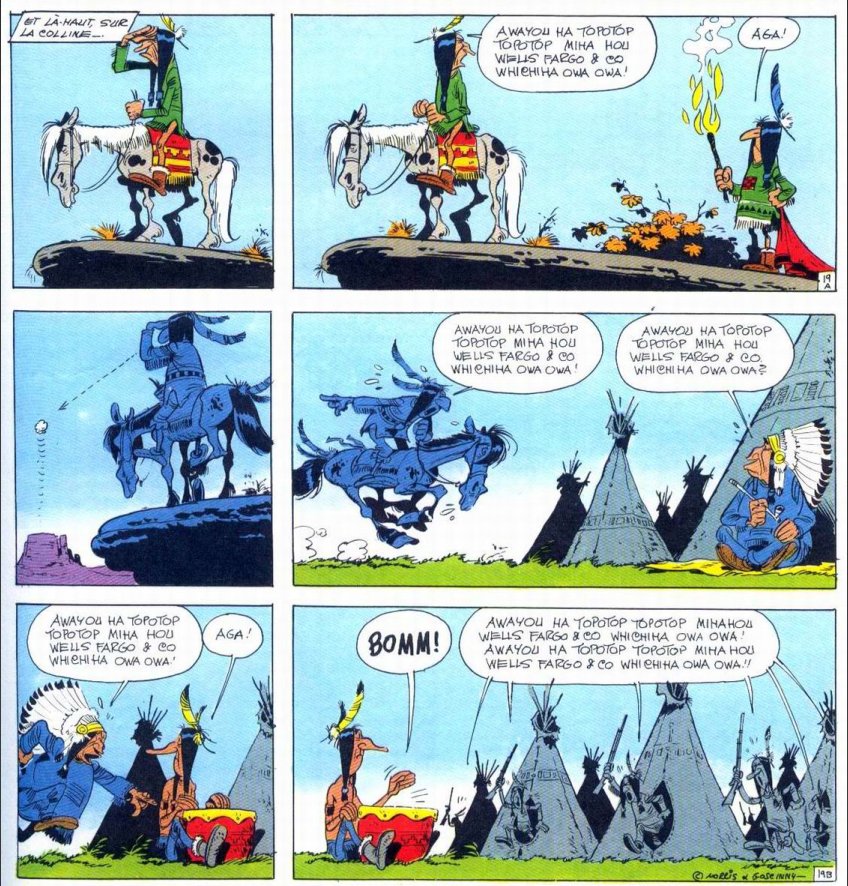
Lucky Luke – “La Diligence” (Dargaud, 1968 series) #32 by Morris and Goscinny
The joke here is that a single puff of smoke or one beat of a drum can communicate large quantities of information, which of course is not the case.
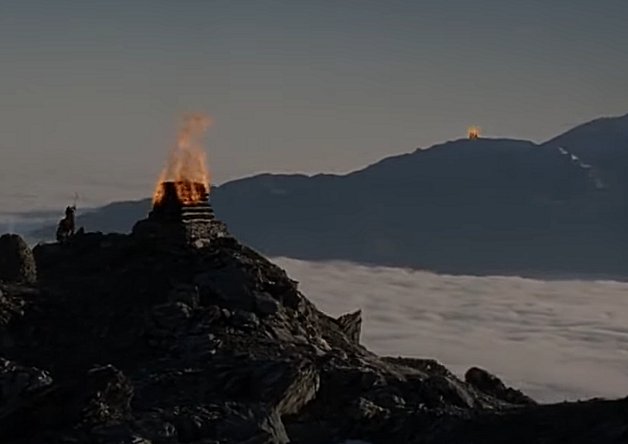
One of the most stirring cinematographic representations of optical telegraphy can be found in Peter Jackson’s version of J.R.R. Tolkien’s “The Two Towers,” where the beacons of Gondor – signal fires strategically placed on mountaintops – played a crucial role in summoning Rohan’s forces to help Gondor.
The Beacons of Gondor
Once electricity came on the scene, the electrical telegraph, augmented by Morse Code, became the dominant method of rapid long-distance communication, and was the underpinning of the telegram system for which Western Union became so famous.
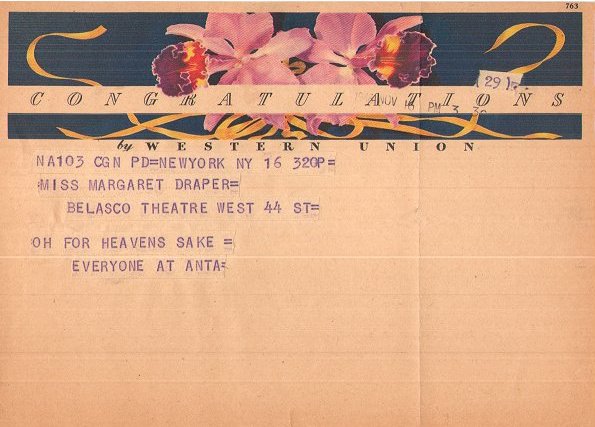
Telegrams – about which I have written elsewhere – were used for everything where information had to be transmitted rapidly, from business meetings, to military applications, to notifications of death, to congratulations on Broadway, and countless other uses.
Telegram sent to my mother from ANTA (American National Theater and Academy) wishing her good luck in “For Heaven’s Sake, Mother” on November 16, 1948. Sadly, the play only ran for fourdays.
So when the telephone made its debut on the world stage, Western Union supposedly turned up its nose and sniffed loftily that it was not anything worthy of consideration. While the invention of the telephone, followed by the modern Internet and the proliferation of smartphones, ultimately doomed the telegram to the vaults of history, at the time concern about the new technology was real. The supposed internal memo at Western Union, however, was not. A lovely article at Wondermark discusses the origins of this urban legend in great detail and is worth the read if such things interest you.
Be aware, however, that even the telegraph itself was met with skepticism by shortsighted individuals:
“I watched his face (Samuel F.B. Morse) closely to see if he was not deranged, and was assured by other Senators as we left the room that they had no confidence in it either.”
-Senator Oliver Smith of indiana, 1842, after witnessing a first demonstration of the telegraph
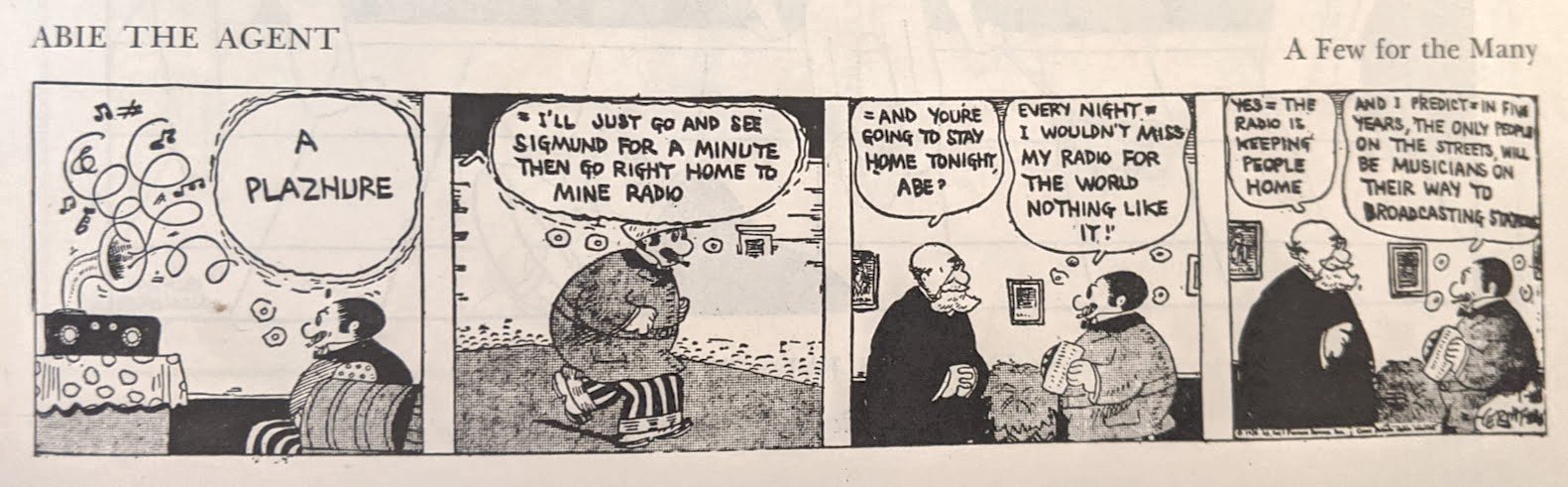
The Radio
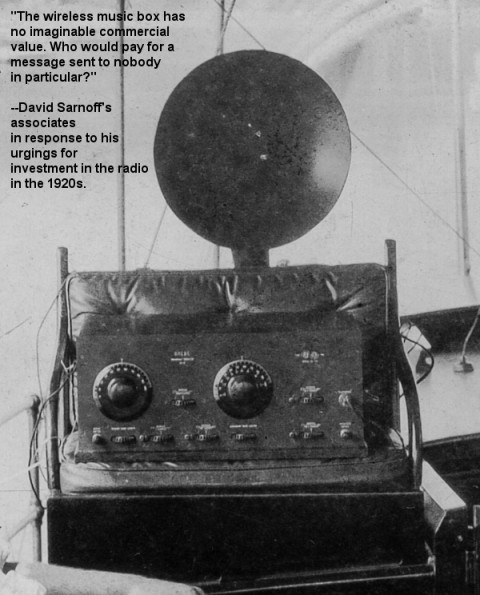
“The wireless music box has no imaginable commercial value. Who would pay for a message sent to nobody in particular?” — David Sarnoff’s associates in response to his urgings for investment in the radio in the 1920s.
David Sarnoff was an early pioneer in the promotion of wireless radio as a new technology. I asked Perplexity about the supposed response from investors, and it had this to say:
In summary, although the quote closely reflects real skepticism Sarnoff faced, there is no documented evidence that an investor sent this precise message to him—the wording appears to be apocryphal or retrospective, encapsulating broader contemporary attitudes
Obviously, “fear of the new, from those with a vested interest in the old” (from the Wondermark article linked above) didn’t keep the radio from becoming immensely popular.
The March of Technology
“Computers in the future may weigh no more than 1.5 tons.” attributed to Popular Mechanics from 1949
This is a true quote, but is often quoted out of context, unlike the quote in the image above. Popular Mechanics was making a forecast based on the technology of that time, suggesting computers could shrink significantly but still be very large by modern standards. This reflected an era when computers were massive and used vacuum tubes. The prediction was reasonable then but didn’t foresee transistor and integrated circuit breakthroughs that led to much smaller, lighter computers. You don’t know what you don’t know.
More about Computers
Once more, this quote is a misinterpretation; a very good background is found here. The short explanation is:
From a question on the history of IBM on their website, “Did Thomas Watson say in the 1950s that he foresaw a market potential for only five electronic computers?” IBM offers the following explanation:
We believe the statement that you attribute to Thomas Watson is a misunderstanding of remarks made at IBM’s annual stockholders meeting on April 28, 1953. In referring specifically and only to the IBM 701 Electronic Data Processing Machine — which had been introduced the year before as the company’s first production computer designed for scientific calculations — Thomas Watson, Jr., told stockholders that “IBM had developed a paper plan for such a machine and took this paper plan across the country to some 20 concerns that we thought could use such a machine. I would like to tell you that the machine rents for between $12,000 and $18,000 a month, so it was not the type of thing that could be sold from place to place. But, as a result of our trip, on which we expected to get orders for five machines, we came home with orders for 18.”
You don’t know what you don’t know
“I have traveled the length and breadth of this country and talked with the best people, and I can assure you that data processing is a fad that won’t last out the year.”
-The Editor in Charge of Business Books for Prentice Hall, 1957
“But what … is it good for?“
-Engineer at the Advanced Computing Systems Division of IBM, 1968, commenting on the microchip.
“There is no reason anyone would want a computer in their home.”
-Ken Olson, president, chairman and founder of Digital Equipment Corp., 1977
The three quotes above are not examples of obtuseness or stupidity, but rather the inability to predict the incredible rush of innovation that the computer industry would experience. I have written about the incredible shrinking data storage elsewhere, and even that article is now outdated; SanDisk has introduced a 4TB MicroSD card, whether or not something of this nature is even needed.
There’s nothing new under the sun
“Everything that can be invented has been invented.”
–Charles H. Duell, Commissioner, U.S. Office of Patents, 1899.
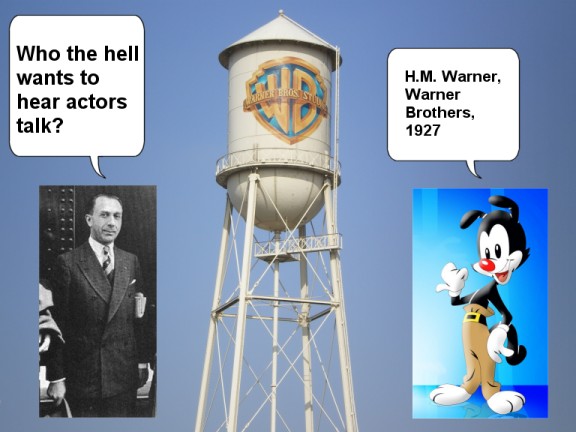
According to Quote Investigator, Warner probably said this but more confirmation would be useful. The linked article provides some interesting background about resistence to the inclusion of sound and voice in films, which up until that time were entirely silent.
There are many more “boneheaded quotes” out there, but the above dive into some of the most famous is an indication that each one deserves to be investigated for accuracy before spreading them around as 100% accurate.
I swear on a stack of bibles (or The Origin of Species, whichever makes you feel more comfortable) that there was. I remember clearly eating at one, and being astonished at the size of their 5″ patty and huge buns. But the Internet is pretty sure that there was never one there, and will still respond with – what seems to me – inaccurate information. So in order to put that discrepancy to rest, I did a deep dive into the history, and this is what I came up with.
I first submitted the question to Perplexity – History of Whataburger in Salt Lake City? – and this was the result:
There is currently no evidence that Whataburger has ever operated in Salt Lake City or anywhere in Utah as of August 2025. While Whataburger has aggressively expanded in recent years—opening locations in new states like Nevada, the Carolinas, and others—none of the latest location lists or official press material mention Utah or Salt Lake City as a market served by the chain.
But there is a Facebook group called “If You Grew Up in Salt Lake, Then You Will Remember This,” and back on 23 January, 2022, Irene Vialpando asked the group whether they recalled the existence of a Whataburger on State Street around 800 South. Many people responded that they not only recalled the restaurant with its swivel chairs in the 1970s, but ate there, and also recalled the huge patties, and some even chimed in that they or members of their family used to work there. Still others were adamant that there was never any such outlet in Utah.
The responses from those who recalled a Whataburger were so encouraging that I decided to dig deeper. I asked Gemini the following question under the “research” tab:
I absolutely and without question recall the existence of a Whataburger outlet on State Street around 800 South in Salt Lake City in the 1970’s. I ate there, and I remember being gobsmacked by their 5″ patty, so this is not a false memory. Many other people at the Facebook group “If You Grew Up In Salt Lake, Then You Remember This” have clear recollections of this restaurant’s existing for a brief time. Problem is, when I submitted the question to Perplexity and Google and Wikipedia, the answer came back that no, Whataburger never had a presence in Utah. Can you help me reconcile the discrepancy? I know for a fact that one was there.
The response from Gemini was as follows:
Executive Summary
his report investigates the compelling recollection of a Whataburger outlet on State Street around 800 South in Salt Lake City during the 1970s, a memory that contradicts readily available online historical records. While mainstream digital sources generally indicate no Whataburger presence in Utah, a deeper examination of corporate expansion strategies and local fast-food history reveals a more nuanced picture. Evidence suggests a strong possibility of a short-lived Whataburger location in Utah during the specified period, operated by a now-defunct franchisee, Western World Foods Inc. The user’s vivid memory of a “5-inch patty” aligns precisely with Whataburger’s signature product. Alternatively, the memory of a large patty could be attributed to Red Barn, another chain present in Salt Lake City at the time, which offered a burger with a nearly identical patty size. Ultimately, the collective memory and specific product detail lend significant credence to a genuine, albeit brief, Whataburger appearance in Salt Lake City.
The User’s Vivid Recollection: A Personal Account
The core of this inquiry stems from a remarkably clear and persistent personal memory. The user explicitly recalls the presence of a Whataburger restaurant on State Street, specifically around 800 South, in Salt Lake City during the 1970s. This recollection is not merely a vague impression; it is anchored by a distinct sensory detail: the user remembers being “gobsmacked by their 5″ patty.” This specific, quantifiable characteristic serves as a critical identifier for the restaurant in question. The user’s emphatic statement, “this is not a false memory,” underscores the profound certainty associated with this experience.
Furthermore, this is not an isolated individual memory. The user notes that “Many other people at the Facebook group ‘If you grew up in Salt Lake, then you remember this’ have clear recollections of this restaurant’s existing for a brief time.” This collective memory, while not offering definitive documentary proof, indicates a shared experience within the local community that warrants thorough investigation. Online discussions from Salt Lake City forums further show individuals recalling “Whataburger” or “Eat-a-Burger” when discussing lost restaurants from the 1970s, suggesting a common thread in local historical memory. The convergence of these individual and collective memories, particularly around a specific product characteristic, provides a compelling starting point for reconciling the perceived historical discrepancy.
Whataburger’s Corporate History and Western Expansion (1970s)
To understand the potential for a Whataburger presence in Utah, it is essential to review the company’s historical growth and its product characteristics. Whataburger was founded in Corpus Christi, Texas, in 1950, with an ambitious goal: to serve a “better burger that took two hands to hold”. From its inception, the original Whataburger featured a quarter-pound patty served on a distinctive 5-inch bun. This particular dimension, the 5-inch bun, is a direct and precise match for the user’s specific memory of the patty size that left such a strong impression. This consistency in product design throughout Whataburger’s history is a strong indicator of brand identity, making the user’s specific memory a highly reliable detail for identifying the brand, rather than a generic “large burger” from another chain. The company’s commitment to this unique bun size from its earliest days means that if the user distinctly remembers a 5-inch patty, it strongly points towards a Whataburger experience.
Whataburger’s expansion beyond Texas began relatively early, with the first location outside its home state opening in Pensacola, Florida, in 1959. By 1963, the chain had grown to 26 restaurants, extending its reach to Florida, Tennessee, and Arizona. The 1970s marked a period of significant corporate growth, with the company introducing its first drive-thru in 1971 and celebrating the opening of its 100th restaurant in 1972. By the mid-1970s, Whataburger’s footprint had expanded to over 200 restaurants across 12 states.
The Western World Foods Inc. Franchise and Utah’s Connection
Despite the official corporate history often not explicitly listing Utah as a state with Whataburger locations during this period, a crucial detail emerges from the records of its franchising operations. In 1972, a Texas-based Whataburger franchisee, Western World Foods, initiated an ambitious plan to expand the Whataburger brand nationally. This expansion strategy specifically included the development of 14 new restaurants across four Western states: New Mexico, Arizona, Colorado, and Utah.
Further supporting this planned presence, by 1975, “Whataburger of Nevada” was incorporated, and David Hawley was appointed as the Vice President of Operations for both Nevada and Utah. This appointment strongly suggests that active steps were indeed being taken to establish Whataburger locations in Utah, mirroring the development of six Nevada locations that opened by January 1976 under the same franchisee.
The operational model of Western World Foods was distinct; while they licensed the Whataburger name, menu, and logo, they chose to build structures with a “protruding tower in the middle” instead of the classic A-frame design. However, Western World Foods’ ambitious venture proved to be short-lived. By September 1979, Whataburger of Nevada ceased advertising, and its stores, along with other Western World Foods locations, likely closed within a few months. Whataburger’s subsequent reduction in its West Coast presence was directly linked to the dissolution of Western World Foods, which Whataburger eventually purchased.
The existence of Western World Foods’ plans for Utah, coupled with the appointment of a Vice President specifically for Utah operations, strongly indicates that at least one Whataburger location could have opened in Salt Lake City, even if for a very brief period. The short lifespan and subsequent dissolution of Western World Foods provides a compelling explanation for why these locations might not appear in standard, long-term corporate histories or readily accessible online databases. The official Whataburger history, which outlines the company’s core corporate expansion, often omits details of short-lived or problematic franchise ventures. This explains why a user’s initial searches might yield results stating no Whataburger presence in Utah, even if a temporary one existed.
It is also important to differentiate the Texas-based Whataburger from an unrelated chain named “What-A-Burger,” founded in Virginia in 1957. Although both chains share similar names and were involved in trademark disputes in 1970 , the Virginia-based chain did not expand westward into Utah. The user’s specific memory of a 5-inch patty aligns with the Texas Whataburger’s signature product, making confusion with the Virginia chain highly unlikely.
Table 1: Whataburger’s Western US Expansion Initiatives (1970s)
State
Franchisee/Subsidiary
Key Dates/Details
Outcome/Notes
Colorado
Whataburger of Colorado Inc. (under Western World Foods Inc.)
Operated throughout 1970s; locations opened 1972-1975; likely closed late 70s/early 80s
Short-lived stint, difficult to research; some buildings still exist under different businesses.
Arizona
Western World Foods Inc.
Expanded to Arizona by 1963 (corporate); Western World Foods also had locations
Some Western World locations held onto by Whataburger after 1979.
New Mexico
Western World Foods Inc.
Part of 1972 expansion plans for 14 new restaurants
Some Western World locations held onto by Whataburger after 1979.
Nevada
Whataburger of Nevada (under Western World Foods Inc.)
Incorporated 1975; six locations opened by Jan 1976; stopped advertising Sept 1979
Short-lived; exit related to dissolution of Western World Foods. Buildings often repurposed.
Utah
Western World Foods Inc.
Included in 1972 plans for 14 new restaurants; David Hawley named VP of Operations for Nevada & Utah by 1975.
Strong indication of planned or short-lived presence, likely closed with Western World Foods in 1979.
California
Whataburger of California (under Western World Foods Inc.)
Presence from mid-70s (~1973) until 1987.
Short-lived stint, difficult to research.
This table directly addresses the primary discrepancy in the user’s query. It highlights that Utah was explicitly part of a significant, albeit ultimately unsuccessful, Western expansion initiative by a Whataburger franchisee. By placing Utah within the context of other Western states where Whataburger did have a presence, even if short-lived, it validates the possibility of a Utah location and provides an evidence-based counter-argument to the general online narrative. The table also implicitly sets the stage for understanding why such a presence might be difficult to trace: its short duration and the failure of the franchising entity.
Salt Lake City’s Fast-Food Landscape (1970s)
To provide comprehensive context and explore alternative explanations for the user’s memory, it is important to examine other prominent burger chains operating in Salt Lake City during the 1970s, particularly those known for offering larger patties.
Prominent Local Chains
Dee’s Drive-In: A long-standing fixture in Utah for nearly five decades, Dee’s Drive-In was a well-known local burger chain. It was eventually sold to Hardee’s in the late 1970s. While iconic for its “Dee’s Clowns” and family-friendly advertising , its standard burger patty size was typically 1/8 pound. This is significantly smaller than the 5-inch/quarter-pound patty described by the user, making Dee’s an unlikely candidate for the “gobsmacked by 5-inch patty” memory.
Crown Burger: Crown Burger opened its doors in Salt Lake City in 1978. It quickly gained fame for its signature “Crown Burger,” which features a quarter-pound hamburger patty generously topped with a thick mound of hot pastrami on a sesame seed bun. While the patty size (quarter-pound) is comparable to Whataburger’s, the distinctive addition of pastrami and the opening year (1978) might differentiate it from the user’s specific memory of a Whataburger experience earlier in the 1970s.
Eat-a-Burger: This restaurant is mentioned in Salt Lake City online discussions as a fondly remembered, now-defunct establishment. Eat-a-Burger was located at the intersection of Regent Street and 200 South. Although its specific patty dimensions are not detailed in the available information, it was generally known for serving “large” burgers. However, its documented location is not on State Street around 800 South, which is a key detail in the user’s memory.
Other Local Favorites: The 1970s Salt Lake City fast-food scene included other local burger joints such as Don’s, Arctic Circle (recognized for its fry sauce and crinkle fries), and JB’s Big Boy (known for its triple-decker burger). The Training Table, a regional chain founded in Utah in 1977, also specialized in “gourmet burgers”.
National Chains with Large Patties
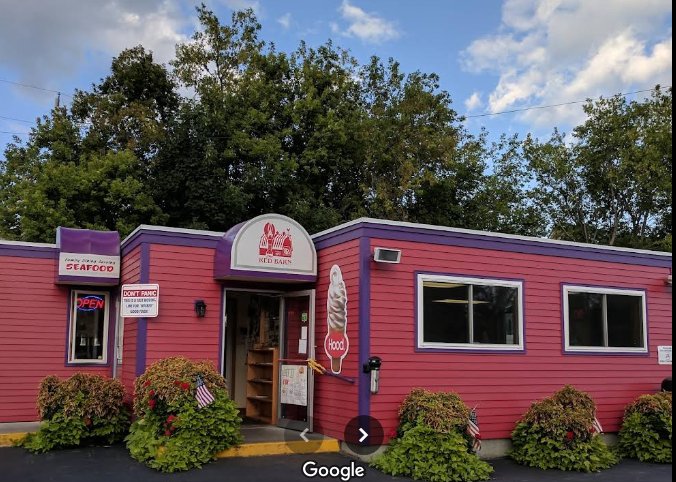
Red Barn: This national fast-food chain, established in 1961, had a significant presence across the country, boasting over 300 locations in 19 states by the 1970s. Red Barn was particularly known for its substantial burger offerings, including the “Big Barney” (comparable to a McDonald’s Big Mac) and the “Barnbuster” (similar in style to a Quarter Pounder or Burger King’s Whopper). Crucially, a 5.0 oz patty from Red Barn was specified as having “Patty Dimensions: 4 7/8 inches”. There was indeed at least one Red Barn location confirmed to be in Salt Lake City.
The patty dimensions of Red Barn’s “Barnbuster” (4 7/8 inches) are remarkably close to the user’s recollection of a “5-inch patty.” Given Red Barn’s confirmed presence in Salt Lake City and its reputation for large burgers, it presents a strong alternative explanation for the user’s memory if a Whataburger did not exist at the specified location. The memory of a distinctive large patty could easily be attributed to a well-known “big burger” chain, especially over the span of decades.
Salt Lake City Business Directories and Archives
To definitively confirm or refute the presence of a Whataburger or Red Barn at “State Street around 800 South,” a detailed examination of historical records would be necessary. Salt Lake City directories for the 1970s are available through the Utah City Directories Collection, including directories for South Salt Lake City. These valuable resources list residents, streets, businesses, and organizations, often including advertisements, and are designed to be searchable.
Additionally, the J. Willard Marriott Library at the University of Utah maintains the Utah Digital Newspapers (UDN) repository, which provides free access to over nine million pages from 400 newspapers published in Utah from 1850 to 2023. This extensive resource allows for searching historical newspaper content, which would be critical for finding advertisements or news articles about restaurant openings or closures on State Street around 800 South during the 1970s. The available information indicates that State Street around 800 South was indeed a commercial area with various tenants, including restaurants.
While these archives are excellent resources for historical research, the challenge lies in the potential for short-lived businesses, such as a Western World Foods Whataburger (if it opened), to have left minimal or no advertising footprint, or for their records to be obscure within the vastness of the archives. The absence of a listing in widely accessible digital archives does not definitively prove non-existence, especially for a brief operation. This highlights the inherent difficulty in definitively proving or disproving a short-lived historical business through common online searches, which is precisely why the user’s initial inquiries were inconclusive.
Table 2: Prominent Salt Lake City Burger Chains (1970s) with Patty Characteristics
Restaurant Name
Type (Local/National)
Key Burger/Patty Size
Known Locations (1970s)
Notes
Whataburger
National (via franchisee)
Quarter-pound patty on 5-inch bun
Planned for Utah (Western World Foods)
Strong match for patty/bun size memory; potential short-lived presence.
Dee’s Drive-In
Local
1/8 pound patty
Fixture throughout Utah
Patty size significantly smaller than user’s memory.
Very close match for patty size memory; known for large burgers.
Crown Burger
Local
Quarter-pound patty (with pastrami)
Opened 1978 in Salt Lake City (377 E 200 S)
Patty size matches, but opened late 70s and distinctive pastrami.
Eat-a-Burger
Local
“Large” burgers (specific size not found)
Regent Street and 200 South
Known for large burgers, but location not on State St.
JB’s Big Boy
National/Regional
“Big Boy” (triple-decker)
Present in Salt Lake City
Known for large, multi-patty burgers.
This table is essential for systematically evaluating alternative explanations for the user’s memory. By explicitly comparing patty and bun sizes across various burger chains known to be in Salt Lake City during the 1970s, it allows for a direct assessment of how well each chain aligns with the user’s specific recollection. This structured comparison immediately highlights that Dee’s Drive-In is an unlikely match due to its smaller patty size. Conversely, it identifies Red Barn as a very strong candidate for potential misattribution because its patty diameter (4 7/8 inches) is nearly identical to the 5-inch patty remembered by the user, and Red Barn had a confirmed presence in Salt Lake City. This comparison helps to narrow down the possibilities and provides a clear, data-driven framework for understanding how the user’s memory could be accurate in its sensory detail (large patty) but potentially misattributed in terms of the specific brand.
Reconciling Memory and Records: Analysis of Discrepancies
The conflict between the user’s strong personal memory and the lack of readily available online documentation poses a classic challenge in historical research. However, the collected information allows for a plausible reconciliation, suggesting that the user’s memory is likely accurate.
The Case for a Short-Lived Whataburger Presence
The most compelling evidence supporting the user’s memory stems from the documented expansion plans of Western World Foods, a Whataburger franchisee. Their 1972 initiative explicitly included plans for 14 new restaurants across New Mexico, Arizona, Colorado, and crucially, Utah. This is not a vague aspiration but a concrete business strategy. Furthermore, the appointment of David Hawley as Vice President of Operations for both Nevada and Utah by 1975 strongly indicates that tangible steps were being taken to establish Whataburger locations in Utah. The presence of a dedicated executive for Utah operations suggests more than just theoretical planning; it points to active development.
While specific addresses for Utah locations are not detailed in the available information, the rapid dissolution of Western World Foods in 1979 provides a clear and coherent explanation for why any Utah Whataburger that opened would have been very short-lived. A brief operational period, especially one ending in a franchise failure and subsequent corporate acquisition, would naturally lead to minimal or no permanent digital or easily accessible historical records. Businesses that operate for only a few years, particularly those whose parent franchising entities dissolve, often leave little to no lasting public footprint in broad historical databases. The user’s strong memory, corroborated by a local Facebook group, aligns perfectly with the idea of a real, but ephemeral, business presence. This situation illustrates that the absence of easily discoverable evidence does not equate to evidence of absence, particularly for short-lived ventures or those impacted by corporate restructuring.
Alternative Explanation: Misattribution to Red Barn
If, for any reason, a Whataburger location did not materialize at the specified address or was too fleeting to be widely remembered, the user’s vivid memory of the “5-inch patty” could plausibly be attributed to Red Barn. Red Barn was a national chain with a confirmed presence in Salt Lake City and offered a “Barnbuster” burger with a 4 7/8-inch patty. This dimension is remarkably close to a 5-inch patty, a difference that could easily be imperceptible or rounded up in a long-term memory. Red Barn was also known for its “large burgers” , making it a strong candidate for leaving the impression of a “gobsmacking” large patty.
Human memory, especially over several decades, can sometimes conflate details from similar experiences. The most salient feature for the user was the “5-inch patty.” While Whataburger indeed featured a 5-inch bun, Red Barn offered a patty of almost identical diameter. If a Red Barn was located on State Street around 800 South (a detail that would require further specific directory research to confirm), it is conceivable that the user experienced the impressive patty size at Red Barn but later associated it with the more widely known “Whataburger” name, especially if the latter was rumored or briefly planned for the area due to Western World Foods’ activities. This scenario demonstrates how a memory can be factually accurate in one detail (the size of the burger) but potentially misattributed in another (the specific brand), particularly when similar products exist and historical presence is ambiguous.
The Challenge of Verifying Specific Locations (State Street, 800 South)
To definitively confirm or refute the presence of either a Whataburger or a Red Barn at the precise location of “State Street around 800 South,” a more granular and dedicated search of 1970s Salt Lake City business directories and local newspaper archives would be necessary. These resources, which often contain specific business listings, advertisements, and news of openings or closures, would provide the most direct evidence. The available information confirms that State Street around 800 South was a commercial area with various tenants, including restaurants.
While general historical records confirm Whataburger’s plans for Utah and Red Barn’s presence in Salt Lake City, pinpointing a specific address like “State Street around 800 South” requires a level of detailed, local-level historical data that is not fully provided in the current information. The current findings confirm the possibility and likelihood of a Whataburger presence, and a strong alternative in Red Barn, but not absolute certainty for the exact address. This highlights the limitations of broad historical searches and the necessity for highly localized, detailed archival research to resolve such specific historical queries.
Conclusion and Key Takeaways
The user’s vivid and corroborated memory of a Whataburger outlet in Salt Lake City during the 1970s, characterized by its memorable 5-inch patty, is highly credible despite the absence of this information in common online historical searches.
The most probable explanation for this discrepancy lies in the documented, albeit short-lived, expansion efforts of Whataburger’s franchisee, Western World Foods Inc. In 1972, Western World Foods explicitly included Utah in its plans for 14 new restaurants across the Western United States, and by 1975, an executive was appointed with operational oversight for both Nevada and Utah. Whataburger’s signature product from its inception was indeed a quarter-pound patty on a 5-inch bun, designed to be held with two hands. This precise detail strongly supports the idea that the user genuinely encountered a Whataburger product. The subsequent dissolution of Western World Foods in 1979 provides a clear and compelling reason why any Whataburger locations opened in Utah would have been very brief and consequently left minimal or no readily accessible historical footprint in broader corporate records.
While a short-lived Whataburger presence is the most direct explanation, the possibility of misattribution to Red Barn cannot be entirely dismissed. Red Barn, a national chain with a confirmed presence in Salt Lake City , offered a “Barnbuster” burger with a 4 7/8-inch patty , a dimension remarkably close to the user’s recollection. If a Red Barn was located at the remembered address, it could account for the patty size memory. However, the user’s specific brand recall, further supported by others in a local social media group, leans towards a genuine Whataburger experience. Therefore, it is highly probable that the user’s memory is accurate regarding a short-lived Whataburger presence in Salt Lake City during the 1970s, likely operated by Western World Foods Inc. The perceived absence in common online historical records is best explained by the brief operational period and the subsequent failure and acquisition of the franchising entity
Key Takeaways
Memory vs. Digital Records: Personal and collective memories can contain accurate details about historical events, even when contradicted by easily accessible digital records. This is particularly true for short-lived business ventures, especially those that were part of unsuccessful franchise expansions, as they often leave minimal lasting digital footprints.
Franchise Complexity: Corporate histories often simplify or omit the intricate details of complex, short-lived, or unsuccessful franchise expansions. This simplification can lead to gaps in public knowledge and historical records, making it challenging to trace every aspect of a company’s past operations.
Salient Details as Memory Anchors: Specific and unique product features, such as a “5-inch patty,” can serve as powerful anchors for long-term memories. These distinct details can help individuals accurately recall a particular experience, even if the associated brand name might become slightly conflated or misremembered over the passage of time, especially when similar products existed in the market.
The Value of Local History: Reconciling such historical discrepancies often necessitates delving into granular local historical archives, such as city directories and local newspapers. These resources often contain more detailed and localized information than broader national databases, proving invaluable for verifying specific addresses and operational dates of businesses that may have had a limited or ephemeral presence.
TIL Whataburger in Texas and What-A-Burger in Virginia opened about the same time in 1950 but didn’t know of each other’s existence until 1970. They both sued the other, but the court ruled that customers were not likely to be confused about whether the burgers served came from Texas or Virginia. : r/ – Reddit, https://www.reddit.com/r/todayilearned/comments/8u200m/til_whataburger_in_texas_and_whataburger_in/
The first location was in the parking lot of the current 377 East 200 South location. It seated 75 people. John worked from 3 am to 5 pm doing all of the prep work for the homemade Onion Rings and Chili. Within 30 days, people were lined up like a train outside the front door, waiting to come in. The original building was torn down 1½ years later and the current building was built, seating 150 people. – Crown Burgers Salt Lake City Utah, https://www.crown-burgers.com/story.php
This is an impressively deep dive into the history of Salt Lake restaurants, and for me, the key takeaway is this:
Therefore, it is highly probable that the user’s memory is accurate regarding a short-lived Whataburger presence in Salt Lake City during the 1970s, likely operated by Western World Foods Inc.
I’m 74. My memory is clearly not what it was, but this I can tell you: I have never eaten at a Red Barn in my life, with the exception of a non-chain-related independent outlet up in Augusta, Maine.
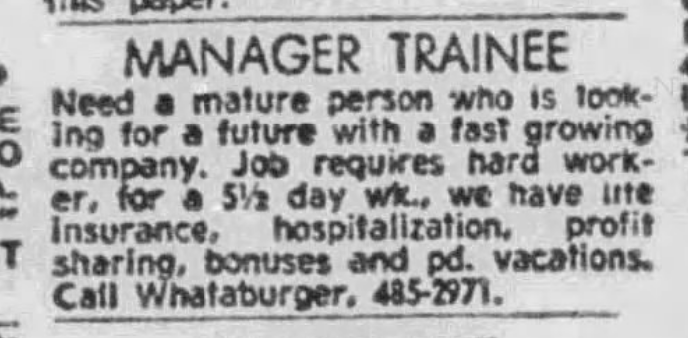
Last of all, and most important, this want ad appeared in the Salt Lake Tribune on The Salt Lake Tribune on Nov 29, 1973, Page 60:
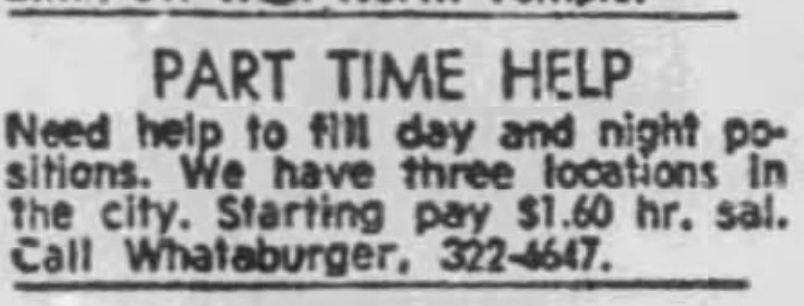
And on Fri, Nov 30, 1973, Page 61, the following ad was seen:
Three locations! And, if you have a subscription to Newspapers.com, you can see dozens of similar solicitations between 1973 and 1974.
As a result, I feel 100% confident, based on my recollections of Salt Lake in the ’70s and the results of Gemini’s search, that there was indeed at least one Whataburger in Salt Lake at one point, and most likely three, and that I and many other people enjoyed their brief existence.
This post was spawned by one of Heather Cox Richardson’s “Letters from an American” which was also posted on Facebook.
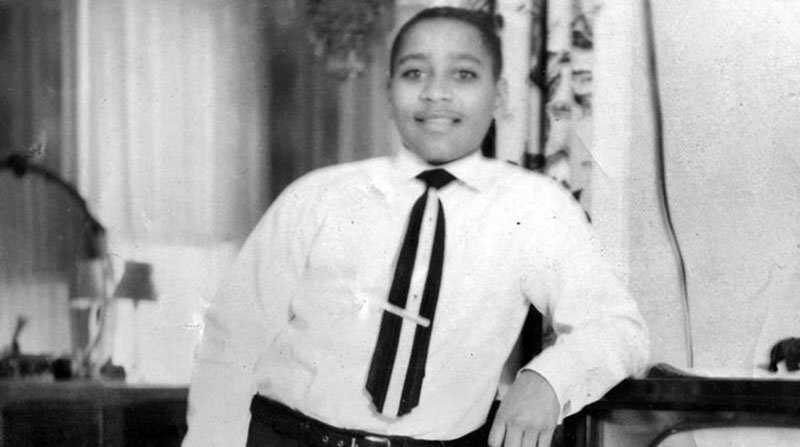
She wrote about the tragic 1955 murder of Emmett Till, an innocent 14-year-old boy, and about the hateful and unrepentant attitude of J. W. Milam, one of Till’s two killers.
Emmett Till
“What else could we do?” Milam said. “He was hopeless. I’m no bully. I never hurt a n* in my life. I like n*s, in their place (emphasis mine). I know how to work ’em. But I just decided it was time a few people got put on notice. As long as I live and can do anything about it, n*s are gonna stay in their place.”
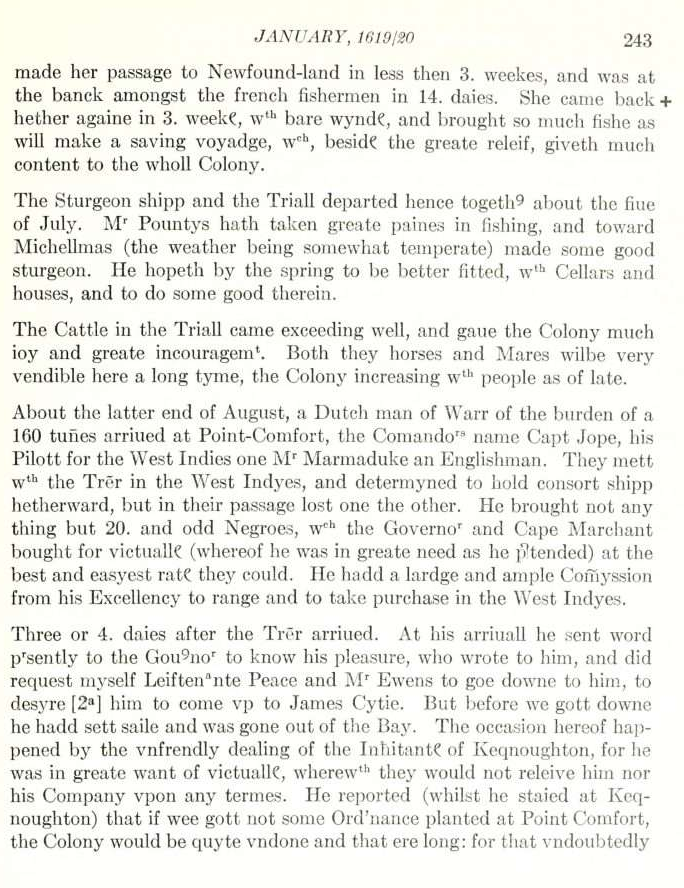
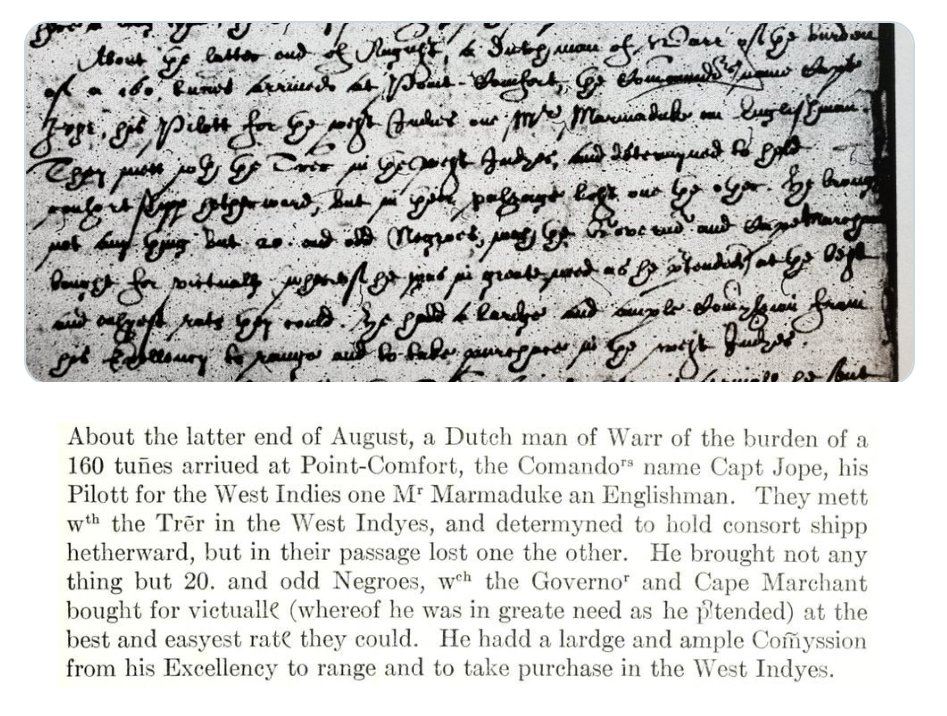
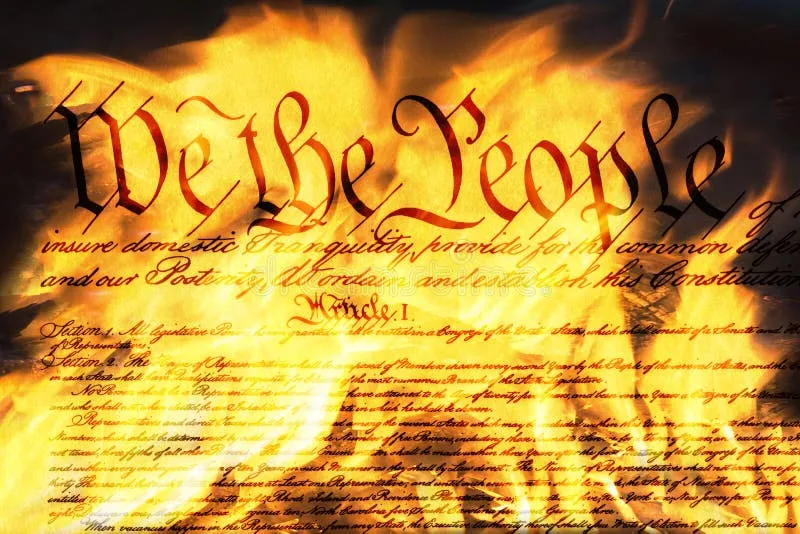
Milam’s attitude had it roots in 1620 when a Dutch man-of-war traded “20 and odd Negroes” for “victualle,” according to a letter from Virginia Colony secretary John Rolfe to Sir Edwin Sandys. From there, it evolved into a system of utter oppression and cruelty by whites, who used the principle of human bondage to treat their unfree laborers as less than cattle for their own petty satisfaction. These attitudes and the economy which arose as a result – largely the growing of cotton in the South – were officially and legally repudiated by the Civil War and subsequent amendments to the Constitution which guaranteed “life, liberty, and the pursuit of happiness” to all citizens, and not just wealthy white landowners – but the attitudes in the hearts of many in the South clearly did not die, as witnessed by the conditions that Blacks dealt with prior to the Civil Rights area, predominantly in the South.
While thinking about John Rolfe’s letter, I kept having flashbacks to elementary school, and of vague memories of learning about the arrival of the Dutch ship in Jamestown. I could have sworn that the text was recorded as “20. and odd negars,” (at that time the word was simply a corruption of the Portuguese word for “black,” and had not yet become the hateful slur of later times). So I started doing some digging, and was intrigued to find that I was not the only one who remembered things erroneously.
The following websites commemorating the 400th anniversary of the beginning of human bondage in America quote that passage from Rolfe’s letter in that manner:
Here is plainly transcribed “20. and odd Negroes.” If you were not sure about the accuracy of the transcription, below we can see a scan of the original letter:
Having been unsuccessful in finding any explanations on the Internet for the discrepancy, I turned to Perplexity, an AI search engine which provides references with everything it is able to find. What I asked:
“The first arrival of African slaves in America is recorded in a letter by Virginia colony secretary John Rolfe, in which he recounted – according to some – that a Dutch Man o’ War traded “20 and odd Negars” for “victuals.” But a scan of the letter itself shows that the word Rolfe used was “negroes,” and the Encyclopedia of Virginia provides an accurate transcript of the letter from Rolfe to Sir Edwin Sandys. Even a report from the Congressional Black Congress in 2019 uses the phrase “20 and odd Negars.” I want to know how Rolfe’s “negroes” was changed to “negars” in some reports.”
I was not unhappy with the result [emphasis added to the salient parts]:
John Rolfe’s 1619 letter documenting the first arrival of Africans in Virginia describes the sale of “20. and odd Negroes.” This exact phrase—using “Negroes”—is confirmed by direct transcripts from reputable sources such as the Encyclopedia of Virginia and republished excerpts of the letter, all of which indicate Rolfe wrote “Negroes” and not “Negars”.
The origin of the spelling “Negars” or its substitution for “Negroes” in some later reports seems to trace to evolving English usage and to historical misreadings or reinterpretations over time. Several factors contribute to this confusion:
The early 17th-century English language was not standardized, and words referring to people of African descent included a range of spellings—such as “negroes,” “negers,” “negars,” and, later, “[n-word]” — all derived from the Spanish and Portuguese “negro” (meaning black), and ultimately from the Latin “niger”.
The spelling “negars” appears in several 18th and 19th-century works, and was sometimes used interchangeably with “negroes” or as an early variant in American English, especially in regions influenced by Dutch or non-standard English dialects.
Some secondary sources and later historical writings incorrectly retrojected¹ these variant spellings into the context of 1619, perhaps due to faulty transcription practices, unfamiliarity with the original manuscript, or confusion regarding the shifting terminology used to describe African-descended people in colonial records.
In summary, John Rolfe’s original letter used the word “Negroes,” but through later historical reinterpretations, variances in early English spelling, and repeated citation errors, the term “Negars” emerged in certain secondary sources and reports. But direct examination of Rolfe’s correspondence confirms that “Negroes” was his actual word choice in the context of the 1619 arrival.
At least, at this point, I know that my original memory from my grade-school days was not imagined up, and have a good idea of what happened between John Rolfe’s penning his letter and subsequent reporting.
The Old Wolf has spoken.
Footnotes
¹ I love the word “retrojected,” to project into the past.
I found this beautiful and comforting. “Elohai neshamah shenatata bi tehorah hi” is the beginning of a traditional prayer recited upon awakening – it translates roughly as “God, the soul You have given me is pure.”
For some background, the full Hebrew prayer is below, found here:
Elohai n’shamah shenatata bi t’horah hi.
My God, the soul You have given me is pure.
Atah v’rataH,
For You created it,
atah y’tzartaH,
You formed it,
atah n’fachtaH bi,
You made it live within me [breathed it into me].
v’atah m’shamraH b’kirbi,
And you watch over / preserve it within me,
v’atah atid lit’laH mimeni ul’hachaziraH bi leatid lavo.
and/but one day, You will take it from me and restore it in the time to come.
It is interesting to me that this prayer by Rabbi Keller reflects a core plot point in The Chosen, the seminal novel by Chaim Potok. In it, one of the protagonists is raised by his father, a rabbi, in silence (i.e. without non-essential communication or fatherly affection). The father later goes on to explain:
“Ah, what a price to pay…. The years when he was a child and I loved him and talked with him and held him under my tallis when I prayed…. ‘Why do you cry, Father?’ he asked me once under the tallis. ‘Because people are suffering,’ I told him. He could not understand. Ah, what it is to be a mind without a soul, what ugliness it is…. Those were the years he learned to trust me and love me…. And when he was older, the years I drew myself away from him. ‘Why have you stopped answering my questions, Father?’ he asked me once. ‘You are old enough to look into your own soul for the answers,’ I told him. He laughed once and said, “That man is such an ignoramus, Father.’ I was angry. ‘Look into his soul,’ I said. ‘Stand inside his soul and see the world through his eyes. You will know the pain he feels because of his ignorance, and you will not laugh.’ He was bewildered and hurt. The nightmares he began to have…. But he learned to find answers for himself. He suffered and learned to listen to the suffering of others. In the silence between us, he began to hear the world crying.“
This novel, and this passage in particular, always touched me deeply. I was moved to hear the sentiment expressed in a modern prayer for peace, but also for compassion and compassionate action.
The Old Wolf has spoken.
Footnotes:
¹ This line reflects the prayer Modeh/Moda ani, which is recited upon awakening and before getting out of bed. “As this prayer does not include any of the names of God, observant Jews may recite it before washing their hands.” In Talmudic times, Jews traditionally recited Elohai Neshamah upon waking. The prayer was later moved to the morning synagogue services. (Wikipedia)
When in the course of human events it becomes necessary for a people to break from a leader who governs with cruelty, contempt, and corruption, a decent respect to the opinions of humankind requires that they should declare the causes which impel them to the separation.
We hold these truths to be self-evident: that all people are created equal, endowed with inherent dignity and unalienable rights—among these are life, liberty, equality, and the pursuit of justice.
That to secure these rights, governments derive their power from the consent of the governed. When a leader becomes destructive of these ends, it is the right and duty of the people to refuse allegiance and to stand united in the defense of their freedoms.
The current holder of high office has shown himself to be unfit to lead a free and just society.
* He disrespects women, mocking survivors of violence and stripping away their rights.
* He fuels racism and white supremacy, scapegoating communities of color and denying their equality.
* He assaults free speech, attacking the press, punishing dissent, and spreading disinformation.
* He exploits public office for private gain, enriching himself and the billionaire class while abandoning the poor and working people.
* He undermines justice, ignores the rule of law, and places himself above accountability.
* He disregards science, endangering lives in times of crisis and sacrificing the planet for profit.
* He fans division and incites violence to maintain power, wielding fear as a weapon against the people.
Time and again, we have protested peacefully, spoken truthfully, and appealed to our shared humanity. We have been met with indifference, hostility, and violence. A leader who governs through hatred and greed is unfit to govern at all.
Therefore, we, the people of conscience and conviction, do solemnly declare our independence from this tyrant and all he represents.
We withdraw our consent.
We refuse to be complicit in cruelty.
We reject the abuse of power for personal gain.
We stand for dignity, truth, equality, and justice for all people.
With firm reliance on each other and unwavering hope in our collective strength,
We pledge to resist oppression in all its forms,
To uphold the rights of the vulnerable,
And to build a future grounded in compassion, courage, and shared humanity.
Let this declaration be both a breaking and a beginning.
Found at Closer to the Edge on Substack. Worth reading, worth remembering, worth sharing.
SECTION I: THE PREAMBLE
When in the course of human events, a government abandons its duty and weaponizes its power against the people it was meant to serve, it becomes the right, and the obligation, of the people to resist.
We are not radicals. We are not extremists. We are not ungrateful.
We are citizens who have watched our leaders celebrate the suffering of others, legislate away human dignity, and laugh as they strip healthcare from the sick and food from the hungry. We have waited. We have hoped. We have pleaded for decency.
But the government of the United States, as it now stands under President Donald J. Trump, no longer serves the public good.
It does not preserve life—it endangers it.
It does not secure liberty—it undermines it.
It does not promote happiness—it enshrines cruelty.
This is not the product of incompetence. It is intentional. He governs with malice. He legislates with vengeance. He drapes himself in flags and lies and calls it patriotism, while millions bleed beneath the weight of his policies.
We do not rise today to tear this country down.
We rise to tear it back from those who have hijacked it.
We rise not in rebellion against America, but in defense of its soul.
Read the remainder at Closer to the Edge, and do all you can to resist the fascism of this illegitimate administration.
Keen and on-point video discussion about the psychology of Trump voters by “jayneconverse3,” self-described “Political junkie, history teacher, disgusted American.” The original video is here, in case you’d like to listen to her.
I’ve been dying to dig into this. I’ve been asking myself why Trump’s followers can’t see reality. So I did my research, and I’m going to share it with you.
Let’s talk about the psychology behind the Trump Cult, because that’s what it is. It’s not a normal political movement anymore, it’s a cult of peronality and if we want to fight it, we have to understand it. So, let’s break it down.
First, Trump doesn’t offer policies, he offers identity. He’s not popular because of what he does, but because of what he represents. To many of his followers, he’s a walking, talking middle finger to a system they believe has failed them.¹
They see him as “their guy,” not because he’s honest, not because he helps them, but because he talks like them, rages like them, and punches the people they’ve been told to blame for everything.²
In psychology, there’s a term for this: “Identity fusion.” It’s when your personal identity becomes fused with your group or leader. That’s why criticism of Trump feels like a personal attack to his supporters. It’s not just “he’s being criticized,” it’s “I’m being criticized.”
Second, he offers revenge, not solutions. He doesn’t promise to fix healthcare, or raise wages, or protect your rights; he promises to go after “them.” Whether it’s immigrants, the press, Black activists, LGBTQ people, liberals, college students, elites, anyone outside the tribe… that’s classic authoritarianism.
Give people a sense of loss, tell them who stole it, then promise to make them pay. And to some people, that rage, that promise of vengeance is more emotionally satisfying than actual policy. It doesn’t fix their problems, but it feels like power.
Third: People crave order, and Trump promises strength. When institutions fail, when you don’t trust the media, the courts, elections, schools³, you start to look for a savior: Someone who says, “Only I can fix it.” That’s why Trump acts like a strong man. He creates the crisis, then sells himself as the only one tough enough to stop it. He’s done that over and over and over again. He’s not leading a movement, he’s leading a dependency.
Fourth: His follwers are trapped in an information bubble. They don’t just believe lies, they live inside them. Fox News, MAGA influencers, far-right churches, Trump’s own app Truth Social is a closed-loop ecosystem that tells them every day, “The elites hate you, the media lies, only Trump tells the truth.” ⁴ This is called “epistemic closure.” It’s cult logic. If Trump says it, it’s true. If the world says otherwise, the world is lying.
And then fifth: Shame is too powerful, so they double down, just like Trump does. Some Trump supporters know deep down that they’ve been conned. They’ve seen the cruelty, the corruption, the chaos, but they’ve already invested years of their identity into defending him.⁵ To walk away now would mean confronting shame, losing their community, admitting they were wrong, and that’s terrifying to them, so instead they dig in deeper.
And finally, and this one matters, Trump makes them feel seen. He tells them, “They’re not after me, they’re after you. I’m just in the way.” That line is emotional manipulation, but it works… because for millions of people who feel ignored, dismissed, mocked by elites, Trump says, “You matter. You’re not crazy, they are.” He gives them belonging, and in a country where loneliness is rising and inequality is everywhere, belonging is everything.
So when people ask, “Why do people love him? Why would they follow him off a cliff?” it’s not just politics, it’s psychology, it’s identity, and it’s fear. This is deliberate. Trump didn’t create the cult, he just saw the cracks in our society and weaponized them.
But here’s the thing: not everyone in that cult is unreachable. Some are too far gone, but others are on the edge, quiet, doubting, hurting. We don’t get them back with facts, we get them back by offering something Trump never will: real community, real care, and real solutions. Because people don’t join cults when they are happy and secure. They join when they are scared, isolated, and desperate for meaning.
So here’s your call to action: Keep speaking truth, keep exposing the con, and when you can, offer people a way out that doesn’t begin with shame, but with dignity. This fight isn’t just about defeating Trump, it’s about breaking the spell and building something better in it’s place. That’s how we get them in, that’s how we get them to abandon him.
Let’s do it.
There is one other thing I would like to add to this salient analysis, and that’s a mini-essay by someone who goes by the handle “xenophonsXyphos.” It dovetails nicely with what Ms. Jayne has said above, and really should be considered if we want to understand the mentality of the MAGA cult. Their statement has been mildly censored for a family-friendly audience:
You all don’t get it. I live in Trump country, in the Ozarks in southern Missouri, one of the last places where the KKK still has a relatively strong established presence. They don’t care what he does. He’s just something to rally around and hate liberals, that’s it, period. He absolutely realizes that and plays it up, they love it, he knows they love it, and the fact that people act like it’s anything other than that just proves that liberals are idiots, all the more reason for high fives all around.
If you keep getting caught up in why do they not realize blah blah blah and how can they still back him after blah blah blah, you are not understanding what is the underlying motivating factor of his support. It’s much it. 🤬 liberals, that’s pretty much it.
Have you noticed he can do pretty much anything imaginable and they’ll explain some way that rationalizes it that makes zero logical sense? Because they’re not even keeping track of any logical narrative, it’s irrelevant, 🤬 liberals is the only relevant thing, trust me, I know first hand what I’m talking about. That’s why they just laugh at it all, because you all don’t even realize they really truly don’t give a 🤬 about whatever the conversation is about, it’s just a side-mission story that doesn’t really matter anyways. That’s all just trivial details the economy, health care, whatever. 🤬 liberals.
Look at the thing with not wearing the masks. I can tell you what that’s about. It’s about exposing fear. They’re playing chicken with nature and whoever flinches just moved down their internal pecking order, one step closer to being a liberal.
You gotta understand the one core value that they hold above all others is hatred for what they consider weakness, because that’s what they believe strength is, hatred for weakness. And I mean passionate, sadistic hatred. And I’m not exaggerating. Believe me. Sadistic, passionate hatred, and that’s what proves they’re strong, their passionate hatred for weakness. Sometimes they lump in vulnerability, a compromised circumstance, or an overwhelming circumstance in their with weakness, too, because people tend to start humbling themselves when they’re in those circumstances and that’s an obvious sign of weakness.
Kindness = weakness. Honesty = weakness. Compromise = weakness. They consider their very existence to be superior every way to anyone who doesn’t hate weakness as much as they do. They consider liberals to be weak people that are inferior, almost a different species, and the fact that liberals are so weak is why they have to unite in large numbers, which they find disgusting, but it’s that disgust that is a true expression of their natural superiority.
Go ahead and try to have a logical, rational conversation with them though. Just keep in mind what I said here and think about it.
The Old Wolf has spoken.
Footnotes
¹ Much of that belief stems from 60 years of GOP disinformation and jingoism from people like Nixon, Reagan, Newt Gingrich, Rush Limbaugh, and others.
² From a New York Times article on Jackson County Florida: “A few miles away, another prison employee, Crystal Minton, accompanied her fiancé to a friend’s house to help clear the remnants of a metal roof mangled by the hurricane. Ms. Minton, a 38-year-old secretary, said she had obtained permission from the warden to put off her Mississippi duty until early February because she is a single mother caring for disabled parents. Her fiancé plans to take vacation days to look after Ms. Minton’s 7-year-old twins once she has to go to work.The shutdown on top of the hurricane has caused Ms. Minton to rethink a lot of things.”I voted for him, and he’s the one who’s doing this,” she said of Mr. Trump. “I thought he was going to do good things. He’s not hurting the people he needs to be hurting.”
This is representative of the mindset of many Trump voters: He needs to hurt Democrats and Liberals.
³ See Footnote 1
⁴ This meme has been circulating for some time, but it says basically the same thing.
This one goes layers deep. Lately my inbox has been swamped with an endless stream of these, (and I’ve written about them before)
But they are still going out, and people are still biting and losing lots and lots of money.
The first red flag is “Congratulation!!” – State Farm would never make such an egregious grammar error.
So if you Get Started, you’ll be taking through an inane survey – doesn’t matter what you click, you’ll be “qualified” – and then told you only need to pay for Shipping and Handling and you’ll collect a fabulous reward.
Well, you’ve just given your credit card number to a bunch of unscrupulous scammers, and it may be used for all sorts of illegitimate purposes. But you’ve also agreed (as outlined in the “terms and conditions,” which nobody reads) to sign up for not one but three recurring services which will be very, very hard to cancel.
Terms and Conditions Agreement By participating in the contest, you agree to abide by the following terms and conditions (“Agreement”). This Agreement details the membership pricing, benefits, and terms associated with the Daily Win Prize website (the “Site”). The Site is operated by the Site Operator (“we,” “our,” or “us”). Membership & Benefits As a thank-you for your participation, you’ll receive complimentary access to exclusive resources within our renowned Epic Read Online, known for its high-quality offerings. As a member, you’ll also enjoy valuable monthly benefits, including significant savings on a variety of products. You can cancel your membership at any time by contacting us, and all recurring charges will be immediately stopped. VISA Card Members: ➽Initial Price: $14.77 Continued Membership: $73.85 billed monthly (every 31 days) By becoming a member, you’ll access exclusive benefits like substantial savings on a range of products. You can cancel your membership at any time by contacting us, stopping all recurring charges. Review the terms carefully before proceeding. If you have questions or need clarification, don’t hesitate to contact us. Mastercard Members: ➽Initial Price: $11.47 Continued Membership: $76.49 billed monthly (every 31 days) As a Mastercard member, you’ll enjoy monthly savings and exclusive benefits. If you wish to discontinue membership, you can do so at any time. If you choose to continue, your recurring membership fee will be charged every 31 days at the specified rate. We recommend reviewing the full terms before proceeding. Feel free to reach out for additional information. Cancellations & Refunds: You have the right to cancel your order at any time. To do so, please contact our customer service at +8554185206, and we will issue a refund within 5-7 business days. You may also email us at support@tradestreamshop.com for assistance. Risk of Loss: All purchases made through the Site are under a shipment contract. Once items are delivered to the carrier, the risk of loss and ownership transfers to you. Permitted Use of the Site You are granted a limited, non-transferable, and non-exclusive license to use the Site for personal purposes only. Unauthorized use, including the following, is prohibited:Resale or Commercial Use: You may not use the Site for commercial purposes or resell any products.Content Misuse: Reproducing, distributing, modifying, or exploiting the Site’s content without written permission is not allowed.Reverse Engineering or Copying: You may not disassemble or reverse-engineer the Site’s features or content.Framing or Unauthorized Embedding: Framing or embedding any proprietary content without permission is strictly prohibited. Intellectual Property: The Site’s content, including text, graphics, logos, and trademarks, is owned by the Site Operator and protected by intellectual property laws. Unauthorized use of the Site’s content is prohibited and may result in legal action. User Content: You are solely responsible for the content you submit to the Site, including text, images, or other materials (“User Content”). By submitting content, you grant the Site Operator a royalty-free, non-exclusive, worldwide license to use your content for marketing, promotion, and other purposes. You agree not to submit any content that violates intellectual property rights or is unlawful. Acceptable Use Policy: When using the Site, you agree not to: Submit Infringing Content: Content that violates the rights of others, including intellectual property rights.Engage in Harmful Behavior: Harassment, abusive language, or activities that disrupt or damage the Site or its users.Upload Malware or Spam: You may not upload viruses or unsolicited advertisements, or collect user data without consent.The Site Operator reserves the right to take action against any violations, including content removal or account suspension. Third-Party Sites: The Site may contain links to third-party websites. The Site Operator is not responsible for the content or practices of these third-party sites. Any use of third-party sites is at your own risk, and their terms and conditions apply. Disclaimer of Warranties The Site is provided “as is” and “as available,” without any warranties, express or implied. We do not guarantee the accuracy, availability, or completeness of any content or services provided on the Site. Limitation of Liability: We are not responsible for any indirect, incidental, or consequential damages resulting from your use of the Site. Our total liability for any claim related to the Site will not exceed the amount you paid to us in the past 12 months. Claims must be filed within two years of the event. Indemnification: You agree to indemnify and hold the Site Operator harmless from any claims arising out of your use of the Site, your User Content, or any breach of this Agreement. Arbitration: Any disputes between you and the Site Operator will be resolved through binding arbitration. Class actions are not permitted, and all arbitration proceedings will be conducted individually. You must provide notice of your intent to arbitrate 60 days in advance. Termination of Agreement: This Agreement remains effective while you use the Site. The Site Operator reserves the right to suspend or terminate your account for violations of this Agreement. Upon termination, all content associated with your account may be deleted. Copyright Law: We respect intellectual property rights and expect users to do the same. Unauthorized use of content on the Site will result in removal of infringing materials and potential termination of accounts. General Provisions: The Site Operator may update the Site and this Agreement at any time. Continued use signifies your acceptance of the most current terms.Invalid terms will not affect the remainder of the Agreement.This Agreement is governed by the laws of Utah. Fitness App Trial Offer: By using our services, you agree to participate in a 45-day free trial of the Fitness Elite Daily App. If you do not cancel before the trial period ends, ➽ you will be billed at the regular rate of $45.78 every 45 days. To cancel or modify your subscription, please contact +18886971512 or support@fitnesselitedaily.com By accepting these terms, you acknowledge that you have read and understood the Agreement and agree to comply with all conditions stated above.
So if you’re average Joe or average Jane, you’ll see charges on your credit card account for $122.27 every month unless you call to cancel, and those charges will repeat, and repeat, and repeat until you get wise and manage to get past the phone agents who are trained to deflect your cancellation request, and who are very, very good at what they do.
Be safe out there. Don’t click on these solicitations. Don’t give your credit card number out unless you’re on a secure website and know who you are dealing with.
I hate scammers with the fury of a thousand blue-hot suns.
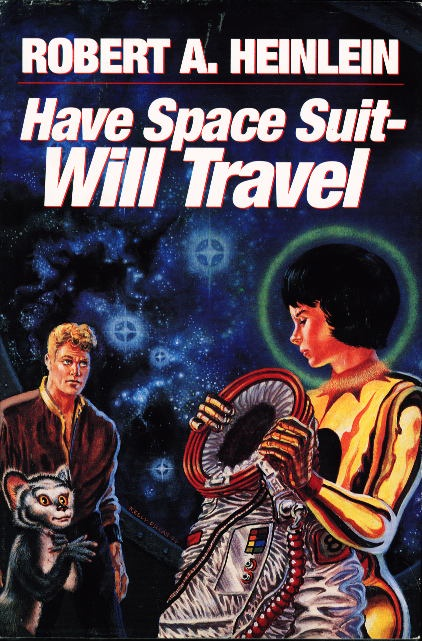
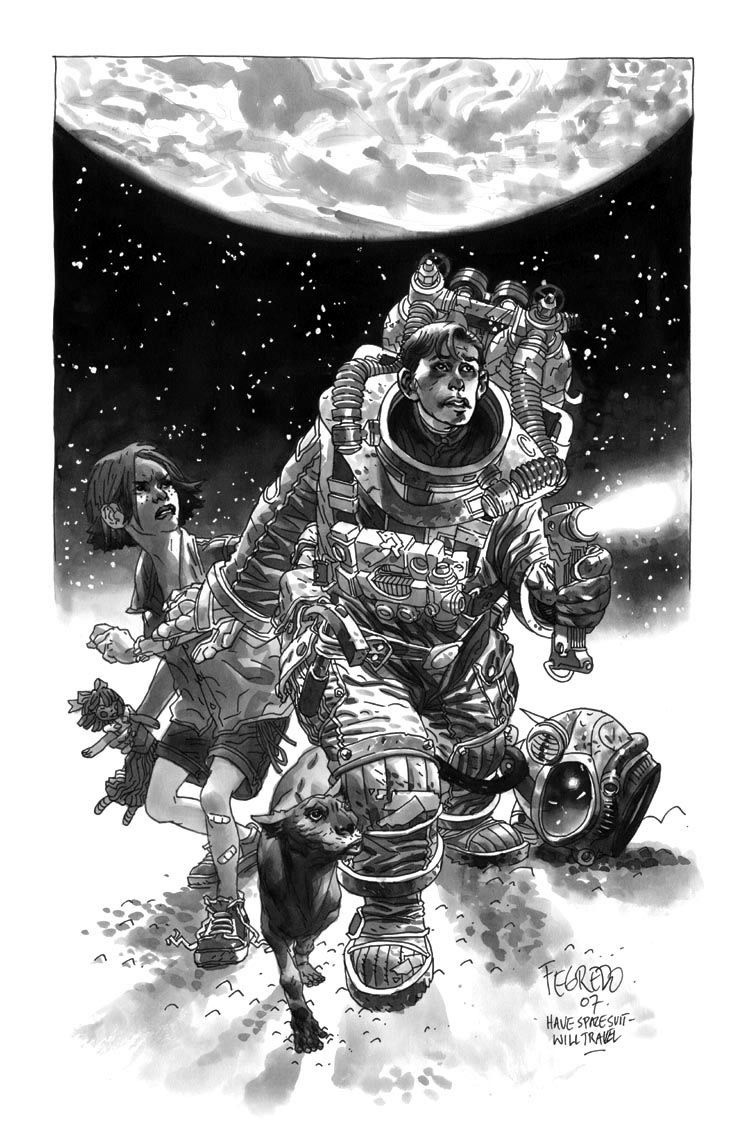
This is the book that opened my mind to Science Fiction. I read it in 1961 when I was 10, and life was never the same. I even read it to my 10-year-old grandson last year with video calls (he lives about 2,000 miles away from me.) This is the only illustration in the book itself, but it’s a pretty good representation of Kip and Peewee’s trek across the lunar surface. That said, numerous other people have come up with SF pulp cover illustrations, none of which ever matched the images that I had created in my mind.
This one is close for the protagonist, deuteragonist and the setting. Kip looks too old, though, he’s just a high-school kid. Peewee is pretty darn good.
Wrong on all levels. Peewee is not a bar hostess, Kip is not the varsity quarterback, and the Mother Thing is not a lemur – only her eyes were described in that way.
This artist here tried to capture the Mother Thing – way too anthropomorphic; Iunio (not bad); Jojo the dogface boy (as good as any, I guess); Skinny and Fats (within the realm of possibility) and Him (or Wormface, and I’d guess that the illustrator didn’t even read the book.
I like this artist’s style, Kip is a definite possibility, but Peewee looks like she just ate a bad mushroom. Mother Thing is still way off base – she’s totally alien, not like a cat, and far more amorphous.
God help us. But I do give this artist credit for trying to create a non-humanoid Mother Thing.
Not bad as illustrations go, but again the Mother Thing is only analogous to a lemur in the look of her eyes. Far too cat-like here.
I like the representation of Oscar in this cover illustration.
Very generic and not really indicative of the book at all. It should be mentioned in passing that the artistic skills of all these illustrators are not in question. I couldn’t do 1/100th as well. I just judge them based on how closely they match Heinlein’s descriptions in the book.
This one gets a gold star for the representation of Kip’s struggle to get back to the Wormfaces’ base on Pluto after setting the Mother Thing’s beacon. I can feel his frozen anguish.
So after wishing for decades that I could have a visual of the main characters in the story that more closely matched what I saw in my head, I commissioned my artist daughter to come up with one. She had read the book, and we conferred on the main points of each character, but I gave her free reign to use her imagination, and this is what she came up with. I just love it. Wormface is appropriately horrific and petrifying, and the Mother Thing is totally inhuman but with that “loving mother” look that is so poignantly described in the novel.
“Mother Very Thoughtfully Made A Jelly Sandwich Under No Protest.” ¹ Great mnemonic.
Footnotes
¹ “Protest.” Pluto. Still a planet, always a planet.




















 Playing in the World Game