I became acquainted with the work of Hendrik (Henry) Glintenkamp through my father, who owned two of his paintings – “Mexican Mountains” (sold to a private collector) and “Sunlight in the Valley” (Donated to the Los Angeles County Art Museum). Father acquired these from Glintenkamp’s wife Chinnie, with whom he was acquainted. Glintenkamp was significant in a minor way, and many galleries have one or two of his works. The two signed woodcuts illustrated below are still in my possession.
Henry Glintenkamp, American Artist (1887 – 1946)
The painter and illustrator Henry Glintenkamp (1887-1946) is known mainly for his anti-war illustrations that appeared in The Masses and other publications in the early twentieth century. As a painter, he was additionally successful, particularly in his landscape and urban scenes. Born in Augusta, New Jersey, the son of Hendrik and Sophie Dietz Glintenkamp, Henry received his elementary art training at the National Academy of Design (1903-06) before his study with Robert Henri the two years following. One student’s recollection of Henri’s classes, that of Helen Appleton Read, gives an indication as to the influence he effected on students such as Glintenkamp: “The old idea was to learn to draw the figure before the student had ideas. Henri’s idea was to have ideas first, paint pictures, make compositions, which is the same thing; learn to draw as you go along. He taught us to paint from the inside out so to speak, try to find out that inner thing that made one particular man or woman different from any other man or woman. (William Innes Homer, 1969, p. 150).
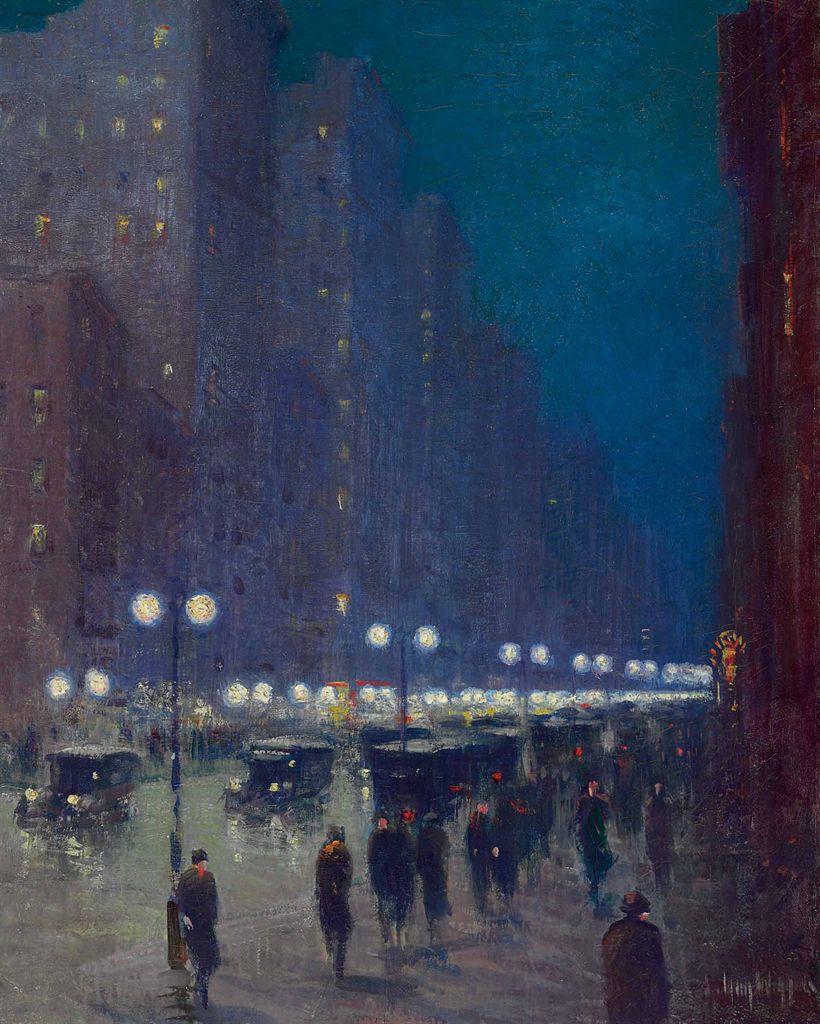
Henri consequently attracted artists like Glintenkamp interested in returning to a sense of human qualities. Setting up his studio in the Lincoln Arcade Building with Stuart Davis and Glenn O. Coleman, Glintenkamp did work that reflects a preoccupation with urban scenes and landscapes. These works are broadly handled with heavy impasto and rapid strokes, but all retain an enigmatic quality undoubtedly intensified by his use of a more tonal palette of misty shades. His urban scenes appear through a sort of mist. Despite his limited palette, there is no sense of quietude in the artist’s work, nor is there any predominance of figures as in a more popular genre scene. Instead, the focus would seem to be the relationship not of man, but of nature to her environment. Glintenkamp’s expressive works rely heavily on mood, attained from darkened tones, as well as a strained or unpredictable display of nature. “Henry Glintenkamp’s art is marked by a sensuous and vigorous paint surface which no doubt was the first encouraged and perhaps even inspired by the teachings of Robert Henri.” (Fort, 1981, p. 27).
In May of 1910 Glintenkamp exhibited his works as a student at the Henri School (Sloan, 1906-13, p. 418) and at the Exhibition of Independent Artists of 1910. Two years later, he accepted the position of instructor at the Hoboken Arts Club in New Jersey and in 1913, he took up with others in the organization of The Masses, designed as a publication devoted to humanitarian causes. This publication stood in stark opposition to war, as its articles and cartoons reflected pacifism: “Of course some were more vehement than others in their objections to the ‘immorality of armed conflict’. . . not overly subtle in their artistic protests, which in some ways indirectly reflected President Wilson’s isolationist policy” (Love, 1985, p. 380). Of his cartoon, paired with an article entitled “Making the World Safe for Democracy,” by Boardman Robinson, one noted that it might “‘breed such animosity toward the Draft as will promote resistance and strengthen the determination of those disposed to be recalcitrant,’ but it did not tell people that it was their duty nor to their interest to resist the law” (Young, 1939, p. 321). At the Armory Show (1913), Glintenkamp exhibited The Village Cemetery. In 1917, Glintenkamp moved to Mexico to avoid the draft, and remained there until 1924, supporting “the socialist agenda of Mexico’s new leadership.” (Boone, 1998-99, p. 66).
The period following 1917 marks a new phase in the artist’s development. Brighter in color and compositionally more involved, his later works are more discordant than the artist’s earlier work. The artist sacrificed the atmospheric quality of the limited palette for the increased influence of modernist movements. After extensive travels in Europe, Glintenkamp returned to New York in 1934, and became a teacher at the New York School of Fine and Industrial Art and the John Reed Club School of Art. As chairman for the committee responsible for the organization of an Exhibition in Defense of World Democracy, in 1937, Glintenkamp continued his humanitarian purpose, though never really took up with the socialist rebels, many of whom followed similar groups and publications. Indeed, Glintenkamp was instrumental in founding the American Artists’ Congress; he continued serving its needs as both the organization’s president and secretary. A peripheral member of the impressionist-tonalist group in his early career, Glintenkamp had progressed through many American movements by the time of his death in 1946.
Sources:
Sloan, John. John Sloan’s New York Scene. From the Diaries, Notes and Correspondence 1906-1913. Ed. Helen Farr Sloan. New York: Harper and Row, 1965, pp. 418, 606; Young, Art. Art Young, His Life and Times. New York: Sheridan House, 1939, pp. 320, 321, 324, 332-33; Homer, William Innes. Robert Henri and His Circle. Ithaca, NY: Cornell University Press, 1969; Fort, Ilene. “Henry Glintenkamp (Graham).” Arts Magazine 55 (June 1981): 27; Leff, Sandra. Henry Glintenkamp 1887-1946: Ash Can Years to Expressionism. Paintings and Drawings 1908-1939. Exh. cat. New York: Graham Gallery, 1981; Zurier, Rebecca. Art for the Masses: Radical Magazine and Its Graphics, 1911-1917. Philadelphia: Temple University Press, 1988, p. 165; Boone, M. Elizabeth. España: American Artists and the Spanish Experience. Traveling exh. cat. New York: Hollis Taggart Galleries, 1998-99, pp. 66-67.
ART: HENRY (Henrik) GLINTENKAMP, STUDENT OF ROBERT HENRI
By VIVIEN RAYNOR
Published: April 10, 1981
The New York Times
PAINTINGS and drawings by Henry Glintenkamp make up the latest in a series of revivals at the Graham Gallery (1014 Madison Avenue at East 78th Street). Glintenkamp, who died in 1946 at the age of 58, was a student of Robert Henri from 1906 to 1908, which places him at the very heart of the New York scene of those days.
The Henri School, as one of its most distinguished alumni, Stuart Davis, remarked, was ”radical and revolutionary.” Commenting that the lectures of the school’s head ”constituted a liberal education,” Davis noted ”enthusiasm for running around and drawing things in the raw ran high.” And, like today’s models in soft-drink commercials, the early 20th-century realists played as hard as they worked. Davis mentions frequent visits, with Glintenkamp and Glenn Coleman, to the saloons of Newark and Harlem, where, ”for the cost of a 5-cent beer,” black pianists could be heard turning ”the blues or Tin Pan Alley tunes into real music.”
The Whitmanism of the time certainly left its mark on Glintenkamp, who, unlike Davis, remained a representational painter. His 1911 portrait of a newsboy is very much in the Henri style, with the head and shoulders emerging from glossy blackness and the lips, nose and protruding ears heightened theatrically with red. City-scapes of roughly the same time, like those depicting the waterfront in winter and on a wet night, are also pretty robust.
Even so, Glintenkamp managed to develop a personal style with a palette knife, particularly in his views of snowy fields. The technique makes him seem more advanced than he was, as Sandra Leff indicates in her catalogue to the show. Not that the artist, a participant in the Armory Show, was immune to modernism; there is evidence of his having glanced at Matisse and, in the faceted, overlife-size head of Muriel Hope Eddy (1925), he is experimenting with Cubism.
But this is an atypical and embarrassing picture with a background filled with vignettes of a man and a woman at home and out on the town. Much better – probably the best work in the show – is the study of a woman in a black hat and coat that is classically simple but at the same time quite expressionistic.
Glintenkamp produced many prints – woodcuts and etchings, mainly – but none are included in the exhibition. Still, there are drawings, some of them humorous, that give an inkling of his graphic style. The artist was a newspaper cartoonist for a while, and like Davis and others contributed drawings to The Masses.
Once recovered from the effect of Henri, Glintenkamp produced several bold canvases such as the study of dark poplars on a snowcovered hill and the view of mountains and a red sky reflected in foreground water. He doesn’t resemble Marsden Hartley technically, but there is a kind of clumsiness in the best of his pictures that evokes the older master. (Through May 16).
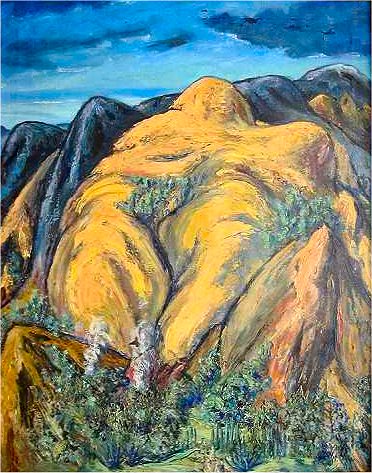
“Mexican Mountains” (Opus 1, 1940)
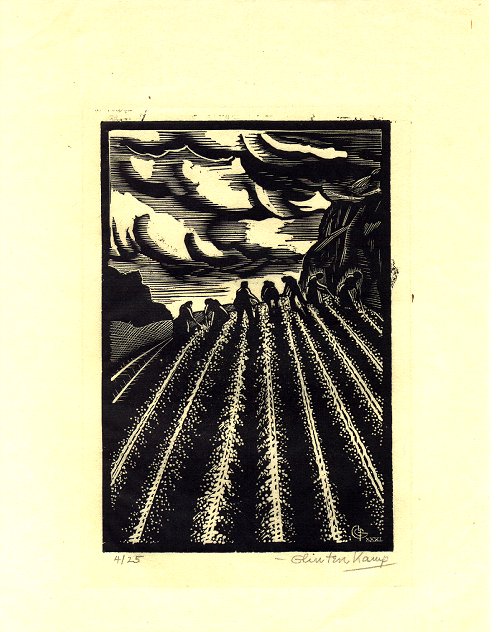
Woodcut 1 – Untitled – Original – Signed
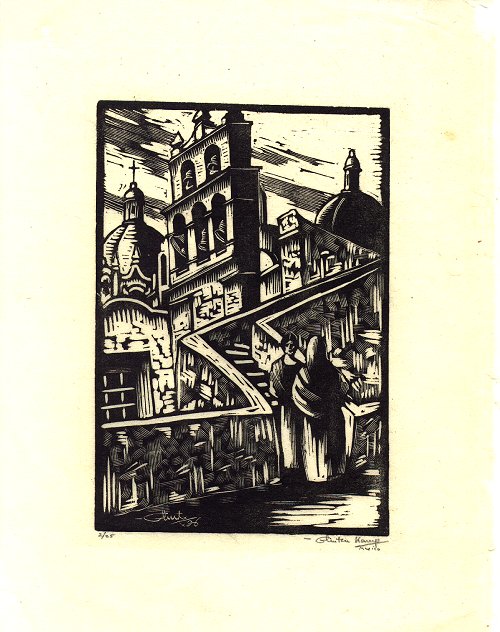
Woodcut 2 (Mexico) – Untitled – Original – Signed
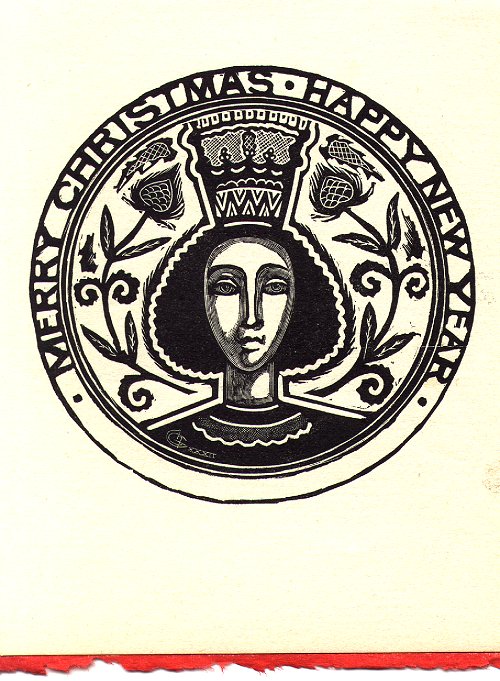
Glintenkamp Christmas Card – Print – Notepaper used by Chinnie Glintenkamp, Henry’s wife.
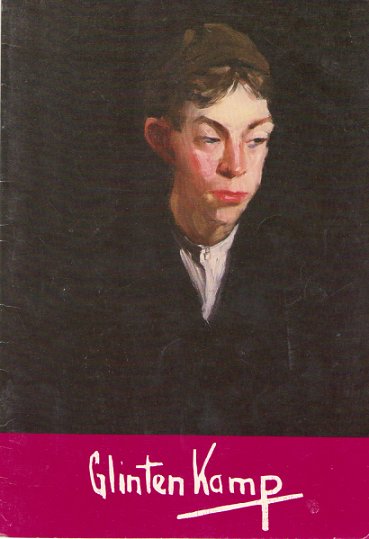
Catalog from the Graham Galley
“Henry Glintenkamp, 1887-1946
Ash Can Years to Expressionism
Paintings and Drawings 1908-1939”
External link: Henry Glintenkamp and the Ashcan School of American Art
The Old Wolf has spoken.







 Playing in the World Game