Funny business: Because they’re free!

Ever since everyone in my elementary school class was taught how to read The Herald Tribune (go ndéanai Dia trócaire air), way back in 1961 or so, I have loved the daily funnies. I remember waking up early when I was in high school, heading for a local coffee shop, and starting my day with a cup of coffee and The Waterbury Republican.

There were all kinds of funnies, and I had my favorites, which I assiduously saved for last each day.
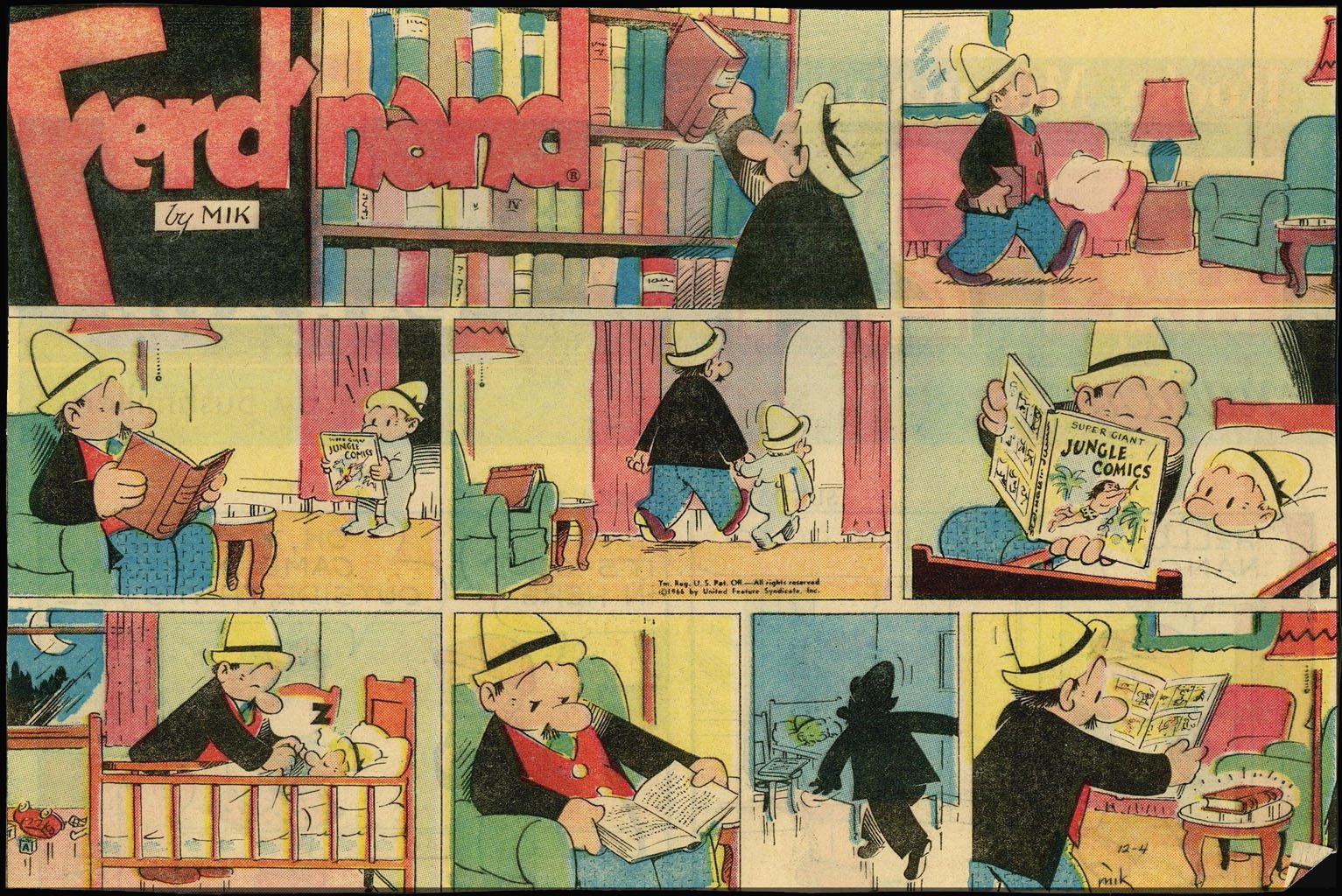
Ferd’nand by Mik (found at mydelineatedlife.blogspot.com)

Dondi, by Irwin Hasen. Found at Mr. Blog’s Tepid Ride

And my all-time favorite:

Rick O’Shay, by Stan Lynde.

Other strips, the soap operas like Mary Worth and Apartment 3-G, did nothing for me and I just skipped over them.

Remember that, there’s going to be a test.

Finally, when the newspapers ceased to be practical because of the internet (around 2002 for me) I became a fan of webcomics.

Webcomics are great. They are directly responsible for my hooking up with my wife, whom I love with all my heart and soul (even though she scared the living daylights out of me this morning at 3 AM and we hates her, hates her, hates her forever precious), and I’ve had to be selective about which ones I read, because there are thousands of them out there, and so many of them are top-drawer.

Some strips have discussion fora attached, one of which was how I met above-mentioned beloved wife (who is still in the doghouse). Most forum participants enjoy discussing and speculating about each day’s strip and upcoming plot possibilities, as well as an entire universe of random topics that crop up; indeed, a forum can become a living community. But there’s a strange phenomenon that afflicts these virtual villages: some people take up residence for the express purpose of being critical of the subject matter. Like the poor degenerate I mentioned in this post, they plunk themselves down and blow raspberries at the strip and its creator, day after day, without end.

Now, some of these people are just trolls, but there seems to be another phenomenon operating here. Like people who leave a religion and then spend the rest of their lives complaining about it, these netizens seem incapable of finding joy in anything positive, but must needs expend their energy complaining about something they hate. For the love of Mogg and his entire holy family, with thousands of webcomics out there, where is the value in reading something that annoys you? Coming back to my newspaper days, I can equate this phenomenon with my taking the time to hand-write a letter to the editor complaining about how boring and insipid I found Mary Worth, and threatening the artist with bodily injury and death. Every day.

A particularly egregious example of this sort of inanity is found at the “Bad Webcomics Wiki” (no link provided):

Essentially it’s nothing more than one man’s cesspool of hate and piss; the author is flat-out miserable, and assuages his pain by inflicting his misery on the rest of the world.

It’s not only the forums, either – artists get direct hate mail from readers, and it appears that this was even the case before the advent of the internet. Gary Larson’s The Pre-History of the Far Side contains some absolutely choice correspondence from people who found his cartoons offensive in some way or another. His response, in addition to mocking them in a published work, was
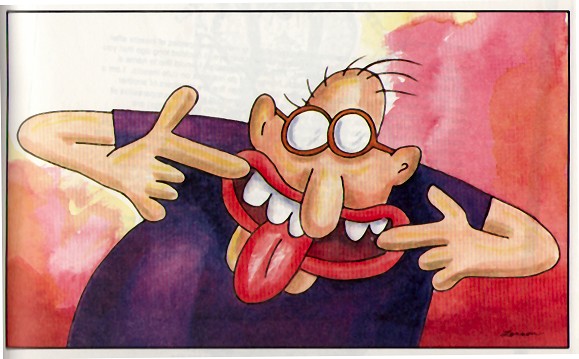
Teresa Burritt, the authoress of the offbeat Frog Applause, regularly posts hate mail from people, and recently blogged about it; I count a number of cartoonists among my personal friends, and some of them have shared correspondence with me that would either curl your hair or amuse you no end, depending on how you looked at it. Most of these artists take this sort of impotent vitriol in stride, and either ignore it or make a point of mocking it publicly to further enrage their detractors. Others I am acquainted with have a hard time with the sound and fury, and I hope they can get to a point of tranquility where they don’t allow the noisy idiots to dampen their spirits.

This whole essay was spawned by today’s Sinfest, by Tatsuya Ishida,
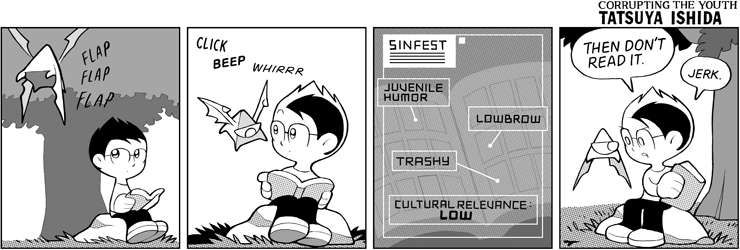
and another creation by Paul Taylor, author of the inimitable Wapsi Square:

The whole point here, which I recommend warmly to everyone who ever read a webcomic that they didn’t care for, is this:

Life is far too short to waste your time on such negative energy. If you read something you don’t like, for the love of Mogg’s holy grandmother, just ignore it. Better yet, find something positive to do – anything at all – and do it. As Artemus Ward said to the orfice-seekers pestering Abraham Lincoln:

“Go home, you miserable men, go home & till the sile! Go to peddlin tinware — go to choppin wood — go to bilin’ sope — stuff sassengers — black boots — git a clerk-ship on sum respectable manure cart — go round as original Swiss Bell Ringers — becum ‘origenal and only’ Campbell Minstrels — go to lecturin at 50 dollars a nite — imbark in the peanut bizniss — write for the Ledger — saw off your legs and go round givin concerts, with techin appeals to a charitable public, printed on your handbills — anything for a honest living, but don’t come round here drivin Old Abe crazy by your outrajis cuttings up!”

A better sermon I have never heard.

The Old Wolf has spoken.

Comments are closed for this topic.
So just how much sushi is that?

Yesterday I posted about the rice on the chessboard problem, and after I finished, my mind got… squirrel!

Well, yeah, that’s about how it works. I started wondering how long that much rice would last if you were feeding the entire population on a daily diet of 2027 calories. All of this is hypothetical, because living on nothing but rice is not great nutrition, but it would keep you alive – sort of – and a good percentage of the world’s population would kiss your feet if you provided them with that much rice (19.7 ounces) daily on a regular basis.

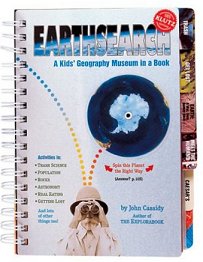
Since that squirrel just trotted through my mind, I’d like to pause here and put in a plug for an awesome book, Earthsearch by John Cassidy. This little wonder is a geography museum for kids that you can hold in your lap, full of games and facts and hands-on stuff. I was reminded of this by the fact that one section actually contains 4.8 ounces of rice, less than half of what the average kid (8-14 years old) needs per day. This is divided again into two bags, 2.8 ounces and 2.0 ounces respectively – and a spinner that shows your odds (1:20) of being born in the Western world. If your spin is lucky, you get to eat almost 500 calories. Spin poorly, and all you get is about 280 calories, enough to keep a kid hungry for a while and drive the point of world malnutrition home.

Back to our regularly scheduled programming: I’m also assuming that everyone is an adult male, 5’11” tall and about 150 lbs, which is where the 2027 calories come from. Of course that’s going to fluctuate wildly when you factor in the dietary needs of women, children, and people of different sizes and metabolisms. Still, it’s good enough for government work – all I’m doing here is coming up with a nice round number that my mind can wrap itself around.

Thanks to a handy dandy spreadsheet, I didn’t need to do much math.

  •  461,168,602,000 metric tons of rice (bigger than Mount Everest, remember), at 35,273.962 ounces per ton is equivalent to 16,267,243,742,541,100 (16.2 quadrillion) ounces.
  • Today, the world’s population, according to Worldometers is estimated at 7,066,853,164.
  • If it takes 19.7 ounces of rice to feed our average citizen, then we’re going to require 139,266,082,699.99 (139.2 billion) ounces of rice to feed the world for a day.

Which means that with his reward from King Shihram, Sissa ibn Dahir could feed today’s world for 116,807 days, or the equivalent of 320 years. That is a lot of sushi.

The Old Wolf has spoken.

*How* much rice?

When I was young, I heard the story of the rice and the chessboard.

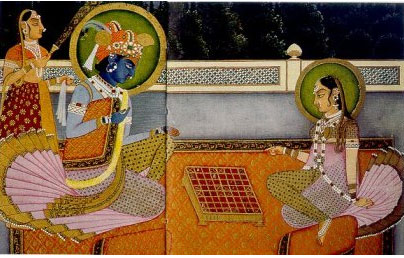
King Shihram of India was an oppressive tyrant. One of his subjects, Sissa ibn Dahir, invented the game of chess as a strategic (and social) training tool, and the king was so pleased that he asked Sissa what reward he wanted. Sissa’s answer was that the king should put one grain of rice (or wheat, in some versions) on the first square of a chessboard, two grains on the second square, four grains on the third square, eight grains on the fourth square, and so on, doubling the number of grains of rice with each square.

The King thought he had gotten off easy, but the simple math of exponential increase demonstrated that Sissa was no fool: the total weight of rice would exceed the weight of all living things on earth and make a heap larger than Mount Everest.

I always wondered just how much rice that was, but back then we didn’t have Wikipedia, and I don’t think such an “inconsequential” article would have made it into the Brittanica. Now, however, all is different.

An illustration of the operating principle is below:

The abbreviations refer to Mega (million), Giga (billion), Tera (trillion), Peta (quadrillion), and Exa (quintillion).

This principle was used by Ray Kurzweil who coined the term “The Second Half of the Chessboard,” referring to the point at which an exponentially growing factor begins to have a significant economic impact on an organization’s overall business strategy. The example above shows that the first square of the second half contains more rice than the entire first half combined.

Mathematically, the total number of grains of rice can be expressed as

(or so I’m told), which resolves to 264 – 1 (or so I’m told.) Dammit Jim, I’m a linguist, not a mathematician.

On the entire chessboard there would be 264 − 1 = 18,446,744,073,709,551,615 grains of rice (that’s 18.4 quintillion), weighing 461,168,602,000 metric tons, which would be a mountain of rice larger than Mount Everest. This is around 1,000 times the global production of rice in 2010 (464,000,000 metric tons).

Looking at the amazing Humphrys map comparing the heights of various mountains, look at how tiny St. Peter’s cathedral is in comparison (click the map for full size).

Even had King Shihram been able to pay, Sissa would have had difficulty finding a place to put his reward. And that’s a whole lot of sushi.

The Old Wolf has spoken.

Y solve for X?

“As you can see, I have memorized this utterly useless piece of information long enough to pass a test question. I now intend to forget it forever. You’ve taught me nothing except how to cynically manipulate the system. Congratulations.”
-Calvin (Bill Watterson)

When I was in high school, I remember thinking similar things on a regular basis. Why in the world do I need to know this? And to some extent, it’s true. While I can remember the quadratic equation, I have never once needed to determine the roots of ax2 + bx + c = 0.

Funny thing about that. It seems to be a more popular perception than I thought.

Randall Munroe, XKCD. Posted by permission.

This philosophy taken to its logical conclusion is probably what led Isaac Asimov to say, “There is a cult of ignorance in the United States, and there always has been. The strain of anti-intellectualism has been a constant thread winding its way through our political and cultural life, nurtured by the false notion that democracy means that “my ignorance is just as good as your knowledge.” (Newsweek, 21 January 1980).

However, Munroe’s alt-text for the above cartoon is “The only things you HAVE to know are how to make enough of a living to stay alive and how to get your taxes done. All the fun parts of life are optional.” That’s just what I was incapable of getting my head around at the time: oftentimes the only purpose in learning is to teach us how to learn, and what a joy that is in itself.

When I was a kid, librarians were held in high esteem. If you couldn’t find something you wanted you went to the librarian, who either knew the answer immediately or knew exactly where to find it. They were the living Wikipedias of the era, and they understood the joy of learning.

“Were man to live coeval with the sun, the patriarch-pupil would be learning still.”
-Young, “Night Thoughts.”

There’s something to be said for a broad-based education in preparation for choosing a career, but better than teaching endless rafts of facts in preparation for the almighty standardized tests, schools ought to be teaching kids how to learn and how to think and how to question; minds that can do this are the fertile seedbeds of innovation and social justice.

The Old Wolf has spoken.

Violet, resistance is futile.

Science is full of facts and numbers and formulæ and things to remember. Keeping it all straight can be a chore, even for the geniuses. As a result, over time people have developed interesting ways of remembering the order of things in groups and categories.

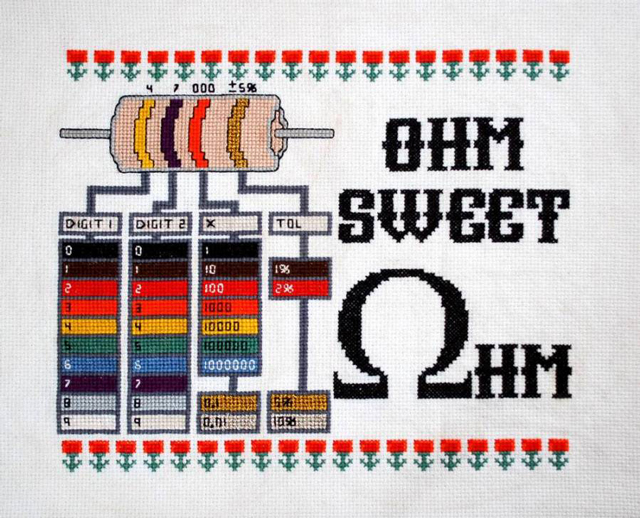
Cross-stitch reminder of resistor codes, courtesy of Adafruit.

Another way of remembering the color values:

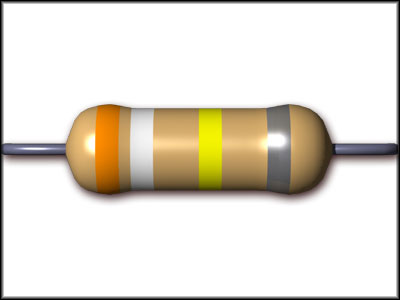
First two (or three) digits: Bad boys rape our good girls, but Violet gives willingly – get some now ->

Black, Brown, Red, Orange, Gold, Green, Blue, Violet, Grey, White (gold, silver and none refer to the tolerance band)

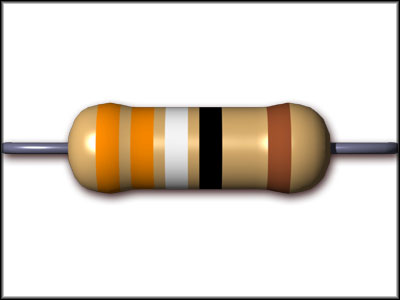
Resistors can be ever more complicated than in the early days when this mnemonic was developed. Six-band resistors have three significant digits, a multiplier, a tolerance band, and a temperature coefficient.

339Ω with a 1% tolerance.

39 kΩ with a 10% tolerance

Mnemonics are a good way of remembering other things as well. Most of us became good friends with Roy G. Biv in school:

Partial rainbow over Utah Lake, Mt. Timpanogos in the background. The order of colors in a rainbow are Red, Orange, Yellow, Green, Blue, Indigo, Violet.

There are numerous mnemonics for remembering the order of the planets in the solar system; my favorite is found in Robert A Heinlein’s Have Space Suit, Will Travel: Mother Very Thoughtfully Made A Jelly Sandwich Under No Protest (he used “T” for Terra, and included the “A” for Asteroids.)

And for what it’s worth, to Hell with the AIU. Pluto may be smaller than some of the other TNU’s and dwarf planets out there, but it was part of the solar system since Tombaugh discovered it, and by the dessicated skull of Mogg’s grandfather, there it stays. Randall Munroe of XKCD fame disagrees, and I give him mad props for being a genius, but as far as I’m concerned,

Huge selection of mnemonics here.

The Old Wolf has spoken.

On the internet, urban legends never die

Stumbling around this morning waiting for a student to show up online (he never did), I came across this:

Now, I had never heard this – but my stepdaughter happens to be insane about hippos, so I thought this might make a cute shirt for her. A bit of searching, however, raised a problem: despite countless hits and re-posts and re-blogs, and entries in things like Yahoo Answers (otherwise known as the blind leading the blind, but don’t get me started), it seems that it’s just not true.

It turns out that hippos produce a natural sunscreen. From Wikipedia: “Their skin secretes a natural sunscreen substance which is red-colored. The secretion is sometimes referred to as “blood sweat,” but is neither blood nor sweat. This secretion is initially colorless and turns red-orange within minutes, eventually becoming brown. Two distinct pigments have been identified in the secretions, one red (hipposudoric acid) and one orange (norhipposudoric acid). The two pigments are highly acidic compounds. Both pigments inhibit the growth of disease-causing bacteria; as well, the light absorption of both pigments peaks in the ultraviolet range, creating a sunscreen effect. All hippos, even those with different diets, secrete the pigments, so it does not appear that food is the source of the pigments. Instead, the animals may synthesize the pigments from precursors such as the amino acid tyrosine.”

Like all mammals, hippos produce white milk; when the milk mixes with these skin secretions, it may acquire a pink color cast. At ASPCA kids, one of the answer-writers produced this with regard to the question:

“You’re right about hippos oozing an awesome red-pink liquid to keep away bugs and germs and avoid sunburn, Finley! But pink milk? Sounds too crazy to be true. But you’re also right that many websites claim hippo babies are drinking pink milk.

I’m sorry to say that I don’t know any hippos personally, so to answer your question I had to turn to the experts—specifically, Dr. Rebecca Lewison, an ecologist and hippo conservationist at San Diego State University. According to Dr. Lewison, the pink milk thing is totally false! She thinks people are confusing hippos’ pink secretion with their milk. I guess you can’t believe everything you read on the Internet—except when at ASPCA Kids, of course.”

I’ll take the word of the experts on this one. Hippo milk is white.

The Old Wolf has spoken.