“Boom?”

And therein lies a tale.

79m7wNq

The above photo, found at reddit, illustrates he beginning of the construction of the Empire State Building in 1930. The top half of the image shows steam shovels carving away a hole for the foundation. Since Manhattan’s bedrock, ideally suited for the foundations of large skyscrapers, is closer to the surface in midtown and by the Battery, blasting was used to move that rock out of the way. (Historical note: the theory that this bedrock depth was responsible for the clustering of skyscrapers in those areas is giving way to other economy-based theories).

The procedure for this blasting was to drill holes in the rock face, have steam shovels cover up the area to be cleared with huge blankets made of twisted steel cables at least 1″ in diameter, and let fly. The resounding “whump!” was audible for blocks. The blankets were then removed, and the rubble cleared away by Mike Mulligan, Mary Jane, and friends. I loved watching this process as a kid, and construction companies would put windows in the walls around the building site so that rubberneckers could enjoy the spectacle. I was grateful to see these photos, as clear pictures of the process are difficult to find.

Earlier in life, however, there was a downside.

When I was about two, my parents lived in an apartment on Madison in the 90s. My room was next to the kitchen. One day I remember wandering into the darkened kitchen and beginning to play (I’m sure I had been forbidden to touch!) with the gas stove. It was cool to turn the knobs and watch the flame come on, and then turn them off and watch the blue fire dance around the burners before going out.

Remember this was in the early 50s: the oven had no automatic lighter, but you had to turn it on and stick a match down a hole in front to ignite the burner. I, however, knew nothing of that – all I know is that I must have turned that central knob, and when nothing happened, go back to the other four. However, the oven was filling up with gas, and the next time I turned on a burner, the inevitable happened.

With a roar, the gas-filled oven exploded. I was saved from serious injury by the fact that the oven door was taller than I was… when it blew open, it hit me on the forehead and I lost the front of my hair and my eyebrows, gathering a significant cut in the process, but my face and body were protected from the flames by the door itself.

I’m sure my parents were scared spitless, and relieved that I handn’t been killed outright. But my mother reported to me later in life that for a long time thereafter, when one of those construction blasts went off, my eyes would get as big as saucers, and I’d look at her, and ask “Boom?”

To this day I still don’t respond well to loud noises or being startled. I wonder if there’s a residual effect going on there? The most accurate of all Sun Microsystems “fortune” lines, at least for me, is “You will be surprised by a loud noise.”

Works every time.

The Old Wolf has spoken.

Do it yourself: Nothing ventured, nothing gained.

About 15 years ago I bought this Braun shaver, and it served me well for at least 15 years. The rechargeable batteries finally wore out, and I wondered if it would be worth trying to replace them myself rather than pay an appliance repairman ten prices for the privilege.

How to open it? I found a totally useless article on eHow (typical of all these crowdsourced answer sites like WikiHow, FixYa, Yahoo! Answers, and so many others – the blind leading the rutting blind) and then figured out how to get the thing open myself. Once you do, getting to the guts is pretty easy – and the little electronic board with the batteries pops right out. Nice German engineering.

I bought a couple of new NiMH rechargeables, and set about replacing them. The beggar was that those batteries were not soldered to the board, the were spot-welded at the contact points… but with some careful work I was able to get them out.

Popped the new batteries in, and the whole board started to smoke and melt.

Crap. I must have put the new batteries in backwards or something. I thought I was doing it right.

20150415_164000

RIP Braun – It’s the component in the front that really lit up – what looks like burning under the left battery is just residue from the original adhesive.

So this particular attempt at DIY didn’t work out so well… but that’s how I learn. Over the last half-century, I’ve assembled enough handyman skills to install a bathroom into a totally unfinished space, and all of that experience came from just jumping in and doing it. I made mistakes along the way, but these days most things go pretty smoothly.

So I had to run out and get a new Braun (I feel very loyal to that brand, I’ve been using good Braun shavers since 1974, the first one bought in Austria) and hopefully this one will last me at least 15 years, by which time I’ll get my grandkids to buy me a new one for Christmas, so I won’t have to try this particular experiment again.

I’m sure there will be others.

The Old Wolf has spoken.


PS: Ah, the luscious smell of burning silicon…

Avag Co Bepsig: These coins are Evil!

http://theoldwolf.com/Fraud/index.htmlNote: Before you read the article below, please read the following disclaimer, made necessary by some of the comments this post has generated.


These coins are not evil. They are cheap bits of plastic from some manufacturer in China. They have no special qualities, no magic powers. There is no witch named “Avagnanian Coishousness of Bepsigosity” – that’s just nonsense from a writer of satire. He might as well have used “A Vague Consciousness of BepsiCola.” There are no witches in this world. A lot of people who want to be one, and pretend they are, but dark magic and fortune telling and bad luck and the evil eye are all products of people’s imaginations.


Well, let me backpedal a bit.

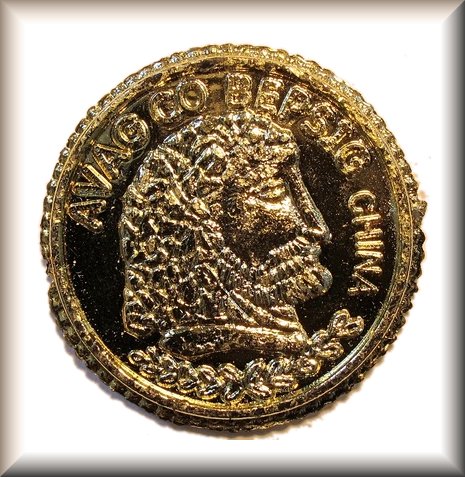
Somehow, I managed to come into possession of one of these little plastic gems:

Avag.jp

I’m certain it came to me from one of the fraud letters that my mother used to receive when she was alive (and continues to receive years after her death).

At any rate, here it is. Being a linguist by profession, I was curious about the inscription – whether it was sheer garbage or was based on anything real. I found a lovely description, completely tongue-in-cheek, at The Captain’s Blog:

This is a warning for aspiring pirates intent on purchasing a bag full of plastic novelty coins. Be aware that the brand of plastic coins bearing the legend “AVAG CO BEPSIG” are enchanted. That’s right, enchanted….

At our very first PiratePalooza I made the mistake of buying just such a bag of Avag Co Bepsig coins and made a fair show of giving them out whenever possible. Yet, when I returned to port I found that I still had a good many of the coins in me purse. Over the course of the year I continued to find more of the coins. Some in my bed, some in the settee, some in the stern of my autocarriage. Every time I found an Avag Co Bepsig coin I returned it to me leather coinpurse, full in the knowledge that I had them collected, each and every one.

And still I continued to find more, in places I thought I’d looked before. It’s fairly ridiculous how these things seem to breed in captivity, easily outstripping the population of coat hangers rutting in me washroom.

Without a doubt, my collection of these bewitched plastic coins outnumbers my original purchase and I am now consigned to the fact that some day in the future my ship will be awash in these devilish discs of dementia, certain to sink ‘neath their accursed weight and artificial shininess. For now I can only serve as example to those of you lucky enough yet to avoid these shiny promises from the heart of Avagnanian Coishousness of Bepsigosity, for that it what it turns out the name means.

Avagnanian Coishousness be a person… a Bane Witch of terrible antiquity and uncertain designs upon humanity, Cap’n Drew in particular. And even though I now know the source of me curse don’t expect me to take it all noble-like. No, no.

Know this, me hearties: I’ll take no pity upon any of you, so watch your backs. I’ll be certain to try slipping one of me famous cursed coins into your open pockets, purses, pouches and gaping glimpses of cleavage.

You’ve been warned.

Of course, this is all in fun. But the world is so full of a number of things, I suppose we should all be yanking our hair out in frustration if we knew the depth and breadth of human gullibility. Over at Ripoff Report, I found this letter from a dear soul who was so glad she was warned about the evil enchantment that lay on these coins, received in one of these fraudulent “prayer letter” scams:

You have sent me prayer letters. The one I recently opened on Oct. 16, 2011 although you sent it in May 2011. I just came across it . Although the letter was right on in what I was specifically praying for..you placed 2 coins in the letter to put one in my house that fiances will increase in my house & the other to place in my purse for financial increase. Once i did this & went to bed all night I could not sleep God woke me & told me to google the words on the coins they say “Avag Co Bepsig” I googled these words & discovered they are a WITCH”S name. You see I am a born again believer in Christ Jesus He Is My Lord & Savior..He Promises To Not Let His Children Walk In Darkness…I was at my dad’s house who is a Pastor & has won many to Christ. I was going to put one coin in his house but The Holy Spirit kept telling me NO!!! You see I am EXPOSING YOU !!! THis witch turned a man’s coins to plastic…if you people are really of Christ Jesus why would’nt God show you about these coins before you started sending them out??? God Promises Not To Let THose Who Truly Love Him Walk In Darkness…He EXPOSED you to me!!!

Now, in the interest of full disclosure I need to point out that I have a spiritual walk of my own, but I’ve always done my best to temper my faith with reason.[1] Not doing so leads to madness, or to the kind of attitude one sees above, where “if you read it in the Bible, or if you see it on the Internet, it has to be true.” In the end, it’s scary to think the kinds of world views upon which ordinary people, legislators, and national leaders can base their behavior.

In a recorded interview which once existed on YouTube, Richard Dawkins fielded a question from a Muslim who asked whether atheists could judge right from wrong in the absence of an absolute morality. Professor Dawkins proceeded to shred the question simply by making reference to things like the beating of women and punishment for apostasy, and summed up his analysis by saying that if these kinds of things are what absolute morality brings, he’d rather live without it; instead, he favors a morality that is developed and tested and tried and revised by the strength of reason and humanity. I’m put in mind of the four-way test of the Rotarians, used as a guide for business and personal relationships:

Of the things we think, say or do

  1. Is it the TRUTH?
  2. Is it FAIR to all concerned?
  3. Will it build GOODWILL and BETTER FRIENDSHIPS?
  4. Will it be BENEFICIAL to all concerned?

There’s a lot of wiggle-room in the first one, because among humans “truth” is hard to ferret out, except within the realm of pure science; but the last three ask the same question in different ways, to wit, “will it raise the human condition?”

Whatever we believe, we cannot afford to go through life not asking this question. Religion and humanism have as their ultimate goal to make their practitioners better people. If you’re still a jerk, it’s not working.

The Old Wolf has spoken.


[1] Now don’t jump down my throat about inconsistencies here… one of these days I’ll get my thoughts together in a more comprehensive essay about why I believe what I do, although a brief summary might be extrapolated from this entry. After that, feel free to shred my Weltanschauung if it brings you joy, but I’m pretty certain that the exercise will be entirely academic.

If you found a wallet, would you return it?

949599-0-20130914052823

Hottest buzz in the travel world: a human error caused United Airlines to offer tickets for $0 for a brief time. Some of the comments are telling.

One Houston woman booked a Christmas trip back to Washington to visit her parents for $5; the return leg was $220, but it was still a cheap ticket. But why wait? She decided to try booking a cheap flight to surprise her parents today. “It was $5 round-trip, no fees, nothing,” she says. “This is nuts.” She checked in right away and printed her boarding pass hoping to increase her chances of being able to use the ticket.

United, to their credit, decided to honor the fares.

One attorney – irony! – who got six tickets to LA for all of $60, said “They took the high road, said, ‘We made a mistake.’ It may cost them some money on the front end, but it saves them potential litigation and bad press.”

The bad behavior of corporations is always good for a public outrage fest or a media frenzy, and there’s no disputing the fact that many businesses, large and small, are out to get as much as they can from the public and their employees as the law will permit. It’s natural, then, that people should see a chance to get their own back when the opportunity presents itself as a well-deserved entitlement, but there’s something fundamentally wrong with this attitude. Taking advantage of an obvious error is no better than finding a wallet on the street, stuffed with cash, and keeping it.

Speaking of lost wallets, it appears that according to one study, honest people outnumber the dishonest by a margin of three to one – but from where I sit, a 25% failure rate is still a pretty dismal showing. You can say all you want about times being tough, but honesty is an absolute: you don’t take, nor do you have a right to, that which is not yours. An Ethiopian cab driver in Las Vegas understood this when he found $200,000 left in his cab and promptly returned it; the owner tipped him $2,000 for his honesty, but I was unsettled by some of the comments from his friends:

“That’s all? How about 10 percent, at least? That’s $20,000. How about 15 or 20 percent? That’s the going rate for tips in Vegas, after all.”

There is no greater reward for honesty than the knowledge in one’s heart that one has done the right thing. Even if the owner of the money had been a thermonuclear cheapskate – had he given the cabbie nothing at all, or $5.00, for example – the fact remains that the money was never the cabdriver’s in the first place, and he had no right to a penny of it; this concept was obviously lost on his friends, who saw an opportunity to profit from someone else’s mistake and were disappointed when it wasn’t as lucrative as they hoped.

So our lawyer friend, who had the good fortune of scoring six – count them, six – free tickets due to United’s error, was not only reveling in his good fortune, he was also dangling the litigation card by implying that if United had failed to honor their error, they would have been sued – and sadly, there’s no question that he is right. In fact, I’m sure he would have happily jumped on the bandwagon for a share of the settlement, or at the very least, the billable hours from his work on the case. United understood this, and decided quickly that it would be cheaper to eat the costs of their error than face a rash of lawsuits and bad publicity – none of which would have been possible without a universal sense (or at least, extrapolating from the wallet study, a 25% sense) that “finders keepers” trumps “thou shalt not steal.”

Justification for dishonesty takes many forms. Conversations with Nigerian scammers have shown that there is a country-wide sense that any money extorted from rich westerners is payback for decades of colonial rape (from the 419eater Ethics page):

  1. Nigeria was a happy and peaceful country until the west came along.
  2. Western companies, such as Halliburton and Shell, bribed their way into the country and proceeded to strip Nigeria of its assets leaving the inhabitants poverty stricken and struggling to survive.
  3. The West is responsible and now it is payback time.

One scammer wrote,

“Ok, I don’t really call it cheating, most times the smart person become victorious. Some body has to pay what we call retribution. From what Africa went through during the Slave trade era, the west took all our resources, manpower, and our cultural and traditional wares… Some body will pay some how what your lineage owed.”

On top of this, there is a culture in Nigeria that esteems those who can make money without working.

On the other hand, sometimes dishonesty is born of countrywide desperation – a perfect example of a society that functions more or less based on the Ferengi “Rules of Acquisition” is Kinshasa, in the Democratic Republic of Congo. An article in the September, 2013 issue of National Geographic paints a vivid picture of a society that is doing its best to survive plunder from within and without:

Despite its status as the capital city of the second largest country in all of Africa, Kinshasa is a marvel of dysfunction. Each of the government ministries has to be, as one U.S. official tactfully puts it, “basically self-financing”—meaning much of the money it has is generated by bribery and extortion. This is especially true of the police, who, says the aid adviser, “are one hundred percent on the take. Every one of them is an officer for one reason: to collect for himself.”

You would be right to expect anarchy from this collision of burgeoning poverty and state failure. But the West’s faith in institutions happens to be irrelevant in this slapdash confluence of metropolis and village. Nor is Kinshasa’s story the familiar African tale of woe, oppression, and no way out. Having first gained independence in 1960 from their Belgian colonizers, who left behind no governing capacity to speak of, and having then been deceived and plundered by the dictator Mobutu Sese Seko, the Congolese have long since discarded expectations that their civil institutions and elected leaders will perform as promised. The miracle of Kinshasa is that it has not discarded hope along the way. On the contrary: This is a city of frenzied entrepreneurship, where everyone is a salesman of whatever merchandise comes along, an uncertified specialist—self-employed, self-styled—a creator amid chaos, an artist in a shed.

I’ve been to Kinshasa four times, and experienced this first hand.

  • I brought some computer equipment into the country on behalf of a gentleman who was providing it for his friends. $200.00 “duty” had to be paid before it would be released, and I’m certain that fee was determined arbitrarily by the customs agent on duty for that day, to be shared with my “escort” who facilitated all my dealings while in the country.
  • When leaving the airport, I was surrounded by people who demanded money for everything and nothing; the sleepy-eyed “official” lady at the gate who asked if I had any Congolese francs; when I said yes, she said, “Give them to me.” Now, there is a government requirement that no Congolese money can be taken out of the country, so she was justified in asking – but the fact that I produced a handful of currency worth only about 50¢ clearly annoyed her, and it was plain that the government would see little, if any, of what she collected. [1] Other people, none of whom I knew, simply asked directly: “Give me twenty dollars.”
  • My above-mentioned escort was a leading member of the Church community I was there interacting with. A rising star among the congregation, he was a trusted advisor to the mission president and a member of Church leadership. He ended up plundering the office safe and throwing away an astonishing opportunity to advance both in his country and in the world… all for a few dollars within easy reach that he thought he was entitled to because he could take them.
  • On the subject of missionaries, the Church in Congo was obliged to re-supply their missionary apartments after every transfer, because everything that had value was stripped by the departing missionaries, sold on the street, and the funds sent back to waiting families. At the time, the administration was instructed that there was to be no disciplinary action for such things, because this behavior was so deeply-rooted in the culture.

It gets sticky, doesn’t it? When your entire country is based on “catch as catch can,” there seems little hope for breaking out of the cycle. For what it’s worth, I love the Congolese people that I have known, and I wouldn’t presume to judge them; I can’t imagine living in such chaos, nor do I know what I would do in their shoes. But we live in a different society than Nigeria or the DRC; the poorest of the poor in our nation would be considered solidly middle-class by many African cultures.

United Airlines made a mistake, and stood by it; from a strictly ethical point of view they were not obliged to, but from a public-relations point of view they made the best choice possible. It gets them some positive karma (which they sorely need, after the “United Breaks Guitars” debacle) and ends up being cheaper in the long run. But the episode serves to point out that we have a serious breakdown of ethics in our own country, one which will surely cause our nation more collateral damage in the future.

The Old Wolf has spoken.


[1] I am reminded of the attitude of Praetor Garovirus in “Asterix in Switzerland”:

asterix

Against all enemies, foreign and domestic.

This past Thursday I had the honor of attending a naturalization ceremony for some friends of mine. Originally from the UK, they’ve been in the US for around 10 years or so with a green card, and last February they initiated the process for becoming a citizen. It was expensive, tortuous and byzantine, and they had to deal with the best and the worst of American career bureaucrats, but they persevered, and on Thursday they were sworn in as United States Citizens.

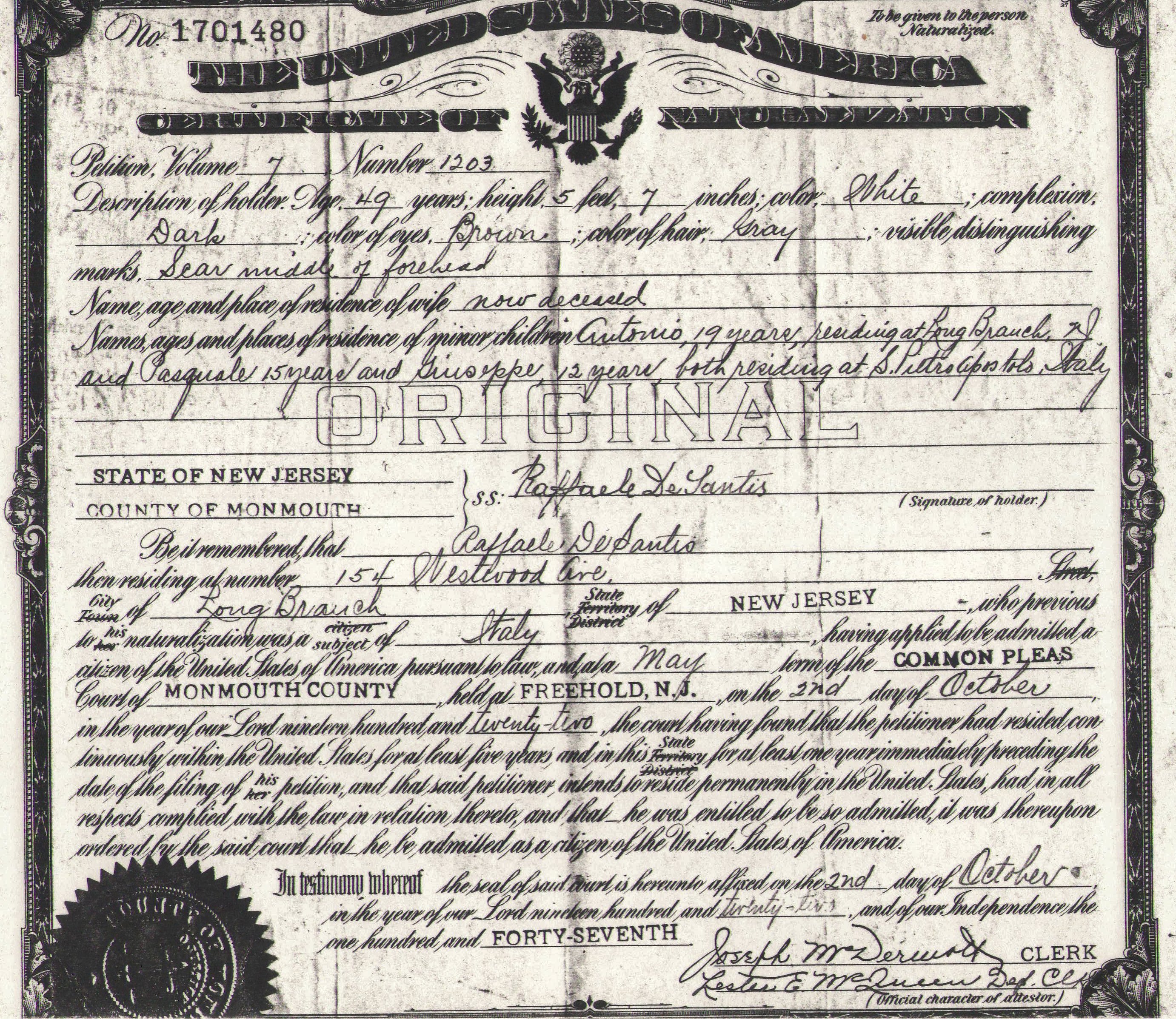
Despite being born of immigrant ancestors, this was the first time I have ever attended such a ceremony. It brought many feelings to the surface. My own paternal grandparents came to this country in around 1900 from Calabria and Tuscany, both in Italy. At some point they were naturalized, but I have no documentation; however, my grandfather’s brother became a citizen on October 2nd, 1925, and I managed to score a copy of his naturalization certificate:

Rafaelle Naturalization Certificate


The ceremony was solemn in nature, being an official session of court presided over by a federal judge, and was held in Abravanel Hall in Salt Lake City.

Oath


Colors were posted, the Pledge of Allegiance was said, dignitaries spoke, and in the end, a court official administered the following oath to over 400 newly-minted Americans:

“I hereby declare, on oath, that I absolutely and entirely renounce and abjure all allegiance and fidelity to any foreign prince, potentate, state or sovereignty, of whom or which I have heretofore been a subject or citizen; that I will support and defend the Constitution and laws of the United States of America against all enemies, foreign and domestic; that I will bear true faith and allegiance to the same; that I will bear arms on behalf of the United States when required by the law; that I will perform noncombatant service in the armed forces of the United States when required by the law; that I will perform work of national importance under civilian direction when required by the law; and that I take this obligation freely without any mental reservation or purpose of evasion; so help me God.”

Citing-Danger-Schumer-Calls-for-Scrapping-New-Screening-Plan-for-Statue-of-Liberty

This process takes place every other month in Salt Lake… and is repeated on a regular basis in countless cities throughout the country.  Thousands of people who saw the lamp lifted beside the golden door, and came here searching for a better life than the ones they had in their countries of birth. Despite all its flaws and challenges and mistakes and foibles and inconsistencies, they wanted to be a part of this country and the ideals that it still, at some level, stands for: freedom, a vote, and the opportunity to do with their lives what they will. At the end of the ceremony, microphones were passed to a few of the new citizens, and they expressed their feelings; the speakers came from Egypt, Mexico, Guatemala, Russia, Congo, Pakistan, Mongolia, the United Kingdom, and over 30 other nations were represented in the body of applicants. Each one expressed gratitude for their newly-conferred freedoms, and the fact that even though they were the nation’s newest citizens, they were in every respect equal to those who lived here since 1776.

It was an odd mixture of feelings. The ceremony was designed to be patriotic in nature, but patriotism seemed out of place in that gathering – it was more a coming home. I reflected on my own immigrant ancestors, and millions like them who left their natal shores to embark on often perilous journeys to an unknown land, a land about which they knew little other than stories. They came, and were processed through Ellis Island and other centers on other shores. They lived, worked, and died, and in so doing they became a part of this country and its history.

Now we are faced with another immigrant question – the fate of 11 million immigrants who came to this country another way, through porous borders. Often their journey was no less perilous, and often moreso – many have died in the attempt. Their reasons for coming have been no less elevated – they sought a better life in a country of opportunity when their own country offered them nothing but poverty, or oppression, or death. But they didn’t come through Ellis Island, and they didn’t follow the rules. And now we have to figure out what is to be done with them, and their families, some of whom have been here for multiple generations.

veggie

If we as Americans want to continue enjoying cheap, abundant produce, we need these laborers – and this is only one small sector of our economy where immigrants figure significantly. But if we are to honor the dedication and sacrifice of those who entered our country and came through the front door, as did my ancestors, as did my friends last Thursday, providing a streamlined path to citizenship for those who did not follow the laws seems like an intolerable slap in the face. For these people there must be a path to citizenship provided, but not one that disrespects those who came here and became citizens under due process of law. Quoting Rep. Jason Chaffetz, R-Utah, “There should be a pathway to citizenship – not a special pathway and not no pathway. But there has to be a legal, lawful way to go through this process that works, and right now it doesn’t.”

It is not an easy decision, because we’re dealing with multiple generations of people – many of whom were born in this country. I don’t support blanket amnesty, but I don’t support throwing all these people out on their ear either. We must keep working to find balance between honoring the law and being both human and humane.  The congressional debate continues.

For those who received their naturalization certificates last Thursday, whatever Congress decides will have little impact other than the one that illegal immigrants cause on the overall economy, an economy of which they are now part and parcel as fully-recognized, taxpaying citizens. These I honor especially, for the efforts they made to become part of our nation in the duly appointed way. To these new Americans, I wish all the prosperity and security that they worked so hard to obtain. This is no less than I wish for our undocumented aliens, but I want them to obtain it the same way as my friends and my ancestors did.

The Old Wolf has spoken.

No, we haven’t “broken English.”

A recent article over at The Guardian asks the question, “Have we literally broken the English language?”

The gripe stems from the fact that the word “literally,” meaning (and only meaning, dammit, if you listen to the prescriptivists) “to the letter, in a literal way or sense,” has now been updated with an additional definition. According to the Oxford English Dictionary, it can now be “‘used for emphasis rather than being actually true.” Google’s added definition states that literally can be used “to acknowledge that something is not literally true but is used for emphasis or to express strong feeling”.

Randall Munroe riffed on this some time ago in his wonderful XKCD:

literally

Cushlamochree, people – get a grip.

One of the first things I learned when I started studying historical linguistics is that language is about as fixed as the clouds of Jupiter. A course in Romance Philology, taught by the illustrious Madame A.M.L Barnett, had me watching the exquisite steps from Vulgar Latin into French, Italian, Portuguese, Spanish, Romanian, Catalan, and Romansch [1] over the course of 800 years; it was intriguing to be able to chart the transformation of Vulgar Latin blastemare[2] into the Italian bestemmiare or the French blâmer (whence we get our word “blame”).

Let’s look at some examples from more recent history, and our own language:

  • Meat used to mean food in general; now it simply refers to the flesh of animals.
  • Meet used to mean “appropriate,” whereas now it means “to encounter.”
  • Corn used to refer to all kinds of grain, whereas now it means that great stuff we eat at picnics on the 4th of July. Amaizing, isn’t it? [3]
  • Actual meant “pertaining to an action;” it now means “real” or “genuine.”
  • Awful used to mean “full of awe” i.e. something wonderful, delightful, amazing, instead of “horrible” or “terrible.”
  • Besom, meaning “a broom,” is only encountered in very old texts like the Bible and rare literary references.

And on and on. In fact, have a look at the original text of Chaucer’s Canterbury Tales:

Middle English (late 1300’s) Modern English
This carpenter out of his slomber sterte,
And herde oon crien ‘water’ as he were wood,
And thoughte, “Allas, now comth Nowelis flood!”
He sit hym up withouten wordes mo,
And with his ax he smoot the corde atwo,
And doun gooth al; he foond neither to selle,
Ne breed ne ale, til he cam to the celle
Upon the floor, and ther aswowne he lay.
This carpenter out of his sleep did start,
Hearing that “Water!” cried as madman would,
And thought, “Alas, now comes down Noel’s flood!”
He struggled up without another word
And with his axe he cut in two the cord,
And down went all; he did not stop to trade
In bread or ale till he’d the journey made,
And there upon the floor he swooning lay.

If that doesn’t do it for you, let’s look at Beowulf:

Old English (8th-11th Century) Modern English
Ðá wæs on burgum Béowulf Scyldinga
léof léodcyning longe þráge
folcum gefraége — fæder ellor hwearf
aldor of earde — oþ þæt him eft onwóc
héah Healfdene héold þenden lifde
gamol ond gúðréouw glæde Scyldingas·
ðaém féower bearn forðgerímed
in worold wócun weoroda raéswan:
Heorogár ond Hróðgár ond Hálga til·
hýrde ic þæt Ýrse wæs Onelan cwén
Heaðo-Scilfingas healsgebedda.
Then was in boroughs, Beowulf the Scylding (Beaw),
beloved king of the people a long age
famed among the folk — his father having gone elsewhere,
elder on earth — until unto him in turn was born
high Half-Dane, he ruled so long as he lived
old and battle-fierce, the glad Scyldings;
to him four sons in succession
woke in the world, the leader of the legions:
Heorogar and Hrothgar and good Halga;
I heard that Yrse was Onela’s queen,
the War-Scylfing’s belovèd embraced in bed.

Yes, it’s English – even though some of the letters have long since fallen out of use. Anyone not familiar with the history of language would swear that this was another language altogether… which, in a sense, it was.

The bottom line is that usage drives language, not rules. Scream all you want about the Oxford Comma [4], in as little as 100 years, people may not even know that it ever existed; in 400 years, English as it is spoken today may no longer even be recognizable.

Having used and worked with and studied multiple languages over the course of a career, it’s my own feeling that folks who get their knickers in a twist about  how language should be used are basically holding up their hand to try to change the mighty Amazon in its course; “As well you might have piled dry leaves to stop Euroclydon!” [5] Language is going to change, whether you like it or not, whether you want it or not, and whether you complain about it or not.

That’s not to say that there is no need for rules or style – I cringe when I see people mistake “lose” and “loose,” or mix up “there,” “they’re,” and “their.” But these rules are in place for the sake of meaning and clarity, enforced largely by academics and journalists and publishers for their rarified purposes; authors regularly violate every conceivable regulation if it suits their good pleasure (have a look at e.e. cummings or James Joyce if you don’t believe me.)

In the end, then, the claim that adding a dictionary meaning for the “misuse” of a word is tantamount to “breaking English” is  folly, and naught more than clickbait. Sadly, about 99% of the Internet is made of such nonsense.

The Old Wolf has spoken.


[1] And that list is by no means complete.

[2] Itself from the Late Latin blasphemare, which is visible as the ancestor of blaspheme, blasphemy

[3] Valid for Americans only. Other varieties of English still use this meaning, and refer to the stuff on the cob as maize.

[4] That’s for you, Melissa

[5] The Life and Teachings of Jesus and His Apostles, Church Educational System Manual

Some things just deserve to be shared.

I found this by chance over on Reddit, serendipitously, without looking for it, in a random discussion about Portland, Oregon. There were a lot of humorous comments – the article had to do with a dispute between passengers and a cabdriver, but then the conversation drifted into the nature of Portland as a city.

And then this gem popped up, written by /u/fwaht. I’ve corrected one or two things for spelling and style, but it’s otherwise unedited. The added emphasis is mine.

The “Successful” Person

If you’re what society calls a “successful” person, then you’re probably making more than two standard deviations above the mean, and you probably have a family. And you’re probably working a 9-5 job, or something like it, where you spend roughly ⅓ of all the waking time you’ll ever have doing it. And your employer wants your best time, the time where you’re most energetic and willing to get things done. Your other time is probably spent in a lethargic daze staring at a television (and as you age it gets worse). And why are you watching television instead of doing something you can look back on in ten years be proud of? Because only unsocialized losers haven’t seen the latest episode of American Idol or the latest sports event.

The average company is not run as a meritocracy. If you were a boss, would you want to see the person that quietly does excellent work and all but ignores you and everyone else get the promotion? Or would you want your “friend,” the guy that talks with you about football and your kids and makes you happy, to get the promotion even though he doesn’t do such great work?

No, you need to play the game. Most every business is its own Machiavellian-themed nightmare or kingdom depending on the ease with which corruption and deception and social lubrication comes to your character (and if it doesn’t come to you easily, then you will fall behind those that are better at it).

And what do you win after having beat this game? Retirement? You mean 10-20 years of low-quality life where you have the freedom that you could have had all your life if you chosen a life of less responsibility, of placing less importance in what’s expected of you than trying to do what you’ve always really, really wanted to do. Did you need those new cars, that large house and expensive furniture, the expensive meals, and so on and on? No, they made you happy for a short while, but then you just slid back into normalcy – you were on a hedonistic treadmill. Here you are, 60 years old, with all sorts of aches and pains, and remembering the senility your parents drifted into around this age. Remembering how you wished they just died quickly while feeling your intelligence diminish every year as it has since you reached 50.

And on your deathbed, what are you going to look back on and be proud of? Your children? They will die soon, and so will their children. In a short while you’ll be long forgotten as they will, and any trace of your genetic legacy will have disappeared – you aren’t Genghis Khan. Nothing of you will remain. And why should you care about such a thing after you’re dead anyway?

The “successful” person has sculpted their future and life into a hell worse than the one given to Sisyphus, and yet as miserable and meaningless as they are, they still come to think they’re better than others somehow.

While this may sound a bit negative, it’s a very accurate distillation of business and working life, and a wakeup call to those who find themselves on the treadmill. This would be a good place to share another good tidbit I found while surfing around:

Dream

In the United States, it’s getting harder to build a successful business or enterprise on a shoestring; increasing regulation, coupled with the consolidation of wealth at the highest levels, has made it more challenging to get off the treadmill than it was for great-grandpa who started life manning a vegetable pushcart in Little Italy in 1900. Harder, but not impossible.

If a person is really interested in success that lasts, they won’t be able to measure it by the standards found in Corporate ‘Murica. From where I sit, true success can only be measured by the number of people one has served, and the level to which one has raised the human condition. Efforts of this nature will ripple through time, whereas the accumulation of stuff and the generation of progeny who will walk in the same corporate rut will, as fwaht has noted, be forgotten within a span of time so short as to be insignificant in social terms.

I am proud of my children – each of them is looking for ways to make a difference rather than to die with the most toys. It’s not easy, but keeping one’s eye fixed outside the societal box of corporate norms is the only way to ensure that one’s efforts count for something after our bodies have returned to dust.

The Old Wolf has spoken.

Wikipedia is suffocating under the weight of its editors.

My last post was about The Whiteboard, an online webcomic which has had an 11-year run and continues unabated. In that essay, I wanted to reference the Wikipedia article for it, but found to my chagrin that the article which had once existed had been deleted. There was only a reference to the deletion-discussion page, so I hopped over to see what the debate looked like.

Naturally, a comic strip as famous as Peanuts has no problem being represented there, but there is a decided lack of consistency about lesser-known strips; while Schlock Mercenary by Howard Tayler is well-represented, the long-running Freefall by Mark Stanley, a slow-moving but thought-provoking space drama/comedy, has had its article deleted repeatedly despite being an online presence since 1996.

The debate page I referred to is a nauseating morass of cerebral onanism, navel-gazing and self-aggrandizement. There’s only one comment there I saw which approaches my feelings about what Wikipedia has become:

In answer to the question “Why should webcomics get their own special treatment?”, user Bushranger replied,

“Because the WP:GNG fails here. While “Everybody Knows About It” is (or should be) at WP:ATA, the fact that webcomics such as this and Dominic Deegan apparently fail it despite being some of the best-known webcomics on the Internet points out that there is something not working here. They are things that the average Internet user is very likely to come across and come to Wikipedia seeking the answer to “what is this thing I heard about?”, and if they don’t find information on them here, even if the removal of that information was in complete compliance with the rules, then Wikipedia is not serving its readers. I won’t !vote Keep for the simple reason that I can’t articulate a policy-based reason to keep, but I cannot in good consience !vote Delete because of how the situation is as mentioned above.” (Emphasis mine)

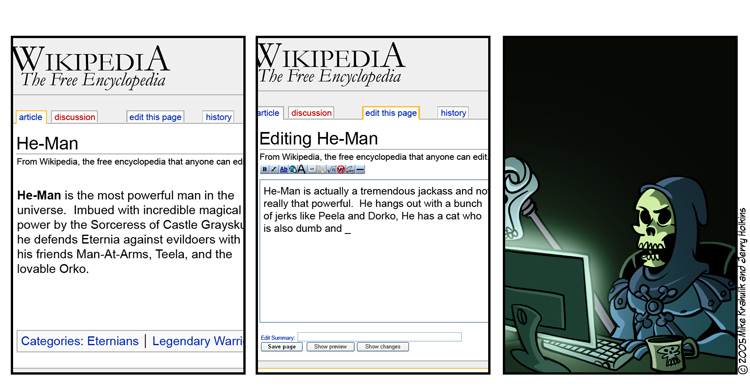
Wikipedia was designed as the encyclopedia that anyone can edit. While over time, it became obvious that certain controls needed to be established in order to maintain reliability of content (edit wars are a common occurrence),

Skeletor Wikipedia

the question about what deserves representation on Wikipedia has been overshadowed by the egos of dominant editors, a large percentage of whom – it seemeth me – are using Wikipedia as a vehicle for consolidating power and inflating their own status rather than serving the original philosophy of a Wiki.

In my own opinion, webcomics which have existed faithfully and consistently for periods of 11 and 17 years are certainly deserving of an article. They exist; they have followers; they are popular among certain subsets of the population, and if someone comes to Wikipedia looking for information about something, they should be able to find it.

The executive summary: As long as information presented is accurate, it’s not up to any editor (or even a community of them) to decide for others what is relevant and what is not.

The Old Wolf has spoken.

A tax on people who are bad at math

Most of us dream of it. The big win.

“Next summer I’ll make the strike, and this time I’ll put it into something safe for the rest of my life, and stop this fool wandering around.” [1]

800px-Stateswithlotto

The above map shows the states (in blue) which have state-sponsored lotteries. When the jackpot rises to the hundreds of millions of dollars, people flock to the convenience stores and plunk down a few dollars for the chance at a big one. But the probability of winning is so vanishingly small that players are simply flushing their money down the toilet for a brief, titillating dream.

The infographic below is large, but rather enlightening, as it makes your chances rather visible in terms of scale.

suckers

In Arabic, the appropriate expression is “بكرة في المشمش” (bokra fil mishmish, or “tomorrow, when the apricots bloom.”) That’s the equivalent of “How about never. Is never good for you?”

Proponents of lotteries push the idea that it’s cheap entertainment, cheaper than going to a movie or bowling or to a dance or concert. But I’m put in mind of Isiah 29:8:

“It shall even be as when an hungry man dreameth, and, behold, he eateth; but he awaketh, and his soul is empty: or as when a thirsty man dreameth, and, behold, he drinketh; but he awaketh, and, behold, he is faint, and his soul hath appetite.”

It is cheap entertainment… cheap as in the sense of little worth. When I was a kid in the 50’s, “made in Japan” was the equivalent of cheap slum, garbage, worthless trash – nowadays “made in China” seems to have taken over that shame (although we consume millions of tons of it from Wal-Mart and other places.)

Oh, make no mistake… I’ve been tempted. I live in one of the six states which has no lottery, and a couple of times I’ve been sorely tried… a little drive would take me over the border where I could plunk down my quatloos like the rest of humanity. But thankfully, I’ve prevailed, simply by reminding myself of the odds, and realizing that most of my money would be going to subsidize expenses for a state other than my own.

Despite the odds, millions play – and many others drop cash for worthless “systems” like the one shown here:

scumbag

Yes, I’d love to be a multi-millionaire… but like WOPR said at the end of “War Games”, it’s a strange game… the only winning move is not to play.

The Old Wolf has spoken.


[1] Van Tilburg Clark, Walter, “The Wind and the Snow of Winter”

Father’s Day in Retrospect

My own father passed away in 1989 at the age of 80. Last week, he would have been 104. Interestingly, we shared a birthday. His portrait hangs above our fireplace during the month of June to commemorate the twin holidays.

I miss him something terrible… and he was a toxic son of a bitch.

As I contemplate the incongruity in that sentence, it does not escape me that there are people out there for whom Fathers’ Day is a yearly reminder of inescapable horrors. How do you celebrate this national day of remembrance if your father raped you every day from the time you were three until you finally ran away from home? What kind of holiday is it for you if your back and your psyche still carry the scars inflicted by leather belts and cutting words? Not all daddies are the warm, loving, protective creatures we see in the memes and glurges.

Abusive Father


This picture hurts to look at; it’s very close to home.

It was difficult to forgive my father for his shortcomings while he was still alive, because he was so damned difficult to be around. People who knew him from afar thought he was debonair, witty, dashing, charming, and suave. He was, after all, a prominent actor with an IMDB rap sheet as long as your arm, and he moved in some fairly interesting circles. He was a gifted sculptor, spoke several languages, was an accomplished dialectician, and during his heyday was in large demand for playing heavies, Mexican banditos, Italian gangsters, tough attorneys, and the like. He was all of that, but for those who dwelt inside his intimate circle, he was mean, stubborn, selfish, violently angry, combative, aggressive, immovable, and not a little psychotic. The trouble was that he also had a good heart, loved his family, and wanted only what was best for them (filtered, of course, through what was best for him.) As a result, the situation for me was never black and white – which made reconciliation even more difficult.

I wish I could have come to terms with all of it while he was still alive, because there is so much I could have learned from him, if I was willing to receive it. I can only be content with having laid the demons to rest, and celebrating what good there was to celebrate. Even after his passing, it wasn’t easy – because he never really recognized how much pain he inflicted on those who were the closest to him. But harboring resentment, they say, is like drinking poison and expecting it to kill the enemy, and I’ve found that to be true. Forgiveness is a healing balm, and a space I’d much rather live in.

As alluded to above, I had it fairly easy. While my father’s words cut like knives [1], he never violated me, never hit me. I cannot hope to understand what some others have gone through, and the journey to peace is going to be different for everyone; I always think of Forrest Gump knocking down Jenny’s childhood home with a bulldozer as part of her symbolic journey to wellness. Ultimately, people who hurt us die – but the issues we carry inside us go on forever unless we ourselves put them to rest.

A beloved mentor of mine fell by the wayside in life as a result of being unable to forgive a perceived insult. It changed his life completely, and isolated him from a massive community of friends, associates and supporters. I lost contact with him about 7 years ago, and I can only assume he passed away; but I would have loved to see him set aside his stubbornness and return to the company of those who loved and honored him.

When it comes to understanding the power of forgiveness, there is one I look to as a guide who embodies the power of letting go. Azim Khamisa lost his son in a tragic gang-related incident; a 14-year-old boy, given a gun and told to “make his bones,” shot Azim’s son Tariq while he was delivering pizza to a false address as part of a gang initiation. Instead of falling into the trap of a lifetime of hatred, he realized that there were victims at both ends of that gun, and partnered with the shooter’s grandfather, Ples Felix, to establish a foundation that teaches young people how to reject kid-on-kid violence. The young triggerman, Tony Hicks, has been influenced by this unusual choice, and has been offered employment by Khamisa’s foundation when his 25-year sentence has been completed.

Everyone’s situation is different, and I cannot speak to each person’s horrors, nor do I attempt to minimize their suffering. But forgiveness is a gift that we give largely to ourselves, and I know from personal experience that coming to terms with injustice and letting go is much preferable to internal anguish carried around for a lifetime; my soul is cankered enough on its own without deliberately adding acid to the mix.

For some, there may never be reason to celebrate, other than to hoist a glass and say “thank God the bastard is gone.” But I know it is possible to come to a point where the day of remembrance is no longer torment; when one can take joy with friends or family who had better experiences, and honor the vast majority of fathers out there who – despite personal failings – did their best to shelter and nurture and protect and raise their children into responsible, caring and contributing adults.

The Old Wolf has spoken.


[1] The Greeks have a proverb for it: “Η γλώσσα κόκκαλα δεν έχει και κόκκαλα τσακίζει” (the tongue has no bones, but it breaks bones).