I think most of us would like to live forever. Teenagers certainly think they will, and some folks enter their names into the Darwin Award pool, gleefully shouting YOLO! all the while.
The sad fact is, the bus will come for each and every one of us[1] sometime within the next 115 years, based on mortality statistics. For me it will come much sooner than that, but I’m certainly in no rush.
With the advent of social media, however, there is now the option (and inevitability) that our online presence can or will outlast our physical presence on this green earth. As the first picture above alludes to, some of us would rather not have our online presence be quite so public.
Whatever the case, we now have options to handle any situation. Like anything else, a little bit of advance preparation goes a long way. For people heavily involved in the online world who would like to buy a bit of immortality, Google has launched a “Data After Death” tool, which arranges for your email, blog posts, Google+ data, contacts, documents, photos and YouTube videos to be sent to one or more loved ones or deleted entirely if your account becomes inactive for a length of time. Of course this can be done manually by putting instructions into a will or codicil, but that presupposes you have descendants who give a rat’s south-40, and who are technically savvy enough to carry out your wishes. As for deleting your browser cache and history, at this point only a human can do that for you; fortunately, my wife and all my kids are fairly connected, and will probably be willing to help out.
More than craving any sort of immortality, this essay was spawned by the loss of some online friends and acquaintances. One, a long-time participant in an online forum, passed away suddenly, and the other forumites only learned the sad news through fortunate happenstance. A second, a very prolific and talented digital artist, completely vanished from the online world without a word; the third, a web cartoonist and blogger par excellence shut down her blog, deactivated her email account, and left a two-sentence explanation for her readers that she would probably not be heard from in the foreseeable future. All of these were cause for concern. Whenever the bus comes for me, I want my friends to know about it.
In my previous post, I mentioned The Last Sermon of Ladson Butler. I may do something similar – and hopefully I’ll have time before a meteor lands on me – but I will almost certainly do it electronically. I’ve already got instructions in my will file on how to log in to my Facebook account and the forums I frequent most often, to let people know that I’ve shuffled off to the great beyond, in case anyone cares. Even if they don’t, knowing what happened is better than seeing someone just go silent.
To my now-silent acquaintances – and this includes many people with whom I interacted over a period of years on various fora and listservs, and who have simply moved on or drifted away – I miss you – and I hope that wherever you are and whatever you’re doing, life brings you all the joy and happiness you deserve.
The Old Wolf has spoken.
[1] If you haven’t already, watch “Heart and Souls” with Robert Downey, Jr. A delightful film.
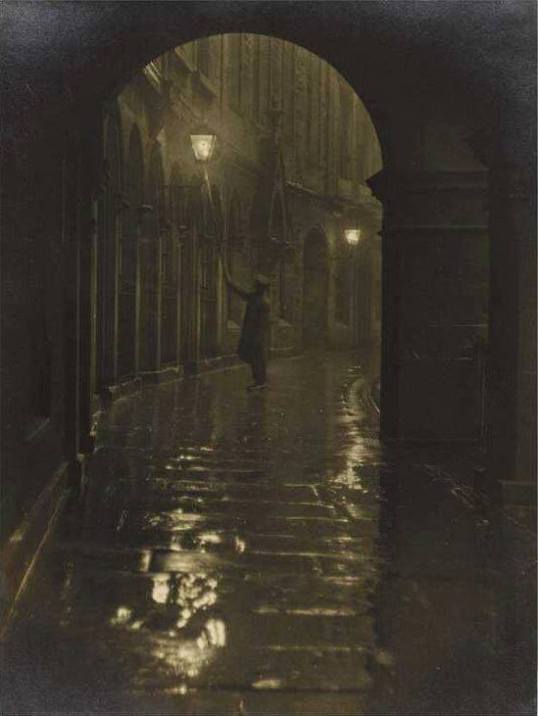
Lamplighter, Victoria Terrace, Edinburgh, 1928. Photographer Unknown
The Lamplighter
My tea is nearly ready and the sun has left the sky;
It’s time to take the window to see Leerie going by;
For every night at teatime and before you take your seat,
With lantern and with ladder he comes posting up the street
Now Tom would be a driver and Maria go to sea,
And my papa’s a banker and as rich as he can be;
But I, when I am stronger and can choose what I’m to do,
O Leerie, I’ll go round at night and light the lamps with you
For we are very lucky, with a lamp before the door,
And Leerie stops to light it as he lights so many more;
And O! before you hurry by with ladder and with light,
O Leerie, see a little child and nod to him tonight! -Robert Louis Stevenson
This poem, one of my favorites in A Child’s Garden of Verses, refers to the days when lamplighters would come around the streets of Edinburgh, lighting the gas lamps. As a child, Stevenson was an invalid (hence the reference to “when I am stronger”), and looking out of the window to see the lamplighter would be a bright spot in the lonely child’s day; to be noticed and nodded to would be exceptional.)
A Child’s Garden of Verses, Platt and Munk, 1929, illustrations by Eulalie
In a book that I wish everyone in the world could read, because it is filled with goodness and sadness and love and despair, and the kind of language that Eudora Welty and O. Henry and Walter Van Tilburg Clark knew how to use, language which not only conveys a message but which also fills the mouth – language which, like a finely aged beef or a vintage wine, deserves to be rolled around on the tongue and savored – William Saroyan wrote:
THE LITTLE BOY named Ulysses Macauley one day stood over the new gopher hole in the backyard of his house on Santa Clara Avenue in Ithaca, California. The gopher of this hole pushed up fresh moist dirt and peeked out at the boy, who was certainly a stranger but perhaps not an enemy. Before this miracle had been fully enjoyed by the boy, one of the birds of Ithaca flew into the old walnut tree in the backyard and after settling itself on a branch broke into rapture, moving the boy’s fascination from the earth to the tree. Next, best of all, a freight train puffed and roared far away. The boy listened, and felt the earth beneath him tremble with the moving of the train. Then he broke into running, moving (it seemed to him) swifter than any life in the world.
When he reached the crossing he was just in time to see the passing of the whole train, from locomotive to caboose. He waved to the engineer, but the engineer did not wave back to him. He waved to five others who were with the train, but not one of them waved back. They might have done so, but they didn’t. At last a Negro appeared leaning over the side of a gondola. Above the clatter of the train, Ulysses heard the man singing:
“Weep no more my lady, 0 weep no more today We will sing one song for the old Kentucky home For the old Kentucky home far away”
Ulysses waved to the Negro too, and then a wondrous and unexpected thing happened. This man, black and different from all the others, waved back to Ulysses, shouting: “Going home, boy-going back where I belong!” The small boy and the Negro waved to one another until the train was almost out of sight
Then Ulysses looked around. There it was, all around him, funny and lonely-the world of his life. The strange, weed-infested, junky, wonderful, senseless yet beautiful world. Walking down the track came an old man with a rolled bundle on his back. Ulysses waved to this man too, but the man was too old and too tired to be pleased with a small boy’s friendliness. The old man glanced at Ulysses as if both he and the boy were already dead.
The little boy turned slowly and started for home. As he moved, he still listened to the passing of the train, the singing of the Negro, and the joyous words: “Going home, boy-going back where I belong!” He stopped to think of all this, loitering beside a china-ball tree and kicking at the yellow, smelly, fallen fruit of it. After a moment he smiled the smile of the Macauley people-the gentle, wise, secret smile which said Hello to all things.
-William Saroyan, The Human Comedy
Apparently the profession lasted a lot longer than I had realized; the picture in London below is purported to have been taken in 1962, found at /r/historyporn.
Today as in the past, little children with their hearts full of innocence and wonder wave to the big people passing by; the delight that illuminates their faces on the rare occasion when someone takes the time to notice them, and wave back, or nod, or smile, or say hello, is large return on a small investment. Here’s a perfect modern example:
I’D LIKE to say a word in favor of fundamentalists. They’re getting a bad rap.
The dictionary says that fundamentalism is a movement in twentieth-century Protestantism emphasizing as fundamental the literal inerrancy of the Scriptures, the second coming of Jesus Christ, the virgin birth, and so on. Also a movement or attitude similar to Protestant Fundamentalism.
I don’t happen to subscribe to any of those beliefs, but it’s a point of view, and some of the people I’ve encountered whose point of view it is are very nice people.
The bad rap comes from a confusion of fundamentalism and fanaticism. “Moslem fundamentalists meaning terrorists did thus and so,” the media will report. Most all, if not all, Moslems are fundamentalists-that doesn’t mean they all want to blow people up.
I hear from fundamentalists-kids and adults-in my role as an author of children’s books. I hear from bigots and fanatics too but they’re not automatically the same people.
Here’s a case that comes up from time to time: I’ll get a letter from a kid, or a class, commending me for not using profanity in books I write. Sometimes, there’s an explicit religious connection made, sometimes not. Sometimes the letter comes from a religious school.
I write back to the kid or the class, and explain that I do not, as a rule, use vulgar language in books I write for kids as a matter of choice and preference-but that I would not hesitate to use it if the story called for it. For example, if I wrote a character who cussed-I’d have him cuss. It wouldn’t bother me.
I go on to explain that it’s a good idea to be able to distinguish between polite and impolite language, and to try to respect people’s sensibilities-but that I do not believe that words have power within themselves, and by making a special case of certain words and expressions, we imbue them with a power they should not have.
I tell them that I use vulgar language around the house, and when I’m alone, I use nothing else.
Then I suggest-now get this-that maybe they’d like to show my letter to their teacher, pastor or parents, and maybe have a discussion with them, or their class, and compare their ideas on the subject with mine.
And they do it! What do you think of that? These fundamentalist kids, or their teacher, will write back to me and say that they had an interesting talk based on my letter. I don’t expect anyone changes their basic views – but they’re willing to take a look at mine,
They’re not so bad.
Of course, I’m not talking about the educator from down south who accused me of being a Satanist because I wrote a story about a werewolf-but that guy would be a pain in the posterior whatever he believed.
I have more friends and associates than I can enumerate, and that’s a good thing. It would have been nice to win the Powerball Lottery (no, I don’t play), but I count my wealth in friends rather than gold.
Naturally, these friends are all over the ideological spectrum: some are devout Christian evangelicals, some are devotees of other faiths, others equally dedicated humanists, deists, atheists, anti-theists, and everything in between – and I do my best to respect them all.
And now it’s the Christmas season.
My son’s fiancée posted this on Facebook yesterday…
And my son followed it up with this video as a comment:
I watch with interest as the Christmas season draws nearer, and the blogosphere and social media sites fill up with comments about what the holiday means, who should be celebrating it, and why, and when, and begin to cast aspersions on the common sense, parentage, IQ and chromosomal structure of those who think differently.
It’s sad, really – because it’s an unwinnable argument; everyone gets to choose what the holiday means to them, and act accordingly.
Take the video above: The points it makes are matters of historical record, and I found very little in the essay to argue with. But the creator’s conclusion – that because of the things mentioned in the video, he chooses not to celebrate Christmas – seems to have shot wide of the mark.
C.S. Lewis posited that the historical Jesus was either God or fraud, with no room for the “great human teacher” argument. [1] Personally I’m OK with that assessment, but I know that there are just about as many opinions about Yeshua of Nazareth as there are people. Whatever one may believe about the historical figure, a few things are consistent across most accounts.
He was supremely kind to those who were different, in trouble, or down and out.
He had no patience with hypocrisy and oppression in the name of self-righteousness
He helped others wherever he could, fed the hungry, administered to the ill, comforted the sad, and encouraged the weak.
Everything he did in the way of lifting the human condition, he encouraged others to do likewise.
The estimable Mr. Lewis notwithstanding, that would be a life worth celebrating.
It is true that over the last two millennia, more evil has been perpetrated in the name of faith; but in contrast, an equal if not greater amount of good has been done as well. The first gets the headlines and is widely pointed to by opponents of religion; the second is done quietly, in bedrooms, back streets, alleys, and out-of-the-way places, and rarely attracts the attention of a media dedicated to selling advertising.
Over the last two millennia, the public celebration of Christmas has morphed from a religious feast day into an orgiastic frenzy of obscene consumption. Society at large has indeed succeeded in taking Christ out of Christmas, leaving nothing but a mass: a mass of confusion, a mass of greed, a mass of debt, and a mass of emptiness; but in countless homes around the world, there are those who celebrate the season by striving to live lives worthy of that original One; lifting the hands that hang down, and strengthening the feeble knees of others in need. Each of us gets to choose, and each of us gets to be right about our choice. We are free to look at the Christmas holiday as a reminder of all the hypocrisy and evil perpetrated in the name of faith by those who have lost sight of what the original Jesus was about; or, as the words of a lovely song state so well, we can choose to see the holiday as something else:
Christmas is a feeling filling the air, It’s love and joy and laughter of people everywhere. Christmas is a feeling bringing good cheer; It reaches out to touch you when the holidays draw near.
Along with Saroyan’s The Human Comedy, “A Christmas Carol” by Dickens ranks very high on my list of important and human writings. The transformation of Scrooge from all that our society today embodies – cold, commercial, heartless, penurious, usurious, and cruel – into someone who captured that feeling of joy and a desire to reach out and do good to all who crossed his path, underscores once again that we are at choice about how we view this holiday season. Each year the words bring me back, and I yearn to read the story again, each time with fresh eyes:
“[Scrooge] became as good a friend, as good a master, and as good a man, as the good old city knew, or any other good old city, town, or borough, in the good old world … and it was always said of him, that he knew how to keep Christmas well, if any man alive possessed the knowledge. May that be truly said of us, and all of us!” – Dickens, “A Christmas Carol”
We live in a peculiar, complex, and often bizarre and frightening world – but like Scrooge, despite the challenges, I would “honor Christmas in my heart, and try to keep it all the year,” pushing back against the tide and celebrating goodness, and giving, and helping everyone to win. That’s how I want to keep Christ in Christmas. Others may disagree, but that’s their privilege.
The Old Wolf has chosen.
[1] “I am trying here to prevent anyone saying the really foolish thing that people often say about Him: I’m ready to accept Jesus as a great moral teacher, but I don’t accept his claim to be God. That is the one thing we must not say. A man who was merely a man and said the sort of things Jesus said would not be a great moral teacher. He would either be a lunatic — on the level with the man who says he is a poached egg — or else he would be the Devil of Hell. You must make your choice. Either this man was, and is, the Son of God, or else a madman or something worse. You can shut him up for a fool, you can spit at him and kill him as a demon or you can fall at his feet and call him Lord and God, but let us not come with any patronizing nonsense about his being a great human teacher. He has not left that open to us. He did not intend to.” C.S. Lewis – Mere Christianity
I was recently introduced to a most wonderful blog, Zen Pencils: Beautifully illustrated quotes from great minds. The author/artist is Gavin Aung Than, a freelance artist living in Melbourne, Australia. A huge shout-out to Gavin for creating something of such lasting positive energy. In many ways, Gavin’s artwork and world view reminds me of the work of Winston Rowntree (a pseudonym! I wish I knew who he really is) who does Subnormality! Rowntree’s work is decidedly more offbeat, but also encourages readers to examine and explore and question the world we live in, and make the most of themselves in spite of the challenges life can offer.
I can’t honestly say how I found Zen Pencils – it could have been a Stumble, or a recommendation from a friend on Facebook, or via email. However it happened, I’m grateful. The post I found first is “Books are Awesome,” a quote by Carl Sagan. Reading the notes led me to another Sagan quote, reflected in the title of this post.
Click the thumbnail to be taken to the original page, which contains the full quote.
Now, I happen to really, really, really love Carl Sagan, in much the same way as I really, really, really love Isaac Asimov. Both were staunch and lifelong humanists, each striving for and encouraging others to grow, to develop, to improve, and to raise the human condition. (For what it’s worth, I have long suspected that the good Dr. Asimov was a closet believer in something greater than man – or at the very least, in the hope that Man could evolve into something far greater than he now is; all you have to do is read his short story, “The Last Question” for a glimpse of that longing.) Whether I’m right or wrong about that, he remained dedicated to humanist principles all his life.
Here’s another bit of Sagan-lore that I love to revisit on occasion, because it just makes me feel so good (along with all the other Symphony of Science videos):
Sagan is undeniably one of the greatest ambassadors of pure science that humanity has ever seen.
Which puts me in a quandary.
Because I’m “a believer.”
Humanists and the religious have been heaving word bombs and vitriol at each other for as far back as human written records go, and I’m here to say publicly, in words that will end up in the cloud forever until the heat death of the universe, that it’s a crying shame, and unworthy of the principles that both espouse. There is room in this great big, vast, endless, amazing, astonishing, wondrous, and (dare I say it) miraculous universe, for science and belief – and have very little left over (the Germans say “nichts übrig”) for people whose sole purpose in life seems to be depriving others of their basic human dignity.
Whether it’s a Nobel prize-winning scientist, ensconced in his well-papered office in the genetics department of a major Ivy League university who bitterly mocks and de-humanizes people of faith, or a Bible-thumping head of a $300-billion-dollar megachurch who foams from the pulpit to televisions worldwide that the Second Coming is nigh because of the wicked unbelievers of the world, or just you and me, neighbors, being dicks to one another, there’s no room in my world for this kind of negative energy.
I’m not about to attempt apologetics for all religion everywhere; the history books and modern news reports are full of horrors perpetrated by one group of humans on another because of a difference of belief, be it big or small – a syndrome superbly enough mocked by Jonathan Swift in his analogy of the “big-endians” vs. “little endians” that a simple reference to Gulliver’s Travels will suffice. It is enough for me to say that any person of faith who seeks to make another human being less, for any reason, both misunderstands and defiles the tenets and commandments of whatever god they claim to worship.
Sagan once wrote, “How is it that hardly any major religion has looked at science and concluded, ‘This is better than we thought! The Universe is much bigger than our prophets said, grander, more subtle, more elegant?’ Instead they say, ‘No, no, no! My god is a little god, and I want him to stay that way.’ A religion, old or new, that stressed the magnificence of the Universe as revealed by modern science might be able to draw forth reserves of reverence and awe hardly tapped by the conventional faiths.” Sagan was so close to his own epiphany when he said that, but it seems that he lacked whatever spark was required to take that last step and posit the existence of a God great enough to create the wondrous universe that he described, simply because there was no empirical, measurable evidence of such a creator. What he was left with was wonder and admiration for the unfathomable complexity of the space we live in, and admirable philosophies such as the one found in the Zen Pencils episode that entitles this post.
For me, there is evidence enough. To paraphrase a scripture that I value, all things denote there is a God; the earth, and everything on it, its motion, and also all the planets which move in their regular form, demonstrate that there is a Supreme Creator. Even positing, for the sake of argument, hydrogen atoms evolved to consciousness, there is no compelling evidence to explain the awesome regularity and mathematical perfection we see in nature or in music; no scientific reason to explain why I can remember the amazing Yorkshire puddings my wife made for me last week, or that the slope of a line is defined by the relationship y = mx + b, or that I have a class to teach this morning at 1:40 AM. In my mind, if creation were an accident, our world would be as random and unpredictable as one of Bill Watterson’s offbeat Sunday Calvin and Hobbes strips.
But see, that’s just me. I resonate with the idea that I’m more than a collection of vibrating strings that came together to be me for 80 years or so; I take comfort in looking at the wonders of the universe that we’re just beginning to understand, and having someone to thank for it; and I especially take joy in knowing that I should hang on to my fork, because there’s something better yet to come.
If belief and humanism are to coexist, each must observe certain boundaries. I support the free exercise of religious faith, but not the imposition of one group’s beliefs on others; I support a secular government and public education system which teaches only empirical truths, but one which does not go out of its way to teach that people who do believe in something more than pure science are gibbering idiots. Private schools can teach what they want – that’s their privilege, and that’s why they are private – but I would encourage them to adhere to the same principles of universal human dignity.
Years and years ago, scientists began dreaming of a mind-boggling system that would deliver Curiosity to the surface of Mars. If they had not had the dream, that amazing little beast would not now be puttering around the surface of our solar neighbor, zapping rocks with its lasers and finding evidence of surface water.
It is our dreams that drive our reality. I dream of a world that works for everyone, no exceptions, and that’s what I am working for. The thoughts of Sagan and others like him go into the pot and become part of the energy that is driving me forward.
This post started with a memory. I was thinking about a vacation trip my wife and I took this summer, and a humble motel in South Paris, Maine. I wrote about Goodwin’s Motor Inn over at Yelp, and one of the things I said was:
“The bathroom was well-cleaned. The shower head must have been installed back in the days before the government took to shoving its nose in everyone’s business, and to Pluto with water-saver fixtures, thank you… the absolutely Amazonian cascade of hot water that greeted me when I turned it on was enough to make me cheerfully forgive any other shortcomings the room might have had.”
It really was nice. And I’ve never liked water-saver shower fixtures from the time they became federally mandated; you can certainly get clean with 2.5 gallons per minute, but most of the time I just don’t feel like I’ve had that real cascade experience I grew up with in the 50’s.
I know I’m not the only one. Here’s a shot from the instruction sheet of a WaterPik shower head:
Other companies have tapped into consumer frustration with low water flow; Zoe Industries, realizing that the DOE regulations were written on a per head basis, began manufacturing some lovely multi-head devices, some with up to eight nozzles.
Unsurprisingly, the government was not happy with this arrangement, and not only did they re-write their regulations to bypass the per-head loophole, they levied fines of close to half a million dollars against Zoe for non-compliance. Even though that particular emmerdement was “settled” and Zoe only had to pay around $30,000, the company will have to stop manufacturing its multi-head fixtures at the end of 2012, and the company is fighting for its life. If you want one, you’ll have to hurry.
There’s something fundamentally annoying about government interference in private life and private business; an early cartoon dealing with income taxes still resonates today:
In the case of water, however, it’s quite plain that more is at stake than just personal convenience, because water is a global concern.
71% of earth’s surface is covered with it, yet wars are fought over access to enough. As the population of our planet continues its more than exponential growth, ensuring access to clean water for the world’s population will continue to become more difficult.
As Americans, we belong to the 8 nations that consume over 50% of the world’s fresh water resources:
That usage is not just based on personal consumption, but also on the amount of water required to produce food and other products; our hunger for beef and other meats is responsible for a large percentage of our overall use, as outlined in an article Treehugger.
In the case of water, the science is clear; we have to conserve, or we’re going to run out; living in a desert state drives that message home on a daily basis.
Coming full circle, technology is doing all it can to produce products that save more water without sacrificing performance; the EPA’s WaterSense program is just one example.
I understand the need for conservation, but dang, that shower at Goodwin’s was nice.
Ever since everyone in my elementary school class was taught how to read The Herald Tribune (go ndéanai Dia trócaire air), way back in 1961 or so, I have loved the daily funnies. I remember waking up early when I was in high school, heading for a local coffee shop, and starting my day with a cup of coffee and The Waterbury Republican.
There were all kinds of funnies, and I had my favorites, which I assiduously saved for last each day.
Other strips, the soap operas like Mary Worth and Apartment 3-G, did nothing for me and I just skipped over them.
Remember that, there’s going to be a test.
Finally, when the newspapers ceased to be practical because of the internet (around 2002 for me) I became a fan of webcomics.
Webcomics are great. They are directly responsible for my hooking up with my wife, whom I love with all my heart and soul (even though she scared the living daylights out of me this morning at 3 AM and we hates her, hates her, hates her forever precious), and I’ve had to be selective about which ones I read, because there are thousands of them out there, and so many of them are top-drawer.
Some strips have discussion fora attached, one of which was how I met above-mentioned beloved wife (who is still in the doghouse). Most forum participants enjoy discussing and speculating about each day’s strip and upcoming plot possibilities, as well as an entire universe of random topics that crop up; indeed, a forum can become a living community. But there’s a strange phenomenon that afflicts these virtual villages: some people take up residence for the express purpose of being critical of the subject matter. Like the poor degenerate I mentioned in this post, they plunk themselves down and blow raspberries at the strip and its creator, day after day, without end.
Now, some of these people are just trolls, but there seems to be another phenomenon operating here. Like people who leave a religion and then spend the rest of their lives complaining about it, these netizens seem incapable of finding joy in anything positive, but must needs expend their energy complaining about something they hate. For the love of Mogg and his entire holy family, with thousands of webcomics out there, where is the value in reading something that annoys you? Coming back to my newspaper days, I can equate this phenomenon with my taking the time to hand-write a letter to the editor complaining about how boring and insipid I found Mary Worth, and threatening the artist with bodily injury and death. Every day.
A particularly egregious example of this sort of inanity is found at the “Bad Webcomics Wiki” (no link provided):
Essentially it’s nothing more than one man’s cesspool of hate and piss; the author is flat-out miserable, and assuages his pain by inflicting his misery on the rest of the world.
It’s not only the forums, either – artists get direct hate mail from readers, and it appears that this was even the case before the advent of the internet. Gary Larson’s The Pre-History of the Far Side contains some absolutely choice correspondence from people who found his cartoons offensive in some way or another. His response, in addition to mocking them in a published work, was
Teresa Burritt, the authoress of the offbeat Frog Applause, regularly posts hate mail from people, and recently blogged about it; I count a number of cartoonists among my personal friends, and some of them have shared correspondence with me that would either curl your hair or amuse you no end, depending on how you looked at it. Most of these artists take this sort of impotent vitriol in stride, and either ignore it or make a point of mocking it publicly to further enrage their detractors. Others I am acquainted with have a hard time with the sound and fury, and I hope they can get to a point of tranquility where they don’t allow the noisy idiots to dampen their spirits.
This whole essay was spawned by today’s Sinfest, by Tatsuya Ishida,
and another creation by Paul Taylor, author of the inimitable Wapsi Square:
The whole point here, which I recommend warmly to everyone who ever read a webcomic that they didn’t care for, is this:
Life is far too short to waste your time on such negative energy. If you read something you don’t like, for the love of Mogg’s holy grandmother, just ignore it. Better yet, find something positive to do – anything at all – and do it. As Artemus Ward said to the orfice-seekers pestering Abraham Lincoln:
“Go home, you miserable men, go home & till the sile! Go to peddlin tinware — go to choppin wood — go to bilin’ sope — stuff sassengers — black boots — git a clerk-ship on sum respectable manure cart — go round as original Swiss Bell Ringers — becum ‘origenal and only’ Campbell Minstrels — go to lecturin at 50 dollars a nite — imbark in the peanut bizniss — write for the Ledger — saw off your legs and go round givin concerts, with techin appeals to a charitable public, printed on your handbills — anything for a honest living, but don’t come round here drivin Old Abe crazy by your outrajis cuttings up!”
It reminded me that my grandmother, gone to her reward these 33 years, used to be terribly precise about how she made sandwiches.
A great cartoon over at Left-Handed Toons addressed this issue with regards to how Subway made their sandwiches:
I always thought this was terribly funny, mostly because it was true. What I didn’t know is that people like Drew Mokris, poking merciless fun at Subway for their un-geometric procedures, actually made a difference. At least in Australia and New Zealand.
Found this over at Gawker; the original article from The Consumerist is gone (and their robots.txt file stopped the Wayback Machine from scraping it), but it was picked up by various news feeds, including NPR.
However, not all store managers were down with the change:
This manager is a douchebag.
And the article over at the Inquisitr documents one particular sandwich artist named Chris whose sole purpose in life appeared to be frustrating customers.
I’ve been working at subway for about a year and a half, and it always amuses me when people complain about not tessellating cheese. Now, merely to amuse myself, not only do I not tessellate the cheese, but I also leave gaps in the cheese placement so that an indeterminate amount of your bites will be cheeseless. Also, I put a really small amount of dressing on your sandwich whenever you ask for it. Then when you ask for more, I squirt out a large quantity before you can say stop so that your sandwich has far too much dressing. Then, when I cut the sandwich in half, I only cut it 3/4ths of the way through so that you have to messily tear the rest of the sandwich yourself.
Yes, he’s a douchebag too. If I were running a Subway store, he’d be looking for a job at McDonald’s faster than you can say “bogan.”
I don’t eat at Subway all that often, but I’ve never had a bad experience there. Now I’m tempted to go, just to see how they do it in my vicinity.
About 20 minutes south of my home is a 5,000-head dairy ranch owned and operated by the Church of Jesus Christ of Latter-day Saints. Today several of us went down this morning to volunteer a morning’s work, as members from local congregations do on a regular basis throughout the year.
I had never been to this particular outfit; our task for the day involved covering up a mountain of silage, and cleaning up excess tires on other mountains. Here are a few photos of the event.
7:45 AM: Heading off to work. More joined us at the work site, and some folks brought their kids along, who had a great time and also contributed to the best of their ability.
Sunrise over Elberta AG
Pulling plastic over the silage. This was a fresh mountain of corn – it had just rained, the silage was wet, and had begun to ferment; the smell was very pleasant.
Looking East over other mountains of silage – some corn, some chopped cornstalks, others unknown.
Some of the hills had too many tires on them; they only need two rows of casings along the edges. Our second task for the day involved pulling off the extras, stacking them up in the aisles, and getting them into large front-loaders which took them away for storage.
Heavy work; most of the tires were full of water. Another detail headed over to a field that was scattered with tires over about an acre, and worked to get them all piled up into a central location.
At around 10:00 they brought us chocolate and cookies-n-cream milk from BYU’s creamery, which was a nice pick-me-up, and one family had brought doughnuts for the crew. Welcomed! I was about out of energy.
We did good work today – but I can’t remember having been quite so exhausted in a long time. I’m not as young as I was 40 years ago…
The Internet is full of glurges – stories designed to make the reader feel good, or uplifted, or inspired. You know – the kind of thing you find in the “Chicken Soup for the Left Handed Ginger Soul.”
Now, I happen to have a very sappy heart, so there are a lot of these that resonate with me, whether they are true or not – and a good percentage of them aren’t. But in the end there’s nothing wrong with a good story – witness the success of the recent 50 Shades of Gray, which to me has less redeeming value than a nice tale about six disabled puppies rescued by a one-eyed wolverine who had just been run over by a steamroller.
People have told stories since the beginning of time. Stories to entertain, but more important, stories to pass on traditions and values which were important to the society that preserved them. A good example appears in Elie Wiesel’s book, Souls on Fire
When the founder of Hasidic Judaism, the great Rabbi Israel Shem Tov, saw misfortune threatening the Jews, it was his custom to go into a certain part of the forest to meditate. There he would light a fire, say a special prayer, and the miracle would be accomplished and the misfortune averted. Later, when his disciple, the celebrated Maggid of Mezritch, had occasion, for the same reason, to intercede with heaven, he would go to the same place in the forest and say: “Master of the Universe, listen! I do not know how to light the fire, but I am still able to say the prayer,” and again the miracle would be accomplished. Still later, Rabbi Moshe leib of Sasov, in order to save his people once more, would go into the forest and say, “I do not know how to light the fire. I do not know the prayer, but I know the place, and this must be sufficient.” It was sufficient, and the miracle was accomplished. Then it fell to Rabbi Israel of Rizhin to overcome misfortune. Sitting in his armchair, his head in his hands, he spoke to God: “I am unable to light the fire, and I do not know the prayer, and I cannot even find the place in the forest. All I can do is to tell the story, and this must be sufficient.” And it was sufficient.
The Christian scriptures are also full of parables and allegories, and whether you put any particular stock in their historical or spiritual value, most of them boil down to a single message: “Don’t be a dick, and help other people whenever you can.”
So here’s a glurge for you. It makes sense to me, and I like the message, which I have found to be true both now, and in retrospect:
“During my second month of college our professor gave us a pop quiz. I was a conscientious student and had breezed through the questions, until I read the last one: “What is the first name of the woman who cleans the school?” Surely this was some kind of joke. I had seen the cleaning woman several times. She was tall, dark-haired and in her 50’s but how would I know her name? I handed in my paper, leaving the last question blank. Just before class ended, one student asked if the last question would count toward our quiz grade. “Absolutely,” said the professor. “In your careers, you will meet many people. All are significant. They deserve your attention and care even if all you do is smile and say ‘hello’.” I’ve never forgotten that lesson. I also learned her name was Dorothy.” –Source Unknown
I believe that every person we encounter is there for a purpose. If we can leave them happy that we crossed paths, we have fulfilled our human responsibility, and no more can be asked.

![Darwin award candidate[1]](https://playingintheworldgame.com/wp-content/uploads/2013/04/darwin-award-candidate1.jpg)

























 Playing in the World Game