Beware of Fake Malware Warnings

Surfing around for a picture I was looking for yesterday, I came across this warning:
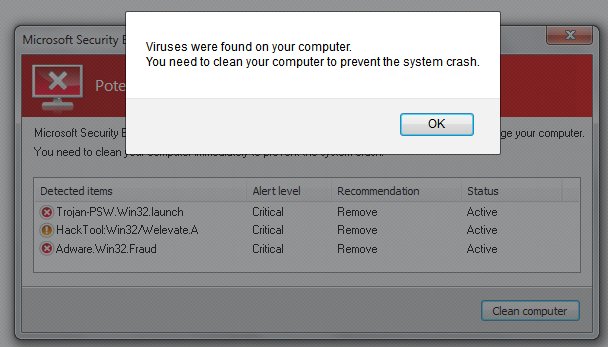
Since I had recently switched from AVG Free to Microsoft Security Essentials (it seems to work just as well, and doesn’t consume anywhere near as much CPU overhead, just for the record), it caught my attention. However, the strange English also caught my attention.

Clicking on the OK button, the full alert became visible:
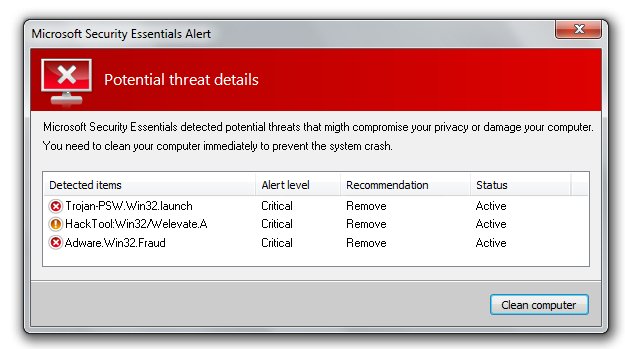
Again, there’s that “to prevent the system crash.” Microsoft may be guilty of useless error messages and worthless help files, but at least they use correct English. Hovering my mouse over the “Clean Computer” button showed a redirect to some alphabet-soup URL, meaning that anyone who clicks that button will be redirected to a site which will load the victim’s computer up with trojans, viruses and malware, oh my. The last insult is that the warning crippled the “Back” button in Firefox, so I had to close it out and restart to get off the page.

Be careful out there, folks. Just because you get a warning like this on your screen doesn’t mean your computer is infected. If you’re already using a reliable Malware scanner, you are most likely protected. Take note of the page (so you don’t go back) and get away from that URL as quickly as possible. Odds are you still have a clean computer.

The Old Wolf has spoken.

No, you didn’t win this. No, you can’t have it. No.

DEAR,

MY NAME IS GENERAL MARTINS TANJUL. I AM THE DEPOSED MAGNATE OF PETROCO IN LAGOS, NIGERIA, AND I NEED YOUR HELP IN MOVING THE AMOUNT OF $US 205 MILLION IN CASH OUT OF MY STORAGE VAULT TO YOUR COUNTRY…

So goes about every scam letter from the Lads from Lagos, often accompanied by pictures like the one above. For some strange reason, people continue falling for these mind-bendingly absurd emails; if they didn’t, the boys would give up their trade and find some other way to separate suckers from their money.

The photo above actually does represent about $205,000,000 and was seized as part of the biggest cash-drug bust in history, somewhere in Mexico City.

Yeah. So if you weren’t sure, it’s a scam. It’s always a scam. Any email from anyone you don’t know, where the subject is money, is a scam.

Be careful out there.

The Old Wolf has spoken.

Combatting Elder Fraud

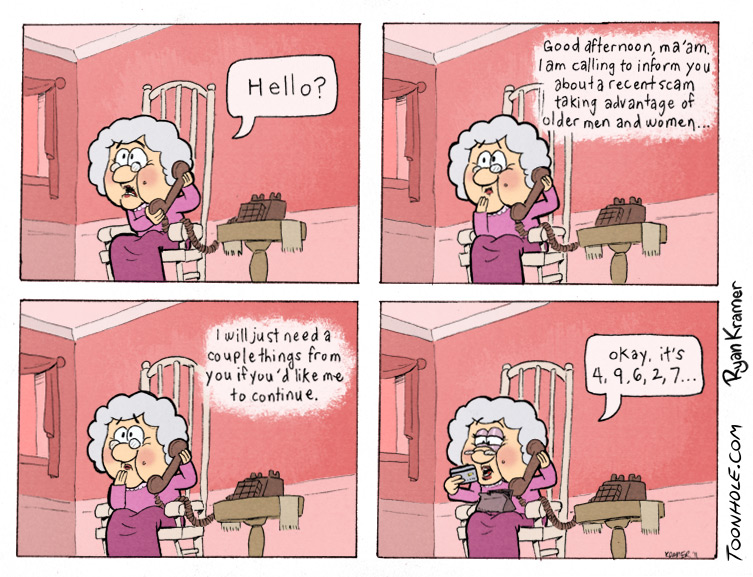
A buddy of mine in the UK linked to this cartoon, which despite being humorous also points out a very real danger for the elderly:

2012-02-24-ScamArtist

(Click the image to see the full-size cartoon)

My own mother, go ndéanai Día trocaire uirthi (Irish for “may God have mercy on her”), was victimized unmercifully by fraudsters, and lost substantial amounts of money to these miserable wastes of human cytoplasm. As a result, I was moved to put together the Sweepstakes Fraud Factsheet, as this was the kind of operation that caused her the biggest problems.

Be aware that these solicitations, while causing minimal financial loss themselves, are typically bait for larger operations. Once a victim has responded, they’ve not only lost $19.95, or however much they send for one of these worthless reports, but they are now on an ever-more-widely-circulated “pigeon list,” and can expect floods of additional solicitations and personal calls from advance-fee criminals.

This is only one of innumerable ways that the scum-suckers of the earth target the elderly; disreputable telemarketers will sell anything to anyone who is willing to give out a credit card number, and many of these spurious sales also result in recurring charges to bank accounts and credit cards.

Moral: Be careful yourselves, and if you have elderly loved ones, especially ones who are becoming senescent, do all you can to take charge of their finances or appoint guardians with power of attorney before the douchebags get their foot in the door. The FTC has a raft of additional information which lists the most common scams and how to protect yourself and your families.

The Old Wolf has spoken.