Predictions of the Year 2000
from The Ladies Home Journal of December 1900
by John Elfreth Watkins, Jr. “What May Happen in the Next Hundred Years”
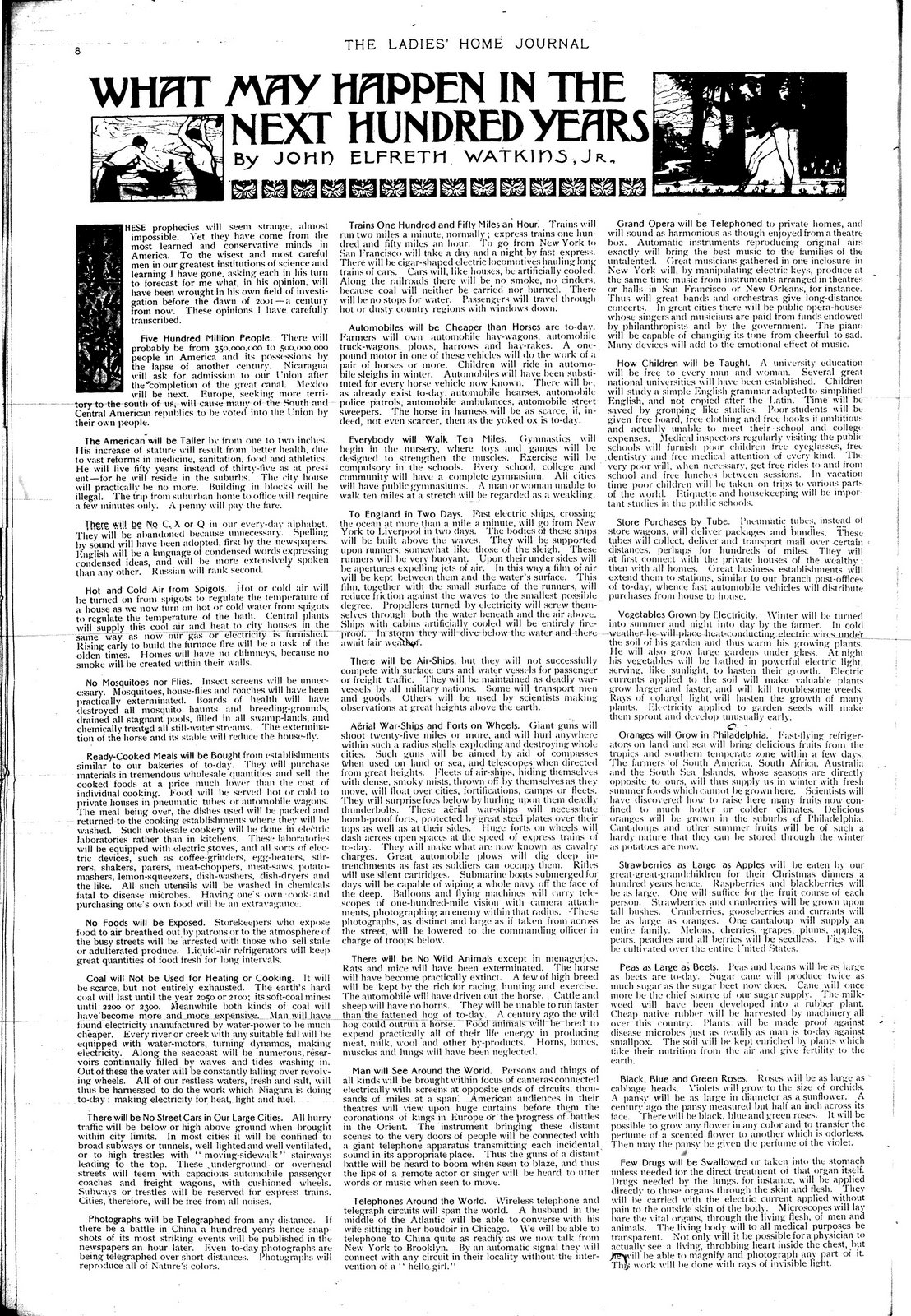
Original Article. Transcription follows below, with random commentary in color:
“These prophecies will seem strange, almost impossible. Yet, they have come from the most learned and conservative minds in America. To the wisest and most careful men in our greatest institutions of science and learning I have gone, asking each in his turn to forecast for me what, in his opinion, will have been wrought in his own field of investigation before the dawn of 2001 – a century from now. These opinions I have carefully transcribed.”
Five Hundred Million People. There will probably be from 350,000,000 to 500,000,000 people in America and its possessions by the lapse of another century. Nicaragua will ask for admission to our Union after the completion of the great canal. Mexico will be next. Europe, seeking more territory to the south of us, will cause many of the South and Central American republics to be voted into the Union by their own people.”
Close, considering that the 1900 number was 76,094,000. The 2000 census reported 281,421,906 people.
The American will be taller by from one to two inches. His increase of stature will result from better health, due to vast reforms in medicine, sanitation, food and athletics. He will live fifty years instead of thirty-five as at present – for he will reside in the suburbs. The city house will practically be no more. Building in blocks will be illegal. The trip from suburban home to office will require a few minutes only. A penny will pay the fare.
The US life expectancy in 2000 was 77.1 years. One of my favorite children’s books was “The Goops,” by Gelett Burgess. One of the poems follows:
CONSIDERATION
When you’re old, and get to be
Thirty-four or forty-three,
Don’t you hope that you will see
Children all respect you?
Will they, without being told,
Wait on you, when you are old,
Or be heedless, selfish, cold?
I hope they’ll not neglect you!
I always chuckled as a child at the concept of being old at thirty-four or forty-three, and chalked it up to humoristic license. However, The Goops was published in 1900, when the average life expectancy was 46.3 (male) and 48.3 (female). Watkins underestimated the average lifespan in his day, and also underestimated what modern medical science has done for today’s expected lifespan. As for the “rapid transit” Watkins envisioned, we’re not quite there yet.

These were 15 ¢ when I was growing up in New York. When the new New York City Transit Authority raised the fare from a dime to 15 cents, turnstiles could not register two different coins. So 48 million of dime-sized, “Small Y”, brass Y-cut tokens were minted. Unfortunately, prices went in the wrong direction, with a single ride on NYC’s subway costing $2.25.
There will be No C, X or Q in our every-day alphabet. They will be abandoned because unnecessary. Spelling by sound will have been adopted, first by the newspapers. English will be a language of condensed words expressing condensed ideas, and will be more extensively spoken than any other. Russian will rank second.
A piece of language satire often attributed to either Mark Twain or “European Union Spelling Reform” and ending up “Ze drem vil finali kum tru!” has circulated for years around fax machines and the internet. However, it appears that the original idea for this bit of doggerel came from
Meihem In Ce Klasrum
by Dolton Edwards.
Because we are still bearing some of the scars of our brief skirmish with II-B English, it is natural that we should be enchanted with Mr. George Bernard Shaw’s proposal for a simplified alphabet.
Obviously, as Mr. Shaw points out, English spelling is in much need of a general overhauling and streamlining. However, our resistance to any changes requiring a large expenditure of mental effort in the near future would cause us to view with some apprehension the possibility of some day receiving a morning paper printed in – to us – Greek.
Our own plan would achieve the same end as the legislation proposed by Mr. Shaw, but in a less shocking manner, as it consists merely of an acceleration of the normal processes by which the language is continually modernized.
As a catalytic agent, we would suggest that a “National Easy Language Week” be proclaimed, which the President would inaugurate, outlining some short cut to concentrate on during the week, and to be adopted during the ensuing year. All school children would be given a holiday, the lost time being the equivalent of that gained by the spelling short cut.
In 1946, for example, we would urge the elimination of the soft “c,” for which we would substitute “s.” Sertainly, such an improvement would be selebrated in all sivic-minded sircles as being suffisiently worth the trouble, and students in all sities in the land would be reseptive toward any change eliminating the nesessity of learning the differense between the two letters.
In 1947, sinse only the hard “c” would be left, it would be possible to substitute “k” for it, both letters being pronounsed identikally. Imagine how greatly only two years of this prosess would klarify the konfusion in the minds of students. Already we would have eliminated an entire letter from the alphabet. Typewriters and linotypes kould all be built with one less letter, and all the manpower and materials previously devoted to making “c’s” kould be turned toward raising the national standard of living.
In the fase of so many notable improvements, it is easy to foresee that by 1948, “National Easy Language Week” would be a pronounsed sukses. All skhool tshildren would be looking forward with konsiderable exsitement to the holiday, and in a blaze of national publisity it would be announsed that the double konsonant “ph” no longer existed, and that the sound would henseforth be written with “f ” in all words. This would make sutsh words as “fonograf” twenty persent shorter in print.
By 1949, publik interest in a fonetik alfabet kan be expekted to have inkreased to the point where a more radikal step forward kan be taken without fear of undue kritisism. We would therefore urge the elimination at that time of al unesesary double leters, whitsh, although quite harmles, have always ben a nuisanse in the language and a desided deterent to akurate speling. Try it yourself in the next leter you write, and se if both writing and reading are not fasilitated.
With so mutsh progrs already made, it might be posible in 1950 to delve further into the posibilities of fonetik speling. After due konsideration of the reseption aforded the previous steps, it should be expedient by this time to spel al difthongs fonetikaly. Most students do not realize that the long “i” and “y,” as in “time” and “by,” are aktualy the difthong “ai,” as it is writen in “aisle,” and that the long “a” in “fate” is in reality the difthong “ei” as in “rein.” Although perhaps not imediately aparent, the seiving in taime and efort wil be tremendous when we leiter elimineite the sailent “e,” as meide posible bai this last tsheinge.
For, as is wel known, the horible mes of “e’s” apearing in our writen language is kaused prinsipaly bai the present nesesity of indekeiting whether a vowel is long or short. Therefore, in 1951 we kould simply elimineite al sailent “e’s” and kontinu to read and wrait merily along as though we wer in an atomik eig of edukation.
In 1951 we would urg a greit step forward. Sins bai this taim it would hav ben four years sins anywun had usd the leter “c,” we would sugest that the “National Easy Languag Wek” for 1951 be devoted to substitution of “c” for “Th.” To be sur it would be som taim befor peopl would bekom akustomd to reading ceir newspapers and buks wic sutsh sentenses in cem as “Ceodor caught he had cre cousand cistls crust crough ce cik of his cumb.”
In ce seim maner, bai meiking eatsh leter hav its own sound and cat sound only, we kould shorten ce languag stil mor. In 1952 we would eliminait ce “y”; cen in 1953 we kould us ce leter to indekeit ce “sh” sound, cerbai klarifaiing words laik yugar and yur, as wel as redusing bai wun mor leter al words laik “yut,” “yor,” and so forc. Cink, cen, of al ce benefits to be geined bai ce distinktion whitsh wil cen be meid between words laik:
Tradspel
ocean
machine
racial |
Drem
oyean
Mayin
reyial |
ENglis
oSan
maSEn
rasal |
Spanglish
óshan
machien
réshal |
Al sutsh divers weis of wraiting wun sound would no longer exist, and whenever wun keim akros a “y” sound he would know exaktli what to wrait.
Kontinuing cis proses, ier after ier, we would eventuali hav a reali sensibl writen langug. By 1975, wi ventyur tu sei, cer wud bi no mor uv ces teribli trublsum difikultis, wic no tu leters usd to indikeit ce seim nois, and laikwais no tui noises riten wic ce seim leter. Even Mr. Yaw, wi beliv, wud be hapi in ce noleg cat his drims fainali keim tru.
Reprinted from Astounding Science Fiction, Street and Smith Publications, Inc. (now Analog Science Fiction and Fact ). 1946.
As far as the condensation of English, Watkins appears to have been predicting Orwell’s “newspeak” (times 3.12.83 reporting bb dayorder doubleplusungood refs unpersons rewrite fullwise upsub antefiling), but he nailed its popularity, as English is today the most widely-spoken language in the world, with approximately 375 million L1 speakers, 375 million L2 speakers, and 750 million EFL speakers, totaling about 1.5 billion speakers. [Wikipedia]. As for Russian’s worldwide status, it comes in only 8th.
Hot and Cold Air from Spigots. Hot or cold air will be turned on from spigots to regulate the temperature of a house as we now turn on hot or cold water from spigots to regulate the temperature of the bath. Central plants will supply this cool air and heat to city houses in the same way as now our gas or electricity is furnished. Rising early to build the furnace fire will be a task of the olden times. Homes will have no chimneys, because no smoke will be created within their walls.
Well, the air doesn’t come from central plants, but he pretty much predicted central heating and air conditioning in houses.
No Mosquitoes nor Flies. Insect screens will be unnecessary. Mosquitoes, house-flies and roaches will have been practically exterminated. Boards of health will have destroyed all mosquito haunts and breeding-grounds, drained all stagnant pools, filled in all swamp-lands, and chemically treated all still-water streams. The extermination of the horse and its stable will reduce the house-fly.
Not even close, sadly.
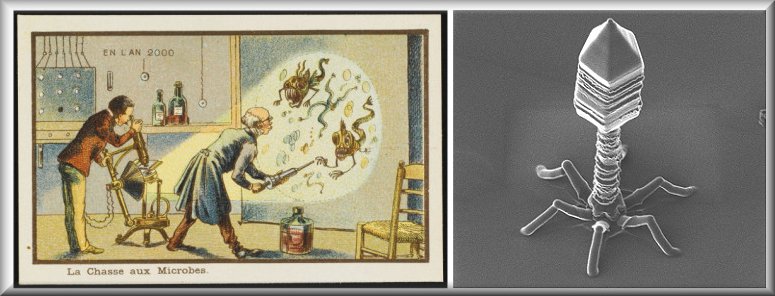
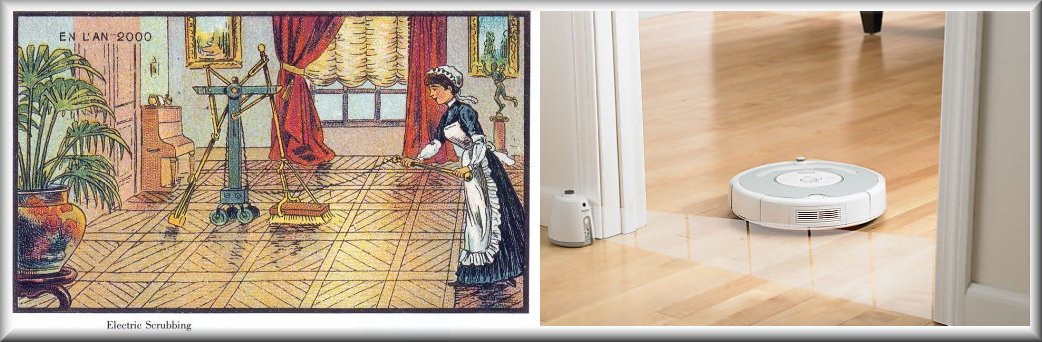
Ready-Cooked Meals will be Bought from establishments similar to our bakeries of today. They will purchase materials in tremendous wholesale quantities and sell the cooked foods at a price much lower than the cost of individual cooking. Food will be served hot or cold to private houses in pneumatic tubes or automobile wagons. The meal being over, the dishes used will be packed and returned to the cooking establishments where they will be washed. Such wholesale cookery will be done in electric laboratories rather than in kitchens. These laboratories will be equipped with electric stoves, and all sorts of electric devices, such as coffee-grinders, egg-beaters, stirrers, shakers, parers, meat-choppers, meat-saws, potato-mashers, lemon-squeezers, dish-washers, dish-dryers and the like. All such utensils will be washed in chemicals fatal to disease microbes. Having one’s own cook and purchasing one’s own food will be an extravagance.
The concept of city-wide delivery of goods was popularized by Edward Bellamy’s 1888 book, Looking Backward. It’s a lovely concept, but seems grossly impractical, although some “visionaries” still dream of similar schemes:
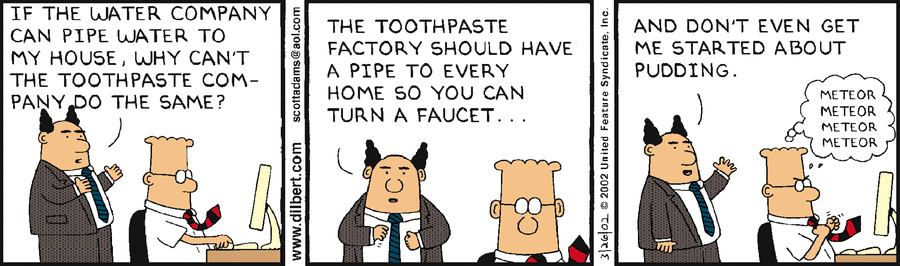
No Foods will be Exposed. Storekeepers who expose food to air breathed out by patrons or to the atmosphere of the busy streets will be arrested with those who sell stale or adulterated produce. Liquid-air refrigerators will keep great quantities of food fresh for long intervals.
It’s rare that Google comes up empty. When living in Austria in the 70’s, I often heard passing references to a Tomatenschutzvorschrift (tomato protection law) which would punish consumers for manhandling produce. Not a whisper on the intertubez about any such thing – maybe I dreamed it up.
Coal will Not be Used for Heating or Cooking. It will be scarce, but not entirely exhausted. The earth’s hard coal will last until the year 2050 or 2100; its soft-coal mines until 2200 or 2300. Meanwhile both kinds of coal will have become more and more expensive. Man will have found electricity manufactured by waterpower to be much cheaper. Every river or creek with any suitable fall will be equipped with water-motors, turning dynamos, making electricity. Along the seacoast will be numerous reservoirs continually filled by waves and tides washing in. Out of these the water will be constantly falling over revolving wheels. All of our restless waters, fresh and salt, will thus be harnessed to do the work which Niagara is doing today: making electricity for heat, light and fuel.
Current estimates show that coal reserves will last until 2142. Watkins was predicting massive use of tidal and other hydroelectric power, which – sadly – along with other alternative energy sources, is not as widespread as it should be.

Support Alternative Energy
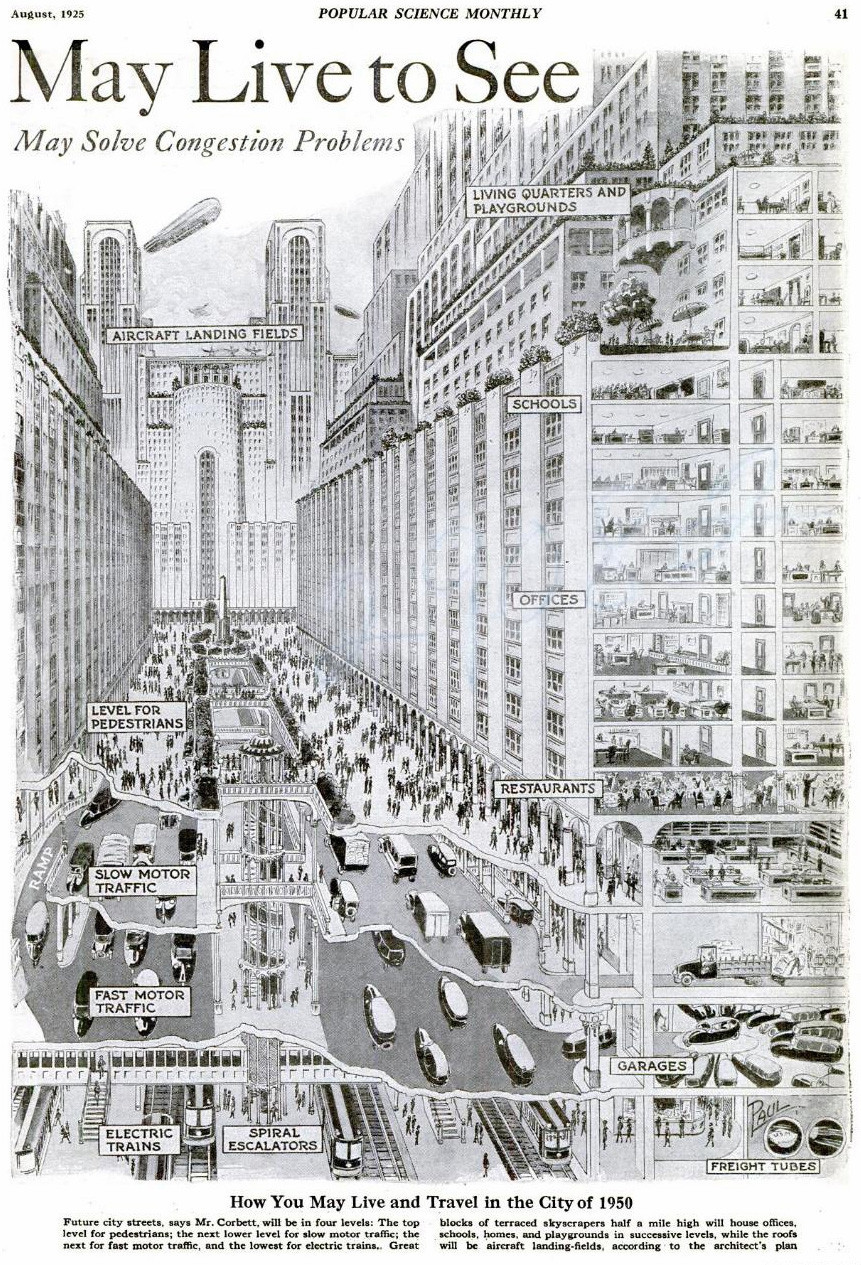
There Will Be No Street Cars in Our Large Cities. All hurry traffic will be below or high above ground when brought within city limits. In most cities it will be confined to broad subways or tunnels, well lighted and well ventilated, or to high trestles with “moving-sidewalk” stairways leading to the top. These underground or overhead streets will teem with capacious automobile passenger coaches and freight with cushioned wheels. Subways or trestles will be reserved for express trains. Cities, therefore, will be free from all noises.
Some cities have turned their cores into pedestrian-only zones, which is a great idea. We need more of this.
Photographs will be Telegraphed from any distance. If there be a battle in China a hundred years hence snapshots of its most striking events will be published in the newspapers an hour later. Even to-day photographs are being telegraphed over short distances. Photographs will reproduce all of Nature’s colors.
That’s the internet and digital photography. Spot-on.
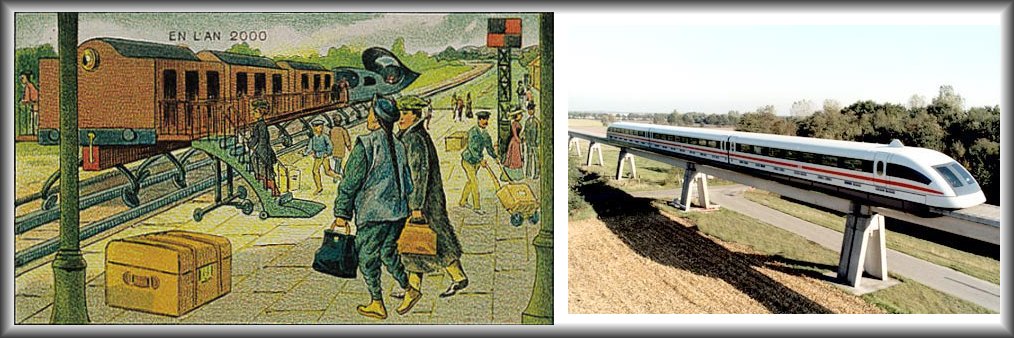
Trains One Hundred and Fifty Miles and Hour. Trains will run two miles a minute, normally; express trains one hundred and fifty miles an hour. To go from New York to San Francisco will take a day and a night by fast express. There will be cigar-shaped electric locomotives hauling long trains of cars. Cars will, like houses, be artificially cooled. Along the railroads there will be no smoke, no cinders, because coal will neither be carried nor burned. There will be no stops for water. Passengers will travel through hot or dusty country regions with windows down.
In 1900 there were 132 Class I railroads – today, only seven. Our rail system was the envy of the world, although the comfort often left something to be desired. Jenkin Lloyd Jones wrote, “Life is like an old-time rail journey — delays, sidetracks, smoke, dust, cinders, and jolts, interspersed only occasionally by beautiful vistas and thrilling bursts of speed. The trick is to thank the Lord for letting you have the ride.” Worldwide, progress is being made on high-speed rail, but the USA is woefully behind the curve. As of 2012 the maximum commercial speed was about 300 km/h (185 mph) for the majority of installed systems (China, Germany, Italy, Japan, South Korea, Taiwan, UK), 310 km/h (195 mph) in Spain and 320 km/h (200 mph) in France. The Shanghai Maglev Train reaches 431 km/h (268 mph). Experimentation on high-speed trains, conventional and maglev, continues; the world speed record is currently 361 mph, held by Japan.
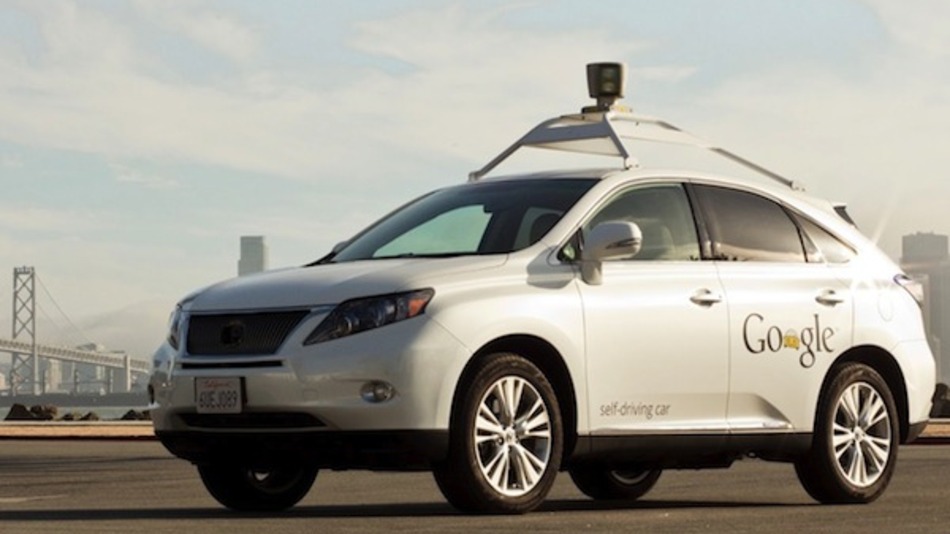
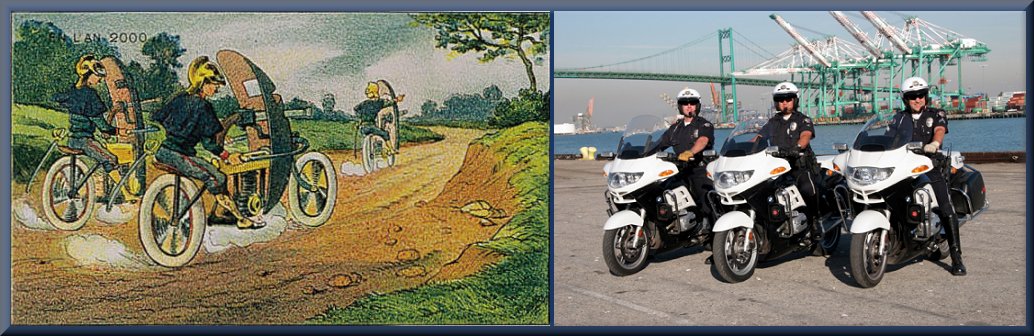
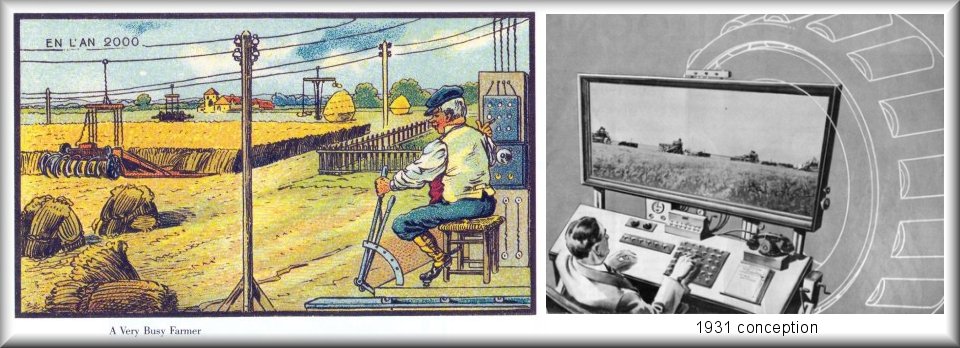
Automobiles will be Cheaper than Horses are today. Farmers will own automobile hay-wagons, automobile truck-wagons, plows, harrows and hay-rakes. A one-pound motor in one of these vehicles will do the work of a pair of horses or more. Children will ride in automobile sleighs in winter. Automobiles will have been substituted for every horse vehicle now known. There will be, as already exist today, automobile hearses, automobile police patrols, automobile ambulances, automobile street sweepers. The horse in harness will be as scarce, if, indeed, not even scarcer, then as the yoked ox is today.
Proliferation: ✓
Price: ✘
Everybody will Walk Ten Miles: Gymnastics will begin in the nursery, where toys and games will be designed to strengthen the muscles. Exercise will be compulsory in the schools. Every school, college and community will have a complete gymnasium. All cities will have public gymnasiums. A man or woman unable to walk ten miles at a stretch will be regarded as a weakling.
Currently, 33% of Americans are considered obese, and 65% are overweight. Countless dollars are wasted on weight loss programs, schemes, nostrums, and scams; every new year, people sign up for gym memberships that they never use (and Gold’s Gym still sucks.) We’re not doing very well in this department.
To England in Two Days. Fast electric ships, crossing the ocean at more than a mile a minute, will go from New York to Liverpool in two days. The bodies of these ships will be built above the waves. They will be supported upon runners, somewhat like those of the sleigh. These runners will be very buoyant. Upon their under sides will be apertures expelling jets of air. In this way a film of air will be kept between them and the water’s surface. This film, together with the small surface of the runners, will reduce friction against the waves to the smallest possible degree. Propellers turned by electricity will screw themselves through both the water beneath and the air above. Ships with cabins artificially cooled will be entirely fireproof. In storm they will dive below the water and there await fair weather.
Two days, no – currently between six and 10. But the comfort, if you can afford it, is opulent.
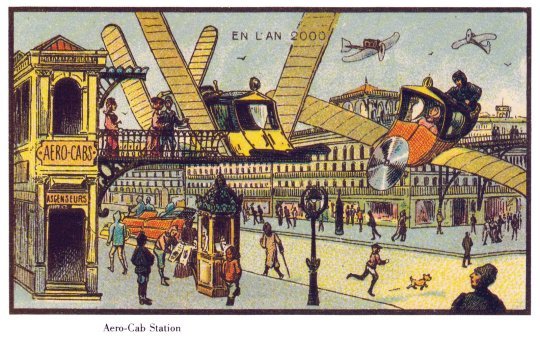
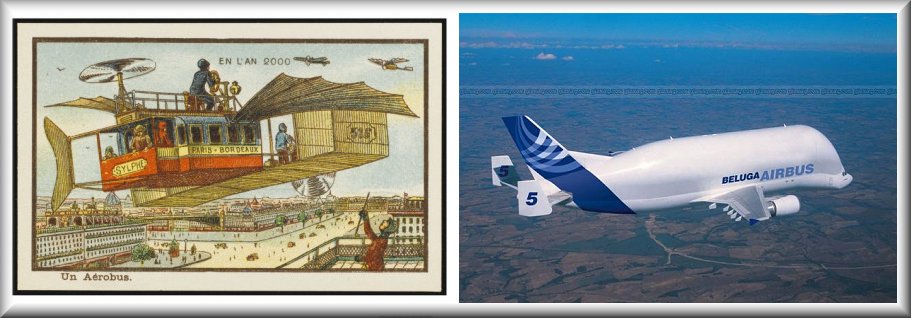
There will be air-ships, but they will not successfully compete with surface cars and water vessels for passenger or freight traffic. They will be maintained as deadly war-vessels by all military nations. Some will transport men and goods. Others will be used by scientists making observations at great heights above the earth.
Missed this one. Unlike ocean travel, airlines are ubiquitous and – unless you can afford first class travel – a pain in the back, neck, ass, and everywhere else.
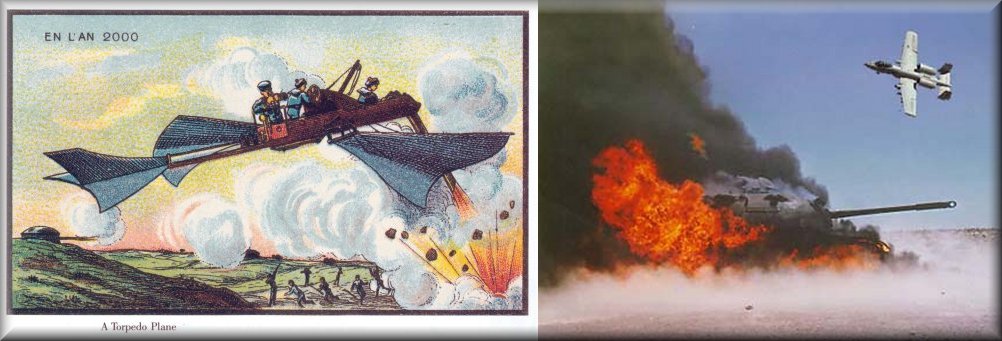
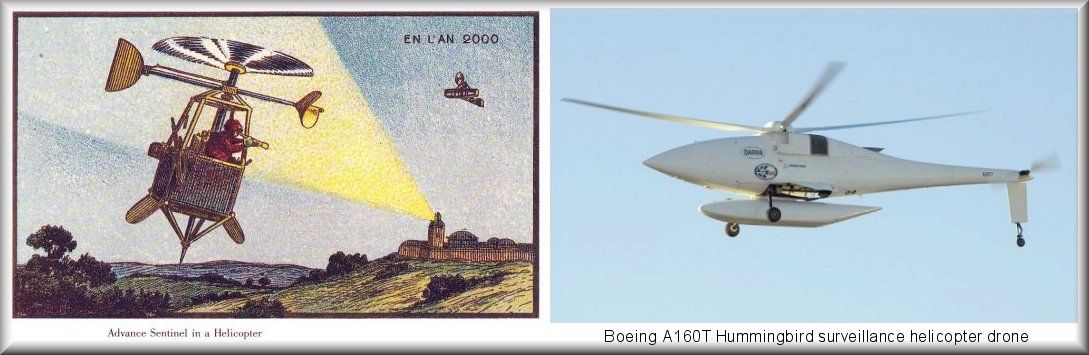
Aerial War-Ships and Forts on Wheels. Giant guns will shoot twenty-five miles or more, and will hurl anywhere within such a radius shells exploding and destroying whole cities. Such guns will be armed by aid of compasses when used on land or sea, and telescopes when directed from great heights. Fleets of air-ships, hiding themselves with dense, smoky mists, thrown off by themselves as they move, will float over cities, fortifications, camps or fleets. They will surprise foes below by hurling upon them deadly thunderbolts. These aerial war-ships will necessitate bomb-proof forts, protected by great steel plates over their tops as well as at their sides. Huge forts on wheels will dash across open spaces at the speed of express trains of to-day. They will make what are now known as cavalry charges. Great automobile plows will dig deep entrenchments as fast as soldiers can occupy them. Rifles will use silent cartridges. Submarine boats submerged for days will be capable of wiping a whole navy off the face of the deep. Balloons and flying machines will carry telescopes of one-hundred-mile vision with camera attachments, photographing an enemy within that radius. These photographs as distinct and large as if taken from across the street, will be lowered to the commanding officer in charge of troops below.
The science of war continues to advance apace, while many American high-school graduates can barely spell their names. What’s wrong with that picture?
There will be no Wild Animals except in menageries. Rats and mice will have been exterminated. The horse will have become practically extinct. A few of high breed will be kept by the rich for racing, hunting and exercise. The automobile will have driven out the horse. Cattle and sheep will have no horns. They will be unable to run faster than the fattened hog of today. A century ago the wild hog could outrun a horse. Food animals will be bred to expend practically all of their life energy in producing meat, milk, wool and other by-products. Horns, bones, muscles and lungs will have been neglected.
In the rat race, the rats are winning.
Man will See Around the World. Persons and things of all kinds will be brought within focus of cameras connected electrically with screens at opposite ends of circuits, thousands of miles at a span. American audiences in their theatres will view upon huge curtains before them the coronations of kings in Europe or the progress of battles in the Orient. The instrument bringing these distant scenes to the very doors of people will be connected with a giant telephone apparatus transmitting each incidental sound in its appropriate place. Thus the guns of a distant battle will be heard to boom when seen to blaze, and thus the lips of a remote actor or singer will be heard to utter words or music when seen to move.
Great prediction: Television and the internet fulfill this one admirably.
Telephones Around the World. Wireless telephone and telegraph circuits will span the world. A husband in the middle of the Atlantic will be able to converse with his wife sitting in her boudoir in Chicago. We will be able to telephone to China quite as readily as we now talk from New York to Brooklyn. By an automatic signal they will connect with any circuit in their locality without the intervention of a “hello girl”.
“Hello girls,” (operators) are largely extinct today. Cell communications are ubiquitous, even in third-world countries.
Grand Opera will be Telephoned to private homes, and will sound as harmonious as though enjoyed from a theatre box. Automatic instruments reproducing original airs exactly will bring the best music to the families of the untalented. Great musicians gathered in one enclosure in New York will, by manipulating electric keys, produce at the same time music from instruments arranged in theatres or halls in San Francisco or New Orleans, for instance. Thus will great bands and orchestras give long-distance concerts. In great cities there will be public opera-houses whose singers and musicians are paid from funds endowed by philanthropists and by the government. The piano will be capable of changing its tone from cheerful to sad. Many devises will add to the emotional effect of music.
Again, live television broadcasts, along with YouTube, verify this prediction. As for music, Moog and Kurzweil, along with many others, have radically changed the landscape of music production.
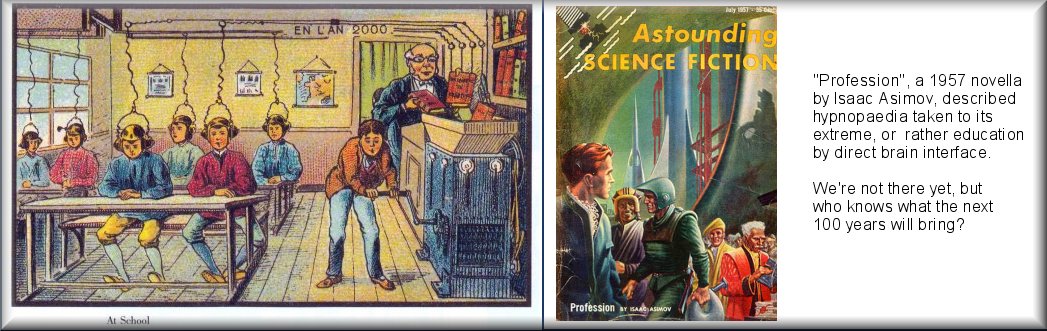
How Children will be Taught. A university education will be free to every man and woman. Several great national universities will have been established. Children will study a simple English grammar adapted to simplified English, and not copied after the Latin. Time will be saved by grouping like studies. Poor students will be given free board, free clothing and free books if ambitious and actually unable to meet their school and college expenses. Medical inspectors regularly visiting the public schools will furnish poor children free eyeglasses, free dentistry and free medical attention of every kind. The very poor will, when necessary, get free rides to and from school and free lunches between sessions. In vacation time poor children will be taken on trips to various parts of the world. Etiquette and housekeeping will be important studies in the public schools.
Except for the simplified English, I could get behind this dream. Unfortunately, we still spend more money on senseless wars than on education and social improvement.
Store Purchases by Tube. Pneumatic tubes, instead of store wagons, will deliver packages and bundles. These tubes will collect, deliver and transport mail over certain distances, perhaps for hundreds of miles. They will at first connect with the private houses of the wealthy; then with all homes. Great business establishments will extend them to stations, similar to our branch post-offices of today, whence fast automobile vehicles will distribute purchases from house to house.
See above, under “Ready Cooked Meals.”
Vegetables Grown by Electricity. Winter will be turned into summer and night into day by the farmer. In cold weather he will place heat-conducting electric wires under the soil of his garden and thus warm his growing plants. He will also grow large gardens under glass. At night his vegetables will be bathed in powerful electric light, serving, like sunlight, to hasten their growth. Electric currents applied to the soil will make valuable plants grow larger and faster, and will kill troublesome weeds. Rays of colored light will hasten the growth of many plants. Electricity applied to garden seeds will make them sprout and develop unusually early.
This item, and the one below, are tantalizing. Hydroponic farms exist, and worldwide transport brings foods long distances, but we’re not quite as utopian as Watkins dreamed of yet.
Oranges will grow in Philadelphia. Fast-flying refrigerators on land and sea will bring delicious fruits from the tropics and southern temperate zone within a few days. The farmers of South America, South Africa, Australia and the South Sea Islands, whose seasons are directly opposite to ours, will thus supply us in winter with fresh summer foods, which cannot be grown here. Scientist will have discovered how to raise here many fruits now confined to much hotter or colder climates. Delicious oranges will be grown in the suburbs of Philadelphia. Cantaloupes and other summer fruits will be of such a hardy nature that they can be stored through the winter as potatoes are now.
Strawberries as Large as Apples will be eaten by our great-great-grandchildren for their Christmas dinners a hundred years hence. Raspberries and blackberries will be as large. One will suffice for the fruit course of each person. Strawberries and cranberries will be grown upon tall bushes. Cranberries, gooseberries and currants will be as large as oranges. One cantaloupe will supply an entire family. Melons, cherries, grapes, plums, apples, pears, peaches and all berries will be seedless. Figs will be cultivated over the entire United States.
These two items (above and below) evoke the GMO debate. It’s by no means as clear-cut as the polarized supporters and opponents would have you believe.
Peas as Large as Beets. Peas and beans will be as large as beets are to-day. Sugar cane will produce twice as much sugar as the sugar beet now does. Cane will once more be the chief source of our sugar supply. The milkweed will have been developed into a rubber plant. Cheap native rubber will be harvested by machinery all over this country. Plants will be made proof against disease microbes just as readily as man is to-day against smallpox. The soil will be kept enriched by plants which take their nutrition from the air and give fertility to the earth.
Most sugar in the US does indeed come from cane. For some interesting history, read about the U and I Sugar Company. As a Utah native, I remember both purchasing beet sugar and the massive welfare projects involving sugar beet farming.
Black, Blue and Green Roses. Roses will be as large as cabbage heads. Violets will grow to the size of orchids. A pansy will be as large in diameter as a sunflower. A century ago the pansy measured but half an inch across its face. There will be black, blue and green roses. It will be possible to grow any flower in any color and to transfer the perfume of a scented flower to another which is odorless. Then may the pansy be given the perfume of the violet.
Lovely idea, but the black rose is still a fantasy.
Few Drugs will be Swallowed or taken into the stomach unless needed for the direct treatment of that organ itself. Drugs needed by the lungs, for instance, will be applied directly to those organs through the skin and flesh. They will be carried with the electric current applied without pain to the outside skin of the body. Microscopes will lay bare the vital organs, through the living flesh, of men and animals. The living body will to all medical purposes be transparent. Not only will it be possible for a physician to actually see a living, throbbing heart inside the chest, but he will be able to magnify and photograph any part of it. This work will be done with rays of invisible light.
Accurate predictions here – while the Star Trek drug injector is not quite there yet, what we have done with human body scanning is nothing short of miraculous.
The Old Wolf has spoken.












 Playing in the World Game