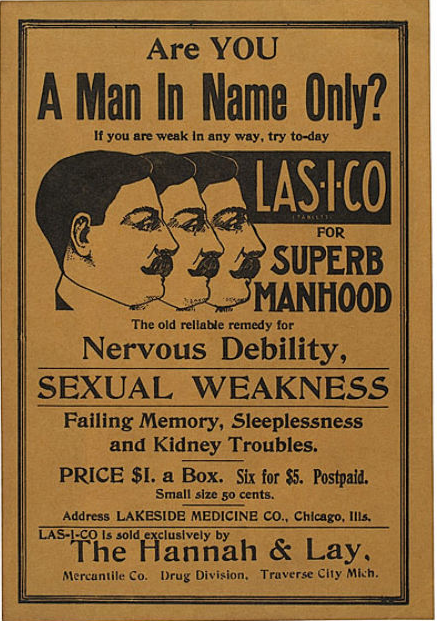
Yesterday it was snake oil and LAS-I-CO tablets; today it’s the açaí berry and raspberry weight loss drops. Do yourselves a favor and stick to tested remedies. I don’t care if they are pharmaceutical or alternative… do some research and make sure you’re not taking some worthless camel ejecta just because a friend or a neighbor or Dr. Oz says it’s effective.
What if you were given that choice? For real. … What if a well-informed, trusted authority figure said you had to make difficult and enduring changes in the way you think and act? If you didn’t, your time would end soon — a lot sooner than it had to. Could you change when change really mattered? When it mattered most?
Yes, you say?
Try again.
Yes?
You’re probably deluding yourself.
You wouldn’t change.
Don’t believe it? You want odds? Here are the odds, the scientifically studied odds: nine to one. That’s nine to one against you. How do you like those odds?
Dr. Edward Miller, the dean of the medical school and CEO of the hospital at Johns Hopkins University… turned the discussion to patients whose heart disease is so severe that they undergo bypass surgery, a traumatic and expensive procedure that can cost more than $100,000 if complications arise. About 600,000 people have bypasses every year in the United States, and 1.3 million heart patients have angioplasties — all at a total cost of around $30 billion. The procedures temporarily relieve chest pains but rarely prevent heart attacks or prolong lives. Around half of the time, the bypass grafts clog up in a few years; the angioplasties, in a few months. The causes of this so-called restenosis are complex. It’s sometimes a reaction to the trauma of the surgery itself. But many patients could avoid the return of pain and the need to repeat the surgery — not to mention arrest the course of their disease before it kills them — by switching to healthier lifestyles. Yet very few do. “If you look at people after coronary-artery bypass grafting two years later, 90% of them have not changed their lifestyle,” Miller said. “And that’s been studied over and over and over again. And so we’re missing some link in there. Even though they know they have a very bad disease and they know they should change their lifestyle, for whatever reason, they can’t.”
———-
While the article above is slanted at corporate leadership and mentions a particular diet plan that was more successful than others, the reason people don’t change is that the benefits of not changing outweigh the prices they are paying.
Every moment is a choice, and every choice has prices and benefits.
I’m currently about 30 pounds above my ideal weight, and that’s because I’m firmly committed to being 30 pounds above my ideal weight. There’s no other reason, no excuse, no story. It’s what I’m choosing.
I’ve released that excess weight twice in my life, and believe you me, it felt awesome. But while I’m committed to getting back to a healthy lifestyle, I may also be committed to staying safe and comfortable, because that protects me from the fear of failure – and the fear of success. Life gets in the way, and it’s oh, so easy to revert to old habits and patterns that serve as protective barriers against the slings and arrows of outrageous fortune.
My body is telling me it’s really time for a change, and I’m feeling like the price I’m paying is higher than I’m comfortable with. Today the scale reads 187. My intention is to get back to 165, which means I’ll have 3 new suits and a whole closet full of pants I can fit into again.
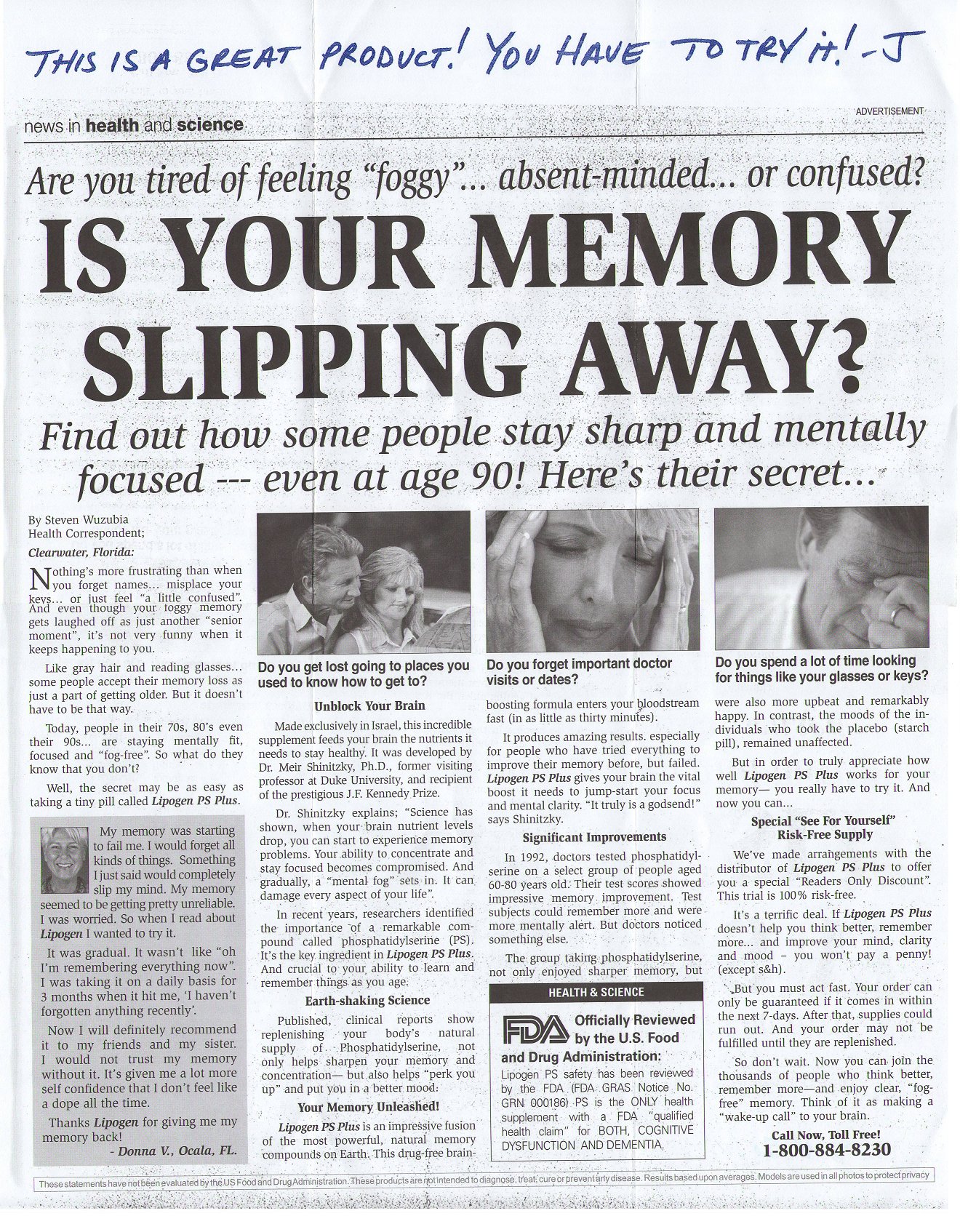
I still get mail addressed to my mother on occasion; she left this world last year at the age of 94. But she was getting ads like this regularly for about 15 years before she finally caught the bus, and as time went on (before we took over her financial affairs) she ordered lots of products, either on her own or at the insistence of skilled but sleazy telephone salesmen. As a result, she ended up on every sucker list out there.
If you have older loved ones, please make sure they throw solicitations like this into the trash, even if they come from places as respectable as the Mayo Clinic – they’re not above drumming up business in the elder sector, and there are thousands of others who are looking for a chance to separate mentally-diminished but resource-wealthy seniors from their incomes, savings, and pensions.
The letter above is pure crap. The company makes a glaring mention of the FDA and implies that said agency has endorsed their product. This is a load of hqiz: the actual FDA letter is here, and if you read it you’ll see that the agency is clearly saying that evidence for effectiveness of phosphatidylserene as a memory-enhancer is feeble at best, although the product is Generally Recognized as Safe (GRAS) based on the information provided to the FDA by the company involved, with the additional disclaimer that the FDA has not done its own research. They went on to say, “FDA continues to believe that the science provides very limited and preliminary evidence sufficient for qualified health claims about phosphatidylserine and reduced risk of these conditions.FDA continues to believe that the science provides very limited and preliminary evidence sufficient for qualified health claims about phosphatidylserine and reduced risk of these conditions“.
Now don’t get me wrong; I’m a long-time proponent of optimal nutrition and there is a lot of science out there about vitamins, minerals, antioxidants, and other co-factors that do benefit health. What I object to is outlandish claims and weasel words from companies looking to make a quick buck from the unsuspecting and uneducated, and there are far too many of those out there.
If you’re looking for things to help your loved ones, be sure to do your due diligence. Research as much as you can on the product involved, and make sure you’re not buying smoke and mirrors, which is what 90% of the stuff being marketed out there really is.
I previously posted about the worthless and deceptive nutritional products hyped to the elderly (and anyone who will cheerfully send in their money); today comes an article announcing
Inspector general: Some supplements for weight loss, immune system make illegal health claims.
Well, .
The article goes on to say that “20 percent of the 127 weight loss and immune-boosting supplements investigators purchased online and in retail stores across the country carried labels that made illegal claims to cure or treat disease.” The DHHS concern is not only with the deceptive marketing, but also that people taking supplements and other natural remedies to treat diseases instead of seeking medical assistance.
Personally, I think the 20 percent figure is a gross underestimate, based on everything I’ve seen in the industry, which remains largely unregulated.
Now getting into a discussion of this nature raises the question: Is the DHHS in the pockets of the pharmaceutical industry and the insurance companies, both of which have a vested interest in keeping people sick? Today’s answers are, “I don’t know,” and “It’s not that simple.” Let me state that I’m pretty convinced that Big Pharma is more interested in making money than in getting people well – otherwise they’d be driving themselves out of the market, which makes good moral sense but poor business sense, and in today’s world money always trumps morals. That said, there are countless drugs which people use on a daily basis which keep them healthy and hearty – if I cut my finger, you’d better believe that I’m going to wash it well with soap and water, and apply Neosporin™ or something like to ward off infection; I suffer from a mild form of Menière’s disease which causes violent vertigo (fortunately for me, only rarely) and if it weren’t for Meclizine™ I might spend a week with my head in the crapper. Not all drugs are bad – but the industry is motivated by the wrong reasons, and one of the greatest mistakes our government ever made was allowing pharmaceutical companies to advertise.
Homeopathy
Then there’s the “natural remedy” market. Let’s take homeopathy as the teacher in the moment. I personally put no stock in what from a scientific viewpoint seems like total mumbo-jumbo [1], but it’s multi-billion dollar mumbo-jumbo, and that kind of money will bring all sorts of gnurrs out of the voodvork. [2] Then there’s the fact that many people whom I love and respect do put stock in it, and claim to have experienced benefits from the use of homeopathic remedies, as well as herbs, oils, alternative health treatment, and so much more.
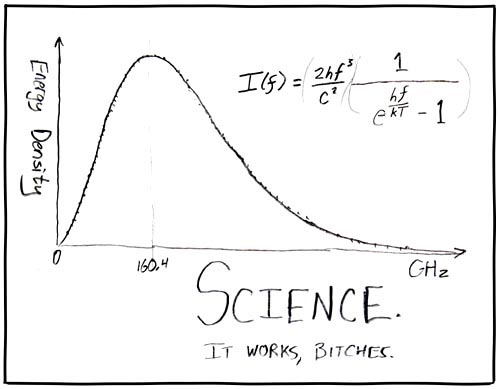
Science is both blessed and burdened by its reliance on empirical evidence. That means in the long run, if the evidence supports a theory, science is required to change its point of view no matter how vehemently one’s gut opposes the discovery. If, continuing in the same vein, a sufficient body of gold-standard trials (randomized, double-blind, placebo-based, with a statistically significant sample) were to show that homeopathic remedies were actually beneficial, the textbooks would have to be rewritten. Thus far that hasn’t happened, and in my book it’s not likely – but one thing I will never do is shut the door on possibility. I’m always open to surprises.
Focusing on prevention
Where I do put stock is in what science has said about degenerative diseases. In the 19th and early 20th centuries, infectious diseases such as diphtheria, pneumonia, tuberculosis, cholera, and influenza were the largest killers of populations. Modern vaccines, antibiotics and anti-virals have drastically reduced the toll; today, we see a different enemy – people by the millions are dying from diabetes, strokes, cardiovascular diseasese, cancer, respiratory diseases, and a host of other degenerative disorders.
The standard unit of nutritional need, the RDA (recommended daily allowance) was developed during World War II by the U.S. National Academy of Sciences to investigate issues of nutrition that might “affect national defense”. In short, these amounts were established as the minimum requirements needed to prevent deficiency diseases such as rickets and scurvy, among others. Even today, RDI (recommended daily intake) and DV (Daily Value) of vitamins, minerals and co-factors are far below what modern science has determined are required for maximum health. Most vitamins supplements on the market today will do just what they were designed to do during WWII – keep you from getting deficiency diseases – but they won’t provide the optimal nutrition the body needs to fight off the ravages of oxidative stress.
In 2002, the Journal of the AMA stated that “most people do not consume an optimal amount of all vitamins by diet alone. Pending strong evidence of effectiveness from randomized trials, it appears prudent for all adults to take vitamin supplements.” [3] Both before and since that time, thousands and thousands of randomized clinical trials have shown that free radical damage (or oxidative stress) is the cause of the vast majority of degenerative diseases, and that providing the body’s cells with the defenses needed can drastically reduce the incidence of these maladies, cutting off the need for curative drugs and treatments at the source.
Conclusion
It should be said in passing that despite all we can do, sometimes people just get sick; like they say in the Japanese massage parlor, “shiatsu happens;” but it’s up to each person who is concerned about their health to do their research and find the solution that works best for them. There are a handful of companies out there who produce nutritional supplements that will give your body the nutrition it needs (combined with and on the foundation of a healthy diet and exercise, of course) to fight off degenerative diseases and maximize your odds for a long and healthy life, and none of them are found on supermarket shelves. Find one of them that works for you and treat yourself well; your body will thank you for it.
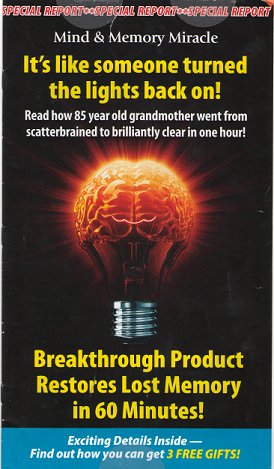
Even though Mother slipped quietly into the Great Beyond last year at the respected age of 94, she still gets mail from all sorts of places – 99% of them wanting her money. Yesterday our mailbox was graced with a 32-page full color glossy brochure (even had circles and arrows) from an outfit named Biowell, guaranteeing her a restored memory and the mind of a 20-year-old if only she would buy a 6-month supply of MentaFit Ultra at the special price of $269.95.
Now, don’t get me wrong. I happen to believe that nutritional supplementation is an essential part of good health, especially given the Standard American Diet (aptly abbreviated SAD) which is chock full of high-glycemic carbohydrates, fats, and very little actual nutrition which our cells are screaming for.
Unfortunately, the largely unregulated supplement industry is a hotbed of fraud, waste, and abuse, and there are precious few reputable companies out there.
MentaFit Ultra is a good example of the worst kind of nonsense. Let’s look at some of the claims found in this brochure:
A study showed that the product restored 70% of memory lost over 5 decades of aging
Losing your memory, forgetting things and disorientation are NOT normal, but the signs of an aging mind. The only way to get off this slippery slope is with MentaFit Ultra… the ONLY way to not be jeopardized by your fading mind any longer. However, if you choose to do nothing, you will likely suffer from a poor memory, poor recall, and poor mental energy in ever-increasing amounts as the problem gets worse. (Scare tactics)
The product was designed specifically to correct mental decline and is the ONLY treatment to help rejuvenate your mind, so you stay mentally healthy into your 80’s, 90’s, and even longer!
Biowell’s B Vitamin Complex (free with the maximum order) will help REVERSE BRAIN SHRINKAGE!
Just one single ingredient is so powerful it even helps exhausted ER doctors stay alert all night long!
A steel-trap memory can be yours… Call now and let it go to work in your brain, clearing out the rust, restoring sharpness, clarity, order and youthful vitality better than any other formula!
Will help you return your mental state back to your 20’s in only ONE HOUR!
You can restore up to 70% of your memory loss due to aging!
And on and on. Pages and pages of references to obscure and misinterpreted studies, pictures of doctors, hyped up claims about the individual ingredients (sage, rhodolia rosea, vinpocetine and Vitamin D3), and hype worthy of a used-car salesman. And a bottle of this relatively worthless stuff sells for $49.95, where it probably cost $3.95 to manufacture, all without any guarantee whatsoever of quality. Face it – if things like this worked even a fraction as well as they claimed, every doctor in the world would be prescribing it, and Alzheimer’s disease and dementia would be a thing of the past.
There’s a huge irony in targeting advertising materials like this at the elderly. They are losing mental acuity as the result of natural aging processes, and hence are more susceptible to slick advertising campaigns which promise outlandish results and offer false hopes, for the low low price of whatever. And Biowell is only one of hundreds of outfits out there who are dedicated to only one proposition: extracting money from unwary and vulnerable consumers. In the last 10 years of my mother’s life, I had to deal with dozens of companies who sold her things she didn’t want, didn’t need, couldn’t use, and didn’t understand – and most of it was (to be charitable) camel ejecta.
“Do not resent growing old, it is a privilege denied to many,” said someone wise. Aging is a normal part of life; every time our cells divide, our telomeres get a bit shorter, and thus far science has not found a way to reverse the process. All physical degeneration can be slowed, however, by making sure the body has ample supplies of the elements needed to keep our cells functioning at the top of their game – vitamins, minerals, co-factors and antioxidants – and sadly we don’t get everything we need from our daily diets. Supplementation is a must for optimal health, but there are only a handful of companies out there that manufacture effective products. If you take things like One-A-Day or Centrum, you might as well be swallowing rocks for all the good you’re doing yourself; do your research – look for companies that follow pharmaceutical good manufacturing processes, and whose products are submitted to independent laboratories like NSF, and which exceed industry standards for completeness, bioavailablilty, purity, potency, and safety.
You may be wondering why I haven’t recommended any of these companies by name. It’s simple – I distribute for one of them, and this post is not designed as a guerrilla marketing pitch. But the takeaways here are two:
Protect your elderly loved ones from worthless products and questionable marketing campaigns. Be involved in their lives, and make sure that you are aware what they are spending their hard-earned money on. Telemarketers are ruthless, and mail solicitations are deceptive and misleading – most supplements offered through the mail are worth less than the powder to blow them to Hell with.
Get on some high-quality supplements. What you need won’t be found at your grocery or discount store – do your homework and get informed. Your body will thank you for it.
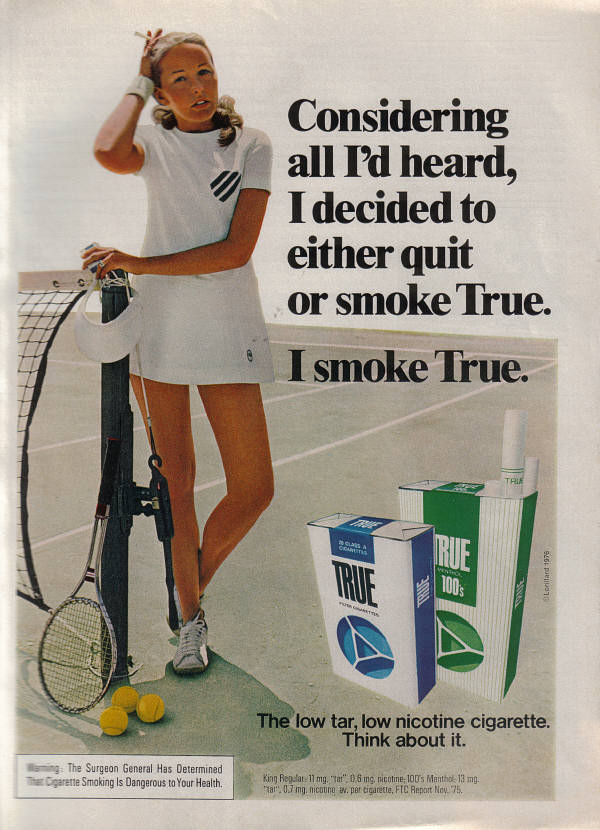
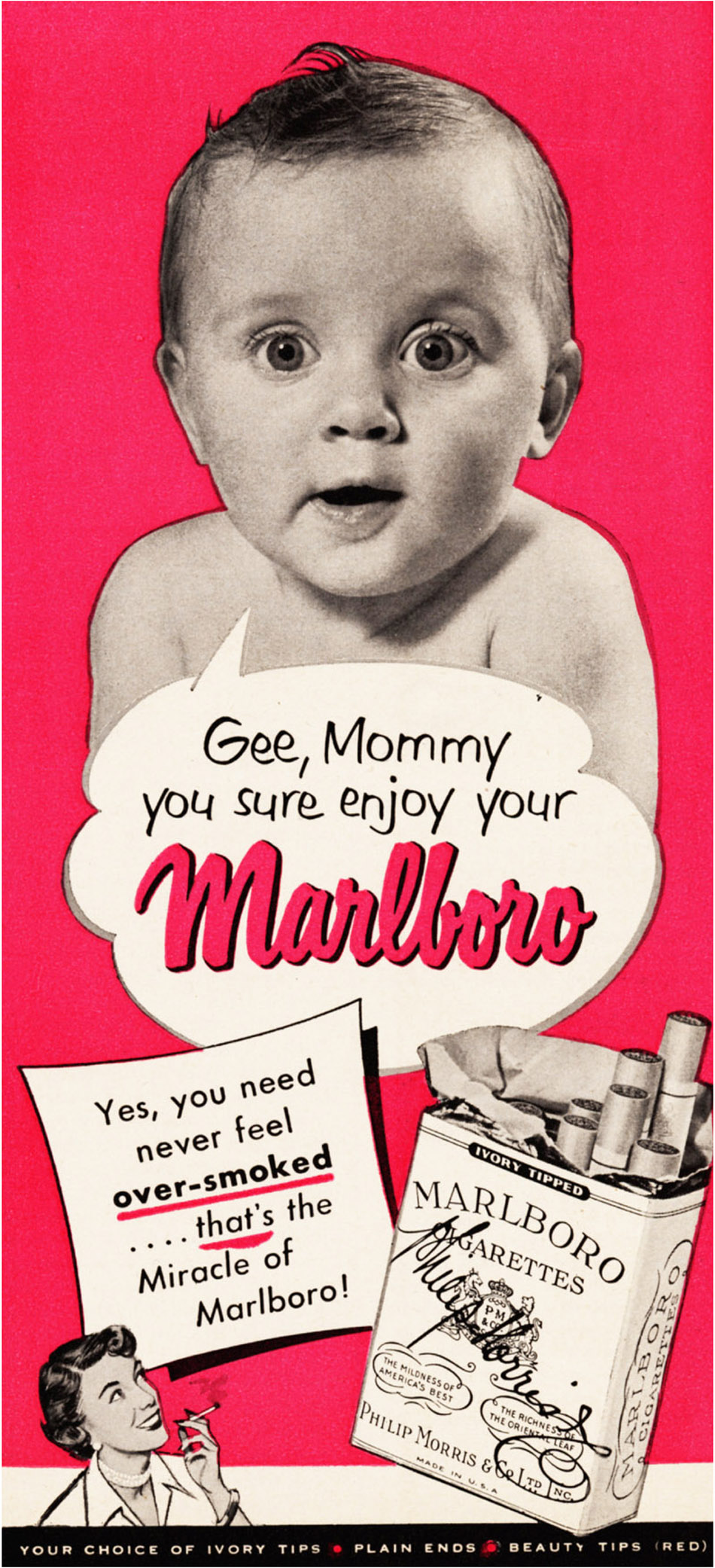
Back in the day, tobacco companies could advertise, and advertise they did. Everywhere. Subways, buses, magazines, radio, television, courtesy packs on airplanes, you name it. The more powerful ads drove the more powerful brands. The Marlboro man was everywhere:
Rugged, strong, and healthy – notice the absence of the Surgeon General’s warning on this example from the 60’s.
But in those days, tobacco execs would go on national television and swear that tobacco wasn’t harmful, even to pregnant women (many of whom actually preferred smaller babies)…
… which babies were also used to hawk tobacco products.
Of course, now we know more than we did then:
But this is now, and that was then.
Two of the more popular cigarette campaigns actually capitalized on bad grammar:
This slogan was routinely held up by prescriptive grammarians as an example of abominable usage: “like,” they said, is a preposition governing nouns and noun phrases, and should never be used as a conjunction introducing an adverbial clause. “Winston tastes good as a cigarette should,” intoned the English teachers, was the only acceptable form. Naturally, the ad execs picked up on the furor and capitalized on it:
Not to be left out of the action, MAD magazine put this on the back of their January 1971 issue, which shows that many folks were quite aware of the dangers of smoking, thank you, even while the Tobacco execs were perjuring themselves on the national scene.
In fact, “In December 1952 [Reader’s Digest] published “Cancer by the Carton“, a series of articles that linked smoking with lung cancer. This first brought the dangers of smoking to public attention which, up to then, had ignored the health threats.” (Wikipedia) An interesting article summarizing the history of tobacco and health concerns can be found at CNN Interactive.
Popular stars shilled for tobacco on a regular basis – it seems so bizarre to watch Granny Clampett and Jane Hathaway discussing the merits of Winston, but it’s amusing to see how they worked the grammar issue in at the end in a Madison Avenue “double whammy”.
The Flintstones got into the act as well:
I confess with some shame that tobacco contributed to putting bread in my mouth for some time; mother functioned as a spokeswoman for Camel cigarettes for a year.
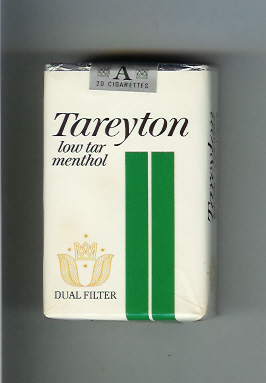
But when it came to using bad grammar, Winston was hardly the only offender – Tareyton’s campaign confused nominative and oblique to good effect in their highly successful slogan, “Us Tareyton smokers would rather fight than switch.”[1]
Despite the peccadillo – it seems that cigarette ads thrived on controversy – this particular advertising campaign was wildly successful in the 60’s, and pushed Tareyton’s popularity close to the top of the charts.
But not all products, even those from the makers of successful brands, were an instant hit.
Back in 1966, when I was 15, I was on one of my semi-regular visits to my mom’s brother in Salt Lake. We took a trip up to Idaho to see some additional relatives, and I remember spending some time in a tobacco warehouse, helping to run cartons of cigarettes through the tax-stamp machine. (Had the government gotten wind of our little diversion, the owner could have been shut down, but oversight was lax and attorneys less numerous in those days.) While I was working there that day, I noticed something unusual – a carton of Tennyson cigarettes, which I had never before heard of.
Now, the more astute among my readers will be asking themselves, “What does a 15-year-old know from tobacco?” As it happens, even at that tender age I was somewhat of a tobacco connoisseur. I had started smoking in high school, finding that it was a gateway to a certain level of acceptance, for as little as that was worth. And I parlayed my small bit of social coin into a minor fortune by becoming a user of odd and revolting brands.2 (In Connecticut, the legal age for tobacco was 16, but even before that I had no end of “friends” who would procure for me in exchange for a small consideration.)
Strong and with a different flavor than American standards.
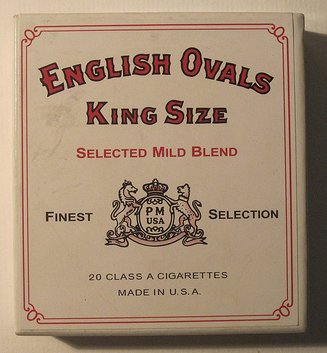
Oval cigarettes. Cute gimmick, but nothing special otherwise.
Absolutely foul. If I had these, I was guaranteed nobody would bum off me.
Tasted just about like smoking a cow pie. Or so I imagine.
Had kind of a fruity taste, unlike anything else I had ever smoked. Meh. However, Lark’s claim to fame was their commercial, the 1960’s version of Google Street View – the Lark truck would run around different places with a TV camera on the back, blaring the William Tell Overture, and asking people, “Show Us Your Lark Pack!” I saw this truck run down 1st Avenue in Manhattan one day; even if I had had a pack of Larks on me, I decided that discretion would have been the better part of fame, since I was still underage in New York.
[Edit: I had a copy of the commercial in question here, which I had posted at YouTube. Even though it was listed as public domain under a Creative Commons license, it appears that the brand is still owned by Trademarks LLC. The video was removed at YouTube, but for some odd reason still played here. In light of some communication with the above-mentioned company, I have removed the video. Unless it is taken down elsewhere, however, you can still see it here (3rd one on the list).
Now, since we’re on the subject of advertising in general as well, I nominate Salem cigarettes for the most insidious commercial ever devised. As a linguist who has studied close to 20 languages over the course of my life (although I don’t claim to speak them all), I can tell you that anything you produce will remain in your memory much longer than anything you hear. When learning a language, speaking is much more powerful than listening; they are different skills, yes, but the first cements things in your memory a lot longer than just hearing them, even multiple times. The following ad is much like getting up at 3:00 AM in the home of a musician, and playing only the first five notes of “Shave and a haircut” on the grand piano. It’s a guarantee that an irritated and foggy victim will stumble down the stairs to finish the “two bits” part before being able to go back to sleep.[3]
Unfortunately, despite these commercials being ancient, many of them have been taken down on copyright grounds. But go here and advance to 6:40, and you’ll get one of the ads that I’m referring to. Unless you are some kind of superhuman being, you will finish the line, and you will sing the brand name in your head. There is no escape.
There were others. I knew every brand on the market, and some that weren’t. I even rolled my own for a while, although not very skillfully, but when I couldn’t get these, I’d smoke anything I could get my hands on. My mother smoked Carltons (why bother, I wondered?) and when I’d cadge hers, I ripped the filter off; ultimately I settled on Luckies as my brand of choice. And of course, in the process, I became a 3-pack-a-day man by the time I was 18. The end of that story is that I quit, cold turkey, that year and never looked back – but my lungs paid a lifetime price.
So that brings us back to Tennyson, and by now I think you’ll understand why it caught my eye. A brand I didn’t know about? Intriguing! But in those days, there was no Internet, and such arcane knowledge was not to be found anywhere. Only later, thanks to the miracle of the Intertubez, was I able to dig up a bit of history, but even today what’s out there is pretty sparse.
In 1966, Tennyson launched a fairly comprehensive media blitz to publicize their new brand. I’m not sure why Tareyton simply didn’t choose to introduce a menthol version of their already-famous brand.[4]
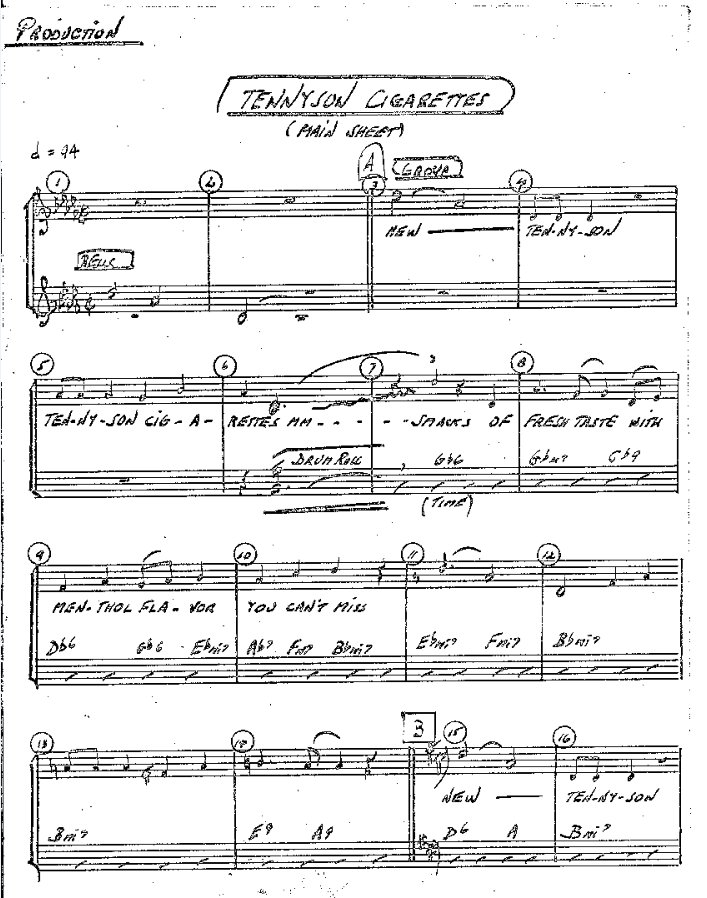
I even remember the jingle. I began to wonder later if I had imagined it, but fortunately the original sheet music which was submitted to the legal process was conserved:
So I’m not senile after all. I may be crazy, but that’s different. As a final bit of curiosity, I also found this:
Same package, same font, same look as Tareyton – but nary a whit of information to be found about what these are, or when or where they were sold. Possibly a European version of Tareyton? One clue:
This has been a bit of a ramble, but I got a good bunch of things out that I won’t have to worry about later (‘Now where did I archive that?’)
The Old Wolf has rambled.
1 In case you’re wondering, it should be “We Tareyton smokers.”
2 Plus ça change, plus ça reste la même chose. Visit The Old Wolf’s Banquet from Hell.
3 Brooke McEldowney, both a very gifted musician and a supremely talented artist who does the webcomics 9 Chickweed Lane and Pibgorn, riffed on this twice. In the first one, Edda and her mother Juliette engaged in this very exercise here; the second, where poor Seth is tormented by his ballet company, is here.
4 As it happens, such a thing exists, even though I only found out about it later as I was researching the topic. Never once did I see these in stores.
I love to garden. And when you’re out working in the hot sun, there’s little that’s more refreshing than getting cancer a cold drink from the garden hose.
Wait, what?
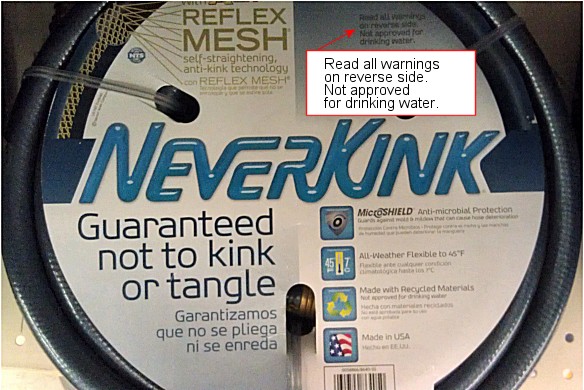
Needed a new hose the other day, so I trotted down to the local hardware store to pick one up. Found a good-quality, non-kinking hose, and when I got home and started unpacking it, I saw something that disturbed me. A lot.
I hadn’t noticed this little “advertencia” on the front at all – notice how it’s not terribly accentuated. On the back was a new sticker added:
Lead? Harmful chemicals? In my hose? Even if I didn’t drink from it – which is beyond stupid – what makes these people think I’d want to spray that water on my veggies?
So I took the infernal thing back, and went looking for a drinking-water safe hose. Turns out the only thing I could find was a flimsy little marine/camper hose, and all the thing does is kink, kink, kink – but at least the water it dispenses is safe for human consumption. Nothing else was for sale… no other options.
I had been meaning to post about this for a while, when today I came across this article from Time magazine, and I saw that other people were thinking about it as well.
Thinking about the least common denominator in society, how likely is it that people are going to read these notices? I mean, I just barely happened to see them. I might have hucked the hose wrapping into the trash without a second thought, and I’ll bet most people do. And everybody drinks from a hose… I mean, sheesh – it’s what we do.
The irresponsibility of this is mind-boggling. I talked about it with my hardware store (they carry stuff from the DoIt suppliers, and that little font change is because otherwise it looks like “Dolt,” which based on the overall quality of that brand may actually be more appropriate) and they told me that’s all they can get. From where I sit, these products don’t belong on shelves anywhere. You can’t tell me that modern technology can’t manufacture a durable, kink-proof hose that’s not full of carcinogenic chemicals… it seems like sheer laziness and gross insouciance to me.
So if you weren’t aware of this, at least read the labels carefully the next time you bring home a garden hose, especially if you have little ones who will be playing in the garden. Do your research – there are choices out there. I sincerely doubt this is a matter of enough national importance to get our lawmakers to take time to look at, but that’s a shame – because they should – it’s a crime to market something so ubiquitously that you know is going to make people sick.
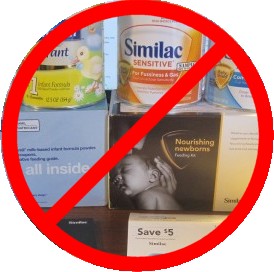
Once again, RoboCop Bloomberg is on the rampage. His NYC campaign “Latch On NYC” is designed to increase the incidence of breastfeeding in New York hospitals.
Pause for breath here.
Breastfeeding is good. In fact, it’s pretty certain that it has significant benefits over bottle feeding. La Leche League has been encouraging new moms for decades, the research is out there, and I don’t need to recap it for you here. But the plain truth is, there are some moms that just can’t, for any number of valid reasons – and it’s not the job of the government, at any level – federal, state, or municipal – to get their collective noses that far into people’s personal choices.
There’s no question that formula manufacturers love giving free samples in hospitals – it’s advertising, plain and simple, and a lot of doctors and nurses and healthcare professionals have a bone to pick with that. But it’s a separate issue: hospitals should not be legislated into locking their formula up just because Hizzoner has a bee in his bonnet. This is way the hqiz out of the purview of any governmental organization, just like some of his other initiatives; our country doesn’t need nanny-state laws.
So yeah, breast-feed your baby if you can; it’s good for the baby, and it’s good for you. But don’t let what Mayor Bloomberg thinks drive your choice – that one is up to you and your family alone.

 .
.












 Playing in the World Game