Betty Crocker, by Betty Crocker

“Early 1950s era commercial for Betty Crocker Spice Cake Mix….hosted by Betty, in person!! From 1949-64, the fictional Crocker, was played by actress Adelaide Hawley (born Dieta Adelaide Fish), who had studied piano and voice at the Eastman School of Music at the University of Rochester before entering vaudeville. From 1937 to 1950 she hosted THE ADELAIDE HAWLEY PROGRAM, a daily talk and new program that reached an audience of over 3 three million daily. So popular was Ms. Hawley as General Mills’ living trademark, she was was considered one of the “most recognizable women in America”, second only to Eleanor Roosevelt. After being dropped by General Mills, she returned to school and earned a diociorate in speech education from New York University in 1967. She moved to the Pacific Northwest with her second husband, Naval Commander Laurence Gordon Cumming and taught English as a second language until her death in 1998 at age 93.”

Text from the YouTube page. Found at Frog Blog.

Vintage Hamilton, Ontario

Found at hensleyhamilton1.

Vintage Hamilton, circa 1925. Click to enlarge.

Also found this posted on Facebook; the comment by the poster there read, “The info on the photo I believe is incorrect. Where the vehicles are turning would be John St., not James St. The large building in the background on the left was the Bank Of Commerce building at the SW corner of King & James. This was apparently a postcard – the original photo had franking marks on it, which I have removed.

Google maps appears to bear him out:

The current corner of King and John.

From the other side of King, looking toward James Street.

Disclaimer

1918: Shipping Children by Parcel Post

Two Girls Sent By Parcel Post over New Motor Mail Truck Route; Postage $1.23
from the Springfield, Mo. Republican September 3, 1918, page 8.

“Josephine McCall, 7 years old, and Iris Carter, 8 years old, have been stamped, mailed and yes delivered by the parcel post from their home in Red Top to their aunt, Mrs. Bessie McCall, 1221 North Campbell Street, Springfield.  They came all the way in one of the new motor trucks over one of the new routes and were driven by W. E. Fawcett who delivered them.

When the relatives of Josephine and Iris at Red Top were troubled as to how to get the children to Springfield without sending someone up with them they hit upon the idea of sending them by parcel post and by the way of the new motor route or “a la motor truck”.  The regulations say that all goods must be stamped and weighed, registered, etc.

The children were weighed and the cost of sending them figured at the regular rates of sending things.  Josephine, it was found could go for 52 cents but it took 70 cents to pay for the mailing and delivery of Iris.

A dollar and twenty-three cents was paid and the children were stamped like ordinary parcels.  When the driver of the new motor truck, W. E. Fawcett , came steaming into Red Top he found the two children awaiting him along with other things he was to deliver to Springfield.

Mr. Fawcett believes that a kid or two at a time to deliver is all right but he is glad the idea does not occur to many parents at present when moving their children and he is dreading the time when he will find children all along the way and persons in parcels at every post office.”


In 1914, the parents of a blonde four-year-old named May Pierstroff sent her from Grangeville, Idaho to her grandparents in another part of the state for 53 cents, the going rate for chickens. Word of her excursion quickly prompted the Post Office Department to forbid sending any human being by mail.
Found at Smithsonian Libraries


1913 New York Times Article


“This city letter carrier posed for a humorous photograph with a young boy in his mailbag. After parcel post service was introduced in 1913, at least two children were sent by the service. With stamps attached to their clothing, the children rode with railway and city carriers to their destination. The Postmaster General quickly issued a regulation forbidding the sending of children in the mail after hearing of those examples.”

Found at the Smithsonian’s Flickr Page.

The practice of sending children by Parcel Post was officially prohibited on June 13, 1920.

The Old Wolf has spoken.

Disclaimer

“Modern” Shop Front – 1890’s

Caption reads, “A modern shop front, with windows fitted with sliding sashes.” The ‘sashes’ are the front two large-paned windows facing the street (the grips are visible along the bottom edge of the window). The sash is fitted with a sash-weight to counteract the enormous weight of a sheet of glass this size. The sash slides upward to open, allowing street-side sale of groceries during times when the weather allows and closing up during inclement weather.

Found at Infomercantile

Disclaimer

Abandoned Texaco Station, 1937

Photo by Russell Lee (American, 1903-1986)

“Abandoned Garage On Highway #2, Western North Dakota, 1937/c1940s. Vintage silver gelatin photograph, typed title, photographer’s Farm Security Administration (FSA) credit stamp, FSA return stamp and numeric annotations in pencil in an unknown hand verso, 17.9 x 24.2cm. Minor wear to edges of margins.

The Farm Security Administration (FSA) was created during the Depression to combat rural poverty. It became famous for its small but highly influential photography program, 1935-44, which realistically portrayed the challenges of rural poverty.”

Found at Joseph Lebovic Gallery

Disclaimer

Lagoon’s “Terroride” Mural

Lagoon has long been one of my favorite places to visit. It’s not the fanciest amusement park in the world, but it’s ours – and the owners have done their best to make it a good place for young and old to have fun for as long as I can remember, which dates back to around 1957 or so.

This mural appeared as the backdrop for the loading area to the Terroride, one of the oldest park attractions and still a favorite. I remember I posted about it at a forum dedicated to Lagoon about three years ago, so I’ll just steal my own comment from there:

“The Terroride mural is a holdover from an age gone by. Many traveling carnivals had dark-rides or dark walkthroughs, and they appealed to people from a rural environment who, “B’gosh I’ll jest swan to Guiney, I never done see’d nothin’ like that in all my born days!” The mural was designed as the visual representation of a nightmare. Apes, skeletons, octopi, spiders, mummies… and Negroes! Hey, back then, “Negroes” were scary! We’re talking 1940’s and before… this is an old mural. Even though it’s not terribly frightening now, or even politically correct, I hope they preserve it – it’s a beautiful piece of history. I recall visiting Lagoon in around 1957 or so, for the first time, and that picture gave me the heebie-jeebies. “

Now that I think about it, the dancing African was probably supposed to represent a juju-man, or witch doctor – which back in more provincial days may have been frightening enough indeed.

[Edit:] Lest anyone think there was even a hint of racism in the minds of management, Lagoon’s owner and general manager Robert E. Freed was fiercely dedicated to the causes of equality; when the Freed family and their partner, Ranch Kimball, took over the lease of Lagoon, the terms forbade blacks in the swimming pool and the ballroom in accordance with a Farmington town ordinance. By the late 1940s, Freed had succeeded in fully opening Lagoon to the black community; when his company acquired the Rainbow Gardens, later known as the Terrace Ballroom, the same policy was adopted.

Posted on a Flickr picture was this description:

“The mural was painted by William M. Tracy, who is probably dead now. He lived in New Jersey. It is believed to have been painted in the 1940’s. William Tracy used to display stunts for dark rides at the industry trade shows. The mural was most likely purchased at the trade show along with some stunts. Bill Tracy also did many of the gags that were in the original Dracula’s Castle, many of which remain in place today. Sadly, he was an alcoholic.”

Others have disputed parts of this, but it’s the only bit of history I’ve been able to find.

If it’s indeed gone, that would be a sadness – I’ll be curious to find out if it was preserved anywhere.

[Update:] I called Lagoon today – apparently the mural has indeed been replaced by some trees, but it has been preserved in the offices at the Lagoon annex. That’s good – a piece of history like this deserves to be saved. Thumbs up!

[Update 2:] The mural is back in its original location, preserved for future generations to marvel at. ❤

The Old Wolf has spoken.

Salt Lake City – Lyric Theatre

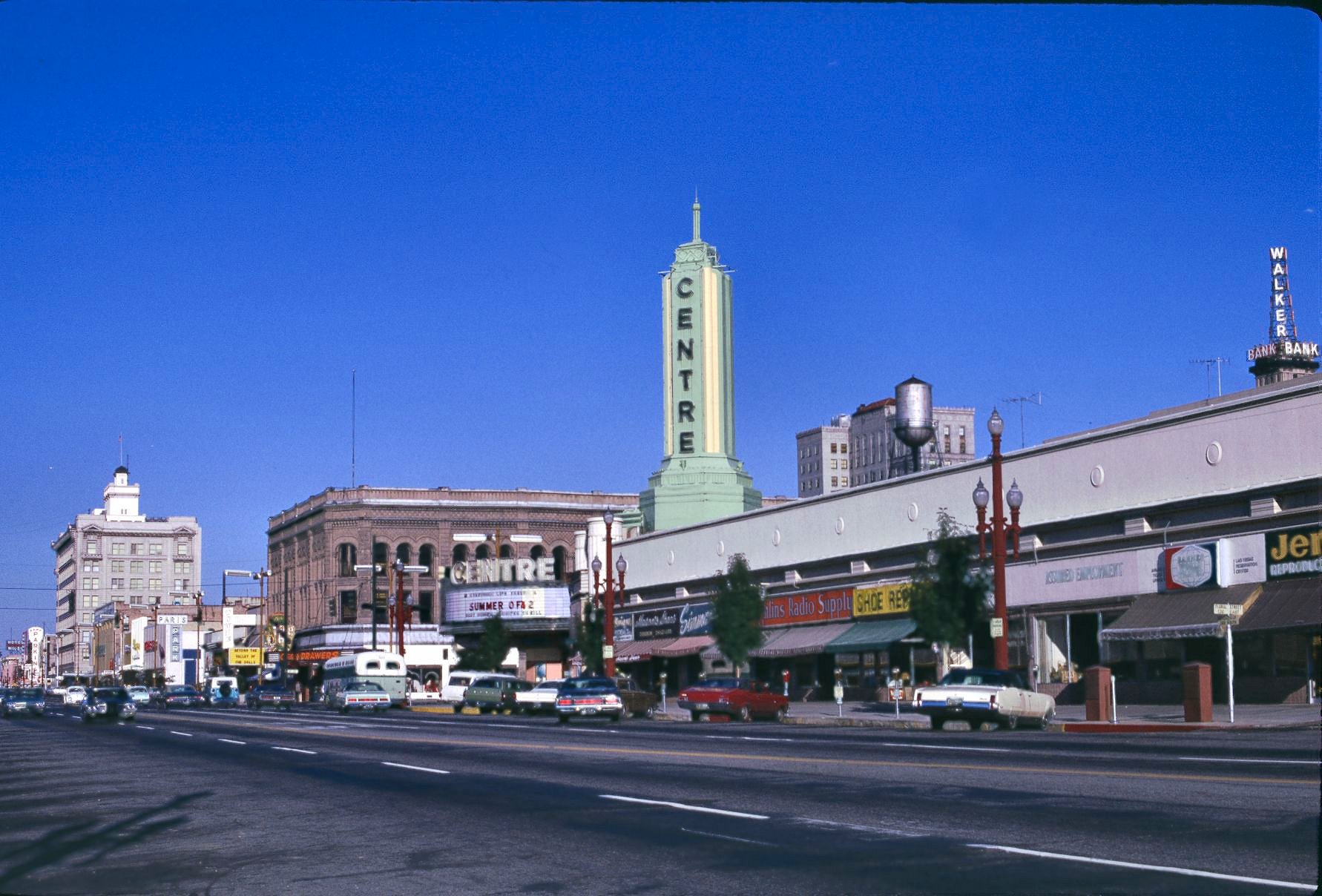
Salt Lake used to have a number of great movie houses; the Center Theatre, the Villa, the Utah Theatre, and the Lyric are ones that I remember well.

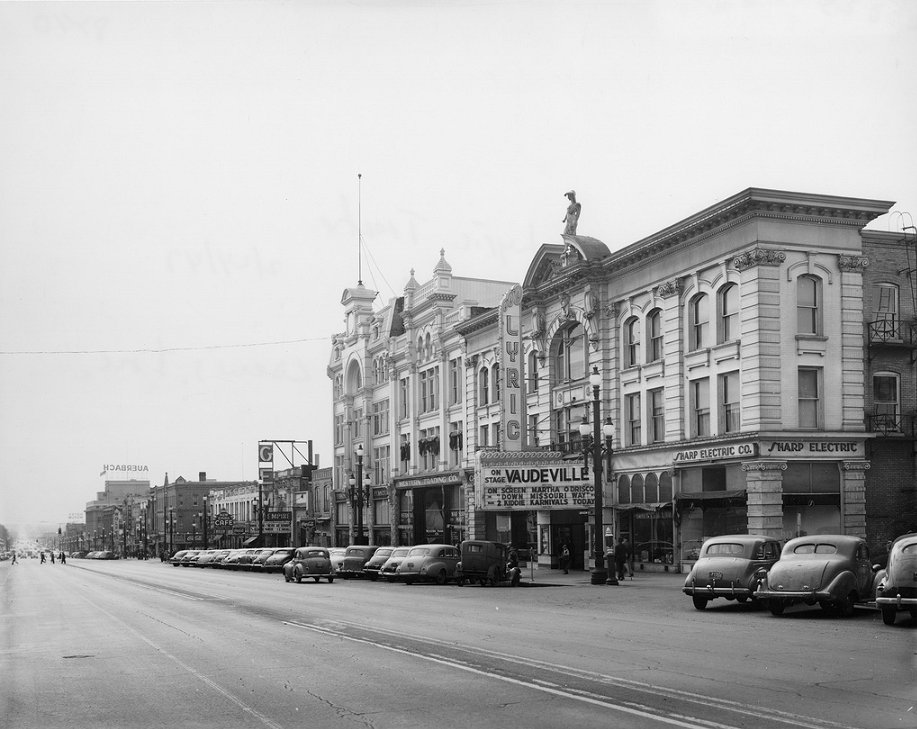
By the time I got to Salt Lake in 1969, coming out from New York where I was raised, the Lyric had become a rather seedy second-run joint, but in the 40’s it was very active both as a live theatre and as a movie house – it became known as the Lyric sometime around 1947.

Lyric Theatre, February 24, 1947 – Found at Utah Heritage Society

In a touch of serendipity, Pinocchio is the movie I recall seeing at the lyric around 1969; I had several hours to kill before I caught a bus to Los Angeles to visit my dad, and I remember sitting in the theatre and watching the whole show 3 times in a row. Back in those days they had newsreels, shorts, cartoons, and a feature presentation. If you came in late, you could just stay until the next show began. Frankly, I miss those days.

Lyric Theatre Interior

In 1971 it was closed as a movie house, and the Church of Jesus Christ of Latter-day Saints bought the building and remodeled it as the Promised Valley Playhouse. During the course of ripping down the marquee, beautiful sculptures were uncovered; the Church hired a restoration expert, and the façade was restored to its original appearance.

The newly-restored Promised Valley Playhouse

Entryway sculptures – closeup

The Venus statue was restored by Arcstone Casting and Design. The original work was created of hammered tin; the statue was restored through composite materials and a new steel armature.

The theatre was used by the Church for local productions and also by the community; my own son had the privilege of performing there as part of a stake play when he was about 12. Tragically, theatre closed in 1996 due to structural problems.

Salt Lake County paid $50,000 for an architectural study, but voted on July 17 2001 against purchasing or leasing the theatre because of the high cost of restoring it. The study concluded that restoration of the Orpheum Theater (the original name when it was constructed in 1911) would cost between $2 million (for a basic seismic upgrade) and $30 million (for a full restoration).

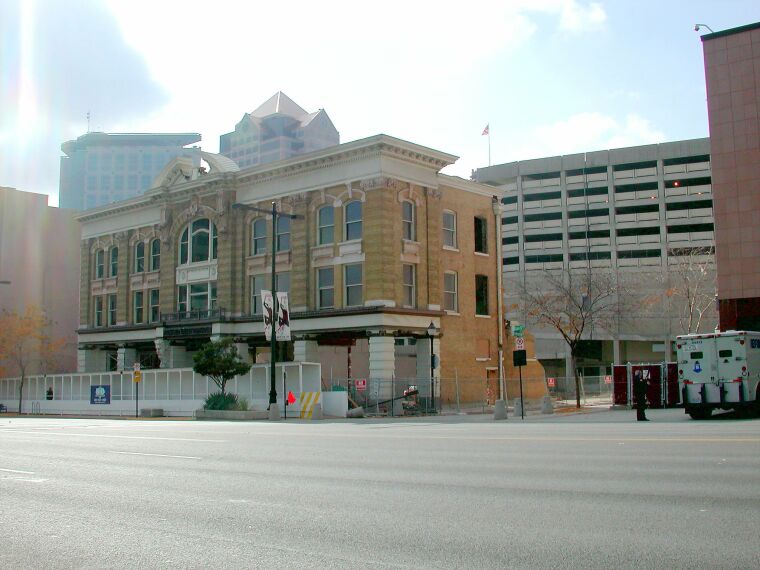
The owner of the building, Zions Securities, demolished the building in 2003 for a multi-story car park; the facade and lobby was preserved and used for office and retail space.

The Lyric is gone, but it will always exist in memory.

The Old Wolf has spoken.

Disclaimer