Senseless criticism

I saw this posted over on Facebook today, on a fan page called “Being Liberal.”

censored

What caught my attention was the prominent picture of the Salt Lake temple of the Church of Jesus Christ of Latter-day Saints, of which I happen to be a member. There were 3,191 comments when last I checked and the debate was in large part your typical flame war between believers and anti-religionsists.

My response at the Facebook page was as follows:

“A picture of this nature is disingenuous and divisive by nature because it cannot convey even a fraction of the big picture. If, for example, you were to put the dollar value of such structures in a chart next to the dollar value of aid rendered by the organization to the disadvantaged or suffering throughout the world, and then in a third column, the dollar value of personal contributions and charitable service to society made by those who belong to your group, that might actually have some statistical value. Since such comparisons are impossible to quantify, the picture has relatively little empirical value other than to engender bitter polemics. If we were to reduce the massive expenditure down to the least common denominator, one could argue that it’s immoral to have a banana for breakfast when millions in Africa have none. One could create a similar montage of vast expenditures by secular organizations and make exactly the same point, so for me the net impact of the picture is an ill-advised and baseless attack on religion for no other reason than a personal bias.”

At the same page, I found this image:

522740_10151167815831275_1860863063_n

Once again, the LDS Church is targeted. Granted, the conference center (pictured) may have cost more than $350 million to build. At the same time, The Church of Jesus Christ of Latter-day Saints as an organization has donated more than $1 billion in cash and material assistance to 167 different countries in need of humanitarian aid since it started keeping track in 1985, and this is over and above the charitable efforts of its individual members. And from the pulpit pictured above is broadcast to the world on a regular basis messages of hope, of faith, of goodness, of charity, and of service, messages which inspire Church members to live lives in harmony with the teachings of the historical Jesus.

For the sake of comparison, the Palace of the Parliament in Bucharest, Romania, built by the avowed atheist and communist  Nicolae Ceauşescu, is estimated to have cost over €3 billion.

800px-Palatul_Parlamentului_1b

There’s a better way to spend one’s energy than tearing down organizations that do a lot of good, simply because one doesn’t happen to ascribe to the philosophy or theology upon which they are based. From a social standpoint, there is nothing intrinsically wrong with either faith or atheism – both systems are capable of tremendous human good and tremendous douchebaggery. Quiet service and the creation of positive energy trumps the public mockery of the beliefs of others any day – at least in my book.

The Old Wolf has spoken.

When one is completely empty inside

Over on Facebook, I got a pointer to a blog post in Norwegian. Now, my Norwegian is hqiz; I studied intensively for 3 months before staffing a seminar for Klemmer and Associates in Asker, Norway, in November of 2008, and it helped me get around and interact with the students, but we’re talking survival. But it’s enough that I could understand the article, and with the help of online resources I worked my way through it enough to determine that it needs to be shared. What follows is my own effort at putting this moving post into English. It’s not perfect by any means, but I think it captures the spirit of what was said.


Tonight my daughter [1], age 7, told me that one of the seventh graders at her school had been bothering her. He pushed her and said something that made her sad.
– Well, what did he say? I asked.
– He called me  …n … he called me … a nigger,‘ [2] said my daughter, with downcast eyes.

My daughter never has downcast eyes. She tends to face the world with clenched fists and a huge smile, but now it looked as though she were ashamed of something. Something in me sank, not particularly because of the n-word, but because of my daughter’s uncharacteristic body language. But I replied in the same tone as I usually do when she talks about things that have happened; I tried to get all the facts on the table before I reacted.

– Do you know what “nigger” means? I asked.
– No, admitted my daughter. Then she took a breath and looked up at me:
– But I knew it meant something bad!
– How did you know that?
– Because he said it in such a mean,  teasing way. And because I was completely empty inside.

That description of being subjected to derogatory remarks was so spot-on that I felt pretty empty inside, too. But my daughter sat there and waited for an answer and an explanation. I took a deep breath and tried to explain. That “nigger” is a word that gets used on people with brown skin, who come from Africa or look like they come from Africa.

– Like  me? So he can SAY that? She widened her eyes and I felt like I had drowned a sack of kittens. I went on to say that word was common in the old days, but it is not used very often anymore. I explained that many people, especially adults and old people, use it without meaning anything bad by it, and without wanting to hurt anyone. They just have not kept up with the times.

But I told her that there are some people who use the word on purpose, to be mean, and that she probably was right, that this particular boy belongs to the latter group. These people tend to stand out.

And I said that no one has the right to call someone something that makes them completely empty inside, whatever that word means. But still, there are many people that say things just to make others sad. And sometimes people say things without wanting to make others sad, but they feel sad anyway.

We had a pretty long chat on the sofa, and another after that evening’s bedtime story session was finished. We discussed what is okay to say to others and what is not okay, and why. We talked about what we should say if we have accidentally made someone else feel empty inside, and what we should say if others are doing it to us. And whether it’s worse if someone we like and love says insensitive things to us. For this unknown boy was, after all, no one of consequence in my daughter’s life, but still, Mommy.

Actually, I had plans to use to use my personal development time this evening watching the zombie series and other fun things, but I ended up pondering a bit instead. Pretty loose and fragmented, I must confess, for mentally I’m dangerously close to zombie level right now. But let me think out loud anyway (after all it is my blog, so I can do what I want): Everyone agrees in principle that saying things to be mean is not allowed. The specific episode my daughter told me about obviously falls into that category. But people who say such things – where do they get this from? And where does one draw the line? There is no agreement.

Not so long ago I had a chat with some of my students at school. They have a pretty rough tone in the classroom, and several have responded that put-downs run pretty freely in the group. Among other things, it happens too often that something is characterized by derogatory prefixes such as Paki, whore- and homo- (for example, “homo music”, i.e. music that any talented guy with normal gender identity would consider worth listening to). The students themselves couldn’t get it through their heads that there was a problem here. We’re just kidding! We only say it to people who can take it, who are in on the joke!

It’s clear that kidding around with friends is fine. But the boundaries of humor are delicate and indistinct. The words we use have so many fine distinctions. One man’s fun banter can be another man’s nightmare. I didn’t mean any harm by it, we pout, as though that should make everything all better. By no means do we want to descend into an “I feel insulted” tyranny, where anyone’s negative feelings about some experience should determine the norm for everyone else’s behavior. But we do need to be crystal clear that every time we choose to say something hurtful (or refrain from saying something nice) to or about someone, we make a choice that affects everyone around us.

What about the person who is not in on the joke? The one who laughs uncomfortably, because he or she doesn’t want to be labeled killjoy or a first-class whiner? And what about the guy who happens to share the same classroom (or break room or dinner table) with two others “jokingly” using derogatory names for each other? He is not a direct recipient of Jesus Christ, you are so fucking gay, man! He’s not really involved at all, but sitting in the same room, he suddenly becomes completely empty inside. And no one says anything about it. So he’s completely empty, all alone.

It is never okay for anyone to be completely empty inside.


Notes

[1] The original Norwegian is “Lillesøster” (Little Sister)

[2] Nigger is the best translation available here. The original Norwegian is neger (negro), in this case used as a derogatory term, but it should be clearly stated here that the word doesn’t carry the immense cultural weight that it does here in the United States.

The Old Wolf has spoken.

Beauty from determination

Courage and determination can change everything.

A young woman in her thirties had been a dancer from a young age. She lost her entire left arm in an accident and fell into a state of depression for a few years.

Someone asked her to lead a dance group for children. That’s when she realized she could not forget dancing. She still loved to dance and wanted to dance again. So she started to do some of her old routines, but having lost her arm, she had also lost her balance. It took a long time before she could even perform simple turns without falling.

It was then that she heard of a young man in his twenties who had lost a leg in an accident. He also was on an emotional roller coaster of denial, depression and anger, but she was determined to find him and persuade him to dance with her. He had never danced in his life, let alone with one leg.

He categorically refused but she did not give up and eventually he accepted against his better judgment, saying that he had no other purpose in life.

She started to teach him dancing.

After several interruptions (never having danced, he did not know how to use his muscles, and discouragement and anger prevailed), they are finally back together and began to receive serious training .

They hired a choreographer to design routines suitable for them and this is the result.

What’s your excuse for not getting what you want out of life?

The Old Wolf has spoken.

Milk and Candy: The New Weapons of Democracy

Milk isn’t the only thing that was airlifted into Berlin during those days.

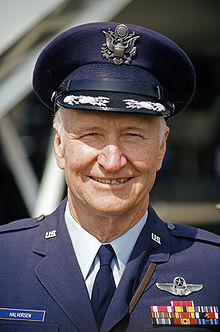
Colonel Gail Halvorsen, the “Candy Bomber.”

“Between the years of 1948 and 1949 Berlin Airlift pilot Lt. Gail Halvorsen was so struck with the friendliness and excitement of the Berlin children that he wanted to do something special for them and to spread a little cheer to their beleaguered times in Berlin during the blockade. Lt. Halvorsen decided to start his own operation and named it “Operation Little Vittles” He practically bought out all the candy available where he was based and out of strips of cloth created miniature parachutes and attached the candy to them. At the beginning, Lt. Halvorsons buddies gave up their rations of candy and gum and also their handkerchiefs to help the cause. The American Confectioners Association asked Lt. Halvorsen how much candy and gum he could use. They sent tons of candy and gum to Westover AFB for processing. 22 schools in Chicopee Massachusetts converted an old fire station into a Little Vittles headquarters. They made parachutes, tied on candy or gum and sent the finished product to Lt. Halvorsen at Rhine Main AFB. When the supplies came on line at Rhine Main all of Lt. Halverson’s squadron and others helped drop the candy and gum. They then air dropped the candy over the city of Berlin (including East Berlin until the Russians told them to stop ) to the eagerly waiting children. By January of 1949 Lt. Halvorsen had air dropped more than 250,000 parachutes loaded with candy on the city of Berlin bringing a little joy to the nearly 100,000 children of Berlin during the Russian blockade.” (From konnections.com)

I had the privilege of knowing Gail when he was the bishop of a neighboring congregation in 1978. A kinder man you could never hope to meet. One man, with a powerful intention, who made a difference in the lives of countless children.

The Old Wolf has spoken.

Let your light shine

The Internet is full of glurges – stories designed to make the reader feel good, or uplifted, or inspired. You know – the kind of thing you find in the “Chicken Soup for the Left Handed Ginger Soul.”

Now, I happen to have a very sappy heart, so there are a lot of these that resonate with me, whether they are true or not – and a good percentage of them aren’t. But in the end there’s nothing wrong with a good story – witness the success of the recent 50 Shades of Gray, which to me has less redeeming value than a nice tale about six disabled puppies rescued by a one-eyed wolverine who had just been run over by a steamroller.

People have told stories since the beginning of time. Stories to entertain, but more important, stories to pass on traditions and values which were important to the society that preserved them. A good example appears in Elie Wiesel’s book, Souls on Fire

When the founder of Hasidic Judaism, the great Rabbi Israel Shem Tov, saw misfortune threatening the Jews, it was his custom to go into a certain part of the forest to meditate. There he would light a fire, say a special prayer, and the miracle would be accomplished and the misfortune averted.
Later, when his disciple, the celebrated Maggid of Mezritch, had occasion, for the same reason, to intercede with heaven, he would go to the same place in the forest and say: “Master of the Universe, listen! I do not know how to light the fire, but I am still able to say the prayer,” and again the miracle would be accomplished.
Still later, Rabbi Moshe leib of Sasov, in order to save his people once more, would go into the forest and say, “I do not know how to light the fire. I do not know the prayer, but I know the place, and this must be sufficient.” It was sufficient, and the miracle was accomplished.
Then it fell to Rabbi Israel of Rizhin to overcome misfortune. Sitting in his armchair, his head in his hands, he spoke to God: “I am unable to light the fire, and I do not know the prayer, and I cannot even find the place in the forest. All I can do is to tell the story, and this must be sufficient.”
And it was sufficient.

The Christian scriptures are also full of parables and allegories, and whether you put any particular stock in their historical or spiritual value, most of them boil down to a single message: “Don’t be a dick, and help other people whenever you can.”

So here’s a glurge for you. It makes sense to me, and I like the message, which I have found to be true both now, and in retrospect:

“During my second month of college our professor gave us a pop quiz. I was a conscientious student and had breezed through the questions, until I read the last one: “What is the first name of the woman who cleans the school?” Surely this was some kind of joke. I had seen the cleaning woman several times. She was tall, dark-haired and in her 50’s but how would I know her name? I handed in my paper, leaving the last question blank. Just before class ended, one student asked if the last question would count toward our quiz grade. “Absolutely,” said the professor. “In your careers, you will meet many people. All are significant. They deserve your attention and care even if all you do is smile and say ‘hello’.” I’ve never forgotten that lesson. I also learned her name was Dorothy.”
Source Unknown

I believe that every person we encounter is there for a purpose. If we can leave them happy that we crossed paths, we have fulfilled our human responsibility, and no more can be asked.

The Old Wolf has spoken.