
That’s alright, cap’n; we always knew your cat was a whoopsie!
(Before anyone gets their nose bent out of shape, that’s my [modified] favorite line from “Stardust.”)
The Old Wolf has spoken.
That’s alright, cap’n; we always knew your cat was a whoopsie!
(Before anyone gets their nose bent out of shape, that’s my [modified] favorite line from “Stardust.”)
The Old Wolf has spoken.
Acts 17: 19-21
And they took him, and brought him unto Areopagus, saying, May we know what this new doctrine, whereof thou speakest, is? For thou bringest certain strange things to our ears: we would know therefore what these things mean. (For all the Athenians and strangers which were there spent their time in nothing else, but either to tell, or to hear some new thing.)
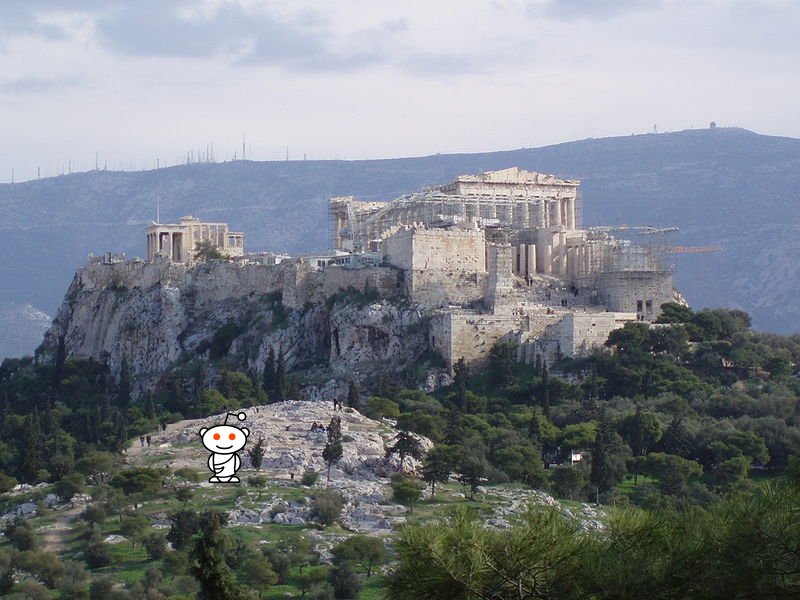
Areopagus (Mars Hill) at the foot of the Acropolis
Anyone who has spent any serious time studying Latin has probably felt the need for something more powerful than Tylenol™ to quiet the throbbing in his or her head. In the absence of Oxycontin™, humor has long been a good substitute for mitigating the effects of “bonus, bona, bonum, boni, bonæ, boni…”
Here a random collection of humorous tidbits regarding the vagaries of classical Latin (and other languages). Macaronics are, properly, text which uses multiple languages, and often bilingual puns.

While not macaronics proper, it’s still a great Latin joke: It reads (liberally translated), “If you can read this bumper sticker, you’re well-educated and TOO DAMN CLOSE!”
——-
What is this that roareth thus?
Can it be a Motor Bus?
Yes, the smell and hideous hum
Indicat Motorem Bum!
Implet in the Corn and High
Terror me Motoris Bi:
Bo Motori clamitabo
Ne Motore caedar a Bo—
Dative be or Ablative
So thou only let us live:—
Whither shall thy victims flee?
Spare us, spare us, Motor Be!
Thus I sang; and still anigh
Came in hordes Motores Bi,
Et complebat omne forum
Copia Motorum Borum.
How shall wretches live like us
Cincti Bis Motoribus?
Domine, defende nos
Contra hos Motores Bos!
–Alfred Dennis Godley
The above poem pokes fun at the difficulty of Latin declensions, and inflects the words “motor” and “bus” as though they were classical Latin nouns (which, in a certain sense, they are.)
——
Latin verbs are memorized with their principal parts:
Most Latin verbs are regular:
amo, amare, amavi, amatus (to love)
salto, saltare, saltavi, saltatus (to dance)
Some, however, are devilishly irregular:
sum, esse, fui, futurus (to be)
ferro, ferre, tuli, latus (to carry) – did you know transfer and translate are basically the same word, meaning “carry across”?
Students, in apparent desperation at having to learn these niceties, came up with
flunko, flunkere, faculty, bouncem
to which I add my own sophomoric creation:
farto, fartere, pui, flatus
I’m quite proud of it, actually. And thanks to reader bman:
spitto, spittere, achtui, splattus

——-
As the title of this article indicates, “leges romanorum boni sunt” (the laws of the Romans are good,) but obviously this sounds like something much sillier.
——-
A bad Latin joke:
A professor of Latin at Yale, (sounds like a limerick in the offing, doesn’t it?) having ordered a meal at a fine New Haven restaurant, decided that he would like some wine with his dinner. So he summoned the wine steward and asked for a bottle of hock. Feeling clever, he added, “hic, haec, hoc.”
“Very good, sir,” replied the wine steward, and left.
Twenty minutes later, no wine. The learned man summoned the steward again, and asked, “Didn’t I order a bottle of hock?”
“You did indeed, sir,” replied the steward, “but then you declined it.”
——
Found on the wall at Pompeii:[1]
Civili derego
Fortibus in ero
Demes nobus, demes trux
Vadis inem, causan dux
——-
Dicora, dicora, doggium!
Ascendit mus horologium.
Insonuit ora,
Descendit mus,
Dicora, dicora, doggium!

——-
Parvus Jacobus Horner
Sedebat in corner
Edens a Christmas Pie
Infuerit thumb,
Extraherit plum,
Clamans, “Quid sharp puer am I!”
——-
Mollis abuti
Has an acuti;
No lasso finis
Molly divinis.
——-
Macaronics are not restricted to Latin, but rather are more properly any sort of bilingual wordplay. As a teenager playing with calligraphy, I did this for my father, who long treasured it:

It’s no more Provençal than I am Abkhazian, but it makes for a funny sign, and good advice in any age.
——-
The above sign leads me to one of the greatest collections of macaronics ever, Mots d’Heures: Gousses, Rames by Louis d’Antin van Rooten. This is a collection of (purportedly) classical French poetry with illuminating notes. However, if one reads them aloud, they become heavily-accented modern Mother Goose rhymes. One of my favorite examples:
Jacques s’apprête
Coulis de nos fête.[a]
Et soif que dites nos lignes.[b]
Et ne sauve bédouine tempo[c] y aussi,
Telle y que de plat terre, cligne.[d]
Notes:
a. Coulis, a sort of strained broth. Jacques was either a sauce chef or an invalid.
b. Jacques was also an alcoholic, since his thirst is beyond description.
c. He was fond of Arab music.
d. He believed the earth was flat. The last word of the line, meaning “wink,” is obviously a stage direction. Poor Jacques, whoever he was, was obviously considered a fool.
——-
A similar work was created for German by John Hulme: Mörder Guss Reims – the Gustav Leberwurst Manuscript. A sample:
Um die Dumm’ die Saturn Aval;
Um die Dumm’ die Ader Grät fahl.
Alter ging’s Ohr säss und Alter ging’s mähen.
Kuh den “putt” um Dieter Gitter er gähn’.
——-
If you are familiar with both classical Greek and French, you might be both delighted and scandalized by
οὐκ ἔλαβον πόλιν, ἀλλά γάρ ἐλπίς έφὲ κακά .[2]
Supposedly from a text by Xenophon – I have not been able to source it definitively – the sentence means “They did not capture the city, since they didn’t have a hope of taking it.” It’s pronounced “Ouk élabon polin, alla gar elpis éphè kaka.”
In French, however, it sounds like something quite different, the kind of thing schoolchildren would laugh up their sleeves about: “Où qu’est la bonne Pauline? À la gare, elle pisse et fait caca.” Google Translate will help you out if you’re really curious.
Vetus lupus locutus est.[3]
[1]Not really. I don’t think the Pompeiians would have resonated with
See, Willy, there they go
Forty buses, in a row
Dem is no bus, dem is trucks!
What is in ’em? Cows and ducks.
[2] If any classical Greek scholar would care to correct this – I know it’s not perfect – I welcome your input.
[3] Resistance is futile.

It would appear that things haven’t changed much from the days of programming in Fortran, PL/1, COBOL, and JCL in the IBM environment.
I share with you a poem by Dan Nessett. I have no idea who this brilliant man is, but he has written some classic DP humor. This one was collected in 1980; old-school programmers will probably relate more than today’s OOP whizkids, but there may be echoes that even the newer generation can relate to.
“I Was Wondering About This Error Message,” I said
Beneath my stare began to blur
10,000 lines of print.
Buried alive by 0C5[1]
Which gave not clue nor hint.
Up from my chair, I neared the lair
Branded “Consultants’ Room.
With puzzled gaze I paraphrased
My mind’s perplexing gloom.
“That bilious sty of wire,” said I,
“Has dumped its DUMP on me.
I cannot guess where in that mess
I’ll find the missing key.”
“The clues are everywhere,” he said.
And I began to think
Of : “Water, water everywhere
But not a drop to drink.”
“Aha!” said he, “Your DCB
Has lost BUFL.
MSHI is far to high
And BLKSIZE looks not well.”
“BLDL in this case will
Cause 0C5 or 4.
To BSP hex ‘503’
Will backspace low cost store.”
“You FREEMAIN twice and GETMAIN once’
This cannot be advised.
And all of this, I’m positive
Has caused your 0C5.”
My jaw had slackened to my knees;
A fly flew in my mouth.
I gathered up my SYSUDUMP
And crawled off in a slouch.
Back to my desk; I placed to rest
My chin upon my hand.
My weary eyes seemed quite surprised
To gaze on print again.
Beneath my stare began to blur
10,000 lines of print.
Buried alive by 0C5
Which gave not clue nor hint.
-Dan Nessett
The Old Wolf has spoken.
[1] 0c5 and 0c4 are basically the IBM compilation error codes that mean “You screwed up big-time somewhere, and I have no idea what’s wrong.”
2.1.3 ABEND CODE 0C4
1. ERROR ID: none
2. DESCRIPTION: This is a storage protection violation generally caused by your program trying to STORE data in memory that is not allocated for your use.
3. CORRECTIVE PROCEDURE: Make sure any subscripts used do not exceed the boundary specified. Correct all bad addresses in a store-type statement.
2.1.4 ABEND CODE 0C5
1. ERROR ID: none
2. DESCRIPTION: The computer tried to ADDRESS an area in a non-existent part of memory (beyond the bounds of our installation memory).
3. CORRECTIVE PROCEDURE: Check for improper subscripts and for inconsistent lists for subprograms.
This reminds me of my very first FORTRAN programming class in 1969, working on a Univac 1108. The instructor told us about various compilation errors we could get, and what they meant. He went on to say that there was one high-level error we were unlikely to see, because in essence it meant that we were smarter than the computer: “unresolvable ambiguity in source code” or some such thing. Guess what the machine gave me when I submitted my very first deck?
Two siblings had an argument. The sister made her brother a pie.

If this weren’t funny enough, here’s the brother’s reaction. You gotta love these two.
It just keeps going, and going, and going.

A man opened his refrigerator to find a small rabbit on the shelf. “What are you doing in here?” asked the man. “Well,” replied the rabbit, “this is a Westinghouse, isn’t it? I’m westing…”
The Old Wolf ducks and runs.
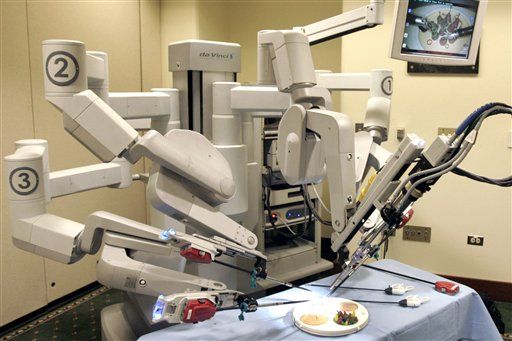
This thing looks like a cross between “2001” and “The Pit and the Pendulum.” I’m not sure I’d let it anywhere near me.
According to today’s news:
“(NEWSER) – You may not have heard of the da Vinci surgical robot, but your local hospital surely has. The $1.5 million robot is a hot item in the medical world, having been used in 367,000 US surgeries last year. Now, however, the FDA is talking a closer look after an increase in reported problems linked to the device, including five deaths, reports AP. In one case, a woman died after the robot nicked a blood vessel. The device is operated by surgeons, and the story takes pains to note that the robot itself may not be at fault.
The multi-armed robot has also made some bizarre moves during surgeries, including refusing to release tissue it was holding and hitting a patient on the face. These days, da Vinci is being used three times as often as it was four years ago; it’s in one of four US hospitals. Some experts say that’s partially thanks to extensive marketing. “The rapid adoption of robotic surgery … has been done by and large without the proper evaluation,” says one. But the robot’s maker, Intuitive Surgical, says “adverse event rates” are “in line with historical trends” after 1.5 million surgeries.”
You can read the AP release here.
Of course, the only thing that ran through my deranged mind was this:

One has to admit the drawing was unsettlingly prescient in terms of what the modern DaVinci looks like.
Let’s just hope it’s not powered by Windows/Intel, but rather something more reliable.
The Old Wolf has spoken.

The postage appears to be French. The image appears to be strange.
With thanks to Colin Nelson for permission to spread this little bit of whimsy and delightful writing around. So here, for your gratuitous reading pleasure, is an account of an intriguing discovery. Original post here.
——————————————————————————–
Archaeological Find
In the County of Meath in Eastern Ireland lies the Boyne Valley. An area that has fascinated scholars and archaeologists for centuries. There you find Brú na Bóinne, the Palace of Boyne. There you find Dowth, Newgrange and Knowth; Dozens of burial tunnels criss-cross the area. They were built about 3200BC making them older than the Pyramids or Stonehenge.
Richard Watkins of Stanford University was part of a team that was investigating Tunnel 22 that runs north-south through Newgrange. About 122 metres down the tunnel, he discovered what appeared to be an ancient cave-in. After 3 days careful work, Watkins and his team discovered that the rocks concealed the entrance to a roughly circular chamber about four metres in diameter.
There were clear signs that this was not a burial chamber but had been inhabited at one time. There were the remains of a fire below a gap in the ceiling that was once, presumably, a primitive chimney and source of light. There were the tattered rags that may have been bedding or clothing and some artefacts (one of which was a knife dated about the eighth century AD).
An examination of the chamber provided evidence that the occupant was connected with a monastery near Drogheda on the River Mattock that pre-dated Mellifont Abbey built on the same site by some 200 years. Records discovered at the abbey site indicated a monk called Muireadhach was entrusted with a “Pagan relic so foul it must be forever banished from the world of the living.”
This reference led Watkins to re-examine the chamber, whereupon he found a hiding place cunningly carved into the chamber wall and hidden behind a close-fitting stone. There was a solid mass about one metre by one metre by 0.5 metre behind the stone, and great care had to be taken in order not to cause any undue damage.
The mass was packaged up and sent to Truro University where Professor John Dean led the team that was to analyse and preserve the find.
It was discovered that the outer part of the mass consisted of about five goat skins; each had to be removed separately. Within was an ancient book. The cover was made of wood and fastened with metal clasps. The pages were fastened to the covers with cords that had only survived because of the protection of the goatskins and the atmosphere of the cavern.
At last, the team could see the first few pages of the book. They contained drawings, now faded, but were once rich in colour. Alongside these drawings were the spidery writings of the scribe in an ancient version of Gaelic (it pre-dated the use of Roman letters).
The search was on for someone who could translate the book. That search ended in Adelaide, Australia with Bryan Tewkes. Tewkes had done extensive research on Pre-Roman Civilisations of the British Isles. It was he that finally identified the book that had filled the ancient monks with so much horror:
“Irish Dancing Part 2: The Hand & Arm Movements”
The Old Wolf and Mad Jack have spoken.
Sharing this because I can’t hit the “like” button over at YouTube more than once. This is parody at its very best, combined with some real social relevance, all wrapped up in a delightful execution.
 Playing in the World Game