A Token Effort

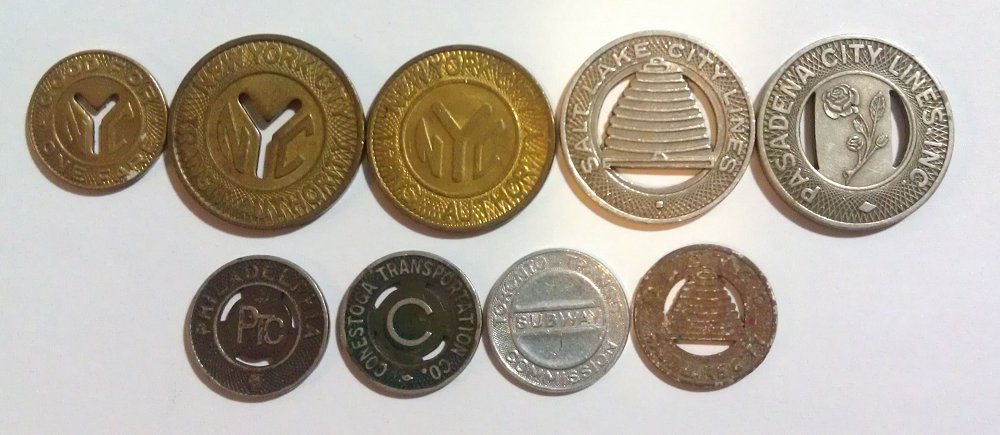
Inspired by a post over at Teresa Burritt’s Frog Blog about “token sucking,” I remembered that I had a few of these floating around in my drawers:

Top Row, Left to Right: NYC Small, NYC Large, NYC non-perforate, Salt Lake City Lines Large, Pasadena City Lines
Bottom Row, Left to Right: Philadelphia, Conestoga Transport Co., Toronto Transport Commission, Salt Lake ULATCO token (dug this one up with a metal detector in the 70’s)

Vintage Hamilton, Ontario

Found at hensleyhamilton1.

Vintage Hamilton, circa 1925. Click to enlarge.

Also found this posted on Facebook; the comment by the poster there read, “The info on the photo I believe is incorrect. Where the vehicles are turning would be John St., not James St. The large building in the background on the left was the Bank Of Commerce building at the SW corner of King & James. This was apparently a postcard – the original photo had franking marks on it, which I have removed.

Google maps appears to bear him out:

The current corner of King and John.

From the other side of King, looking toward James Street.

Disclaimer

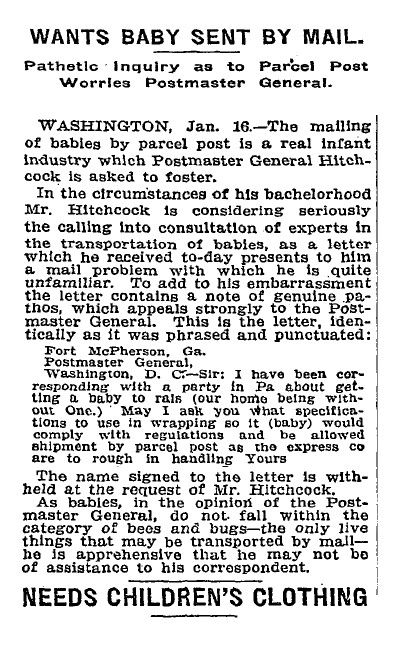
1918: Shipping Children by Parcel Post

Two Girls Sent By Parcel Post over New Motor Mail Truck Route; Postage $1.23
from the Springfield, Mo. Republican September 3, 1918, page 8.

“Josephine McCall, 7 years old, and Iris Carter, 8 years old, have been stamped, mailed and yes delivered by the parcel post from their home in Red Top to their aunt, Mrs. Bessie McCall, 1221 North Campbell Street, Springfield.  They came all the way in one of the new motor trucks over one of the new routes and were driven by W. E. Fawcett who delivered them.

When the relatives of Josephine and Iris at Red Top were troubled as to how to get the children to Springfield without sending someone up with them they hit upon the idea of sending them by parcel post and by the way of the new motor route or “a la motor truck”.  The regulations say that all goods must be stamped and weighed, registered, etc.

The children were weighed and the cost of sending them figured at the regular rates of sending things.  Josephine, it was found could go for 52 cents but it took 70 cents to pay for the mailing and delivery of Iris.

A dollar and twenty-three cents was paid and the children were stamped like ordinary parcels.  When the driver of the new motor truck, W. E. Fawcett , came steaming into Red Top he found the two children awaiting him along with other things he was to deliver to Springfield.

Mr. Fawcett believes that a kid or two at a time to deliver is all right but he is glad the idea does not occur to many parents at present when moving their children and he is dreading the time when he will find children all along the way and persons in parcels at every post office.”


In 1914, the parents of a blonde four-year-old named May Pierstroff sent her from Grangeville, Idaho to her grandparents in another part of the state for 53 cents, the going rate for chickens. Word of her excursion quickly prompted the Post Office Department to forbid sending any human being by mail.
Found at Smithsonian Libraries


1913 New York Times Article

“This city letter carrier posed for a humorous photograph with a young boy in his mailbag. After parcel post service was introduced in 1913, at least two children were sent by the service. With stamps attached to their clothing, the children rode with railway and city carriers to their destination. The Postmaster General quickly issued a regulation forbidding the sending of children in the mail after hearing of those examples.”

Found at the Smithsonian’s Flickr Page.

The practice of sending children by Parcel Post was officially prohibited on June 13, 1920.

The Old Wolf has spoken.

Disclaimer
“Modern” Shop Front – 1890’s

Caption reads, “A modern shop front, with windows fitted with sliding sashes.” The ‘sashes’ are the front two large-paned windows facing the street (the grips are visible along the bottom edge of the window). The sash is fitted with a sash-weight to counteract the enormous weight of a sheet of glass this size. The sash slides upward to open, allowing street-side sale of groceries during times when the weather allows and closing up during inclement weather.

Found at Infomercantile

Disclaimer

Abandoned Texaco Station, 1937

Photo by Russell Lee (American, 1903-1986)

“Abandoned Garage On Highway #2, Western North Dakota, 1937/c1940s. Vintage silver gelatin photograph, typed title, photographer’s Farm Security Administration (FSA) credit stamp, FSA return stamp and numeric annotations in pencil in an unknown hand verso, 17.9 x 24.2cm. Minor wear to edges of margins.

The Farm Security Administration (FSA) was created during the Depression to combat rural poverty. It became famous for its small but highly influential photography program, 1935-44, which realistically portrayed the challenges of rural poverty.”

Found at Joseph Lebovic Gallery

Disclaimer

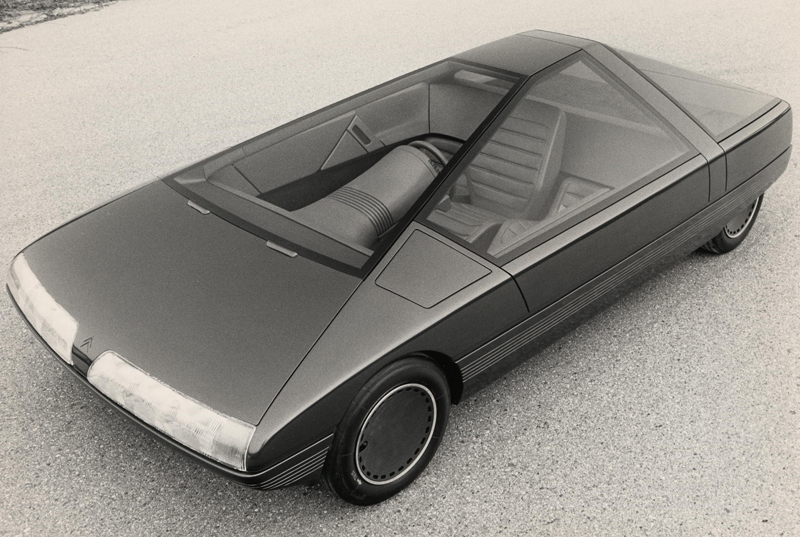
1980 Citroën Karin (Model)

The Citroën was once awarded the title of the world’s ugliest car. But their engineers had high aspirations.

Having no new models to reveal at the 1980 Paris Salon, Citroën stylist Trevor Fiore was given the go ahead to build a model (not a driveable car) for display. The result was the trapezoidal Karin, clearly inspired by Michel Harmand’s design for a GS Coupé. A three seater with the driver being seated centrally and ahead of the two passengers, this layout pre-empted that of the McLaren F1 of 1992.”1

Yeah. I’d drive one, if it existed.


1Found at Citroenet.

Disclaimer

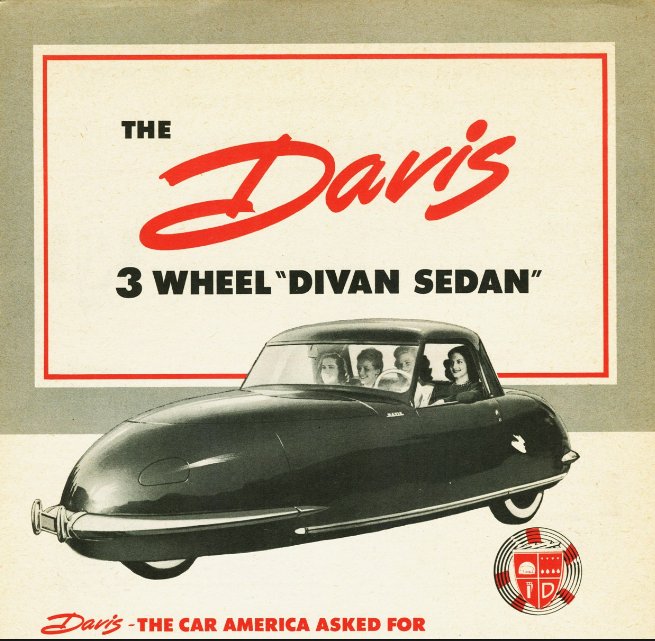
The Davis Three-Wheeler

Some history about the Davis Sedan for your gratuitous enjoyment. To me it looks like a glorified sidecar.

Of course, it could be worse.

It could be a Messerschmitt,

or an Isetta!

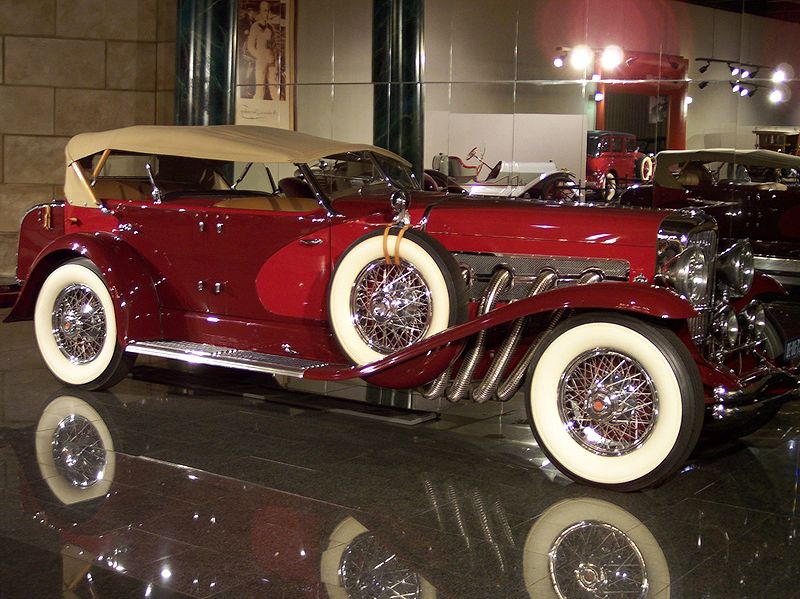
I don’t think any of these cars would have done well in a collision with a Duesenberg.

These beautiful vehicles, by the way, were so coveted and admired that they lent their name to the once-common expression, “That’s a doozy!”

The Old Wolf has spoken.

Disclaimer