‘Tis the Gift to be Simple – A Visit to Sabbathday Lake

IMAG2676

Shaker barn

Off Maine Street at the crest of a rolling hill, just northwest of New Gloucester, Maine, one finds a tidy settlement of white clapboard houses nestled around a quiet road. If one had not seen the signs, one would not know that this is the last surviving active settlement of Shakers, which now consists of three members.  During a recent vacation trip to Maine to visit my wife’s mother and her family there, we spent some time getting to know this peaceful settlement, largely run by a cadre of volunteers known as “Friends of the Shakers,” who help the last members of the order keep their lifestyle going.

Shakers1

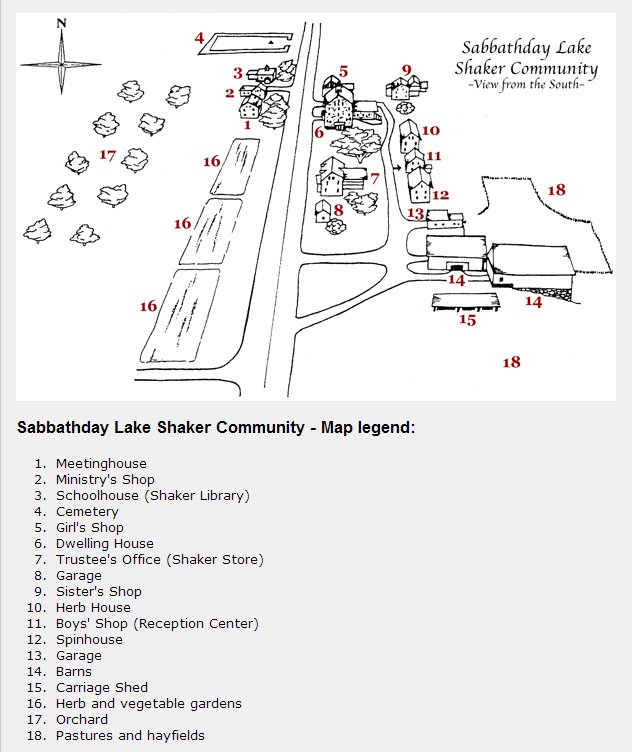
Map and key of the Shaker settlement, from the historical landmark website.

earth

Google Earth capture of the Shaker settlement.

IMAG2679

The Girl’s Shop

We were taken on an hour-long tour (which seemed all too short, given the amount of things there were to see) by a friendly  volunteer; we were able to visit the meetinghouse and the ministry’s shop; had we asked for “Tour B,” we would have seen the Girls’ Shop instead of the ministry’s shop. We’ll have to go back next year and do that one.

Sadly, photography inside the buildings was prohibited, because there were 101,000 wonders that I would have loved to record. But it was fascinating to sit in the meetinghouse where men and women would enter by separate doorways, visit the living quarters of the traveling elders and eldresses who formed the upper levels of Shaker leadership, and see a number of places where they worked at creating simple but extremely beautiful (as well as utilitarian) objects for their daily needs.

We learned of a number of Shaker inventions, among which were those little wobbly casters that people put under school chairs, knowing that folks like to rock back on them; the Shaker version was made of wood, and I’ll be dipped if I know how it was done. We also saw beautiful examples of their handicraft, including cabinetry, chairs, tables, clothing, boxes, pegs for hanging everything on, as well as the functional architecture of their buildings. The books… oh, the books. I would have paid large money to be able to examine some of the volumes that were displayed in desks and cabinets around the buildings.

IMAG2681

Volunteers working in the herb garden

IMAG2682

The Shaker Library, back view

IMAG2683

Shaker Library, front view. With an advance appointment, one can visit this building. Next time.

IMAG2684

The Girls’ Shop, front view.

IMAG2685

Meetinghouse, built in 1794, and ministry’s workshop.

IMAG2686

The Herb Garden

ToniAnneShakerSmall

My wife (the Goodwoman of the House) in front of the museum office, which used to be the boys’ shop; exhibit museum on the right, formerly the spinhouse.

After the tour and visiting the museum, we spent (too much) time in the Shaker Store (formerly the Trustees’ Office; the trustees were members of the order who dealt with the outside world and were in charge of temporal matters, and often only associated with the rest of the community during worship services.) We bought some lovely yarn (I’m planning a nice fair-isle hat), some herbs, and a few books.

Much can be learned about the Shaker faith and history at their official website; theirs is a story of quiet faith, diligence, and devotion which has weathered many changes in the world around them. Their motto, “Hands to Work and Hearts to God” has essentially defined their way of life, although it is not their devotion to celibacy that has ultimately fueled their decline, but rather the concept of community over individualism. A well-written article in the September 1989 issue of National Geographic entitled “The Shakers’ Brief Eternity” presents a respectful and intimate look at their history and their present.

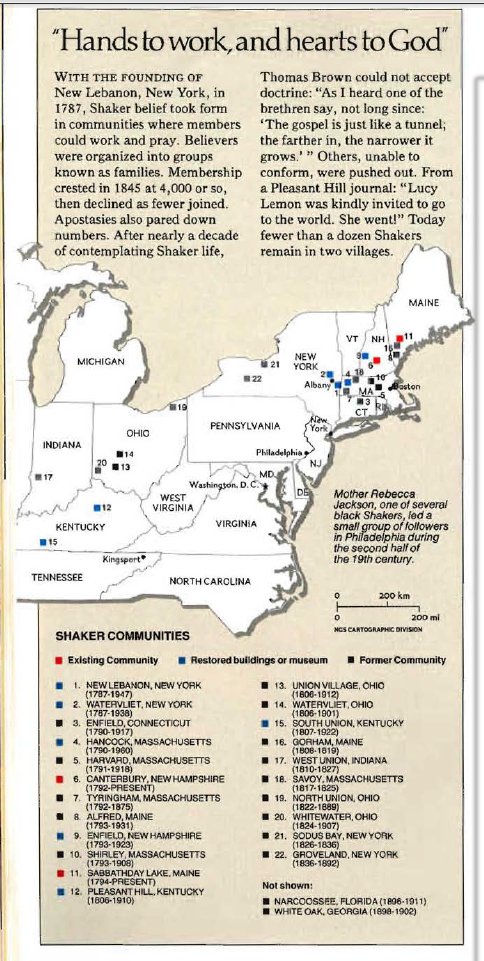
Map.jp

This map from the National Geographic article shows past and present Shaker communities; in 1989, there were two dozen members in two working settlements, the one at Canterbury, NH having since ceased operation with the death of its last member, Sister Ethel, in 1992. (Bangor Daily News, Sep 9, 1992). Despite the devotion to God, there was philosophical disagreement between the communities at Canterbury and Sabbathday Lake; a 1988 article from the Los Angeles Times summarizes the essential point of division:

In 1957, after months of prayer, the three Eldresses [of Canterbury] — Gertrude, Emma and Ida — decided to close the covenant to membership.

In the past 10 years, three men and a woman in their 20s and 30s have become residents of the community at Sabbath Day Lake, but Eldress Bertha does not recognize them as members.

“To become a Shaker you have to sign a legal document taking the necessary vows and that document, the official covenant, is locked up in our safe,” she said. “Membership is closed forever.

“We must live true to our faith and must follow what our leaders say. Our leaders decided it was over, done with. It is sad, but Mother Ann predicted that in time you would be able to count the members on the fingers of your two hands and then the Shakers would be no more. This is where we are now. . . .”

There were words; there were actions. For a while, Canterbury cut Sabbathday Lake off from community funding; after negotiations by their respective legal teams, access was restored. The National Geographic article stated,

Canterbury Shakers accept the quiet ending. They believe Shaker values will endure but in different form. Canterbury slowed down decades ago. Sabbathday Lake chooses a more energetic path. There are sheep to be tended, herbs to be dried, a fence to be mended, meals to prepare. Those seriously interested in the life are sometimes invited to try it. Some stay; some don’t.

The author of the National Geographic article related,

The territory separating the two villages is a minefield of hard feelings. I had been cautioned not to mention my Canterbury visit to SabbathdayLake and vice versa. I ignored the advice with predictable results. At Canterbury there had been a silence when I mentioned Sabbathday Lake. It was an unpleasantness to be swept under the table. At Sabbathday the rancor is blunt, the hurt palpable. “They say Sabbathday was always the least of Mother Ann’s children in the East,” Sister Mildred observes.

While Canterbury functioned, the feelings were hard on both sides. Now that Sabbathday Lake is the last remaining community, memories and feelings may endure, but anyone who will is welcome to explore and embrace Shaker life. According to the tour guides there, the community receives somewhere in the area of two inquiries a week. However, the mean age of the three surviving Shakers is 65, and a fourth member left the community some years ago after he fell in love; the way of the “three C’s” – Celibacy, Community Property, and Charity – is not an easy one to follow.

I was delighted to explore the lives and history of these gentle people. I learned that the Shakers invented one of the first perma-press cloths in existence; that their blue wood stain lasts almost forever; that the finials on their chairs are all different, depending on which community made them; that they wove cloth out of fine wood strips to cover their boxes and other artifacts; and that they were skilled in just about every area needed to be self-sufficient. I look forward to my next visit, and hope that I can learn even more about them in the meantime.

What is the future of the Shakers? No one knows, but the last members put their trust in God as their community has always done.  In a 2006 article in the Boston Globe, Brother Arnold Hadd is quoted as saying,

“I don’t know the mind of God. However, I do believe that if we live in faith – as we do – that, as we have been called and chosen, there will always be others who will also be called and chosen to this life. So, our intention is that there will be more Shakers.”

pho_5x

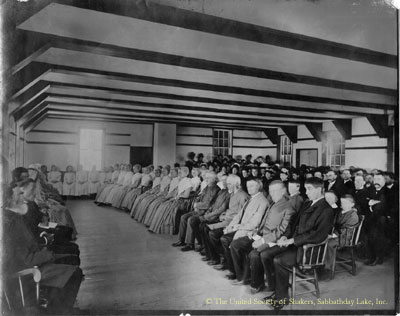
A view of Shaker Meeting from 1885. A photographer from the Poland Spring Hotel took this image. The Shakers are seated in the front benches. The spectators and guests from the Poland Spring Hotel are in the back rows. The women’s entrance can be seen at the back; the men’s entrance is just outside the right frame of the photo. In earlier days, a stairway existed at each end of the hall leading to separate living quarters for the traveling elders and eldresses of the ministry. Collection of the United Society of Shakers, Sabbathday Lake, Inc.

pho_7x

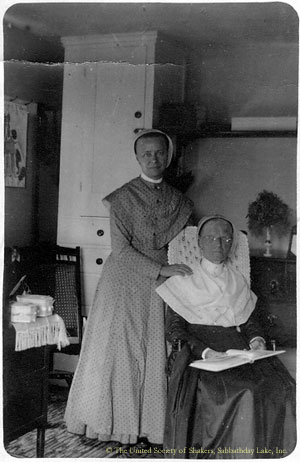
Eldress Elizabeth Haskell (left) and Eldress Harriet Goodwin (right) pictured in their fancy goods workroom at the Ministry’s Shop at Sabbathday Lake in 1899. Collection of the United Society of Shakers, Sabbathday Lake, Inc.

6733

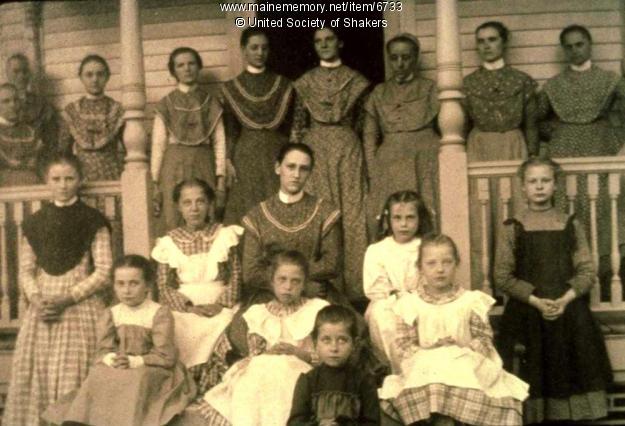
Sisters and girls, Sabbathday Lake Shaker Village, ca. 1902
Pictured from left are, back row, Sisters Clara Stewart, Amanda Stickney, Mamie Curtis, Katherine McTigue, Lizzie Bailey, Laura Bailey, Sarah Fletcher, Jennie Mathers, Ada Cummngs and Claire Chace. In the front row, from left, are Rosamond Drake, Ethel Corcoran, Grace Freeman, unidentified girl, Irene Corcoran, Iona Sedgley, unidentified girl, Emma Soule and Emma Freeman. Although organized as celibate religious communities, Shakers still made provisions for the raising of children. By this time, most of the children who entered the community were orphans. They were placed in either the Girls’ Shop or Boys’ Shop, apart from the adults in the Dwelling House. Caretakers looked after the children, supervising their education, work and play. The group is on the front porch of the Girls’ Shop, Sabbathday Lake Shaker Village.
From Maine Memory Network.

‘Tis the gift to be simple, ’tis the gift to be free
‘Tis the gift to come down where we ought to be,
And when we find ourselves in the place just right,
‘Twill be in the valley of love and delight.
When true simplicity is gain’d,
To bow and to bend we shan’t be asham’d,
To turn, turn will be our delight,
Till by turning, turning we come ’round right.

“Simple Gifts” was written by Elder Joseph Brackett while he was at the Shaker community in Alfred, Maine.

The Old Wolf has spoken.

A Muslim’s Response to Kenya

Over at reddit, a user posted a question under the heading “Atheist looking for knowledge in light of the horrible events in Kenya.” A user named /u/Alienm00se responded with a very clear and cogent look at the extremist mentality, one I wish were shared openly by more members of the Muslim faith. It’s worth repeating, so I share it here.

First; you need to understand the extremist mentality. This is simultaneously independent of any single, and inclusive of any and all religious (Christian/Muslim/Jew ), socioeconomic ( CommunistCapitalist ) and political beliefs ( White Supremacist Conservative/Eco-terror Liberal ). The extremist believes that their way of life, the circumstances in which they grew up, are the only righteous/fair/proper way to live and believes this with such fervor that they are offended merely by the existence of other lifestyles and points of view.

Now (thank God), most religious, socioeconomic and political beliefs do not claim this extremist view, and in fact preach against extremism in favor of tolerance of – if polite disagreement with – other points of view. The extremist must therefore seek twist the belief system in order to make it seem as though its original intent was to promote the destruction of other points of view.

Extremists in Islam, admittedly, perhaps have an easier time with corruption this than other groups, because Islam itself was born in a rebellion of sorts against the ruling pagans of the city of Mecca – the Qurayish. In an effort to liberate themselves from Qurayish rule, and to guarantee their right to freedom of religion and speech, the early muslims fought a revolution against the Meccans for many years; and both the Prophet Muhammad and the Holy Qu’ran give lessons on the rules of war to guarantee that the Muslims did not lose their humanity whilst fighting for freedom.

The Islamic rules of warfare are as follows:

  • “Fight in the name of your religion with those who fight against you.” (read; for self-defense only)
  • “And fight them until persecution is no more, and religion is for Allah. But if they desist, then let there be no hostility except against wrong-doers.”
  • “Permission to take up arms is hereby given to those who are attacked because they have been oppressed – Allah indeed has power to grant them victory – those who have been unjustly driven from their homes, only because they said: “Our Lord is Allah”.

Explicitly forbidden is:

  • Murder of women and children, old men, monks, peasants, employees and traders who are not engaged in the battle.
  • Fighting during months that are sacred to the muslims and to their enemy.
  • Fighting solely to make the enemy muslim; “There is no compulsion in religion. The right way has become distinct from error.” , “But if the enemies incline towards peace, do you also incline towards peace. And trust in God! For He is the one who hears and knows all things.” , “Fight in the way of God against those who fight against you, but begin not hostilities. Lo! God loveth not aggressors.”
  • Disturbing the peace of civillians: “‘Anyone who disturbs free passage in the streets and renders them unsafe to travel, striving to spread corruption in the land by taking money, killing people or violating what God has made it unlawful to violate is guilty . . .”
  • Sneak Attacks – Muhammad (saw) mandated that 4 months notice be given before an attack.
  • Any violence that is not absolutely essential to one’s survival; ““Do not be people without minds of your own, saying that if others treat you well you will treat them well, and that if they do wrong you will do wrong to them. Instead, accustom yourselves to do good if people do good and not to do wrong (even) if they do evil.” , “And do not let the hatred of a people prevent you from being just. Be just; that is nearer to righteousness.”
  • Cutting off water to an enemy population
  • Depriving them of food by destroying crops/livestock; “I instruct you in ten matters: Do not kill women, children, the old, or the infirm; do not cut down fruit-bearing trees; do not destroy any town…”
  • Mistreatment of the enemy’s body while living (torture) or dead (mutilation)

CLEARLY – Terrorist attacks of any kind, including the atrocious massacre in Kenya, goes directly opposed to all muslim teachings; including and especially laws governing war because the terrorists:

  • Killed innocent men, women, the old and children and
  • Did so in an unprovoked sneak attack that
  • Disturbed free passage of the streets for the purpose of
  • Attacking people for not being muslims to make non-muslims fear for their lives because
  • They were filled with hate so strong it prevented them from being just and righteous human beings

Obviously, many religions do not have any rules regarding warfare, so as stated above the arguments made by other extremists are intellectual, rather than having the ability to point to scriptural mentions of war. However, these laws regarding warfare lead to many lives being saved and the reputation of the Muslim army as good and honorable in its time. For example, when the Christian armies took Jerusalem during the Crusades, they murdered every muslim or jewish man, woman and child in the city. Despite this fact, when the Muslims came to re-conquer the city, Saladin allowed even the surrendered soldiers to leave peacfully with their families, despite the earlier massacre, and allowed christians and jews to visit the city for pilgrimage. Despite their claims to the contrary – today’s Mujihadeen are nothing like the early Islamic warriors.

Finally; The Qur’an assures Christians and Jews of paradise if they believe and do good works, and commends Christians as the best friends of Muslims. I wrote elsewhere, “Dangerous falsehoods are being promulgated to the American public. The Quran does not preach violence against Christians.
Quran 5:69 says (Arberry): “Surely they that believe, and those of Jewry, and the Christians, and those Sabeaans, whoso believes in God and the Last Day, and works righteousness–their wage waits them with their Lord, and no fear shall be on them, neither shall they sorrow.”

In other words, the Quran promises Christians and Jews along with Muslims that if they have faith and works, they need have no fear in the afterlife. It is not saying that non-Muslims go to hell– quite the opposite.

When speaking of the 7th-century situation in the Muslim city-state of Medina, which was at war with pagan Mecca, the Quran notes that the polytheists and some Arabian Jewish tribes were opposed to Islam, but then goes on to say:

5:82. ” . . . and you will find the nearest in love to the believers [Muslims] those who say: ‘We are Christians.’ That is because amongst them are priests and monks, and they are not proud.”

So the Quran not only does not urge Muslims to commit violence against Christians, it calls them “nearest in love” to the Muslims! The reason given is their piety, their ability to produce holy persons dedicated to God, and their lack of overweening pride.

The actions of the extremists on rampage killings in Kenya are no more loved by us Muslims than any of the school, temple, workplace, mall, parking lot, or movie theater mass shootings are loved by Americans, and we condemn and despise them for their actions every bit as much as you do.

Asalaamu Alaykum!

The doctrinal differences in belief systems in this context is irrelevant. Neither Christianity nor Islam is practiced perfectly by imperfect people. But hearing a declaration of this nature from a practicing Muslim goes a long way toward reassuring me that Islam is a religion of peace, at least with respect to their non-Muslim neighbors, and those who are guilty of extremist violence are defiling the very faith they claim to honor.

The Old Wolf has spoken.

In Praise of Darwin. In defense of faith.

While hunting for the Greek proverb I used in my last post, I came across this article I had written over at LiveJournal on the 150th anniversary of Darwin’s Origin of Species. I thought it worthwhile enough to share here, slightly modified.


Around 153 years ago, Charles Darwin published his “Origin of Species“. And then the fight started.

The man was a genius of observation, analysis and synthesis. He looked at a jigsaw puzzle spread out all over the world, with virtually millions of pieces, and managed to pull together a single, coherent picture, even though it still has many gaps in it where pieces are missing.

I know of no scientist more praised and more maligned at the same time.

I remember when the Macintosh computer was a relatively new phenomenon, there was this great game called “Darwin’s Dilemma”, which required you to solve puzzles by pushing life forms around on a board and causing them to evolve. The version I had was won when the last two pieces combined to create a tiny image of a nude couple. Sweetly ironic. And, it was a ruddy difficult game to beat, and terribly entertaining to play.

108001_600

Screen capture from a PC version of Darwin’s Dilemma. The Mac version had better graphics. As usual.

Today, the atheist community is holding up Darwin as a standard to which they hope humanity will flock. And militant atheists, just like militant Muslims, or militant Christians, or militant segregationists, or militant anything, are anathema to a society that works for everyone; any ideology which seeks to impose itself on others by dint of coercion  must be fought with all the vigor we can muster as a global community, or we are doomed to perpetual servitude.

The Greeks have an interesting saying: “Η γλώσσα κόκκαλα δεν έχει και κόκκαλα τσακίζει” (the tongue has no bones, but it breaks bones). An ideology can also be imposed without physical weapons; money, lawsuits, media, spin doctors, mockery, academic intimidation and peer pressure can often succeed where violence and terror would not. And today’s evangelical atheists seek to mainstream two main ideas:

1) Religion can be proven false, and
2) Religion is usually or always harmful

The irony in using the Darwin flag as a vexillum for the armies of the unchurched is that Charles Darwin himself professed only to be an agnostic. In Francis Darwin’s biography, (among others), he is quoted as saying, “In my most extreme fluctuations I have never been an atheist in the sense of denying the existence of God.”1

Whether religion can be proven false is irrelevant – since the dawn of consciousness, there have been those who have looked outside themselves for a source of strength, and those who have not. Whether religion is a force for good or evil is irrelevant, because religion is like a weapon: only the person who wields it can decide how it will be used.

On this pale blue dot, there’s room for everyone’s personal beliefs about our place in the universe. If you believe in a power greater than yourself, and it moves you to improve yourself and raise the human condition, that’s a good thing. If you believe in the notion of the greater good because it’s logical and reasonable, and this moves you to improve yourself and raise the human condition, that’s good. And, our great freedoms of thought and speech guarantee you the right to share with others what makes you happy. But to impose your beliefs by the sword is ungood. And to impose your unbelief by social activism is equally ungood. Either way, if you’re a jerk, your personal philosophy isn’t working.

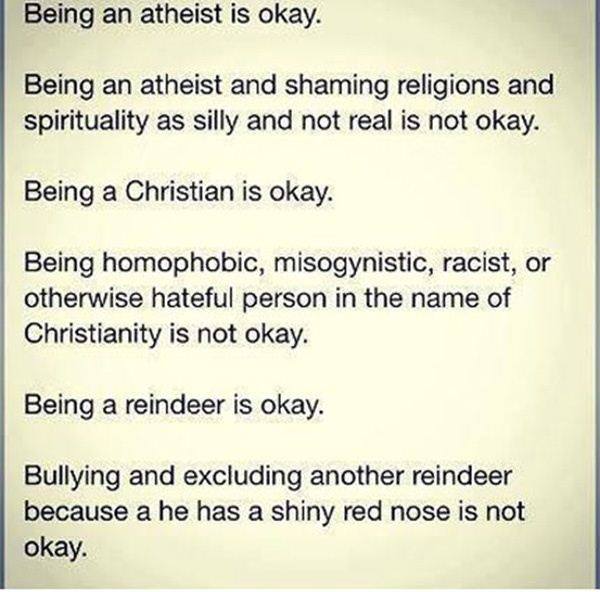
Remember:

983595_584396408258592_1673571756_n

So whatever you happen to believe, let’s lift a glass to Darwin today. His life’s work has gone a long way towards explaining the miraculous diversity of earth’s biosphere. And if I were God, I’d pin a medal on his chest. [2]

The Old Wolf has spoken.


1 Darwin, Francis, The Life of Charles Darwin. London: Tiger Books,1995, 55.
2 So it’s incongruous. So sue me.

Judge not. Period.

Found this story on Reddit, posted by user dk0, and felt moved to share it here, mildly edited for clarity.


A man who worked as an archaeologist was leading a tour group through a museum as part of his summer job. He had a large and prominent tattoo in a visible place, not anything obscene or even particularly challenging.

A person in the tour group, a middle aged woman, was persistently very snippy and dismissive of his lecture and when he finally confronted her about it in front of the group, she said she couldn’t take him seriously because he was tattooed.

He replied “this isn’t an ordinary tattoo, you see.” while slightly tilting the tattooed extremity, almost as if he expected it to beam a glint of light back at the viewer if cambered just right, “this tattoo is magic.” he said with a twinge of mysticism in his voice.

“If i hold it just right, it exposes the prejudice and ugliness of small and petty people.”


It puts me in mind of the little vignette by St. Ex found in The Little Prince:

I have serious reason to believe that the planet from which the little prince came is the asteroid known as B-612.

This asteroid has only once been seen through the telescope. That was by a Turkish astronomer, in 1909.

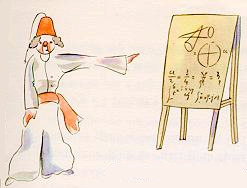
On making his discovery, the astronomer had presented it to the International Astronomical Congress, in a great demonstration. But he was in Turkish costume, and so nobody would believe what he said.

4c

Grown-ups are like that…

Fortunately, however, for the reputation of Asteroid B-612, a Turkish dictator made a law that his subjects, under pain of death, should change to European costume. So in 1920 the astronomer gave his demonstration all over again, dressed with impressive style and elegance. And this time everybody accepted his report.

4d

One would think that certain subsets of society would get the concept of judgment; a man named Jesus is reputed to have said, around 2 millennia ago,

“Judge not, and ye shall not be judged: condemn not, and ye shall not be condemned: forgive, and ye shall be forgiven.”

Certainly those who follow the teachings of that individual understand this, right?

These are “Christians”:

westboro1-3d0baab9ccc674c5428c2cf5342da0ffcee7da0e-s6-c30

The Westboro Baptist Church condemns just about everyone to Hell, without knowing a thing about who they are.

These are Christians too:

Street Morons

Evangelical Christians sending Latter-day Saints to Hell, because they happen to understand God differently than they do.

Of course, debates of this nature always seem laughable to humanists, sort of like fighting over this:

FSM-Fight

So of course, humanists have a firm grip on the destructive nature of judgment, right?

Humanism is a worldview which says that reason and science are the best ways to understand the world around us. Dignity and compassion should be the basis for how we act toward others.
-American Humanist Association

And yet we see statements like the following from Ernest Hemingway: “All thinking men are atheists,” which banishes 4/5 of the world’s population from the ranks of thinking humanity.

To people on both sides of the fence, I say this:

world view

Atheism has taken a prominent place in social dialog since – it seems to me – Madalyn Murray O’Hair entered the scene. It’s hip to be atheist, and in most academic circles it’s de rigeur. People of faith are ostracized, belittled, humiliated, and sidelined. The only acceptable topic of discussion when it comes to religion is its excesses and abuses. By the same token, in other communities, standing up for documented scientific realities such as evolution or global climate change are enough to get you excommunicated, or at the very least subject to the same ostracism and denigration.

That’s no way to run a railroad; it’s no way to run a planet.

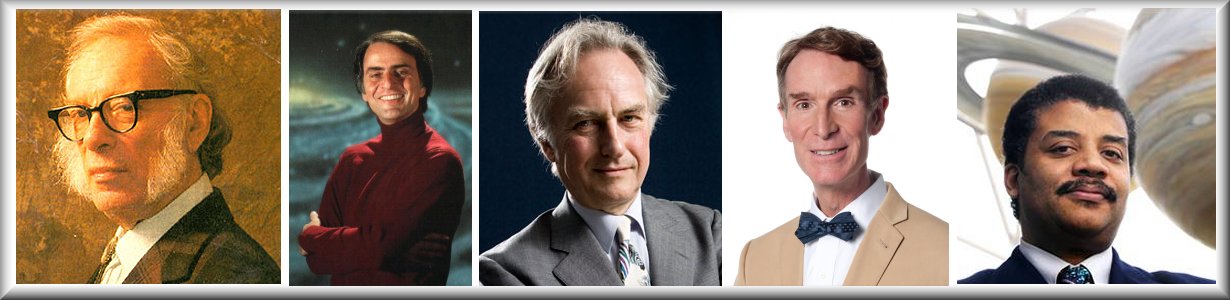
I have massive respect for the likes of these gentlemen [1]:

Scientists

Each one has been, in his own time, a crusader for reason and fact. Some have been combative, others encouraging. Some take the position that religion is an evil to be purged from the face of the earth, others put more energy into encouraging free thought and curiosity. Neil DeGrasse Tyson’s quote is one of my favorites:

“I don’t have an issue with what you do in the church, but I’m going to be up in your face if you’re going to knock on my science classroom and tell me they’ve got to teach what you’re teaching in your Sunday school. Because that’s when we’re going to fight.”
The Amazing Meeting, Keynote Speech, 2008

But I have to say this: I’ve read their writings, and at least two of them sound more than a little hopeful that this empirically-observable universe is not all there is. To their credit, all of them have subjugated any personal hopes or beliefs to the rigors of empirical observation.

There must be room at the table for everyone. No faith is going to convert the world with persuasion or the scimitar, and the passage of time will not still the yearning in the breasts of billions for something higher than themselves, something more personal than the thought of hydrogen atoms evolved to consciousness.

Judge not. Just stop it. Promote what you love, but don’t put down those who don’t fit your mold.

Of the faithful, I beseech: Believe what you will, but don’t deny empirical evidence. Of the humanists, I implore: Promote scientific truth and awareness, but stop relegating believers to second-class intellectual citizenship. Neither of these positions are worthy of a world that works for everyone, with no one left out.

The Old Wolf has spoken.


[1] Asimov, Sagan, Dawkins, Nye, Tyson. It does not escape my attention that there are no ladies in this lineup; I have no doubt that I could find an equal number, but in this case the reality is that the spokespeople for the triumph of reason via science happen to be overwhelmingly male at the moment.

Islam: It’s not what you think (and yes, it is)

I’m not a Muslim, so from the outset I admit it’s unfair of me to even attempt any real assessment of the faith. However, I live (as do we all) in a world that is awash in Islamic issues and Islamic news stories and Islamic internecine conflicts and Islamic soul-searching.

Just today I came across two articles which I thought were intriguing and revelatory.

The Trouble Within Islam

The first, by the honorable Tony Blair [1], points out, legitimately, that there is a problem within Islam that it would be folly to ignore. This is, as the body of the article goes on to explain, is entirely different than claiming that there is a problem with Islam, as so many inflammatory websites and news pieces would have the world believe. It has become de rigeur in some circles to label any criticism of Islam as racist, or “Islamophobic;” nothing could be farther from the truth.

MPJn2Dc

If there is a problem with any ideology that threatens the peace and harmony of people and cultures which touch it, it must be subject to the closest of scrutiny and be willing to succeed or fail on its own merits. We are seeing this today, particularly in the USA where I live, as the humanist community shines the light of reason on the follies and excesses of religions, but particularly Christianity. If the institution has merit, it will endure. If it does not, ultimately it must re-invent itself or fall.

So yes, I agree – and have felt this way for a long time, particularly since the horrors of September 11th – there is a problem within Islam. However, as the second article illustrates, Islam is not what the slavering haters would have us believe.

Global Muslim Delegation Issues Unprecedented Statement Against Anti-Semitism

I have long called for the Islamic mainstream to stand up and shout their outrage about the rot that festers within their own community, much in the same way that mainstream Christians decry the brutal ignorance of the Westboro Baptist Church, and these brave people are doing just that. I laud them for their courage and humanity.

I’ve traveled much in the world, and spent a fair piece of time in Islamic countries. Islam is as varied as every single one of its practitioners, and as a result it’s an exercise in futility and unfairness for either outsider or insider to state unequivocally, “Islam is…”; but recognizing both that there are problems within the community that need to be addressed, and that there are people within the community who are making an effort to do so, are affirming and encouraging – at least to my way of thinking.

As humanity scrabbles its way out of the mud and continues to take baby steps towards the stars, it behooves us all to act as though we are living in a world that works for everyone, even if such a dream is still beyond our grasp.

The Old Wolf has spoken.


[1] Whether you think Mr. Blair is honorable is up to you. I know that during his tenure in office, he was probably as universally reviled as George W. Bush, with whom he collaborated with regards to the Middle East. History will judge; for myself, I respect the man and his efforts.

The Etz Hayyim (Tree of Life) Shtender

I recently posted about the “Hidden Synagogue.” This post has been immensely popular, given the beauty and uniqueness of the artwork it showcases.  Thanks to reader Stephen Levinson who left me a comment at that entry, I have another wondrous thing to share with you.

The Yiddish word “shtender” (שטענדער) literally means a “stander,” but most people would know one as a “lectern.” As a child, I first saw one in the public library, being used to hold up Webster’s large dictionaries.

Traditional Shtender

Shtenders are very popular in yeshivot (jewish institutes of religious learning), and they can be tall, as above, or smaller, to fit on a desk.

sm-shtender_1338_detail

Now, thanks to Stephen, I am aware of another piece of mind-bending craftsmanship and faith, the Tree of Life Shtender.

When I watched this video, I first thought, “Nice concept, but it’s just 3D graphics.”

Wrong. It’s the real McCoy, kinder. Every object you see in the shtender is real, and the whole is beautifully carved.

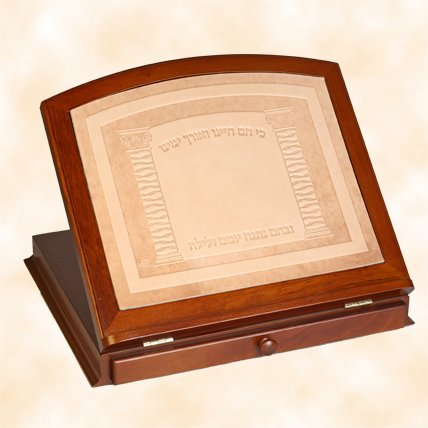
shtender


The Tree of Life shtender

33

The Sabbath Candelabra

An 18-year collaborative work of art between David Moss and artist Noah Greenberg, a number of these beauties have been created and placed in museums, synagogues, and private homes.

Moss himself has described his work in far better detail than I ever could – click through for his explanations; another website on the topic can be found at Bezalel Editions.

Items like this are the product of immense love and devotion, not to mention painstaking craftsmanship. I am pleased to share them with my readership.

The Old Wolf has spoken.

The Hidden Synagogue

Notes:

  1. As reader bklyngalinla has pointed out in the comments below, this piece is a contemporary work of art, rather than being from the inquisition or holocaust periods. However, it is based on older pieces, and is in itself still a phenomenal piece of artwork. Here is a link to another blog that gives more information. I, also, am guilty of not doing any research on my own to verify the facts as stated by the original poster. This, however, has not seemed to dampen reader response to this post, which has been overwhelming – I thank everyone who has come by, simply because I chose to share something I found beautiful and faith-affirming.
  2. The title “hidden synagogue” is not mine, but those of the original poster at Reddit. A number of readers have rightly pointed out that this device would have been used in a home and not a shul; that said, I think the idea is that during such times, attendance at temple would be difficult if not impossible, and the teapot would serve as a way of keeping Torah and Commandments alive in the hearts of the faithful until times were better.

    Why We Tell Stories

    When the founder of Hasidic Judaism, the great Rabbi Israel Shem Tov, saw misfortune threatening the Jews, it was his custom to go into a certain part of the forest to meditate. There he would light a fire, say a special prayer, and the miracle would be accomplished and the misfortune averted.

    Later, when his disciple, the celebrated Maggid of Mezritch, had occasion, for the same reason, to intercede with heaven, he would go to the same place in the forest and say: “Master of the Universe, listen! I do not know how to light the fire, but I am still able to say the prayer,” and again the miracle would be accomplished.

    Still later, Rabbi Moshe‑leib of Sasov, in order to save his people once more, would go into the forest and say, “I do not know how to light the fire. I do not know the prayer, but I know the place, and this must be sufficient.” It was sufficient, and the miracle was accomplished.

    Then it fell to Rabbi Israel of Rizhin to overcome misfortune. Sitting in his armchair, his head in his hands, he spoke to God: “I am unable to light the fire, and I do not know the prayer, and I cannot even find the place in the forest. All I can do is to tell the story, and this must be sufficient.”

    And it was sufficient.

    -from Wiesel, Elie, Souls on Fire

    This teapot strikes me in much the same way. It is almost saying, “We cannot worship in the synagogue, but we can worship at home, and it must be sufficient. And for many, it was sufficient. Hence to my way of thinking, calling it a “hidden synagogue” is not totally amiss.

  3. Regarding the use of menorah vs. chanukia, see the footnote at the end, and then jump in and join the noisy debate in the commentary if you feel so inclined. Just play nice. -O.W.

———————-

Found at Reddit, these are photos of a mind-bending piece of artwork.

The original photos are at Imgur. I cannot adequately express in words how beautiful this is.

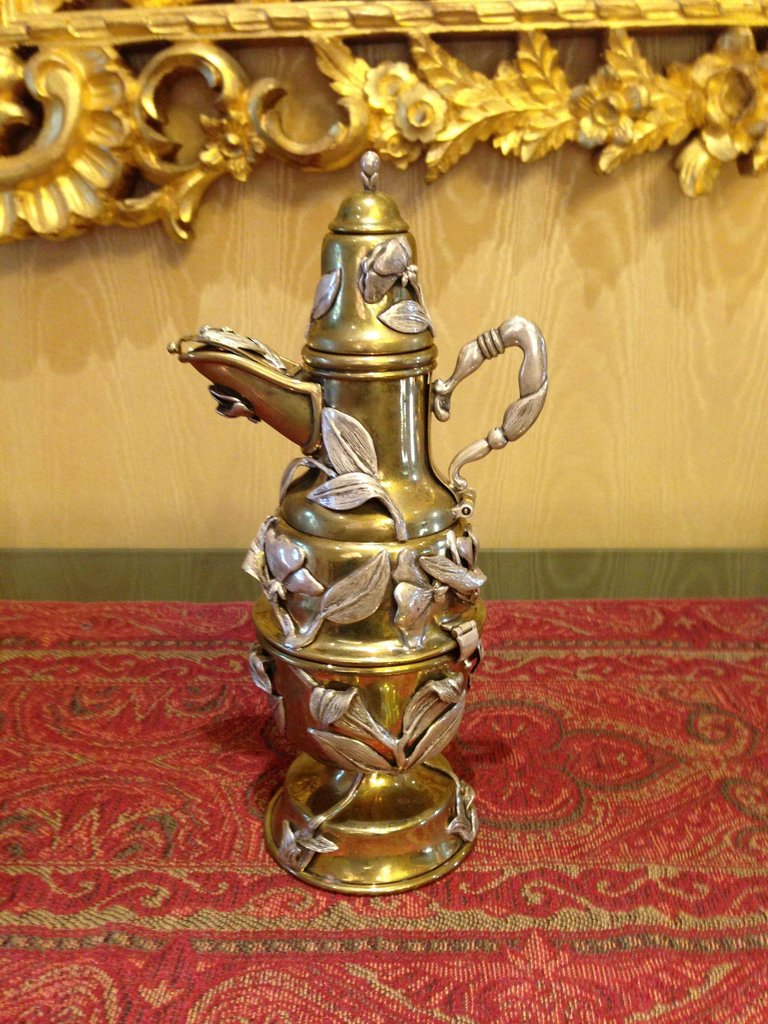
01

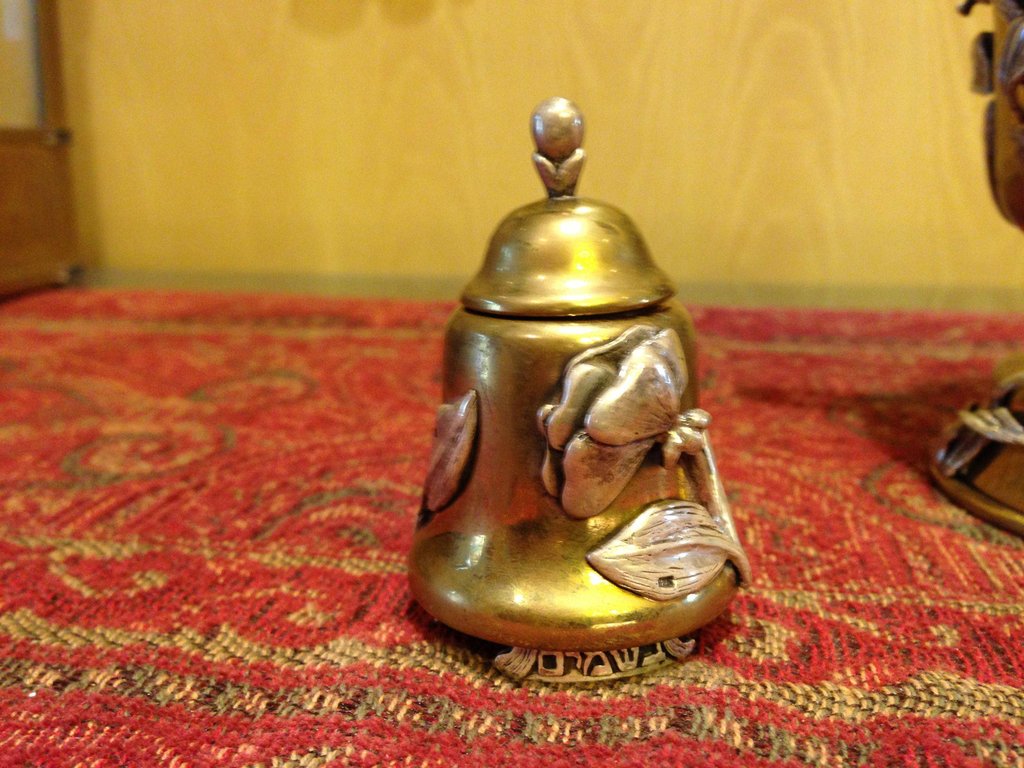
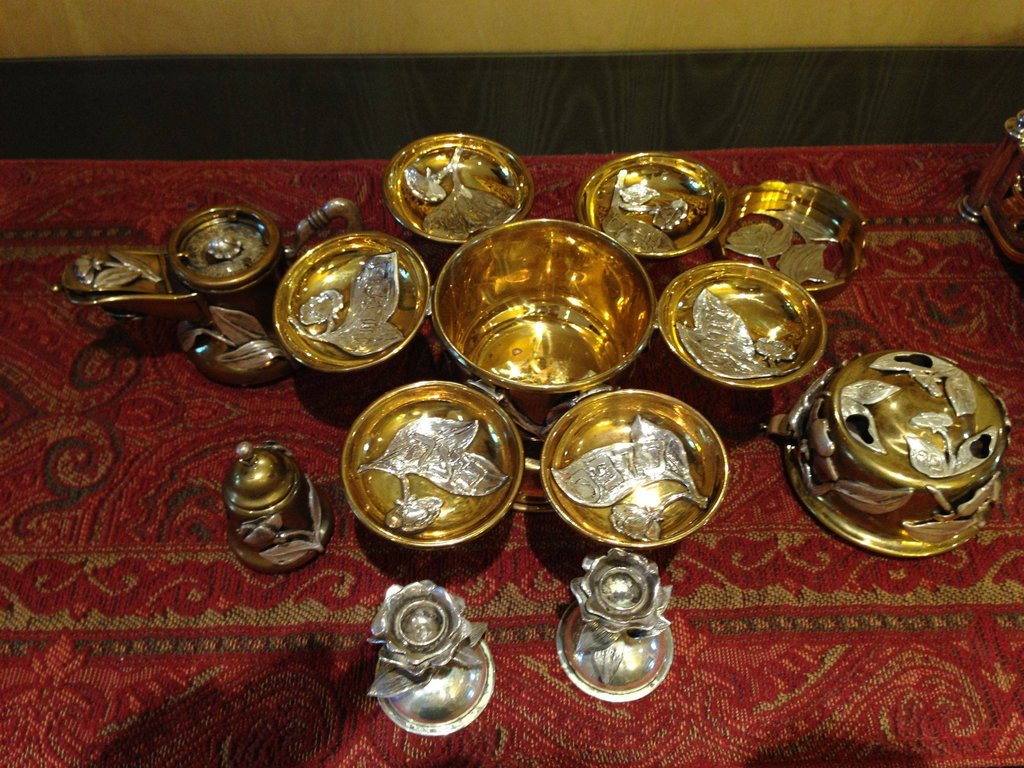
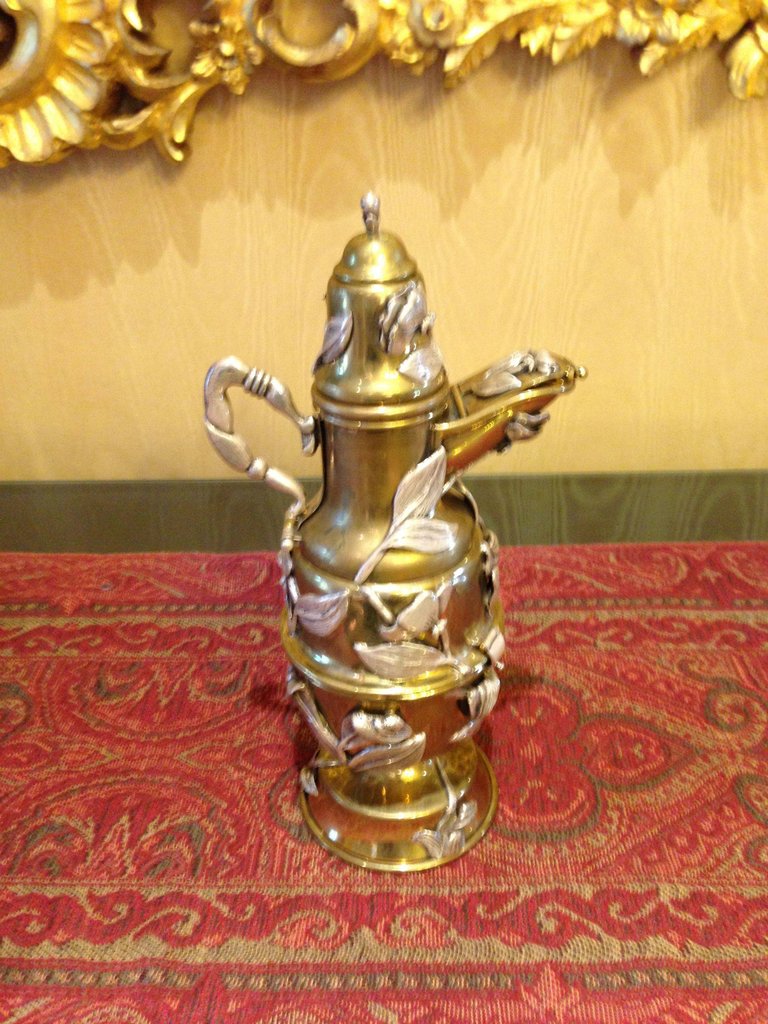
The complete teapot

04

Remove the top…

03

 Its’ a hidden dreidel

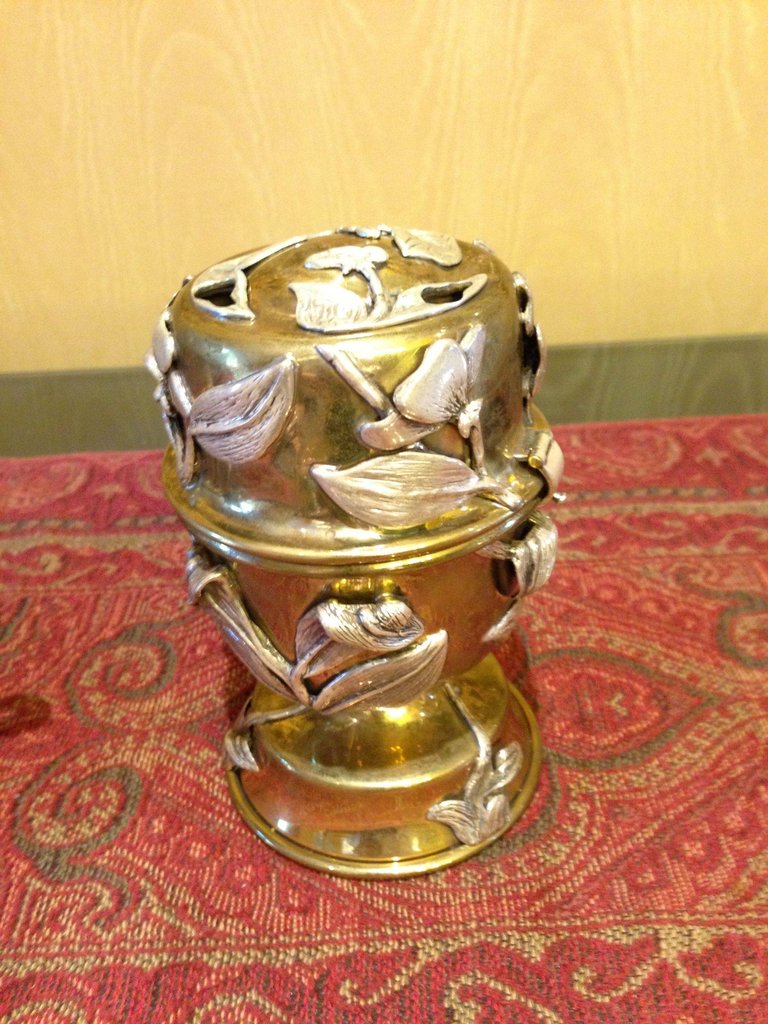
02

Remove the next layer

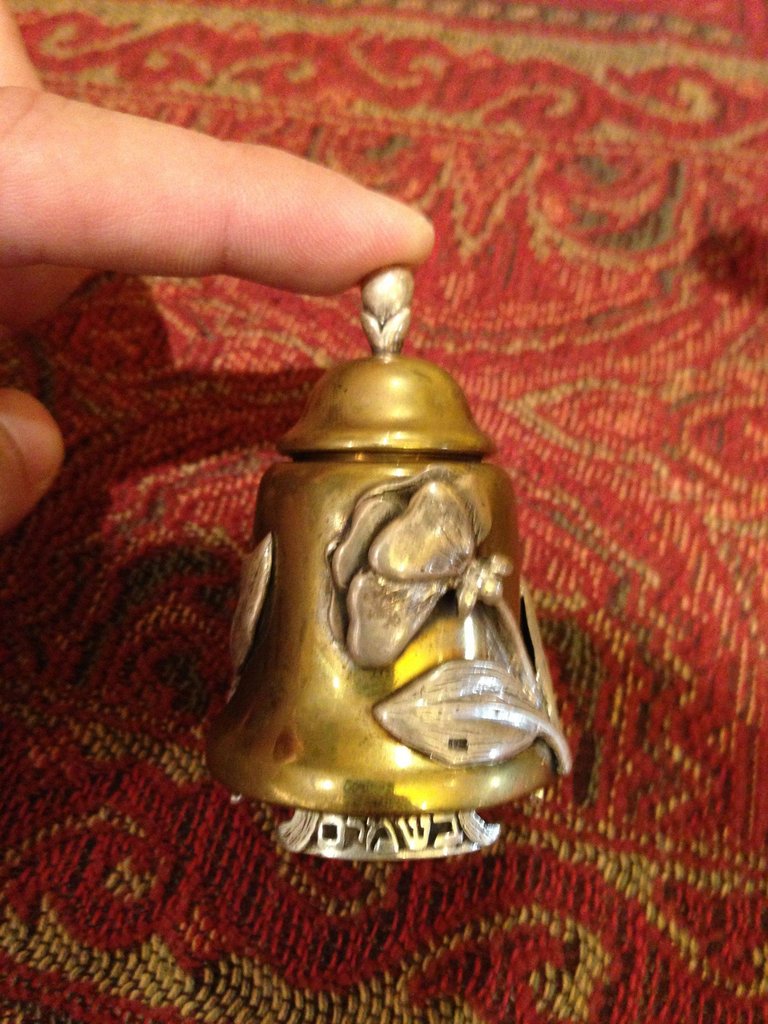
05

A perfume/spice holder. 

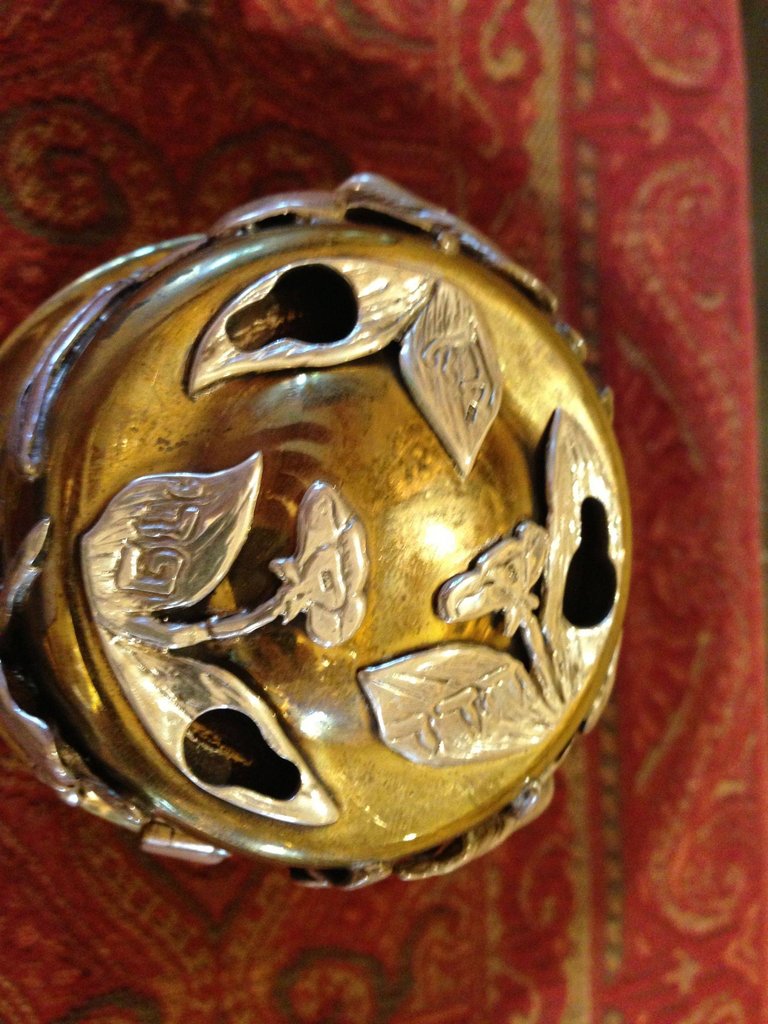
06

Opened

09

The Hebrew word on the bottom says בשמים (basmim), “spices or perfumes”

08

The next layer is…

07

The eternal flame.

11

The Front View – The inscription reads, “The light of god is man’s soul.”

12

But there’s another secret:

10

A complete megilla (the scroll containing the biblical narrative of the Book of Esther, traditionally read in synagogues to celebrate the festival of Purim.)

13

The main body is designed to hold an etrog, the yellow citron or Citrus medica used by Jews on the week-long holiday of Sukkot.

15

The words say “pri etz hadar” (the fruit of the majestic tree), a biblical reference to the etrog.

14

Inside

16

Candlesticks for Shabbos

21

Closeup of candlesticks

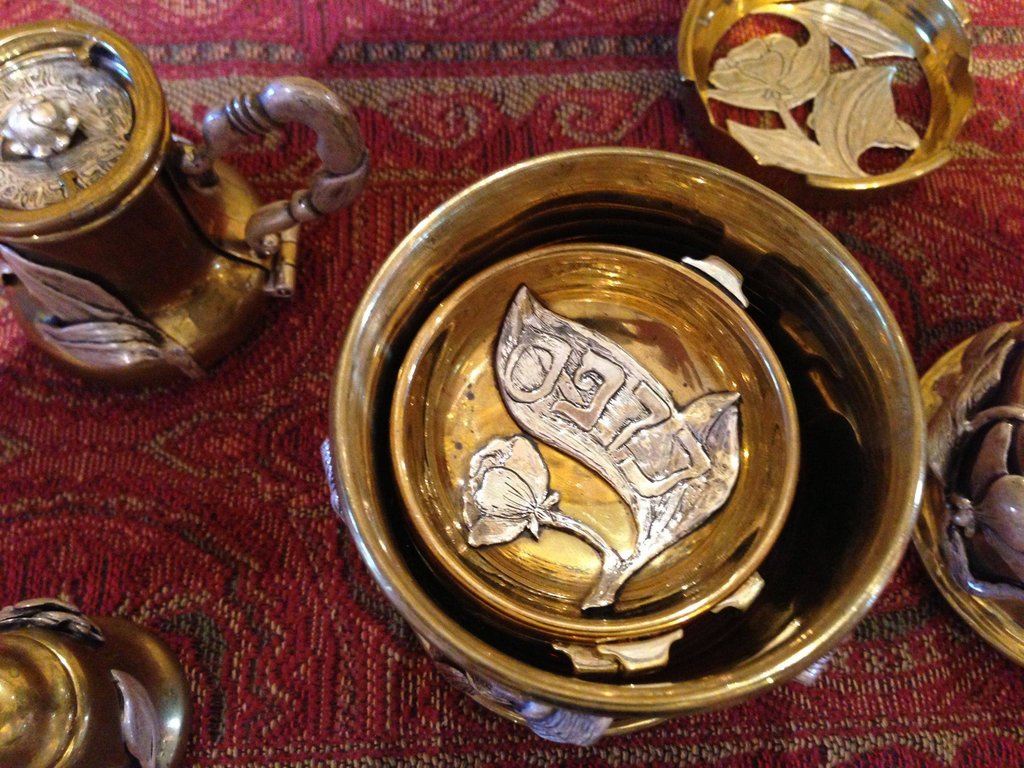
18

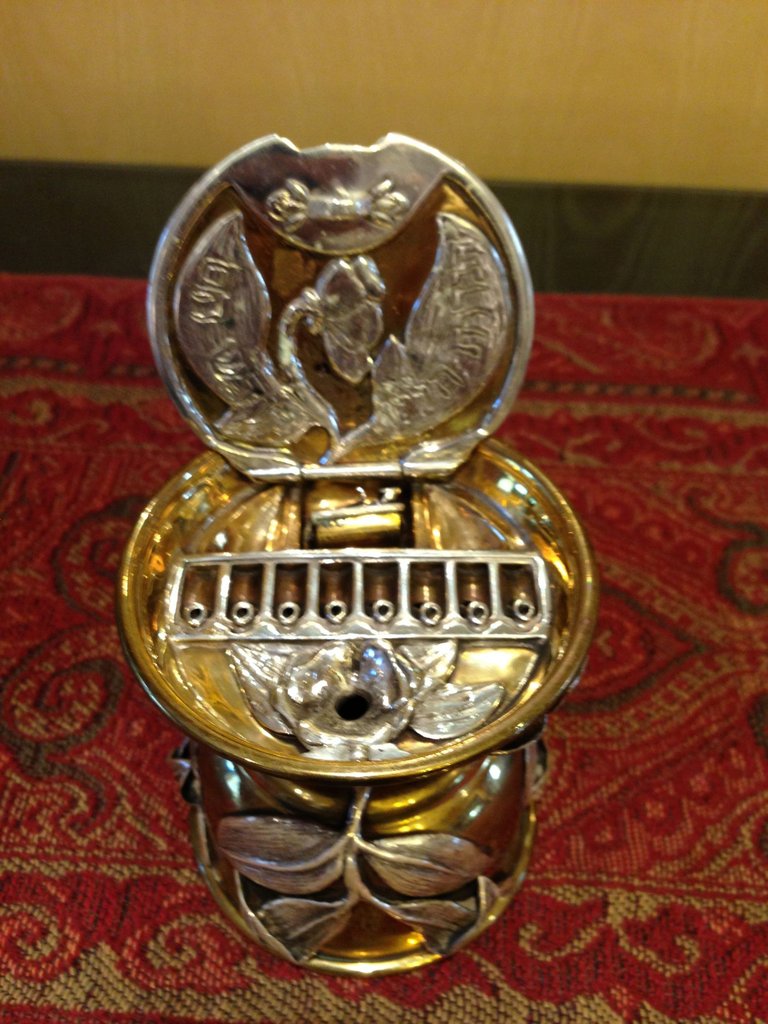
Remove the flowered tray, and under the candlesticks is…

17

A Seder plate.

19

Complete

20

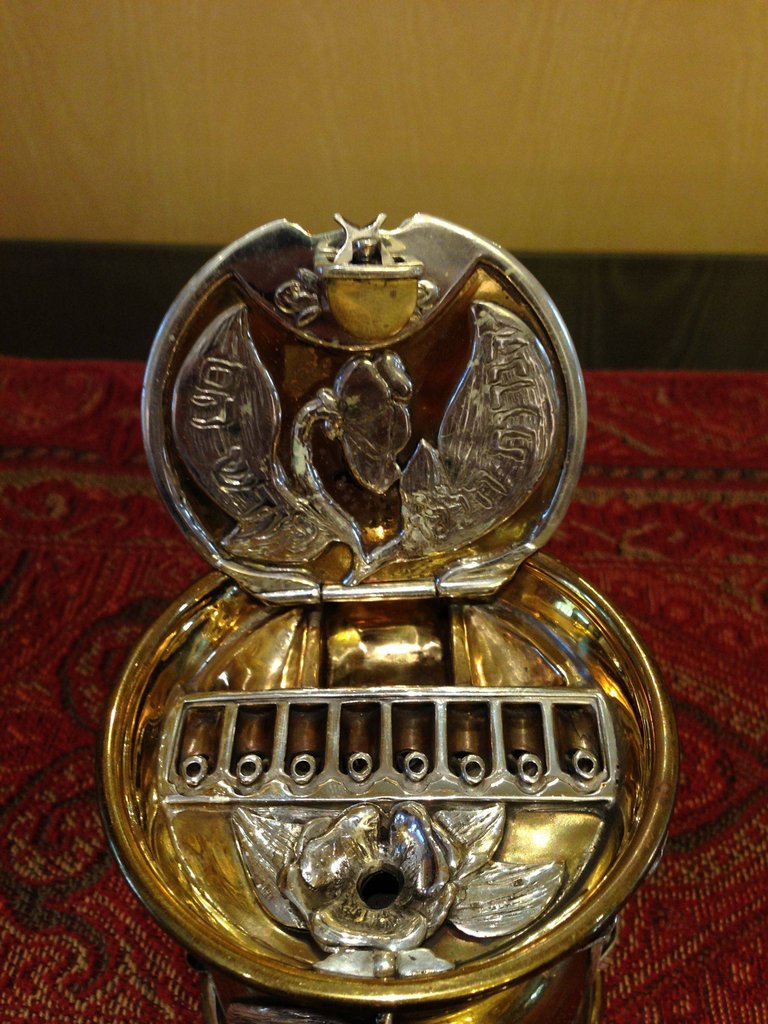
But there’s one more thing.

22

A menorah.[1]

23

With the shammash (“servant”), the 9th light of the menorah used to light the other 8 candles.

24

Reassembled

The Old Wolf is in awe.


[1] With regards to the lamp, Wikipedia has this to say:

The Hanukkah menorah (Hebrew: מנורת חנוכה m’noraht khanukkah, pl. menorot) (also Hebrew: חַנֻכִּיָּה‎ hanukiah, or chanukkiyah, pl. hanukiyot/chanukkiyot, or Yiddish: חנוכּה לאמפּ khanike lomp, lit.: Hanukkah lamp) is, strictly speaking, a nine-branched candelabrum lit during the eight-day holiday of Hanukkah, as opposed to the seven-branched menorah used in the ancient Temple or as a symbol. The ninth holder, called the shamash (“helper” or “servant”), is for a candle used to light all other candles and/or to be used as an extra light. The menorah is among the most widely produced articles of Jewish ceremonial art. The seven-branched menorah is a traditional symbol of Judaism, along with the Star of David.

In the English-speaking diaspora, the lamp is most commonly called a “Hanukkah menorah,” or simply “menorah” for short, whereas in Modern Hebrew it is exclusively called a chanukkiyah, and the Hebrew word menorah simply means “lamp”. The term chanukkiyah was coined at the end of the nineteenth century in Jerusalem by the wife of Eliezer Ben Yehuda, the reviver of the Hebrew language.

Since I am an English speaker, and since the vast majority of Americans are familiar only with the 9-branched “מנורת חנוכה” seen at Chanukkah, I’m sticking with “menorah.” Those who wish to call it a “חַנֻכִּיָּה‎” are correct in doing so.

Thou shalt!

wickedbible


This King James Version Bible is an unspeakably rare collector’s item. The printers were fined 300 pounds sterling for their terrible typographical error in printing the Ten Commandments, omitting the all-important word “not” and rendering the verse as, “Thou shalt commit adultery”! The lot of 1,000 copies were ordered destroyed, but only a handful escaped destruction, making them the rarest of rare. This is the only one for sale in the world. Offered at $89,500 at the Platinum Room.

For those of you who wish to justify yourselves via an appeal to the Scriptures, this is the volume for you.

The Old Wolf has spoken.


Habemus Papam

I’m not a Catholic, but I share in the joy and excitement of my many friends and associates who are, for this is a historic day.

Pope2

Had Cardinal Ouillet been elected, I had this great Cheezburger picture of him ready to go, with the caption “Eh-men!”. The universe, however, perversely robbed me of an opportunity to shine for 15 seconds or so. It would have been worth a few upvotes over at Reddit, certainly.

In the lead-up to the conclave, I have taken the opportunity to re-watch Saving Grace[1] more than once, and today as I watched the new pontiff[2] stand before his assembled faithful, pronounce blessings upon them, bow humbly to receive their prayers, and pray with them in a way that the youngest and poorest Catholic child could understand and follow, I was moved by his simplicity and humility; I could only imagine the terror and weight of responsibility and feelings of unworthiness that filled the new leader’s soul as he confronted this moment.

This is certainly a seminal moment; the first Pope from the new world, and definitely not an aristocrat. Cardinal Bergoglio appears to be doctrinally conservative, which doesn’t bode well for those hoping for reforms in Vatican policies towards the gay community or towards women – but time will tell.

Whatever the case, this man will now have an impact upon the lives of over 1 billion Catholics, and by the ripple effect, indirectly on much of the rest of the world. I offer him my prayers for strength, for health, for good humor and the ability to endure the rigorous life that awaits him, and above all for divine inspiration to lead his flock towards greater equality, greater tolerance, greater understanding, greater peace, and greater prosperity.

The Old Wolf has spoken.


[1] It’s a lovely film, and “it’s a good story.” Watch it if you can – it’s unfortunately not available on DVD, but deserves wider exposure.
[2] I haven’t had a TV in my home for over 15 years, but thanks to the miracle of the Internet, live feeds were available.