“Moving Stairs”: World’s Fair, 1939

WElDPAm

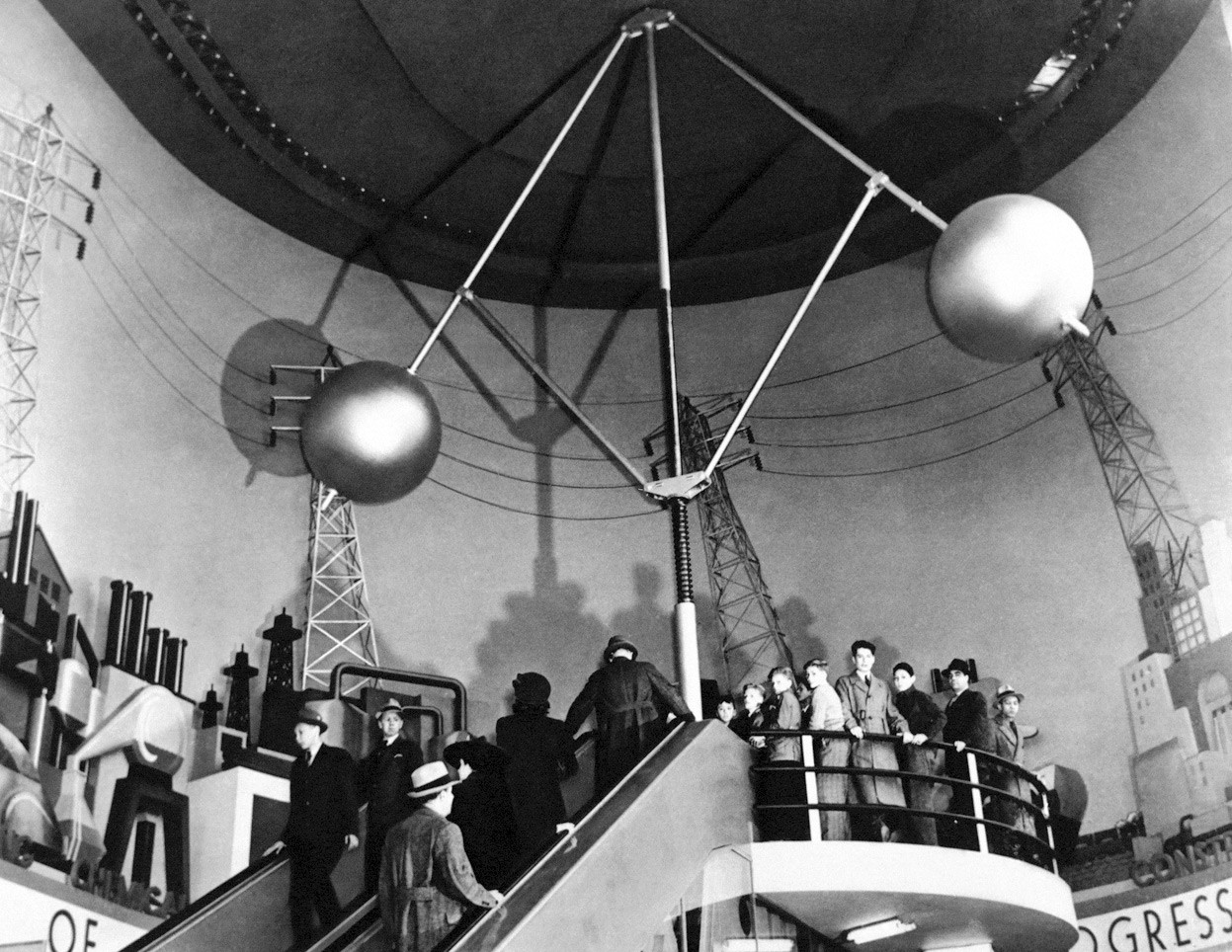
Visitors to the Hall of Power at the New York World’s Fair of 1939 ride the novel “moving stairs.”

The longest escalator in the world is found in the St. Petersburg Metro system, up to 433 feet (132 meters) long.

escalators metro

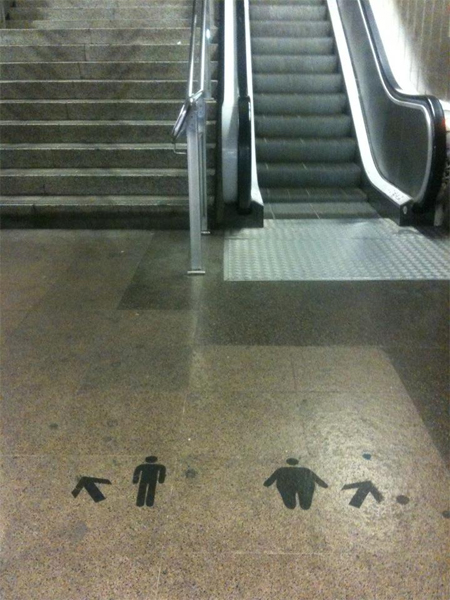
Some folks are still not clear on the concept:

escalator-gym

Only in America

il_570xN.317740446

Advicing good

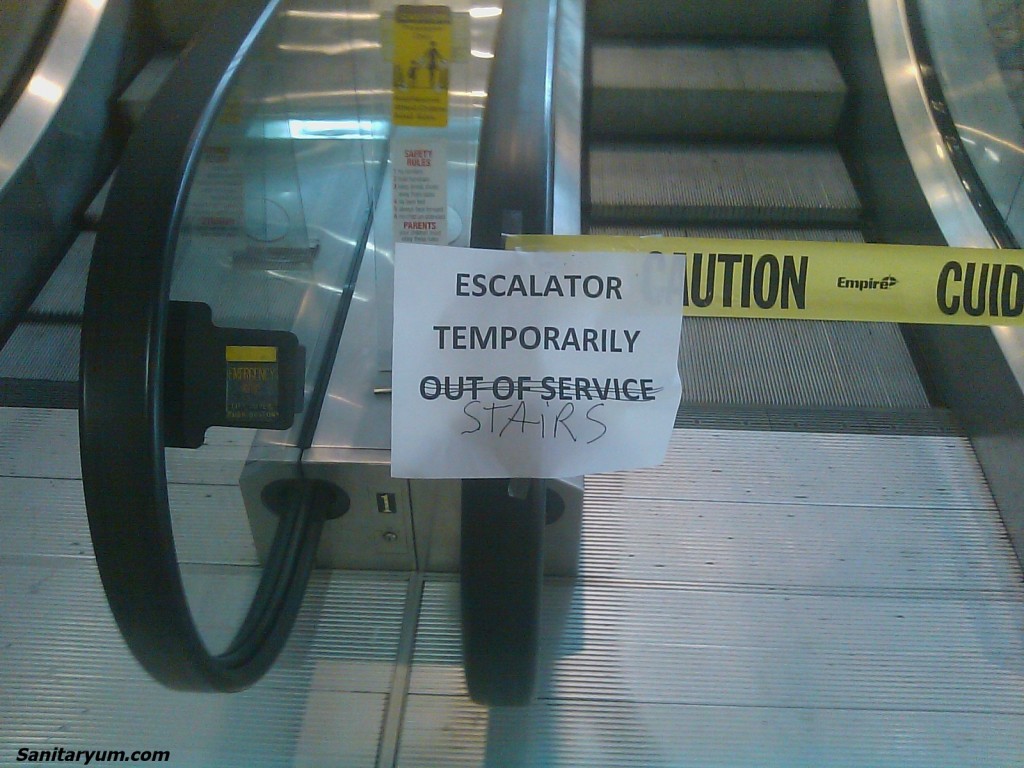
Escalator-Temporarily-Stairs-1024x768

Inconceivable!

auto-escalator-fail-307449

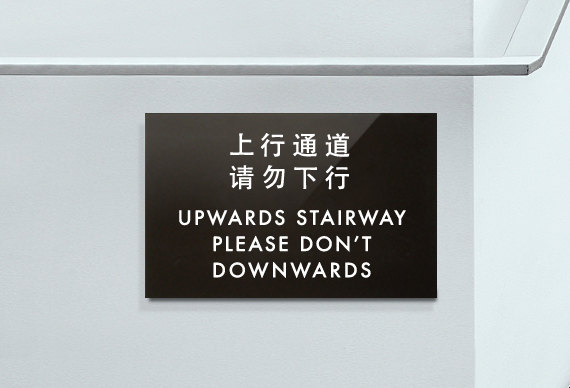
I’m tempted to shout ‘Merica! but this is obviously somewhere in Asia

a.aaa-Funny-Escalator-Sign

Guerrilla art

Garden State Plaza

There we go: ‘Merica! At the Westfield Garden State Plaza in Paramus, NJ.

The Old Wolf has spoken.

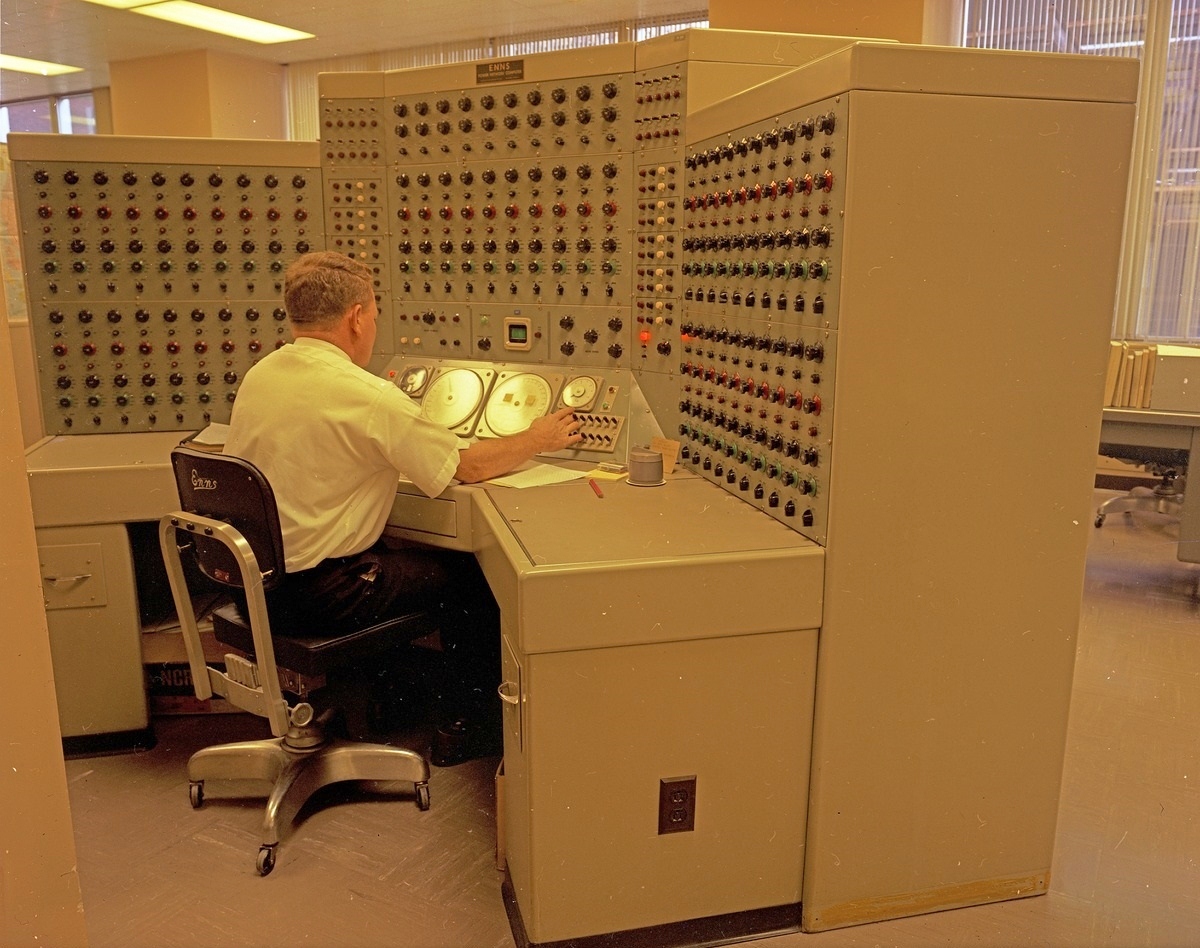
The Enns Power Network Computer, 1968

iba4gnNOqJhiyk

An operator working at an Enns Power Network analog computer. From the City Light, Seattle Municipal Archives. Analog computers were widely used in scientific and industrial applications where digital computers of the time lacked sufficient performance.

009

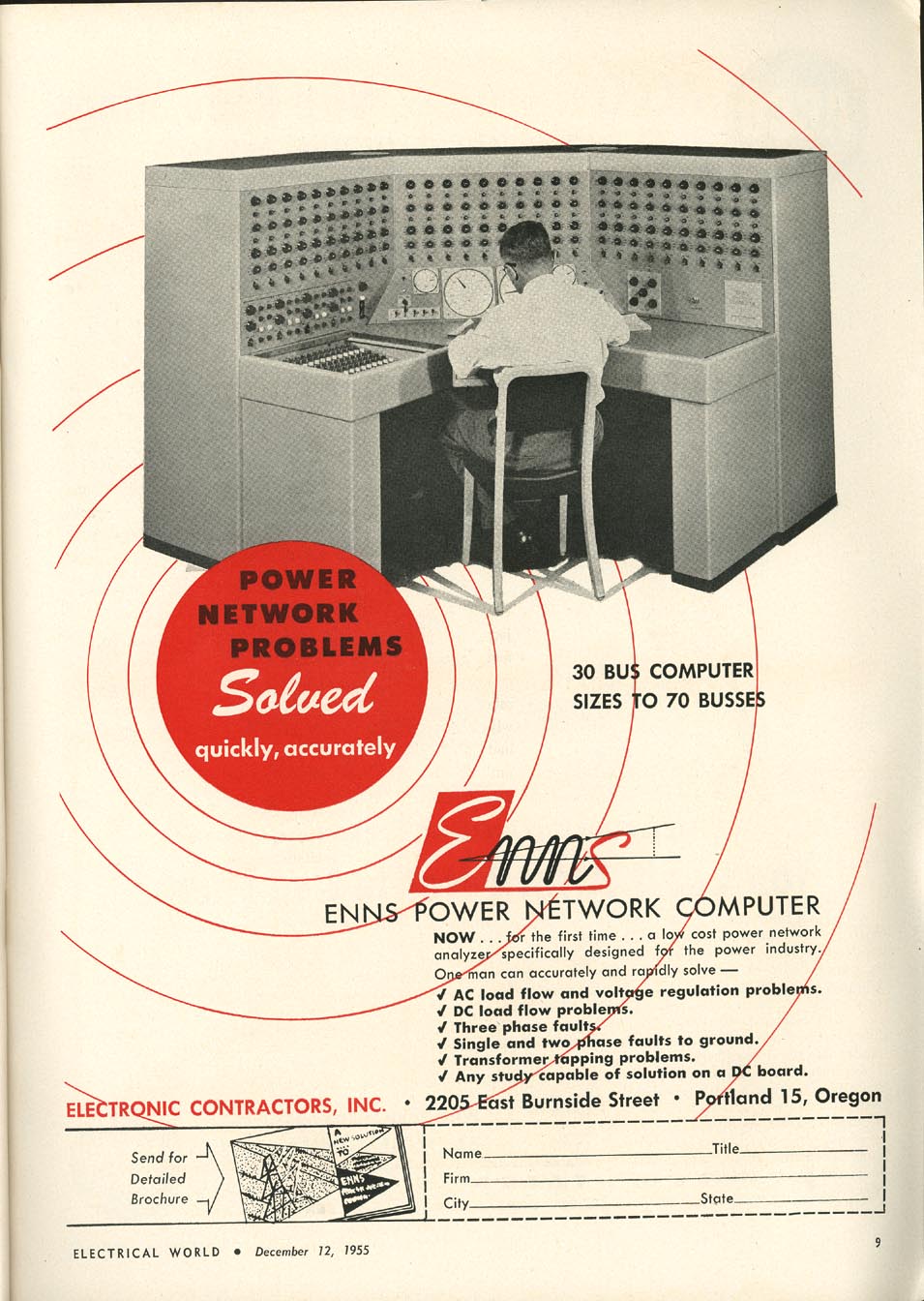
From the December 12, 1955 issue of “Electrical World” magazine, page 9

The Old Wolf has spoken.

Just Imagine: Assembling a telephone

I had a wonderful few minutes watching this old stop-motion film from 1947 showing how a telephone was put together. The music was great (although I couldn’t help seeing Wilson, Keppel, and Betty dancing off in the wings somewhere.)

The old dial phones had quite a few parts, didn’t they? But on the gripping hand, they were built like tanks and lasted pert’near forever.

The Old Wolf has spoken.

The Jaquet-Droz Automata

I started in the world of data processing in 1969 when I took my first FORTRAN class at the University of Utah, and learned the basics of programming a Univac 1108. My very first run spit out “unresolvable error in source code”, which error our instructor told us we would probably never see.

That tidbit aside, one of the things we learned about the history of the computer was that the Jaquard loom, first demonstrated in 1801 and designed to weave cloth based on a chain of “punch cards” was one of the first forays into programmable machinery.
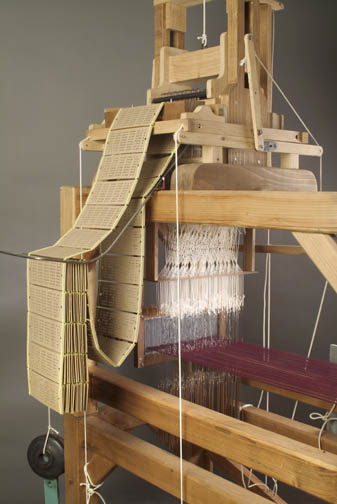
Jacquard Loom

Model of the Jaquard Loom built by students at the Northhampton Silk Project.

What we didn’t learn was that around 30 years earlier, the Jaquet-Droz family of Swiss watchmakers created some absolutely brilliant machinery with programmable capability – the Jaquet-Droz automata.
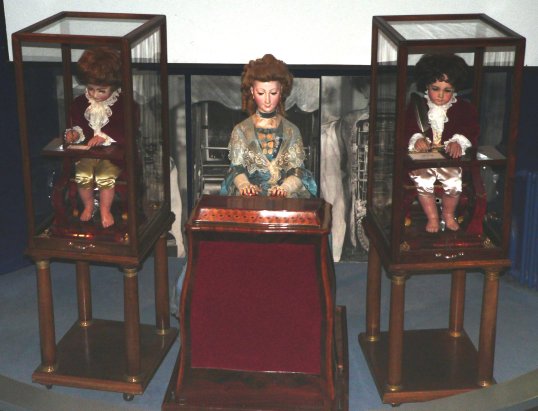
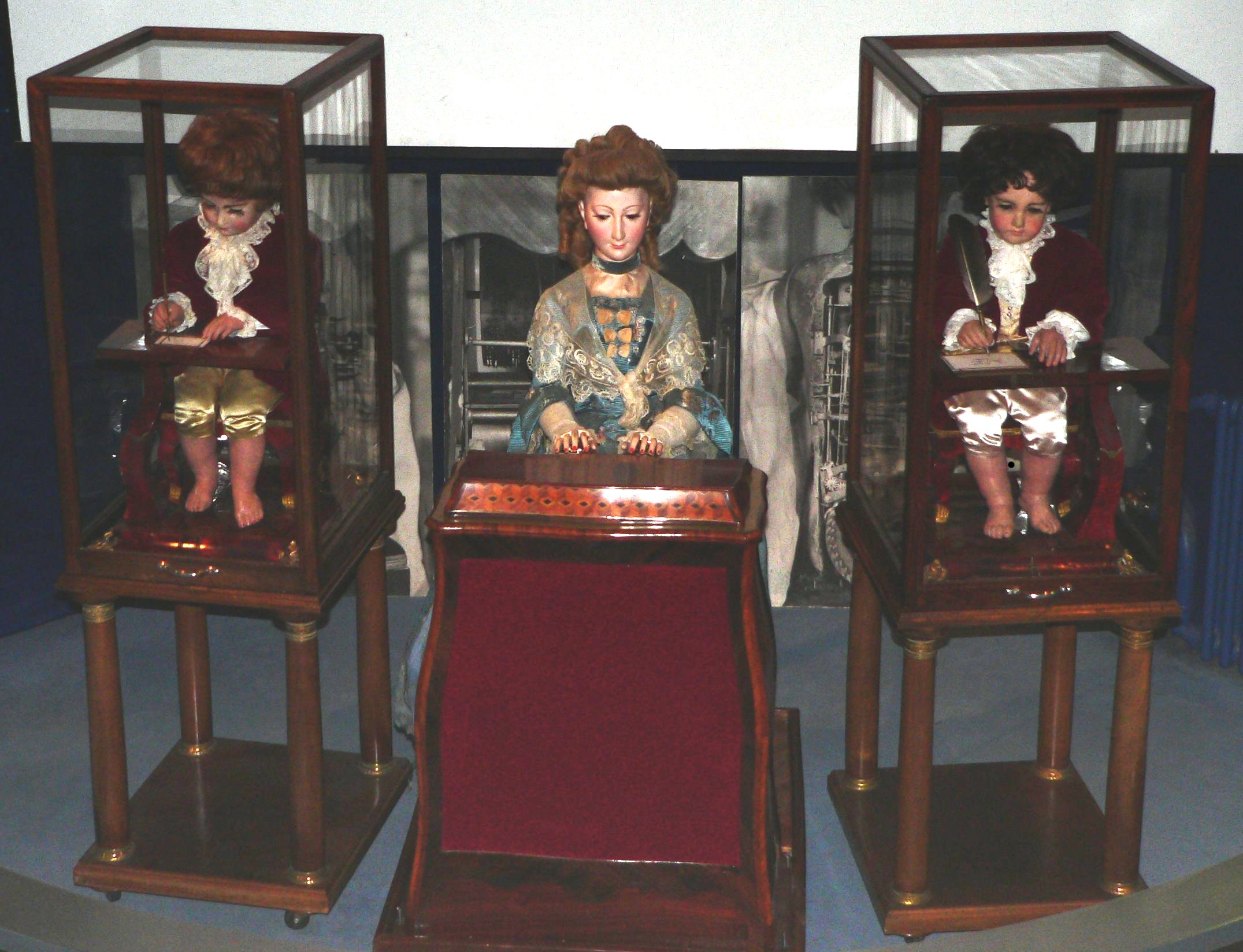
Automates-Jaquet-Droz-p1030472

These three little homunculi, from left “the writer,” “the musician,” and “the draftsman,” are miracles of miniaturization and precision machining, worthy of the finest watchmaking tradition of Switzerland. The currently reside at the Museum of Art and History at Neuchâtel, and I often saw them advertised when I lived there in 1984, although I didn’t get to see them in person.

The descriptions below are from the Wikipedia article linked above:

The musician is a female organ player. The music is not faked, in the sense that it is not recorded or played by a musical box: the doll is actually playing a genuine (yet custom-built) instrument by pressing the keys with her fingers. She “breathes” (the movements of the chest can be seen), follows her fingers with her head and eyes, and also makes some of the movements that a real player would do—balancing the torso for instance.

The draftsman is a young child who can actually draw four different images: a portrait of Louis XV, a royal couple (believed to be Marie Antoinette and Louis XVI), a dog with “Mon toutou” (“my doggy”) written beside it, and a scene of Cupid driving a chariot pulled by a butterfly. The draftsman works by using a system of cams which code the movements of the hand in two dimensions, plus one to lift the pencil. The automaton also moves on his chair, and he periodically blows on the pencil to remove dust.

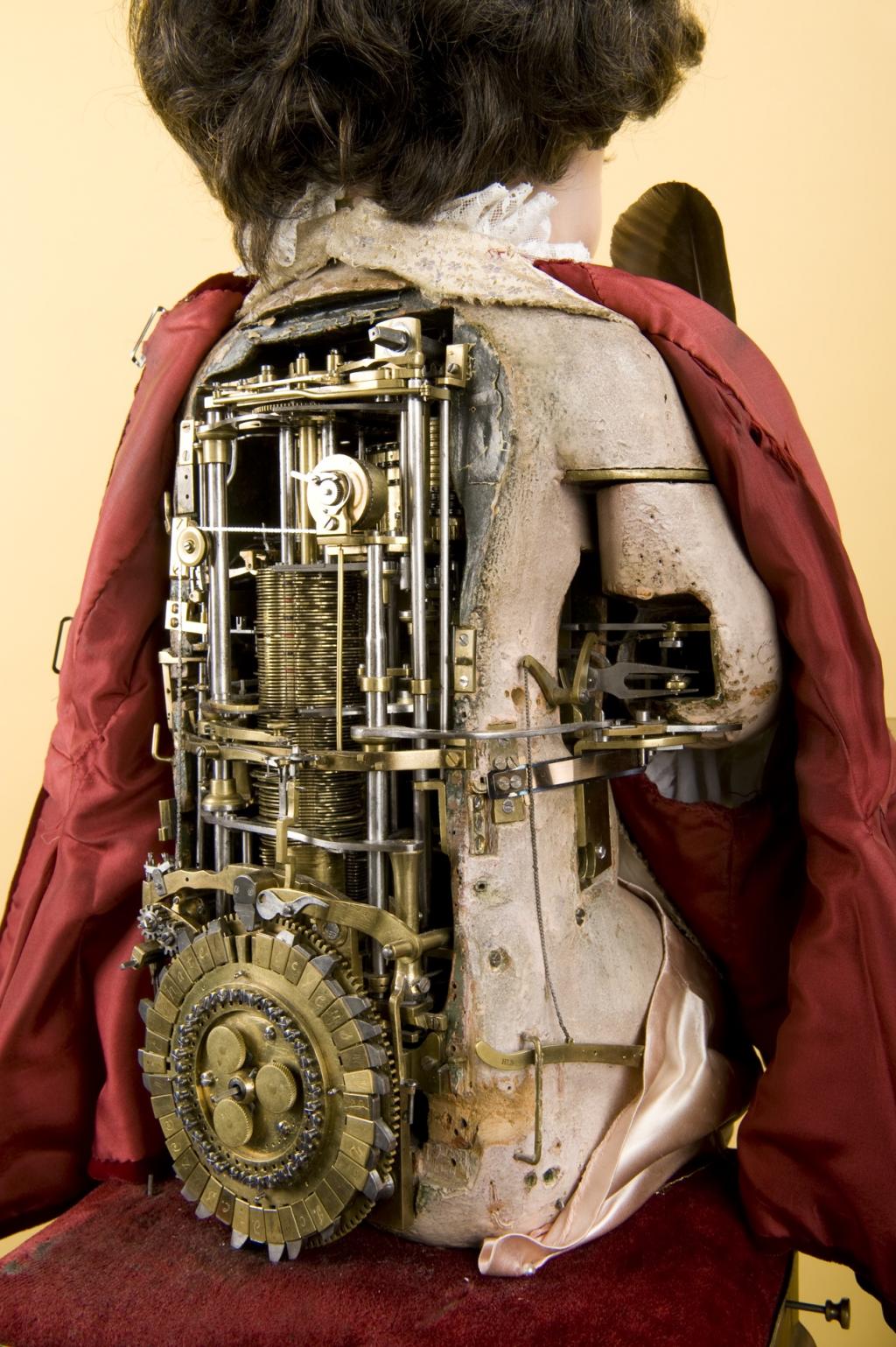
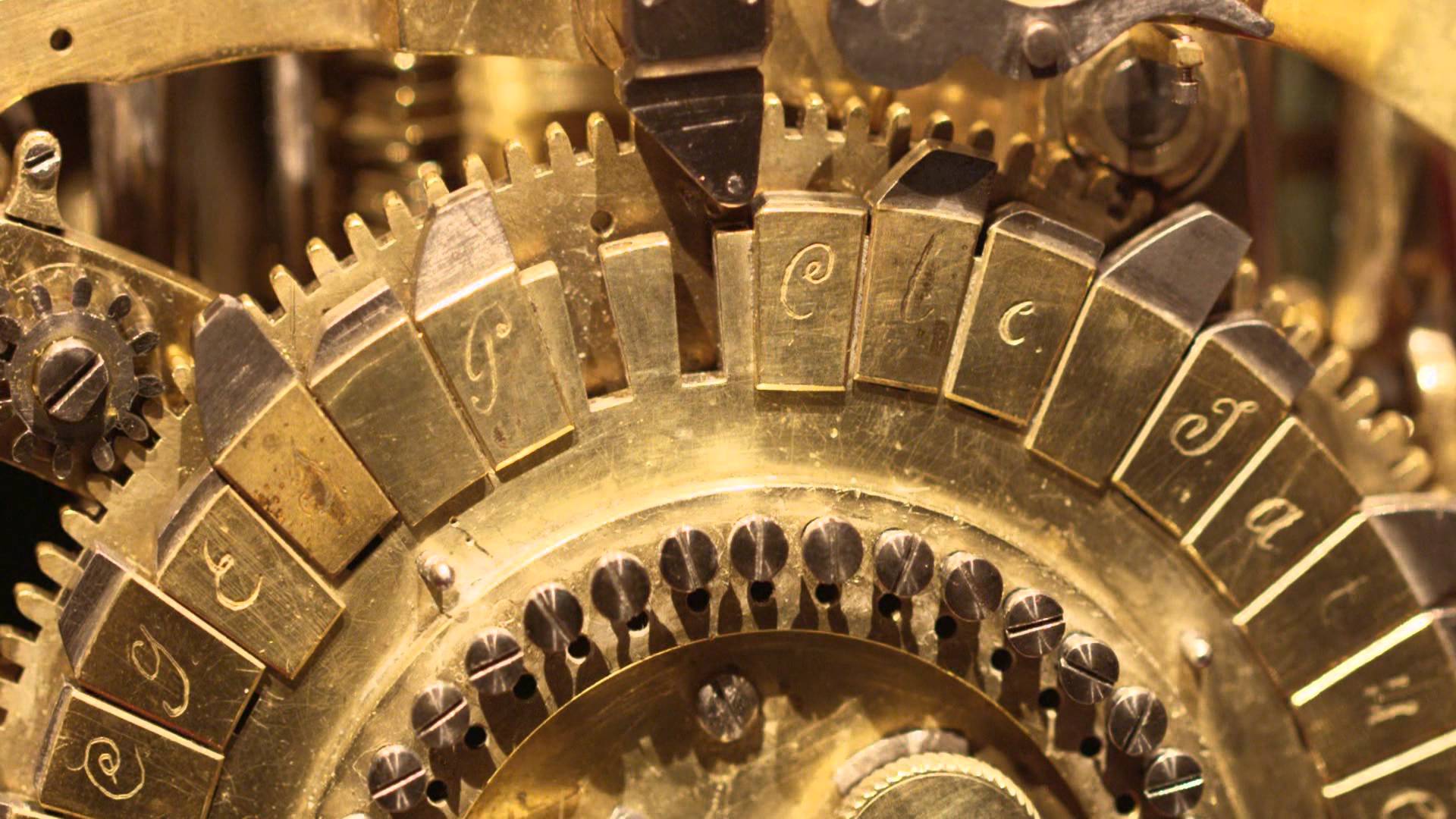
The writer is the most complex of the three automata. Using a system similar to the one used for the draftsman for each letter, he is able to write any custom text up to 40 letters long (the text is rarely changed; one of the latest instances was in honour of president François Mitterrand when he toured the city). The text is coded on a wheel where characters are selected one by one. He uses a goose feather to write, which he inks from time to time, including a shake of the wrist to prevent ink from spilling. His eyes follow the text being written, and the head moves when he takes some ink.

You can watch an informative and eye-popping video about “The Writer” at Chronday.
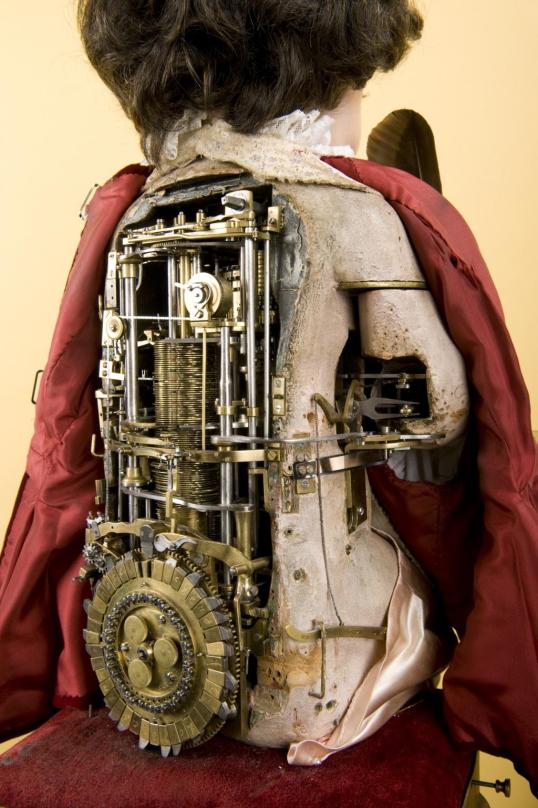
Jaquet_Droz_The Writer_2

Rear view of the writer, showing the programming wheel and the cam arrangement
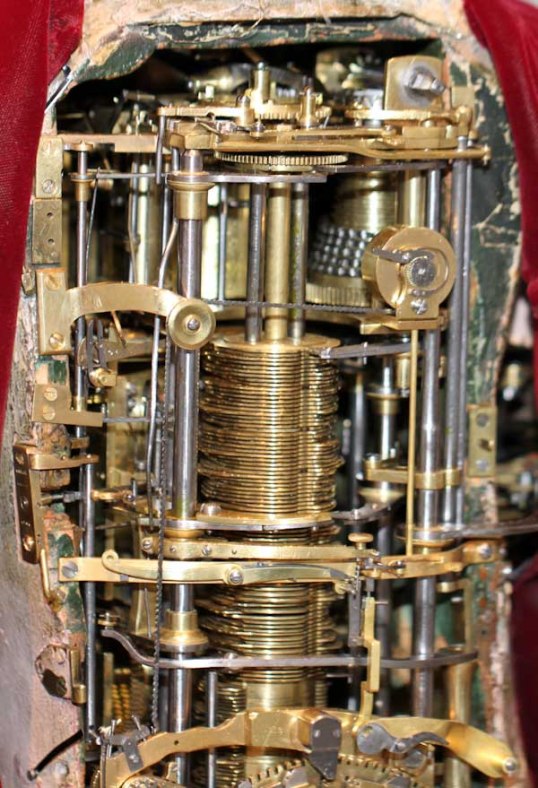
Jaquet-Droz-automata-3

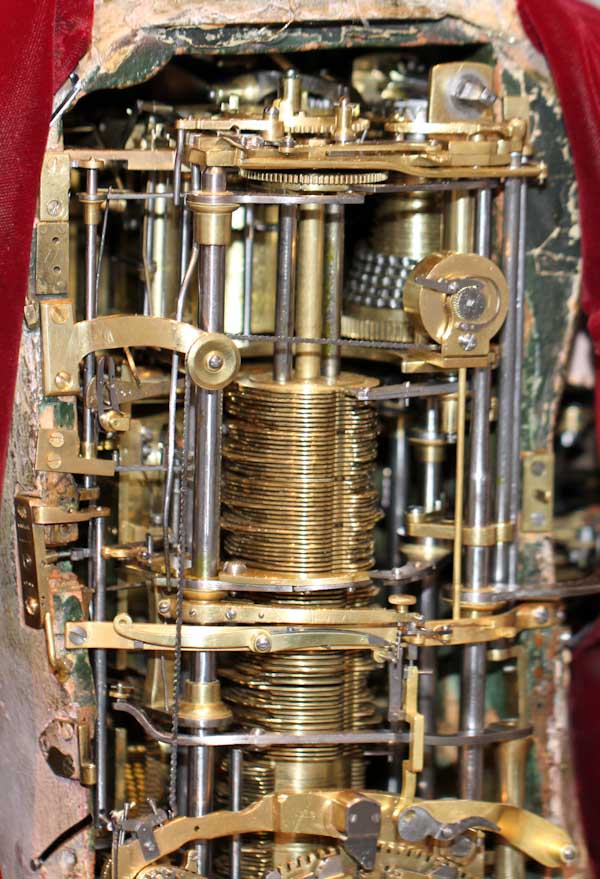
Closeup of the camshaft

maxresdefault

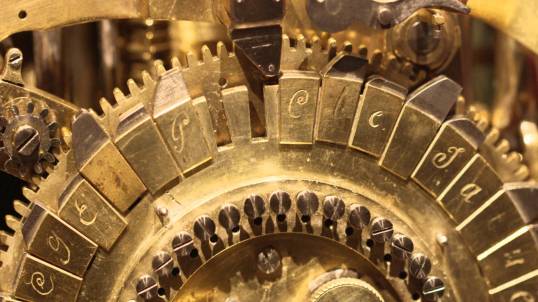
Closeup of the moveable letters which guide the writing.

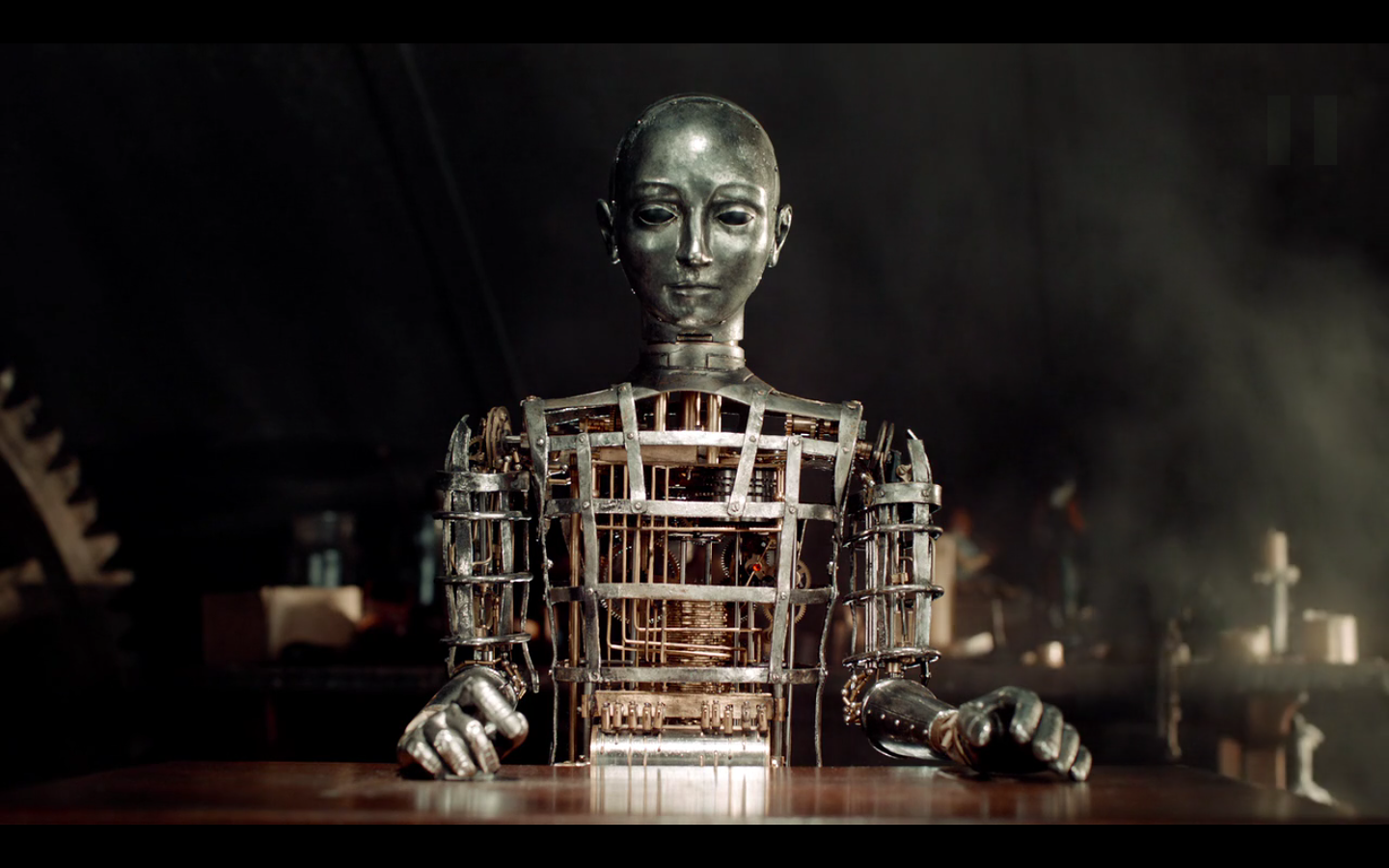
The robot in the movie “Hugo” was inspired by the Jaquet-Droz automata. If you haven’t seen it, I would find a copy at Redbox or Netflix and have a look – I found it well done.
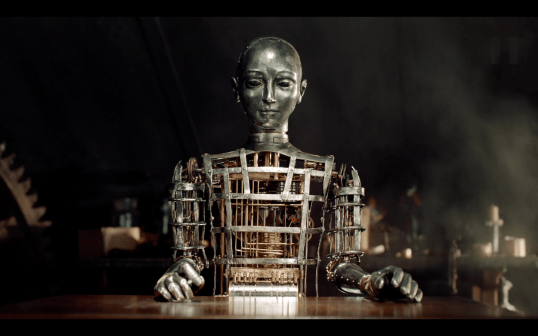
hugo-automaton-2

The Old Wolf has spoken.

The Old Organ Sound

I previously wrote about theatre organs (also known as the Unit Orchestra); I love these instruments, and nowadays modern electronics have been pretty much able to replicate the sound (if not the charisma) of a massive wind-driven instrument.

In the early days of electronic organs, however, Hammond’s drawbar and tone-wheel instruments were king, much as Wang’s word processor, before the advent of Word Perfect, was the system to have in your office. Those days are a relic of the past, but if you’re an oldster and ever went out to the ball game, you’re sure to have heard the dulcet tones of a Hammond playing “Charge!”

In homage of these famous instruments, here’s a beautiful 1950’s Hammond B3 being played at American Music World in Chicago.

As a Dreingabe[1], here is Bernd Wurzenrainer playing the Ady Zehnpfennig version of “Apache” on a 1976 Böhm organ. Dr. Böhm’s organs differed from Hammond in that his tone generators employed subtractive synthesis (like Moog) rather than additive; the sound is crisper than the Hammond, but still has that rich, fluty tone that had appeal in those early days.

The Old Wolf has spoken.

[1] German for ‘freebie’.

The Hotline

der-fernschreiber-der-hotline

Shortly after the Cuban Missile Crisis, the Kennedy White House installed a teletype hotline to be used as a direct link between the heads of Washington and Moscow. It was created on 20 June 1963, and announced to the public on 30 August of that same year.

This device was used for the first time during the 6 Day War of 1967, when Lyndon B. Johnson communicated with Soviet Premier Alexsei Kosygin. Leaders would type their messages in their native languages, and the received communications were then translated.

450px-Jimmy_Carter_Library_and_Museum_99

No, one of these was never used as part of the Kremlin hotline. This one was from the Carter era, probably part of the Defense Red Switch Network.

The teletype system was which was replaced by facsimile units in 1988. Since 2008 the Moscow–Washington hotline has been a secure computer link over which messages are exchanged by email.

The Old Wolf has spoken, and the NSA is listening.

Chester E. Macduffee and his Diving Suit

Picture3


What looks like the packing crate for Robby the Robot is actually a diving suit invented by Chester E. Macduffee, seen here in 1911. The suit weighed 250 kilograms (550 lbs) and was successfully used at a depth of 213 feet in 1915 – because it was not watertight, it was equipped with a water pump that removed water from the leg sections. Very little is known about Macduffee himself; this website provides some additional information and more photos.

The Old Wolf has spoken.
Improving the psychokinetic tester (Fringe humor)

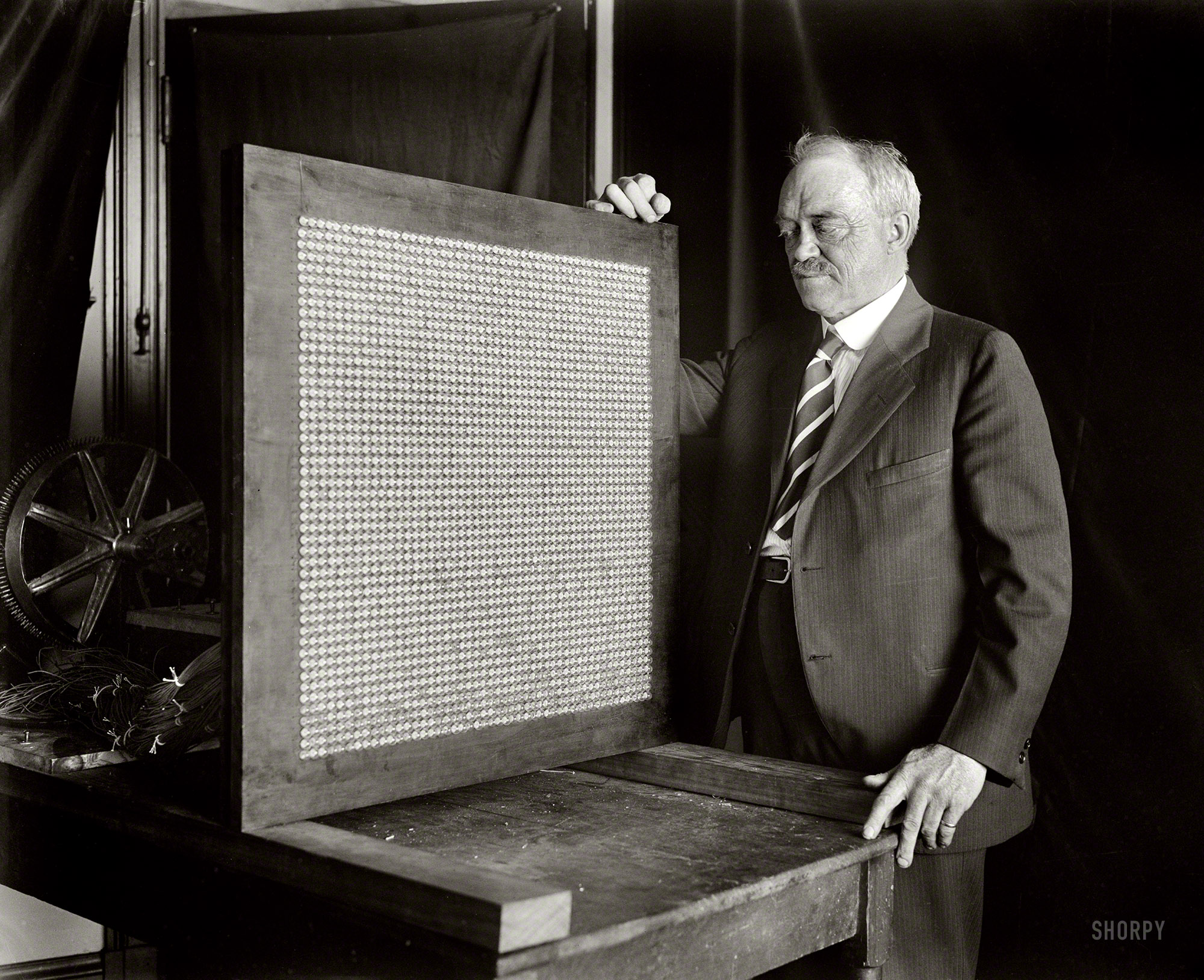
HEC/35000/35091a.tif

A rare picture of an elderly David Robert Jones[1], having improved upon the psychokinetic testing device for another evil plot.

By the silken breast of Mogg’s mother, I miss “Fringe.”

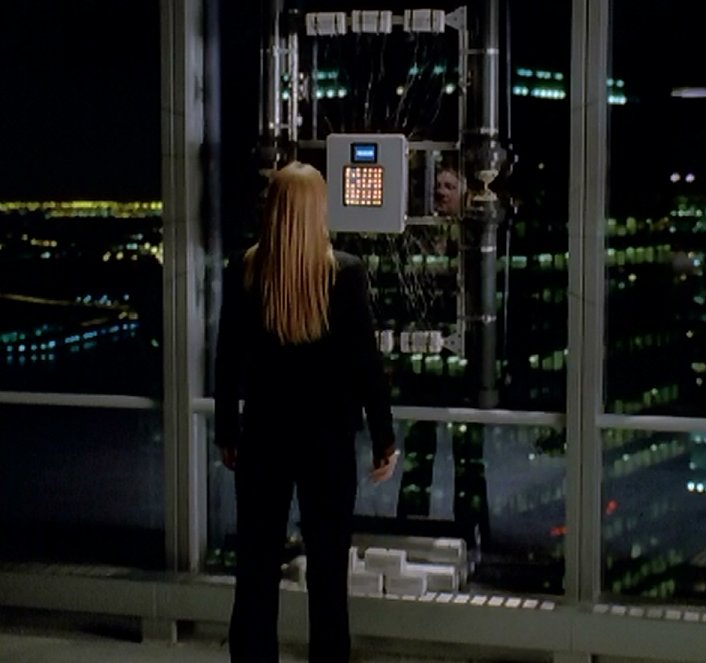
Olivia


Olivia Dunham uses her Cortexiphan-induced psychokinetic powers to defuse a biological bomb. Fringe, Season 1, Episode 14: “Ability”

In actuality, this 1928 photo, taken in Washington, DC is  Charles Francis Jenkins (1867-1934), pictured here with what might be considered an early flat-panel video display, its 48-pixel-square grid composed of small neon lamps. Found at Shorpy.


[1] From Universe 39