
And not just for the ladies. These were common in men’s restrooms as well, dispensing cologne and after-shave.
And not just for the ladies. These were common in men’s restrooms as well, dispensing cologne and after-shave.
Oskar Sala (1910-2002) was a German composer. Paul Hindemith, Sala’s composition professor at the Berlin Academy of Music, introduced his student in 1930 to the engineer Friedrich Trautwein. Together they developed the Trautonium, one of the first electronic instruments. Its development paralleled the thermin and was a precursor to the synthesizer, resulting in a device that lets you mimic not only traditional musical instruments, but can produce voices, animal sounds and synthesized sounds (subharmonics).
In this video, Oskar Sala gives a demonstration of the Trautonium in the Hague. The body of the instrument is similar to that of a pipe organ, having two ‘manuals’ that are played with the fingers, although the normal configuration of black and white keys is missing. Mr. Zaun, a German, gives an introduction, and Sala is accompanied by a pianist as he plays the Trautonium.
The Old Wolf has spoken.
Found a collection of these over at Pleated Jeans.

Yeah, I have a few of these lying around, and a machine that will read them.


In 1977, Hewlett-Packard introduced the HP-01, the world’s first calculator watch. It was not only a marvel of miniaturization for its time, but also had some unique features:
At $650 for the basic model, it was expensive for its time and became a status symbol, however; one online commenter named MrG stated, “I used to work at the Corvallis HP plant, where the HP-01 was built. It was long out of production when I was there, but those who had one regarded it as a prestige item. There was sort of a standing joke that when people took it off their wrist, they walked leaning to the other side — it was kind of a hefty item.”
HP’s information site states, “The HP-01, code-named “Cricket,” was not a successful product for HP. It was too bulky and heavy, and HP sold it though upscale jewelry stores. But miniaturizing the math functions was quite an engineering feat, and when HP discontinued manufacturing the HP-01, its inner workings were destroyed so no one would copy the extraordinarily small package engineering. The HP Archives has a few of the remaining elements.”

It’s small wonder that these items when offered on eBay can fetch up to $5,000 – they are true museum pieces, representatives of the headlong technological rush towards smaller and faster.
I have a small collection of the watches I have owned over time, and one of my favorites is the CA-95, Casio’s calculator watch with multi-alarms, shown at left below. Click through to hear it play.

Before the advent of PDA’s and smartphones, a watch like this was one way a g33x0r could satisfy his itch for technology, and by the 80’s, Casio had refined the circuitry to a point where the DataBank watch on the right, which carried large numbers of memos, appointments, and phone numbers, as well as multiple stopwatches, timers, world time clocks, and alarms, sold for about $65.00. They still sell versions of this watch. You’ll notice that mine is still running – but sadly the case has broken and won’t hold a pin on one side, or I’d still be wearing it.
Sadly, the CA-95 was one of those transient items which came and went, much like their infrared remote watch:
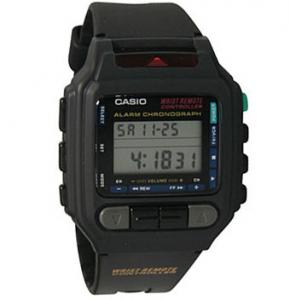
I gave this watch to my younger son, and after he got tired of it I claimed it back. Now, of course, most of the remote codes it contained are out of date, but it’s biggest draw was being able to surreptitiously change the channels on annoying TV’s in public places.
But back to the CA-95: I bought mine in Hannover airport on my way home from CEBIT 1983. I loved this watch, as in addition to the various calculator and timer and stopwatch functions, it had four different musical alarms. One was “Scarborough Fair,” and the other was “The Syncopated Clock.” It had circuitry to give the alarm sounds pitch variations and reverb, and included fairly robust speaker in the back, such that the alarms sounded much better than your typical modulated computer beep. Despite the damage to the LCD, mine still works – sorta. They’re a bear to take apart and put back together again because of all those little buttons, but I loved it so much that I may take it up to CSS in Salt Lake and see if they can get it up and running again.
And, as a gratuitous lagniappe, I also have one of these:

Texas Instruments TI-500.
The Old Wolf has spoken.
Earlier this year I posted this essay about telephone operators; today I happened across this picture which brought back the same kinds of memories.

In an age of smartphones and global cellular service, this is an aspect of life that neither my children nor my grandchildren will never know. I used to think it odd that my own grandparents grew up in an era without airplanes or television, and now I am experiencing what that double-perspective must have been like for them.

The Old Wolf has Spoken.
Marcel Leyat (1885-1986), born in Die, France, was an airplane designer and manufacturer. He began turning out airplanes in 1909. In 1919, he began manufacturing automobiles based on his experience with airplanes. The automobiles were built on the Quai de Grenelle in Paris.
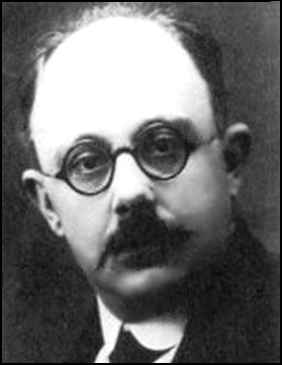
Marcel Leyat in 1914
The first model was called the Hélica, also known as ‘The plane without wings’. The passengers sat behind each other as in an aircraft. The vehicle was steered using the rear wheels and the car was not powered by an engine turning the wheels, but by a giant propeller powered by an 8 bhp (6.0 kW) Scorpion engine. The entire body of the vehicle was made of plywood, and weighed just 250 kg (550 lb), which made it dangerously fast.
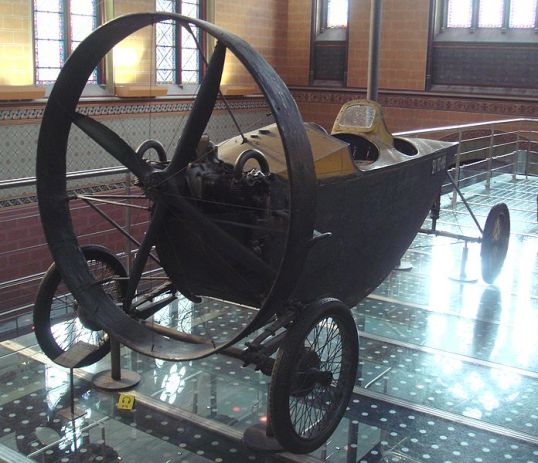
1921 Hélica at the Musée des Arts et Métiers, Paris. (Found at Wikipedia)
In 1927, A Hélica reached the speed of 106 mph (171 km/h) at the Montlhéry circuit. Leyat continued to experiment with his Helica; he tried using propellers with two and four blades. Between 1919 and 1925, Leyat managed to sell 30 vehicles.
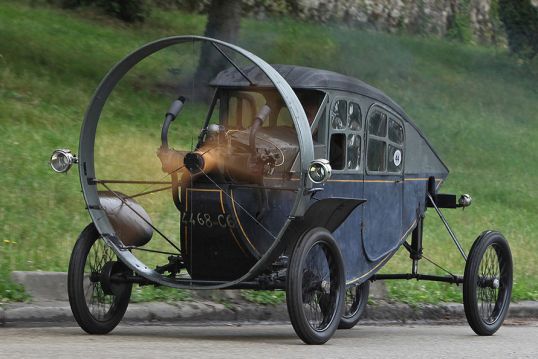
Hélica 2H, Series D21 (found at Frog Blog)
A page about Leyat (in French) can be found here.
This vehicle offers a practical solution for keeping bugs off your windshield; pedestrians who happen to encounter the Hélica would not fare well, I fear me.
The Old Wolf has spoken.

I cannot believe I had forgotten about this wonder. I had one of these… wish I still did, just because it’s awesome!
Well, I’ll have to be content with my TOS phaser, which trumps it for geekitude but not for deliciousness.


The Old Wolf has spoken.
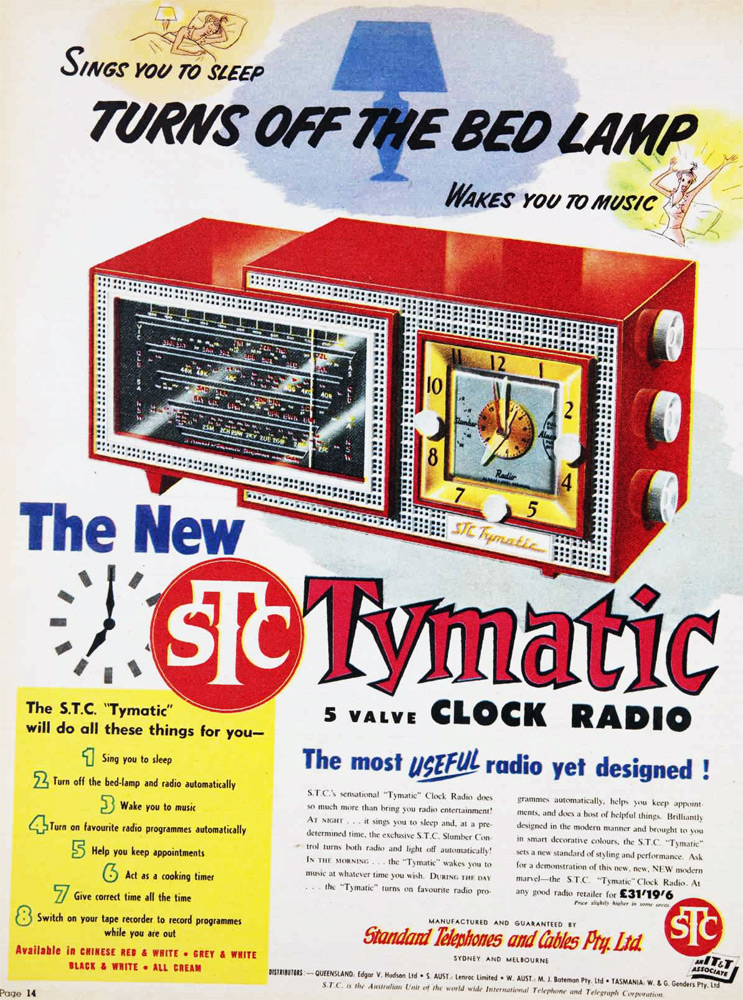
I want to know which buttons to push to dispense the beer or set things on fire.
The Old Wolf has spoken.
(And wish I still had… some of these suckers are worth real money.)
Mr. Machine

This was the grand-daddy of cool toys – for its era. You really could take him apart and put him together, and lo and behold, he still worked!
The Great Garloo (1961)

Garloo was awesome to a 10-year-old. He would bend over and pick stuff up, and you could steer him around with the wheel. Of course, the commercials made stuff like this look a lot neater than they were, but I remember this toy well, and he lasted quite a long time.
Ideal Astro Base
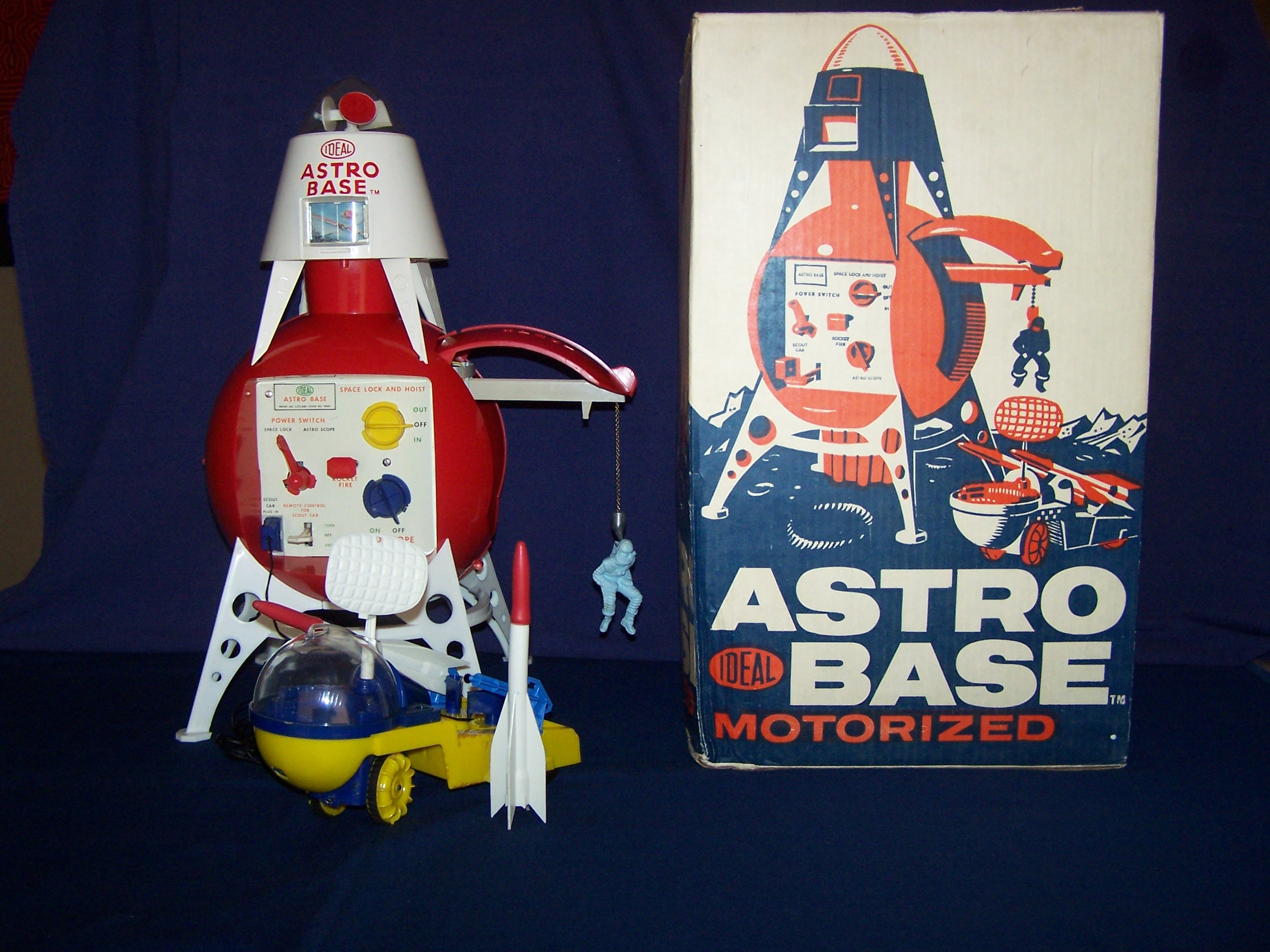
This one was tragic. What a cool toy… and I had one. But apparently mine was defective, and so back it went, to be exchanged for something else.
Remco’s Fighting Lady

The Fighting Lady was one awesome toy. To a kid my age, it was big. It had a plane launcher, a runabout, primary gun, depth charge launchers, and other stuff. I loved this one. More pictures here.
The Petal Camera

This one breaks my heart. If I had only known… this is exactly how mine looked, I think I paid $25.00 for it, and now they can be worth up to $5,000. *sob*
Wff ‘n Proof

This game of symbolic logic was first produced in 1961, I think – I acquired my copy at the NYC World’s Fair in 1964. I had it until the foam packaging that held the cubes crumbled into dust. I’m working on acquiring another copy one way or another.
The Digicomp I

This binary flip-flop computer kit was popular enough that one enterprising engineer has replicated it. It’s on my list of things to get. Again.
The Chemistry Set

This is not the exact set I had, but darn close. I don’t think mine had a radiation detector, but I know it contained a small glass jar of powdered uranium ore. It had glassware, small Erlenmeyer flasks, boiling flasks, beakers, the test tube rack, the alcohol lamp, measuring spoons, a scales, pipettes that you had to heat and draw yourself, and yes, I burned the living piss out of my fingers on more than one occasion – and no one got sued. Today’s chemistry sets have been castrated by lawyers until they barely have any chemicals worth sneezing at, or none at all.

This kit causes us to lament the general state of affairs we have come to thanks to litigiousness, chemophobia, and flagging scientific literacy.”
How pathetic is that? Another interesting article here.
Long one of the unexplained wonders of the world, this peculiar item in Delhi has now been analyzed by scientists, who are still amazed that metalworkers in the 4th or 5th century would have had the kind of knowledge required to create it.

Currently theory holds that the pillar was forged during the reign of Chandragupta II, who reigned from 380 to 413 or thereabouts.
And although it is composed of 98% wrought iron, it has sat exposed to the elements for about 1600 years… and it refuses to rust.
Wikipedia explains that “In a report published in the journal Current Science, R. Balasubramaniam of the IIT Kanpur explains how the pillar’s resistance to corrosion is due to a passive protective film at the iron-rust interface. The presence of second-phase particles (slag and unreduced iron oxides) in the microstructure of the iron, that of high amounts of phosphorus in the metal, and the alternate wetting and drying existing under atmospheric conditions are the three main factors in the three-stage formation of that protective passive film.”
Now that’s too many for this Wolf of Very Little Brain, but apparently the early blacksmiths knew how to do something marvelous. Whether it was by design or by happenstance, no one is quite sure. But there it sits, and if history is any indication, it will be there long after my great-great-grandchildren’s great-great-grandchildren have turned to dust.
The Old Wolf has spoken.
 Playing in the World Game