Pollen: Good for more than hay fever

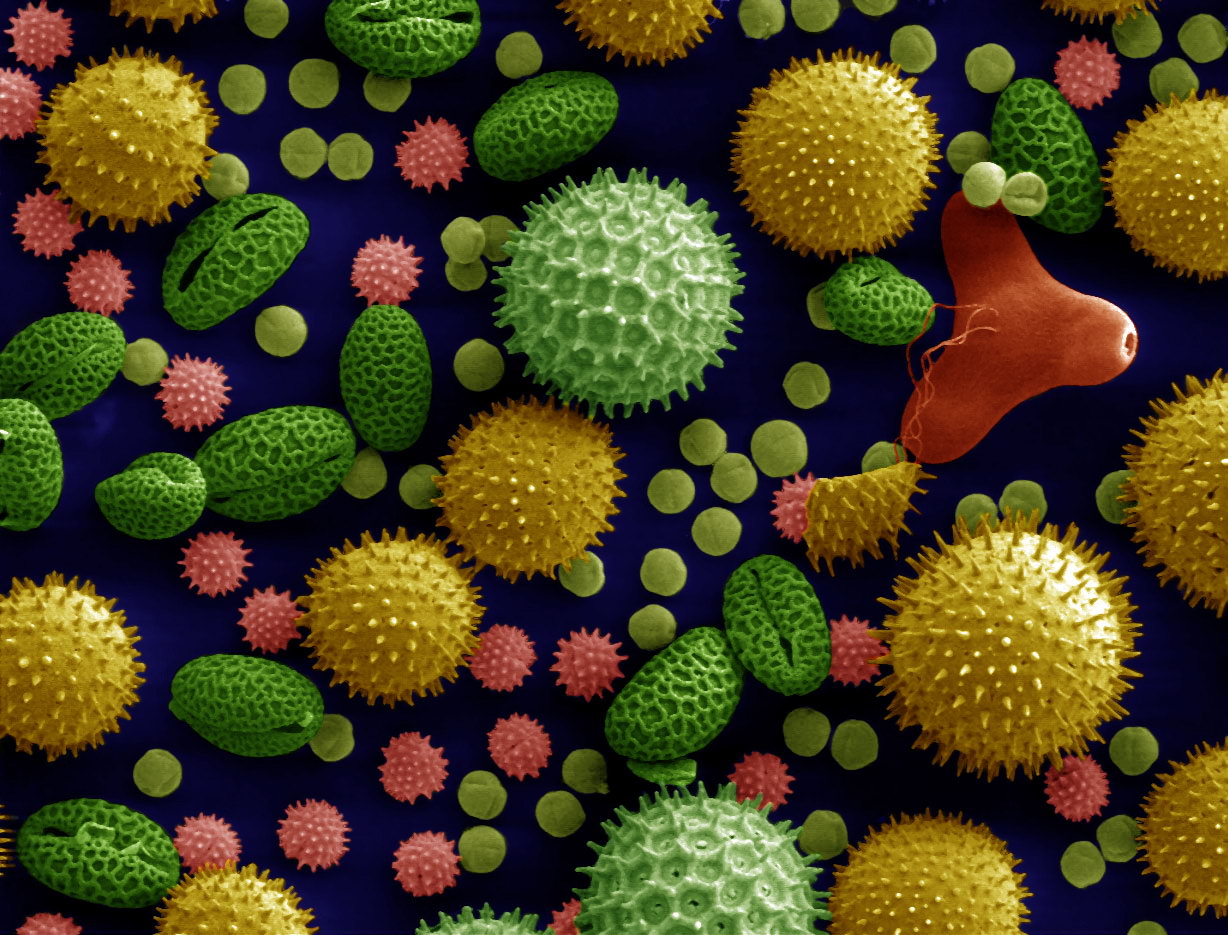
Misc_pollen_colorized


Just look at that stuff. Magnified 500 times (the image is colorized), it’s easy to see why some people’s noses and eyes respond unhappily to the invasion of this vegetative sperm. On the other hand, without it plants would reproduce and the world would be left dead and sterile.

It turns out pollen is great for science, as well. Pollen lasts for a long, long time – millions of years when fossilized.  A 3,200-year drought and cold wave destroyed a late Bronze Age thriving society near present-day Tel Aviv and far beyond, and until now scientists had no clue as to why – but pollen appears to have solved the mystery.

According to The Jewish Press,

A study of fossil pollen particles in sediments extracted from the bottom of the Sea of Galilee has revealed evidence of a climate crisis that traumatized the Near East from the middle of the 13th to the late 12th century BCE. The crisis brought about the collapse of the great empires of the Bronze Age.

Even older, analysis of pollen hundreds of millions of years old showed that flowers may have existed as early as the first dinosaurs, according to an article in LiveScience.

Newfound fossils hint that flowering plants arose 100 million years earlier than scientists previously thought, suggesting flowers may have existed when the first known dinosaurs roamed Earth.

Under high magnification, these little grains are beautiful, and it seems very useful to scientific research. But that is cold comfort to those who suffer from hay fever, a malady from which I have been blessedly exempt – but having watched my kids suffer, I have endless sympathy for those who do.

The Old Wolf has spoken.

Be noble, for you are made of stars.

There is supposedly a Serbian proverb that states, “Будите скромни за вас су од земље, да буде племенита за вас су од звезда.”

Be humble, for you are made of earth. Be noble, for you are made of stars.

[]

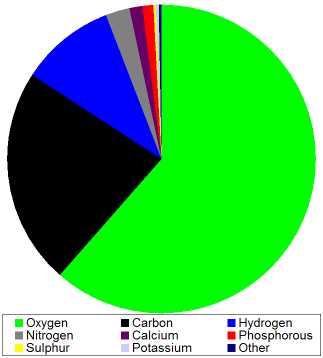
Whether it is Serbian in origin or not, it’s a good proverb. I like it. Because it’s true. From Random Science Tools comes this chart of the relative preponderance of elements in the body of an average 70kg man:

Element             Amount / kg  Amount / Mol.
Oxygen   43 2700
Carbon 16 1300
Hydrogen 7 7000
Nitrogen 1 .8 130
Calcium 1 .0 25
Phosphorus 0 .78 25
Sulphur 0 .14 4 .4
Potassium 0 .14 3 .6
Sodium 0 .10 4 .3
Chlorine 0 .095 2 .7
Magnesium 0 .019 0 .78
Silicon 0 .018 0 .64
Iron 0 .0042 0 .075
Fluorine 0 .0026 0 .14
Zinc 0 .0023 0 .035
Rubidium 0 .00032 0 .0037
Strontium 0 .00032 0 .0037
Bromine 0 .00020 0 .0025
Lead 0 .00012 0 .00058
Copper 0 .000072 0 .0011
Aluminium 0 .000061 0 .0023
Cadmium 0 .000050 0 .00044
Boron < 0 .000048 0 .0044
Barium 0 .000022 0 .00016
Tin < 0 .000017 0 .00014
Iodine 0 .000013 0 .00010
Manganese 0 .000012 0 .00022
Nickel 0 .000010 0 .00017
Gold < 0 .000010 0 .000051
Molybdenum < 0 .0000093 0 .000097
Chromium < 0 .0000018 0 .000035
Caesium 0 .0000015 0 .000011
Cobalt 0 .0000015 0 .000025
Uranium 0 .00000009 0 .00000038
Beryllium 0 .000000036 0 .0000040
Radium 3.1×10⁻¹⁴ 1.4×10⁻¹³

Chemical composition of the human body by mass

chem_comp_of_body_chart

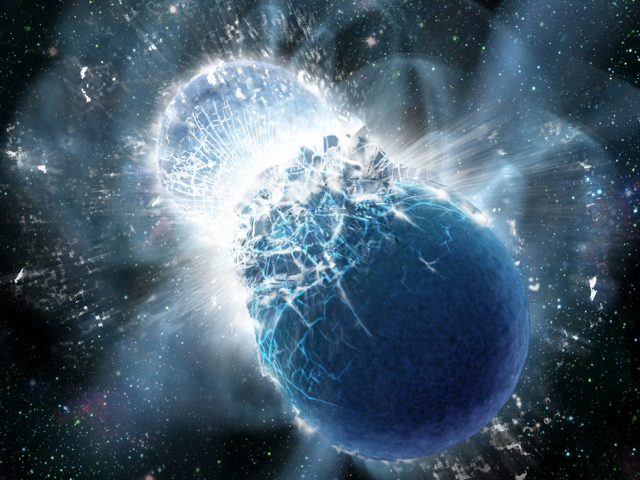
As little as it may be, we have gold in us. And other rare elements. And we have to remember that at the creation of the universe, the only elements present were hydrogen and helium. Every other naturally-occurring element in the periodic table was born in the hearts of dying stars which ended their lives as supernovæ, or – as recently hypothesized in the case of heavier elements like gold – in collisions between neutron stars.

GRB_illustration

I like Carl Sagan’s quote, which he also managed to work into his book Contact: “The universe is a pretty big place. If it’s just us, seems like an awful waste of space.” Whether we are alone in the universe is a question which science has yet to answer, but it’s pretty mind-bending to think that the elements which make up our bodies came from the universe around us. As astrophysicist Neil Degrasse Tyson said,

“Recognize that the very molecules that make up your body, the atoms that construct the molecules, are traceable to the crucibles that were once the centers of high mass stars that exploded their chemically rich guts into the galaxy, enriching pristine gas clouds with the chemistry of life. So that we are all connected to each other biologically, to the earth chemically and to the rest of the universe atomically. That’s kinda cool! That makes me smile and I actually feel quite large at the end of that. It’s not that we are better than the universe, we are part of the universe. We are in the universe and the universe is in us.”

The Old Wolf has spoken.

Are people “good” or “bad” at math?

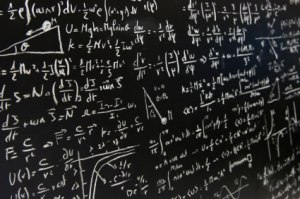
math

Over at Quartz, writer Allison Schrager says no. I originally spotted her article over at Newser, which summarized it this way: “Think You’re ‘Bad at Math’? You’re Just Being Lazy.

While there are some good points in the article, I feel as though her conclusion is flawed.

Yes, math is difficult – especially when you get up into the higher levels. To learn it requires intellectual rigor, patience, discipline, and hours and hours of repetition. I remember this passage from the first science fiction book I ever read as a child, Heinlein’s Have Space Suit, Will Travel:

“Anybody who thinks that studying Latin by himself is a snap should try it.

I got discouraged and nearly quit-then I got mad and leaned into it. After a while I found that Latin was making Spanish easier and vice versa. When Miss Hernandez, my Spanish teacher, found out I was studying Latin, she began tutoring me. I not only worked my way through Virgil, I learned to speak Spanish like a Mexicano.

Algebra and plane geometry were all the math our school offered; I went ahead on my own with advanced algebra and solid geometry and trigonometry and might have stopped so far as College Boards were concerned-but math is worse than peanuts. Analytical geometry seems pure Greek until you see what they’re driving at-then, if you know algebra, it bursts on you and you race through the rest of the book. Glorious!”

I loved that story when I read it at age 10, and I still love it today, but I’m bitterly disappointed that I never had that breakthrough that the story’s protagonist experienced. I did fair to middling through high school in algebra, geometry, trigonometry and analytical geometry, but I was always doing it like a cook follows a recipe – it never burst on me, and I never saw what they’re driving at. So when I hit college with dreams of being a doctor, and discovered that in order to pursue a chemistry major I would have to take all the concomitant calculus courses, that was all she wrote. It was worse than pure Greek, because that’s a subject I did well in.

Mastering a foreign language is no piece of cake either, and yet for some reason I can master enough of a foreign language to become reasonably fluent in 3 months, whereas learning even the rudiments of calculus has eluded me for over 40 years. The disappointment stems from the fact that I love the world of science, and mathematics is the key that unlocks the door to understanding – a door through which I will only ever be able to peer through a keyhole to where the big boys and girls are playing.

This is music to my ears…

“Per me si va ne la città dolente,
Per me si va ne l’etterno dolore,
Per me si va tra la perduta gente.
Giustizia mosse il mio alto fattore:
Fecemi la divina podestate,
La somma sapienza e ‘l primo amore.
Dinanzi a me non fuor cose create
Se non etterne, e io etterno duro.
Lasciate ogne speranza, voi ch’intrate”.
(from Dante’s Divina Commedia)

whereas this makes my mind shut down completely:

75038c7606574331ab8f06be8e78f9df

Kepler’s equation for calculating orbits

Old_Wolf_Tilt

And all we’re talking about here is limits, let alone the really weird things. To a scientist, this is really simple stuff.

My own experience has demonstrated to me that each person born has gifts and abilities unique to them. As no two snowflakes are a like, as no two stars have identical magnitudes or compositions, so no two people have the same talents. For me, math is terribly difficult, and language is uncannily easy.
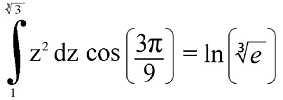
mathjoke3

As a result, the formula above is the only bit of calculus that I have ever been able to memorize – and I’ll never forget it.  Don’t get me wrong – I can’t evaluate it, even though I’m told by smarter friends that both sides equal ⅓; no, I remember it because it’s a limerick. [1]

Integral zee squared dee zee,
From one to the cube root of three,
Times the cosine
Of three pi over nine,
Equals log of the cube root of e.

Lakshmi

Here is a drawing done by my daughter, who has never had an art lesson in her life. This is a gift that springs from within her.

Where I agree with Ms. Schrager is that despite the difficulty, if I worked at it long enough and hard enough, I could master it. But somewhere else there is a brilliant mathematician who trembles in terror at the thought of trying to learn Italian, because he or she knows that it would almost take more effort than it is worth.

In conclusion, I would retitle Ms. Schrager’s article to read: “Yeah, math is hard – but it’s worth the effort.”

The Old Wolf has spoken.


[1] I have hundreds of limericks rattling around in my skull. Unfortunatly,

A limerick packs rhymes anatomical
Into verses quite economical
But the good ones I’ve seen
So seldom are clean
And the clean ones so seldom are comical.
Our bodies do strange things

Rising-Dough1

I recently came across this article about a gentleman who brews his own beer… inside his gut. Apparently he harbors Saccharomyces cerevisiae, with the result that his digestive system was literally manufacturing alcohol every time he consumed carbohydrates due to the fermentation action of S. cerevisiae mixing with carbs and sugar.

From the article:

The man, who at first was assumed by other doctors to be a “closet” drinker,[1] was eventually cured of his condition after being put on a low-carb diet and taking anti-fungal medications to purge his body of S. cerevisiae. But his case now serves as an example of what can happen to a person when taking conventional antibiotics — the body’s delicate microbial ecosystem can undergo drastic changes that leave it prone to takeover by harmful yeast strains.

I recently had an experience that was different but related, and was pretty strange. I’m  putting the rest of this post under a “more” cut, in case it falls into the category of “too much information.”

Continue reading

New Study Reveals: Wolverines Don’t Like to be Teased!

676187766_1357111206

An Open Letter to the Media:

Stop it. Just stop it. The press, television, radio and the blogosphere latch on to every new study and report it as though the results were definitive.

Here’s a perfect example:

Heavy coffee consumption linked to higher death risk – USA Today

Oh, wait – that’s from USA today, the “thinking man’s National Enquirer” (women not exempt either), so probably wise to take anything you read there with a whole box of salt. But seriously, folks:

NIH study finds that coffee drinkers have lower risk of death – National Institutes of Health

Just go out there and do your own research: butter, eggs, chocolate, vitamins, sugar, white flour – and we’re not even talking about the tinfoil hat patent-medicine and nostrums hawked by the populist doctors and talk-show hosts like “green coffee beans[1] and the Açaí Berry – just the run-of-the-mill, everyday stuff; it’s good for you, it’s bad for you, it stops cancer, it causes cancer, it gives you diabetes, it lowers cholesterol, and on and on and on to the lemniscate [2].

As it turns out, most of what the media reports is nothing like the actual conclusions found in the study. Put together a database of 50 peer-reviewed studies, each double-blind, placebo-based and randomized, and if there’s a preponderance of evidence, *then* report on it. Oh, but wait, truth is not as important as eyeballs on ads. Yarg.

Angry Wolverine

This wolverine is angry


[1] In fairness, this particular article pretty much debunks the hype and asks the right questions, but there are plenty of others out there trumpeting the benefits as though this was the greatest thing since sliced bread.

[2] ∞

The sun, up close and personal

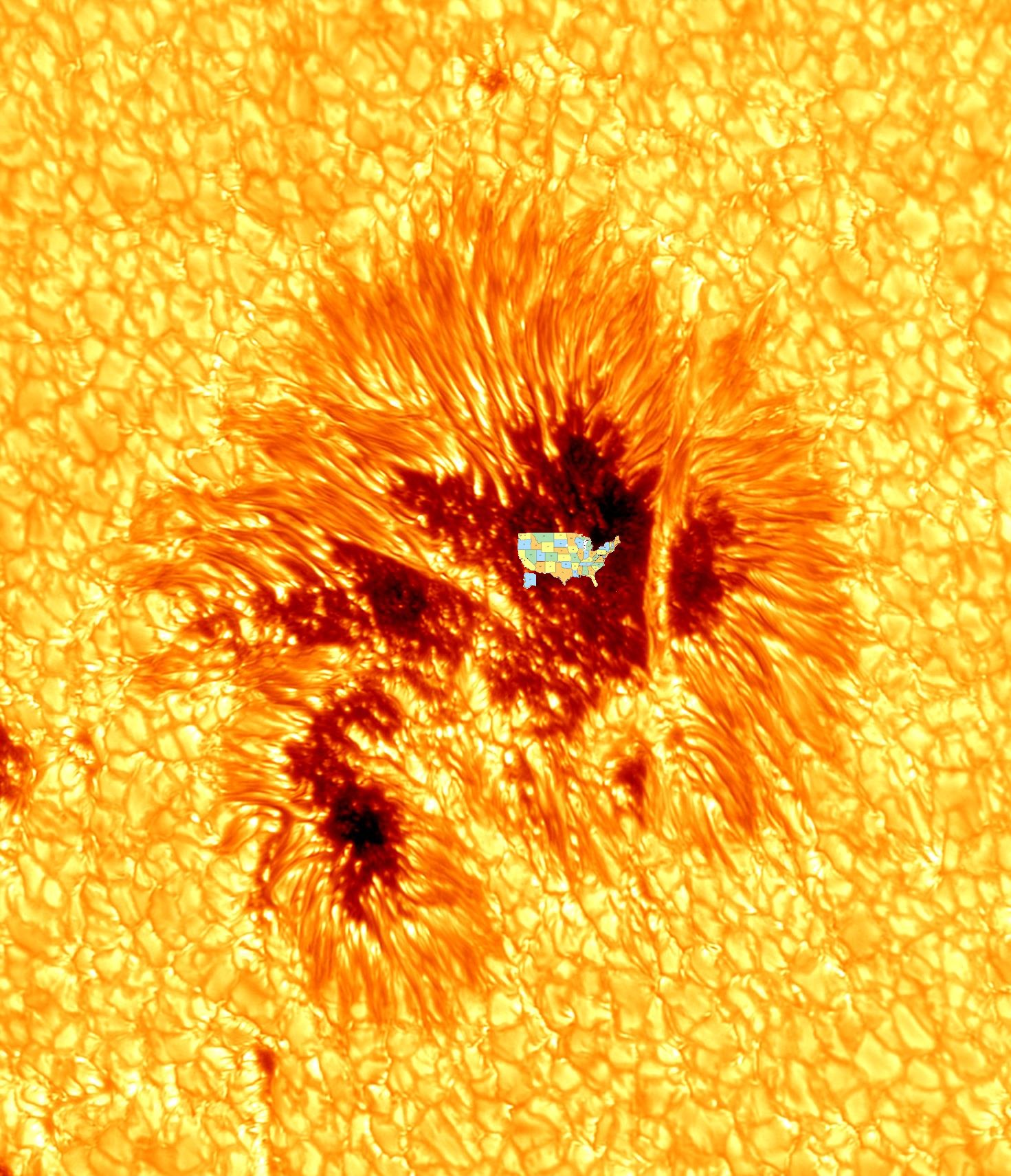
Sunspot


This image of a sunspot (with superimposed USA for approximate scale) was taken by the New Solar Telescope at the Big Bear Solar Observatory. It is the most precise image of a sunspot ever taken. The granules on the sun’s surface are approximately 1 million meters (621 miles) in diameter, and roughly 2500 miles deep.

fig1_avi_nov2012


From the BBSO website: “New observations of the solar granulation with the New Solar Telescope (NST) at the Big Bear Solar Observatory (BBSO) allowed a NJIT-Stanford research team to make the next step in understanding of the solar surface structure. A new complex world of very small granules became visible between normal solar granules. Mini-granules, as small as Maine, form a multi-fractal structure, similar to other systems in nature, such as coast lines, glaciers, earthquakes, stock market, etc. A key property of such systems is their unpredictable, burst-like behavior and jagged, irregular shape. Usually, occurrence of numerous independent random processes lead to the formation of a such system. Studying of such systems is beneficial for understanding both the universe and the social life.”

So much energy there, free for the taking.

The Old Wolf has spoken.

Homage to the Shuttle Program

This awesome film is taken from the upcoming Special Edition Ascent: Commemorating Space Shuttle DVD/BluRay by NASA/Glenn a movie from the point of view of the Solid Rocket Booster with sound mixing and enhancement done by the folks at Skywalker Sound. The sound is all from the camera microphones and not fake or replaced with foley artist sound. The Skywalker sound folks just helped bring it out and make it more audible.

The movie both intrigues and saddens me. I honor every individual who ever worked on this project, from the brave astronauts (and their families) who went and returned, or who went and did not, to those who swept the stairs and emptied the trash. I honor the accomplishments in science and knowledge that these herculean efforts produced.

I express a deep sense of sadness and anger at our legislators over time who were not forward-looking enough to continue funding for the space program, so that a viable replacement might have been ready when our shuttle fleet had aged beyond its usefulness. There is no excuse for such obtuseness; these individuals chose again and again to throw trillions of dollars into unwinnable and futile and fruitless wars, not to mention some of the finest blood of our nation, while beneficial and inspiring projects like this program – and others which might have been – went begging.

Remembering

The Old Wolf has spoken.

Lookit me, Ma – I’m wavin’!

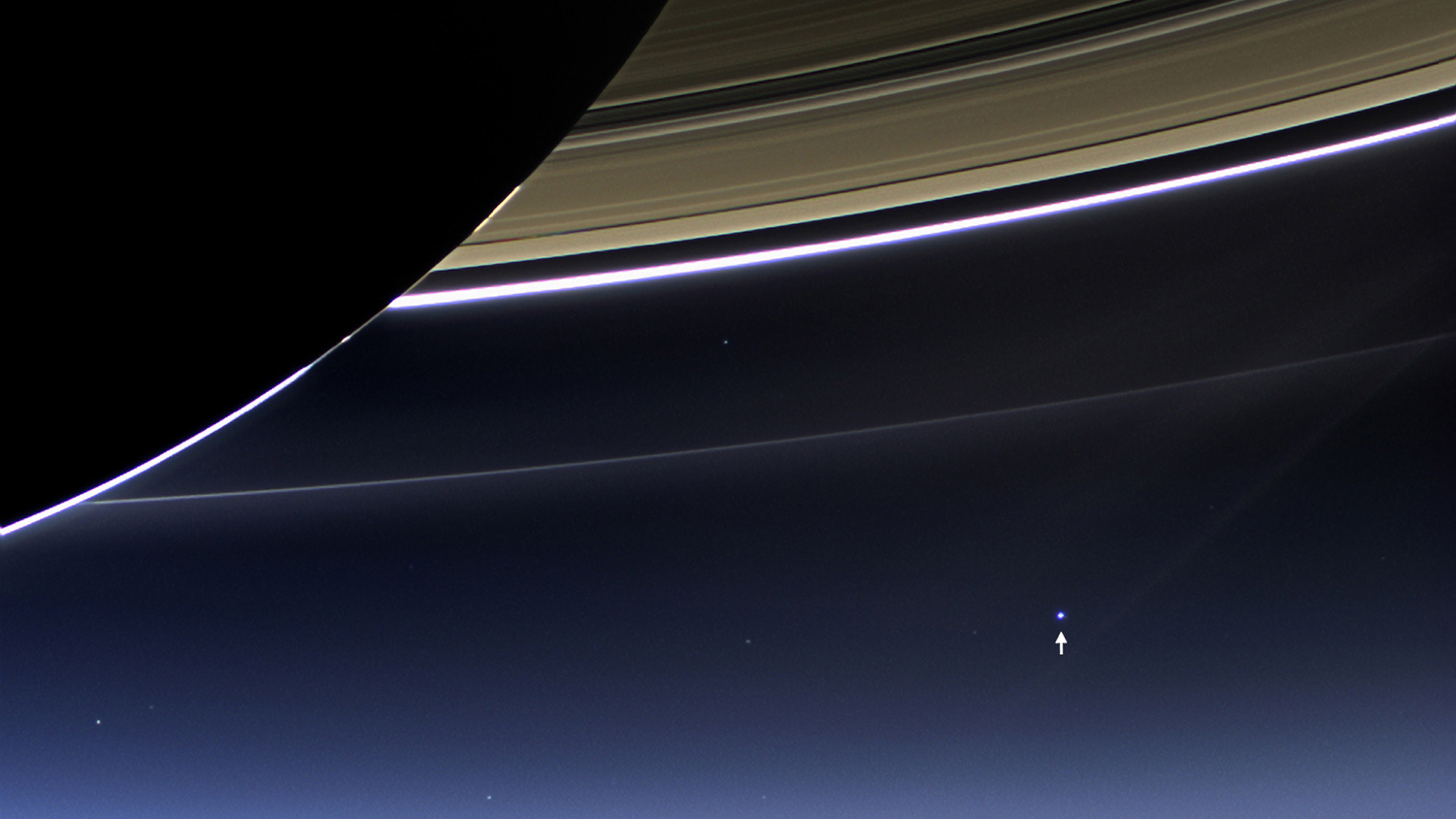
On July 19, 2013, the Cassini spacecraft took advantage of a total eclipse of the sun from behind Saturn to turn its camera back toward Earth. This particular event was publicized in time for people to turn out and wave at the camera, the first time that people on Earth knew ahead of time that their picture would be taken from space.

I waved from my car… if I look hard enough, I think I can see us on the road between Spanish Fork and Payson. 

earth-moon-photo-saturn-2013-annotated

The Earth and the moon from Cassini, beyond the orbit of Saturn. (Click for full resolution – the moon is about one pixel in this image)

cassini-earth-moon-look-bac\

Enhanced view of Earth and Moon

The Old Wolf has spoken.