This video presents a visual representation of just how big a petabyte is [1]. Some of the data was taken from this infographic at Mozy.
But this information dates back to 2009, and now it’s 2013. That’s an eternity in the tech world. Places like BackBlaze [2] and JustCloud are already storing multiple petabytes of data, possibly into the exabyte range. In 2011, scientists estimated that the world’s data storage capacity was 295 exabytes, but again, that was two years ago.
To refresh your memory, the table below, taken from Wikipedia, gives a summary of multiples of bytes.
With recent advances in data storage technology and the continuing juggernautical (I just made that word up) rush towards ever-smaller devices and ever-greater storage density, I wouldn’t be surprised if I were to see yottabyte drives before I shuffle off this mortal coil. My grandchildren will doubtless see the need for even larger data prefixes.
The Old Wolf has spoken.
[1] A petabyte is one quadrillion bytes of data (equivalent to one quadrillion alphabetic letters.)
[2] You can read an interesting article about what BackBlaze did to be able to keep adding 50 terabytes of data per day to its cloud storage, even in the midst of the hard drive shortage brought about by flooding in Thailand. The video below gives you an idea of the backbending and hoop-jumping that was necessary to keep the pipeline open.
Now that Curiosity is puttering around on the surface of our sister planet, and we know that everything went off without a hitch, this HD animation of the mission from launch to exploration seems even more incredible than it did before. Then, it was in the realm of hope and possibility. Now, it’s mind-boggling science.
The video also gives a good idea of some of the astonishing analysis capabilities that this little emissary has.
Hats off to every single individual who played a part in making this possible, from the scientists and engineers to the folks that swept the stairs at night.
“Wolverines don’t like to be teased, researcher learns at great cost!” trumpeted one recent “scientific study”, according to Jonah Goldberg writing at townhall.com. (Note: Goldberg is a right-wing journalist, but he makes a good point here.)
Angry wolverine
His thesis is that media pundits descend on studies which state the obvious like a flock of buzzards on a heretofore overlooked, month-old carcass.
Lovingly culled from “The Irrational Inquirer” [1] is this groundbreaking study:
Incredible!There’s noOsip Grunt!A yearlong $6.5 million government study has revealed that even though a whopping 230 million people are living in the United States, there’ are certain names that not even one person has!
“It’s astounding but true,” said government researcher Norton Whole. “There are over 500 Bob Hubbaffs, thirty-odd Rance Flarths, and even three Puppy Droptunas yet there are thousands, possibly tens of thousands, of names that absolutely NO one has!”
Added the scientist: “To find out just exactly how many ‘names there are that no one has, we’ll need another $6.5 million.
Below is a list of the most common names that no one has:
Micky Mantleheimer
Cappy Greem
Lee Duc Tranh Gumpaluna
Thelmore Cleotis Wojczyk
Meyer Farding
Stubby Osterizer
Fred-Bob Fred
Debbie Hitler
Vince Edwards
Tawni Schleppenschleppen
Naturally, the watchful guardians of our tax dollars immediately pounced on this squandering of public funds:
There’s a Name forThis Tax $$$ Waste:A. Idiot BoondoggleIt took the National Science Foundation one year and $6.5 million dollars of your hard-earned tax dollars to discover that there are no Americans who have certain names.
“This is the single most disturbing thing I ever heard of,” roared Senator Jesse Helms, who spent two months reading the 1,200-page study. “Who cares how many names no one has?”
Helms was so stunned he had to sit down. The study, conducted by National Science Foundation staff researcher Norton Whole, proves something every¬body has known for years and is of no earthly value to anyone!
“Actually, proving that no one had the names only took a couple of hours at the end of the whole study,” Whole admitted to The INQUIRER. “The really time-consuming part was finding – well, I guess you call it creating – the actual names that no one has.”
“That numbskull wasted several hundred thousand hours of valuable computer time making up stupid names,” screamed Senator William Proxmire. “Who the heck cares that there’s no one named Jim-Bob Khrushchev?!”
“I don’t see why everyone’s so worked up, ” said researcher Whole. It seems to me the study very elegantly answers a number of fundamental questions that plague Americans. And don’t forget we still don’t know how many names there are that no one has. Just the 10,000 most common ones!”
Below is the list of the top 10 names that no one has. It is completely worthless.
Therri Shumper
Claudette Spiderbarf
Retail Washington
Cyline “Frodo” Fernandez
Haystacks Singh
Ellen Ayatollah Feinblatt
Richard Chamberlain
Muffy Reeling Moose
Bryce Mortuary Jr.
Dr. Che Lovehandles
-Kenny Bunkport
I don’t know what we’d do without our stalwart congressmen to watch over the public trough public resources.
Of course, the above is all in fun – but it relates to a more serious topic – that of the tendency of our media to jump on every individual study that is published as though the given study had any value whatsoever.
Around the New Year, an article started floating around the news feeds quoting a study that indicates moderate overweight might not pose a health risk, but rather that a bit of extra weight might help people live longer instead. Unlike the LA Times, The Australian pointed out that this study by Katherine Flegal of the CDC, along with a previous study by the same researcher, may be inherently flawed. While Flegal stands by her research, her inclusion of smokers and individuals with existing illnesses may invalidate the conclusions. Anyone who has taken a research and statistics class knows that data can easily be skewed to support a pre-determined conclusion.
Whether or not the study is reliable, it is in the end a single study. Go through the medical literature and the media over the last 20 years, and you’ll find countless “butter is good! / butter is bad!”, “coffee is good!” / “coffee is bad!”, “water is good!” / “8 glasses of water a day is too much!” dichotomies. Each new study, however, offers the media a chance to spin the story into something that will get eyeballs on advertising, which, sadly, seems to be their true raison d’être, rather than providing the public with reliable information. After all, who wants to wait a couple of decades before a trustworthy body of peer-reviewed, double-blind, placebo-based and randomized trials yields a generally-accepted consensus?
The moral of the story is, once again, take nothing that you hear on TV, in printed media, or on the Internet without doing your own research. It’s a lot easier just to swallow what you’re spoon-fed by any number of information outlets, all of whom have obligations to contributors or vested interest in hot-button issues, but if you do that, you’re just playing into the hands of those who would profit from controlling your thoughts.
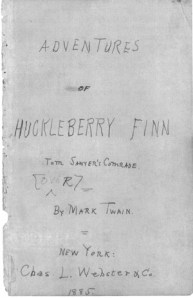
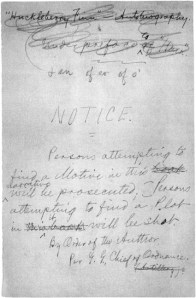
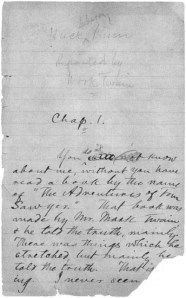
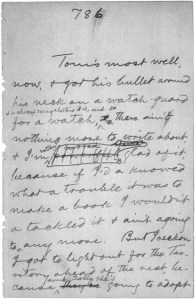
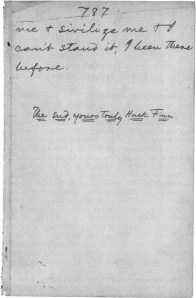
Huck Finn rates among my best-loved books ever. Way, way at the top, up there with Saroyan’s “Human Comedy” and Tolkien’s works. Recently found these scans of original manuscript pages in Twain’s handwriting.
Back in 2009 I hit a coyote at 80 MPH around Carlin, NV. Did some damage to the front end of my Prius, but nothing severe – mostly plastic fairing knocked off under the left wheel well, and took out one of my fog lights.
But this would be different.
You notice this is a race car, the driver is wearing a helmet, and he manages to maintain control. But that was one heck of an impact, and I’ve heard of accidents where the carcass goes straight through the vehicle, taking out the driver.
The WordPress.com stats helper monkeys prepared a 2012 annual report for this blog. Not bad for my first year. I was most interested to see where in the world my readers were coming from. Thanks to everyone who read and/or commented – I hope to make 2013 even more interesting!
Here’s an excerpt:
4,329 films were submitted to the 2012 Cannes Film Festival. This blog had 35,000 views in 2012. If each view were a film, this blog would power 8 Film Festivals
I have more friends and associates than I can enumerate, and that’s a good thing. It would have been nice to win the Powerball Lottery (no, I don’t play), but I count my wealth in friends rather than gold.
Naturally, these friends are all over the ideological spectrum: some are devout Christian evangelicals, some are devotees of other faiths, others equally dedicated humanists, deists, atheists, anti-theists, and everything in between – and I do my best to respect them all.
And now it’s the Christmas season.
My son’s fiancée posted this on Facebook yesterday…
And my son followed it up with this video as a comment:
I watch with interest as the Christmas season draws nearer, and the blogosphere and social media sites fill up with comments about what the holiday means, who should be celebrating it, and why, and when, and begin to cast aspersions on the common sense, parentage, IQ and chromosomal structure of those who think differently.
It’s sad, really – because it’s an unwinnable argument; everyone gets to choose what the holiday means to them, and act accordingly.
Take the video above: The points it makes are matters of historical record, and I found very little in the essay to argue with. But the creator’s conclusion – that because of the things mentioned in the video, he chooses not to celebrate Christmas – seems to have shot wide of the mark.
C.S. Lewis posited that the historical Jesus was either God or fraud, with no room for the “great human teacher” argument. [1] Personally I’m OK with that assessment, but I know that there are just about as many opinions about Yeshua of Nazareth as there are people. Whatever one may believe about the historical figure, a few things are consistent across most accounts.
He was supremely kind to those who were different, in trouble, or down and out.
He had no patience with hypocrisy and oppression in the name of self-righteousness
He helped others wherever he could, fed the hungry, administered to the ill, comforted the sad, and encouraged the weak.
Everything he did in the way of lifting the human condition, he encouraged others to do likewise.
The estimable Mr. Lewis notwithstanding, that would be a life worth celebrating.
It is true that over the last two millennia, more evil has been perpetrated in the name of faith; but in contrast, an equal if not greater amount of good has been done as well. The first gets the headlines and is widely pointed to by opponents of religion; the second is done quietly, in bedrooms, back streets, alleys, and out-of-the-way places, and rarely attracts the attention of a media dedicated to selling advertising.
Over the last two millennia, the public celebration of Christmas has morphed from a religious feast day into an orgiastic frenzy of obscene consumption. Society at large has indeed succeeded in taking Christ out of Christmas, leaving nothing but a mass: a mass of confusion, a mass of greed, a mass of debt, and a mass of emptiness; but in countless homes around the world, there are those who celebrate the season by striving to live lives worthy of that original One; lifting the hands that hang down, and strengthening the feeble knees of others in need. Each of us gets to choose, and each of us gets to be right about our choice. We are free to look at the Christmas holiday as a reminder of all the hypocrisy and evil perpetrated in the name of faith by those who have lost sight of what the original Jesus was about; or, as the words of a lovely song state so well, we can choose to see the holiday as something else:
Christmas is a feeling filling the air, It’s love and joy and laughter of people everywhere. Christmas is a feeling bringing good cheer; It reaches out to touch you when the holidays draw near.
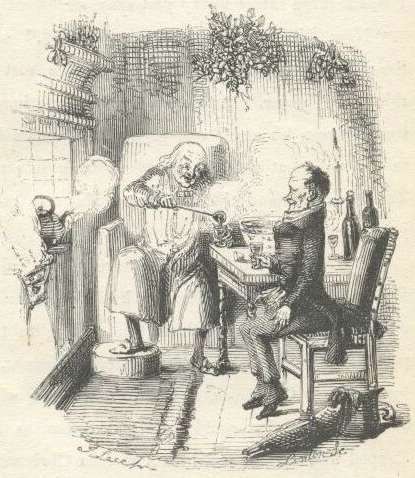
Along with Saroyan’s The Human Comedy, “A Christmas Carol” by Dickens ranks very high on my list of important and human writings. The transformation of Scrooge from all that our society today embodies – cold, commercial, heartless, penurious, usurious, and cruel – into someone who captured that feeling of joy and a desire to reach out and do good to all who crossed his path, underscores once again that we are at choice about how we view this holiday season. Each year the words bring me back, and I yearn to read the story again, each time with fresh eyes:
“[Scrooge] became as good a friend, as good a master, and as good a man, as the good old city knew, or any other good old city, town, or borough, in the good old world … and it was always said of him, that he knew how to keep Christmas well, if any man alive possessed the knowledge. May that be truly said of us, and all of us!” – Dickens, “A Christmas Carol”
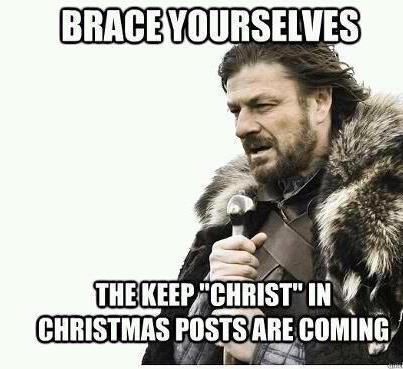
We live in a peculiar, complex, and often bizarre and frightening world – but like Scrooge, despite the challenges, I would “honor Christmas in my heart, and try to keep it all the year,” pushing back against the tide and celebrating goodness, and giving, and helping everyone to win. That’s how I want to keep Christ in Christmas. Others may disagree, but that’s their privilege.
The Old Wolf has chosen.
[1] “I am trying here to prevent anyone saying the really foolish thing that people often say about Him: I’m ready to accept Jesus as a great moral teacher, but I don’t accept his claim to be God. That is the one thing we must not say. A man who was merely a man and said the sort of things Jesus said would not be a great moral teacher. He would either be a lunatic — on the level with the man who says he is a poached egg — or else he would be the Devil of Hell. You must make your choice. Either this man was, and is, the Son of God, or else a madman or something worse. You can shut him up for a fool, you can spit at him and kill him as a demon or you can fall at his feet and call him Lord and God, but let us not come with any patronizing nonsense about his being a great human teacher. He has not left that open to us. He did not intend to.” C.S. Lewis – Mere Christianity
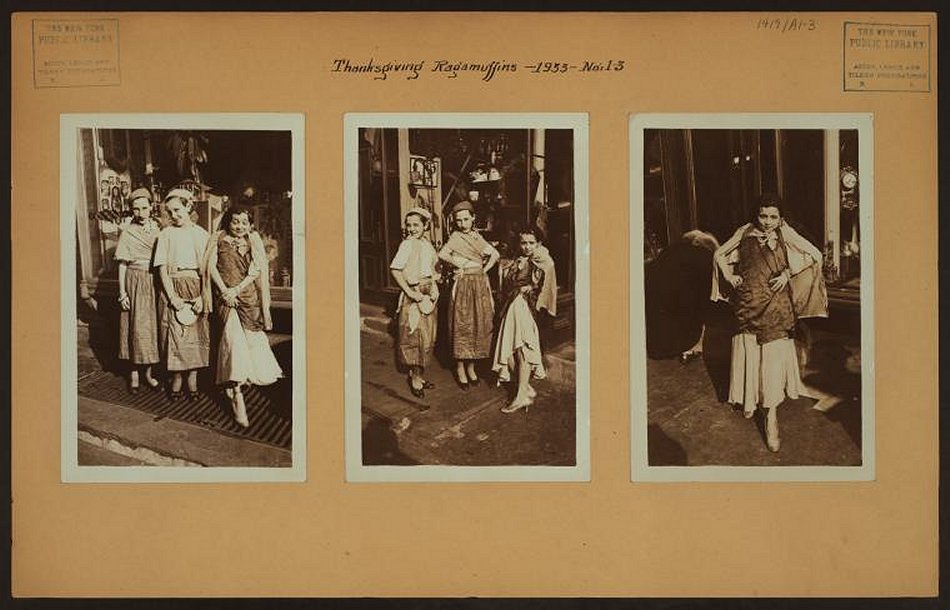
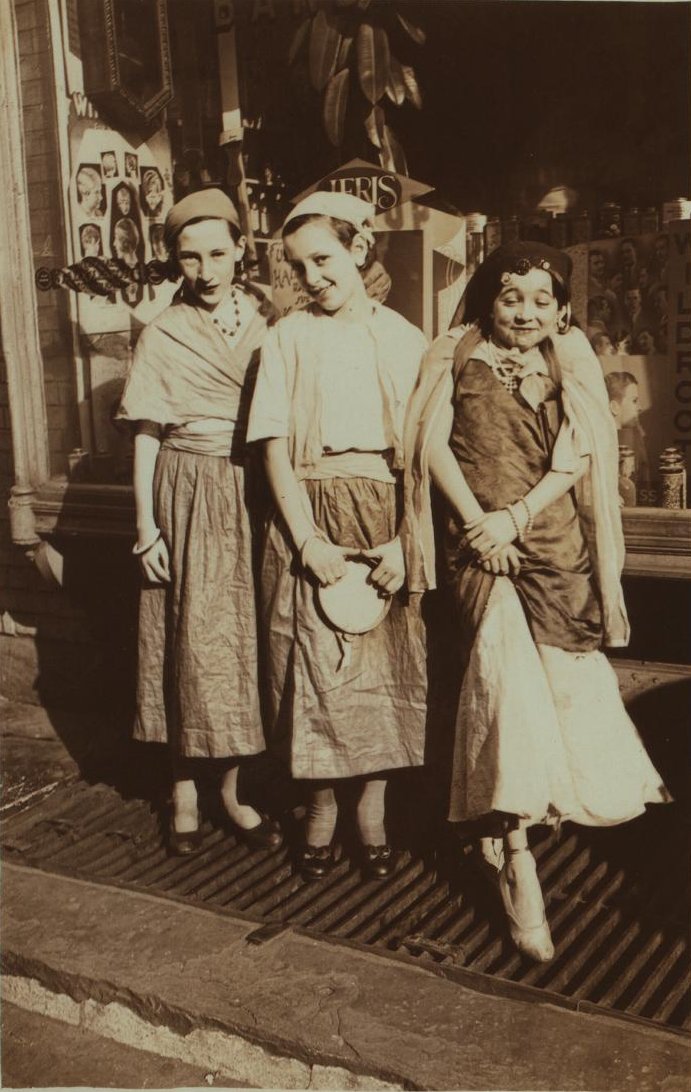
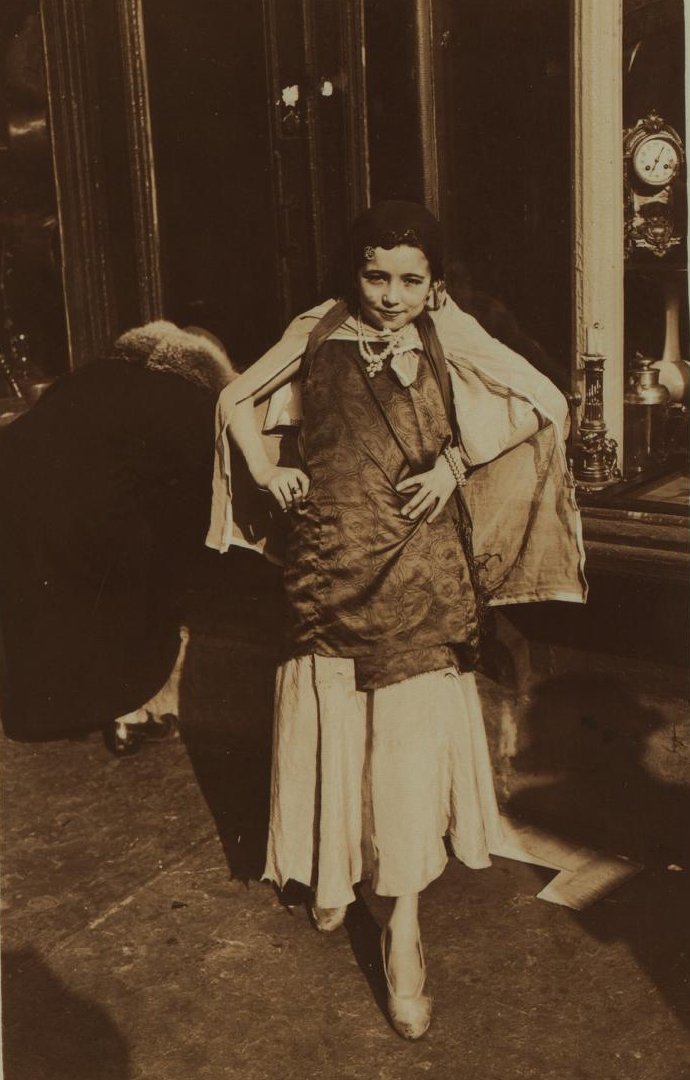
Before Halloween was the holiday known for dressing up in costume and begging for candy (this practice did not become common until the 1940s and 50s), children in NYC often participated in what was called Ragamuffin Day. On Ragamuffin Day – which was Thanksgiving Day – children would dress themselves in rags and oversized, overdone parodies of beggars (a la Charlie Chaplin’s character “The Tramp”). The ragamuffins would then ask neighbors and adults on the street, “Anything for Thanksgiving?” The usual response would be pennies, an apple, or a piece of candy.
In 1936, The New York Times’ only mention of the ragamuffins is to state:
Ragamuffins Frowned Upon: Despite the endeavors of social agencies to discourage begging by children, it is likely that the customary Thanksgiving ragamuffins, wearing discarded apparel of their elders, with masks and painted faces, will ask passers-by, ‘anything for Thanksgiving?’
In 1937, organizations such as the Madison Square Boys Club were reported as having Thanksgiving parades as an effort “to discourage the Thanksgiving ragamuffins.” By 1940, that parade had grown in size to over 400 children and sported the slogan “American boys do not beg.” Though the parading boys still dressed in costume as ragamuffins, many donned costumes of other things and people – such as alarm clocks and Michelangelo. – New York Public Library
According to one expert, “Ragamuffin parades, which harkened back to European traditions, were a chance for the poorer immigrants of New York to march through the streets in extravagant costumes, begging for change.” (From Bank St. Irregular)













 Playing in the World Game
