At one time an actual product (tongue-in-cheek, of course). I have one of these in my files.
From Wikipedia. There are people who will happily exclude their neighbors from heaven (as if they had the authority to do so) for believing in the wrong flavor of millennial doctrine – and these are all mainstream, evangelical faiths.
Mormons couldn’t possibly be Christians – they think God has a body and still talks to people.
“Don’t be a Dick”
A good way to observe your religious holidays – courtesy of Stan Lynde
“For I was an hungred, and ye gave me meat: I was thirsty, and ye gave me drink: I was a stranger, and ye took me in: naked, and ye clothed me: I was sick, and ye visited me: I was in prison, and ye came unto me.”
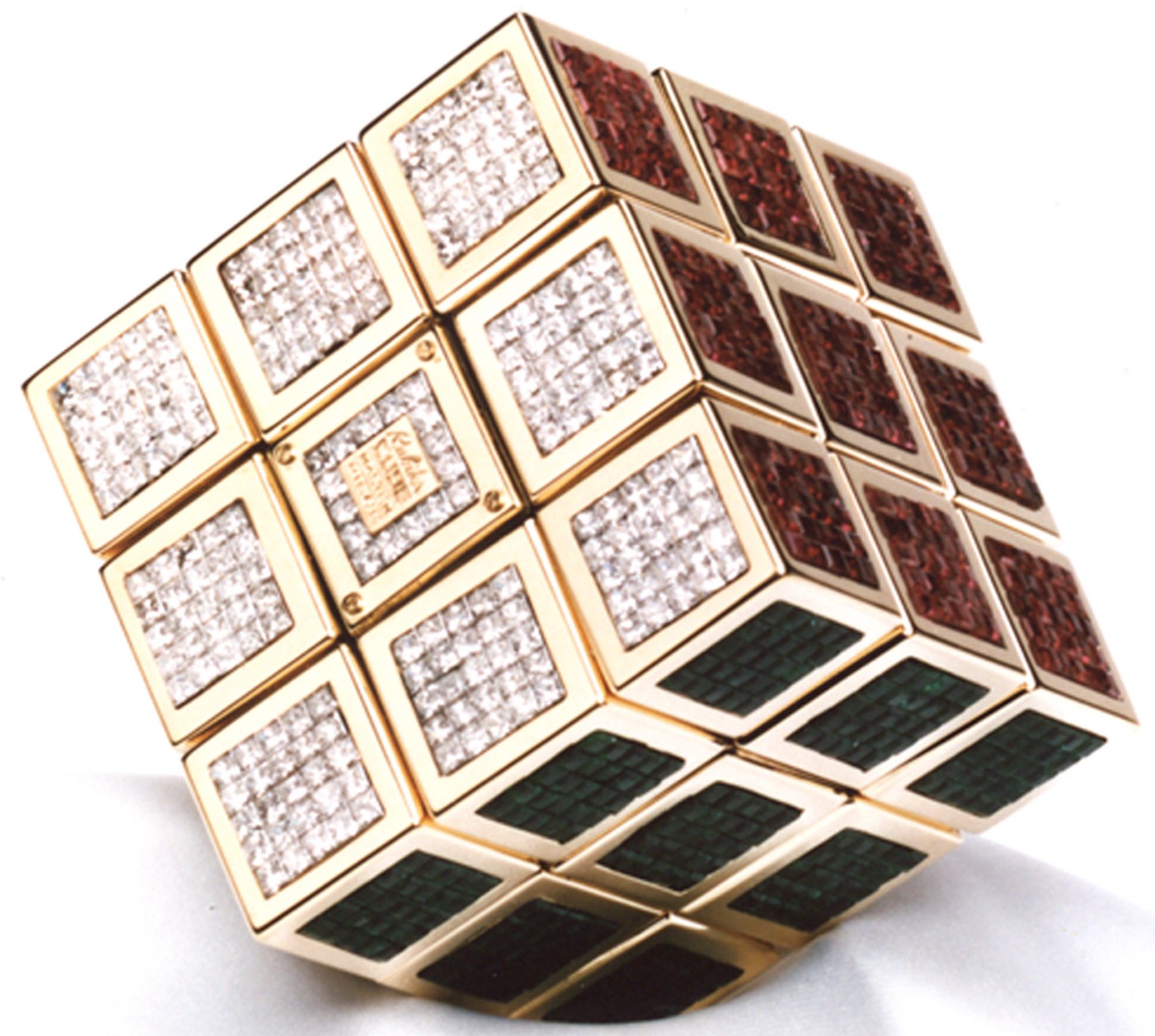
The Rubik’s Masterpiece, also dubbed “The world’s most expensive toy.” Created by Fred Cuellar, founder and CEO of Diamond Cutters International.
“Cuellar’s Rubik’s Masterpiece will be the centerpiece of the 40th anniversary exhibit. Valued at over $2.5 million, the fully functioning Rubik’s Cube required 8,500 man hours to be crafted in 18 karat yellow gold with 25 precious stones per panel set in invisible settings. Cuellar used 185 carats of rubies, emeralds, sapphires, and white diamonds to create the classic colored panels of the Rubik’s Cube puzzle with one small difference. While the original Rubik’s Cube is colored red, green, blue, orange, yellow, and white, Cuellar—himself a lover of puzzles and codes—decided to replace orange with purple for a variety of reasons both clever and protective.” (Full article at PRWeb)
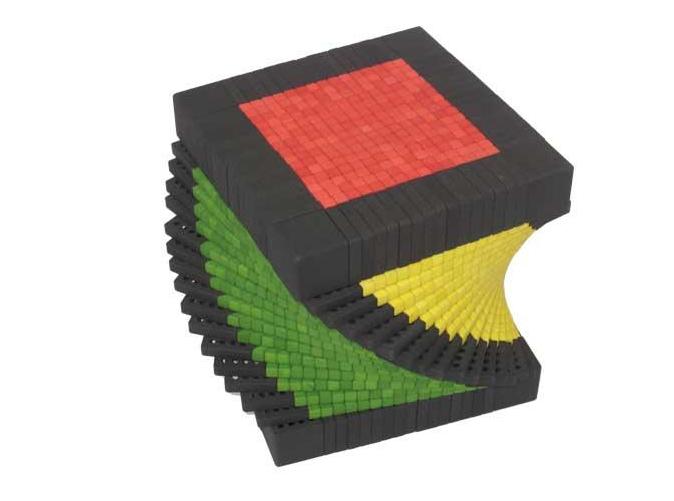
Other oddities in the Cube world include Oskar van Deventer’s “Over the Top”, a 17 x 17 x 17 cube which was produced on Shapeways‘ 3D printer.
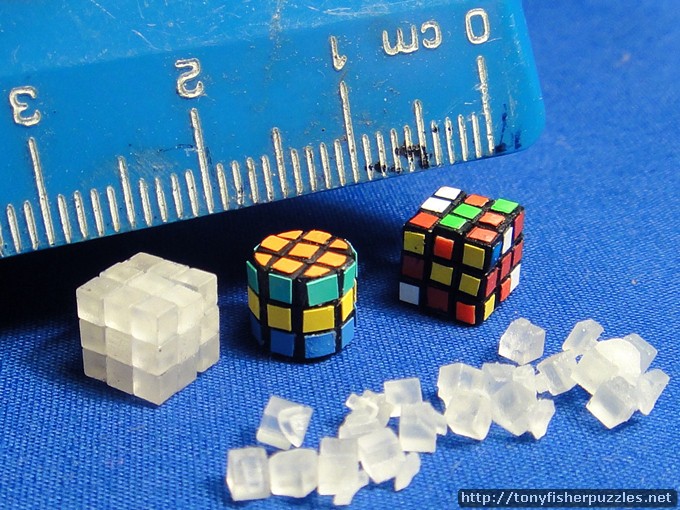
There have been some really tiny cubes made as well, also from 3D printers:
These 6mm wonders were made by Tony Fisher based on a Callum core.
Nowadays with software it’s possible to work puzzles of this nature in more than three dimenions and with insane matrices.
I loved my cube puzzles; I have a standard cube and a 2 x 2 x 2 mini-cube, and at one point owned a 4 x 4 x 4 Rubik’s Revenge which I sold on eBay recently because I could just never solve it. When I was younger I had more patience for such things. Puzzles of this nature were sort of like the “Angry Birds” of the 80’s.
Today the Daily Mail reported the passing of Bobby Hogg, go ndéanai Día trocaire air [1], the last speaker of Cromarty, or the Scottish Black Isle fishing dialect. Bobby Hogg was 92, and last year his brother Donald left the world at age 86, leaving Bobby alone as the only speaker of the dialect.
Donald Hogg
Every fortnight, one of the seven to eight thousand languages spoken on the planet passes into history; the National Geographic maintains an intriguing interactive page of linguistic hotspots which illustrates places in the world where languages are the most threatened. Most of these tongues belong to aboriginal or minority populations, languages like Chulym or Tofa, spoken by a hunter-gatherers who also herded reindeer. Specializing in a skill often allowed a language to develop complex meanings with a single word; for example, the Tofa word döngür means “male domesticated reindeer in its third year and first mating season, but not ready for mating.” [2] But as Hogg’s death has pointed out, there are languages and dialects (dissertations have been written about the difference, and linguists love pseudo-intellectual straining at gnats) which are dying a lot closer to home.
I noticed with interest that there is no color on the Geographic’s page along the western coast of Ireland or in Scotland, yet the Gaelic languages have suffered significant losses. Dolly Pentreath who died in 1777 was the last native speaker of Cornish; Ned Maddrell, who passed away in 1974, was the last native speaker of Manx. [3] Both tongues experienced scholarly revivals, and each language now has second language speakers and a few children who are being raised as native speakers. Scots Gaelic (Gàidhlig), Irish Gaelic (Gaeilge), Welsh (Cymraeg) and Breton (Brezhoneg) are all relatively endangered, although Welsh and Breton are the strongest, and Irish is being valiantly if ineffectively promoted and defended by the government and various groups within Ireland.
Which brings me to the “7rl” up in the title of this post.
In 1970, I had completed my second year of college and was back in New York for a few weeks before heading off to Naples, Italy for a year of work and study abroad. I stopped into a bar to use the phone and ended up talking to the bartender for a few minutes; when he found out I was studying languages, he said to me, “Well, don’t learn Irish.” That was like asking Maru not to jump in a box – I promptly went out and found a copy of Teach Yourself Irish by Myles Dillon and Donncha Ó Cróinín. Unfortunately, this book was printed before Irish spelling reform eliminated most of the silent consonants used in their hellish spelling (you will note that I said “most” – there are still plenty left!) – and without any real guide to pronunciation, I was unable to make any headway with the language, so I put the book on my shelf where it sat gathering dust.
20 years later, however, I stumbled across Linguaphone’s Cúrsa Gaeilge (Irish Course) in the West Valley City library – and it included tapes which became my Rosetta Stone; Irish is a beautiful and intriguing language which I continue to study as time permits. I’ve even attended an Irish Weekend in San Francisco, and would go back every year if resources permitted.
Irish postal vans used to carry the logo
which stood for “Post agus Telegrafa” (Post and Telegraph); there are still some old manhole covers and other relics around bearing this logo as well. The image below shows clearly that the siglum is not a number 7, but rather a different symbol altogether.
Wikipedia reports that “the Tironian sign resembling the number seven (“7”), represents the conjunction et, and is written only to the x-height; in current Irish language usage, this siglum denotes the conjunction and.” Thus in the Irish language, “7rl” stands for either “agus rudaí eile” or “agus araile,” both of which mean “etcetera” or “and so forth.” [4]
Coming full circle, there are some great (if sparse) resources about the Cromarty dialect out there:
Am Baile, the Highland Council’s History and Culture website, published a pamphlet about the Cromarty dialect which includes a lexicon (2.3 MB pdf file)
20 audio clips of Bobby and Donald talking about their dialect can be found here.
The Telegraph printed an article in 2007 about Bobby and Donald, including the following phrases:
Talking Cromarty
Thee’re no talkin’ licht
You are quite right
Ut aboot a wee suppie for me
Can I have a drink too?
Thee nay’te big fiya sclaafert yet me boy
You are not too big for a slap, my boy
Pit oot thy fire til I light mine
Please be quiet, and allow me to say something
I love this last one; while American English has some colorful dialects buried in remote pockets, our language is pretty bland when it comes to expressions like this.
The death of a language is a tragic thing, because it means the loss of so much culture and history that went along with its speakers. I support the efforts of organizations like Am Baile and Daltai na Gaeilge to encourage the use and revitalization of these beautiful and intriguing tongues.
Tá an sean-fhaolchú labhartha.
Notes:
[1] Irish for “May God have mercy on him”
[2] Astute readers will say, “Oh yeah – just like Eskimos have 23 (or 42, or 50, or 100) words for snow.” One such published list of Inuit words for snow follows:
Aiugavirnirq – very hard, compressed and frozen snow
Apijaq – snow covered by bad weather
Apigiannagaut – the first snowfall of Autumn
Apimajuq – snow-covered
Apisimajuq – snow-covered but not snowed-in
Apujjaq – snowed-in
Aput – snow
Aputiqarniq – snowfall on the ground
Aqillutaq – new snow
Auviq – snow block
Katakaqtanaq – hardcrust snow that gives way underfoot
Kavisilaq – snow roughened by snow or frost
Kiniqtaq – compact, damp snow
Mannguq – melting snow
Masak – wet, falling snow
Matsaaq – half-melted snow
Mauja – soft, deep snow footsteps sink into
Natiruvaaq – drifting snow
Pirsirlug – blowing snow
Pukajaak – sugary snow
Putak – crystalline snow that breaks into grains
Qaggitaq – snow ditch to trap caribou
Qaliriiktaq – snow layer of poor quality for an igloo
Qaniktaq – new snow on ground
Qannialaaq – light, falling snow
Qiasuqqaq – thawed snow that re-froze with an icy surface
Qimugjuk – snow drift
Qiqumaaq – snow with a frozen surface after a spring thaw
Qirsuqaktuq – crusted snow
Qukaarnartuq – light snow
Sitilluqaq – hard snow
Well, it turns out that the truth is both far more simple and far more complex. There’s a difference between packing semantic density into a single discrete lexical item, and using multiple suffixes to produce new meanings from a single root. At Language Log, Geoffrey K. Pullum, author of The Great Eskimo Vocabulary Hoax, said:
“If you wanted to say “They were wandering around gathering up lots of stuff that looked like snowflakes” (or fish, or coffee), you could do that with one word, very roughly as follows. You would take the “snowflake” root qani- (or the “fish” root or whatever); add a visual similarity postbase to get a stem meaning “looking like ____”; add a quantity postbase to get a stem meaning “stuff looking like ____”; add an augmentative postbase to get a stem meaning “lots of stuff looking like ____”; add another postbase to get a stem meaning “gathering lots of stuff looking like ____”; add yet another postbase to get a stem meaning “peripatetically gathering up lots of stuff looking like ____”; and then inflect the whole thing as a verb in the 3rd-person plural subject 3rd-person singular object past tense form; and you’re done. Astounding. One word to express a whole sentence. But even if you choose qani- as your root, what you get could hardly be called a word for snow. It’s a verb with an understood subject pronoun.”
The entire page is worth reading if you’re interested in such things.
Another example of aggressive word formation comes from the Turkish language. It is said that the single word Avrupalılaştırılamayabilenlerdenmısınız is the equivalent of an entire sentence: “Are you one of those who is not easily able to be Europeanized?” This, however, is misleading because Turkish agglutinates (i.e. crams whole bunches of stuff together); it’s not really fair to call the monstrosity above a “word.” Here’s a breakdown of how the thing is put together:
Avrupa: Europe
Avrupa-lı: European
Avrupa-lı-laş-mak: become European (mak is the infinitive ending)
Avrupa-lı-laş-tır mak: to make European
Avrupa-lı-laş-tır ı l mak: (reflexive) to be made European (with the linking consonant “l”)
Avrupa-lı-laş-tir ıl abil mek: to be capable of being Europeanized (the infinitive ending mak changes to mek because of vowel harmony)
Avrupa-lı-laş-tır ıl ama mak: not to be capable of being Europeanized
Avrupa-lı-laş-tır ıl ama y abil mek: this time the abil is probability: that there is a probability that one may not be capable of being Europeanized
Avrupa-lı-laş-tır ıl ama y abil en: the one that may not be capable of being Europeanized
Avrupa-lı-laş-tır ıl ama y abil en ler: the one that may not be capable of being Europeanized (-ler, -lar is the plural suffix)
Avrupa-lı-laş-tır ıl ama y abil en ler den: of or from the ones who may not be capable of being Europeanized
mı? question tag (officially, this should be written separately, but it’s very common usage not to do so)
mısınız? are you (Second person plural, also used for formal second person singular)
[3] At one point as I was following my passion for all things Celtic, I stumbled across a Manx Language resource page and discovered to my delight that the spoken samples by Ned Maddrell and John Kaighin were close enough to Irish to be understandable. I regret that I don’t have time to dig deeper into this language.
[4] Which reflects the nature of many of my posts here… pretty much a free-association experience. Sorry.
In a recent post, I referenced The Cooking of Vienna’s Empire by Time/Life. This picture always made me smile.
The caption reads, “Even in Vienna, the simplest food often tastes best. Witness this cabbie downing his sausage and beer with quiet satisfaction while waiting for a fare in front of St. Stephan’s Cathedral.”
If I know the Viennese, this guy was anything but quietly satisfied, and was probably griping to himself about the tourists, the government, the church tax, the weather, the beer, life, the universe, and everything. No, seriously – I love the Austrian people with all my heart, but the caption on the photo just doesn’t do reality justice.
But my goodness, that Würstel mit Senf (sausage with mustard) looks good. Hope he has a pile of Kren (fresh shredded horseradish) under his slice of bread… I can’t count how many times I’ve stopped at a sausage stand on the streets and snagged just what he’s having, or perhaps a Leberkäsesemmel – the Austrian version of a bologna sandwich, only 10 times better.
So many memories… I’ve shared a couple of them before, here and here, but there are so many it’s hard to choose from among them. I lived in Austria from February 1975 to December of 1976, and I’d go back in a heartbeat. So here are some of the more significant ones for me, in no particular chronological order.
Allerheiligen
Hallowe’en in Austria is a holy day, not one of ghosts and goblins. The evening before November 1, All Hallows Day, people make a pilgrimage to the cemetery and light candles for the souls of the dead. This was taken in Vienna’s Zentralfriedhof (Central Cemetery) on October 31, 1976.
And the following morning:
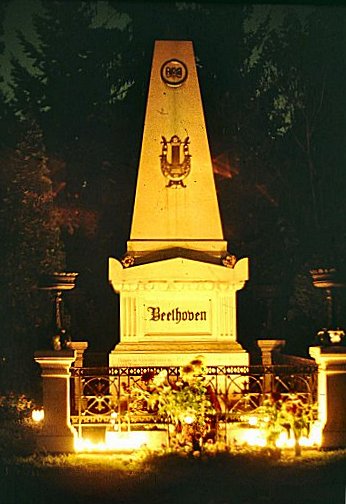
I love Beethoven’s music more than any other, and I was honored to be able to honor his memory at so many different sites.
The Beethoven Monument in Vienna
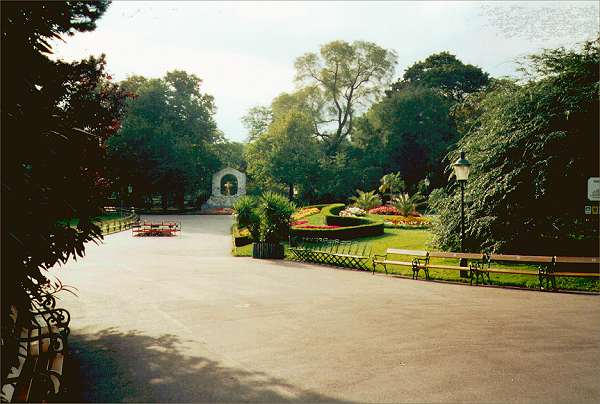
Vienna, of course, is the home of many famous musicians:
The Strauss Memorial in Vienna’s City Park
Hot chestnuts for sale beneath the old Stadtbahn (City Elevated Train) tracks. A wonderful thing, these… I remember them at Christmas time on the streets of New York in the 50’s. 12 chestnuts for about 60¢ – the exchange rate was about 15 Austrian Schillings to the dollar at the time.
One of the old Stadtbahn trains.
Tichy Ice Cream parlor on Reumannplatz 13 in the 11th Bezirk
Still there, still famous. Here you get gelato, not American style ice cream, in a whole symphony of flavors.
I laughed hard the first time I saw a police beetle. I didn’t laugh at all the first time one of them pulled in front of me flashing a sign, “Bitte Folgen” (please follow) and I collected a speeding ticket.
Stefansdom – St. Stephen’s Cathedral
Sachertorte is the quintessential Austrian pastry. A sponge cake covered with apricot jam and chocolate, this cake is designed to be taken with schlagobers (whipped cream) and plenty of water. There are more Austrian pastries than you can shake a stick at, and you may like some of them more than this one – but it remains my favorite to this day.
I could go on. In fact, I will go on in another post. But now I want some Sachertorte, and I don’t have any. So I shall sit in the middle of the floor and cry.
It’s a funny thing about life; if you refuse to accept anything but the best, you very often get it. -W. Somerset Maugham
I bargained with Life for a penny,
And Life would pay no more,
However I begged at evening
When I counted my scanty store;
For Life is a just employer,
He gives you what you ask,
But once you have set the wages,
Why, you must bear the task.
I worked for a menial’s hire,
Only to learn, dismayed,
That any wage I had asked of Life,
Life would have paid.
Warning: This is a very long post. I’m pulling together a lot of information from a number of different sources, primarily so I can solidify the memories. The core, however, is a tribute to some fine people who had a significant impact on my early development.
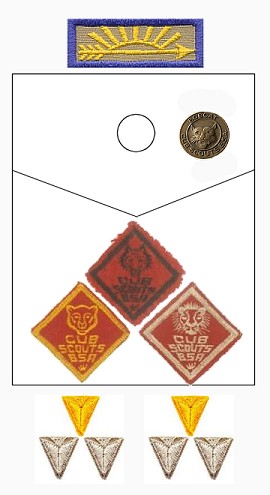
When I was about 8 years old, I joined a cub scout pack in New York City, back in the days when you first got a Bobcat pin for joining, and then earned your Wolf, Bear, and Lion patches. The Webelos patch (now called the Arrow of Light) was the last award, the bridge between the Cub and Scout programs. Kids today don’t know that Webelos stood for Wolf, Bear, Lion, Scout. My uniform pocket looked something like this:
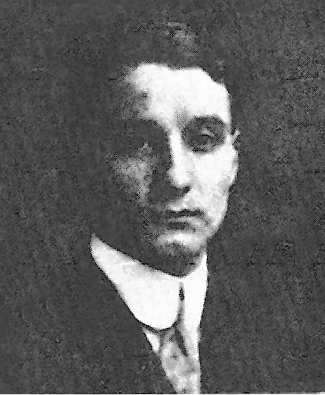
Arnold Belais
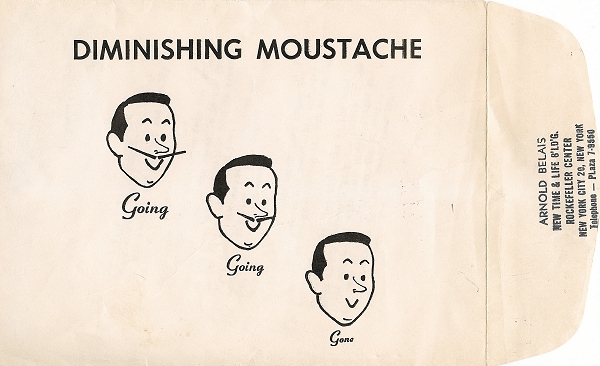
I wasn’t much for knots and pinewood derbies, and it’s hard to do scouting stuff in Manhattan, but I enjoyed the interactions and I learned a lot. The best part of the experience, however, came serendipitously when, in 1962, an old gentleman with a raspy voice gave me his business card – after showing me a magic trick with it.
I had unknowingly crossed paths with Arnold Belais, affectionately known to the New York magic crowd as “The Rube Goldberg of Magic.” And my life would never be the same.
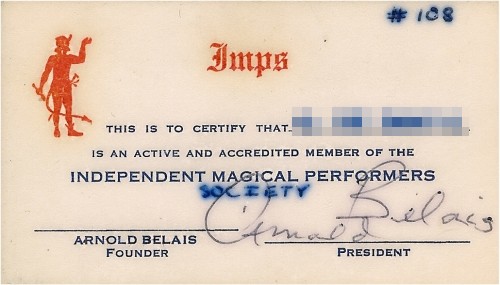
The Society of American Magicians was founded in 1902, but Arnold – an early member who joined that organization in 1912 – was interested in bringing magic to the youth – and that may have been why he was hanging around a cub scout pack. Right at that time, he was busy forming a feeder group for SAM, a club for young magicians called the IMPS (Independent Magical Performers’ Society), and I fell in love with the idea at once.
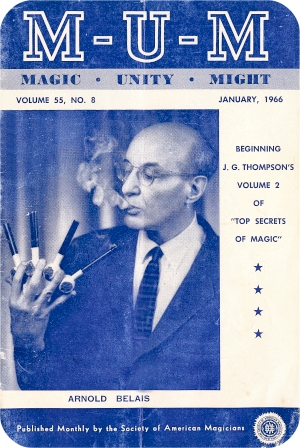
I also fell in love with Arnold, and was privileged to visit him and his dear wife Hortense in their New York apartment, where Arnold showed me his workbench where he tinkered together some of the most outrageous magic effects I have ever seen. His love of pipe, cigar, and cigarette magic also earned him the title “SmoKing.” He demonstrated his home-built “multiplying pipes” routine for me – I even got to hold those pipes, which appear in the picture below, and whoever ended up with that piece of equipment has a rare treasure.
Arnold was featured in the January, 1966 issue of M-U-M, the official organ of the SAM:
The article in its entirety by Leslie P. Guest follows:
Arnold Belais By Leslie P. Guest M-U-M, January 1966
Through his inventions and unusual routines, mostly dealing with cigars, cigarettes and pipes, Arnold Belais has earned the title of “Smo-King”; but among his many friends in provincial New York City he is affectionately known as “The Rube Goldberg of Magic.”
This is because Arnold is eternally experimenting, and coming up with weird concoctions of magic -halfbaked, un-rehearsed, but ingenious; and often snapped up and put to use by professional performers. Our perfectionist member, Dai Vernon once remarked, “I would rather watch one of Arnold Belais’ experimental routines than see a three-year magic student essay all the moves in Erdnase.”[1]
You can kid Arnold, and many people do; but all admire him for his long and devoted service to magic and to our Society. Just think – S.A.M. Member No. 414, who joined in 1912 – thus has been a Compeer for 53 consecutive years! There are no more than three members living today who can equal his record; yet he has never sought high office, being content to carry out any specific job assigned to him, and doing it well.
Arnold Belais was born November 4, 1890 in New York City, and has always lived here. His first glimpse of magic was at age eight, when a playmate showed him a Ball Vase and other wondrous wood-turnings from a German Magic Set. Later that year he saw Elmer P. Ransom (particularly noted for his Clay Pipes Routine) on the stage of a Sunday School Auditorium. Later, on that same stage he saw Jean Irving, and Roltare Eggleston; then three generations of the Flosso Family – father-in-law Louis (Pop) Krieger, King of the Kups and Balls; then Al Flosso, the Coney Island Faker; then AI’s son, Jackie Flosso.
At age twelve he bought his first book on magic – authored by Fred Morphet -at a side-show. From this he learned to blow soap-bubbles magically – the bubbles went up in flames when ignited! This probably started Arnold in pyrotechnics; it is estimated that he has burned holes in more handkerchiefs than any other magician.
Then followed hundreds of shows as an amateur at schools, churches, hospitals, scout meetings and conventions; later the full round of service shows for the American Theatre Wing. In 1910 his picture appeared on the cover of “The American Magician” – we will reproduce that cover for you, if practical. In 1912 he joined the Society of American Magicians, and was initiated in Martinka’s Little Back Room Theatre.
About 1938, when Leith Loder started the Parent Assembly Open House Meetings (continuously sparkplugged by Paul Morris), Arnold attended from the inception, and became known as “The Perennial Opener.” Since the Open House was dedicated to progress and innovation in magic, this was the right spot for Arnold’s experimental routines. One of these developed into his “Multiplying Pipes”, featured and sold by Tannen Magic Co. since 1948.
In August of 1961, the “IMPS” was started by Paul Morris and Arnold Belais. The “Independent Magical Performers Society” is an idea for providing training for junior magicians. It was, and is, most successful in its field; and a number of these juniors have since applied for, and attained membership in our Parent Assembly.
Also in 1961 Arnold was appointed Chairman of the Membership Committee of the Parent Assembly, and earned recognition from the National Council for having increased the membership to a greater degree than any other Assembly that year.
Arnold Belais has had a long and successful career in Life Insurance, during which he attained the coveted distinction of membership in The Million Dollar Round Table of the National Underwriters. His wife, Hortense is not a magicienne herself, but joins Arnold enthusiastically in his various magical endeavors; They do not travel much these days, but if you visit New York City, you will enjoy meeting Arnold Belais and Hortense.
Arnold passed away on January 29, 1973 at the age of 82, and is terribly missed. But as a member of the IMPS, I learned how to perform in front of a crowd, and once was produced from a large box by senior magician Don Brill. The longer I associated with Arnold, the more taken with the world of magic I became.
As I grew old enough to navigate the streets of New York by myself, I discovered both The Magic Center, run by Russ Delmar on 8th Avenue between 46th and 47th Streets, and Lou Tannen’s magic shop closer to Times Square. Tannen’s was the “upper-crust” place, and they had a lot of high-end stuff there (my Tarbell Course is the one published by Tannen himself), but the Magic Center was more of an old-world everyman’s magic shop, and I felt a lot more comfortable there. I was just a kid, but I hung around there for years and Russ was kind; naturally he wanted to sell me magic, but he always encouraged me and taught me a lot along the way.
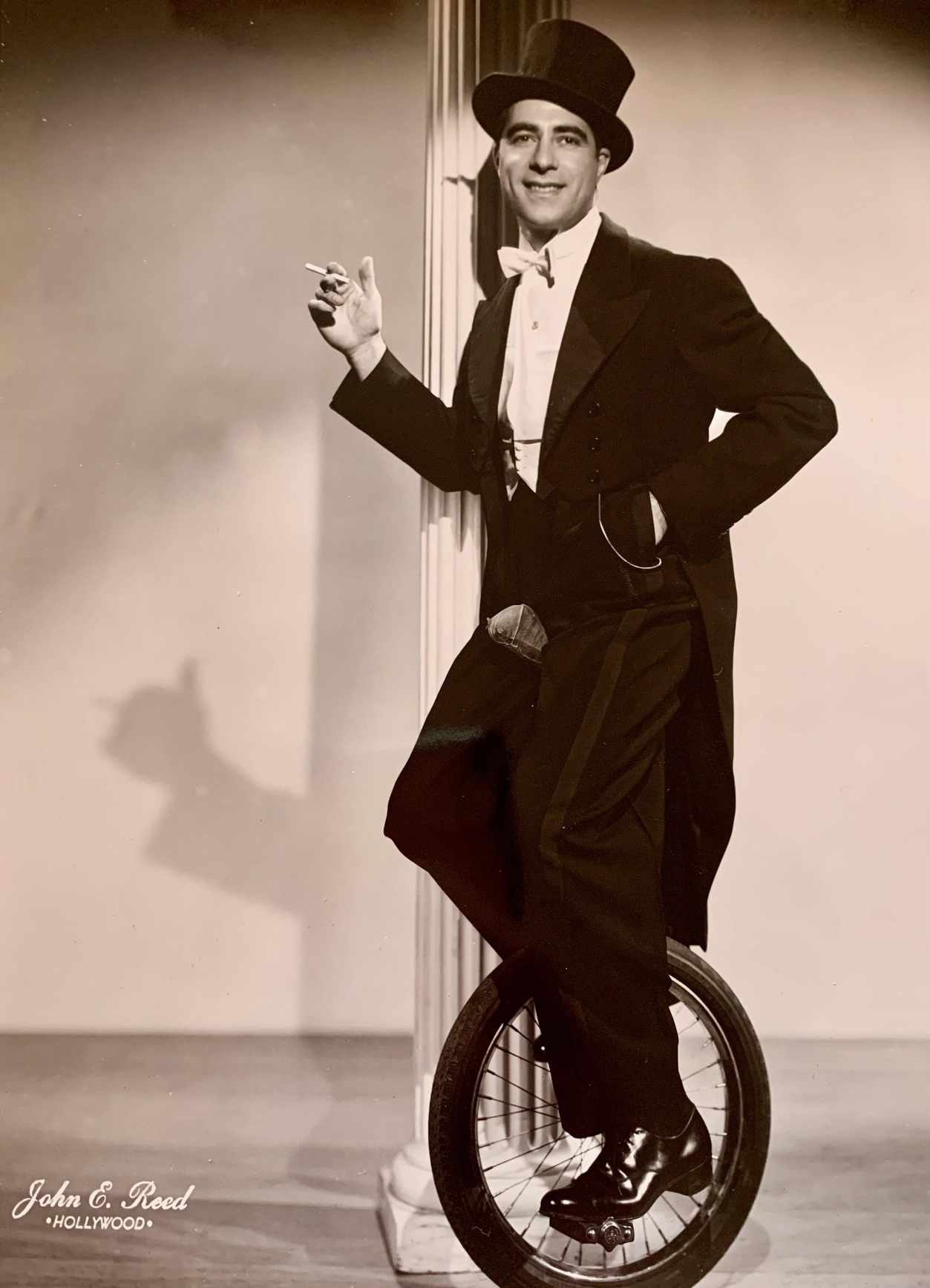
According to Russ’ son, his real name was Anthony DiSario. Russ was a skilled vaudeville dancer who – according to an article in the New York Sun – performed with Gene Kelly at one point, and was also a fencer, a boxer, a trainer in a Philadelphia gym, a juggler, and a unicycle rider; he traveled with the USO to entertain the troops, and met his wife in Germany. I’m not sure how he ended up with his magic stores, but apparently there were two – a larger one with a stage in back, and the smaller one that I knew.
From Mews Items: Amazing but True Cat Stories:
Eggbag the cat was one tricky kitty. For years, he astounded New Yorkers with his famous card trick.
One day in 1975, the gray-white cat walked into the Magic Center, a magic shop on Eighth Avenue, and stayed there, stealing the heart of owner and magician Russ Delmar. The cat was given the name Eggbag after the trick in which an egg is palmed out of a felt purse.
To earn his keep, Eggbag learned a card trick. He would lounge on the counter in the store while Delmar shuffled a deck of cards. “Pick a card,” Delmar would tell a visitor, fanning the deck.
The visitor would select a card without showing it to Delmar or Eggbag and slip it back into the deck. The visitor would then straighten the deck before Delmar would fan the cards in front of the cat.
Eggbag would yawn and stretch. Then suddenly he would bite a card, pull it out of the deck with his teeth, and let it flutter down. The card would be the exact one that the visitor had selected. Every time.
“How does he do it?” said Delmar, repeating a visitor’s question. “He does it very well.”[3]
By the time Russ met Eggbag, I was serving a mission in Austria, and had moved away from New York, so I never met his cat, and I sadly lost touch, but Russ is fondly remembered as a mentor and the owner of my home away from home for so many years. I’d love to know more about him.
Al Stevenson
One of the people I met in Russ Delmar’s shop was Al Stevenson.
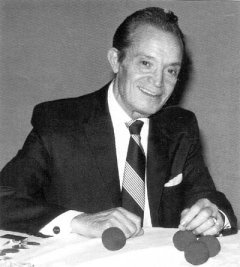
Like Russ, he was a showman and a salesman, but he also became a friend. My mother was quite taken with him (she was also a performer) and he was a guest in our home more than once. Al was also written up in M-U-M, and the article by Leslie Guest is show below.
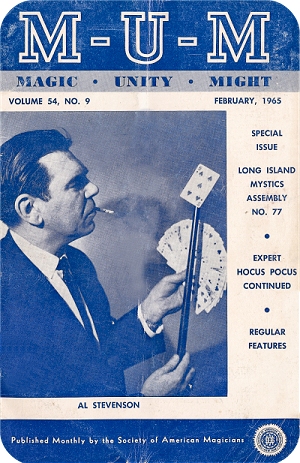
Al Stevenson By Leslie P. Guest M-U-M, February 1965
This issue of “M-U-M” is dedicated to Long Island Mystics Assembly No. 77 and their chosen cover subject is Al Stevenson. Al is a recent member of the Assembly; but after all, they are a comparatively new group, although all live wires, and 100% active in magic.
Al Stevenson was born September 1, 1916 in Chicago, Illinois. Naturally his first affiliation was with Chicago Assembly No.3; then with the Parent Assembly; and because he lives in Massapequa on Long Island, he cast his lot with Assembly No. 77. He is also a Past President of The Wizards’ Club of Chicago, the Manipulators of Chicago, and of three hypnotic societies. For the past four years he has been Associate Editor of “Hugard’s Magic Monthly.”
His impetus in magic was at age eleven, receiving a free magic trick at a movie matinee about magicians. He says little of his early years, but he maintained and built up his magical skills, and has a rather remarkable service record. He spent three years in the Lincoln Brigade during the Spanish Civil War. This included 17 months in a Fascist Concentration Camp. He was a pilot for three months, and a machine gunner for 15 months, during which time he was shot down.
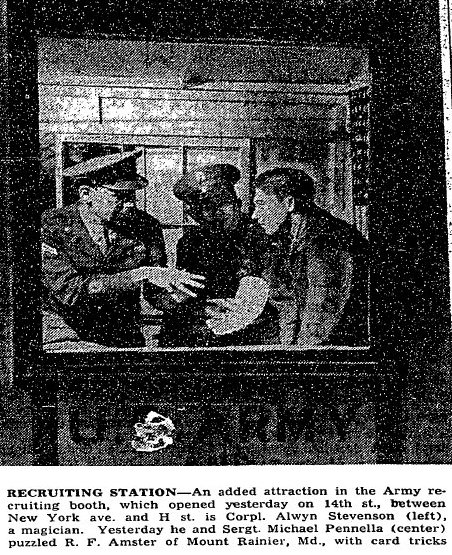
Later he served three years in the U.S. Army and four years in the U.S. Air Force. He had various duties, and while with the Recruiting Service he used magic to get prospects interested.
From the Washington Post, Nov. 9, 1948
Then he was sent to Bolling Field, Washington – but by mistake he was classified as a “musician” and assigned to the Air Force Band. The mistake rectified, he went into Special Services, taught a class in magic, and did hospital and service club shows.
He did shows in France, England, Ireland, Germany, Belgium, Holland, Japan, Spain and Scotland, which is covering considerable territory. One show was in a submarine at New London, Connecticut; and for contrast, another was for U.S.A.F. General Hovey while flying in a B-17 Bomber. He also became interested in Hypnosis, and at one period was assigned to Camp Stoneman California Military Hospital as a Consultant Hypnotist, working with combat fatigue and war-induced neurosis. Another interesting assignment was to the Counter Intelligence Corps at Camp Halobird, Maryland. He assumed nine different identities, birthdates, etc., acting as a “captured prisoner.” The students would interrogate him, and their grades depended on the skill with which they extracted information from him. A good chance for Al to improve his own science of misdirection!
Since his service years, Al Stevenson has had an interesting career as a performer, teacher, author and magic dealer. During his stay in California he travelled with a carnival as a pitch-man, which is good training for behind-the-counter selling.
As a teacher he was founder of The Illinois Institute of Hypnotic Research and The California Society of Hypnotists. He learned the deaf-and-dumb sign language in order to teach magic to a deaf group in Michigan. He recalls that his favorite student was probably the biggest guy in the world -Henry Hite of the vaudeville act of Low, Hite & Stanley -seven feet nine inches tall! That chap could perform without a raised platform!
Al Stevenson is the author of “A Complete Course in Hypnosis.” “75 Tricks with the Stripper Pack,” “75 Tricks with the Svengali Deck,” plus some fine routines for Sponge Balls and other items which he markets. In Hollywood he advertised his hypnotic course in the local papers with rather unhappy results. It turns out the printed copy read, “A Complete Course in Happiness.”
He was a magic demonstrator in 13 magic shops; owner of two. One of his early jobs was in the Dell O’Dell Shop in Hollywood. While working in Boston he made a dollarbill-ring for a slightly tipsy customer; but the bill used was $100. The customer thanked Al and left, but soon returned, cold-sober. A block from the shop he had been held up at the point of a gun, his near-empty wallet and watch taken -but the ring was not noticed. He gratefully tipped Al $20 from the rescued $100!
For four and a half years Al Stevenson was the owner of The Wizard’s Shop in the New York Subway Times Square Station. This was an amazing hole-in-the-wall shop, located right in the heavy stream of traffic. People were always in a hurry, but AI, with his pitchman-acquired skill, could hold their interest and make sales. Among his regular customers was an armless man who loved magic. He bought the tricks, but had his wife learn to do them, and present them for their guests at their home.
Al Stevenson is now a partner in The Wizards’ Work Shop of Massapequa, mail-order and wholesale distributor of magical specialties. He makes remarkable sponge-balls and other compressible items. He likes to do table magic, some real sleight of hand and an apparent sleight routine by black art. Completely dedicated to magic, Al is a useful friend and instructor in most branches of our art, and certainly a great asset to Assembly No. 77.
Al was a complex character, and the official biography in M-U-M left out several important points about his life. A great deal of information about Al was posted on a website called The Wizard Shop by Steven Zaretsky, who was related to Al by marriage. The site is now offline, but most of it is available through the Wayback Machine, and I have also archived it off for safekeeping. If time permits, I may resurrect it so that it gets greater exposure.
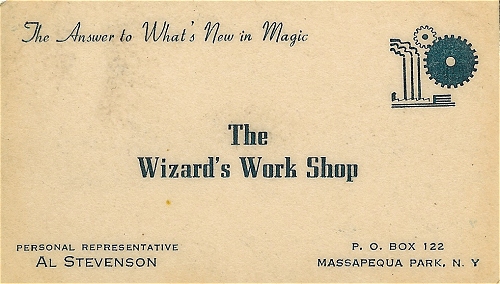
Al’s business card
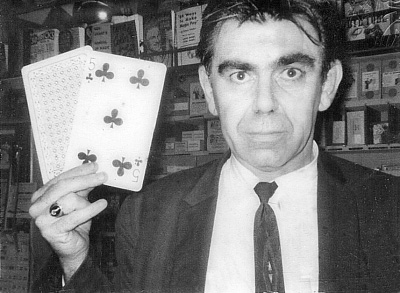
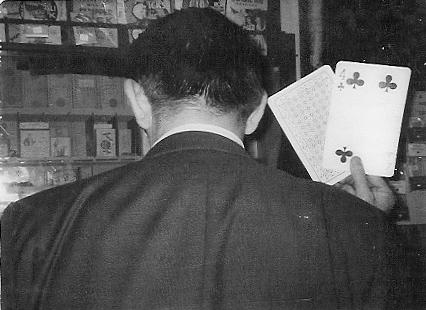
Here’s a photo of Al in The Magic Center. I was there the day he took this – it’s actually a gimmick he used. Force a 4 of clubs and tell your patsy you had a polaroid photo of yourself taken the day before… you “knew” which card he was going to pick.
When the guy complains that’s not his card, turn the thing over and say ‘Well, I always was a little backwards!'”
From 1982 to 1999, Charles Windley published Backstage, a journal for magicians. The following article about Al was published in Issue No. 5:
From “Backstage”, #5, April 1982 Published by Charles Windley Al Stevenson 75 Tricks With A WIZARD DECK, 1962
Al Stevenson was one of the most prolific magicians I ever met.
I was performing at Hubert’s Museum in New York and would pass through the 42nd Street subway arcade on my way to work. One afternoon I noticed a crowd gathered around a stairwell and realized that one of the street entrances had been replaced by a magic shop. The Transit Authority had re-routed the exit and boarded up the area leaving a 10 x 8 foot alcove. An enterprising pitchman – quick to realize an opportunity – had rented the small space from the transit authority for $60 a week and turned it into a little store. He peg-boarded the three walls and placed an eight foot showcase across the front. Four feet above the counter was a long mirror hung at a 45 angle so those in the back could have a bird’s eye view of the demonstrations. Above this was a roll-down door so that the place could be locked at night.
Hung across the back wall was a sign that proclaimed “THE WIZARD SHOP“. The area was well-lit. During both the morning and evening rush hours, hundreds of stripper decks passed across the counter along with dozens of other small pocket tricks. As the weeks went by, The Wizard Shop grew in popularity and more expensive tricks were added although the stripper deck always remained the chief rent-payer. I voluntarily shilled his tip a couple of times and Al, the owner, and I soon became good friends. Suddenly I found myself working behind the counter every Tuesday (my only day off at Hubert’s) for 10% of the day’s gross. This not only paid MY rent but also gave Al a needed break for other projects with which he was involved. It turned out that he was not just another pitchman but was quite knowledgeable about magic.
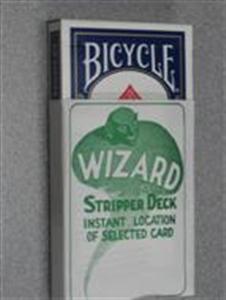
He didn’t like the term stripper deck as he felt it gave away the secret, so he re-named it “The Wizard Deck” (after the shop) and designed a green wrapper with a drawing of a huge demon. I didn’t know then that the demon was real. The name became so widely used that it was eventually adopted by Haine’s House of Cards, the manufacturer, and the name and green wrapper with the demon is still in use today.
Al then wrote 75 Tricks with a Wizard Deck which he published and sold at the shop. This little $1.50 pamphlet has become a standard magic shop item and today is sold around the world in five languages. The demon also appears on the cover of the book. Al then wrote 75 Tricks with a Svengali Deck which enjoys the popularity. His 3rd book, 75 Tricks with a Mene-Tekel Deck, was never completed.
In addition to his books, Al took over as editor of “Hugard’s Magic Monthly” upon Hugard’s death and invented over 30 magic effects which he manufactured and sold at his little shop. He created many professional tricks including a Card On Ceiling with the cards IN their case so that the magician doesn’t have to play 51 pick up after the trick; a complete black art act that could be performed anywhere under almost any conditions and a chemical method of lighting cigarettes that was a boom to the cigarette manipulator. He was also the first to use foam rubber for sponge balls. At first he cut the balls by hand but later developed a special heat process which is the method still used today. He made foam balls, wands, fish, Coke bottles, carrots and an ice cream cone.
Al Seldom discussed his past, especially the demon, but once in a while I would get him wound up and he would tell stories of his days as manager of Dell O’Dell’s Magic Studio in Hollywood or his adventures as a professional soldier in the Spanish Civil War. He was involved at one time with the C.I.A., developing methods of smuggling papers and microfilm across international borders, and he had spent time as a hypnotist with U.S. Army Intelligence. Between all this, he had traveled most of the world as a magician and/or pitchman.
I learned two important lessons from Al. He taught me that the method is of very little consequence; the end result – a pleased audience – is what counts. He also said, “Always Be a magician…don’t just do tricks!”
When not involved with magic, Al spent his time battling his demon. He put up a strong fight but finally lost. One cold November night in 1964 as he was leaving the Brooklyn Academy of Music, the monkey bit too hard and he quietly fell down and rolled over in the snow.
Magic lost a prize that night, one that it never really knew it had.
It’s entirely appropriate to mention that this published version of Al’s death is not entirely accurate, but was somewhat modified for a magic publication. Shortly after Al passed away, I called his home as I often did, and was told an entirely different story about the event. The lady who answered the phone told me that he and she had been out to the films the previous night, and had seen “The Battle of the Bulge”. He left early because he wasn’t feeling well, and retired early. In the morning, he was gone. As alluded to in the above article, the big green demon was real, and Al had struggled for a long time with some sort of substance abuse, which ultimately led to his all-too-early demise. The truth never tarnishes the reputation of a great man, and my estimation of Al and his accomplishments and kindness is not a whit less.
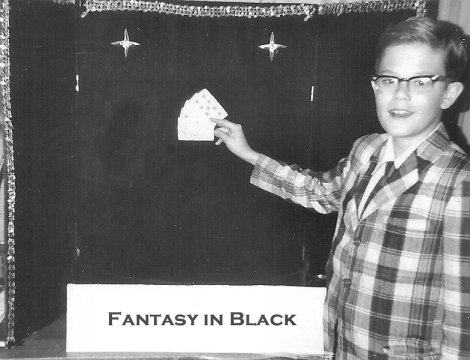
I saved my earnings from delivering groceries at Daitch Shopwell on 1st Avenue and 58th Street, and purchased one of Al’s “Fantasy in Black” setups.
Never mind that I look like a weed in that madras jacket; it was 1963, I was 12, and didn’t know any better. But I loved the effect; the board long since deteriorated, but I still have a number of the original gimmicks which would serve just as well if I ever construct a new background. I also have a beautiful set of Chinese sticks that Al manufactured for me, and one or two of his other items; sadly, the sponge items which I obtained for him did not stand the test of time and crumbled. I loved the hand-painted sponge fish best of all.
Naturally I was devastated at Al’s passing, but the bitterness of loss swiftly passed and was replaced by the sweetness of memory. I’m honored to have known this outstanding entertainer who had such a big impact on me in my formative years.
Slydini
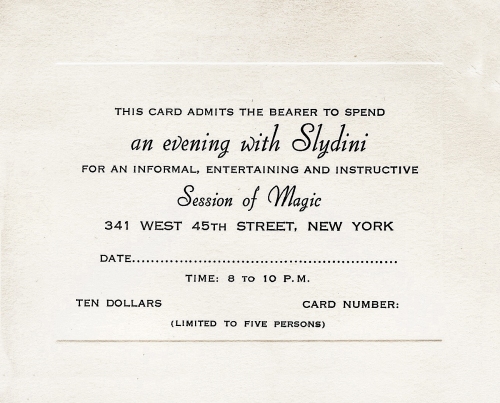
One of the greatest favors Al did for me was getting me in to a personal seminar with Tony Slydini.
One of the foremost close-up magicians of all time, Tony in later years hosted private seminars where he would perform and teach a routine or two. It was an astonishing night, watching this man’s work. There were 5 of us, if I recall, including Al himself, and Slydini taught us his “coins through table” routine. I will never forget the experience.
Ten bucks was a fortune for me back then, but I never regretted having gone.
Conclusion
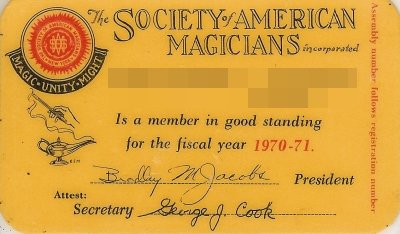
Time marches on, and while I still have almost all of my paraphernalia, real life and work and marriages and children and grandchildren pretty much erased any facility I had with a deck of cards… but not the love in my heart for the craft. I was a member of S.A.M. for a while, earning money doing children’s parties – so although my skills are dusty, I still consider myself a professional, and honor those who have turned their love into a career.
The Old Wolf has spoken.
1. If you want to learn all the moves in Erdnase, you can still do it here.
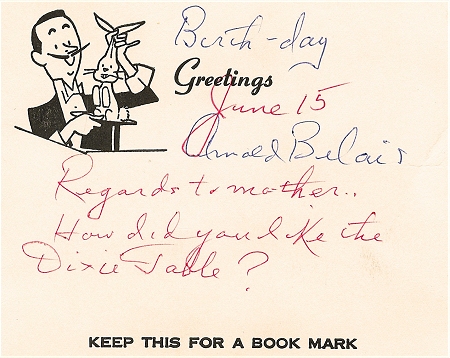
2. The card refers to the Dixie Magic Table. This was a gathering of magicians that took place on a regular basis at the Hotel Dixie in Manhattan. Even though I was just a kid and way out of my league, I enjoyed sitting with the old professionals and watching their amazing closeup work. Most of them were kind enough, but Joe Barnett once demonstrated an eye-popping routine, and told me I could learn how to do it in his book, Barnett on Sleights. I raced to Lou Tannen’s to buy it, only to discover to my chagrin that I had been sent on a fool’s errand – no such book existed. I was bitterly disappointed, but never held it against the Tannens – in fact, I could tell they were rather pissed at Joe for pulling this stunt. It’s worthy of note that after that I never again went back to the Dixie…
3. Allan Zullo and Mar Bovsun, Mews Items: Amazing but True Cat Stories(Kansas City: Andrews McMeel Publishing Company, 2005) p. 27
A blurb today at Newser announces that Friday will be a “Blue Moon.”
No, it won’t.
Summer began on June 20, and has only 3 full moons:
2012
Jul
3
18:52
Tue
2012
Aug
2
03:27
Thu
2012
Aug
31
13:58
Fri
The next full moon won’t be until September 30, after the autumnal equinox. The next real Blue Moon will be August 21, 2013. But as Sky and Telescope noted, “With two decades of popular usage behind it, the second-full-Moon-in-a-month (mis)interpretation is like a genie that can’t be forced back into its bottle.”






















 Playing in the World Game