The Life and Times of Maud Müller

While perusing a children’s book which once had belonged to my wife’s stepfather (I was checking it out to see if it was worth keeping, but it was too badly deteriorated), a scrap of paper fell out – an old newspaper clipping. Old and wrinkled, it was almost like cloth, and turned out to be a humorous poem about a young lady named Maud Muller.
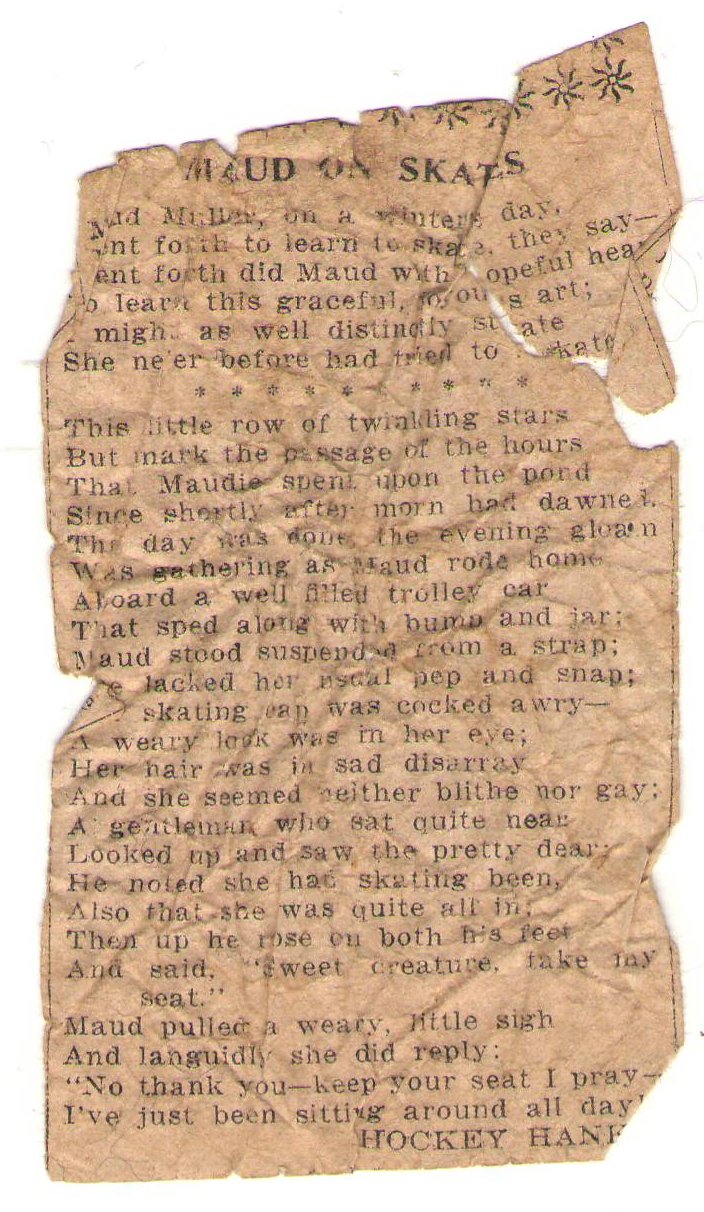
Maud Miller on Skates

What I discovered was that the original was written by John Greenleaf Whittier, which includes the famous tag line, “For of all sad words of tongue or pen, The saddest are these: ‘It might have been!’ ” It appears that the others I have found are the equivalent of “fan fiction,” but I share them with you anyway in the spirit of fun.

MAUD MÜLLER

by: John Greenleaf Whittier (1807-1892)

MAUD MÜLLER, on a summer’s day,
Raked the meadows sweet with hay.
Beneath her torn hat glowed the wealth
Of simple beauty and rustic health.

Singing, she wrought, and her merry glee
The mock-bird echoed from his tree.
But, when she glanced to the far-off town,
White from its hill-slope looking down,

The sweet song died, and a vague unrest
And a nameless longing filled her breast–
A wish, that she hardly dared to own,
For something better than she had known.

The Judge rode slowly down the lane,
Smoothing his horse’s chestnut mane.
He drew his bridle in the shade
Of the apple-trees, to greet the maid,

And ask a draught from the spring that flowed
Through the meadow across the road.
She stooped where the cool spring bubbled up,
And filled for him her small tin cup,

And blushed as she gave it, looking down
On her feet so bare, and her tattered gown.
“Thanks!” said the Judge, “a sweeter draught
From a fairer hand was never quaffed.”

He spoke of the grass and flowers and trees,
Of the singing birds and the humming bees;
Then talked of the haying, and wondered whether
The cloud in the west would bring foul weather.

And Maud forgot her briar-torn gown,
And her graceful ankles bare and brown;
And listened, while a pleasant surprise
Looked from her long-lashed hazel eyes.

At last, like one who for delay
Seeks a vain excuse, he rode away,
Maud Muller looked and sighed: “Ah, me!
That I the Judge’s bride might be!

“He would dress me up in silks so fine,
And praise and toast me at his wine.
“My father should wear a broadcloth coat;
My brother should sail a painted boat.

“I’d dress my mother so grand and gay,
And the baby should have a new toy each day.
“And I’d feed the hungry and clothe the poor,
And all should bless me who left our door.”

The Judge looked back as he climbed the hill,
And saw Maud Muller standing still.

“A form more fair, a face more sweet,
Ne’er hath it been my lot to meet.
“And her modest answer and graceful air
Show her wise and good as she is fair.

“Would she were mine, and I to-day,
Like her, a harvester of hay:
“No doubtful balance of rights and wrongs,
Nor weary lawyers with endless tongues,

“But low of cattle, and song of birds,
And health, and quiet, and loving words.”
But he thought of his sisters, proud and cold,
And his mother, vain of her rank and gold.

So, closing his heart, the Judge rode on,
And Maud was left in the field alone.
But the lawyers smiled that afternoon,
When he hummed in court an old love-tune;

And the young girl mused beside the well,
Till the rain on the unraked clover fell.
He wedded a wife of richest dower,
Who lived for fashion, as he for power.

Yet oft, in his marble hearth’s bright glow,
He watched a picture come and go:
And sweet Maud Muller’s hazel eyes
Looked out in their innocent surprise.

Oft when the wine in his glass was red,
He longed for the wayside well instead;
And closed his eyes on his garnished rooms,
To dream of meadows and clover-blooms.

And the proud man sighed, with a secret pain,
“Ah, that I were free again!
“Free as when I rode that day,
Where the barefoot maiden raked her hay.”

She wedded a man unlearned and poor,
And many children played round her door.
But care and sorrow, and child-birth pain,
Left their traces on heart and brain.

And oft, when the summer sun shone hot
On the new-mown hay in the meadow lot,
And she heard the little spring brook fall
Over the roadside, through the wall,

In the shade of the apple-tree again
She saw a rider draw his rein,
And, gazing down with timid grace,
She felt his pleased eyes read her face.

Sometimes her narrow kitchen walls
Stretched away into stately halls;
The weary wheel to a spinnet turned,
The tallow candle an astral burned;

And for him who sat by the chimney lug,
Dozing and grumbling o’er pipe and mug,
A manly form at her side she saw,
And joy was duty and love was law.

Then she took up her burden of life again,
Saying only, “It might have been.”
Alas for maiden, alas for Judge,
For rich repiner and household drudge!

God pity them both! and pity us all,
Who vainly the dreams of youth recall;
For of all sad words of tongue or pen,
The saddest are these: “It might have been!”

Ah, well! for us all some sweet hope lies
Deeply buried from human eyes;
And, in the hereafter, angels may
Roll the stone from its grave away!

(One Hundred Choice Selections. Ed. Phineas Garrett. Philadelphia: Penn Publishing Co., 1897.)
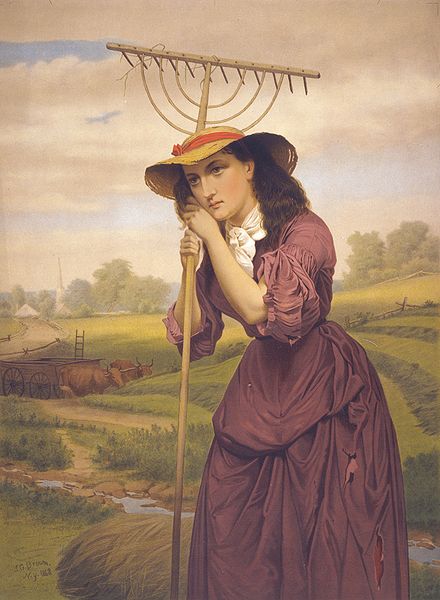
440px-Maud-Muller-Brown

John Gast, artist, after J.G. Brown

“Mr. Whittier’s statement of the origin of his poem “Maud Müller” is thus given. He was driving with his sister through York, U.S.A., and stopped at a harvest field to enquire the way. A young girl raking hay near the stone-wall stopped to answer their inquiries. Whittier noticed as she talked that she bashfully raked the hay around and over her bare feet, and she was fresh and fair. The little incident left its impression, and he wrote out the poem that very evening. “But if I had had any notion that the plaguey little thing would have been so liked, I should have taken more pains with it.” To the inquiry as to the title, Maud Müller, he said it was suggested to him, and was not a selection. It came as the poem came. But he gives it the short German pronunciation, as Meuler, not the broad Yankee, Muller.” (From Parodies of the works of English & American authors, Volume 5, p. 240)

MAUD MULLER IN WINTER

Maud Muller on a winter day
Went out upon the snow to sleigh.
Beneath her high heeled number six
Were a foot of hay and four hot bricks.
Singing she slode, and her merry glee
Shook the snow all off the tree.
“Wait till the clouds roll by!” she howled.
And as she passed the people scowled.
On her dexter side sat a fresh young dude
With his arm out of place as they sweetly slude.
But her howling died, and a vague distress
And a quart of snow filled the back of her dress.
For the reins were held in a careless hand,
And the basest drum in a parade’s band.
Went boom, bum, boom! And one cold day
A tandem left with an upturned sleigh.
Alas, for the dude! three cheers for the sleigh!
And hurrah for the chestnuts that ran away!
The saddest words at hier father’s door
Were these, “You needn’t cone back no more.”
The livery bill when he hied him thence
Was seventeen dollars and fifty cents.
-Boston Globe.

MAUD ON SKATES

Maud Muller, on a winter’s day
Went forth to learn to skate, they say –
Went forth did Maud with hopeful heart
To learn this graceful, joyous art;
I might as well distinctly state
She ne’er before had tried to skate.

* * * * *
This little row of twinkling stars
But mark the passage of the hours
That Maudie spent upon the pond
Since shortly after morn had dawned
The day was doen, the evening gloan
Was gathering as Maud rode home
Aboard a well-filled trolley car
That sped along with bump and jar;
Maud stood suspended from a strap;
She lacked her usual pep and snap;
Her skating cap was cocked awry –
A weary look was in her eye;
Her hair was in sad disarray
And she seemed neither blithe nor gay;
A gentleman who sat quite near
Looked up and saw the pretty dear;
He noticed she had skating been,
Also that she was quite all in’
Then up he rose on both his feet
And said, “Sweet creature, take my seat.”
Maud pulled a weary little sigh
And languidly she did reply:
“No thank you – keep your seat I pray –
I’ve just been sitting around all day!”
HOCKEY HANK

MRS. JUDGE JENKINS
[Being the only genuine sequel to “Maud Müller”)
By Bret Harte

“Maud Müller, all that summer day,
Raked the meadow sweet with hay;

But when he came, with smile and bow,
Maud only blushed, and stammered, “Ha-ow?”

And spoke of her “pa,” and wondered whether
He’d give consent they should wed together.

Old Muller burst in tears, and then
Begged that the Judge would lend him “ten;”

For trade was dull, and wages low,
And the “craps,” this year, were somewhat slow.

And ere the languid summer died,
Sweet Maud became the Judge’s bride.

But on the day that they were mated,
Maud’s brother Bob was intoxicated;

And Maud’s relations, twelve in all,
Were very drunk at the Judge’s hall.

And when the summer came again,
The young bride bore him babies twain;

And the Judge was blest, but thought it strange
That bearing children made such a change;

For Maud grew broad and red and stout,
And the waist that his arm once clasped about

Was more than he now could span; and he
Sighed as he pondered, ruefully,

How that which in Maud was native grace
In Mrs. Jenkins was out of place;

And thought of the twins, and wished that they
Looked less like the men who raked the hay

On Muller’s farm, and dreamed with pain
Of the day he wandered down the lane.

And looking down that dreary track,
He half regretted that he came back;

For, had he waited, he might have wed
Some maiden fair and thoroughbred;

For there be women fair as she,
Whose verbs and nouns do more agree.

Alas for maiden! alas for judge!
And the sentimental,—that’s one-half “fudge;”

For Maud soon thought the Judge a bore,
With all his learning and all his lore;

And the Judge would have bartered Maud’s fair face
For more refinement and social grace.

If, of all words of tongue and pen,
The saddest are, “It might have been,”

More sad are these we daily see:
“It is, but hadn’t ought to be.”

(From Parodies of the works of English & American authors, Volume 5, p. 240)

 

Islam: It’s not what you think (and yes, it is)
I’m not a Muslim, so from the outset I admit it’s unfair of me to even attempt any real assessment of the faith. However, I live (as do we all) in a world that is awash in Islamic issues and Islamic news stories and Islamic internecine conflicts and Islamic soul-searching.

Just today I came across two articles which I thought were intriguing and revelatory.

The Trouble Within Islam

The first, by the honorable Tony Blair [1], points out, legitimately, that there is a problem within Islam that it would be folly to ignore. This is, as the body of the article goes on to explain, is entirely different than claiming that there is a problem with Islam, as so many inflammatory websites and news pieces would have the world believe. It has become de rigeur in some circles to label any criticism of Islam as racist, or “Islamophobic;” nothing could be farther from the truth.

MPJn2Dc

If there is a problem with any ideology that threatens the peace and harmony of people and cultures which touch it, it must be subject to the closest of scrutiny and be willing to succeed or fail on its own merits. We are seeing this today, particularly in the USA where I live, as the humanist community shines the light of reason on the follies and excesses of religions, but particularly Christianity. If the institution has merit, it will endure. If it does not, ultimately it must re-invent itself or fall.

So yes, I agree – and have felt this way for a long time, particularly since the horrors of September 11th – there is a problem within Islam. However, as the second article illustrates, Islam is not what the slavering haters would have us believe.

Global Muslim Delegation Issues Unprecedented Statement Against Anti-Semitism

I have long called for the Islamic mainstream to stand up and shout their outrage about the rot that festers within their own community, much in the same way that mainstream Christians decry the brutal ignorance of the Westboro Baptist Church, and these brave people are doing just that. I laud them for their courage and humanity.

I’ve traveled much in the world, and spent a fair piece of time in Islamic countries. Islam is as varied as every single one of its practitioners, and as a result it’s an exercise in futility and unfairness for either outsider or insider to state unequivocally, “Islam is…”; but recognizing both that there are problems within the community that need to be addressed, and that there are people within the community who are making an effort to do so, are affirming and encouraging – at least to my way of thinking.

As humanity scrabbles its way out of the mud and continues to take baby steps towards the stars, it behooves us all to act as though we are living in a world that works for everyone, even if such a dream is still beyond our grasp.

The Old Wolf has spoken.


[1] Whether you think Mr. Blair is honorable is up to you. I know that during his tenure in office, he was probably as universally reviled as George W. Bush, with whom he collaborated with regards to the Middle East. History will judge; for myself, I respect the man and his efforts.

Mike Olbinski: Supercell video

Beautiful time-lapse video of Mother Nature getting her knickers in a twist. Watch this at 108op and go full screen. You can see a beautiful still from the video here.

Of course, since I have an odd mind, if you hadn’t figured that out by now, I couldn’t help but think of this much older and much less serious video effort:

The Old Wolf has spoken.

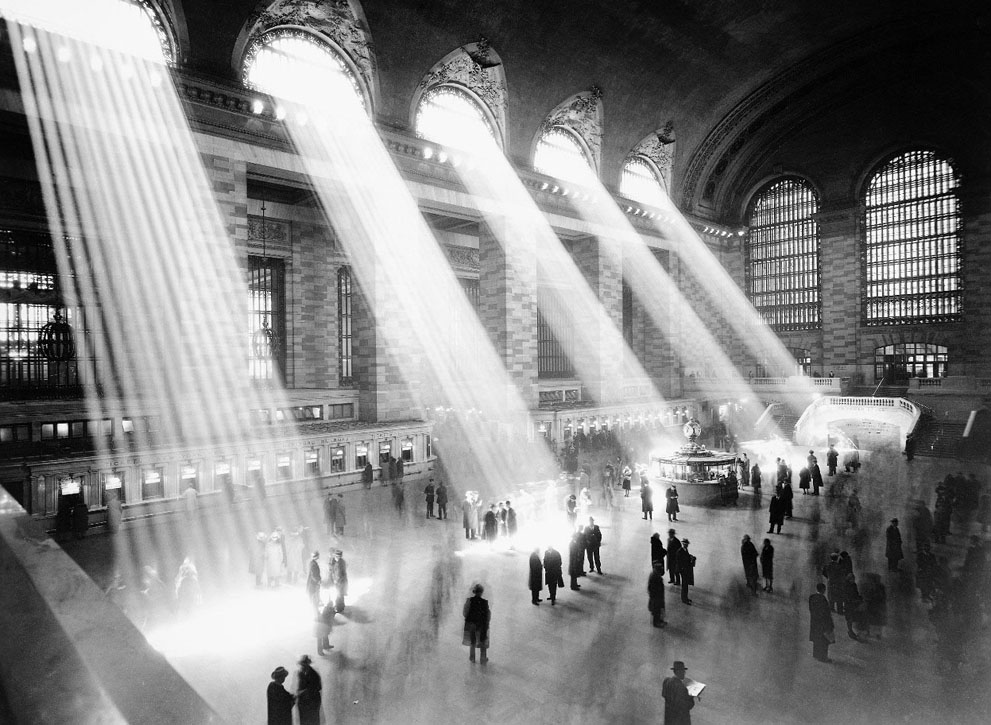
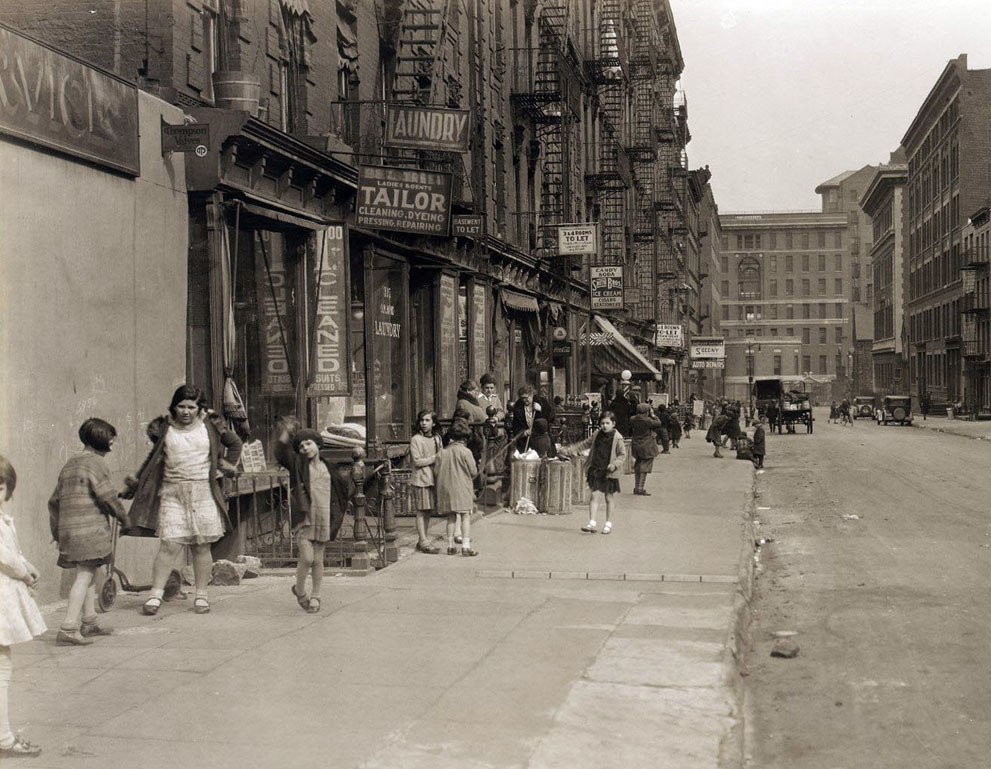
New York, New York! Historic Photos From the NYC Municipal Archives

The New York City Municipal Archives just released a database of over 870,000 photos from its collection of more than 2.2 million images of New York throughout the 20th century. Their subjects include daily life, construction, crime, city business, aerial photographs, and more. Visit the selection below, or see 53 photos. Found at The Atlantic.

s_n01_wpa00834

Sunlight floods in through windows in the vaulted main room of New York City’s Grand Central Terminal, illuminating the main concourse, ticket windows and information kiosk. Photo taken ca. 1935-1941. (Courtesy NYC Municipal Archives)
s_n02_dma01739
Aerial view of New York City, looking north, on December 16, 1951. (Courtesy NYC Municipal Archives)
s_n03_bpm05546
28th Street Looking east from Second Avenue, on April 4, 1931. Google map streetview today here. (Courtesy NYC Municipal Archives)
s_n04_dpw00709
Meeker Avenue Bridge under construction, looking south, showing Brooklyn approach, on June 29, 1939(Joseph Shelderfer/Courtesy NYC Municipal Archives)
s_n05_bps05149
Shadows are cast beneath the Brooklyn Bridge, seen from a stable roof, on May 6, 1918.(Eugene de Salignac/Courtesy NYC Municipal Archives)
s_n06_bps12071
A worker on the Brooklyn Bridge, on November 19, 1928. (Eugene de Salignac/Courtesy NYC Municipal Archives)
s_n07_bpq03110
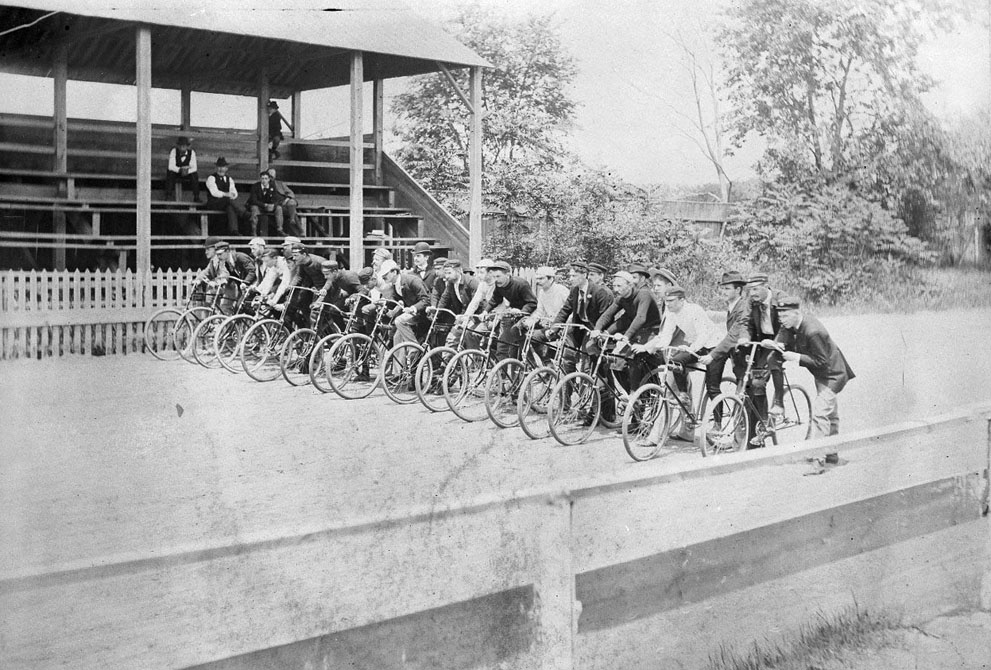
Markus Mercury Wheel Club, Flushing Race Track, bicyclists ready to race in June of 1894. (Courtesy NYC Municipal Archives)
s_n08_ac02526b
Original City Hall subway station, IRT Lexington Avenue Line, in 1904. (Courtesy NYC Municipal Archives)
s_n09_bpb02297
Coney Island looking east from Steeplechase Pier showing Sunday bathers, crowd on beach, on July 30, 1922.(Rutter, Edward E./Courtesy NYC Municipal Archives)
s_n10_dscls019
A two-horse team street cleaner, with sprayer, squeegee, and roller at rear. (Courtesy NYC Municipal Archives)
s_n11_bpsi1002
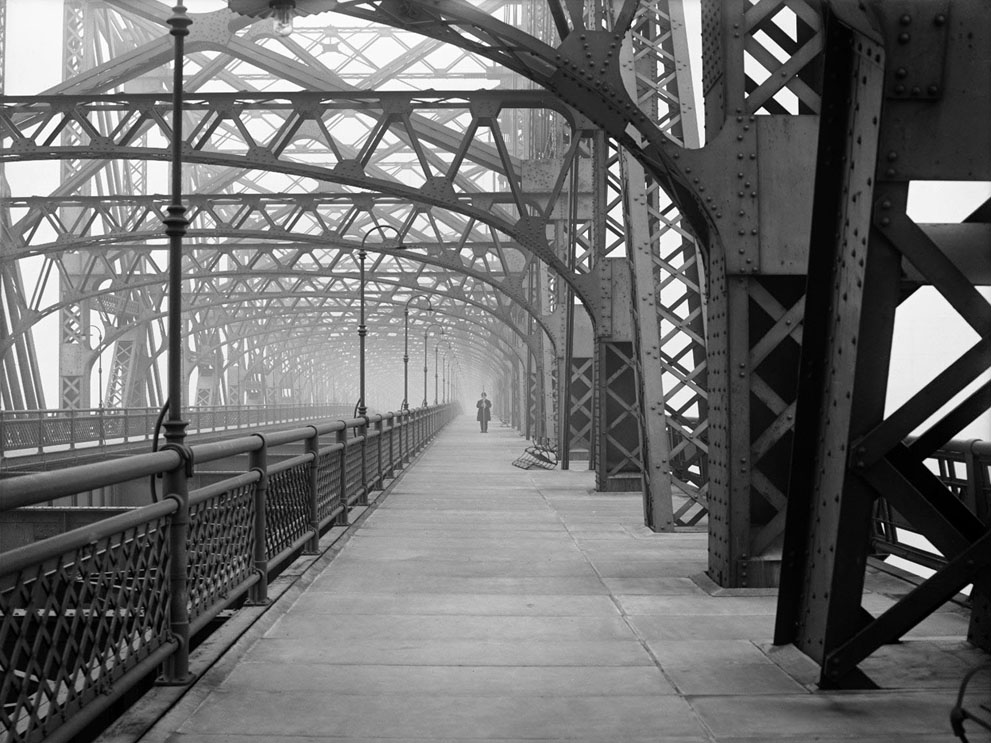
An experimental exposure made on the Queensboro Bridge, on February 9, 1910.(Eugene de Salignac/Courtesy NYC Municipal Archives)
s_n12_wpa00501
Italian vegetable sidewalk stand, on Bleeker Street, near Church of Our Lady of Pompeii, in August of 1937.(Bofinger, E.M./Courtesy NYC Municipal Archives)
s_n13_wpa00647
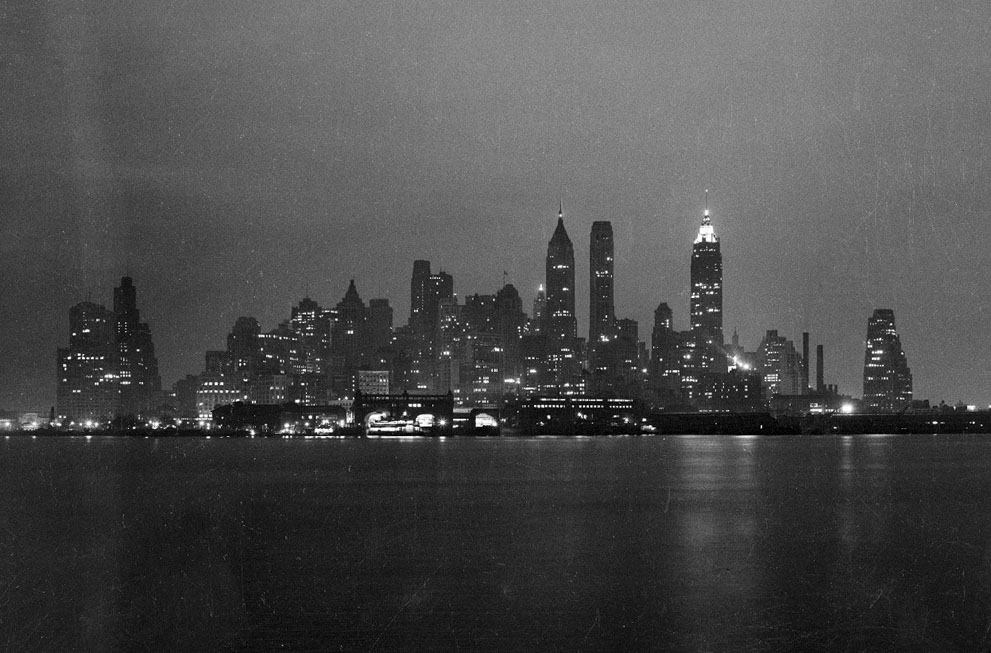
Lower Manhattan skyline at night, seen from either the Staten Island Ferry or Governor’s Island, in February of 1938.(Bofinger, E. M./Courtesy NYC Municipal Archives)
s_n14_mac00269
Hayden Planetarium, American Museum of Natural History, West 81st St, between Columbus Avenue and Central Park West.(Courtesy NYC Municipal Archives)
s_n15_mac01538
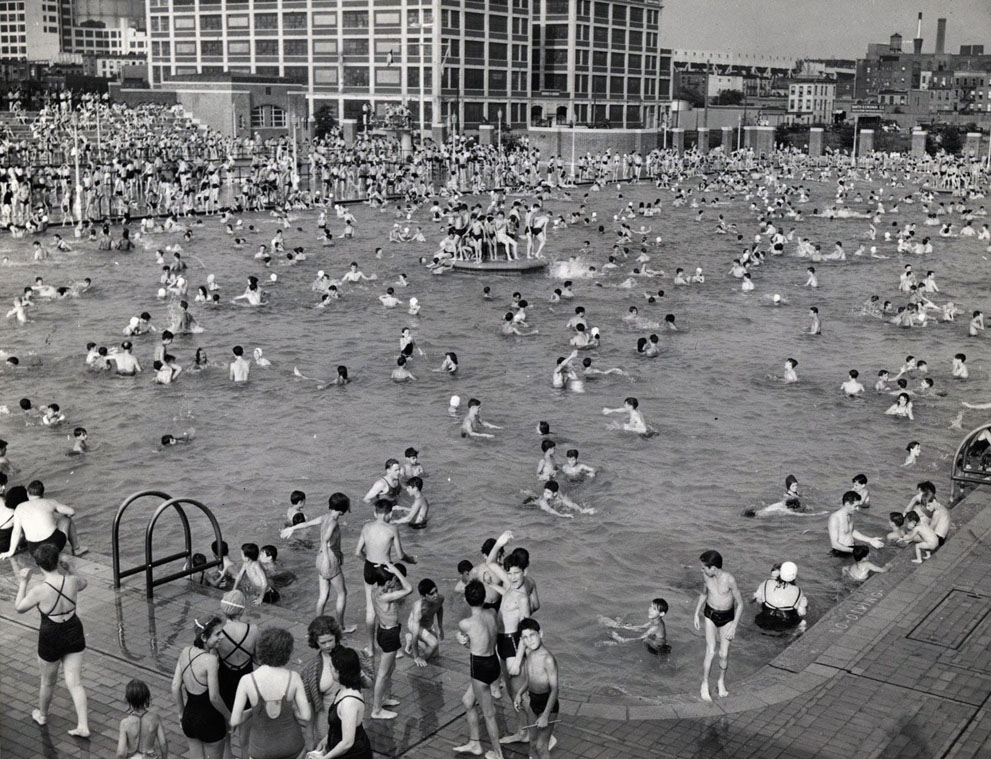
Red Hook Swimming Pool, Clinton, Bay & Henry Streets, Brooklyn. Bathers as far as the eye can see.(Courtesy NYC Municipal Archives)
s_n16_bpsi0444
Queensboro Bridge under construction, on August 8, 1907. (Eugene de Salignac/Courtesy NYC Municipal Archives)
s_n17_bpsi2117
The Queensboro Bridge, showing reconstruction of tracks looking east, on November 22, 1929.(Eugene de Salignac/Courtesy NYC Municipal Archives)
s_n18_bps00997
A one-legged newspaper boy and other “newsies”, on Delancey Street, on December 26, 1906.(Eugene de Salignac/Courtesy NYC Municipal Archives)
s_n19_pde00887
New York Police Department evidence photo, homicide scene. Jos Kellner, 404 East 54th Street, murdered in hallway, on January 7, 1916. (Courtesy NYC Municipal Archives)
s_n20_bpq07376
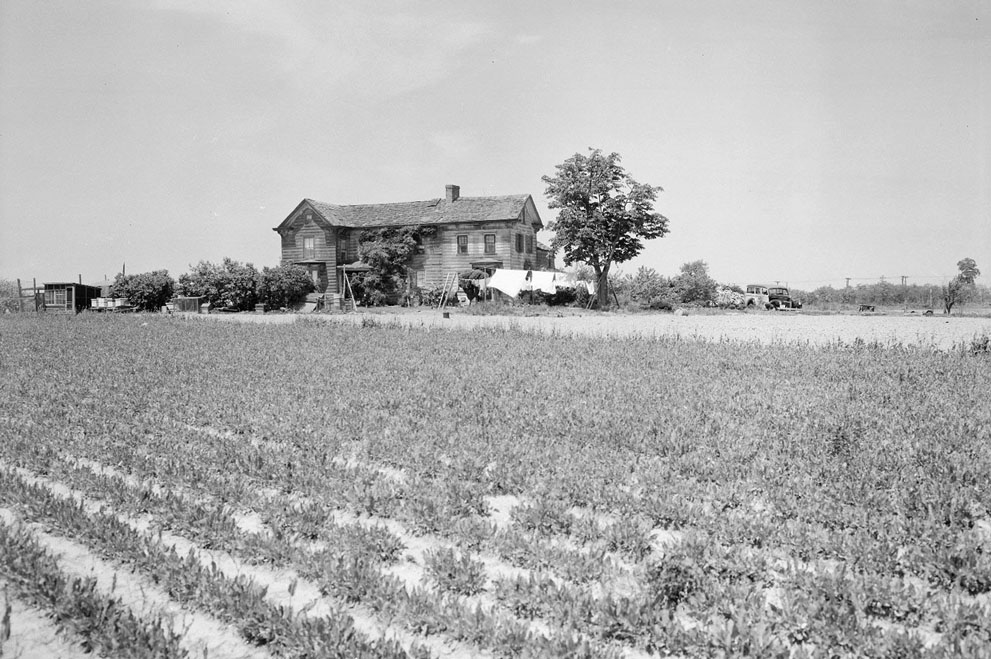
Powell House at 195th Street and 58th Avenue North, Queens, on May 20, 1941 (Courtesy NYC Municipal Archives)
s_n21_wpa00552
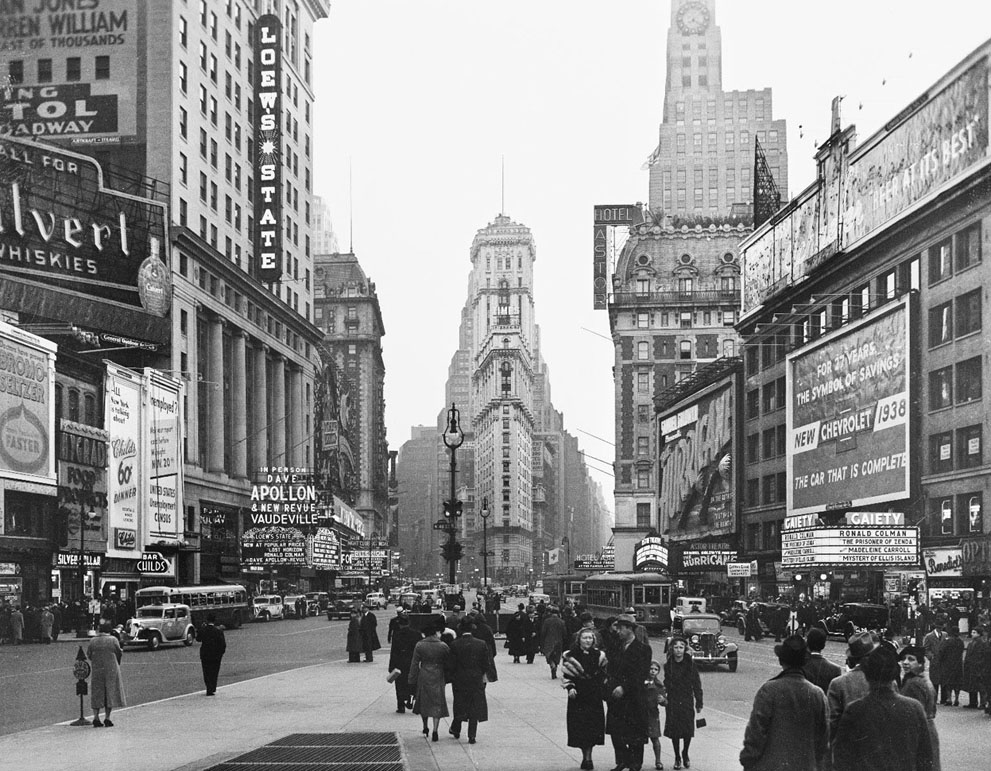
Times Square theaters by day, in New York City. The Times Building, Loew’s Theatre, Hotel Astor, Gaiety Theatre and other landmarks are featured in this January, 1938 photo. (Bofinger, E.M./Courtesy NYC Municipal Archives
The Old Wolf has spoken

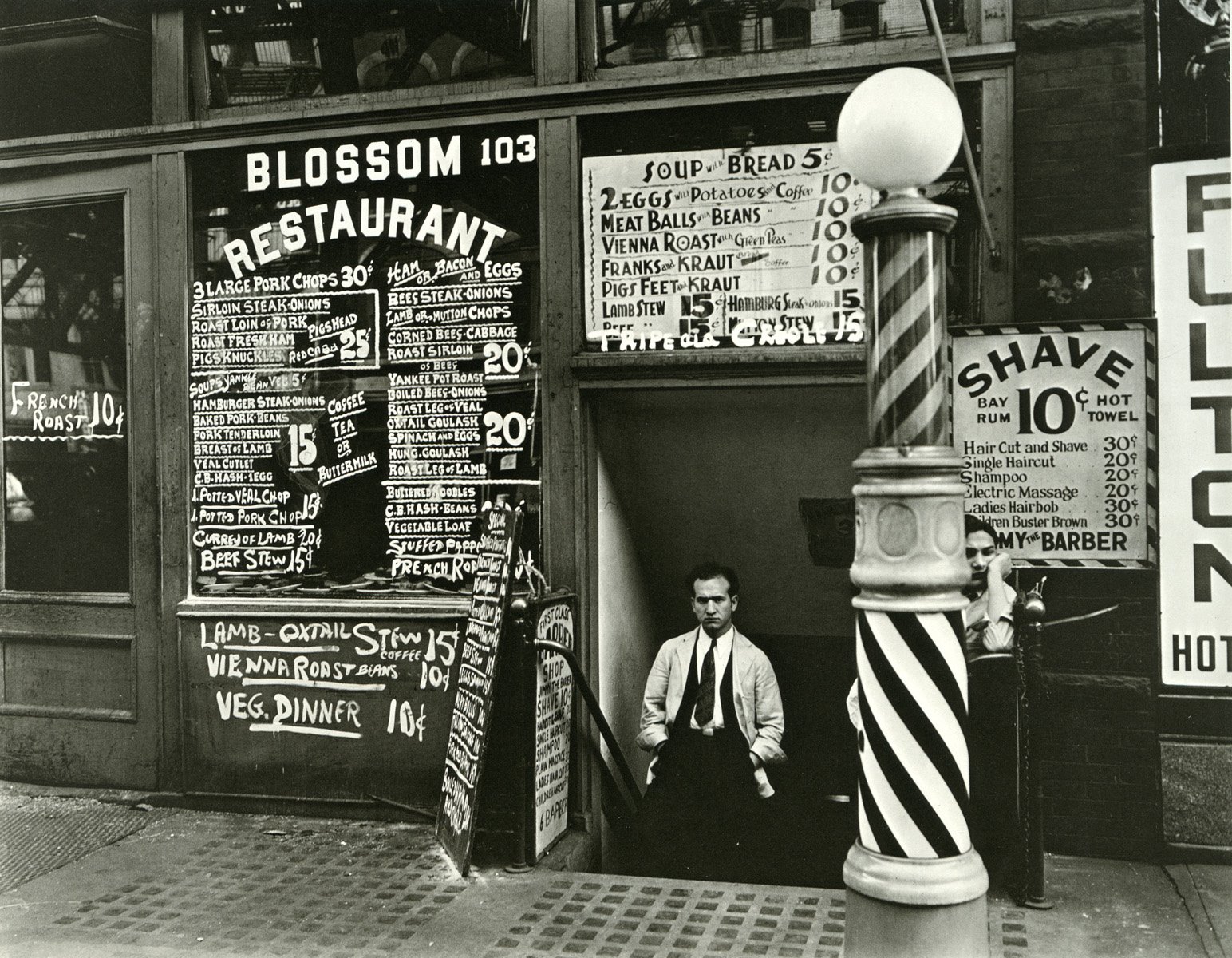
Blossom Restaurant, 1935. The Bowery, New York City

Blossom_Restaurant;_103_Bowery_by_Berenice_Abbott_in_1935


New York City, the Bowery. Photo by Berenice Abbott

Just spend a while looking at those prices. Now, according to the Bureau of Labor Statistics calculator, 30¢ in 1935 would be worth $5.09 today. Where could you get three large pork chops for that price? Certainly not even in my sleepy little town in southern Utah. No, I suspect the BLS has either not factored in the brutality of the depression, or its numbers are somewhat skewed in general.

♫ The Bow’ry, the Bow’ry!
They say such things,
And they do strange things
On the Bow’ry! The Bow’ry!
I’ll never go there anymore! ♫

by Charles H. Hoyt and Percy Gaunt
From the Broadway play A Trip to Chinatown (1891)

The Old Wolf has spoken.

Impractical idea No. 103

456061627_30a64f016c_o

In one of the more iconic images of the early 20th century, a faked photograph shows a blimp mooring at the top of the Empire State Building. The tower was originally designed with such moorings in mind, but the entire idea was a bust from the get-go.

Empire_State_Building_Mooring_Mast_412_426

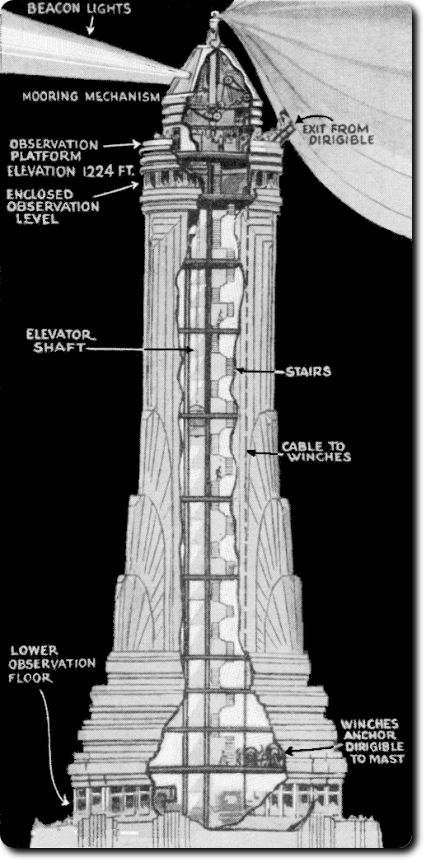
Here’s the schematic showing how passengers would disembark from a transatlantic dirigible, take stairs down from the 103rd floor platform to the 102nd, and then the elevator to a processing station on the 86th floor. never mind that dirigibles had their passenger compartment in the center, and passengers would be required to navigate narrow passages to get to any potential nose exit.

Empire_State_Building_closeup_of_top_412_426

The 103rd floor is largely a mechanical room, but it has a narrow door leading to the outside balcony:

Empire_State_Bldg_103rd_Floor_Interior_02_412_426

If you’re a dignitary, there’s a chance you can get up there for a photo op – here former Buffalo Bills QB Ryan Fitzpatrick. Notice how low the balcony wall is, which is why the general public is not permitted.

6a00d83451b85a69e2017ee9438ab4970d-550wi

As for why they never went ahead with the dirigible plan?

zr3__losangeles_lakehurst_nosestand

The US Navy, testing its airship the USS Los Angeles (ZR-3), saw it rise to a near-vertical position, after her tail rose out-of-control while she was moored at the high mast at Naval Air Station Lakehurst, New Jersey in 1927.

Airships can only be moored by the nose at such masts, and severe updrafts from the Empire State Building would have whipped any dirigible around like a child’s balloon.

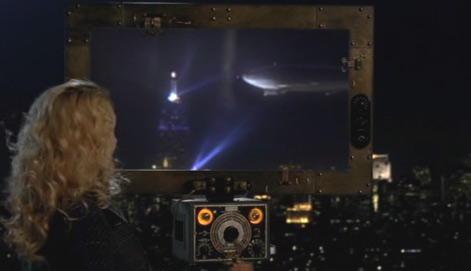
Well, at least they managed it somehow in “Fringe.”

fringe-zeppelins

Showing the alternate universe to the military

The Old Wolf has spoken.

New York Market, 1917

Interior retail stalls at Washington Market in New York City in 1917. New York Word-Telegram & Sun Newspaper Collection

12750u


While this is much larger and brighter, it still has the same feel of an indoor market I found in Toulouse, France in 1970:

Europe Trip - Jun 1971 - Toulouse Market


Of course, such places still exist: here Quincy Market in Boston:

quincy-market-4


I’ve always loved spaces like this, and I think we need more of them.

The Old Wolf has spoken.

Sushi Yasuda in NYC does away with tipping

I’ve blogged about tipping before. Now, a few bold restaurants are beginning to buck the trend.

(Reblogged from The Consumerist)

Note: Sushi Yasuda is the restaurant’s correct name – it appeared in the original article as “Yasada”.

 NYC Restaurant Tells Customers That Tipping Is Not Allowed
By  June 7, 2013

 (From ThePriceHike.com)

(From ThePriceHike.com)

As we’ve discussed here many, many times, restaurant wait staff often rely on tips because their base pay is generally far below the minimum wage level. Since tipping is an anomaly overseas, waiters in most other countries are paid a living wage. Thus, one sushi restaurant in Manhattan, which claims it has always paid its employees well, has recently started telling customers that tips will not be accepted.

On his Price Hike blog, Bloomberg food critic Ryan Sutton writes about the note that was recently added to the bottom of all receipts at Sushi Yasuda in NYC. It reads:

Following the custom in Japan, Sushi Yasuda’s service staff are fully compensated by their salary. Therefore gratuities are not accepted. Thank you.”

Sutton talked to the restaurant’s owner who says he decided to not go the route of some restaurants who simply add 18-20% service charges on to bills rather than have customer tip. That’s really just the same as the old system; it just saves the diner the hassle of doing basic math.

Instead, Yasuda’s owner raised the menu prices a bit and simply tells customers: Do Not Tip Your Waiter.

“We just take tipping out of the equation,” he explains to Sutton.

The reason more restaurants don’t follow this model is that they are afraid higher menu prices will drive away customers, but this owner maintains that “if you have faith in what you’re serving, and how you’re serving it, you know that when your customers have a good meal and look at their final tally it’s going to be around the same.”

He claims that paying your staff a solid wage that doesn’t fluctuate from day-to-day based on tips is a good way to build stability among your workers.

In spite of this being the standard for most of the world, there are only a very small number of restaurants in the U.S. that don’t accept tips and also don’t tack on service fees.


According to the poll at the bottom of the Consumerist’s page, the question “Should more restaurants do away with tipping?” provided (to me) unsurprising results:

results

Whereas in my previous posts I’ve stressed that tipping is not optional and that servers depend upon tips for their daily wage, I would be entirely in favor of eliminating tipping at restaurants and paying servers a dependable, living wage. Naturally, if restaurateurs try to take advantage of this trend to their own benefit and to the detriment of their employees, that doesn’t work… but I’d be willing to bet a lot of servers would line up for a regular job where busting their ass for a party of cheapskate douchebags never enters the equation.

Hats off to Sushi Yasuda! 

The Old Wolf has spoken.

Lies, Spies, and Videotape.

8501189

Edward Snowden. Hero? Traitor? Irrelevant?

It’s a big deal, and the calls for lionization, incarceration, exculpation, evaporation, and a lot of other “-ations” are beginning to ring from coast to coast and across the world.

I have no doubt the NSA, CIA, FBI, and Mogg knows what other hush-hush agencies would like to see this man suffer in the fiery heat of Satan’s hottest furnace for eternity. On the other hand, civil libertarians are calling for an immediate pardon for a man they see as a brave and fearless national hero.

It appears that Snowden certainly broke the law in releasing the information that he did, but in so doing it also appears that he brought to light an even greater violation of principles than he himself is guilty of. So where do we draw the line?

mission-impossible-season-5

“As usual, if you or any member of your IM force is caught or killed, the Secretary will disavow any knowledge of your actions.”

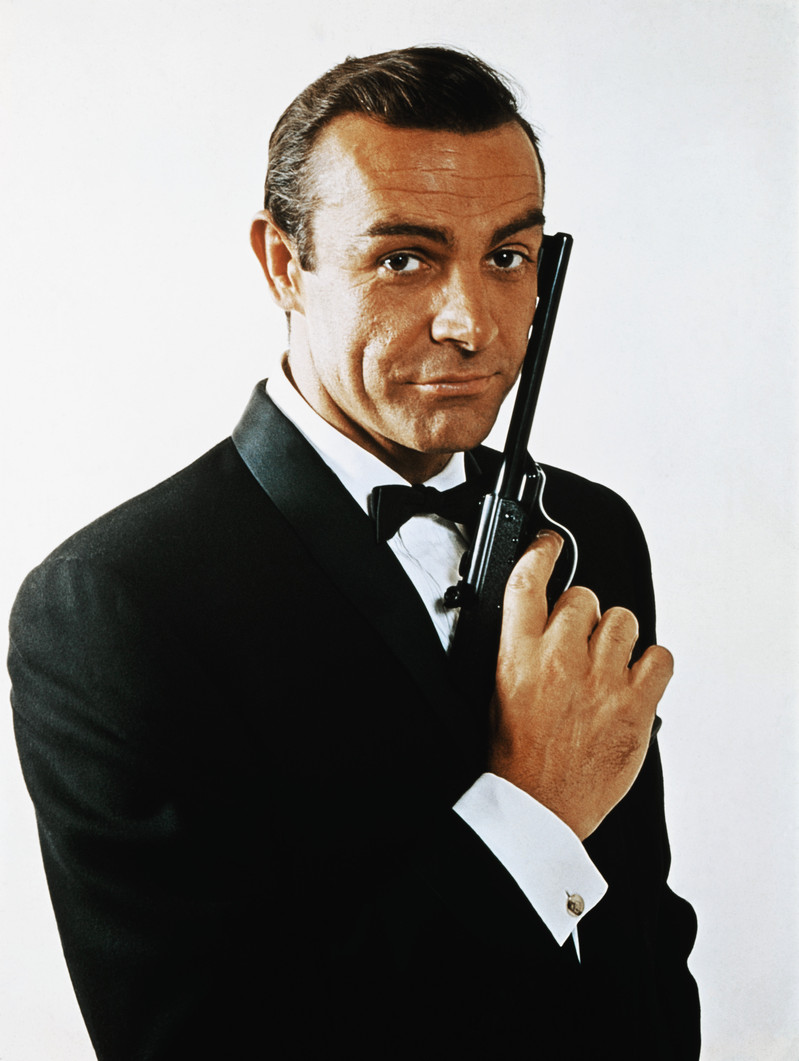
Sean Connery as James Bond

License to Kill

Spies are paid to lie. Governments who employ them lie on a regular basis. The popularity of the action/spy thrillers on TV and in movies proves that we expect, nay, demand it. In real life it may not be right, but it becomes a matter of national security in some cases; nations simply don’t operate along the same moral lines as we would like them to. Can you imagine what would happen if governments were  completely open, honest, and transparent with one another? [1] The “good guys” are pretty much obliged to resort to deception and subterfuge to combat the “bad guys,” and keep their nations safe. That’s what the NSA and the CIA are there to do. For what it’s worth, we even spy on our friends. Don’t ask me how I know… I’d have to lie to protect certain other people.

Unfortunately, the CIA and NSA and other alphabet-soup agencies have also been tasked with things that have much less to do with keeping our nation safe than with keeping it rich, at the expense of other governments and peoples. If you’d like a glimpse into that shadowy world, read “Confessions of an Economic Hit Man,” by John Perkins; it will most likely raise both your eyebrows and your conscience. An extract of Amazon’s review:

“John Perkins started and stopped writing Confessions of an Economic Hit Man four times over 20 years. He says he was threatened and bribed in an effort to kill the project, but after 9/11 he finally decided to go through with this expose of his former professional life. Perkins, a former chief economist at Boston strategic-consulting firm Chas. T. Main, says he was an “economic hit man” for 10 years, helping U.S. intelligence agencies and multinationals cajole and blackmail foreign leaders into serving U.S. foreign policy and awarding lucrative contracts to American business. “Economic hit men (EHMs) are highly paid professionals who cheat countries around the globe out of trillions of dollars,” Perkins writes. Confessions of an Economic Hit Man is an extraordinary and gripping tale of intrigue and dark machinations. Think John Le Carré, except it’s a true story.”

What has been revealed by Snowdon goes far, far beyond keeping our nation safe from external evils; it has much more to do with controlling a domestic population, and despite groans and sobs of denial from those in the know, I can’t believe – I refuse to believe – that this massive accumulation of data can and will not be used for financial and potentiary gain by those in a position to access and use it.

And the fact that this mind-boggling misuse power was authorized years ago by the “patriot act” does not make it any more right. I’m glad it came to light, and I’m glad there’s a dialog going on, and I hope that some people are going to get their feet held to the fire, and I hope that what comes out of it is more transparency, and better for the citizenry of our country than for the power brokers.

I don’t condone illegal behavior. But I do believe in the principle of the “greater good.” I think Mr. Snowdon has recognized that his actions would carry a heavy price, and it was a price he is willing to pay to act according to the dictates of his conscience. I have no idea how all this is going to play out, but for me, at this moment, I’m keeping him in the plus column.

The Old Wolf has spoken.


[1] Somewhere out there is a science fiction story (or perhaps creative fantasy) about a special blend of coffee that mutates somewhere, and has the stunning effect of making people reasonable. After drinking some of it, the French delegate to the UN stands up and shouts, “It’s all balls!” In the end, the entire world has partaken, and governments actually start acting with decency and common sense, for the good of all the people of the world. I have never been able to relocate this story. If it sounds similar to Mark Clifton’s 1952 story “The Conqueror,” that’s not surprising – instead of coffee it was a mutant pychotropic dahlia root that changed the world:

“So it came about that one by one the members of the Politbureau tasted of the dahlia, even to the leader himself.

All of this took much time, and meanwhile heads of other nations who were not so suspicious of every shadow, and not so inaccessible, were eating regularly of the dahlia.

When finally the sincere word of peace and goodwill came ringing from Moscow to all the world, it was echoed back with all sincerity.”

A lovely story. Read it, if you’d like a smile.

World’s Top Languages

The other day I posted about being able to talk to most of the world’s people by learning 20 languages out of the over 7,000 currently existing ones. I forgot to post this infographic, so I’ll just add it here as an addendum, because I found it interesting, and it’s actually the thing that got me thinking about the subject.

182727_617345131626380_582618989_n


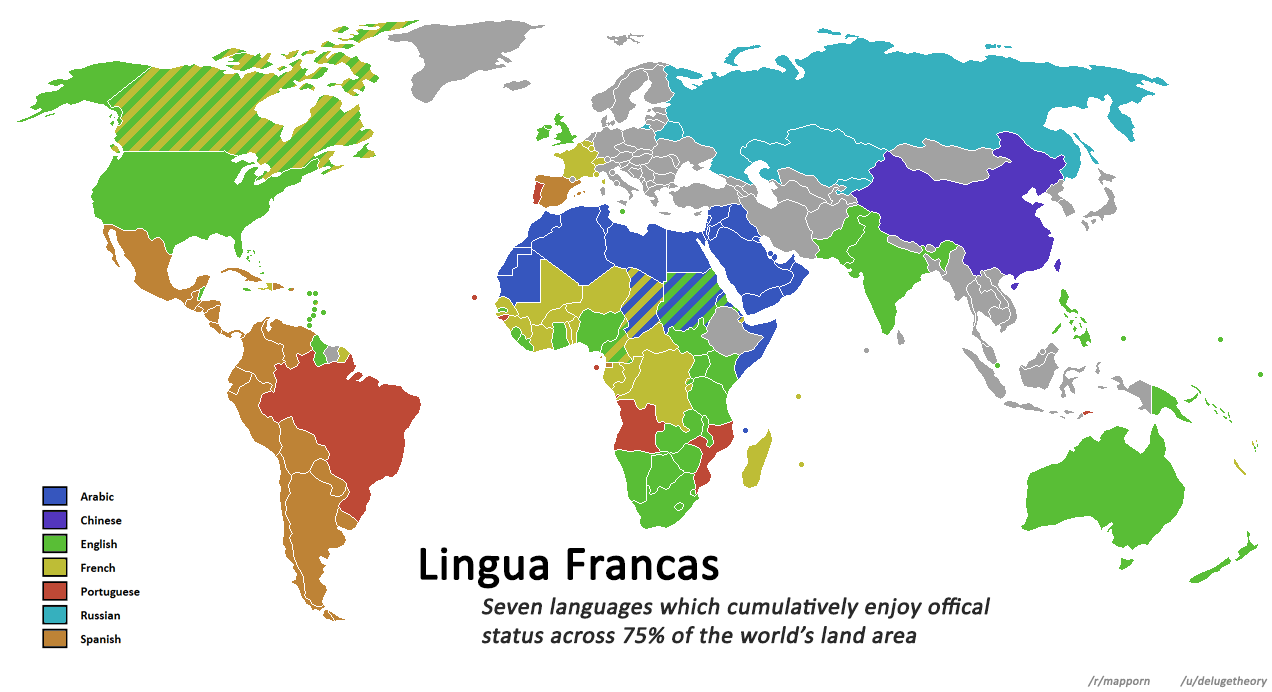
In addition, here’s a map showing how linguae francae, or “portmanteau languages”, are distributed across the globe; one can see the broad reach of the top seven.

tumblr_moodwegXI01rasnq9o1_1280

The Old Wolf had forgotten.