The Incredible Singing Clock

From the July, 1934 issue of Moderm Mechanix:

Singing Clock

Educated Clock Sings, Talks, and Plays the Pipe Organ

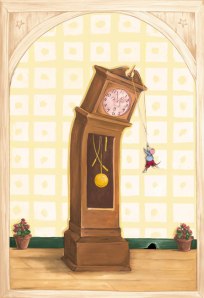
A CRIPPLED inventor of Akron, Ohio, has recently completed what he believes is the world’s most wonderful clock. The remarkable instrument gives the comparative time in 27 different cities. In addition, it sings, talks and plays a reedless pipe organ every hour.

Every day the clock commemorates the death of America’s martyrs. At the hour of Lincoln’s funeral it recites the Gettysburg address. The time of President McKinley’s burial is marked by a playing of the old hymn, “Lead, Kindly Light.” At the hour of President Garfield’s interment, the remarkable timepiece plays “Gates Ajar.”

Valued at $50,000, the educated clock was built by 70-year-old Marvin Shearer after ten years of painstaking work. The clock contains 5000 pieces of wood, a mass of electrical control wires several miles in length, and is twice the height of an ordinary man.

The inventor’s granddaughter made two comments on the original page; I have reproduced them here in slightly edited form.

There were actually TWO clocks.

Marvin Shearer was my grandfather. I have searched everywhere for one of his clocks. I did trace the “Electric Wonder” to the Hotel Lobby of the Ritz in New York City but when it was remodeled, they got rid of the clock. No one there has been there long enough to know what happened to it. If anyone ever locates one of them PLEASE e-mail me at donnaleecotter16 [at] gmail [dot] com.

Here is what I know of his works:

Marvin carved a clock that was eight feet wide and thirteen feet high. It was called the ELECTRIC WONDER. He started this clock in 1927,  and completed it in 1931. He also carved a second smaller clock, and perhaps a third.

There is an article in “The New York Times” dated April 7, 1909, about a “Wonderful Clock Made by Cripple”.

Another article I found was in The “Omaha World Herald” dated November 15, 1903, titled, “Queer Clock That Tells Many Things an Ohio Man Works on for Three and a Half Years”.

The Electric Wonder

This exhibit took 15 months to design. It contains 7172 pieces of wood from 32 different countries, from all parts of the world.

It has nearly 1½ miles of electric wire, 17 clock dials, and gives time in all parts of the world.

It shows important events of United States History from 1492 to 1934.

Our Navy of 47 ships pass by according to their classification.

It tells the weather conditions 24 hours in advance. It plays a reedless pipe organ, the only one of its kind in the world.

It shows and gives the Funeral Marches of our assassinated Presidents.

It shows the goddess of Liberty or eternal light in memory of American soldiers who lost their lives while in service for their country. It has chimes, harps, electrical cascade, electrical railway, an airship and a dirigible. Also, Indian history and arrowheads of the lone Indians from the battlefield of Custer’s Last Fight.

The Electric Wonder is 13 feet high, weighs 3800 lbs. has 168 electric lights and took 19,000 hours or nearly 7 years to build.

It has been endorsed by leading electricians and engineers of today. It is a merit to its maker as well as mankind.

I repeat the plea of the inventor’s granddaughter – if anyone has any clue as to the ultimate fate of this or other of Shearer’s works, please contact her. This is an astonishing achievement.

The Old Wolf has spoken.

Hospital Charges Explained

Redditor “badengineer” gives a compelling and clear explanation of what’s going on with wildly-fluctuating hospital charges. Not a lot of mainstream folks read Reddit, so I thought this was worth cross-posting over here.


I work for a top tier academic medical center as a corporate strategist, so I’m at least aware of how the various hospitals in my state are doing, how pricing works and what the market dynamics are. There are a few things that should be pointed out….

First, you’re right. The charge rate certainly doesn’t correlate to quality metrics.

The charge rate listed in the data (available as an 11MB excel file at CMS.gov) has nothing to do with anything. It’s not a real price. It doesn’t correlate to the price anyone pays except for the extremely rare millionaire who doesn’t have insurance. Medicare doesn’t pay it, 95% of uninsured people can’t pay it, insurance companies don’t pay it.

It’s primarily a negotiating trick, with some accounting tricks thrown in for good measure.

People need to understand how pricing works, because it’s the cancer at the heart of healthcare.

At any given hospital, there are a hundred different prices for any given procedure. Medicare and Medicaid pay all hospitals the same amount for Procedure X. Most hospitals lose 20% (or more) on that Medicare price and make it up on the private companies.

Every single private health insurance company pays a different price, very often 150% of what Medicare is paying. Each plan negotiates prices all on its own, in secret. They have no idea what other insurance companies pay. It’s in no one’s interest to share that price. It hurts hospitals’ future negotiations if their lowest negotiated price is public and it hurts payers negotiations if it gets out that they overpay some hospitals.

The hospital says “X costs us $50K, Y costs $60K, $Z costs $20K.”

The insurance company they’re negotiating with says “we normally pay $25K, $35K and $9K for those procedures. How about we give you 50% of your charge rate?”

The hospital says “OK”.

As a result, at a single hospital there can literally be 100 plans paying different prices for your gall bladder removal. Multiply that by 3,000 hospitals in the country. There are maybe 3,000,000 different prices for that surgery out there. All completely secret. You can imagine how that might create problems.

So basically, this charge rate is nothing more than a bit of insight into a hospital’s chosen negotiating tactics. They either price high and discount a lot, or price low and discount a little.

Uninsured people are screwed no matter what. If you’re uninsured and land in the hospital, you’re likely going bankrupt. It’s almost irrelevant whether it’s a $200K bill or a $100K bill. You’re going bankrupt. You might think this pricing was designed to extract money from that uninsured population, but hospitals get so little money from them that most don’t think about trying to squeeze them more using this charge rate. A vast majority of that care is just written off.

If the charge rate doesn’t correlate to real prices, it definitely doesn’t correlate to quality. There’s very often an inverse relationship between cost and quality to begin with. Medical errors are expensive and the places that reduce them save a ton of cash in lawsuits, readmissions (in cases where they’re penalized for them), etc. For example, we’re an awesome hospital you’ve heard of, but some organ transplants cost 35% less at the best-of-the-best place, because they do it so frickin’ well. That’s real cost. Not fake charge book cost. Usually, the better the care, the cheaper it is.

The odd thing about this story is that it isn’t new. Dartmouth Health Atlas has been publishing similar data for decades. It’s great to see it being covered, because it’s insane and a clear symptom of a deeper problem, but I was surprised to see it on the front page of the Times.

And every time I write something about this, I have to add: neither insurance companies nor hospitals are (on the whole) getting particularly rich off of this. As crazy as it sounds, this is not the result of unusual greed or a morally corrupt industry. It’s a historical artifact more than anything. Non-profit hospitals (which is almost all of them) earn an average of 2.5% operating margin and that’s shrinking. I dunno about for-profit hospitals, but they’re still not raking it in like people think they are. Health insurance plans earn more like 3.5% on average. If you chart the most profitable sectors of the economy, that puts them pretty far down the list. Drug companies, in comparison, are deep into double digit margins.

Of course, that’s relatively small profit on a truly mind-boggling amount of money (17% of the american economy) so it has a gigantic effect. It also tends to concentrate a lot of pain on people who can’t afford to pay it.

Anyway, that low profit margin gets at why no one breaks out and tries to be more transparent. A tiny downtick in your reimbursement rates will sink you. As our contracting guy says, last time our main payer got slightly miffed and decided to throw some business across town, we laid off 500 people the next year.

This is just how the system works. It’s not a conspiracy. It’s a perfect example of how a a bad system forces a bunch of rational actors to do absolutely batshit crazy things. Everyone could stand to earn and do a lot more if things were rationalized and we did away with this system of invisible prices. That’s the tragedy of the commons for you.

All hospitals and insurers are forced to play this game. Whether that’s a big 100-facility for-profit chain, a gigantic charity-oriented catholic system, an academic research center or your community hospital. This is how money moves in the system. Any real fix stands to hurt so many players that it’s pretty unlikely we’ll see change from a political standpoint. I’m kind of hoping the whole thing just collapses under it’s own weight and something better can arise from the ashes.


The system seems beyond fixing to me, but for the sake of our conscience we must continue looking for solutions, because what we have now is an immoral cesspool.

The Old Wolf has spoken.

Übercrappy and Filth

Abercrombie CEO Mark Jeffries still only wants ‘thin, beautiful’ customers. There’s only one problem.

fitch


Gacked from Reddit

This kind of corporate douchebaggery is, unfortunately, legal… but it certainly doesn’t make for a responsible corporate image. But A&F has a long, long tradition of being shallow and exclusive; I present for your gratuitous enjoyment a cartoon by Al Frueh, published in The New Yorker in 1926 (click for a larger version)

Abercrombie and Fitch


I remember buying one of A&F’s lighter-fluid-fueled hand warmers in their NYC shop as a kid, because it looked cool:

Handwarmer


It’s basically just a slow-burning lighter, but it worked great. Aside from that, I don’t think I’ve ever purchased anything from them over the subsequent 50 years. But then, I’m not one of the “beautiful people,” so that’s OK according to them.

The Old Wolf has spoken.

What else could you do with $22 Billion?

In 1921, the Chicago Tribune published the following cartoon by John T. McCutcheon, one of the foremost artists and political cartoonists of our nation. The numbers refer to the amount spent on World War 1, which for the United States is estimated at $22,625,253,000.00.[1]

War

The title was “What the money spent on one war would do if applied to peaceful purposes.”

The list is as follows:

  • It would criss-cross the continent with boulevards.
  • It would irrigate and reclaim all our arid spaces.
  • It would supply free education of the highest and most modern type.
  • It would re-forest all the denuded timber lands
  • It would build ship canals from the Gulf of Mexico to the Great Lakes and the St. Lawrence
  • It would electrify all railroads and give them the speed of the modern interurban systems.
  • It would supply every farmer with a tractor which will low 50 acres a day.
  • It would build hydro-electric plants capable of supplying the nation with power.’
  • It would buy all the coal mines of the country and have them owned by the government.
  • It would give us a self-supporting merchant marine, without which we cannot be independent.
  • It would eliminate the slums and afford wholesome housing for everybody,.
  • It would supply the poor of the nation with the best of hospitals and promote anti-disease research.
  • It would provide every seaport with a deep and well-protected harbor.
  • It would build landing fields and mooring piers for a system of trans-continental air routes.
  • It would provide old age insurance, which would rob the creeping years of their terrors.

Based on Dave Manuel’s inflation calculator, the amount spent by the USA on World War I would be the equivalent to $342,806,863,636.36 in 2012 dollars.

Given that the cost of the war in Iraq was roughly $2.2 trillion dollars, (more if you count the interest on the debt incurred to finance that war), we’re looking at a figure roughly an order of magnitude greater.

The economy is now so large and things have become so expensive that the same 2.2 trillion today would not do as much as it might have in 1921… but it would do a hell of a lot. According to David Roberts, it would have gotten our nation halfway to a renewable energy system.

I’m rapidly approaching retirement age. While everything on McCutcheon’s list is noteworth, it was that last bullet point up there that made me sit up and take notice, especially with the GOP slavering to cut social security benefits to balance their warmongering.

Given the employment situation in our nation, which on the ground and in the trenches is far worse than any civil servant or policy wonk would ever admit to, I have to ask the question:

“As a nation, and as human beings, have we taken total leave of our senses?”

signs

Let it be remembered that only Congress can wage war, and despite the efforts of repetitive previous administrations to promote and promulgate wars for personal gain – I’m looking at you, Dick Cheney – only Congress can authorized the funding. And yet we continue to elect, and re-elect, people – largely privileged and wealthy individuals who are unaffected by the economic terror that is snapping at the heels of so many, both elderly and young – who happily raise their hands to vote for obscene outlays of our national cash, present and future, taken from the pockets of you and me and our children and grandchildren – for the purpose of death and destruction.

When it first percolated up, the Tea Party sounded like a wonderful idea. I even attended a rally in my home town years ago, thinking I would find like-minded citizens who wanted to return to the concept of a republic run for the benefit of its people. What I saw that day was the wildest fringes of every tinfoil-hat group on the planet, and immediately saw that there was no salvation to be hoped for under that head.

I’m beyond outraged and beyond terrified. The increasing gap between the rich and the rest of us worries me not only for myself (as long as social security holds for a while, I should be OK on a daily basis, but that won’t help me pay off any housing debt any faster) but for my posterity. We have the wherewithal as a human species to make life better for everyone on the planet, but apparently not the moral (and certainly not the money-fueled political) will to do it.

Something’s gotta give. As the inimitable Benjamin Franklin said at the signing of our Declaration of Independence, “We must all hang together, or assuredly we shall all hang separately.”

The Old Wolf has spoken.


[1] Spartacus Educational

Oh, so being a programmer is *still* like that?

compile

It would appear that things haven’t changed much from the days of programming in Fortran, PL/1, COBOL, and JCL  in the IBM environment.

I share with you a poem by Dan Nessett. I have no idea who this brilliant man is, but he has written some classic DP humor. This one was collected in 1980; old-school programmers will probably relate more than today’s OOP whizkids, but there may be echoes that even the newer generation can relate to.

“I Was Wondering About This Error Message,” I said

Beneath my stare began to blur
10,000 lines of print.
Buried alive by 0C5[1]
Which gave not clue nor hint.

Up from my chair, I neared the lair
Branded “Consultants’ Room.
With puzzled gaze I paraphrased
My mind’s perplexing gloom.

“That bilious sty of wire,” said I,
“Has dumped its DUMP on me.
I cannot guess where in that mess
I’ll find the missing key.”

“The clues are everywhere,” he said.
And I began to think
Of : “Water, water everywhere
But not a drop to drink.”

“Aha!” said he, “Your DCB
Has lost BUFL.
MSHI is far to high
And BLKSIZE looks not well.”

“BLDL in this case will
Cause 0C5 or 4.
To BSP hex ‘503’
Will backspace low cost store.”

“You FREEMAIN twice and GETMAIN once’
This cannot be advised.
And all of this, I’m positive
Has caused your 0C5.”

My jaw had slackened to my knees;
A fly flew in my mouth.
I gathered up my SYSUDUMP
And crawled off in a slouch.

Back to my desk; I placed to rest
My chin upon my hand.
My weary eyes seemed quite surprised
To gaze on print again.

Beneath my stare began to blur
10,000 lines of print.
Buried alive by 0C5
Which gave not clue nor hint.

-Dan Nessett

The Old Wolf has spoken.


[1] 0c5 and 0c4 are basically the IBM compilation error codes that mean “You screwed up big-time somewhere, and I have no idea what’s wrong.”

2.1.3 ABEND CODE 0C4
1. ERROR ID: none
2. DESCRIPTION: This is a storage protection violation generally caused by your program trying to STORE data in memory that is not allocated for your use.
3. CORRECTIVE PROCEDURE: Make sure any subscripts used do not exceed the boundary specified. Correct all bad addresses in a store-type statement.

2.1.4 ABEND CODE 0C5
1. ERROR ID: none
2. DESCRIPTION: The computer tried to ADDRESS an area in a non-existent part of memory (beyond the bounds of our installation memory).
3. CORRECTIVE PROCEDURE: Check for improper subscripts and for inconsistent lists for subprograms.

This reminds me of my very first FORTRAN programming class in 1969, working on a Univac 1108. The instructor told us about various compilation errors we could get, and what they meant. He went on to say that there was one high-level error we were unlikely to see, because in essence it meant that we were smarter than the computer: “unresolvable ambiguity in source code” or some such thing. Guess what the machine gave me when I submitted my very first deck?

Breakfast around the world

Reblogged from a post at Imgur.

Note: Comments over at Reddit have been a lot of “No, that’s not it you moron” and such like. I’ve experienced a lot of these, and can vouch for a number of them, including the USA, Australia, Germany, Turkey, Full English, Italy, France, Portugal, Canada, and Egypt. Of course, what you may be having in your pensione may be entirely different from what the folks upstairs are having in their apartment, but I can tell you these are pretty representative.

Full English

Full English

Sausages, bacon, eggs, grilled tomato, mushrooms, bread, black pudding and baked beans. Knocked back with a cup of tea.

Cuba

Cuba

Usually consists of sweetened coffee with milk with a pinch of salt thrown in. The unique Cuban bread is toasted and buttered and cut into lengths to dunk in the coffee.

Poland

Poland
Known locally as Jajecznica, consists of scrambled eggs covered with slices of kielbasa and joined by two potato pancakes.

Morocco

IFLrBT3[1]
Usually consists of different breads with some chutney, jam, cheese or butter. They have a really delicious crumpet-style bread which they make in huge slabs for you to tear a bit off, and a semolina pancake bread called Baghir.

Portugal

hgPT35F[1]
Delicious and simple, stuffed croissants and plenty of coffee served in the sun.

Australia

ajKtk1k[1]
Only one crucial ingredient here, Vegemite. Traveling Aussies are often found with a sneaky pot of the sticky, salty brown stuff in their backpack. Just don’t get in the Vegemite vs Marmite war – everybody knows Marmite is better, but let them have their fun.
Note: The original author is obviously touched in the head. Marmite, and Parwill, but Vegemite is the king of the yeast spreads.

Brazil

zMiTGz3[1]
A selection of meats, cheeses and bread is the normal breakfast fare.

Italy

K2yhmFe[1]
‘Cappuccino e cornetto’ aka a cappuccino and croissant.

Germany

t2sl5kF[1]
Wursts, local cheeses and freshly baked bread, all washed back with a strong coffee.

America

tDVKQGF[1]
Home made thick pancakes with bacon, syrup and blueberries.

France

CgEb9Dq[1]
Le croissant, plain or with crushed almonds, butter, chocolate or cream., and coffee of course.

Argentina

lhNnu7a[1]
Usually consists of “mate” (an infusion drink made with leaves of “yerba”) or dulce de leche with “facturas,”a croissant-like typical pastry.

Canada

YtDiSDI[1]
Perogies are boiled, baked or fried dumplings made from unleavened dough and traditionally stuffed with potato filling, sauerkraut, ground meat, cheese, or fruit. Then you’ve got some sausages and toast to mop it all up.
Note: That, or they go to Tim Hortons

Mexico

qI4NMDw[1]
The delightful plate above consists of beef tips, chilequiles and other assorted goodies eaten in Manzanillo. Nachos, cheese and beans always feature heavily and a delicious, spicy breakfast is the norm.

Thailand

FhA7dCx[1]
Usually consists of some meaty treat dropped in a semolina/porridge mixture. What you see above is pork porridge. It features Chinese doughnuts, beansprouts, pork intestine stuffed with peppery pork mince, sliced pork heart, stomach slivers and blood pudding. A bit more interesting than toast and jam anyway.

Bolivia

WyC9RR1[1]
Saltenas are a bit like empanadas crossed with Cornish pasties. They’re the traditional option for a Bolivian breakfast and usually filled with meat and vegetables, and slightly sweetened with sugar.

Egypt

oBLyadD[1]

The breakfast of choice here is Foul Muddamas. It’s made from fava beans, chickpeas, garlic and lemon. Above you’ll see the dish topped with olive oil, cayenne, tahini sauce, a hard boiled egg, and some diced green veggies.

Note: it’s pronounced “fool”

Japan

0TsoiK7[1]
What do you mean you’ve never had tofu for breakfast? It’s a popular choice in Japan, along with fish and rice. Soak it in soya sauce and you’ve got yourself one delicious, and semi-healthy breakfast.

China

ITn4PsJ[1]
A lot like lunch and dinner in China. Expect noodles, rice, sticky coated chicken and fried veggies.

Mongolia

DIgRDqP[1]
Generally consists of boiled mutton with lots of fat and flour and maybe some dairy products or rice. In western Mongolia they add variety to their diets with horsemeat.

Pakistan

Awt9VAL[1]
In Pakistan you’ll get Aloo Paratha for your breakfast. It’ s an Indian unleavened flatbread made by pan frying, wholewheat dough on a tava. The dough contains ghee and the bread is usually stuffed with vegetables. It’s best eaten with butter, chutney or some other spicy sauce. It’s not uncommon to roll it up and dip it in your tea.

Estonia

xmHJJJP[1]
Curd cheese on a wheat bloomer – known locally as ‘cheese on toast’. The creamy topping can be supplemented with ricotta or fromage fraiche instead, if you prefer.

Venezuela

2Nw7EsT[1]
Empenadas are the order of the day. Fill the little pastries with fresh cheese, minced meat or any combination of veggies and beans.

Ghana

E4S1Sws[1]
The most popular breakfast item in this African country is waakye. It’s basically rice cooked in beans and is found at all the street stalls in Ghana.

Turkey

Ku6tfQa[1]
The full Turkish treatment usually consists of a few varieties of cheese, butter, olives, eggs, tomatoes, cucumbers, jam, honey, and spicy meat.
The Old Wolf is now hungry.

Happy Anniversary

anniversary_026

Three years ago today, in Palmyra, New York, the most wonderful lady in the world became my bride.

The subsequent three years have been “interesting times” in the “Chinese Curse” sense of the word[1], but I would not trade them for anything. Among other things, we worked for the Census, made new friends, fixed up and sold a home, bought a home, had my elderly mother with us for a year until she moved to a nursing home, endured some injuries, got chickens, raised gardens, suffered through underemployment and discouraging job hunts, held yard sales, endured night-time work schedules, traveled around the country (never rent a Budget truck unless you have a death wish), had children come and go and come and go, painted the house (halfway done!), installed a bathroom in our basement, made countless trips to Savers and Deseret Industries to get rid of stuff (and, unfortunately, pick up more), adopted cats, cooked wonderful things to eat, learned new skills, hosted knitting nights…  and done our best to love, honor and build one another up.

I wouldn’t exchange a minute of it.

Both of us were married before, and we’re happy to have “gotten it right” the second time around. (Cue Ol’ Blue Eyes here.)

To the love of my life: Thank you for three wonderful years – may the next forever be even more amazing.

The Old Wolf has spoken.


[1] It is said that an old Chinese curse intones, “May you live in interesting times.” I am fully aware that no such curse exists, but it’s a great way of expressing an idea. Hush.