Certain breeds of dog get a bad rap, especially in the media. If ever there’s an incident where dogs frighten, hurt or kill a person, you can be sure it will be reported with much more terror and alarm if the dog happened to be a Doberman, a Rottweiler, a German Shepherd, or a Pit Bull.
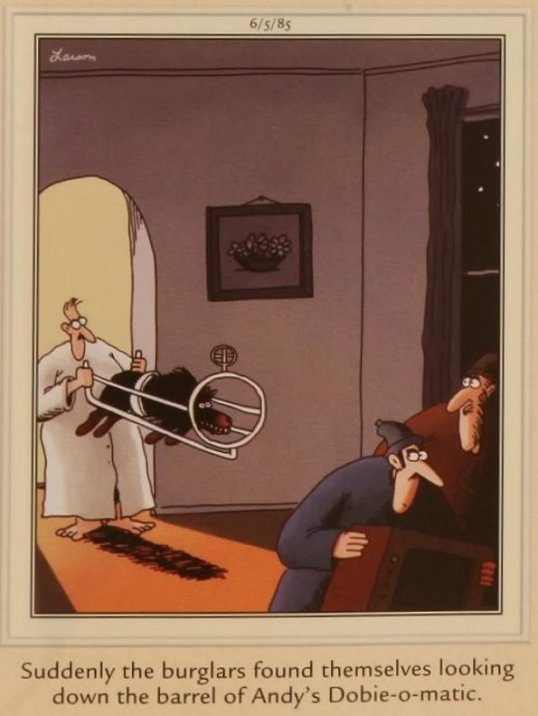
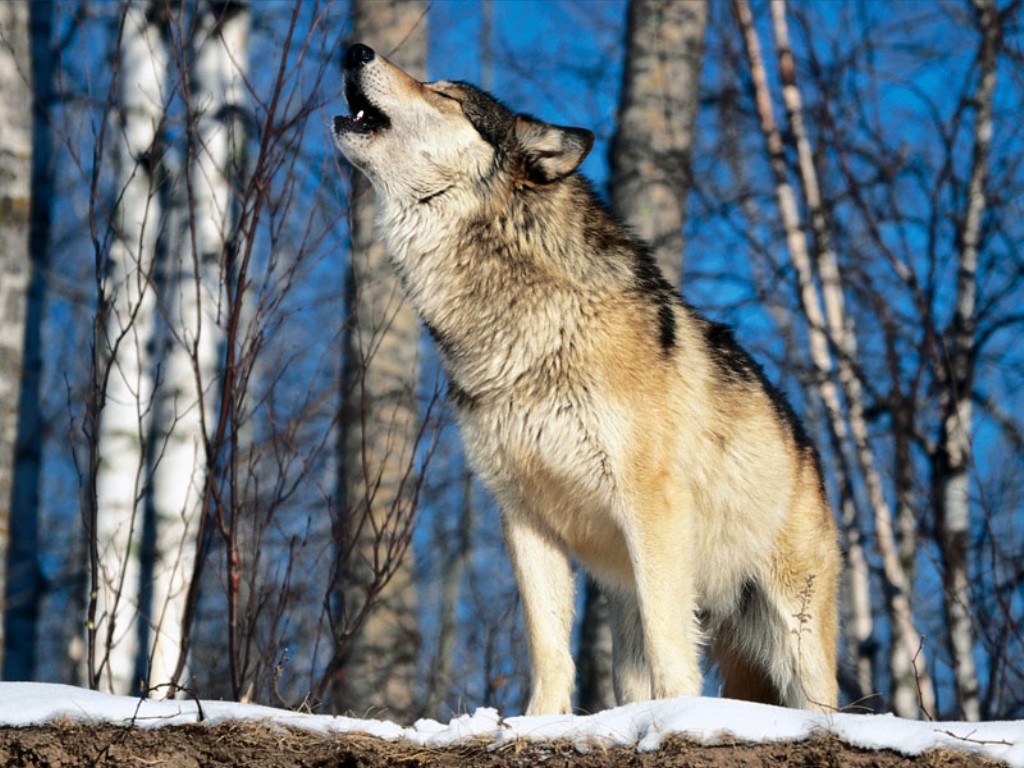
Humanity has been living with dogs for a long, long time, and it would be well for us to remember that although domesticated, they are the descendants of grey wolves.
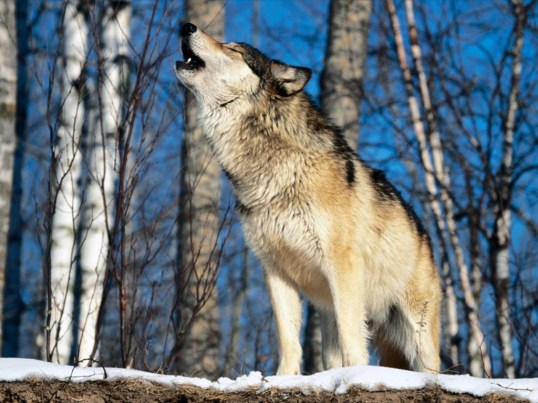
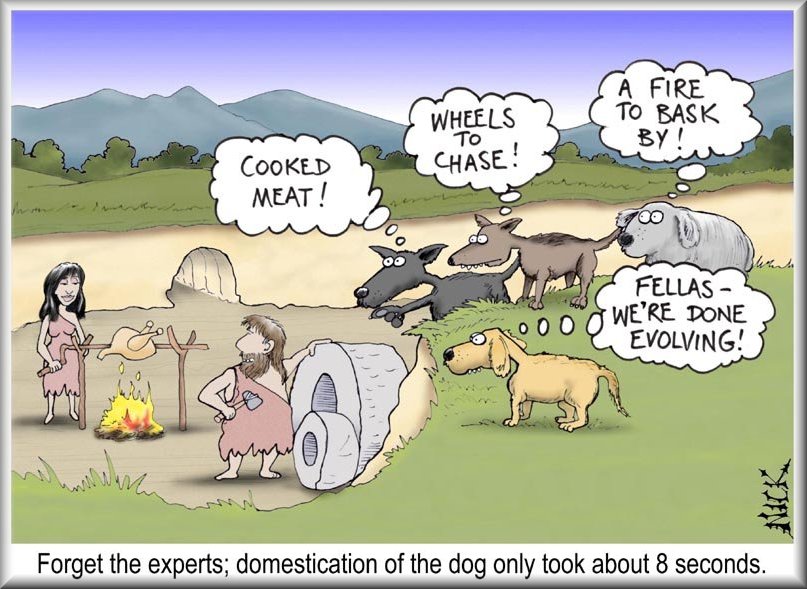
There came a time when dogs realized there was value in a partnership with those hairless apes.
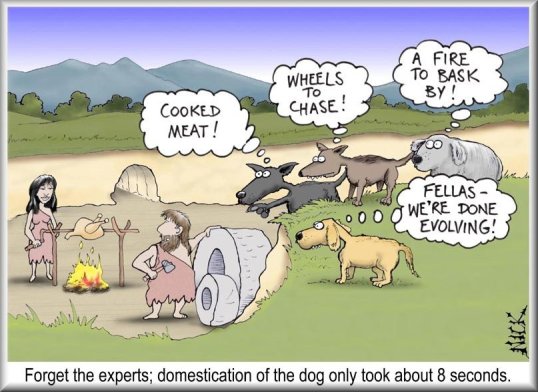
Cartoon by Nick Kim
People who have had any relationship with dogs at all know that these creatures are some of the most loving, brave, and faithful souls that have ever been sent to earth.
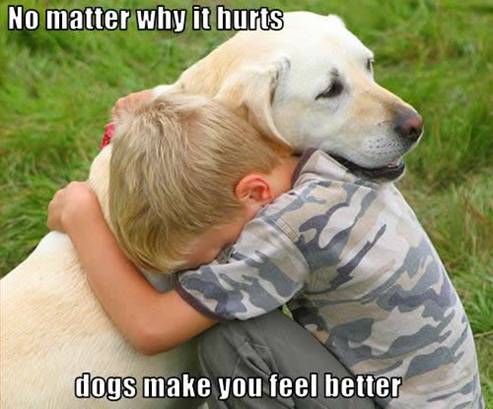
Most recently, therapy dogs brought comfort to those affected by the Boston Marathon tragedy.
—————-
Quality
If you can start the day without caffeine,
If you can get going without pep pills,
If you can resist complaining and boring people with your troubles,
If you can eat the same food every day and be grateful for it,
If you can understand when your loved ones are too busy to give you any time,
If you can overlook it when something goes wrong through no fault of yours and those you love take it out on you,
If you can take criticism and blame without resentment,
If you can ignore a friend’s limited education and never correct him,
If you can resist treating a rich friend better than a poor friend,
If you can face the world without lies and deceit,
If you can conquer tension without medical help,
If you can relax without liquor,
If you can sleep without the aid of drugs,
If you can say honestly that deep in your heart you have no prejudice against creed, color, religion or politics…
Then my friends, you are almost as good as your dog.
—————–
Here’s a lovely story that gets forwarded around a lot. It’s a glurge, and I still like it.
A man and his dog were walking along a road. The man was enjoying the scenery, when it suddenly occurred to him that he was dead. He remembered dying, and that the dog walking beside him had been dead for years.
He wondered where the road was leading them. After a while, they came to a high, white stone wall along one side of the road. It looked like fine marble. At the top of a long hill, a tall arch that glowed broke in the sunlight. When he was standing before it, he saw a magnificent gate in the arch that looked like mother of pearl, and the street that led to the gate looked like pure gold.
He and the dog walked toward the gate, and as he got closer, he saw a man at a desk to one side. When he was close enough, he called out, “Excuse me, where are we?” “This is Heaven, sir,” the man answered. “Wow! Would you happen to have some water?” the man asked. Of course, sir. Come right in, and I’ll have some ice water brought right up.” The man gestured, and the gate began to open. “Can my friend,” gesturing toward his dog, “come in, too?” the traveler asked. “I’m sorry, sir, but we don’t accept pets.” The man thought a moment and then turned back toward the road and continued the way he had been going with his dog.
After another long walk, and at the top of another long hill, he came to a dirt road, which led through a farm gate that looked as if it had never been closed. There was no fence. As he approached the gate, he saw a man inside, leaning against a tree and reading a book. “Excuse me!” he called to the reader. “Do you have any water?” “Yeah, sure, there’s a pump over there.” The man pointed to a place that couldn’t be seen from outside the gate. “Come on in.” “How about my friend here?” the traveler gestured to the dog. “There should be a bowl by the pump.” They went through the gate, and sure enough, there was an old-fashioned hand pump with a bowl beside it. The traveler filled the bowl and took a long drink himself, then he gave some to the dog.
When they were full, he and the dog walked back toward the man who was standing by the tree waiting for them. “What do you call this place?” the traveler asked. “This is Heaven,” was the answer. “Well, that’s confusing,” the traveler said……”The man down the road said that was Heaven, too?” “Oh, you mean the place with the gold street and pearly gates? Nope. That’s Hell.” “Doesn’t it make you mad for them to use your name like that?” “No. I can see how you might think so, but we’re just happy that they screen out the folks who’ll leave their best friends behind.”
—————–
A recent news article at the BBC describes a dog who kept a young girl alive in freezing temperatures.
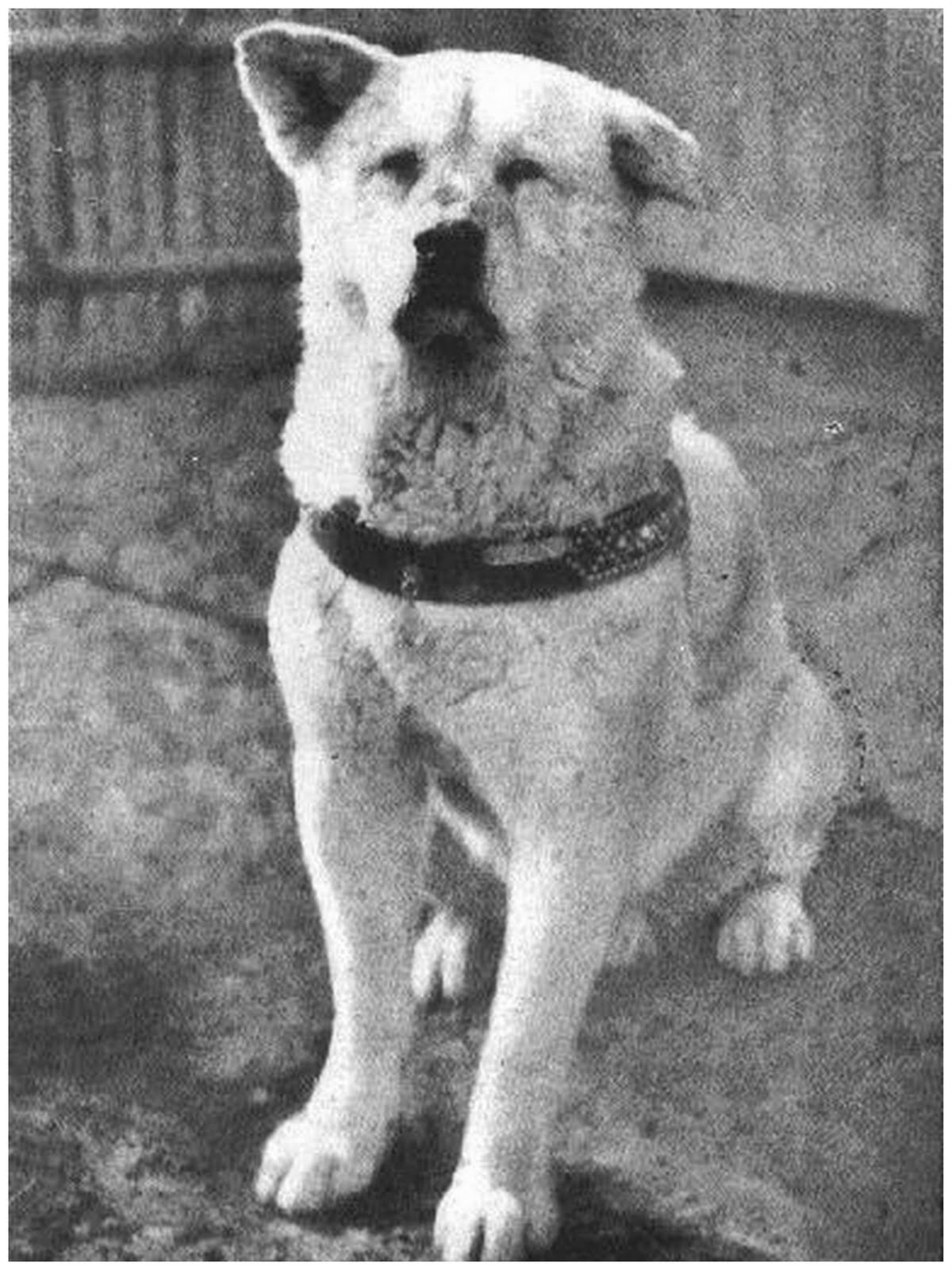
And of course, there are the stories of Hachikō…
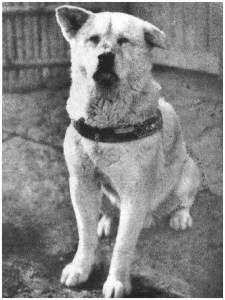
Red Dog…
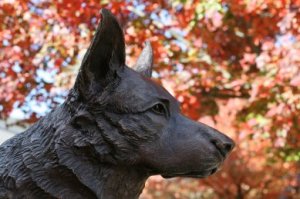
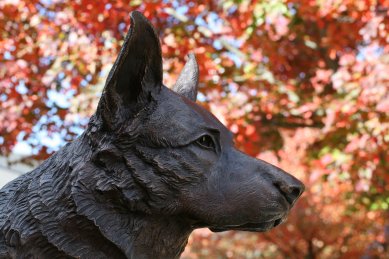
The red dog monument

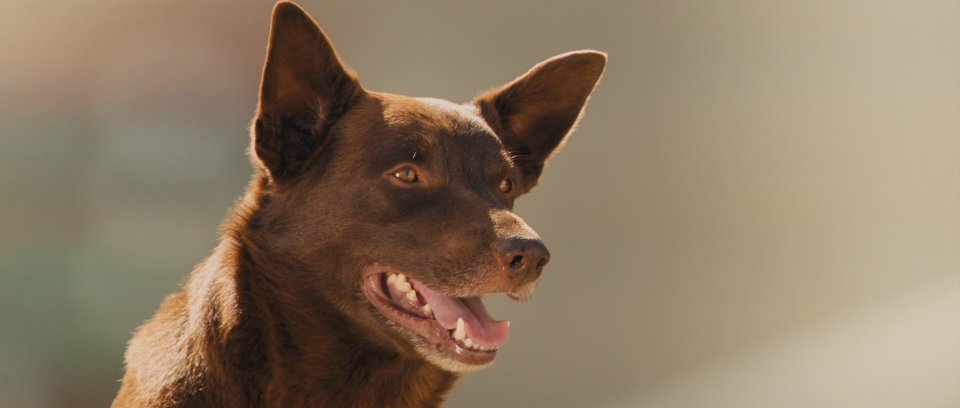
Koko (go ndéanai Día trocaire air)[1], the kelpie who starred in the iconic movie,
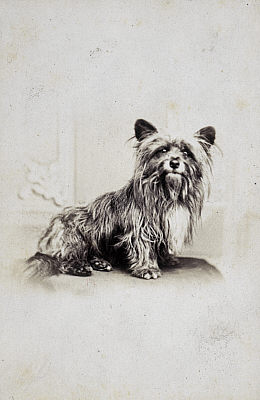
and Greyfriar’s Bobby.
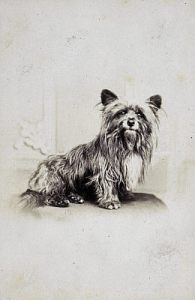
Albumen print (ca. 1865), thought to be of Bobby (from Wikimedia Commons)
Although Bobby’s story has been challenged by numerous authorities, there is no end of documented tails [sic] (see Hachikō above) of dogs who have demonstrated extraordinary love and faithfulness.
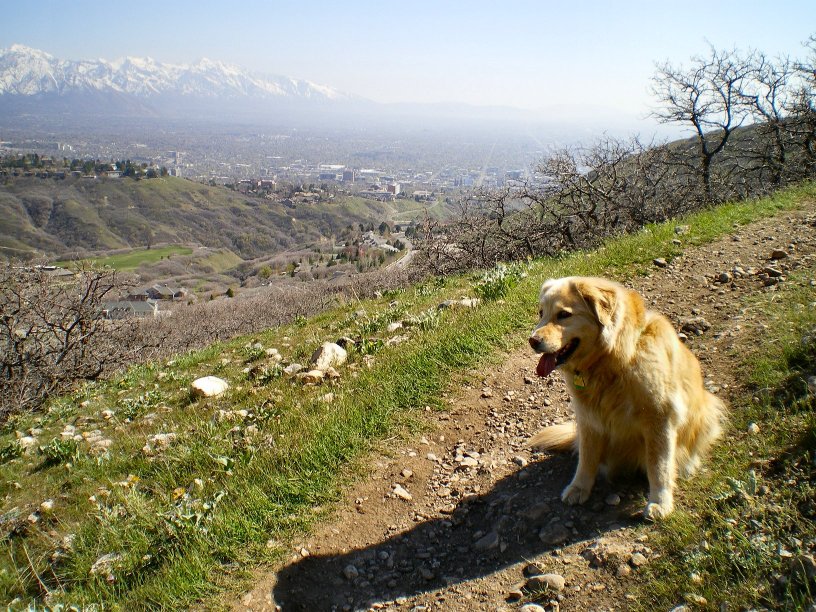
I’ve known many dogs, but none as faithful or loving as Céilidh. She was the very best… we covered thousands of miles together on our walks.
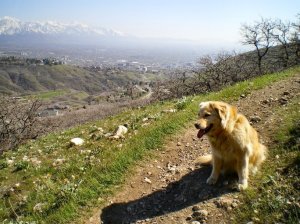
For what it’s worth, there are cultures in the world that consider dogs unclean. I can only pity them… they are missing out on one of the greatest sources of love and friendship that the Earth has to offer.
All of this having been said, there is no breed of dog that has ever exhibited a tendency for more aggressiveness than another. The breeds I mentioned above have gotten an especially bad rap because many people train these dogs to be aggressive for use in security, police work, or the heinous activity of dogfighting. Because they are animals, they will respond exactly as they are trained – consciously or unconsciously – to do.
A famous poem by By Dorothy Law Nolte, Ph.D. has a lot to say about dogs as well as children:
Children Learn What They Live
If children live with criticism, they learn to condemn.
If children live with hostility, they learn to fight.
If children live with fear, they learn to be apprehensive.
If children live with pity, they learn to feel sorry for themselves.
If children live with ridicule, they learn to feel shy.
If children live with jealousy, they learn to feel envy.
If children live with shame, they learn to feel guilty.
If children live with encouragement, they learn confidence.
If children live with tolerance, they learn patience.
If children live with praise, they learn appreciation.
If children live with acceptance, they learn to love.
If children live with approval, they learn to like themselves.
If children live with recognition, they learn it is good to have a goal.
If children live with sharing, they learn generosity.
If children live with honesty, they learn truthfulness.
If children live with fairness, they learn justice.
If children live with kindness and consideration, they learn respect.
If children live with security, they learn to have faith in themselves and in those about them.
If children live with friendliness, they learn the world is a nice place in which to live.
Copyright © 1972 by Dorothy Law Nolte
Dogs are even more intuitive and less reasoned than children. Mark Twain once famously said,
“If you pick up a starving dog and make him prosperous, he will not bite you. This is the principal difference between a dog and a man.”
Any dog that is raised with love will give love, devotion, protection, and service in return. Any dog that is beaten, abused, starved, chained, made afraid, or tortured is a candidate for aggressive behavior – I don’t care if it’s a Pit Bull or a Yorkshire Terrier… dogs have no sense of their own size, as anyone with a chihuahua can attest to.
Pit bulls tend to get the worst rap of all, and it’s entirely undeserved.
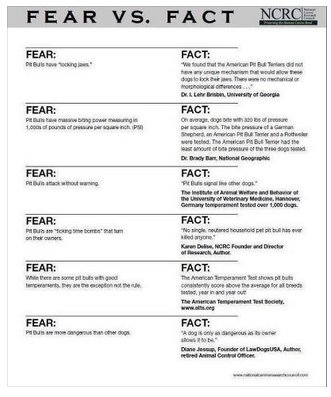
This poster by the National Canine Research Council (full-size PDF file here) outlines a number of fears about Pit Bulls, with the documented facts about the breed. The same things, however, could be said about any breed of dog that is looked up on by the public (again, largely thanks to the media and the entertainment industry) as being dangerous.

To end this essay on a lighter note, I share a story that I first heard in Irish. The translation below is mine.[2]
——————
Ti-Boy and the Dogs
Like his father, Ti Charlie, and his uncle, Ti Antoine, Ti-Boy LeBlanc was a big strapping fellow, and never was there a more terrible bully in Terrebonne Parish, Louisiana, than his dog. The other night, Ti-Boy was drinking beer and eating boiled crawfish with a couple of his buddies in a bar on route 20. In comes a stranger, and after a few words with the bartender, up comes he to Ti-Boy.
Stranger: Is that your big dog out there?
Ti-Boy: Yeah, he’s mine.
Stranger: Well, my dog just killed your dog.
Ti-Boy: Your dog killed my dog? Incroyable! What kind of dog do you have, anyway?
Stranger: A Chihuahua.
Ti-Boy: A Chihuahua?!? You’re putting me on! There’s no chance in Hell that a little bitty dog like that could do any damage to a dog that’s as big as a horse!
Stranger: I’m telling you he killed it.
Ti-Boy: How?!
Stranger: The little creature got stuck in its throat…
The Old Wolf has spoken.
[1] Irish = “May God have mercy upon him,” said when mentioning someone deceased.
[2] The original story:
Ti Boy agus na Madraí
Dála a athar, Ti Charlie, agus a uncail, Ti Antoine, fear mór scafánta ba ea Ti Boy LeBlanc. Bhí maistín mór millteach aige an madra ba mhó i bParóiste Terrebonne, Louisiana. Tráthnóna amháin bhí Ti Boy ag ól beorach agus ag ithe boiled crawfish lena chuid cairde i dteach tábhairne ar Route 20. Tháinig strainséir isteach. Tar éis cúpla focal leis an mbartender, chuaigh an fear seo go dtí Ti Boy.
Strainséir: An leatsa an mada mór amuigh ansin?
Ti Boy: Sea. Is liomsa é.
Strainséir: Bhuel, tá mo mhadasa théis do mhadasa a mharú.
Ti Boy: Mharaigh do mhadasa mo mhadasa? Incroyable! Cén sórt mada tá agat, anyway?
Strainséir: Chihuahua.
Ti Boy: Chihuahua!?! Tá tú ag tarraingt asam! Dheamhan seans ag mada beag bídeach mar sin aon damáiste a dhéanamh do mhada atá chomh mór le bromach!
Strainséir: Tá mé á rá leat gur mharaigh sé é.
Ti Boy: Cén chaoi?!
Strainséir: Chuaigh an créatúirín i bhfostú ina scornach…
(Originally found at http://www.ncf.carleton.ca/~bj333/HomePage.home.html – link now 404)













![Darwin award candidate[1]](https://playingintheworldgame.com/wp-content/uploads/2013/04/darwin-award-candidate1.jpg)