A Taxonomy of Trump Tweets – from On the Media.”

On the Media is “WNYC’s weekly investigation into how the media shapes our world view. Veteran journalists Brooke Gladstone and Bob Garfield give you the tools to survive the media maelstrom.”

A recent segment intriguingly addresses the PEOTUS’ twitter-storm, and how the media should appropriately respond.

As we all know, Donald Trump’s tweets have become a potent force in our new era. On the one hand, a single tweet can cripple opponents, activate supporters, move markets, and subsume the news cycle. On the other, they’re a window into Trump’s wee-hours, unfiltered id. But when his tweets are full of half-truths, distortions, and often bold-faced lies, should journalists treat them as normal presidential utterances, or something else? Cognitive linguist George Lakoff believes that the press must understand how Trump uses language if we’re to responsibly report on his tweets, not just magnify their misinformation. He talks with Brooke about the categories he’s come up with for thinking about Trump tweets.

A summary of the categories:

  1. Preemptive Re-framing – Trump’s tweet stated, “In addition to winning the Electoral College in a landslide, I won the popular vote if you deduct the millions of people who voted illegally.” This was rated “Pants on Fire” by Politifact, but it effectively re-frames the popular vote in the minds of those who see the tweet, thus distorting the facts in the public arena.
  2. The Diversion Tweet – This kind of tweet is akin to the magician’s misdirectional “nothing up my sleeve.” While you’re busy looking at his or her sleeve to be sure, jiggery-pokery is happening elsewhere. A good example is focusing on Hamilton, as Trump did when he tweeted “The Theater must always be a safe and special place.The cast of Hamilton was very rude last night to a very good man, Mike Pence. Apologize!” In this way, people focus on Hamilton rather than the $25 million settlement in the case of  fraud allegations against Trump University.
  3. The Trial Balloon – Send up something and see how the public reacts, so you’ll know what to do in the future. When Trump tweeted, “The United States must greatly strengthen and expand its nuclear capability until such time as the world comes to its senses regarding nukes,” he watched to see how the public responded to this idea; in this case there was a brief discussion about nuclear policy which quickly faded from the public consciousness.
  4. Deflection – In which you attack the messenger. After being pointedly called out by Meryl Streep for mocking a disabled reporter, Trump attacked the messenger: “Meryl Streep, one of the most over-rated actresses in Hollywood, doesn’t know me but attacked last night at the Golden Globes. She is a Hillary flunky who lost big. For the 100th time, I never “mocked” a disabled reporter (would never do that) but simply showed him “groveling” when he totally changed a 16 year old story that he had written in order to make me look bad. Just more very dishonest media!The video is out there; no matter how much he denies it, Trump’s actions can not be interpreted as anything other than cruel mockery of a man’s afflictions – but attacking Ms. Streep, one of the most accomplished and versatile actresses of this generation, deflect’s the public’s view from the issue at hand. This was also evident as Trump attacked Buzzfeed, CNN, and the BBC around reports on the supposed Russian dossier.

Lastly, Lakoff presents an example of a Trump tweet that uses all four strategies at once:

“Intelligence agencies should never have allowed this fake news to “leak” into the public. One last shot at me.Are we living in Nazi Germany?”

  • Pre-emptive framing: “This is fake news.”
  • Diversion – Getting the public to discuss whether or not this is fake news rather than addressing the issue itself.
  • Deflection – Attacking the messengers
  • Trial balloon – Will the intelligence agencies be stopped, and are they working like Nazi Germany?

And, of course, tucked away in the tweet is the invocation of a corollary to Godwin’s Law: In any online discussion, whoever first brings up a reference to Hitler has lost the argument, and the discussion is ended.

Lakoff’s suggestions for the press on how to handle the onslaught of 3 AM tweets, as well as the entire podcast (it’s only about 8 minutes long) are well worth the listen.

The Old Wolf has spoken.
Donald Trump, Brigham Young, and the meaning of a contract.

That Donald Trump is a “shrewd businessman” – I can put it no more charitably than that – is no secret. He himself has said that he takes pleasure in reneging on contracts if, according to him, work is poor, or not up to snuff, or late.

However, among the 1,450 lawsuits against Trump and Company are a significant percentage of people testifying that his modus operandi is to stiff people who work for him. In the past, he has generally gotten away with it because he was the 900-lb gorilla in the ring, and most people didn’t have the gumption or the legal resources to go up against him.

But recently, this practice came around and bit him on the honus, hard.

Trump’s company chose to pay small contractor Paint Spot $34,863 on a $200,000 contract. Paint Spot rustled up some high-powered lawyers willing to work on contingency and waive their fees if they lost, and sued Trump. During the trial,

Trump’s legal team looked positively stricken when the construction manager admitted during testimony that the company had decided not to pay The Paint Spot because it felt like it had “already paid enough.”

Trump’s loss was delicious. It illustrates plainly the standard operating procedure of a man who has made millions on the backs of others, without caring who gets hurt in the process – one of the classic hallmarks of a sociopath, of which Trump easily checks off at least five:

Antisocial Personality Disorder, as defined by DSM-5 – only three of these are sufficient to classify a sociopath.

1) failure to conform to social norms with respect to lawful behaviors as indicated by repeatedly performing acts that are grounds for arrest;
2) deception, as indicated by repeatedly lying, use of aliases, or conning others for personal profit or pleasure;
3) impulsivity or failure to plan ahead;
4) irritability and aggressiveness, as indicated by repeated physical fights or assaults;
5) reckless disregard for safety of self or others;
6) consistent irresponsibility, as indicated by repeated failure to sustain consistent work behavior or honor financial obligations;
7) lack of remorse, as indicated by being indifferent to or rationalizing having hurt, mistreated, or stolen from another.

Now, in contrast, let’s take a bit of satirical history from the pages of Samuel Clemens.

In  Mark Twain’s “Roughing It,” Chapter 14, we read the story of Mr. Street, busy with stringing telegraph wires across the rugged desert.

Unto Mormons he had sub-let the hardest and heaviest half of his great undertaking, and all of a sudden they concluded that they were going to make little or nothing, and so they tranquilly threw their poles overboard in mountain or desert, just as it happened when they took the notion, and drove home and went about their customary business! They were under written contract to Mr. Street, but they did not care anything for that. They said they would “admire” to see a “Gentile” force a Mormon to fulfil a losing contract in Utah! [Emphasis mine]

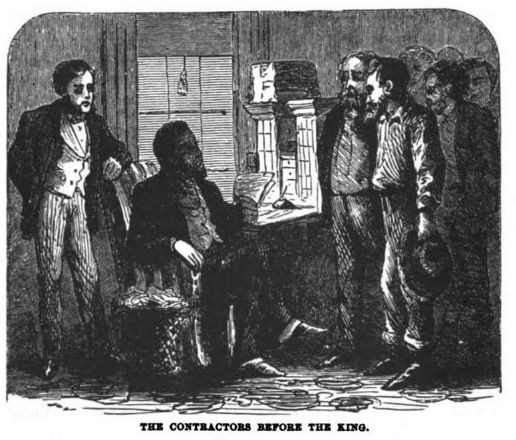
Mr. Street was in dismay to find himself in a country where “contracts were worthless,” until another Gentile (Note: This is the term that was long used in Mormon country for people not of that faith) suggested he go see Brigham Young. While in doubt that someone with only religious authority could help, he paid the President a visit and

laid the whole case before him. He said very little, but he showed strong interest all the way through. He examined all the papers in detail, and whenever there seemed anything like a hitch, either in the papers or my statement, he would go back and take up the thread and follow it patiently out to an intelligent and satisfactory result. Then he made a list of the contractors’ names. Finally he said:

“Mr. Street, this is all perfectly plain. These contracts are strictly and legally drawn, and are duly signed and certified. These men manifestly entered into them with their eyes open. I see no fault or flaw anywhere.”

Then Mr. Young turned to a man waiting at the other end of the room and said: `Take this list of names to So-and-so, and tell him to have these men here at such-and-such an hour.

brigham

They were there, to the minute. So was I. Mr. Young asked them a number of questions, and their answers made my statement good. Then he said to them:

“You signed these contracts and assumed these obligations of your own free will and accord?”

“Yes.”

“Then carry them out to the letter, if it makes paupers of you! Go!”

And they did go, too! They are strung across the deserts now, working like bees. And I never hear a word out of them.

While there is no evidence proving that this specific incident occurred, Roughing It is a semi-autobiographical novel detailing Twain’s travels, and through the satire some truth gleams like gems. I am inclined to believe the story has basis in fact for a number of reasons, most importantly that Brigham Young valued honesty and decried duplicity.

My mother used to sing me a little song when I was very young:

Before you make a promise,
Consider first it’s importance.
Then, when made,
Engrave it upon your heart.

I suspect my mother learned this from her father, and Linda K. Burton, general Relief Society President for the Church of Jesus Christ of Latter-day Saints, heard the same song from her own grandfather

Honesty is one of the traits of a compassionate leader, one who says what (s)he means and does what (s)he says. I cannot, I will not support as the leader of my country someone who takes perverse pleasure in lies and deception to profit at the expense of others.

The Old Wolf has spoken.

To the millennials of this election.

Reblogging this with the kind permission of the author, David Gerrold. I saw this on Facebook, and felt it was so relevant that it deserved a wider audience.

So … I think I’ll blur the details here.

There was this person who was expounding on the upcoming election and why he wasn’t going to vote for Hillary Clinton. It was his first time voting, you see, and he wanted someone who understood and represented his generation.

He said to me, “You don’t understand — ”

And that’s where I had to stop him. “Look, I do understand. Really.”

“How can you understand? You’re too old.”

“Do you think I was born old? Y’know, I have pictures. Here’s me at thirteen — ”

“But times were different then — ”

“Yes, they were. You could get polio and measles and smallpox. An appendectomy was a serious operation. People smoked everywhere, there was no getting away from the smoke. In school, they taught us to duck and cover in case of a nuclear attack. Whites and blacks still had separate restrooms and drinking fountains. Women couldn’t get a legal abortion. Gas had lead in it. Vegetables were sprayed with DDT. You could be arrested for being gay. Yes, times were different.”

“No, I meant that protesting was a fad, not serious like — ”

“Excuse me? Do you want to see the scar on my scalp where I was hit by a thrown bottle at the first gay rights march? We also had civil rights demonstrations, anti-war marches, and rallies for women’s rights as well. That was no fad. People were dying — ”

“No, look, man — it’s the establishment. That’s what’s wrong — ”

“And you want to replace the establishment with what? A different establishment? Listen — when I was your age, when my generation was your age, we were just as frustrated and just as impatient as you are now. Honest. Am I saying we were wrong? Hell, no. We were right. Better than that, we were so right, we were self-righteous. We went around saying, ‘Don’t trust anyone over 30,’ as if somehow when you turned 30, you became one of them. Y’know?

“You know what we missed? We missed the obvious — that there were a lot of good men and women over 30 who understood the issues, and the complexities of the situation better than we did — because they’d been fighting that fight for a lot longer. We had emotion, we had energy, we had spirit — but we didn’t have enough experience, enough history, enough of everything we needed to effect real change.

“So we didn’t turn out for Hubert Humphrey and we handed the country to Richard Nixon. And a generation later, other people didn’t turn out for Al Gore and handed the country to George W. Bush. And what was missed — both times — was the fact our impatience was the single biggest mistake we could make.

“Hubert Humphrey had experience, he had wisdom, and he shared our goals. Al Gore had experience, he had wisdom, and he shared our goals. But somewhere, enough of us decided that he was too old or too much of the establishment or didn’t really represent us enough, or would just give us more of the same when what we really wanted was more, better, and different, even if we couldn’t define it — enough of us felt that way to hand the presidency to a much worse administration.

“So, no — it isn’t that you’re wrong. It’s that there are people who’ve been down this path before. We know where it leads. And it’s not a good place. We know what this mistake looks like. Because we’ve made it ourselves — and we’re asking you not to make the same mistakes we did, because each time we make this mistake, everyone gets hurt.”

And he said, “So that’s a fancy way of saying ‘suck it up, buttercup, you can’t have what you want.”

And I said, “No, but if that’s the way you want to hear it, then that’s the way you’re going to hear it. The way government works, nobody gets everything they want. The way government is supposed to work, everybody negotiates — and eventually everybody gets a piece of what they need to keep going. Nobody likes that, but consider what the alternative is — if some people get everything they want, that means a lot of people are going to get nothing at all. We keep trying that, it doesn’t work. Let’s go back to the stuff that does work.”

“But I don’t like her — ”

“I’m not asking you to like her. I’m asking you to respect that she knows how to do the job. He doesn’t. You can have your protest vote, that’s your right, but that’s letting everybody else decide who gets the oval office. And you might want to think long and hard about which of the two will build on what President Obama has accomplished and which of the two will tear it all down with no idea of why it worked in the first place. Your choice.”

And he said, “That’s not much of a choice.”

And I said, “The hell it isn’t. It’s a choice between experience and ignorance. That’s the clearest choice I’ve ever seen in an election.”

He didn’t have an answer for that.

And that’s the point —

‘I might be old, but I’m not stupid. And I suspect that a lot of other members of my generation feel the same way. We remember when we were impatient. And we remember the mistakes that our impatience created.

“Old people don’t tell young people what to do and what not to do because we want to control your lives — we just want to warn you not to make the same mistakes we did.

“But you will. Or you won’t. Because it’s your choice. Always.”

As a coda, another comment from a good friend of mine, Jeremy Grimshaw, also quoted with permission:

I’ve got an anxiety in my gut that makes it impossible for me to watch the presidential debate in real time tonight–not because I worry Hillary will do poorly or that Trump will do well, but because I fear that it doesn’t matter how well she does or how poorly he does. The fact that nearly half of all Americans take a person as cruel, crass, immoral, fraudulent, oblivious, and arrogant as Trump seriously as a potential national leader, that they have dimmed and warped their epistemic lenses so terribly that they aren’t appalled by the mere fact of his sharing a stage with her, fills me with despair. What could he say that is worse than he has already said? What depth of depravity remains for him to sink to? It’s not a matter of cringing at the content or tone of the trash he flings or wringing my hands about her responses being forceful enough. I just can’t bear to watch people watching him as if he were a valid option, as if he even belonged in the same arena as her. Remember, when she was in the war room helping call the shots that killed Bin Laden, he was touching up his spray-tan for the reality-TV cameras. We are about to offer the decorum of potential presidentiality to a man who raided the coffers of his charity to commission a gigantic painting of himself in a suit of armor to hang on the wall of a golf resort bar. The most absurdist comedy writers in the country could not conjure a more outlandish parody of the Presidency than the one the Republican Party has nominated to the office.

I can’t watch the debate because I can’t bear to watch America being so incredibly stupid. At a certain point, ignorance, made willful by moral and mental neglect and partisan indolence, crosses the threshold into blasphemy.

Two candidates. Neither perfect. One with decades of experience in governance, the other with nothing but bluster and xenophobia.

Please, please… consider so carefully what kind of a world you want to build, and vote for the candidate who most closely mirrors your values, even if it’s not a perfect match.

The Old Wolf has reposted.