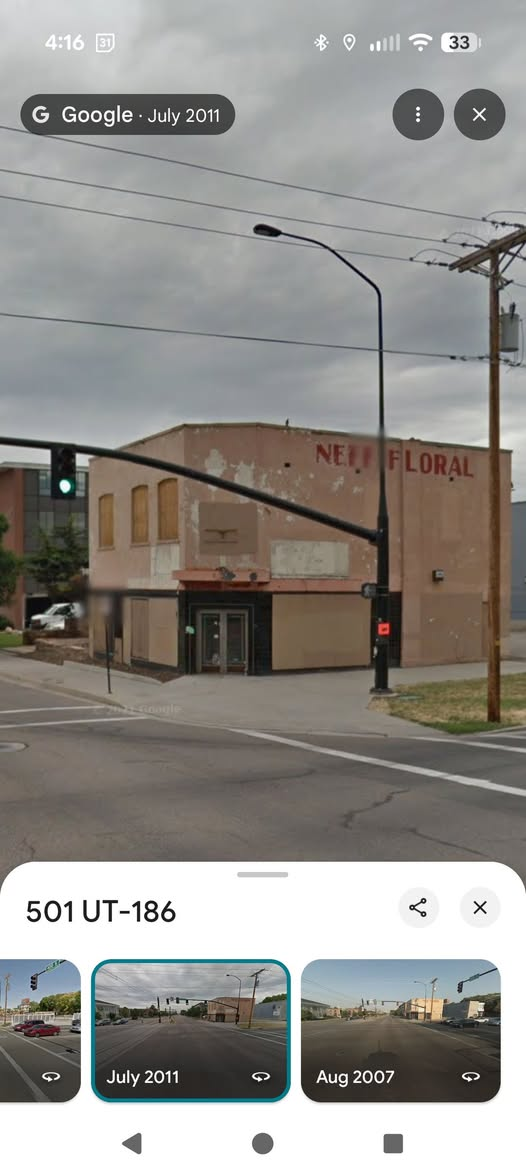
This was the Northeast corner of 500 South and 400 East in 2011. Before being taken over by Neff Floral, it was The Clock Cafe, owned and operated by Ray William Saunders for 40 years. True to its name, there was a clock right above the door. I ate there many times when I was living in the Broadway Apartments complex at 440 East 300 South with my grandmother in 1969.
I considered it the archetypical greasy spoon, but they had great food and always a warm and friendly reception. Sadly, I was unable to find any photographs of the cafe itself. The building has since been demolished and replaced by an apartment complex. Does anyone else remember The Clock Cafe? If you by chance have a photo of it, I’d love to see you post it in a comment.
I swear on a stack of bibles (or The Origin of Species, whichever makes you feel more comfortable) that there was. I remember clearly eating at one, and being astonished at the size of their 5″ patty and huge buns. But the Internet is pretty sure that there was never one there, and will still respond with – what seems to me – inaccurate information. So in order to put that discrepancy to rest, I did a deep dive into the history, and this is what I came up with.
I first submitted the question to Perplexity – History of Whataburger in Salt Lake City? – and this was the result:
There is currently no evidence that Whataburger has ever operated in Salt Lake City or anywhere in Utah as of August 2025. While Whataburger has aggressively expanded in recent years—opening locations in new states like Nevada, the Carolinas, and others—none of the latest location lists or official press material mention Utah or Salt Lake City as a market served by the chain.
But there is a Facebook group called “If You Grew Up in Salt Lake, Then You Will Remember This,” and back on 23 January, 2022, Irene Vialpando asked the group whether they recalled the existence of a Whataburger on State Street around 800 South. Many people responded that they not only recalled the restaurant with its swivel chairs in the 1970s, but ate there, and also recalled the huge patties, and some even chimed in that they or members of their family used to work there. Still others were adamant that there was never any such outlet in Utah.
The responses from those who recalled a Whataburger were so encouraging that I decided to dig deeper. I asked Gemini the following question under the “research” tab:
I absolutely and without question recall the existence of a Whataburger outlet on State Street around 800 South in Salt Lake City in the 1970’s. I ate there, and I remember being gobsmacked by their 5″ patty, so this is not a false memory. Many other people at the Facebook group “If You Grew Up In Salt Lake, Then You Remember This” have clear recollections of this restaurant’s existing for a brief time. Problem is, when I submitted the question to Perplexity and Google and Wikipedia, the answer came back that no, Whataburger never had a presence in Utah. Can you help me reconcile the discrepancy? I know for a fact that one was there.
The response from Gemini was as follows:
Executive Summary
his report investigates the compelling recollection of a Whataburger outlet on State Street around 800 South in Salt Lake City during the 1970s, a memory that contradicts readily available online historical records. While mainstream digital sources generally indicate no Whataburger presence in Utah, a deeper examination of corporate expansion strategies and local fast-food history reveals a more nuanced picture. Evidence suggests a strong possibility of a short-lived Whataburger location in Utah during the specified period, operated by a now-defunct franchisee, Western World Foods Inc. The user’s vivid memory of a “5-inch patty” aligns precisely with Whataburger’s signature product. Alternatively, the memory of a large patty could be attributed to Red Barn, another chain present in Salt Lake City at the time, which offered a burger with a nearly identical patty size. Ultimately, the collective memory and specific product detail lend significant credence to a genuine, albeit brief, Whataburger appearance in Salt Lake City.
The User’s Vivid Recollection: A Personal Account
The core of this inquiry stems from a remarkably clear and persistent personal memory. The user explicitly recalls the presence of a Whataburger restaurant on State Street, specifically around 800 South, in Salt Lake City during the 1970s. This recollection is not merely a vague impression; it is anchored by a distinct sensory detail: the user remembers being “gobsmacked by their 5″ patty.” This specific, quantifiable characteristic serves as a critical identifier for the restaurant in question. The user’s emphatic statement, “this is not a false memory,” underscores the profound certainty associated with this experience.
Furthermore, this is not an isolated individual memory. The user notes that “Many other people at the Facebook group ‘If you grew up in Salt Lake, then you remember this’ have clear recollections of this restaurant’s existing for a brief time.” This collective memory, while not offering definitive documentary proof, indicates a shared experience within the local community that warrants thorough investigation. Online discussions from Salt Lake City forums further show individuals recalling “Whataburger” or “Eat-a-Burger” when discussing lost restaurants from the 1970s, suggesting a common thread in local historical memory. The convergence of these individual and collective memories, particularly around a specific product characteristic, provides a compelling starting point for reconciling the perceived historical discrepancy.
Whataburger’s Corporate History and Western Expansion (1970s)
To understand the potential for a Whataburger presence in Utah, it is essential to review the company’s historical growth and its product characteristics. Whataburger was founded in Corpus Christi, Texas, in 1950, with an ambitious goal: to serve a “better burger that took two hands to hold”. From its inception, the original Whataburger featured a quarter-pound patty served on a distinctive 5-inch bun. This particular dimension, the 5-inch bun, is a direct and precise match for the user’s specific memory of the patty size that left such a strong impression. This consistency in product design throughout Whataburger’s history is a strong indicator of brand identity, making the user’s specific memory a highly reliable detail for identifying the brand, rather than a generic “large burger” from another chain. The company’s commitment to this unique bun size from its earliest days means that if the user distinctly remembers a 5-inch patty, it strongly points towards a Whataburger experience.
Whataburger’s expansion beyond Texas began relatively early, with the first location outside its home state opening in Pensacola, Florida, in 1959. By 1963, the chain had grown to 26 restaurants, extending its reach to Florida, Tennessee, and Arizona. The 1970s marked a period of significant corporate growth, with the company introducing its first drive-thru in 1971 and celebrating the opening of its 100th restaurant in 1972. By the mid-1970s, Whataburger’s footprint had expanded to over 200 restaurants across 12 states.
The Western World Foods Inc. Franchise and Utah’s Connection
Despite the official corporate history often not explicitly listing Utah as a state with Whataburger locations during this period, a crucial detail emerges from the records of its franchising operations. In 1972, a Texas-based Whataburger franchisee, Western World Foods, initiated an ambitious plan to expand the Whataburger brand nationally. This expansion strategy specifically included the development of 14 new restaurants across four Western states: New Mexico, Arizona, Colorado, and Utah.
Further supporting this planned presence, by 1975, “Whataburger of Nevada” was incorporated, and David Hawley was appointed as the Vice President of Operations for both Nevada and Utah. This appointment strongly suggests that active steps were indeed being taken to establish Whataburger locations in Utah, mirroring the development of six Nevada locations that opened by January 1976 under the same franchisee.
The operational model of Western World Foods was distinct; while they licensed the Whataburger name, menu, and logo, they chose to build structures with a “protruding tower in the middle” instead of the classic A-frame design. However, Western World Foods’ ambitious venture proved to be short-lived. By September 1979, Whataburger of Nevada ceased advertising, and its stores, along with other Western World Foods locations, likely closed within a few months. Whataburger’s subsequent reduction in its West Coast presence was directly linked to the dissolution of Western World Foods, which Whataburger eventually purchased.
The existence of Western World Foods’ plans for Utah, coupled with the appointment of a Vice President specifically for Utah operations, strongly indicates that at least one Whataburger location could have opened in Salt Lake City, even if for a very brief period. The short lifespan and subsequent dissolution of Western World Foods provides a compelling explanation for why these locations might not appear in standard, long-term corporate histories or readily accessible online databases. The official Whataburger history, which outlines the company’s core corporate expansion, often omits details of short-lived or problematic franchise ventures. This explains why a user’s initial searches might yield results stating no Whataburger presence in Utah, even if a temporary one existed.
It is also important to differentiate the Texas-based Whataburger from an unrelated chain named “What-A-Burger,” founded in Virginia in 1957. Although both chains share similar names and were involved in trademark disputes in 1970 , the Virginia-based chain did not expand westward into Utah. The user’s specific memory of a 5-inch patty aligns with the Texas Whataburger’s signature product, making confusion with the Virginia chain highly unlikely.
Table 1: Whataburger’s Western US Expansion Initiatives (1970s)
State
Franchisee/Subsidiary
Key Dates/Details
Outcome/Notes
Colorado
Whataburger of Colorado Inc. (under Western World Foods Inc.)
Operated throughout 1970s; locations opened 1972-1975; likely closed late 70s/early 80s
Short-lived stint, difficult to research; some buildings still exist under different businesses.
Arizona
Western World Foods Inc.
Expanded to Arizona by 1963 (corporate); Western World Foods also had locations
Some Western World locations held onto by Whataburger after 1979.
New Mexico
Western World Foods Inc.
Part of 1972 expansion plans for 14 new restaurants
Some Western World locations held onto by Whataburger after 1979.
Nevada
Whataburger of Nevada (under Western World Foods Inc.)
Incorporated 1975; six locations opened by Jan 1976; stopped advertising Sept 1979
Short-lived; exit related to dissolution of Western World Foods. Buildings often repurposed.
Utah
Western World Foods Inc.
Included in 1972 plans for 14 new restaurants; David Hawley named VP of Operations for Nevada & Utah by 1975.
Strong indication of planned or short-lived presence, likely closed with Western World Foods in 1979.
California
Whataburger of California (under Western World Foods Inc.)
Presence from mid-70s (~1973) until 1987.
Short-lived stint, difficult to research.
This table directly addresses the primary discrepancy in the user’s query. It highlights that Utah was explicitly part of a significant, albeit ultimately unsuccessful, Western expansion initiative by a Whataburger franchisee. By placing Utah within the context of other Western states where Whataburger did have a presence, even if short-lived, it validates the possibility of a Utah location and provides an evidence-based counter-argument to the general online narrative. The table also implicitly sets the stage for understanding why such a presence might be difficult to trace: its short duration and the failure of the franchising entity.
Salt Lake City’s Fast-Food Landscape (1970s)
To provide comprehensive context and explore alternative explanations for the user’s memory, it is important to examine other prominent burger chains operating in Salt Lake City during the 1970s, particularly those known for offering larger patties.
Prominent Local Chains
Dee’s Drive-In: A long-standing fixture in Utah for nearly five decades, Dee’s Drive-In was a well-known local burger chain. It was eventually sold to Hardee’s in the late 1970s. While iconic for its “Dee’s Clowns” and family-friendly advertising , its standard burger patty size was typically 1/8 pound. This is significantly smaller than the 5-inch/quarter-pound patty described by the user, making Dee’s an unlikely candidate for the “gobsmacked by 5-inch patty” memory.
Crown Burger: Crown Burger opened its doors in Salt Lake City in 1978. It quickly gained fame for its signature “Crown Burger,” which features a quarter-pound hamburger patty generously topped with a thick mound of hot pastrami on a sesame seed bun. While the patty size (quarter-pound) is comparable to Whataburger’s, the distinctive addition of pastrami and the opening year (1978) might differentiate it from the user’s specific memory of a Whataburger experience earlier in the 1970s.
Eat-a-Burger: This restaurant is mentioned in Salt Lake City online discussions as a fondly remembered, now-defunct establishment. Eat-a-Burger was located at the intersection of Regent Street and 200 South. Although its specific patty dimensions are not detailed in the available information, it was generally known for serving “large” burgers. However, its documented location is not on State Street around 800 South, which is a key detail in the user’s memory.
Other Local Favorites: The 1970s Salt Lake City fast-food scene included other local burger joints such as Don’s, Arctic Circle (recognized for its fry sauce and crinkle fries), and JB’s Big Boy (known for its triple-decker burger). The Training Table, a regional chain founded in Utah in 1977, also specialized in “gourmet burgers”.
National Chains with Large Patties
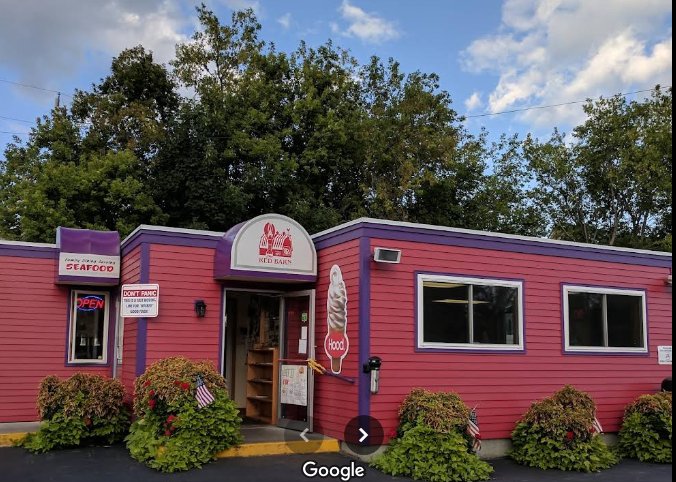
Red Barn: This national fast-food chain, established in 1961, had a significant presence across the country, boasting over 300 locations in 19 states by the 1970s. Red Barn was particularly known for its substantial burger offerings, including the “Big Barney” (comparable to a McDonald’s Big Mac) and the “Barnbuster” (similar in style to a Quarter Pounder or Burger King’s Whopper). Crucially, a 5.0 oz patty from Red Barn was specified as having “Patty Dimensions: 4 7/8 inches”. There was indeed at least one Red Barn location confirmed to be in Salt Lake City.
The patty dimensions of Red Barn’s “Barnbuster” (4 7/8 inches) are remarkably close to the user’s recollection of a “5-inch patty.” Given Red Barn’s confirmed presence in Salt Lake City and its reputation for large burgers, it presents a strong alternative explanation for the user’s memory if a Whataburger did not exist at the specified location. The memory of a distinctive large patty could easily be attributed to a well-known “big burger” chain, especially over the span of decades.
Salt Lake City Business Directories and Archives
To definitively confirm or refute the presence of a Whataburger or Red Barn at “State Street around 800 South,” a detailed examination of historical records would be necessary. Salt Lake City directories for the 1970s are available through the Utah City Directories Collection, including directories for South Salt Lake City. These valuable resources list residents, streets, businesses, and organizations, often including advertisements, and are designed to be searchable.
Additionally, the J. Willard Marriott Library at the University of Utah maintains the Utah Digital Newspapers (UDN) repository, which provides free access to over nine million pages from 400 newspapers published in Utah from 1850 to 2023. This extensive resource allows for searching historical newspaper content, which would be critical for finding advertisements or news articles about restaurant openings or closures on State Street around 800 South during the 1970s. The available information indicates that State Street around 800 South was indeed a commercial area with various tenants, including restaurants.
While these archives are excellent resources for historical research, the challenge lies in the potential for short-lived businesses, such as a Western World Foods Whataburger (if it opened), to have left minimal or no advertising footprint, or for their records to be obscure within the vastness of the archives. The absence of a listing in widely accessible digital archives does not definitively prove non-existence, especially for a brief operation. This highlights the inherent difficulty in definitively proving or disproving a short-lived historical business through common online searches, which is precisely why the user’s initial inquiries were inconclusive.
Table 2: Prominent Salt Lake City Burger Chains (1970s) with Patty Characteristics
Restaurant Name
Type (Local/National)
Key Burger/Patty Size
Known Locations (1970s)
Notes
Whataburger
National (via franchisee)
Quarter-pound patty on 5-inch bun
Planned for Utah (Western World Foods)
Strong match for patty/bun size memory; potential short-lived presence.
Dee’s Drive-In
Local
1/8 pound patty
Fixture throughout Utah
Patty size significantly smaller than user’s memory.
Very close match for patty size memory; known for large burgers.
Crown Burger
Local
Quarter-pound patty (with pastrami)
Opened 1978 in Salt Lake City (377 E 200 S)
Patty size matches, but opened late 70s and distinctive pastrami.
Eat-a-Burger
Local
“Large” burgers (specific size not found)
Regent Street and 200 South
Known for large burgers, but location not on State St.
JB’s Big Boy
National/Regional
“Big Boy” (triple-decker)
Present in Salt Lake City
Known for large, multi-patty burgers.
This table is essential for systematically evaluating alternative explanations for the user’s memory. By explicitly comparing patty and bun sizes across various burger chains known to be in Salt Lake City during the 1970s, it allows for a direct assessment of how well each chain aligns with the user’s specific recollection. This structured comparison immediately highlights that Dee’s Drive-In is an unlikely match due to its smaller patty size. Conversely, it identifies Red Barn as a very strong candidate for potential misattribution because its patty diameter (4 7/8 inches) is nearly identical to the 5-inch patty remembered by the user, and Red Barn had a confirmed presence in Salt Lake City. This comparison helps to narrow down the possibilities and provides a clear, data-driven framework for understanding how the user’s memory could be accurate in its sensory detail (large patty) but potentially misattributed in terms of the specific brand.
Reconciling Memory and Records: Analysis of Discrepancies
The conflict between the user’s strong personal memory and the lack of readily available online documentation poses a classic challenge in historical research. However, the collected information allows for a plausible reconciliation, suggesting that the user’s memory is likely accurate.
The Case for a Short-Lived Whataburger Presence
The most compelling evidence supporting the user’s memory stems from the documented expansion plans of Western World Foods, a Whataburger franchisee. Their 1972 initiative explicitly included plans for 14 new restaurants across New Mexico, Arizona, Colorado, and crucially, Utah. This is not a vague aspiration but a concrete business strategy. Furthermore, the appointment of David Hawley as Vice President of Operations for both Nevada and Utah by 1975 strongly indicates that tangible steps were being taken to establish Whataburger locations in Utah. The presence of a dedicated executive for Utah operations suggests more than just theoretical planning; it points to active development.
While specific addresses for Utah locations are not detailed in the available information, the rapid dissolution of Western World Foods in 1979 provides a clear and coherent explanation for why any Utah Whataburger that opened would have been very short-lived. A brief operational period, especially one ending in a franchise failure and subsequent corporate acquisition, would naturally lead to minimal or no permanent digital or easily accessible historical records. Businesses that operate for only a few years, particularly those whose parent franchising entities dissolve, often leave little to no lasting public footprint in broad historical databases. The user’s strong memory, corroborated by a local Facebook group, aligns perfectly with the idea of a real, but ephemeral, business presence. This situation illustrates that the absence of easily discoverable evidence does not equate to evidence of absence, particularly for short-lived ventures or those impacted by corporate restructuring.
Alternative Explanation: Misattribution to Red Barn
If, for any reason, a Whataburger location did not materialize at the specified address or was too fleeting to be widely remembered, the user’s vivid memory of the “5-inch patty” could plausibly be attributed to Red Barn. Red Barn was a national chain with a confirmed presence in Salt Lake City and offered a “Barnbuster” burger with a 4 7/8-inch patty. This dimension is remarkably close to a 5-inch patty, a difference that could easily be imperceptible or rounded up in a long-term memory. Red Barn was also known for its “large burgers” , making it a strong candidate for leaving the impression of a “gobsmacking” large patty.
Human memory, especially over several decades, can sometimes conflate details from similar experiences. The most salient feature for the user was the “5-inch patty.” While Whataburger indeed featured a 5-inch bun, Red Barn offered a patty of almost identical diameter. If a Red Barn was located on State Street around 800 South (a detail that would require further specific directory research to confirm), it is conceivable that the user experienced the impressive patty size at Red Barn but later associated it with the more widely known “Whataburger” name, especially if the latter was rumored or briefly planned for the area due to Western World Foods’ activities. This scenario demonstrates how a memory can be factually accurate in one detail (the size of the burger) but potentially misattributed in another (the specific brand), particularly when similar products exist and historical presence is ambiguous.
The Challenge of Verifying Specific Locations (State Street, 800 South)
To definitively confirm or refute the presence of either a Whataburger or a Red Barn at the precise location of “State Street around 800 South,” a more granular and dedicated search of 1970s Salt Lake City business directories and local newspaper archives would be necessary. These resources, which often contain specific business listings, advertisements, and news of openings or closures, would provide the most direct evidence. The available information confirms that State Street around 800 South was a commercial area with various tenants, including restaurants.
While general historical records confirm Whataburger’s plans for Utah and Red Barn’s presence in Salt Lake City, pinpointing a specific address like “State Street around 800 South” requires a level of detailed, local-level historical data that is not fully provided in the current information. The current findings confirm the possibility and likelihood of a Whataburger presence, and a strong alternative in Red Barn, but not absolute certainty for the exact address. This highlights the limitations of broad historical searches and the necessity for highly localized, detailed archival research to resolve such specific historical queries.
Conclusion and Key Takeaways
The user’s vivid and corroborated memory of a Whataburger outlet in Salt Lake City during the 1970s, characterized by its memorable 5-inch patty, is highly credible despite the absence of this information in common online historical searches.
The most probable explanation for this discrepancy lies in the documented, albeit short-lived, expansion efforts of Whataburger’s franchisee, Western World Foods Inc. In 1972, Western World Foods explicitly included Utah in its plans for 14 new restaurants across the Western United States, and by 1975, an executive was appointed with operational oversight for both Nevada and Utah. Whataburger’s signature product from its inception was indeed a quarter-pound patty on a 5-inch bun, designed to be held with two hands. This precise detail strongly supports the idea that the user genuinely encountered a Whataburger product. The subsequent dissolution of Western World Foods in 1979 provides a clear and compelling reason why any Whataburger locations opened in Utah would have been very brief and consequently left minimal or no readily accessible historical footprint in broader corporate records.
While a short-lived Whataburger presence is the most direct explanation, the possibility of misattribution to Red Barn cannot be entirely dismissed. Red Barn, a national chain with a confirmed presence in Salt Lake City , offered a “Barnbuster” burger with a 4 7/8-inch patty , a dimension remarkably close to the user’s recollection. If a Red Barn was located at the remembered address, it could account for the patty size memory. However, the user’s specific brand recall, further supported by others in a local social media group, leans towards a genuine Whataburger experience. Therefore, it is highly probable that the user’s memory is accurate regarding a short-lived Whataburger presence in Salt Lake City during the 1970s, likely operated by Western World Foods Inc. The perceived absence in common online historical records is best explained by the brief operational period and the subsequent failure and acquisition of the franchising entity
Key Takeaways
Memory vs. Digital Records: Personal and collective memories can contain accurate details about historical events, even when contradicted by easily accessible digital records. This is particularly true for short-lived business ventures, especially those that were part of unsuccessful franchise expansions, as they often leave minimal lasting digital footprints.
Franchise Complexity: Corporate histories often simplify or omit the intricate details of complex, short-lived, or unsuccessful franchise expansions. This simplification can lead to gaps in public knowledge and historical records, making it challenging to trace every aspect of a company’s past operations.
Salient Details as Memory Anchors: Specific and unique product features, such as a “5-inch patty,” can serve as powerful anchors for long-term memories. These distinct details can help individuals accurately recall a particular experience, even if the associated brand name might become slightly conflated or misremembered over the passage of time, especially when similar products existed in the market.
The Value of Local History: Reconciling such historical discrepancies often necessitates delving into granular local historical archives, such as city directories and local newspapers. These resources often contain more detailed and localized information than broader national databases, proving invaluable for verifying specific addresses and operational dates of businesses that may have had a limited or ephemeral presence.
TIL Whataburger in Texas and What-A-Burger in Virginia opened about the same time in 1950 but didn’t know of each other’s existence until 1970. They both sued the other, but the court ruled that customers were not likely to be confused about whether the burgers served came from Texas or Virginia. : r/ – Reddit, https://www.reddit.com/r/todayilearned/comments/8u200m/til_whataburger_in_texas_and_whataburger_in/
The first location was in the parking lot of the current 377 East 200 South location. It seated 75 people. John worked from 3 am to 5 pm doing all of the prep work for the homemade Onion Rings and Chili. Within 30 days, people were lined up like a train outside the front door, waiting to come in. The original building was torn down 1½ years later and the current building was built, seating 150 people. – Crown Burgers Salt Lake City Utah, https://www.crown-burgers.com/story.php
This is an impressively deep dive into the history of Salt Lake restaurants, and for me, the key takeaway is this:
Therefore, it is highly probable that the user’s memory is accurate regarding a short-lived Whataburger presence in Salt Lake City during the 1970s, likely operated by Western World Foods Inc.
I’m 74. My memory is clearly not what it was, but this I can tell you: I have never eaten at a Red Barn in my life, with the exception of a non-chain-related independent outlet up in Augusta, Maine.
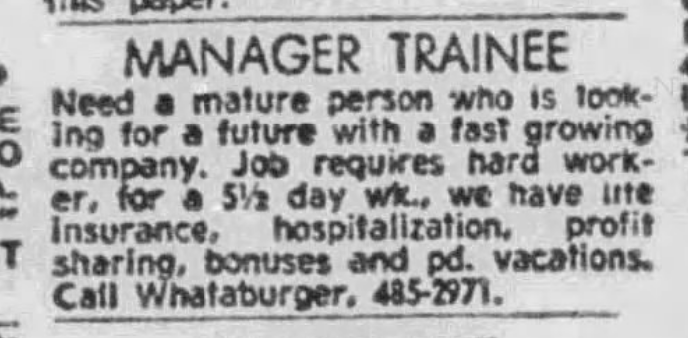
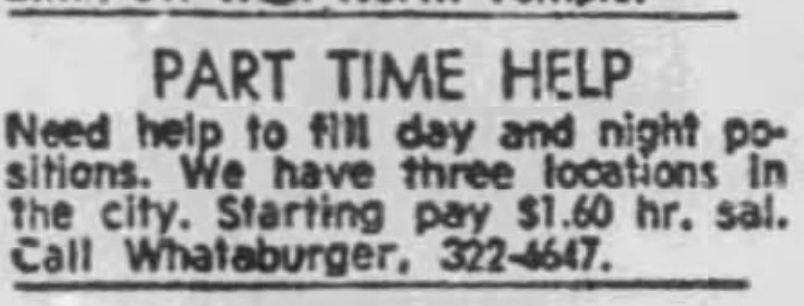
Last of all, and most important, this want ad appeared in the Salt Lake Tribune on The Salt Lake Tribune on Nov 29, 1973, Page 60:
And on Fri, Nov 30, 1973, Page 61, the following ad was seen:
Three locations! And, if you have a subscription to Newspapers.com, you can see dozens of similar solicitations between 1973 and 1974.
As a result, I feel 100% confident, based on my recollections of Salt Lake in the ’70s and the results of Gemini’s search, that there was indeed at least one Whataburger in Salt Lake at one point, and most likely three, and that I and many other people enjoyed their brief existence.
Sam Weller’s Zion Book Store, a ten-minute walk from my office and for decades a fixture on Salt Lake’s Main Street.
Weathering the TRAX construction with grace and fortitude, Weller’s ultimately made the decision to locate to smaller quarters in Salt Lake’s Trolley Square and shift a portion of their business online. The loss to downtown was incalculable, but the Salt Lake City government has only itself to blame for allowing the downtown area to die on the vine in favor of several downtown malls as well as encouraging a pattern of growth that supported large corporate buildings instead of smaller, affordable retail space.
Nothing pleased me more than rummaging through Sam’s massive used book section – there was always treasure to be found there. While Weller’s continues to serve the community, their likes will not be there again.
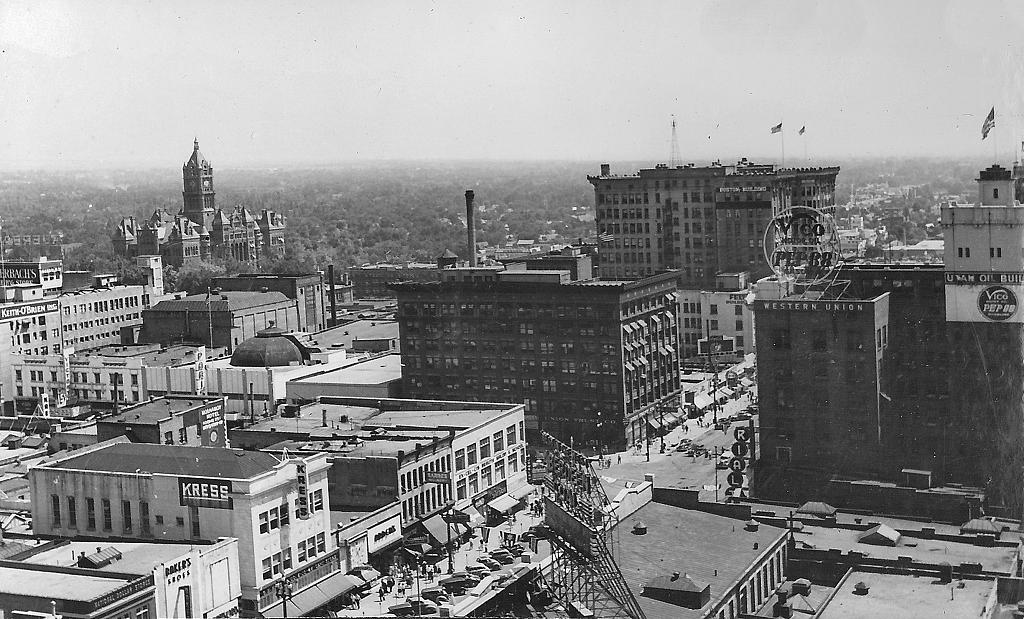
Taken from the Continental Bank building where my uncle, Courtney Rogers Draper, officed with his father, Delbert Morley Draper. Courtney was a promising attorney before being sent to the Philippines in 1939. He was interned by the Japanese and lost his life on the Enoura Maru in Takao Harbor on December 15, 1944.




 Playing in the World Game