Stuff

I’m a packrat. I freely admit it. However, lately I’ve come to start calling myself an “archivist” – it sounds much more respectable; and there can be value in preserving things for posterity.

A recent series of photographs by Huang Qingjun, however, makes me wistful for the simplicity that some people live with. Well, almost.

Said Huang:

“The idea for the series about people’s material goods, now called Jiadang (Family Stuff), came in 2003 with some photos he took for the magazine Chinese National Geography. But the project didn’t really get under way until three years later, when Huang started travelling around China looking for suitable places and people.

“Most people thought what I was proposing was not normal. When I explained I wanted to set up a photo, that it would involve taking everything out of their house and setting it up outside, that took quite a lot of explaining,” he says.

“But almost all of them, when they realised what I was trying to do, they understood the point.”

These captivating images raise the question: How much 家当 (jiadang) do we really need? So many of us are accumulating things far beyond our needs, in a mad rush to die with the most toys. While I could surround myself with gewgaws and gimcracks (especially in my kitchen) until I had no more place to live, I do understand that 99.9% of it would be useless if it ever came to living without electricity or in, say, 350 square feet of space.

Leonardo Da Vinci once said that simplicity was the ultimate in sophistication. Less stuff means less work taking care of it, dusting it, and moving it; less money spent on acquiring it; and more time to pursue the only thing we can really take with us – relationships.

Am I going to “sell all that I have, and give to the poor” tomorrow? No, not bloody likely – I’m an addict and I know it. But I will be more careful in future, and will bend my will toward offloading as much of it as I can possibly bear to part with.

My thanks to Huang xiansheng for a wonderful glimpse into an unburdened life.

Read more and see more images at the BBC.

The Old Wolf has spoken.
Sexism, 1959-style

Not too much to say about this classic video, other than it’s a small first step in overcoming deeply-entrenched male attitudes toward women in the workplace. While it seems laughable to watch today, it was produced in deadly earnest. I’d like to think we’ve come a long way since then; yet while progress has definitely been made, there’s still a lot of good-ol’-boy stuff going on in the 21st century. Perhaps it’s time for someone like Steven Spielberg to produce an updated version.

The Old Wolf has spoken.

Baby’s First Baby: Not what you think

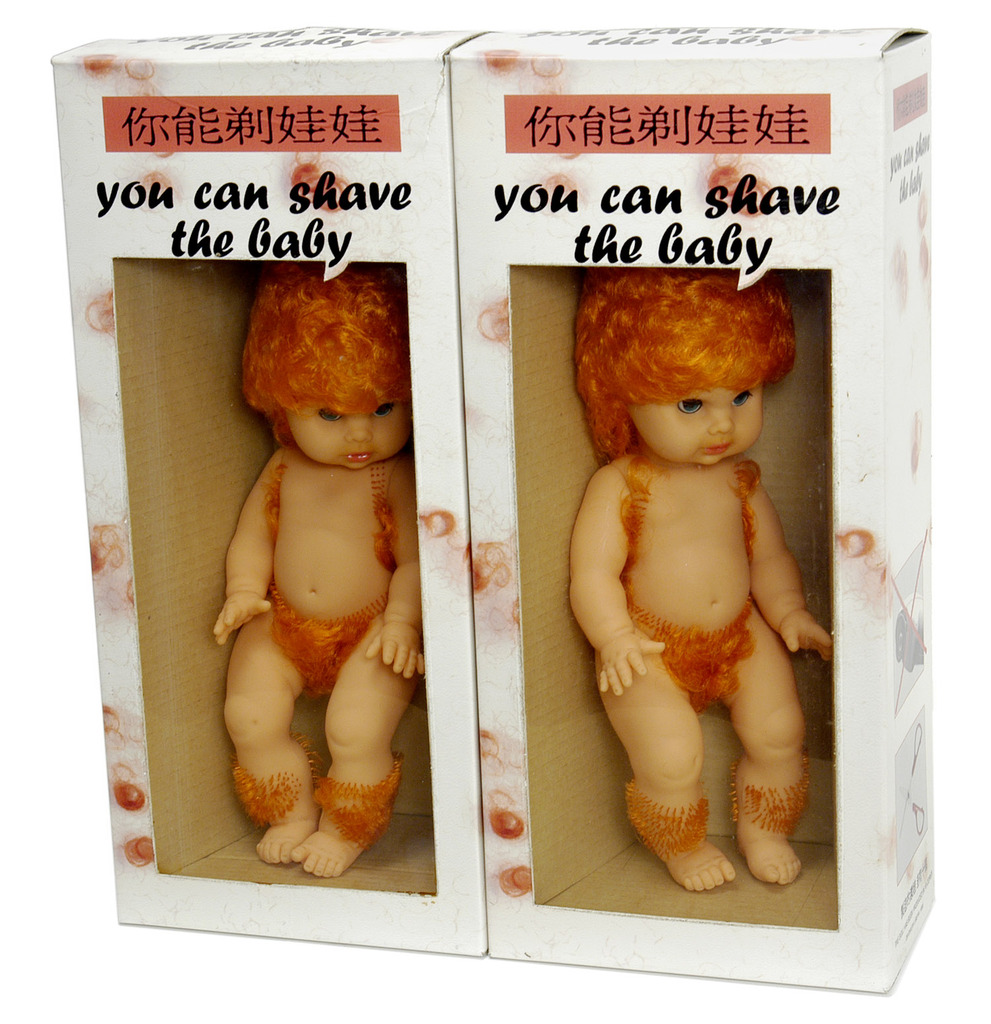
Some time ago I came across this monstrosity of a toy – obviously from China, and rating about 9.85 on the “what the hqiz?” scale:

This is real. It’s not  a Photoshop. And I wonder what kind of mushrooms they’re selling at the Chinese markets these days.

Today I stumbled across a similar offering and immediately despaired of humanity.

The good news is, this isn’t real – but rather a work of art with a message, by artist Darren Cullen.

Cullen says over at his blog,

“It seems like the majority of commentators have misunderstood my intentions however and decided I’m making a comment on reality tv shows exploiting teen pregnancies. I’m not. It’s about the way these toys intrinsically train girls to have and care for children while they are still only children themselves. If you look in any toy catalogue the girls section is wall-to-wall babies and prams, make-up kits, kitchen sets and hoovers. We complain that children are growing up too quick, getting pregnant too early, when the only toys we give them teach kids to act like adults and prepare to have babies. It’s goes without saying that teaching young girls that these are the type of things which adult women should and do concern themselves with is also a very narrow definition of womanhood.”

This is a message I can get behind.

The Old Wolf has spoken.

Beauty from determination

Courage and determination can change everything.

A young woman in her thirties had been a dancer from a young age. She lost her entire left arm in an accident and fell into a state of depression for a few years.

Someone asked her to lead a dance group for children. That’s when she realized she could not forget dancing. She still loved to dance and wanted to dance again. So she started to do some of her old routines, but having lost her arm, she had also lost her balance. It took a long time before she could even perform simple turns without falling.

It was then that she heard of a young man in his twenties who had lost a leg in an accident. He also was on an emotional roller coaster of denial, depression and anger, but she was determined to find him and persuade him to dance with her. He had never danced in his life, let alone with one leg.

He categorically refused but she did not give up and eventually he accepted against his better judgment, saying that he had no other purpose in life.

She started to teach him dancing.

After several interruptions (never having danced, he did not know how to use his muscles, and discouragement and anger prevailed), they are finally back together and began to receive serious training .

They hired a choreographer to design routines suitable for them and this is the result.

What’s your excuse for not getting what you want out of life?

The Old Wolf has spoken.

Migrants, 1936

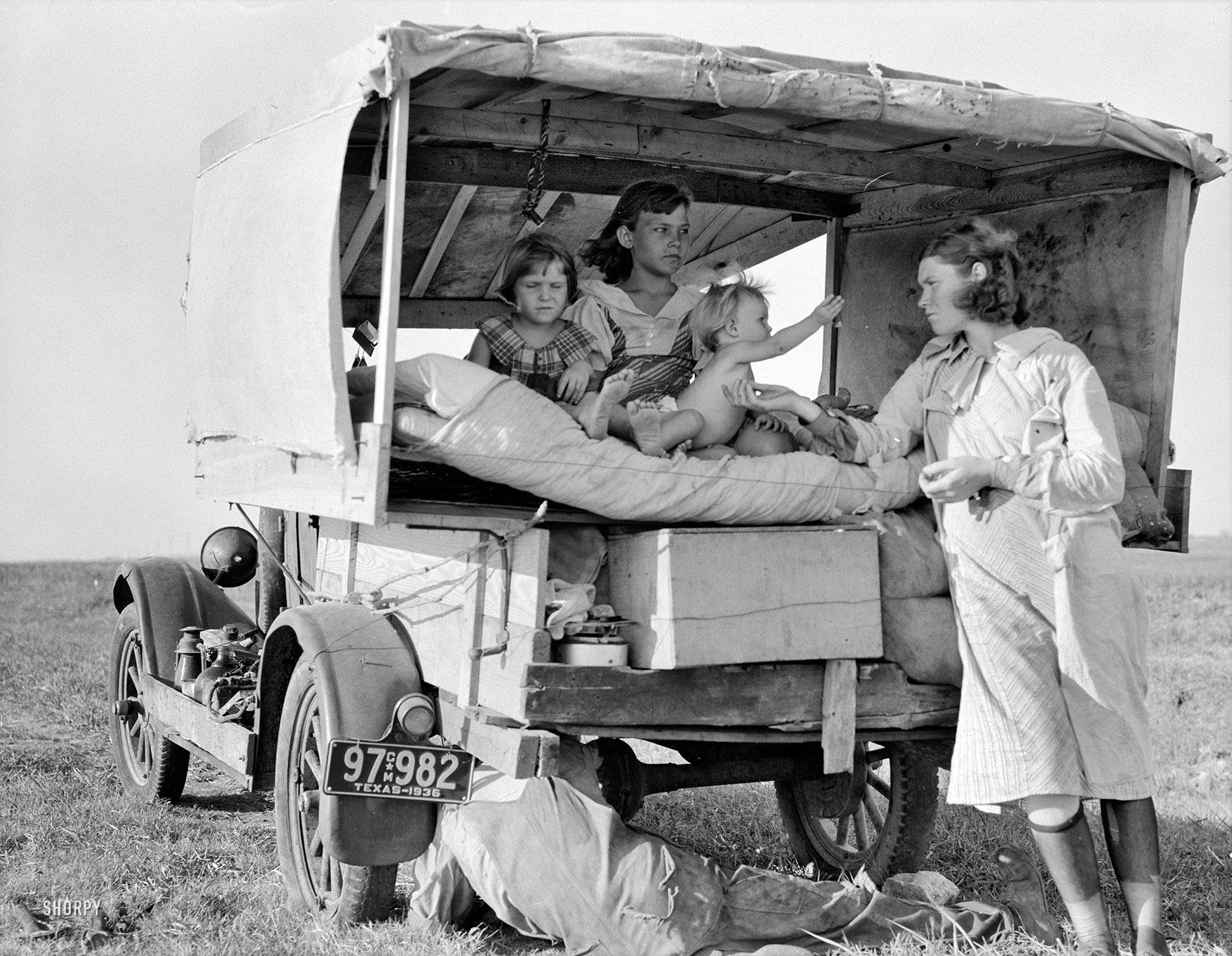
August 1936. “Family between Dallas and Austin. The people have left their home and connections in South Texas, and hope to reach the Arkansas Delta for work in the cotton fields. Penniless people. No food and three gallons of gas in the tank. The father is trying to repair a tire. Three children. Father says, ‘It’s tough but life’s tough anyway you take it.'” Medium-format nitrate negative by Dorothea Lange for the Resettlement Administration.

Found at Shorpy

Shelley Berman: Tenjewberrymud

Despite the fact that it has been widely copied and published on the net as an actual conversation from a hotel in Asia, and purportedly published in the Far East Economic Review, the dialogue below never actually took place in any hotel anywhere in the world. It is an intentionally composed humorous fiction and is entirely the creation of Shelley Berman, written as a chapter in his book, published as A HOTEL IS A PLACE, A HOTEL IS A FUNNY PLACE, and A HOTEL IS A VERY FUNNY PLACE, by Price/Stern/Sloan Publishers, Inc. Copyright © 1972, 1985. Any claim to the contrary is utterly baseless and erroneous. I post it here not only because it’s very funny, but because the true attribution (and the correct version) deserves more widespread exposure.


(Reading hints: You are on the phone. The other party is also in the hotel.)

Morny, rune sore-bees.

Oh sorry, I thought I dialed room service.

Rye. Rune sore-bees. Morny. Jewish to odor sunteen?

Yes, order something. This is room thirteen-oh-five. I want…

Okay, torino-fie. Yes plea?

I’d like some bacon and eggs.

Ow July then?

What?

Aches. Ow July then? Pry, boy, pooch…?

Oh, the eggs! How do I like them? Sorry. Scrambled, please.

Ow July thee baycome? Crease?

Crisp will be fine.

Okay. An Santos?

What?

Santos. July Santos?

Uh…I don’t know…I don’t think so.

No? Judo one toes?

Look. I really feel bad about this, but I just don’t know what judo-one-toes means. I’m sorry…

Toes! Toes! Why Jew Don Juan toes? Ow bow eenlish mopping we bother?

English muffin! I’ve got it! You were saying toast! Fine. An English muffin will be fine.

We bother?

No. Just put the bother on the side.

Wad?

I’m sorry. I meant butter. Butter on the side.

Copy?

I feel terrible about this but…

Copy. Copy, tea, mill…

Coffee!! Yes, coffee please. And that’s all.

One Minnie. Ass rune torino-fie, strangle-aches, crease baycome, tossy eenlish mopping we bother honey sigh, and copy. Rye?

Whatever you say.

Okay. Tenjewberrymud.

You’re welcome.