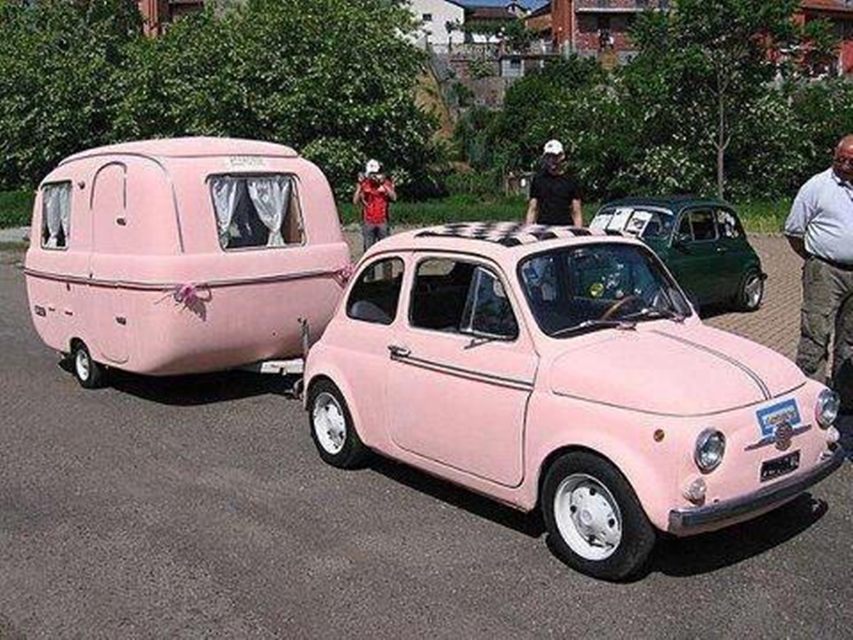
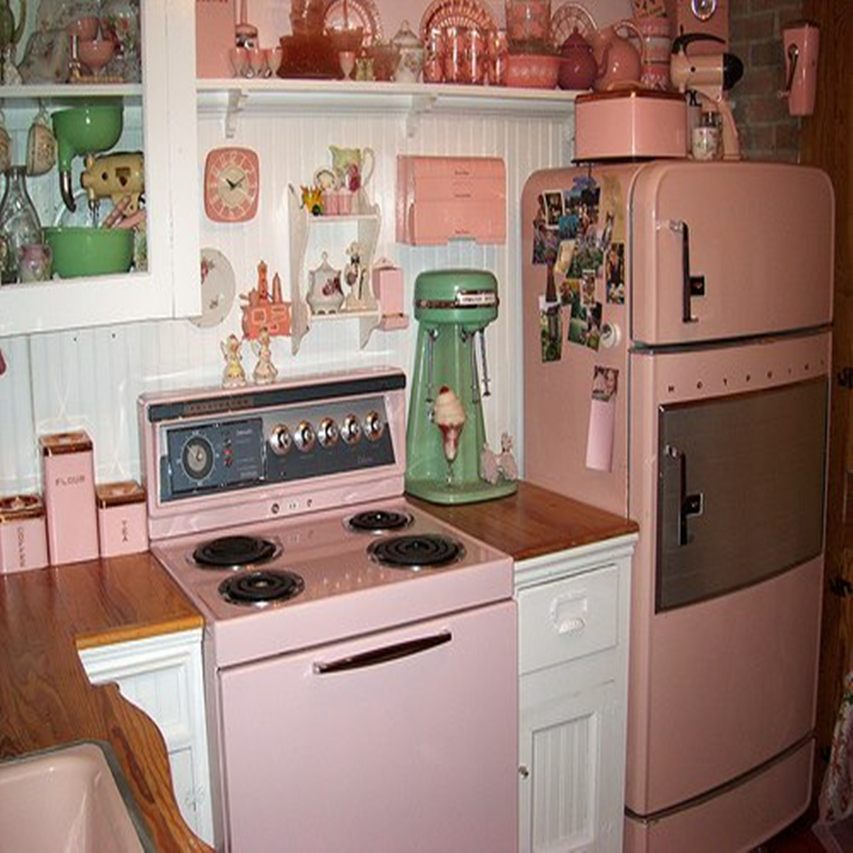
My wife, not so much; pink is anathema to her. But back in the day, things like this were (tragically) not so uncommon.
Pink mini-car and mini-trailer
Pink Kitchen
Pink Kitchen, version 2.
We bought a home in 1992 that had been built in the early 50’s and updated slightly in the 70’s. The two upstairs bathrooms were, respectively, avocado green and fluorescent orange. What about that decade that brought out the Colors of Cthulhu I’ll never know, but I’m glad the madness passed.
Prior to and during the Winter Olympics of 1976, I lived in the old Olympic Village which had been constructed for the 1964 games, and which were later converted into apartments.
1964 Olympic Village, Innsbruck
Outside the window of my apartment, one could see the final preparations being placed on the new Olympic Village; some athletes had already begun to move in.
New Olympic Village in final stages of preparation
Flag of the USSR being displayed from a window
While my circumstances did not allow for visiting any of the events, we were able to visit a number of venues prior to the games, and it was possible to see the ski jumping event and the Olympic flames in the stadium from the train station.
The excitement in the city during the games was palpable. I felt this decades later as I volunteered during the winter Olympics of 2002 in Salt Lake City; these games are the event of a lifetime, and Innsbruck was fortunate to be able to host the games twice within 12 years.
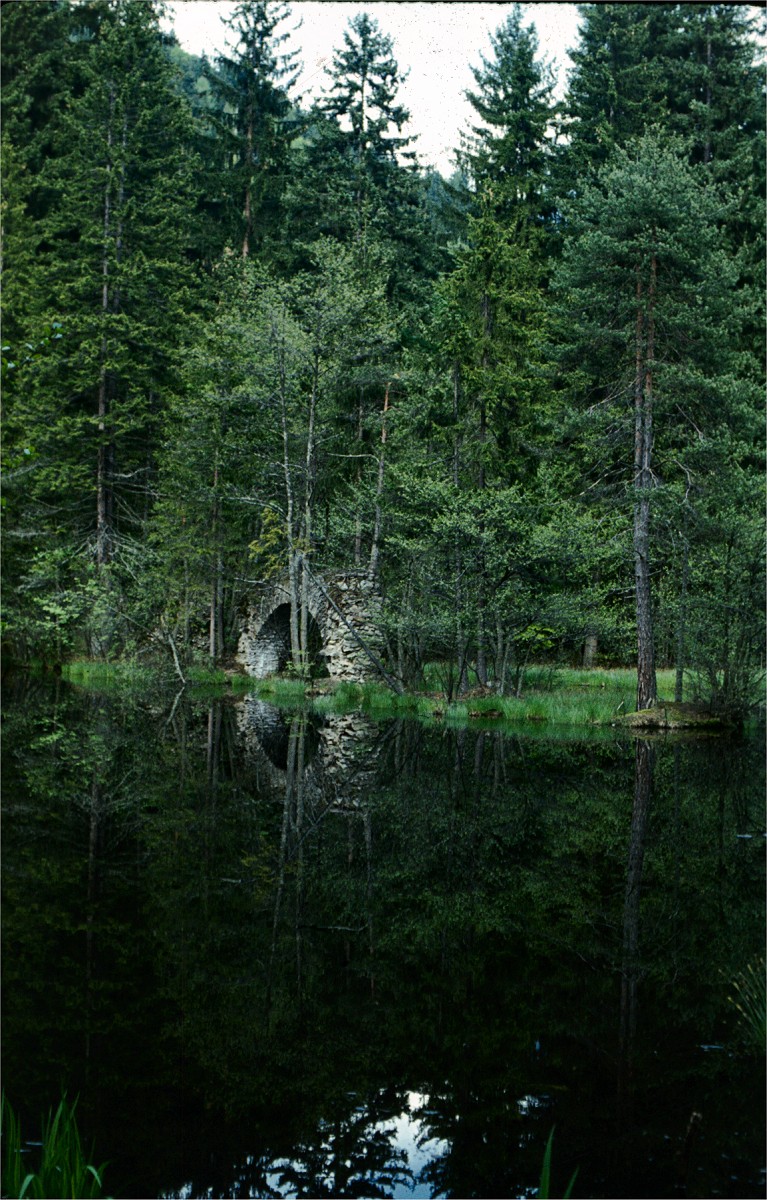
Taken in Austria somewhere – cushlamochree if I can remember where, but sometime between 2/75 and 12/76. Sharing for no good reason other than I like the picture.
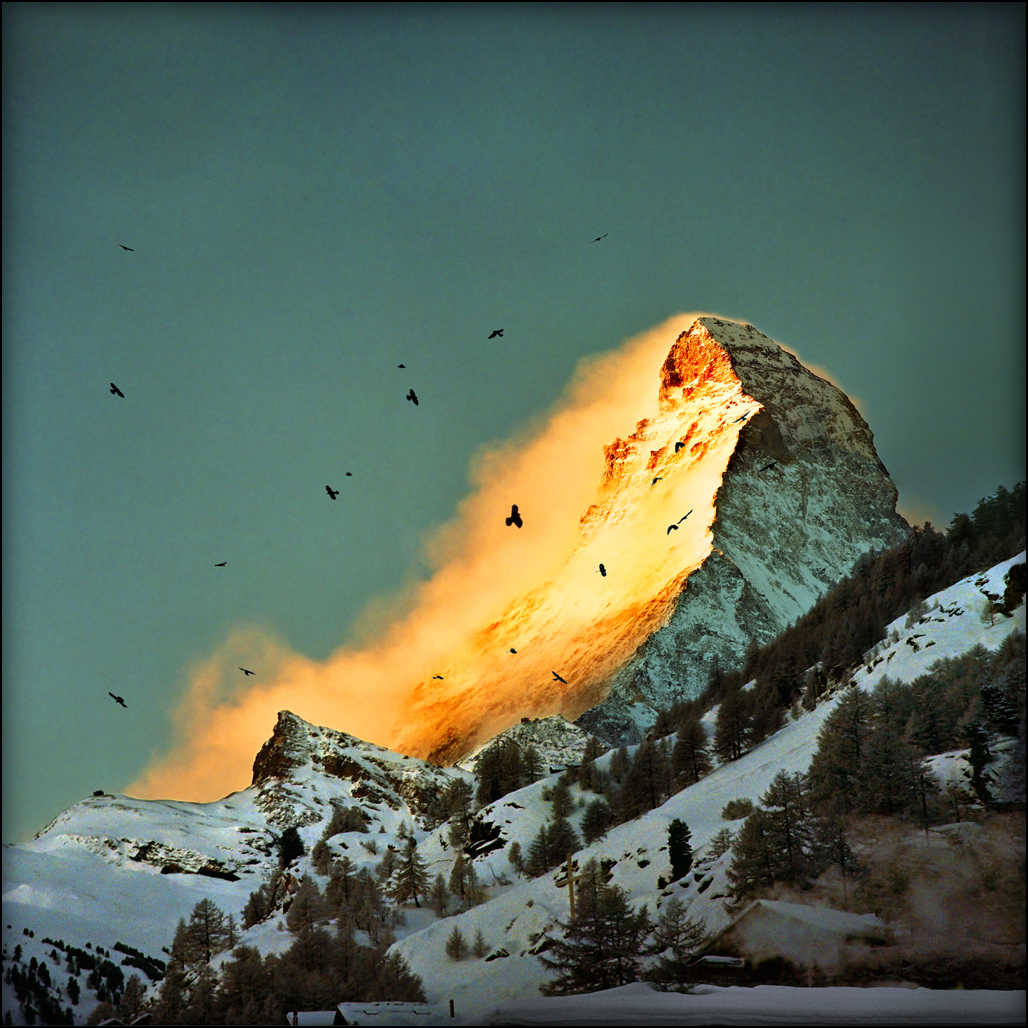
Astonishing photo by Katarina Stefanovic. See this and 39 other amazing shots at BigPicture.
My picture is nowhere near as stunning… but it’s mine. I love Switzerland with a passion… I wish I were rich enough to afford a retirement home auf der Alm…
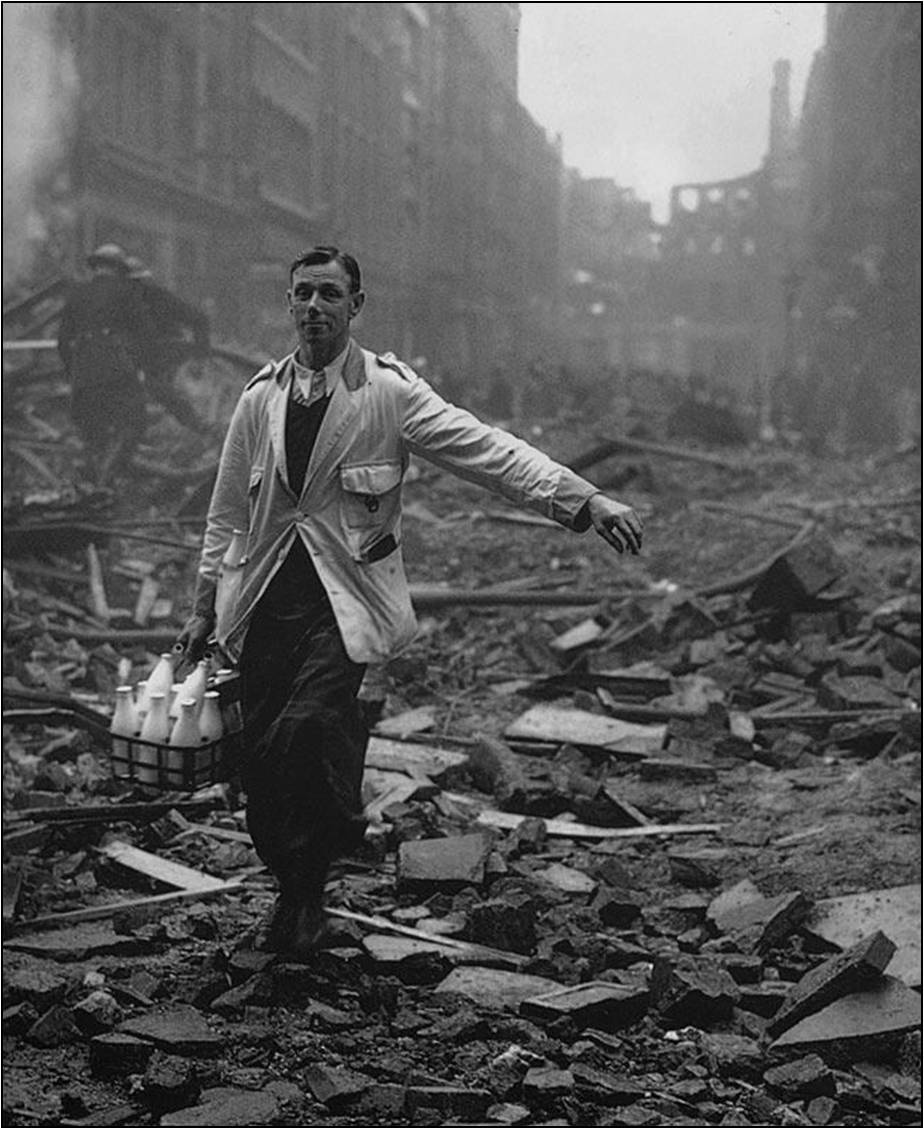
What looks like an object lesson in keeping the upper lip stiff turns out to be a bit of propaganda designed to give courage to Londoners living in unimaginable conditions… but carries a powerful message just the same. The photograph from 1940 was staged; the milkman is the photographer’s assistant and posed for this photo in order to boost the morale of the brave citizens of London. However, the blitz was real, and I have no doubt that the photo represents countless acts of just such courage and endurance which were not captured on film.
The 267-day Blitz left 30,000 Londoners dead and another 50,000 wounded… without dampening British resolve or significantly damaging its ability to wage war. Without meaning disrespect to anyone or minimizing their loss, these numbers make the attacks on 9/11 look small by comparison. The high-profile nature of the target, however, and the fact that modern-day Americans have never experienced destruction of this nature on their home soil, increased the psychological impact of the event. In both cases, the forces of evil failed in their purpose, and only left their intended victims stronger in the end.
I found a reference to this interview elsewhere, but the original link was dead. Fortunately I found the full interview at another site, and choose to reproduce it here for preservation. It is a piercing look at an honest and complex man. I have added the images to the original text.
Since coming to the paper three years ago this week, the Star’s theatre critic Richard Ouzounian has attracted considerable attention to his series of celebrity interviews. McArthur and Company has just published 56 of them under the title “Are You Trying To Seduce Me, Miss Turner?” named after his encounter with the star of the stage version of The Graduate. The excerpt that follows is one of his favourites.
This is one that I owed Richard Harris.
When we met at the Toronto Film Festival in September 2001, I felt as if I had spent a privileged patch of time with a unique man.
As you’ll read below, he opened his heart and soul to me about a great many things.
Unfortunately, most of it never got into the paper. When I returned from our time together, my editors told me to “play up the Harry Potter angle and forget about the rest,” just as Harris had suspected they would.
The next day, when the truncated interview appeared, Harris was rightly furious and vented about it to one of my colleagues.
“I trusted that bastard, and told him a lot of important things, but what does he print? Nothing but goddamn Harry Potter.”
That day, by the way, was Sept.11, and everything soon acquired a different perspective.
I never saw Harris again, and I thought of trying to write to him, but time slipped through my fingers.
Harris died on Oct.25, 2002, of Hodgkin’s Disease. And when, shortly after his passing, I found out that this book was to be published, I made myself a promise. I vowed to dig out my notes from that afternoon we spent together and print the interview that Richard Harris had entrusted me to deliver.
Here it is.
“Don’t ask me about that damned stupid Harry Potter movie. That’s not why I’m here.”
Richard Harris, as always, isn’t afraid to speak his mind, even to the point of denigrating his work as Aldus Dumbledore in the upcoming Harry Potter And The Philosopher’s Stone.
He’s at the Toronto International Film Festival to help drum up support for something that he does believe in: My Kingdom, the film by Don Boyd that sets Shakespeare’s King Lear in contemporary Liverpool.
Harris, who turns 71 on Oct.1, plays a British crime lord named Sandeman whose wife’s murder causes him to divide his “kingdom” among his three daughters.
“I like this movie because it’s not afraid to embrace the darkness. Most films run around lighting tiny candles and think they make a damn bit of difference. Don Boyd has a pretty good idea of how black the universe can be and so do I.”
His rheumy eyes search me out. “I know what it’s like to scrape the bottom of the barrel of despair and stir the shavings into your Guinness. That’s a cup we’ve drained to the dregs many times, both me and Lear.”
The parallels with Shakespeare’s tragedy are skilfully worked out by director Boyd, and Harris does some of his richest work, made even more effective because it’s so understated. “At first they wanted me to rant and rave, but I told them no. People will see it and say, `Look, it’s Richard Harris going over the top again,’ and I won’t do it.”
He sees me smiling and pokes my arm roughly. “All right now, tell the truth, what was the worst bit of overacting you ever saw me do … out with it!”
I volunteer that it was probably in 1977’s Orca and Harris laughs until he’s stopped by a fit of coughing, something that happens several times during our 90 minutes together.
“Oh, that fecking killer whale! What a piece of shite that was. No wonder I was hitting the blow so heavy in those days.” His gaze is suddenly level. “You know cocaine nearly killed me?” I nod feebly in agreement, having heard the gossipy reports over the years. “My heart stopped, and they had to bring me back to life again — 1978, I think that was.”
He sips at his coffee. “I’d like to say I changed my life overnight, but that wouldn’t be the case. I tried though, and I got better … even if my acting didn’t.”
I ask him why he seems so eager to put himself down.
“Because I had a gift of gold once, and I threw it all away for a handful of silver. I took the talent God gave me and pissed it into a river called Hollywood.”
He was one of nine children born to an Irish farmer named Ivan Harris in Limerick on Oct.1, 1930. “All nine of us were looking for a way out, and I thought mine was going to be a rugger, but the TB ended all that.
“So I decided to become an actor instead. Why? I had the gift of the gab and I could charm the knickers off any girl that drew breath. I was a handsome bugger then. No, not handsome, beautiful.”
Harris sees me staring askance at his vainglorious boast and chafes. “Well, I was beautiful, dammit, and I’m such an ugly old beast now that I can take some pride in the joys of my youth.”
He made a huge stage success in Brendan Behan’s The Quare Fellow, and a spate of British films followed, culminating in his performance as Frank Machin in Lindsay Anderson’s 1964 This Sporting Life.
“They cast me as a rugger player who was a bastard. That didn’t take much acting from me. No wonder it made me a star.” And brought him his first Oscar nomination for Best Actor.
After a detour to Italy to star in Michelangelo Antonioni’s Red Desert, Harris went to Hollywood, making a decorative hole on the screen in films like Hawaii and Caprice.
Then, in 1967, came Camelot.
“Don’t ask me why I still love that bloody story so much. But I can’t look at the movie anymore. I was too gorgeous then. It makes me weep to see what a rag-and-bone man I’ve turned into.”
A young waiter retrieves Harris’s coffee cup, giving his disreputable looks a wide berth. “Can I smoke here?” Harris shouts after him. Getting no answer, he shrugs and lights up a cigarette. “I’ll just do it till they order me to stop, which is what I’ve done all my life.”
Camelot made him a superstar, and then he hopped to the top of the recording charts as well, with his unexpected rendition of Jimmy Webb’s “Macarthur Park.” I tell Harris how much I used to enjoy hearing him sing it.
“Sentimental bollocks,” is his initial reply, but then he softens. “I still remember some of it, especially when I’m in my cups.” And then, magically, he rasps out a few lines:
“I will drink the wine while it is warm
And never let you catch me looking at the sun …”
We look at each other for a moment, and then he breaks the spell. “That’s not bad, but don’t ask me why they left that fecking cake out in the rain …”
And again he laughs, until a bout of coughing stops him. “I’m not well, not at all well, but after all I’ve done to my body in my lifetime, that shouldn’t surprise me.”
Harris had one last film hurrah with the surprise success of A Man Called Horse in 1970, but for the rest of the decade, the work got worse and worse, while the antics got wilder and wilder.
In the 1980s, the excesses of his early days gave way to relative sobriety, while years of touring as King Arthur in the stage version of Camelot rebuilt his finances, and allowed him the luxury of choice.
“When you’re poor and raising a family, you take what comes along. Now I can commit to the work I do. I cannot put it on at eight in the morning and take it off at six in the evening. When the picture is rolling I give it my all, and then when it’s over, I disappear. I tell the rest of the cast, ‘You’ll never hear from me again.'” ¹
Quality films like 1990’s The Field, which earned him his second Oscar nomination, were the result of his new work habits, as are pictures like My Kingdom, which he’s eager to start discussing again after our journey through his past.
The Field
My Kingdom
“I like the way they’ve worked out my motivation. You see, the beginning is the tricky part. You always wonder why Lear gives his kingdom away, but now that they’ve added the murder of my wife, I have a reason.”
He smiles wickedly. “It reminds me of the day years ago when John Major put his leadership of (Britain’s) Tory party up for grabs. I ran into Brian Mulroney in an elevator at the Savoy Hotel, and asked him what he thought of Major’s move. Mulroney shook his head and said to me, ‘I don’t understand it. You never give up power.’ “
Another thing Harris likes is the fact that this Lear has no Fool, but spends his time instead with his grandson, and Harris is well known for his devotion to his grandchildren.
In fact, were it not for one of them, he would not have agreed to take part in the Harry Potter films.
“Look, I had never even read the books,” admits Harris. “All I knew was that they kept offering me the job and raising the salary every time they called me. And I turned them down for a very good reason.”
“You see, anyone who signs up for the Potter films has to agree to be in the sequels, all of them! I didn’t know if that’s how I wanted to spend the last years of my life, and so I said no.”
He chuckles as he recalls the flurry surrounding his reluctance. “Newspapers, radio, television all had a go at me. The world wanted into this film and this cantankerous f—er called Richard Harris said no.
“But then my granddaughter Ella, who is 11 and whom I worship with my life, came to me one day and said, `Papa, I hear you’re not going to be in the Harry Potter movie.’ I told her that was indeed the case, and then she looked me right in the eye and said, `If you don’t play Dumbledore, then I will never speak with you again.'”
Harris holds out his hands to show how helpless he felt. “What could I do? I didn’t dare have that hanging over my head, and so I said yes.
“It actually turned out to be a pleasant experience. I worked two days one week, then two weeks off, then a few more days’ work. Maybe three weeks in all spread out over months. Very nice at my age — that’s the way to do it.”
He’s also fond of his leading man, 12-year-old Daniel Radcliffe, who plays Potter. “Well, a bit before shooting started, (director) Chris Columbus asked if I’d mind spending some time with the kids so they’d get used to me, and I said `Sure.’ So we all got together one evening, and I sat there showing them card tricks while they sat around discussing show business.
“Finally, Chris got us to read some of our scenes together, and when I finished, young Daniel said to me, `That was quite a good reading. I think you’ll be good in the part.’ Lord, to have that much confidence at his age. I don’t have that much confidence now.”
Although he hadn’t read the books before accepting the role, Harris has come to have great respect for author J.K. Rowling. “I’d like to crawl inside her mind and her bank account. Her command of language is extraordinary. My name, Albus Dumbledore, means `a white Dorset bumblebee,’ and that’s certainly what I look like nowadays.”
Harris, suddenly tired, looked at me. “There, I gave you the stuff about Harry Potter. That’s what the papers want. But try to use the rest of what I said as well.
“Because, you see, I don’t just want to be remembered for being in those bloody films, and I’m afraid that’s what going to happen to me.”
As he stood up, we shook hands, and he held mine for a long time. “To tell you the truth, lad, I’ve done damn little that I’d like to be remembered for — except my sons.”
My Kingdom has never been released in North America, except for a one-week “memorial” showing in Los Angeles in December 2002, after his death.
It deserves a wider audience for many reasons, but most of all, to see this great actor looking unafraid at the shadow of mortality as it moved inexorably toward him.
So let us not remember this man only for Rowling’s Dumbledore, but for a long and stellar career. What he left us to marvel at could hardly be called “pissing away his gift,” but then artists are always their own worst critics.
The Gladiator
The Old Wolf has spoken.
Footnotes
¹ What an experience that must have been for his fellow actors. Had I been that fortunate, I would have said (as did Henry James said in “The Real Thing”), “I’m content to have paid the price–for the memory.”
Joe was my father. During the communist witch hunt, he and many of his colleagues were unjustly tainted by allegations of disloyalty and sedition. This letter was the end of the official episode for my father, but the event had a decided dampening effect on the remainder of his career, as extensive as it was. I often wonder how much more success he could have seen, had there not been this miasma hanging over him.
May we never allow this kind of insult against the American people to be repeated. Big Brother must be fought at every turn.
This King James Version Bible is an unspeakably rare collector’s item. The printers were fined 300 pounds sterling for their terrible typographical error in printing the Ten Commandments, omitting the all-important word “not” and rendering the verse as, “Thou shalt commit adultery”! The lot of 1,000 copies were ordered destroyed, but only a handful escaped destruction, making them the rarest of rare. This is the only one for sale in the world. Offered at $89,500 at the Platinum Room.
For those of you who wish to justify yourselves via an appeal to the Scriptures, this is the volume for you.






 Playing in the World Game