Tell a lie often enough…

… and you’ll sell more tobacco products. (A couple of earlier posts about tobacco products are here and here.)
bemerkenswerte-bucher-1

bemerkenswerte-bucher-2

bemerkenswerte-bucher-3

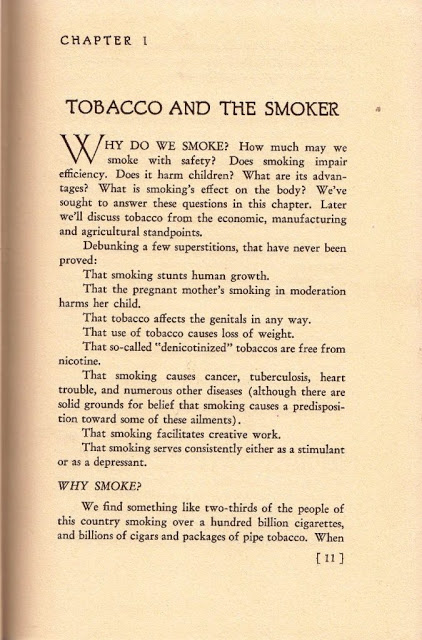
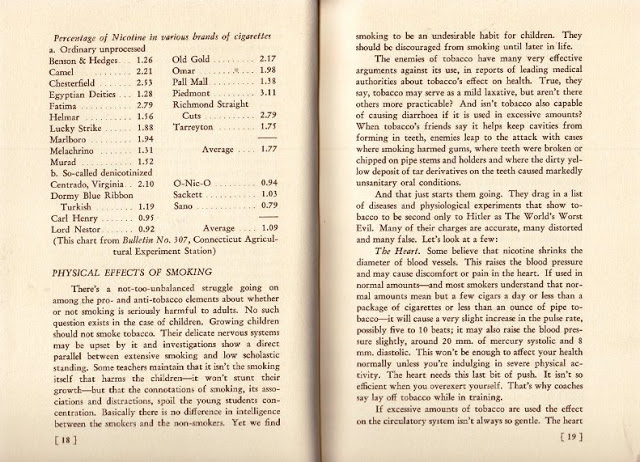
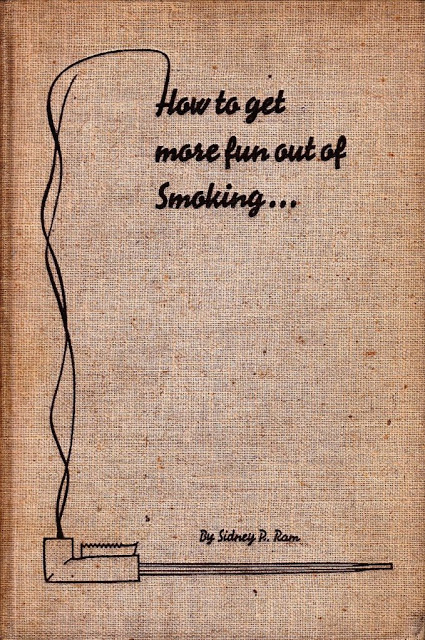
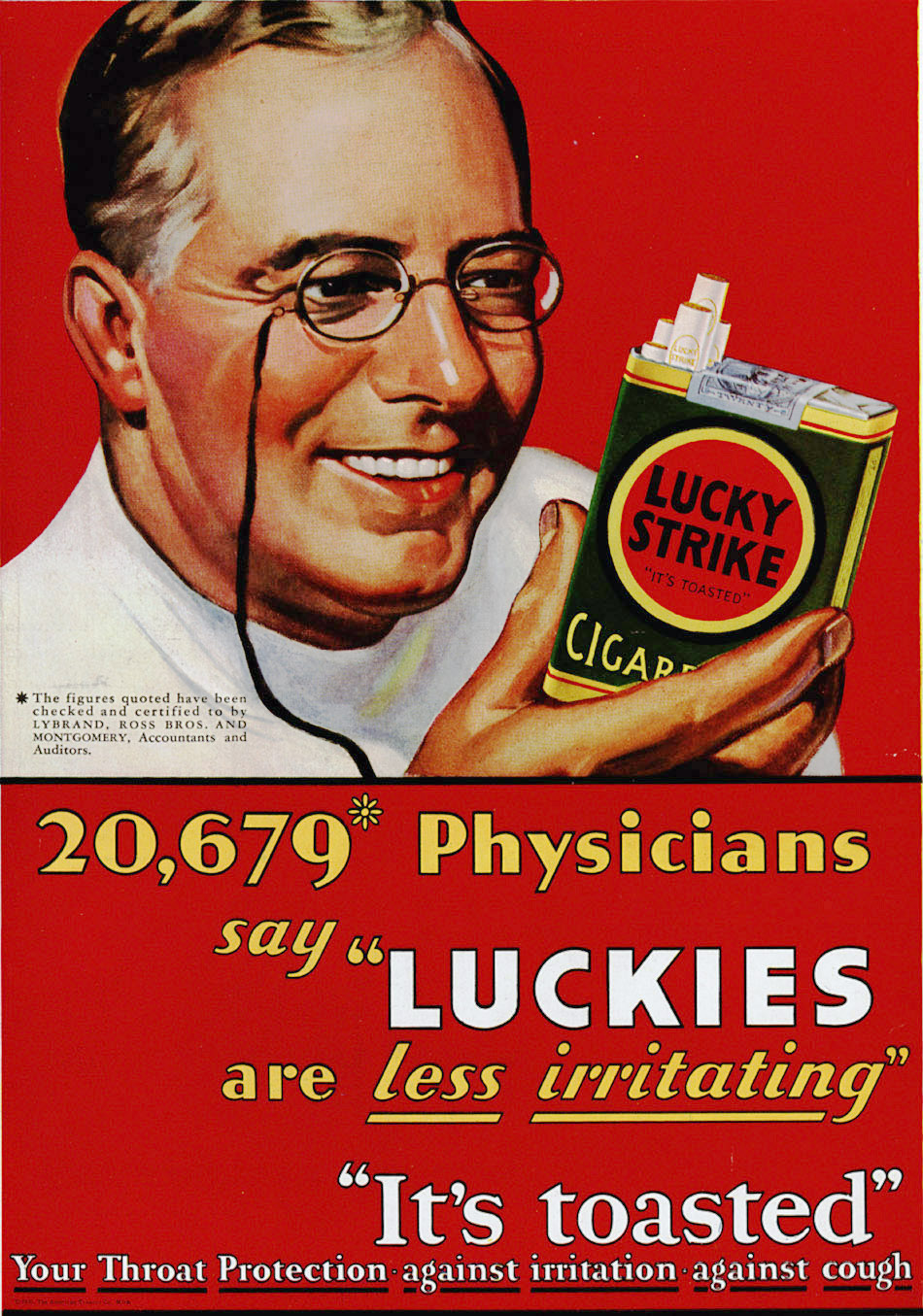
Sydney P. Ram was a Chicago pipe-maker who had a shop on the loop (he retired in 1942).  Apparently his pipes are still sought after by afficionadoes. This book was published in 1941, when advertisements of this nature were still common:

ripleysL

20679physiciansL

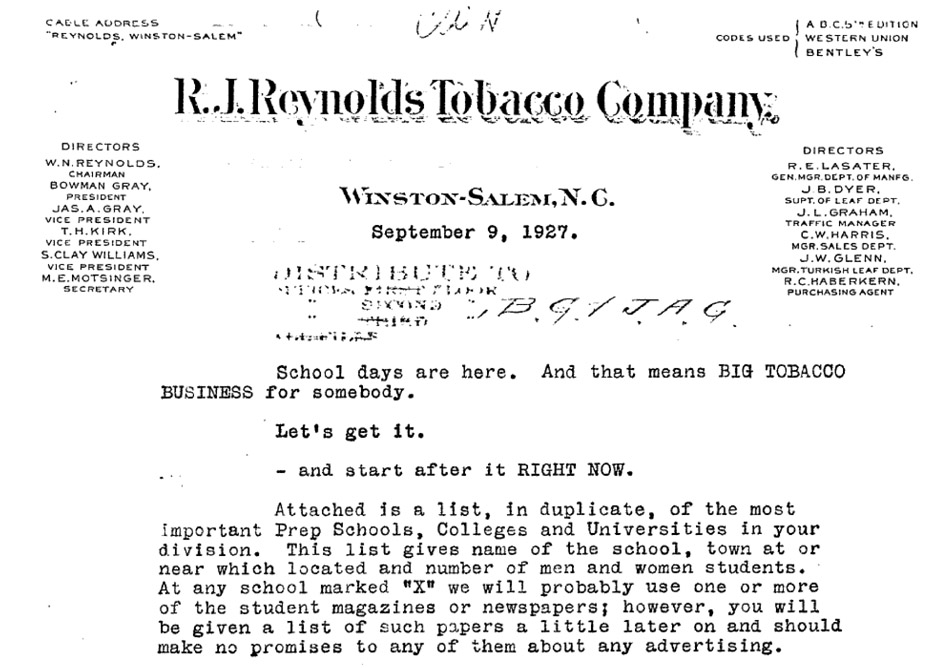
And memos like the following were (while not publicly disseminated) urging marketeers to go after the young:
rjreynoldsL

In 1952, Reader’s Digest condensed an article from the Christian Herald entitled “Cancer by the Carton.” Prior to this, very little was being publicly said about the dangers of smoking, and as we can see from Ram’s book, it was easy to muddle the issue simply by denying the “superstitions.” Anti-smoking PSA’s became one of Readers Digest’s favorite soapboxes, along with anti-Communism.

The situation was well described over at Lisa’s Nostalgia Cafe:

The worlds of advertising and cigarette smoking have been intertwined for as long as we can remember. In the first half of the 20th century, tobacco companies were major contributors to the advertising industry, and many radio and TV programs were sponsored by these companies.

As the 1960s dawned, things were beginning to change. During the 1950s, people became aware of the health hazards of cigarette smoking and began to file court cases against the tobacco companies. Private medical journals published studies linking smoking to lung cancer, and magazines like the Readers Digest ran anti-smoking articles.

The turning point came in 1964 when the Surgeon General released their first report linking smoking to lung cancer, heart disease, chronic bronchitis and emphysema. These results got everyone’s attention. The government, which had been at the mercy of the tobacco lobby, began to get involved and slowly some changes were made.

I was roped into smoking in high school in 1964. After I gave up tobacco five years later, for a while I became a dedicated crusader and I recall getting quite an assortmant of pamphlets, article reprints, buttons,

smokingsnuffyouout   smokingstinks

and other tools for use in my campaign.

Progress has been slow, but continues to be made in our country. The education campaign continues:

The faces of the onlookers are priceless.

Unfortunately and to our shame, tobacco manufacturers have shifted their focus from the US to overseas. As consumers here became more aware of the dangers of smoking, Big Tobacco looked for victims (I use that term deliberately)  in other parts of the globe. In 2019, the global market was worth $614 billion; even Everett Dirksen would be impressed by a number like that.[1]

According to the American Lung Association,

Cigarette smoking is the number one cause of preventable disease and death worldwide. Smoking-related diseases claim over 393,000 American lives each year. Smoking cost the United States over $193 billion in 2004, including $97 billion in lost productivity and $96 billion in direct health care expenditures, or an average of $4,260 per adult smoker.[2]

We can’t give up the fight. It will be slow. Tobacco is a legal product, and many people in the USA still put bread on their family’s table as a result of the industry. Acceptable alternative crops for farmers need to be found, and those who work in the packaging and shipping aspects will need to be moved into other economic sectors. If headway can be made in the legalization of industrial hemp[3], this could prove a godsend for farmers looking for a way out of the tobacco market.

Given the costs to society and individuals incurred as the direct result of tobacco use, the fight is a worthwhile one.

anti_smoking_ad_children

The Old Wolf has smoken (and is glad that he was able to quit when he did!)


[1] Senat0r Everett Dirksen was once reputed to have said, “A billion here, a billion there, pretty soon it adds up to real money.” He may never have said it, but it continues to circulate; after all, nothing on the Internet ever really dies.

[2] “Smoking-Attributable Mortality, Years of Potential Life Lost, and Productivity Losses — United States, 2000–2004”, CDC. Click through for the article.

[3] U.S. Department of Agriculture’s ‘White Paper’ on Hemp
Nutella is dead.

What follows is a translation of a post at antigone XXI, “the blog of frugal abundance”. I share it because I love Nutella, and because these home-made substitutes, organic and raw, look absolutely divine.

————-

Love Nutella?

Great. Enjoy it. I don’t.

Well, yeah. I used to love it. Before, when I discovered it, I loved it, I even adored it. To the extent that I’d eat it strait from the jar, without a teaspoon, just with my fingers, like that. I know, it’s not terribly sanitary. But it’s not all that bad… because after all, I don’t share my Nutella. A jar is for me. Just me. And it got empty really, really fast. Terribly addicting, isn’t it?

Terribly addicting indeed… but not surprising, because because the truth is that Nutella contains monosodium glutamate , aka E621 [1] deeply hidden in the famous word ‘flavorings’. [2] You know, glutamate, the flavor enhancer that stimulates appetite and maliciously destroys neurons … To this is added –  wait for it – a small dose of … plastic ! And yes, our famous spread contains DEHP , one of the most dangerous phthalates, which are usually used to produce packaging and has the nasty tendency to migrate into the product. Be aware that this unwelcome guest is banned in toys and cosmetics because it is considered a carcinogen and induces, uh … testicular atrophy. Nice, huh?

Fine, fine, I’m not telling you anything new when I mention that Nutella is 70% palm oil and refined sugar, remember that skim milk powder and whey? Ferrero refuses to say whether or not they come from animals fed with GMOs.

Oh, but wait, there’s hazelnuts and cocoa at any rate! Oh yeah, well, 20% of the finished product … not bad for a spread that should be composed of 2/3…

Fine, end of discussion. As for me, I say  Nutella is dying.

Make way for the Chocoville Triplets!

 SONY DSC

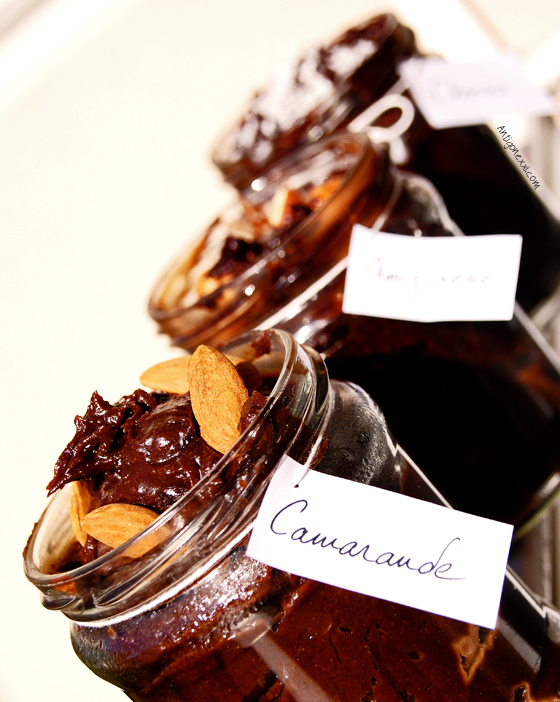
See, when I do things, I don’t do them halfway or only 1/3 of the way. When I say that Nutella is dead, there are already three little girls waiting to take its place in your pantry. First, there’s the eldest: she’s more royal than the King, and an absolute purist. I call her  Choconette. She always quarrels with the middle child, the original of the company, who wants to revolutionize the world a little and answers to the gentle name of Camarande. Lastly, there’s youngest: very shy, a little dreamy, named … well, she’ll tell you her name later, when she feels like it.

I forgot to mention: the three little sisters are all raw and and adapted to simple living as well – only 4 ingredients each, an it please you.

——-

Choconette – Better than the Original

——-

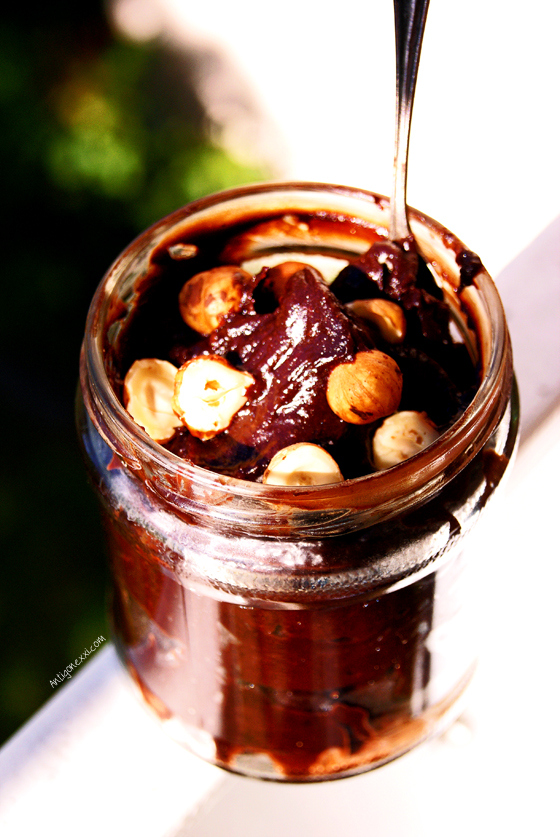
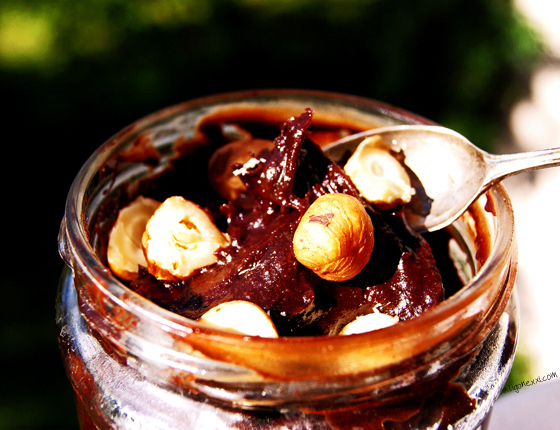
SONY DSC

Makes a 330 ml. or 11 oz. jar

Ingredients :

  • 15 dates (around 90 g. or 3 oz.)*
  • 125 g. or 1/2 cup hazelnut paste
  • 60 ml. or 4 Tbsp agave syrup
  • 30 g. or 1/3 cup cocoa powder (raw if possible)
  • 15 ml. [1 Tbsp] water

* For those who don’t want to use dates, you can substitute 1/2 dried apricots and 1/2 dried bananas (but not banana chips!)

Preparation:

  1. Rehydrate the dates in hot water for about 10 minutes (or 2 hours in cold water)
  2. Put all your ingredients in a blender and… blend!

Don’t hesitate to stop the blender as needed to scrape the sides and place the spread on the blades. If all seems a bit too dry, add a little water or hazelnut oil (or other neutral oil). You can then enjoy, with or without a spoon!

SONY DSC

Uh oh, I get the feeling that the youngest sister is jealous!

 ——-

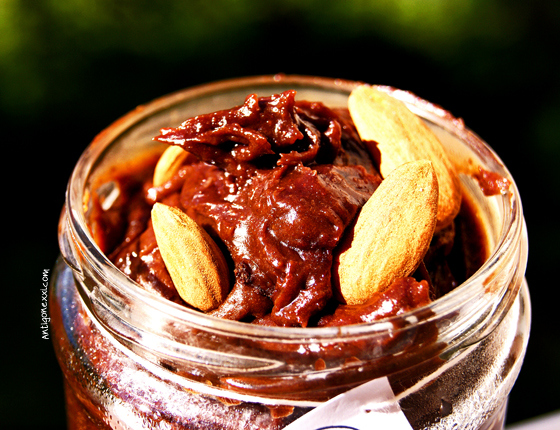
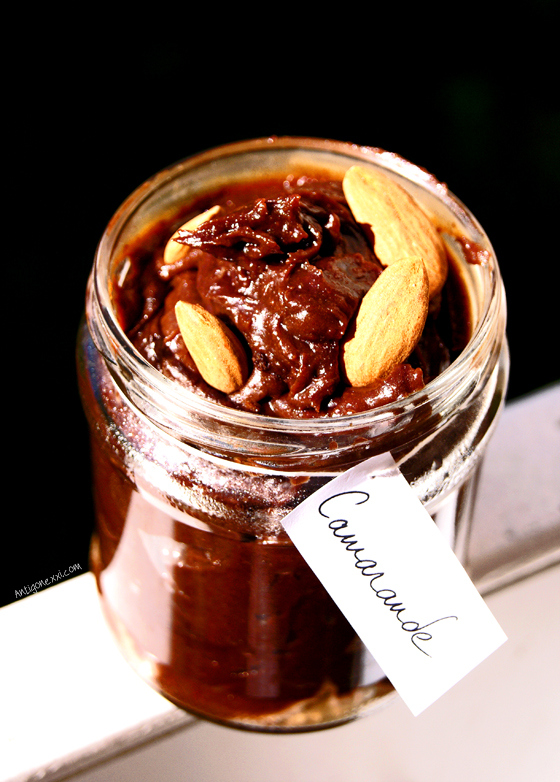
Camarande – Even Better 

——-

 SONY DSC
 Makes a 330 ml. or 11 oz. jar
 Ingredients :
  • 15 dates (around 90 g. or 3 oz.)*
  • 125 g. or 1/2 cup almond paste
  • 60 ml. or 4 Tbsp agave syrup
  • 30 g. or 1/3 cup carob powder
  • 15 ml. [1 Tbsp] water

* Same note as for Choconette if you don’t like dates or if dates don’t like you.

Preparation :

  1. Rehydrate the dates in hot water for about 10 minutes (or 2 hours in cold water)
  2. Combine all your ingredients in a blender. Scrape the sides as needed to make sure the spread is smooth. Add only water or oil… never milk!

Don’t hesitate to stop the blender as needed to scrape the sides and place the spread on the blades. If all seems a bit too dry, add a little water or hazelnut oil (or other neutral oil). You can then enjoy, with or without a spoon!

So, who’s your favorite “Miss Nut Spread” of the year?

 SONY DSC

I’ve got to confess, it’s tough to choose between them.

These spreads keep well in the refrigerator for about a month. Remove them from the refrigerator a little in advance, so they’re softer.

But I can hear the question: “What about the youngest?

Well, the baby is is very shy, and I think she’d rather play the prima donna and have a page all to herself. After all, these rising stars can be terribly capricious! But I’ll give you a hint while you wait for tomorrow:

SONY DSC

And how about you? Have you already given up Nutella? Have you switched to Chokénut or Chocolinette? Or just begun making your own at home?

Translator’s note: whereas the blog post followed up with a separate entry on the following day, I’ve added the last little sister here.

Naughty Chococo

I admit my last post was not very nice.

I talked about three little sisters, and then, bam! I left you hanging without introducing the youngest, and then I said “tomorrow,” and then I made you wait a little longer than you thought I would. I was a bit more generous with the clue I left you, however; if that didn’t pique your curiosity, it must simply be that Nutella has already fried your neurons!

SONY DSC

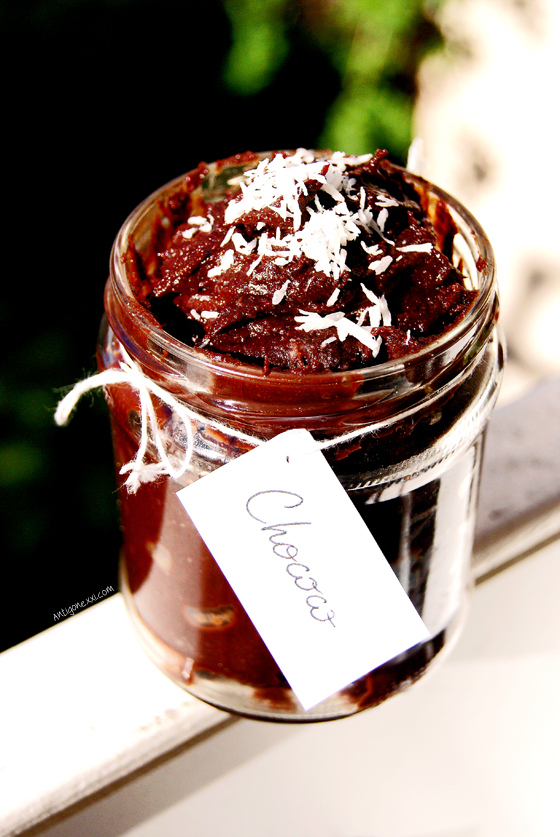
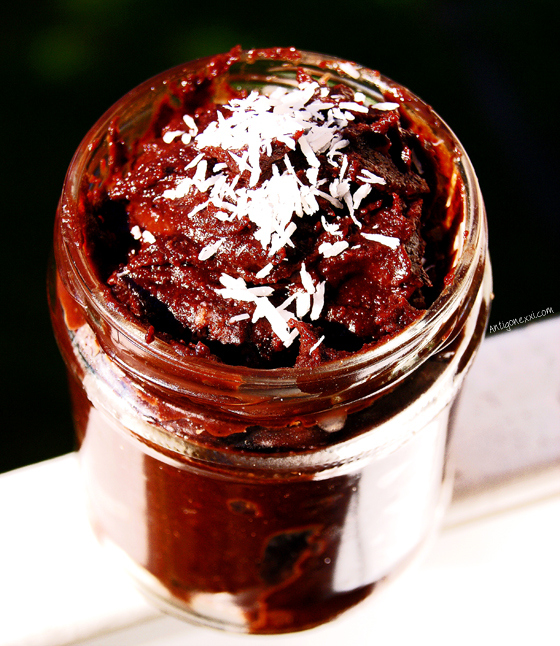
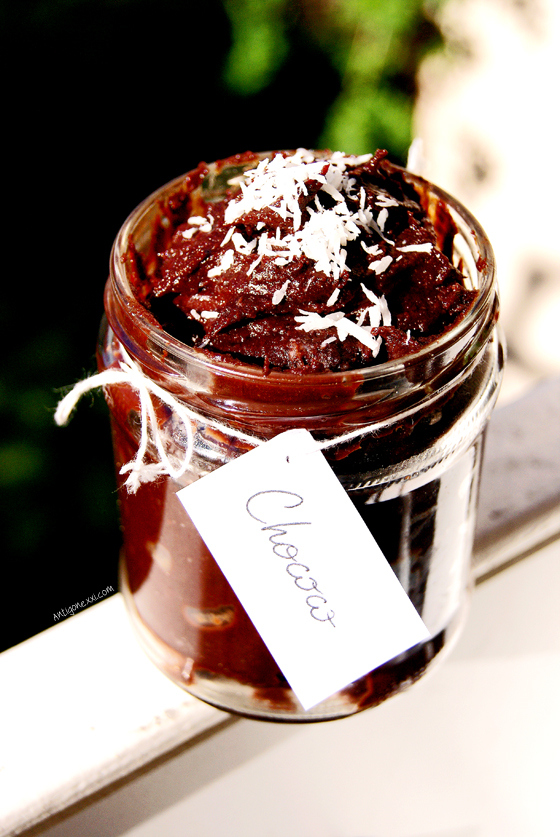
Rest assured, however, your wait has not been in vain – I saved the best for last. As I explained, the youngest is a bit naughty and she was doing her shy bit. I will make amends by introducing you to Chococo:
 SONY DSC

Like her big sisters , Chococo is a raw spread, consisting of only four ingredients, very simple to make and extremely tasty. Note that this is the second time I’ve mentioned coconut butter on this blog, and I hope to convince you to get started as quickly as possible – once tasted, you won’t be able to live without it!

——-

Chococo

——-

Makes a 330 ml. or 11 oz. jar

Ingredients:

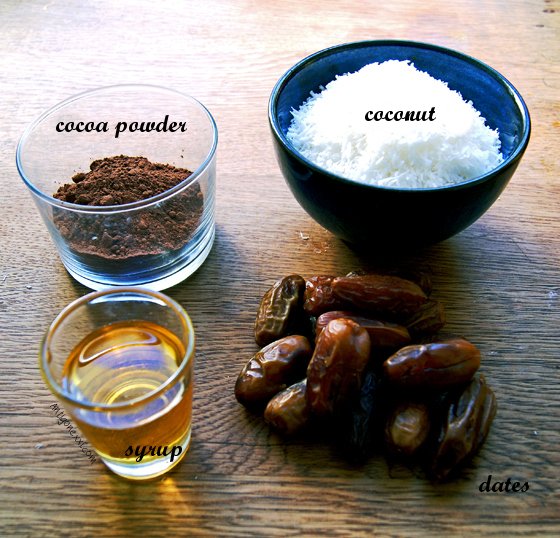
  • 15 dates (about 90 g. or 3 oz.) *
  • 150 g. [2 cups] of grated coconut
  • 60 ml. [4 Tbsp] agave syrup
  • 30 g. [1/3 cup] cocoa powder (preferably raw)
  • 50 ml. [1/4 cup] water
  • (Optional)  1-2 tbsp coconut oil

* Even if dates are perfect here, you can substitute other dried fruit of your choice:

  1. Classic: banana / apricot / fig’
  2. Exotic Version: papaya / mango.

As with Choconette and Camarande, do not forget to rehydrate your dates in water 1 to 2 hours in advance, then drain well.

dsc081752

Preparation:

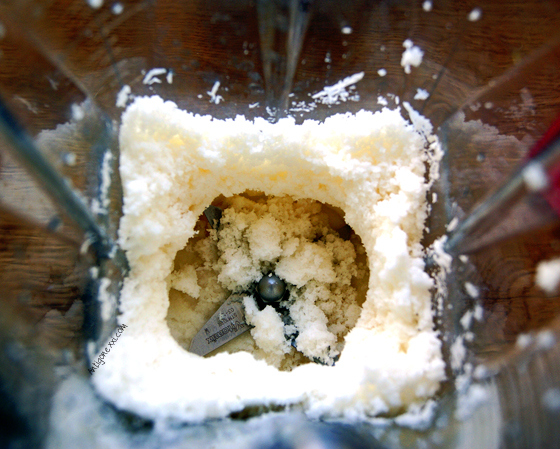
1. Prepare your coconut butter: Place your shredded coconut in the bowl of a food processor and blend until you get a creamy texture. You can add 1-2 tbsp coconut oil to help the butter to ‘take’. Don’t hesitate to stop the machine to scrape the sides and put the future butter back onto the blades.
 SONY DSC
2. Don’t stop until you have obtained a really creamy texture (depending on the size of your blender, double the proportion of coconut to be sure that the butter is formed: it will then store well in the refrigerator and can be used in many other recipes – if you don’t devour it immediately with a spoon.
 SONY DSC
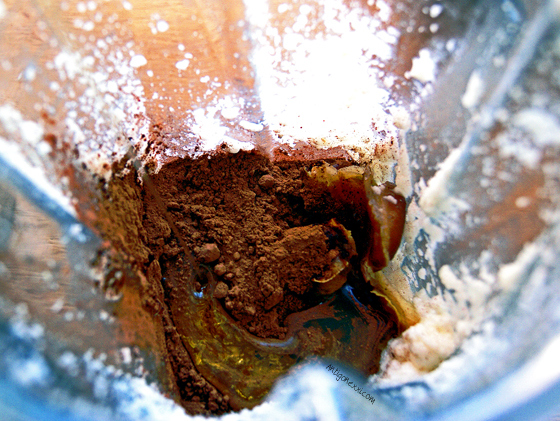
Once your butter is ready, add all the other ingredients in the blender and vroom!, blend!
 SONY DSC

It’s not difficult at all, and in the end you get a little beauty.

SONY DSC

A beauty who is a little less shy now … and who is the pride of her mother!

I would add that this spread, as with her two older sisters, will keep for about one month in the refrigerator. Don’t forget to remove it to soften before serving because, even more than the others, it will tend to stiffen when cool because of the coconut butter. I will let you taste it and then banish the word ‘Nutella’ from your vocabulary.

Ah, yes, one last mention of the word terrible … After posting my previous article, two questions were asked of me, and I’d like to share the answers here:

– The first question: “Can I make several jars at once?”

Yes, if you are very hungry creatures and you are ready to devour everything in less than a month. In this case, don’t worry! It may even be more convenient to double the proportion of the triplets if you have a large mixing bowl and want to get a really creamy texture. However, if you use a less powerful blender or a small stand mixer, then opt for smaller amounts (and I’m not even sure that a small device will allow you to make coconut butter. I haven’t tried it, and I put it to my readers!)

– Second question: “Is it much more expensive than Nutella? 

I admit that I am very bad with  these matters, because when I cook, I do not calculate costs. On top of that, I haven’t eaten Nutella in ages, so I’m not the best person to compare prices, especially since prices vary between organic stores and countries. However, I went to fishing my receipts out of the wastebasket and looked up information on the internet. Here are my rough calculations:

  • agave 7 € / kg -> € 0.48 per spread
  • cocoa powder (not raw): 4 € / 250 g. -> € 0.48
  • carob powder (not raw): 3.5 € / 250 g. -> € 0.42 [ but on sale for 2 € at the moment at Jean Hervé!]
  • hazelnut paste: 14 € / 700 g. -> € 2.50
  • almond paste: 9 € / 700 g. -> € 1.60
  • grated coconut € 5/500 g. -> € 1.5
  • Dates: 8 € / kg -> € 0.72

So here’s what it cost to get 330 g. of spread:

  • Choconette : € 4.12
  • Camarande : 3.16 €
  • Chococo : € 3.12

For comparison, a pot of 220 g. of Nutella costs € 2.02 at Monoprix or € 3.03 for 330 g. So yes, our house versions are slightly more expensive, but do not forget that we are dealing with an organic product!  As for the raw version, sorry: I was lazy and had no way of finding any receipts. I invite you to do the math yourself by checking in raw food stores. Let’s compare organic spreads, calculating for jars of similar size (330 g.)

  • Chocolinette (Noiseraie Productions): 5.99 €
  • Chokénut (Noiseraie Productions): 5.28 €
  • Chocolade (Jean Hervé): € 5.19
  • Karouba (Jean Hervé): € 4.85
  • Hazelnut paste (PERLAMANDE): 5.45 €
 So we come to the following conclusion: for identical quality, the triplets are cheaper than commercial spreads. In the end, you are at choice and can stay with Nutella, but I tell you freely that even if my spreads were two to three times more expensive than Nutella, I’d stick with the homemade version! I had fun doing these little calculations, but for me, the health of my body and that of the planet has no price.

What are your priorities when you purchase a product? 


[1] E numbers designate chemicals that can be used as food additives within the European Union.

[2] In the USA, the ingredients for Nutella are Sugar, Palm Oil, Hazelnuts, Cocoa, Skim Milk, Reduced Minerals Whey (Milk), Lecithin As Emulsifier (Soy), Vanillin: An Artificial Flavor. Whey and Skim Milk always have milk solids with MSG, and the artificial flavor vanillin also contains unlabeled MSG. For a full list of ingredients containing MSG, visit Truth in Labeling.

Flooding in Central Europe

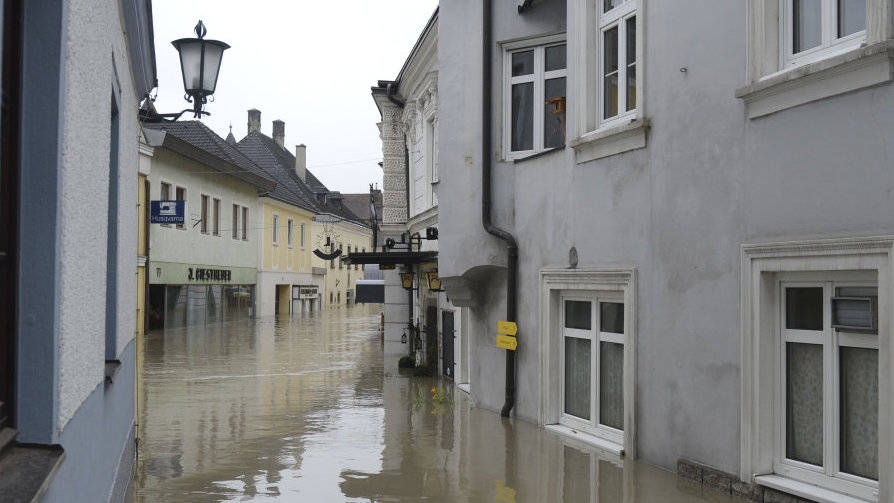
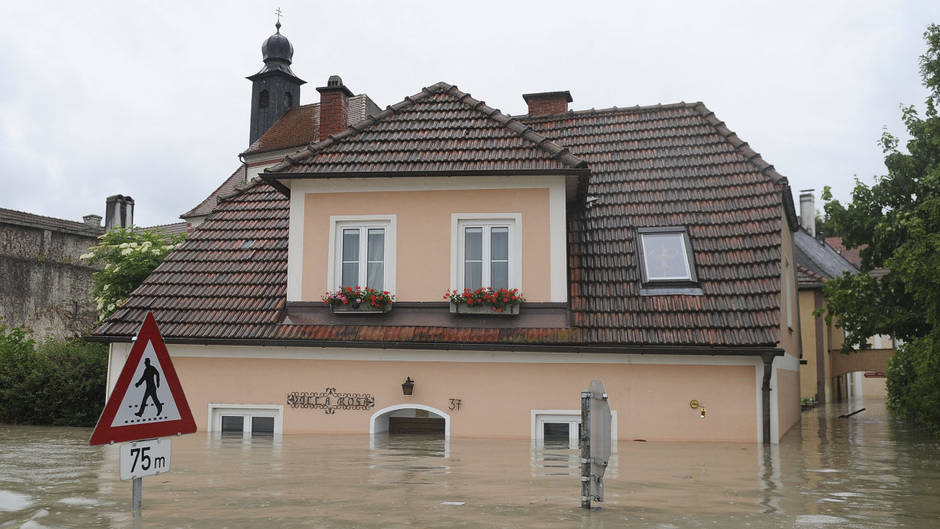
Massive flooding throughout central Europe has cost 10 lives and wreaked incalculable damage… and the water is still rising. My thoughts are with all those affected by this widespread disaster. I share some photos from Austria, as I know the country best of all the others currently being affected.

HOCHWASSER IN ÖSTERREICH: NIEDERÖSTERREICH / MARBACH

Marbach on Tuesday, June 4th.

HOCHWASSER IN ÖSTERREICH: NIEDERÖSTERREICH

Emmersdorf in the neighborhood of Melk.

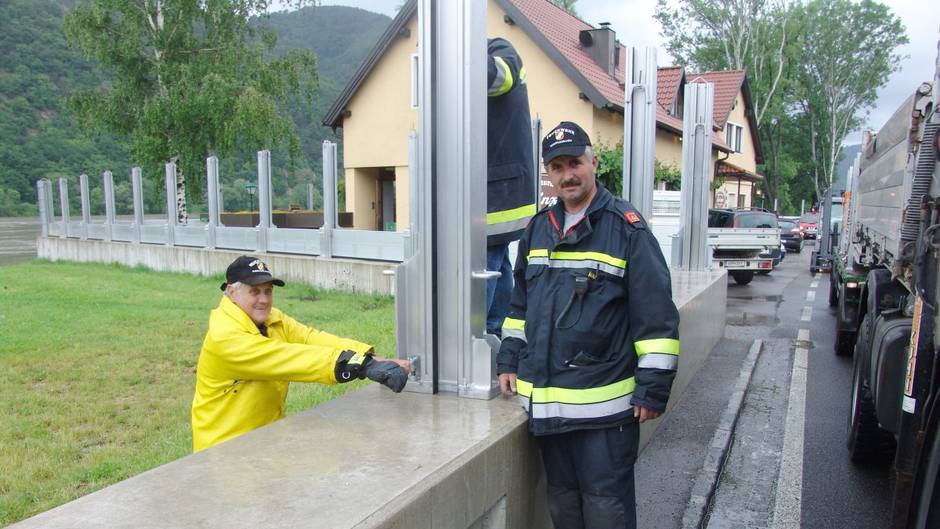
14.702

Building a portable high-water barrier in Spitz. Notice the house in the background.

Hochwasserschutz, Weißenkirchen, NÖ, Wachau

The same house a week later. Without the barrier, it would have been under water.

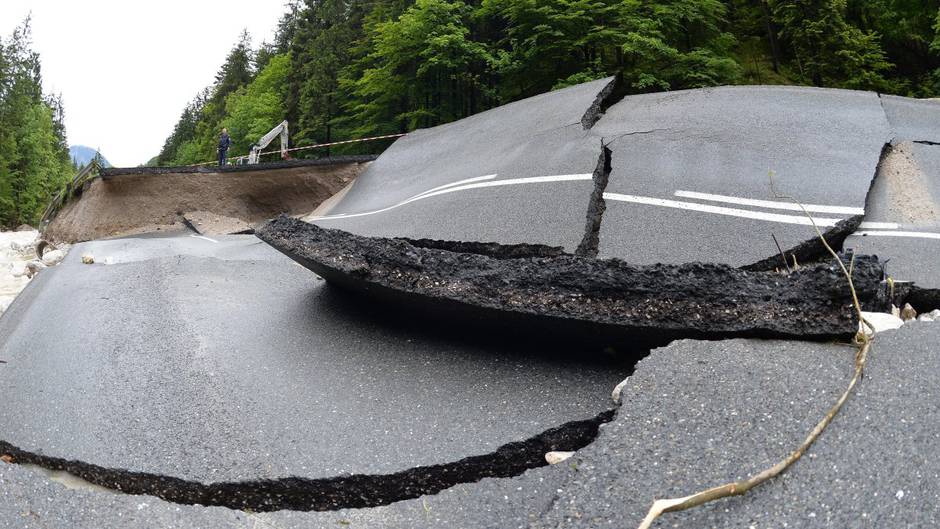
14.740

B138 near Lofer.

AUFRÄUMUNGSARBEITEN NACH DEM HOCHWASSER IN ÖSTERREICH: SALZBURG

Hüttau suffered massive damage.

Click through for a full picture gallery with 103 images.

Donnerwetter! Making fun of German once again.

Yesterday I posted about Germany’s longest official word having been stricken from the dictionary because it’s no longer needed. Today we will descend to sophomoric levels to explore the same noun-compounding phenomenon.

Put away your Dudens and your Langenscheidts and your reference books; this is nothing but silly fun. From various unknown sources across the years:

German Lesson #7

Dog:                                              Barkenpantensniffer
Dog Catcher:                               Barkenpantensniffersnatcher
Dog Catcher’s Truck:                 Barkenpantensniffersnatcherwagen
Garage for Truck:                      Barkenpantensniffensnatcherwagenhaus
Truck Repairman:                      Barkenpantensniffensnatcherwagenmechanikerwerker
Mechanic’s Union:                       Barkenpantensniffensnatcherwagenmechanikerwerkerfeatherbeddengefixengruppe

Doctor:                                         Chestergethumpenpulsentooker
Nurse:                                           Chestergethumpenpulsentookerhelper
Hypodermic Needle:                    Chestergethumpenpulsentookerhelperhurtensticker
Backside:                                      Chestergethumpenpulsentookerhelperhurtenstickerstabbenplatz

Piano:                                           Plinkenplankenplunkenbox
Pianist:                                          Plinkenplankenplunkenboxgepounder
Piano Stool:                                  Plinkenplankenplunkenboxgepounderspinnenseat
Piano Recital:                               Plinkenplankenplunkenboxgepounderoffengeshowenspelle
Fathers at the Recital:                 Plinkenplankenplunkenboxgepounderoffengeshowenspellensnoozengruppe
Mothers at the Recital:                Plinkenplankenplunkenboxgepounderoffengeshowenspellensnoozengruppenuppenwakers

Automobile:                                 Honkenbrakenscreecher
Gasoline:                                      Honkenbrakenscreecherzoomerjuicen
Driver:                                          Honkenbrakenscreecherguidenschtunker
Auto Mechanic:                           Honkenbrakenscreecherknockengepinger‑           sputtergefixer
Repair Bill:                                   Bankenrollergebustenuptottenliste

Propeller:                                     Der airfloggen fann
Self starter:                                  Der airfloggenfann flinger
Control column:                          Das pushenpullen schtik
Rudder pedals:                            Der tailschwingen works
Pilot:                                             Der tailschwingen pushenpullen werker
Student pilot:                               Der dummkoff lernen fliegen
Forced landing:                           Trieen gobackonner ground mitout kraschen
First solo:                                      Trieen gobackonner ground mitout kraschen alone
Precautionary landing:               Looken virst den kraschen
Crosswind landing:                     Trieen gobackonner ground mitout kraschen sidevays
Parachute jump:                          Trieen gobackonner ground mitout der fliegenwagon
Weather radar:                            Das olektroniken stormengeschniffer
Warhead:                                     Das Lautenboomer
Atomic warhead:                         Das eargeschplittene Lautenboomer
Hydrogen warhead:                    Das eargeschplittene Lautenboomer mit grossem Holengraund und alles kaputt!

These remind me of Fraulein Bo-peepen And More Tales Mein Grossfader Told by Dave Morrah:

61oi5li0fxL._SL1024_

An extract from the book:

Fraulein Bo-Peepen
Ben losen der sheepen
Und puzzlen mit der gelooken.
Later der sheepen
Ben homen gecreepen
Mit tailers behinder geshooken.

Nowhere near as scholarly an approach as John Hulme’s Mörder Guss Reims – the Gustav Leberwurst Manuscript, which I mentioned here, but in 1953, so close to the end of the second world war, it struck a popular chord with Americans, who were still getting a kick out of mocking the Germans as late as 1971 when Hogan’s Heroes went off the air.

tumblr_ltt1vawN8k1qh2d7uo1_250

Schulz! Where is Colonel Hogan?

Nowadays we’ve become so much more sophisticated:

Toht

“Your fire is dying…”

Der Old Wolf has gespoken.

Turnips and Cabbage

Dg9hRYt

Children eating their Christmas dinner during the Great Depression.

As I looked at this picture, I was reminded of this passage from Richard Wright’s Black Boy:

“Christmas came and I had but one orange. I was hurt and would not go out to play with the neighborhood children who were blowinghorns and shooting firecrackers. I nursed my orange all of Christmas Day; at night, just before going to bed, I ate it, first taking a bite out of the top and sucking the juice from it as I squeezed it; finally I tore the peeling into bits and munched them slowly.”
-Wright, Richard, Black Boy, Harper and Row, 1965

Poverty sucks. Previously I posted this picture of a desperate woman offering her children for sale in Chicago in 1948. Three years after World War II, when the military machine had largely mitigated the effects of the depression, and people were still struggling. And people continue to struggle today, in 2013, in America the Great and Terrible – which to far too many seems like nothing so much as smoke and mirrors, while the 1% who control over half our nation’s wealth shout, “Pay no attention to that CEO behind the curtain!”

wizard

They say the recession is over. For the wealthy and those whom our tax dollars bailed out, with no accountability or even gratitude, for the CEO’s and executives and board members who benefited with huge salaries and  bonuses, perhaps it is. But not for the average working american. It’s two years on from that article, and economic terror is still snapping at the heels of far too many in our country. Economic giants like Wal-Mart crow about the “opportunities” and “dignity” they provide people:

“Unfortunately there are some people who base their opinions on misconceptions rather than the facts, and that is why we recently launched a campaign to show people the unlimited opportunities that exist at Walmart,” Buchanan said, noting that 75 percent of Walmart managers started as hourly employees. “Every month more than 60 percent of Americans shop at Walmart and we are proud to help them save money on what they want and need to build better lives for themselves and their families. We provide a range of jobs — from people starting out stocking shelves to Ph.D.’s in engineering and finance. We provide education assistance and skill training and, most of all, a chance to move up in the ranks.”

But as the source article indicates, a single Wal-Mart’s low wages can cost taxpayers around $900,000 per year in food stamps and other government programs because wages are so low, no benefits are paid, and hours are kept to unliveable minimums. Nobody said it better than Jib-Jab:

One would think that a skilled laborer with advanced degrees could at least get a job with Wal-Mart; one might think that they would appreciate wisdom, experience and reliability. Unfortunately, that’s the exact opposite of what is happening. The sad truth is that Wal-mart’s turnover rate is obscenely high; 60% would not be considered abnormal in some stores. Managers expect impossible performance, treat employees like refuse and pay as little as the law allows. Report after report from former Wal-Mart employees refer to constant threats of firing and reminders that they needed Wal-Mart to survive; they will fight unemployment claims to the teeth and make sure their employees are aware of this. As a result, HR is actively looking for people who can’t find anything better and who won’t complain, regardless of how poorly they are treated.

How can a business possibly survive on such a model? How can managers who buy into this mindset live with themselves or sleep at night? I truly have no answers to these questions, but the fact that the situation persists is deeply troubling.

To be fair, I know people who have been with their Wal-Mart stores for a long, long time, have risen through the ranks by dint of sheer perseverance and who are grateful for their employment. I know some people who work at the corporate level in IT, and who say they’ve had it a lot worse elsewhere. But the overwhelming preponderance of tales seem to support what is generally supposed about the big box working environment.

If you’d like a good (albeit depressing) read about what life is like for far too many of us in this country, read Nickel and Dimed: On (Not) Getting By in America, by Barbara Ehrenreich[1]; she describes what it’s like to try to live on minimum-wage jobs in our country.

nickel

Her tales of shelters, budget motels, cheap food, endless job interviews, and working in demeaning drudgery, only to find that it was seldom enough to live on, will open your eyes to the harsh realities of our economy. Her conclusion:

The “working poor,” as they are approvingly termed, are in fact the major philanthropists of our society. They neglect their own children so that the children of others will be cared for; they live in substandard housing so that other homes will be shiny and perfect; they endure privation so that inflation will be low and stock prices high. To be a member of the working poor is to be an anonymous donor, a nameless benefactor, to everyone else. As Gail, one of my restaurant coworkers put it, “you give and you give.”

Someday, of course – and I will make no predictions as to exactly when – they are bound to tire of getting so little in return and to demand to be paid what they’re worth. There’ll be a lot of anger when that day comes, and strikes and disruption. But the sky will not fall, and we will all be better off for it in the end.

Again in the interest of fairness, here’s another opinion from Charles Platt in 2009; no idea if he’s a shill or not, but add it to the mix. [2]

As a country, we must do better. We owe it to ourselves, and we owe it to our children. We need to start teaching kids how to think out of the box, how to value humanity, how to run an ethical business, and how to build a world that works for everyone. Richard Wright ended the original version of his autobiography with these words: “With ever watchful eyes and bearing scars, visible and invisible, I headed North, full of a hazy notion that life could be lived with dignity, that the personalities of others should not be violated, that men should be able to confront other mean without fear or shame, and that if men were lucky in their living on earth they might win some redeeming meaning for their having struggled and suffered here beneath the stars.” (Wright, Richard, Black Boy, Harper and Row, 1965)

We must do this.  Otherwise, as John Howard Griffin said in his moving conclusion to Black Like Me, “we will all pay for not having cried for justice long ago.”

The Old Wolf has spoken.


[1] You can find it at Amazon or read a pdf of the book here.

[2] What’s it like for Wal-Mart executives at the stratospheric corporate level? Not all peaches and cream, as Julie Roehm discovered; her odyssey makes for an interesting read as well.

Lunch Atop a Skyscraper… and afterwards.

lunch-atop-skyscraper-new-york-construction-workers-crossbeam

This iconic photo taken in 1932 showed a group of construction workers nonchalantly enjoying lunch on a girder [1] high above New York. A bit of backstory on the photo can be found at The Reel Photo.

What is not often seen is what happened after that particular photo was taken, which is just what you might expect.

qyE1HvL

Nothing better than a good nap after lunch.

The Old Wolf has spoken.


[1] On that note:

An Irish labourer turns up at a building site and asks for employment. “Thick paddy,” thinks the foreman.

“Right ven, Paddy, fink we can hire you? Wot’s the difference between a joist and a girder ven, Paddy?”

“Sure and that’s easy,” replied the Irishman. “Joist wrote Ulysses, and Girder wrote Faust.”

Donnerwetter! German’s longest word stricken

If you’ve ever read Mark Twain’s A Tramp Abroad, you have probably encountered Appendix D: The Awful German Language. Therein, Twain waxes eloquent about the vagaries of the Teutonic tongue and mentions the habit of the German language to smash nouns together into long, unreadable strings. He mentions “Generalstaatsverordnetenversammlungen” (legislator meetings) and “Waffenstillstandsunterhandlungen” (cease-fire negotiations.) He does not mention “Donaudampfschifffahrtsgesellschaftskapitaenswitwe” (the widow of a captain of the Danube Steamship Voyage Company), and I have seen longer versions having to do with the cleaning lady of the captain’s cabin, but this one is somewhat sniffed at by German purists.

enhanced-buzz-15726-1363114236-3


“Hardwood floor sander rental”

Now it appears that the longest official word in the German dictionary has been stricken, because it’s no longer needed.

the Rindfleischetikettierungsüberwachungsaufgabenübertragungsgesetz, or “law delegating beef label monitoring,”  was introduced by Germany in 1999 as part of measures against mad cow disease. But the DPA news agency reported today the law was removed from the books last week because European Union regulations have changed. Just to show you how these monsters are cobbled together:

  • Rind (cow)
  • Fleisch (flesh) [Rindfleisch -> “beef”]
  • Etikettierung (labeling)
  • Überwachung (monitoring)
  • Aufgabe (task)
  • Übertragung (delegation)
  • Gesetz (law)

The additional letters between the nouns are there to make things flow smoothly, in the same way as we take “girls” and “baseball” and “team” and come up with “girls’ baseball team.” And that’s really all they are doing – they just happen to cram everything together into one word.

German has other peculiarities, among which are the maddening tendency to throw all their verbs to the end of a very long clause or sentence. I’m currently reading The Lord of the Rings (Der Herr der Ringe) in German; I can’t wait to get to Volume 3 to find out what happens, because that’s where all the verbs are. [1]

But with the “Längsthauptwortsabschaffung” (longest noun elimination, and I just made that up) having been performed, what’s left as the longest official word? That honor falls to Kraftfahrzeughaftpflichtversicherung (automobile liability insurance)

For what it’s worth, “The Awful German Language” was not Twain’s only foray into German philology. In A Connecticut Yankee in King Arthur’s Court, he came up with Constantinopolitanischerdudelsackpfeifenmachersgesellschafft (İstanbul bagpipe maker company, and remember it’s İstanbul, not Constantinople), which my Teutonically-enabled friends will be quick to point out is improperly formed, but it makes a heck of a magic word. But this segues into the fact that when it comes to smashing words together, the Germans are rank amateurs when compared to Turkish.

turkish-flag-300x225

Avrupalılaştırılamayabilenlerdenmısınız? is a complete sentence, a question which means “Are you one of those who is not easily able to be Europeanized?”

Here’s how it’s formed:

  • Avrupa: Europe
  • Avrupa-lı: European
  • Avrupa-lı-laş-mak: become European
  • Avrupa-lı-laş-tır‑mak: to make European (mak is an infinitive ending)
  • Avrupa-lı-laş-tır‑ı‑l‑mak: (reflexive) to be made European (‑l‑ is a linking consonant)
  • Avrupa-lı-laş-tir‑ıl‑abil‑mek: to be capable of being Europeanized (‑mek is again the infinitive ending, changed as a result of vowel harmony)
  • Avrupa-lı-laş-tır‑ıl‑ama‑mak: not to be capable of being Europeanized
  • Avrupa-lı-laş-tır‑ıl‑ama‑y‑abil‑mek: this time the ‑abil is probability: that there is a probability that one may  not be capable of being Europeanized
  • Avrupa-lı-laş-tır‑ıl‑ama‑y‑abil‑en: the one that may not be capable of being Europeanized
  • Avrupa-lı-laş-tır‑ıl‑ama‑y‑abil‑en‑ler: the ones…..(‑ler, ‑lar is the plural suffix)
  • Avrupa-lı-laş-tır‑ıl‑ama‑y‑abil‑en‑ler‑den: of or from the ones who may not be capable of being Europeanized
  • mı? ‑ question tag (legally, this should be written separately, but it is a very common mistake not to).
  • mısınız? ‑ are you (formal or plural)

To be fair, this is a rather contrived sentence, but it’s legal and grammatical and shows how Turkish agglutination works. Pope John XXIII is reported to have said, at one point during his ten years in İstanbul as Papal Nuncio, “I am fond of the Turks…  It is my special intention, as an exercise in mortification, to learn the Turkish language.” Mortification is right.

I spent about 10 years associating with Turks, the Turkish language, and Turkey, and I would like to go on record as saying that John had the right idea. They’re lovely people, with a beautiful country and a hellish but intriguing language. I keep chipping away at Turkish, and perhaps in one or two more lifetimes I’ll be able to say more than “Günaydın, nasılsınız?”. As Robert Sheckley’s character said in “Shall we have a little talk?“, “Stop agglutinating, dammit!”

Given the events taking place in Turkey at this very moment, I pause to wish the good people of this land every good thing, and the right to freedom and self-determination.

The Old Wolf has spoken.


[1] Just kidding. All the verbs are in the appendices.