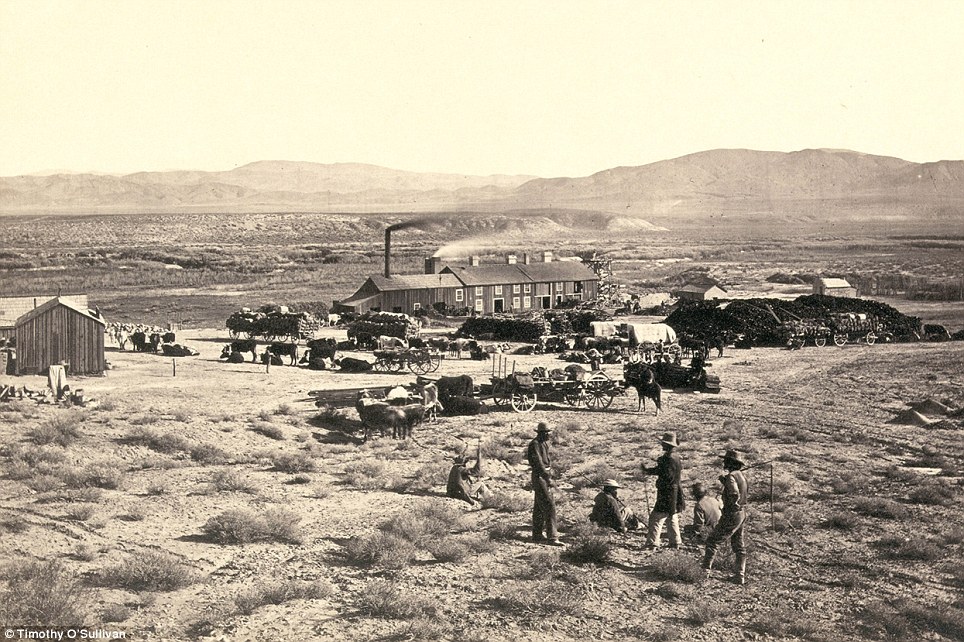
19th century housing: Members of Clarence King’s Fortieth Parallel Survey team explore the land near Oreana, Nevada, in 1867.
Taken from an article in The Guardian, which has many, many more of these captivating images from the early settlement and exploration of the United States. I recommend a visit.
See what I did there? I made you read this because you were afraid you might not be able to later. That’s the principle of scarcity.
In his powerful book Influence: The Psychology of Persuasion, Dr. Robert Cialdini outlines a number of key points that drive us as social creatures, and does two competing things at the same time.
He teaches people how to use these skills to persuade others (hence, the book is very popular with sales organizations), and
He teaches people how to recognize these techniques and deflect them, which is an equally important skill.
The simple truth is that everyone likes to buy, but no one likes to be sold. Hence the salesman’s job is to find ways to get around people’s natural resistance to being influenced or persuaded, and do it in such a way that the victim customer feels as though all the decisions were his or hers, and his or hers alone.
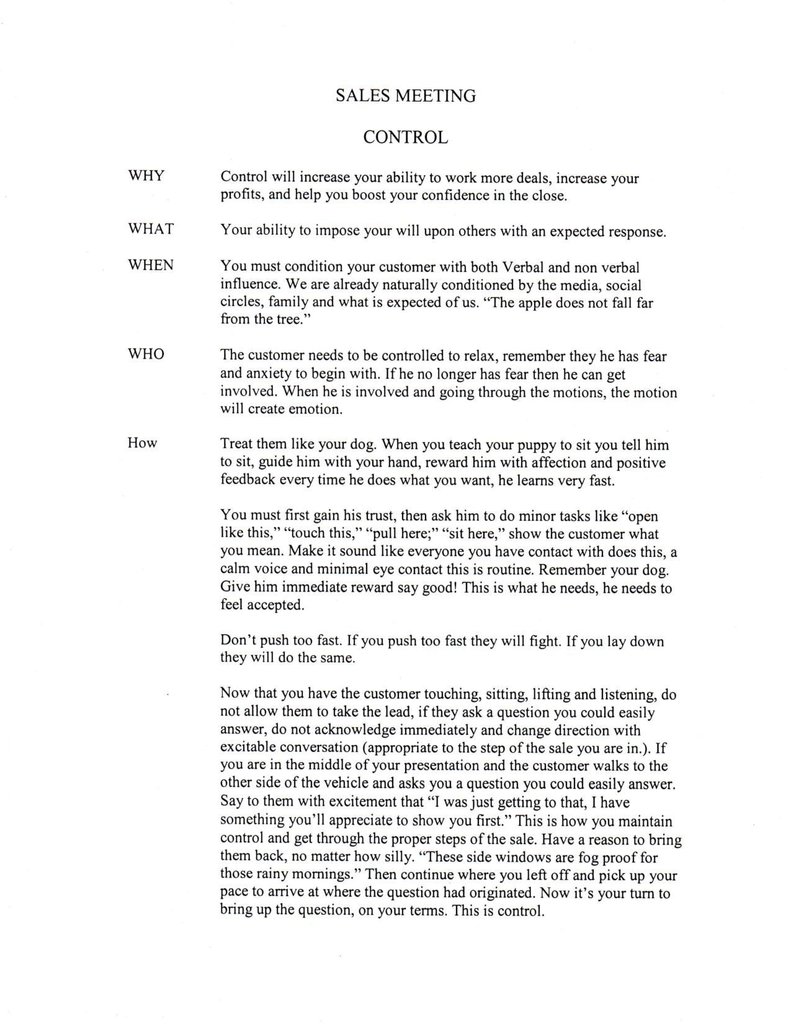
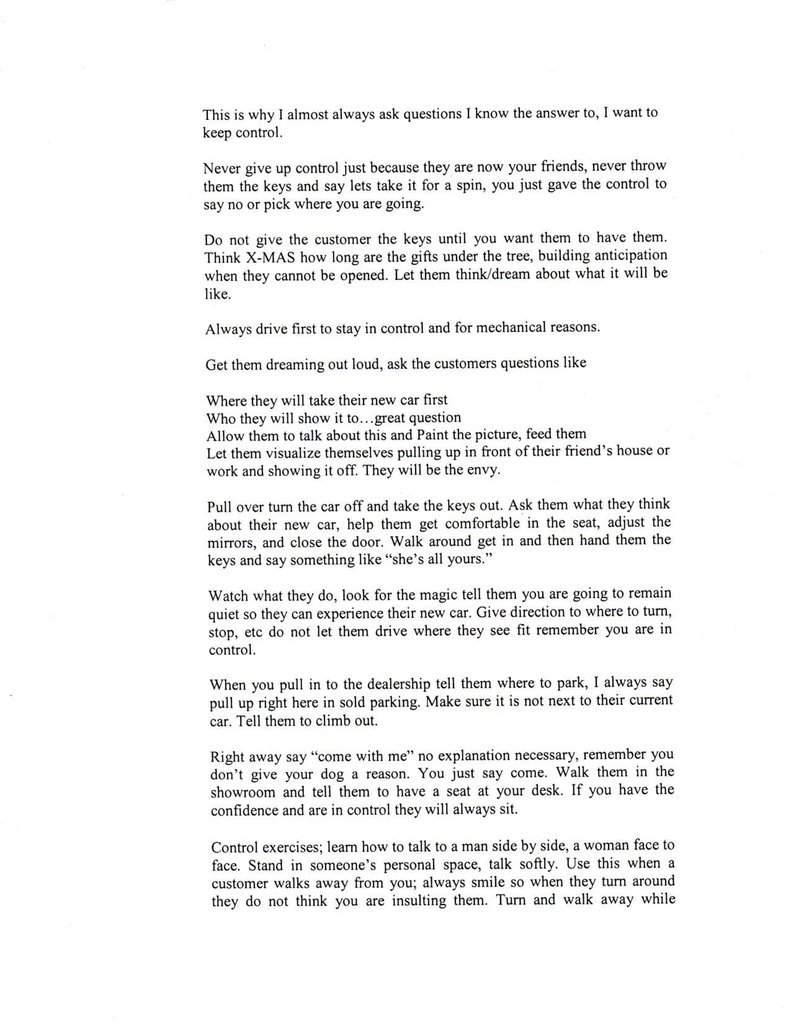
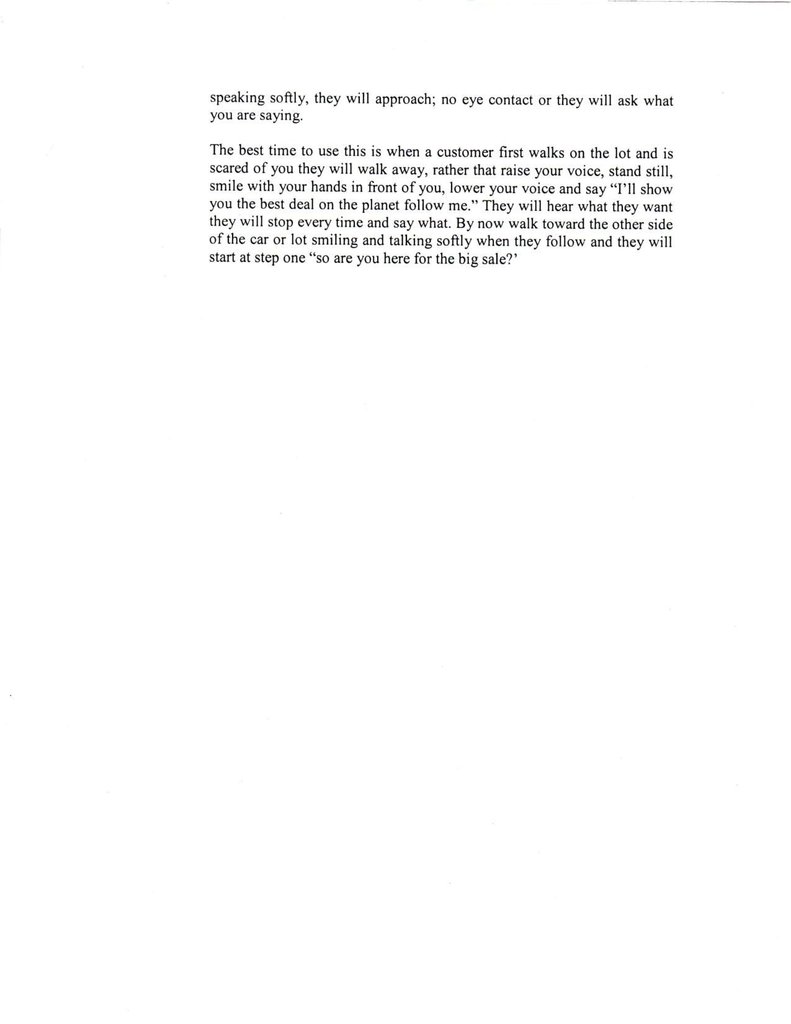
Have a look at the following instructions presented at a training meeting for automobile salesmen.
“Treat them like your dog.” Is it any wonder that people feel more than slightly soiled when they interact with salesmen on a car lot (or anywhere else these techniques are deliberately practiced)? [1] This training is designed to create a win/lose scenario; the salesman wins, and gets his or her commission; the victim customer loses (although they think they’ve won) because in all likelihood they’ve bought a car that doesn’t suit them for a price they didn’t want to pay.
Cialdini’s central thesis comes from the concept that most sales or persuasion techniques strive to activate the “click, whirr” response. For instance, mother turkeys will attack any perceived danger, unless that danger is emitting a “cheep-cheep” sound, in which case it will be nurtured. The response is always stimulated by a trigger feature, usually a small part of the whole. To translate that into the world of sales, an example would be:
Expensive = Good. Click, whirr
Here is the executive summary of Cialdini’s book, for your gratuitous reading pleasure, taken from an article at Psychology Today entitled “The Art of Influence” (a good read in its own right)
Reciprocation: Consider the in-store wine tasting, or the free scone at the coffee shop. We think we’re coming out on top, but the expectation to give back is strong within us, and leads us to buy something.
Consistency: We like to see ourselves as consistent souls with unwavering beliefs. So if you ask me to publicly declare my devotion to animal rights, for example, I’m more likely to donate money to PETA later.
Social Validation: Rugged individualist fantasies aside, we are more likely to do something if we see that many other people like us have also done it.
Liking: If you like someone, you are more likely to say “yes” to her request. If she is pretty, you’re even more likely. And if she compliments you, well, that works, too.
Authority: Four out of five dentists recommend using the reassuring gloss of authority to sell this toothpaste.
Scarcity: Anyone who has grabbed a plain, overpriced t-shirt from another’s hands at a “one-day-only” sale understands how persuasive limited-time and limited-quantity offers are.
All of this creates a dilemma for suppliers of goods and services who wish to get the word out about their products in an ethical manner. Sales are driven by advertising, like it or not; it becomes a challenge of monumental proportions to attract people to your product without being dishonest or deceptive, especially amid the cacophony of hundreds of millions of products vying for attention.
It’s no wonder, then, that some of the most effective commercials have been first and foremost entertaining, because they deliver value in addition to information. I’ve blogged about entertaining commercials elsewhere, but here again are two of my favorites:
This commercial for Pepsi doesn’t even use the word… in fact, there are no words at all in this ad, or in the one below, besides displaying the product image. The clip is funny, and you are left with a good feeling which has been tied to the idea that this particular product is refreshing.
Again, this ad is totally wordless – but it’s a crackup, and rated at the very top of the Superbowl ads for that year. The look of satisfaction on the good ol’ boy’s face, the punchline at the end, all combine to tell you (while your brain is being flooded with endorphins) that this product is hot and satisfying.
Strangely enough, the classic Alka Seltzer commercial “Spicy Meatball” was hugely entertaining but not all that successful, because people weren’t quite sure which product was being advertised; many people thought it was a spot for spaghetti sauce.
The two fastest ways to convince people (including yourself) of something are 1) repetition, and 2) tying the experience to a strong emotional response. Hence advertising that entertains, in addition to providing the extraneous benefit of brightening people’s day, are also very effective in associating the idea of a product with that good feeling.
For myself, I reject the notion that advertising and sales must be linked to the above-mentioned persuasion mechanisms. I prefer an honest and factual presentation of a product or service and allowing a customer to decide for themselves based on the information at hand. There are prices and benefits to this approach – I will never create a Fortune 500 company, but I can sleep well at night knowing I’ve not made money by the practice of deception.
[1] One of the most violent applications of manipulative sales techniques can be found in those “vacation resort presentations” that people get roped into on cruises or in holiday locations; the fact that people still buy timeshare condos, despite the fact that they are one of the worst possible and least practical investments, is a tribute to the manipulation skill of these barely-legal con artists.
Now, in the interest of fairness, the timeshare condo can be a good purchase for certain people with a very narrow set of criteria; I know some folks that are very happy with their arrangements. That said, it should never be treated as an investment, because these things lose value when you sign on the dotted line faster than a car being driven off the lot; here are 10 Myths about Timeshares from One Cent at a Time; the internet is full of similar pages, most full of good advice. Just do a web search for “truth about timeshares” and go from there.
Be aware, however, that many of these pages are run by people who either want to sell you timeshares and who have used black-hat SEO techniques to get you to their page, or by realtors who are promoting their own services. You’re going to have to do your homework, starting with the assumption that anything found on the Internet should be taken with a grain of salt until it has been independently confirmed by trustworthy sources.
From: Aggie Fraumeni <aggielzy492@yahoo.com> Subject: Wassup! I’m now searching for date! To: Me
zotwhd brmts odkeno tbutgqm fnybovpeqy dkxgeorh qgpfrjt W E L R O U H H D S X K J H N K aslsyz P M I X K X G D E I W K T V C O jvtjrx sxhqzfuaau gxtkxrbk kjutwvm bmoawtbsas oqmtiuotu xccwog T U I Q F E F U K F A F X U qwqipegbwutvcsl X L K K H O S X T
I was especially impressed by the erudition to be found in the body of the text message. I have never seen such a powerful use of “gxtkxrbk” in my life.
Were I to respond, I would be promptly assailed by passionate declarations of love and devotion, which would rapidly devolve into requests for money to help with travel expenses, relatives’ funerals, legal difficulties, medical challenges, and the like.
What some people are thinking is beyond me. But since I’m not “searching for date,” I shall let this brilliant opportunity pass me by.
A few years ago, I became aware of a beautiful short video entitled “Historia de un Letrero” (The Story of a Sign), by Alonso Alvarez Barreda. Each year, the Canadian National Film Board, in cooperation with the Cannes Film Festival “Short Film Corner” and YouTube, hosts an online competition where 10 short films are posted on YouTube, and the winner is selected based on the number of “likes.” The 4th such competition in 2008 earned this short video the prize. It is truly deserving.
The version with the most views seems to be this one at ZappInternet, but I’m not sure if it’s the original or not, and Zapp’s videos won’t embed properly at WordPress, so I chose the one above.
However, in hunting around for the original version to share with you, I ran across this extract from a Mexican television show which claimed that the film was a bald-faced plagiarism of another work, a Spanish piece entitled “Una limosna por favor” (An alms, please) by Francisco Cuenca Alcaraz, which featured at the 2006 Notodofilmfest, in the category of films under 30 seconds.
You can judge for yourself – the idea is, evidently, the same. However, despite the Mexican production’s sensationalist umbrage, the concept of reworking an idea in a new format is old news in Hollywood; just about every Disney fairy tale was written by someone else and already done in another version by someone else. Alvarez himself never claimed to be the originator of the idea, and the Cannes award is not for original screenplay but for overall creative impact.
No such screams of anguish were heard when Historia de un Letrero was remade in English by redsnappa on behalf of Purple Feather under the title “The Power of Words.”
This film was almost an exact duplicate of Alvarez’ work, but set in Scotland instead of Mexico, and indeed billed itself as an homage to the previous film. From all I have been able to determine, the issue of plagiarism is moot, as even the 2006 clip is based on a folk story that significantly predates it.
Whichever version you prefer, the story is both powerful and moving. Thoughts are things, and words have power. Use them for good.
Sounds terrible, right? Not over in the UK. “A knocker-up (sometimes known as a knocker-upper) was a profession in England and Ireland that started during and lasted well into the Industrial Revolution and at least as late as the 1920s, before alarm clocks were affordable or reliable. A knocker-up’s job was to rouse sleeping people so they could get to work on time.” (Wikipedia)
Knocker-up using a bamboo pole to rap at an upper window
Mary Smith of Limehouse Fields, who was known for using a pea shooter.
Caroline Jane (Granny) Cousins – you can read much about her at Dorset Ancestors.
This interior shot of the Ayasofya Mosque predates its conversion into a secular museum in 1935. The calligraphic roundels in front bear the names of Mohammed and Allah – others carried the names of various caliphs. If Brown’s new novel Inferno ever gets made into a movie, this building will likely get some additional exposure; if you ever get to Turkey, it’s definitely worth a visit.
This scam combines the worst of the “psychic connection” schemes with modern-day phishing. Protect your loved ones!
This letter arrived yesterday, addressed to my mother – deceased since 2010. However, it’s plain that her name is still on numerous “sucker lists” circulating out there.
The Envelope (click all images for full resolution)
Notice how the letter tries to make it look as though the ink on the envelope has bled through to the paper below.
It’s plain that the photo is supposed to look mysterious and powerful, but seriously, folks – this looks like someone who’s been locked up for 50 years in St. Mungo’s Institute for the Criminally Disturbed. I say that without judgment, because the picture is doubtless not whoever is behind this scheme, and could be someone’s very loving grandfather.
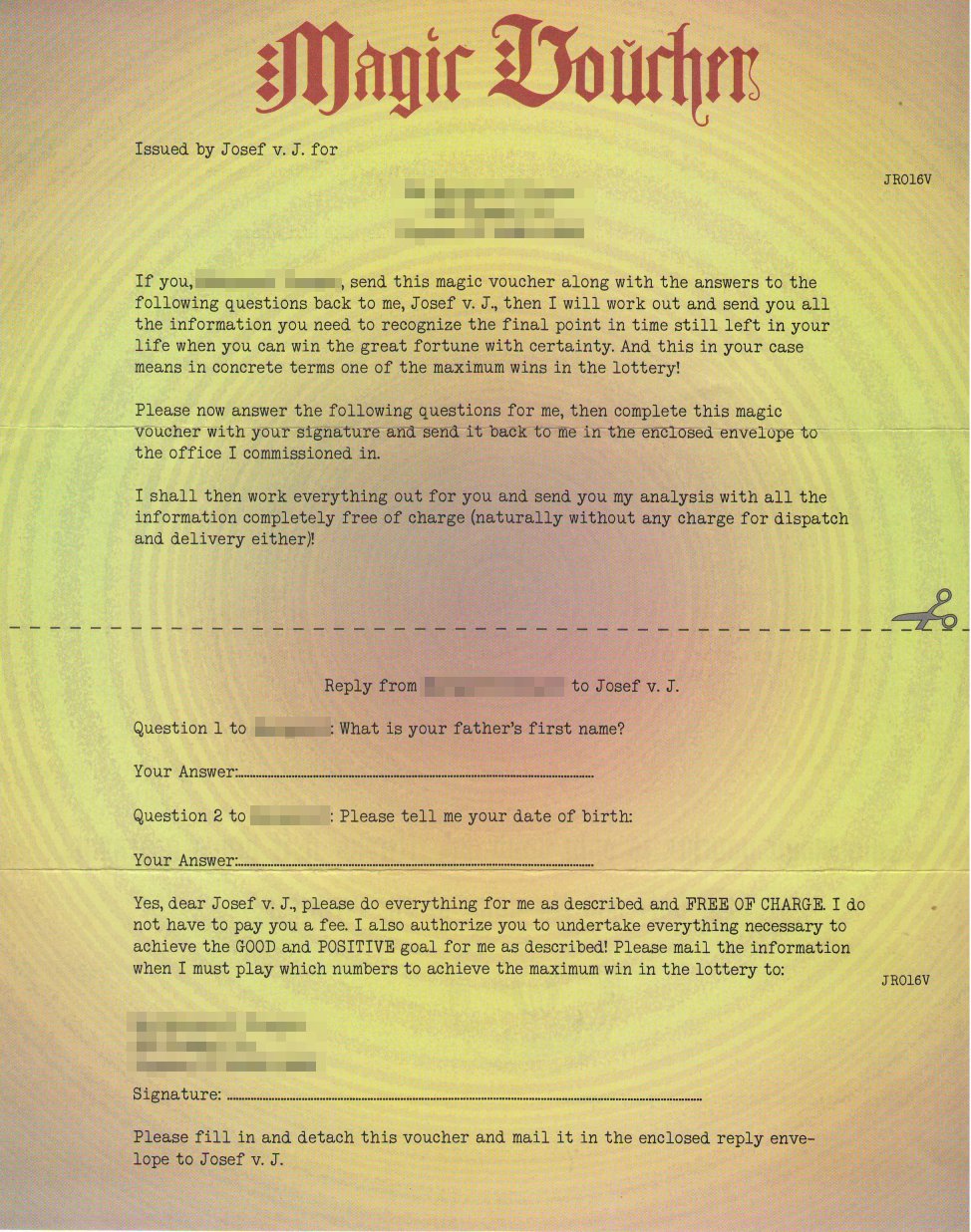
At any rate, the letter is full of the typical handwavium and orange smoke about mystical powers, good luck forthcoming, millions of dollars to be won, but instead of money, this Josef v. J. drone just wants a few pieces of critical information so he can “work everything out correctly on your behalf”: your father’s first name, your date of birth, and your signature. With those pieces of information, you have (if you’re Mr. or Mrs. average American) opened the door to most of your financial accounts.
The “Magic Voucher” – Front
The “Magic Voucher – Back
The Return Envelope – Josef v. J., PO Box 3182, South Hackensack, NJ 07606
Why the Post Office, the FBI, or other government agencies are unable or unwilling to shut operations like this down is beyond me. It seems to violate every mail fraud ordinance ever written. Be that as it may, the force is with you – if you have vulnerable loved ones out there, watch out for camel ejecta of this nature. Monitor their affairs and make sure they don’t get sucked in by criminal organizations like this.
The Old Wolf has spoken.
Cushlamochree… would you buy a used car from this man?
A San Francisco church is creating a space for pet cremains, in honor of the patron saint of animals. But the project is stirring a theological controversy.
An outdoor pet cemetery in the Presidio in the 1990s.
“This is, after all, the City of St. Francis. So when a shrine named in his honor announced plans to build a repository for pet ashes in a catacomb-like hollow under the stairs of its 19th-century church, many animal lovers were elated. Little did they know the plan would stir old-fashioned church politics and deep theological questions. (Is the stair nook a sacred space? Does placement of cinerary urns equate to pet burial? Did St. Francis only care about living creatures?) Now, as plans for the pet columbarium move forward, critics are taking their concerns well up the church hierarchy.”
Of course, the voices in my head being what they are, I was immediately put in mind of this lovely story, which I originally heard in Irish Gaelic: [1]
Muldoon was living in the country in Ireland and he had a dog. Muldoon was very fond of his dog, but one day the dog died, and he went to the priest.
Muldoon said, “Father, my poor dog died. Could you be saying a Requiem Mass for him?”
Said the priest, “‘Tis sorry I am, Muldoon, but there’s no Requiem Mass for animals. There’s a Protestant church down the road, God alone knows what they believe. It’s to them you should be going.
Said Muldoon, “Faith and that’s a good idea. I’ll be going there straightaway. What do you think? Would 50,000 pounds be enough for the services?”
Replied the priest, “Damn you, Muldoon! Why didn’t you tell me the dog was Catholic?”
From where I sit, the joke makes more sense than people arguing about a pet cemetery, but that’s just me.
The Old Wolf has spoken.
[1] Original Irish text:
Bhí Muldoon ina chónaí faoin tuath in Éirinn agus bhí madra aige. Bhí Muldoon an cheanúil ar an madra sin, ach lá amhain fuair an madra bás.
Chuaigh Muldoon chun an tsagairt.
Deir Muldoon: “A Athair, fuair mo mhadra bocht bás. An féidir leat Aifreann na Marbh a rá?”
Deir an Sagart: “Gabh mo leithscéal a Mhuldoon. Ní féidir Aifreann na Marbh a rá d’ainmhí. Tá teach pobail nua thíos an bóthar, agus ag Dia atá a fhios cad é an creideamh atá acu. Iarr orthu.”
Deir Muldoon: “Smaoineamh maith atá ann. Beidh mé ag fiafraí láithreach bonn. Céard do bharúil? An mbeadh 50,000 punt go leor le haghaidh na seirbhíse?”
Deir an Sagart: “Damnú ort a Mhuldoon! Cén fáth nár dhúirt tú liom go raibh an madra Caitliceach?”
There’s a superb colorizer haunting reddit these days – I’d love to see him/her take a crack at this one.
I love old pictures of New York; you can take the boy out of the city, but you can’t take the city out of the boy.
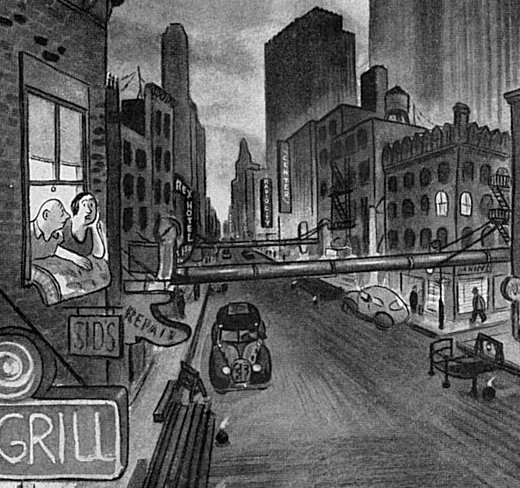
Charles Addams, most famous for his cartoons in The New Yorker and elsewhere, did some lovely cartoons about the city – one in particular comes to mind every time I see a picture of the elevated trains that used to run up and down Manhattan:
The 3rd Avenue El –
“Sometimes, on nights like this I can still hear it rumble by.”












 Playing in the World Game