Alcohol: joyous, insidious, confusing, and funny.

“That’s the problem with drinking, I thought, as I poured myself a drink. If something bad happens you drink in an attempt to forget; if something good happens you drink in order to celebrate; and if nothing happens you drink to make something happen.”

― Charles BukowskiWomen

 ❦

prince
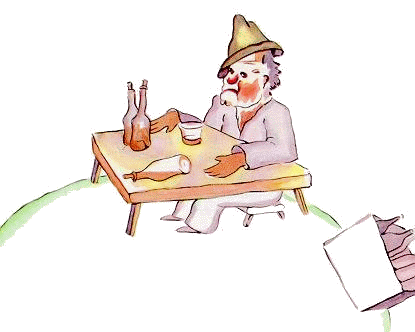
– What are you doing there?
– I’m drinking.
– Why are you drinking?
– To forget.
– To forget what?
– To forget that I’m ashamed.
– Ashamed of what?
– Ashamed of drinking!

Antoine de Saint-Exupéry, The Little Prince

 ❦

I’m a drinker with a writing problem. I only drink on two occasions—when I’m thirsty and when I’m not.

– Breandán Ó Beacháin

 ❦

1620546_10152321161097840_269085463_n


 ❦

After celebrating a bit too enthusiastically, a gentleman staggered out of a bar and began weaving down the street toward home. Ahead of him two nuns approached, and being solicitous of his impaired condition, discreetly parted to let him walk between them.

Nuns


In a moment the fellow stopped, scratched his head, and said to himself, “Now how did she do that?”

 ❦

AN ABERDEEN PROVERB.

“Dinna spend money on drink, but aye keep a corkscrew.”

  ❦

A friend who’s in liquor production,
Has a still of astounding construction,
The alcohol boils,
Through old magnet coils,
He says that it’s proof by induction.

David Letterman’s Top Ten Least Popular Alcoholic Beverages
=========================================

10. Really, Really, Really, Really Old Milwaukee
9. D Train Scotch
8. Amaretto Di Gotti
7. Orville Redenbacher’s Butter Flavored Vodka
6. McBourbon
5. Dinty Moore’s Pork N’ Booze
4. Ernest, Julio, Tom and Roseanne Gallo
3. Dr. Scholl’s Medicated Tequila
2. Seagrams 7, Mets 0
1. Chivas Regis

“There’a a phrase, “the elephant in the living room”, which purports to describe what it’s like to live with a drug addict, an alcoholic, an abuser. People outside such relationships will sometimes ask, “How could you let such a business go on for so many years? Didn’t you see the elephant in the living room?” And it’s so hard for anyone living in a more normal situation to understand the answer that comes closest to the truth; “I’m sorry, but it was there when I moved in. I didn’t know it was an elephant; I thought it was part of the furniture.” There comes an aha-moment for some folks – the lucky ones – when they suddenly recognize the difference.”
― Stephen King

I’ve been mostly teetotal all my life, and fully so since 1969. My Italian relatives would give me a little wine cut with water at dinner, because that’s what was done. When I got really sick at home, mother would make me a toddy with milk, honey, and a half-jigger of brandy. I feel just great, mommy! And one time – once only – in college, I got falling-down drunk at a party up the canyon, and the next morning had the mother of all five-alarm hangovers, one which made the following seem like a romp in the park on a spring day:

Dixon was alive again. Consciousness was upon him before he could get out of the way; not for him the slow, gracious wandering from the halls of sleep, but a summary, forcible ejection. He lay sprawled, too wicked to move, spewed up like a broken spider-crab on the tarry shingle of the morning. The light did him harm, but not as much as looking at things did; he resolved, having done it once, never to move his eyeballs again. A dusty thudding in his head made the scene before him beat like a pulse. His mouth had been used as a latrine by some small creature of the night, and then as its mausoleum. During the night, too, he’d somehow been on a cross-country run and then been expertly beaten up by secret police. He felt bad.

From Kingsley Amis, Lucky Jim.

It was at that point that I decided that alcohol was not my preferred vehicle for having a good time. Bill Cosby dealt with that particular subject expertly here:

Now in some ways, this is a pity. There are some lovely wines and liqueurs out there – I remember fondly some Lambruscos and Irish coffees and some of Uncle Carlo’s home-made wine and those aforementioned hot-toddies, to name a few. It’s a shame that synthehol isn’t a thing. On the other hand, there are some truly hellish concoctions out there as well.

History has shown how well prohibition worked – for good or ill, alcohol will always be a part of human society – but for all the humor and enjoyment humans can find in responsible drinking, the social costs of alcohol abuse are staggering. Despite unflagging efforts by organizations such as MADD, penalties for impaired driving in this country are a joke – killing while drunk behind the wheel is often punished with a slap on the wrist, while repeat offenders manage to avoid serious consequences again and again. This must stop; if we are to consider ourselves a civilized species, the social right to a “good time” ends where people and property are negatively impacted.

I got sober. I stopped killing myself with alcohol. I began to think: ‘Wait a minute – if I can stop doing this, what are the possibilities?’ And slowly it dawned on me that it was maybe worth the risk.
Craig Ferguson

The Old Wolf has spoken.

Reaching for the brass ring

In modern English, “grabbing the brass ring” or getting a “shot at the brass ring” means to go for the gold, or to strive for the best possible reward. The phrase has been found in dictionaries as early as the late 19th century.

MiPTEwI


Coney Island, 1958, photo by Harold Feinstein

The phrase originated with carousels in the late 1800’s; according to Wikipedia:

 “A brass ring is a small grabbable ring that a dispenser presents to a carousel rider during the course of a ride. Usually there are a large number of iron rings and one brass one, or just a few. It takes some dexterity to grab a ring from the dispenser as the carousel rotates. The iron rings can be tossed at a target as an amusement. Typically, getting the brass ring gets the rider some sort of prize when presented to the operator. The prize often is a free repeat ride.”

I grew up in New York in the 50s, and the first carousel in Central Park was opened in 1871. The current one, the Friedsam Memorial Carousel, was  installed in 1950, but I don’t ever recall a brass-ring device; if they ever had one, it must have been removed earlier before its relocation from Coney Island.

l

It’s a great analogy for life. To get that brass ring, you have to stretch, to reach out, to take a risk. Those who sit on the inside, or who watch that little dispenser go by ever turn without reaching for it, will never know what it means to succeed, or even to fail while trying.

Finding our dreams in life is often difficult because we’re too busy living our fears, but one thing is certain: reaching for the stars will always get us farther than sitting in the mud.

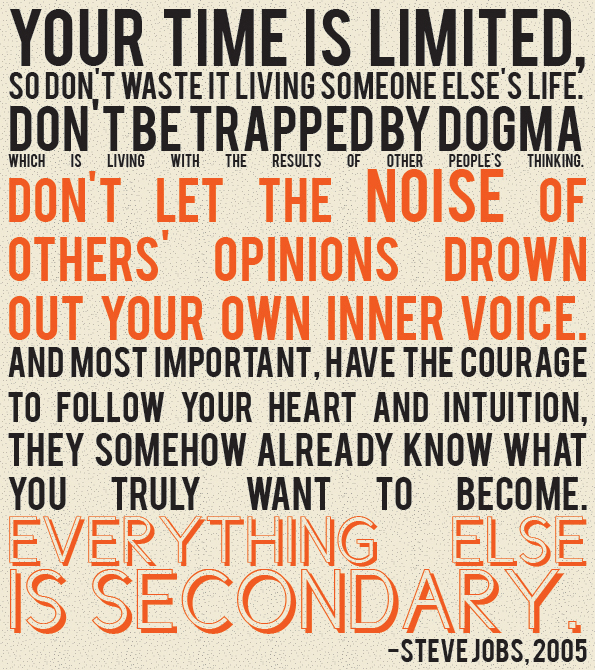
steve-jobs-quote

Go ahead. Reach for the brass ring.

The Old Wolf has spoken.
New York, 1865

IZPHo3b

This photo of lower Hudson Street was taken by Marcus Ormsby in 1865, to showcase the John Peake pharmacy. It’s a beautiful capture of day-to-day life in New York at the close of the civil war.

Some intriguing information about this photo can be found at Ptak Science Books. As one who was raised in New York, such historical photos fascinate me.

The Old Wolf has spoken.

The Joy of being Different.

Different

A lot has been written, both in print media and on the internet, about the importance of being different, or simply being yourself. My first encounter with this philosophy came in high school and we were studying Walden, hence the world view of Henry David Thoreau. He stated famously,

“If a man does not keep pace with his companions, perhaps it is because he hears a different drummer. Let him step to the music which he hears, however measured or far away.”

I agreed with it then, and I agree with it now. It’s far more important, in my way of thinking, to find happiness and fulfillment in life by following one’s heart and one’s dreams than to march in lockstep with the rest of the crowd for the sake of comfort and security. Unfortunately, most of the business and corporate world worships conformity. The image below graced the front of Scott Adams’ Dogbert’s Top Secret Management Handbook.

Managers

For most businesses and large corporations, the working philosophy is “don’t make waves, don’t be different, or (as they say in Japan) “the nail that sticks up gets hammered down.”

the_nail_that_sticks_out_gets_hammered_

“Deru kui wa utareru” – found at Nichiren Buddhist. “Japan is a country that typically prides itself on conformity, and sees anyone who is outspoken and holds different views to popular opinion as a potential threat to the rest of the group.  This lone voice must be knocked back into line.  It doesn’t even matter if the difference is the teaching of a great philosophy or something that can be harmful to society, as long as you are different from the mainstream, you must be put in your place.”

Indeed, other thinkers have an entirely different take on originality; In  his 1999 novel Invisible Monsters, Chuck Palahniuk wrote: “Nothing of me is original. I am the combined effort of everybody I’ve ever known.” Palahniuk is certainly correct in positing that we are all heavily influenced by our environments and whatever we have incorporated into our encyclopedic knowledge of our surroundings, but I disagree that originality is a scarce commodity. Much of it is simply drowned out in the vast sea of conformity that surrounds us. And like any other skill, the art of thinking creatively can be taught, and learned, and practiced, and developed.

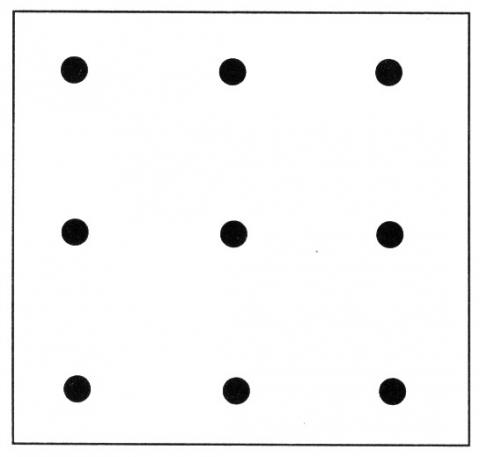
A good example of thinking “outside the box” is the classic nine-dot puzzle.

07ninedot

The challenge is to link all 9 dots using four straight lines or fewer, without lifting the pen and without tracing the same line more than once. Like “Columbus’ egg,” the solution is easy when you know how, but many people will struggle with the puzzle because they can’t get their minds outside the borders created by the dots.

The traditional solution (although there are others) is below:

the-nine-dots-puzzle-solution

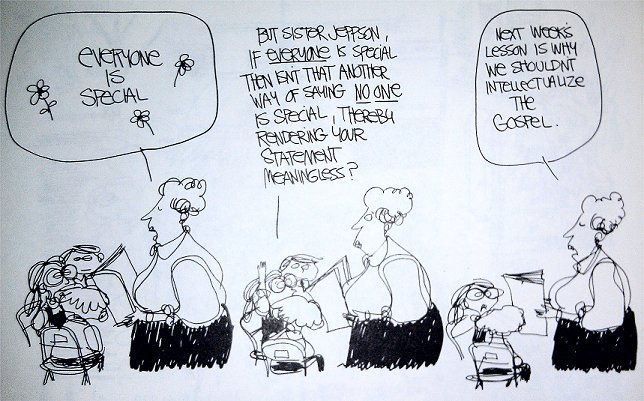
Other organizations, among whom are found religions, are also opposed to the concept of free thought. The cartoon below by Calvin Grondahl describes almost exactly my mother’s experience in Sunday School as a young girl:

Maggie Church


As a result of this and some other similar experiences, she never darkened a church door again.

The good news is that even in the corporate world, there are those who promote, foster, and encourage difference. Apple Computer is one of these. I remember well the 1984 advert which launched the Macintosh line:

Apple’s philosophy has continued to celebrate difference – the following dictum is often attributed directly to Steve Jobs, but was in fact written by Rob Siltanen with participation of Lee Clow, and used in a couple of different advertising campaigns:

The Crazy Ones

Here’s to the crazy ones. The misfits. The rebels. The troublemakers. The round pegs in the square holes.
The ones who see things differently. They’re not fond of rules. And they have no respect for the status quo. You can quote them, disagree with them, glorify or vilify them.
But the only thing you can’t do is ignore them. Because they change things. They invent. They imagine. They heal. They explore. They create. They inspire. They push the human race forward.
Maybe they have to be crazy.
How else can you stare at an empty canvas and see a work of art? Or sit in silence and hear a song that’s never been written? Or gaze at a red planet and see a laboratory on wheels?
We make tools for these kinds of people.
While some see them as the crazy ones, we see genius. Because the people who are crazy enough to think they can change the world, are the ones who do.

To me this makes a lot of sense. One of my Facebook friends posted this today, which got me thinking down these lines in the first place:

1486933_637960289581182_1498031942_n

Another one which I saw earlier and saved off is below:

insane

Naturally, we’re not talking about real mental illness here, which is no laughing matter, and which continues to get short shrift in social and health circles – but rather the simple joy of being oneself, regardless of what the world around you happens to think. Dr. Seuss had it right,

386760_444294978971016_2123145239_n


and Fred Rogers spent a lifetime encouraging children to celebrate their uniqueness:

fred_rogers_quote

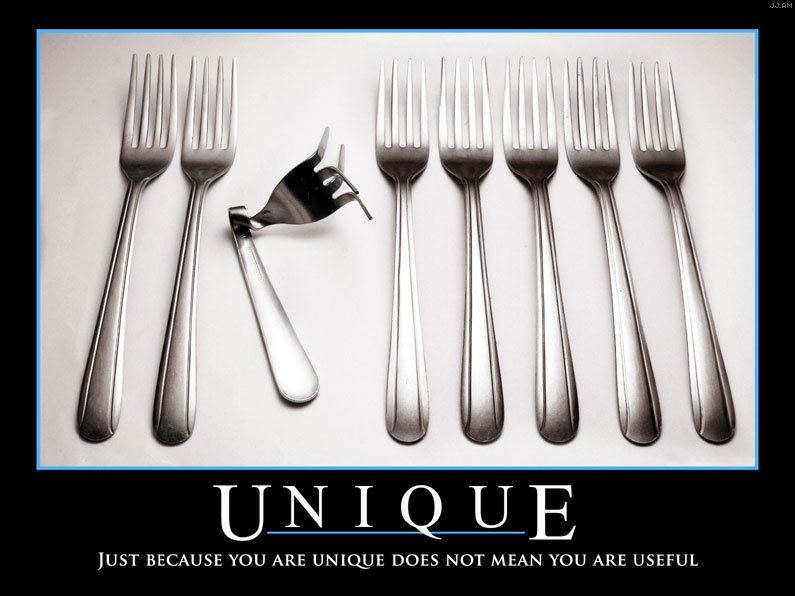
Naturally, for every good philosophy there will always be caveats:

UniqueDemotivator-s795x596-36535

This notwithstanding, the purpose of our existence is to find joy. It is my firm conviction that Tony Gaskins was right when he said,

“If you don’t build your dream someone will hire you to help build theirs.”

Given the emphasis on conformity, and the difficulty in breaking out of society’s molds and expectations, it should be a given that it’s not easy. But I know for a fact that it’s worth it. I have never been happier than when I was being my own vision of who I should be, rather than trying to shove myself into someone else’s mold.

The Old Wolf has spoken.

Wham, bam, tack Madam!

A recent article at BBC (and reported elsewhere as well) indicates that evidence for double-asteroid impacts on earth is growing more credible.

_73661565_73610855

According to astronomers, around 15% of asteroids are binaries, with a smaller “moon” orbiting a larger body. These are formed when a rubble asteroid begins spinning so fast as the result of solar pressure that a portion of its substance is ejected, forming a small satellite.[1]

Several candidates for double impacts exist on earth – Clearwater Lakes in Quebec, Canada are one potential pair (below).

wcgss6crketpe9gn2tl6

It is obvious that any pair of craters must be the same geological age to be identified as a double-strike candidate. Now,  “Dr. Jens  Ormo and his colleagues studied two craters called Lockne and Målingen, which lie about 16km apart in northern Sweden. Measuring about 7.5km wide, Lockne is the bigger of the two structures; Målingen, which lies to the south-west, is about 10 times smaller.”

Dr. Ormo’s team dated the craters using chitnozoan fossils and determined that the Målingen structure and the Lockne crater are the same age, roughly 458 million years; it is hypothesized that these were formed as the result of a twin strike  in the Ordovician Period.

craters

Click through for another article at i09.

The more we know, the more we know that we don’t know. Science!

The Old Wolf has spoken.


[1] See the additional information provided in a comment by engastrobd below.

The pendulum has swung

Scott Adams is funny. Dilbert is funny. For whatever reason you choose to come up with, Adams has his finger squarely on the pulse of the business world, and wastes no time lampooning anything and everything that frustrated corporate workers already know represents the pinnacle of stupidity.

20 years ago, status was determined by how much personal technology you had available.

28816.strip.zoom

15 years ago, the technology was on the road to hyper-miniaturization, and the smaller your phone, the more prestige you had (which gave you the right to treat underlings like dog squeeze.)

7068.strip.zoom

Now that smartphones have begun morphing into pads, tablets, and phablets (what an abominable word!) the prestige tide has now turned.

214942.strip.zoom

Whether that’s a good thing or not remains to be seen.

iphone-10-the-tallest-iphone-yet

At this point, I’m pretty jazzed about the Pebble. This seems like an awesomely useful sidekick to a smartphone… at least until the pendulum swings back the other way again, and everything fits on your one wrist-mounted device anyway.

tvwatch_fullsize_story1

Chester Gould had the right idea half a century ago.

The Old Wolf has spoken.

Tongan Television

Working in an international office can be an educational experience. For 22 years I associated with people from all over the world – in addition to Europeans, we had colleagues from many countries in Latin America and the Pacific – and every Monday we would gather for an inspirational meeting to get the week started off right. Often the designated speaker would present an aspect of their home culture, and I had a chance to learn some fascinating things over time.

a21_lot81_0-max

This is a “Tongan television.” Actually, it’s a neck-rest, or pillow of sorts; the first time I saw something like this was at the Natural History Museum’s Egyptian exhibit in New York – I was probably around six or seven, and I remember wondering, “how in the world do they sleep on those things?”

EGY00275-EM-1-2888_310x310

Later I learned that this particular type was typically used for supporting the head of mummified corpses, but the Tongan ones are most definitely used for sleeping or resting.

There’s no way I can convey the same feeling that I had as my colleague described the tradition of the family’s gathering together after dark, and listening to the patriarch tell stories. Stories of customs and traditions and legends, all designed to pass on to the next generation the family ways of honor and decency.

Sometimes, in Tongan society, a child would go their own way and fail to honor family traditions, getting in trouble or living dissipated lives. Of such children, it was often elegantly said that they “didn’t sleep close.”

The Old Wolf has spoken.

An open letter to a blog spammer.

Internet Theft

Thanks to antifraudnews for the image.

I’ve commented multiple times on the kinds of spam comments that appear in this blog on a regular basis. I just got another comment from one of my “regulars.”

Hmm it seemjs like your website ate my first comment (it was extremely long) so I guess I’ll just sum it up what I submitted and say, I’m thoroughly enjoying yur blog. I as well am aan aspiring blog writer buut I’m still new to everything. Do you havbe any points for inexperienced blogg writers? I’d certainly appreciatge it.

Here’s my response, which (s)he will most likely never see, since these comments are blasted out by bots, but regardless:


Dear Sir or Madam,

Your previous comment was filtered to my spam box by Akismet, may its name be ever praised (over 127 billion spam messages deleted). I deleted your message with great satisfaction. I empty my spam regularly, just to make sure there’s no trace of you, your spoofed email address, or the embedded link to your scummy product or illegitimate service. Whoever you are, you represent the lowest kind of human scum; you are filth, and beneath the dignity of notice.

I’m not interested in garcinia cambogia (a veritable deluge of these recently), porn, “lista de email” (very popular spamming services in Brazil), knockoff products (notably from China and Japan), forex trading, penny stock scams, pirated movies, counterfeit Viagra, or anything else you’re hawking. I’m not interested in being a cog in your black-hat SEO machine. You are irrelevant to the human race.

You want advice for inexperienced “blogg writers?” Don’t spam other people’s blogs with your putrescent effluence. Stay away from my blog. Remember that what you put out into the universe comes back to you a hundredfold; you’re only inviting misery and dark energy into your own life by being involved in these scummy deceptions.

With no respect whatsoever,
-The Old Wolf


If you’re interested in seeing how prevalent this plague is, hop over to Stop Forum Spam, where you can see the most active offenders, their emails, IP addresses, and evidence of their scams. The level of overal scumminess and illicit activity worldwide seems to be increasing exponentially; the only thing we can do is be vigilant and employ good filtering tools wherever they are available, so that the outflow of sewage is never seen.

The Old Wolf has spoken.

The Many Origins of the English Language

Stumbled across an amazing interactive chart showing the various influences which affected the development of the English language over time, and felt it was worth sharing.

English


The picture above is a static capture of the cumulative results; if you want to explore in more detail, have a look at Lexicon Valley. The author, Philip Durin, writes,

The elephant in the room, however, is how Latin and French dominate the picture in just about every period. Even the Anglo-Saxons borrowed from Latin (e.g. fork, street,wine), and ever since the Norman Conquest English has been borrowing hugely from French and Latin—quite often taking the same word partly from each of these languages, especially in the medieval period. Words like government, pay, science, orwar (from French), or action, general, person, and use (French and/or Latin) have become an indispensable part of English. Even among the 1000 most frequently used words in modern English, not far short of 50 percent have come into the language from French or Latin. Numbers do not always tell us everything, though: the total of loanwords from early Scandinavian is relatively low, but the language of the Vikings has left some of the most intimate traces in the vocabulary of English, with words likeleg, skin, sky, and even they, their, and them.

This is an intriguing overview, and now I’m anxious to get a copy of his book, Borrowed Words.

The Old Wolf has spoken.