I share this because it pleases me. No other reason. There.
Over at reddit, user /u/corilee93 posted this picture, and /u/kilroylegend provided the reference. I have always loved the work of Shel Silverstein:
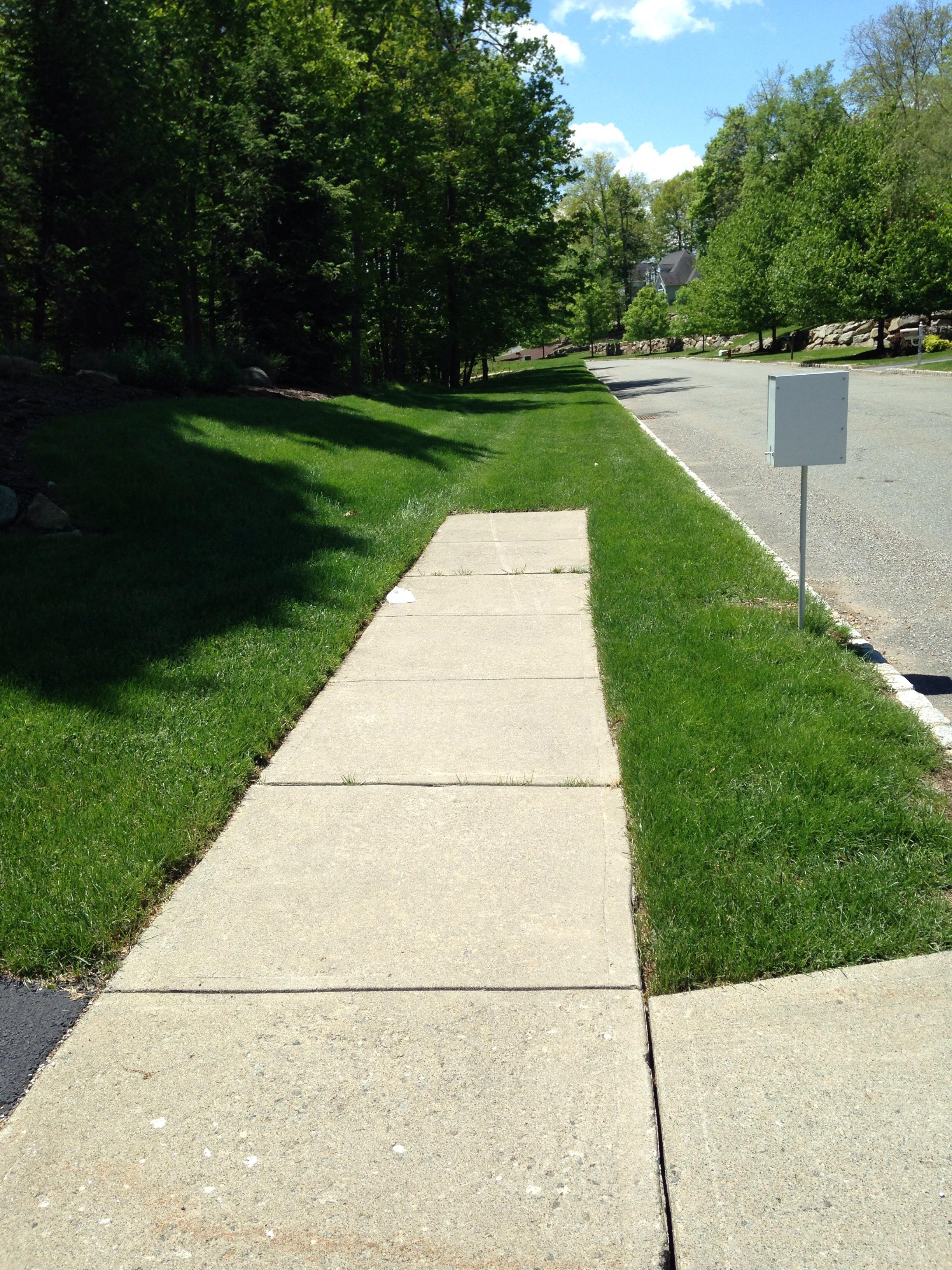
There is a place where the sidewalk ends
And before the street begins,
And there the grass grows soft and white,
And there the sun burns crimson bright,
And there the moon-bird rests from his flight
To cool in the peppermint wind.
Let us leave this place where the smoke blows black
And the dark street winds and bends.
Past the pits where the asphalt flowers grow
We shall walk with a walk that is measured and slow,
And watch where the chalk-white arrows go
To the place where the sidewalk ends.
Yes we’ll walk with a walk that is measured and slow,
And we’ll go where the chalk-white arrows go,
For the children, they mark, and the children, they know
The place where the sidewalk ends.
On May 6th, the government released the National Climate Assessment, 1250 pages long and authored by over 250 people.
What kinds of people? Government-paid alarmists and corrupt scientists, right? A secret cabal of people who are raising a false alarm to discredit… well, you’ve heard all the counter-arguments, not one of which is worth the powder to blow it to Hell with.
Let’s look at some of what went in to this report: [1]
Users and stakeholders were engaged from the very beginning. Everybody could contribute: NGOs, farmer, industry, Native American nations. Many thousands of people consider this as their personal report and have embraced it.
The team included former Bush White House officials with climate science expertise who also functioned as lead authors.
There were reps from the petroleum and mining industries, economists, agronomists, fisheries experts, and city planners. There were experts that dealt first-hand with the aftermaths of Katrina and Sandy and the droughts and fires and power shortages and the spread of disease in the West.
Notice of every meeting was pre-published in the Federal Register, and anyone, any citizen or group at all, was welcomed to come and comment.
There was a several-month open review, during which anyone was welcomed to raise concerns or criticisms, and comments were abundant.
The report was reviewed by the National Academy of Sciences, which is firmly non-partisan.
Comments from all of these sources were incorporated to make the report better.
There was a public, traceable account for every key finding, so that anyone can look back and see how the finding was arrived at, what the studies were that it was based on, and, it is even possible to follow the account back to the original data for those studies.
The conclusions in the report represent a consensus of all of the authors and advisors. The final vote to approve was unanimous.
The report is a product of not just NASA, but a consortium of 13 federal agencies called the US Global Change Research Program. NASA contributed substantially, but so did others, including NOAA/Department of Commerce, the Department of Energy, Department of the Interior, the Environmental Protection Agency, Department of Transportation, Health and Human Services, the Smithsonian, USAID, the Department of Agriculture, the National Science Foundation, the Department of Defense, and the Department of State. It was a combined effort of many, many people from both private and public sectors.
With all of these sources, with all of this transparency, with the wide diversity of contributors and opportunities for public input – not a restricted subset, but anyone could give input, I trust the results of this report implicitly. The results are incontrovertible. This is not just Al Gore grandstanding for political gain (although I think “An Inconvenient Truth” was right on the money, regardless of its underlying motivation) – this is science. And it works.
The Gallup Poll revealed that 1 in 4 Americans doubt the veracity of climate change. However, what the public thinks of established fact is irrelevant. Some people have such an overwhelming need to be right that they ignore indisputable facts. [2] But in the end, this opposition, despite how well-funded it is and for whatever reason, will fade. There may still be over 400 people in the world who believe the earth is flat, but what they believe changes nothing.
If you have any questions, visit the website. Explore it. Understand it. And do what you can to hold back the tide, even if the trend may be irreversible.
The Old Wolf has spoken.
[1] Source: A well-placed official who contributed heavily to the work involved, whom I trust implicitly.
[2] A story from a redditor, /u/RamsesThePigeon:
The year I was in third grade was one of the best and worst of my entire educational experience, and both of those extremes were because of the teacher I had. She was beloved by most of her students – the female ones especially – but had a habit of being passive-aggressive and saccharine towards more difficult pupils. She’d find (or invent) reasons to ignore difficult questions, offer vague threats about impending punishments, or make small efforts to turn classmates against one another. She was not an especially likeable educator, and she became a truly reprehensible one when she insisted that Jupiter was bigger than the sun.
At first, it seemed like a misunderstanding. Our class had just entered into an astronomy unit, and one of our activities was to construct a scale model of the solar system. The reference image we used came from a picture book, and in it, the sun had been reduced in size. The teacher had not noticed this fact, and was therefore operating under the mistaken assumption that Jupiter was our largest celestial neighbor.
Well, I knew better, and I tried to correct her. She replied to me with a tone of aloof dismissal, stating quite clearly that I was wrong. “That’s okay, though,” she said. “After all, you’re in school to learn new things.” Then she smiled sweetly, and I returned to my seat feeling thoroughly confused and frustrated. In the weeks that followed, I engaged in an all-out war against my teacher’s pseudo-science. My father, having heard everything from me, sent me to school with one of his college textbooks, hoping to turn the tide of the battle. My teacher refused to even look at it. “Class,” she said, rolling her eyes, “who can tell Max what the biggest object in the solar system is?”
My face was burning with anger and shame as every other student shouted “JUPITER!”
Things only escalated from there. I refused to back down, despite having been labeled as the class dunce. Each time the topic came up, I tried to offer my evidence… and each time, I was steadfastly opposed by everyone within earshot. Finally, after over a month of torment, our astronomy unit culminated in a field trip to the local planetarium. The show was a breathtaking adventure through our galaxy and the universe beyond, and it left me feeling infinitesimally small… yet strangely empowered. As the lights came up, our guide to the cosmos asked if there were any questions.
“Which is bigger,” I shouted, jumping to my feet, “Jupiter or the sun?!” My entire class sighed in frustration, my teacher barked at me to sit down, and the astronomer looked thoroughly confused.
“The sun, of course,” he scoffed.
A hush fell over the room. After a moment of utter silence, a girl named Melissa spoke up in a condescending tone. “Well, sir, we have a chart that says Jupiter is bigger.” The astronomer looked at her. He looked at my teacher. Then he looked at me with an expression of sympathy.
“Little girl,” he said, returning his attention to Melissa, “if you look at the picture again, you’ll see that the sun is being shown at a fraction of its actual size. Otherwise, it wouldn’t fit on the page.” His gaze moved to his next victim, who had slumped down in her chair so as to be almost as small as her students. “Your teacher should have told you that.”
Upon returning to our classroom, all the students crowded around our reference book. Sure enough, a tiny block of text explained that the sun had been scaled down in the illustration. I declared my triumph, having finally been vindicated. Nobody apologized, my teacher found new reasons to punish me, and I was treated with no small amount of scorn, but I didn’t care. From that day forward, I knew to never be afraid of asking questions, nor of standing up for facts in favor of fiction.
From that day forward – at least until it was taken away – I proudly wore my homemade dunce cap with a smug grin.
This was a teacher. Someone who should have known this bit of close-to-home science knowledge as surely as she knew 2 gozinta 4 two times. But somehow she was ignorant of this fact and clung to it tenaciously, at the expense of humiliating a dissenting student and indoctrinating an entire class with a blatant falsehood.
I look forward with anticipation each year for the knock at the door (one of very, very few I will respond to if it’s a solicitor) from cute little girl scouts selling cookies. I could make myself ill on Samoas.
But the cookies are a fairly modern innovation. In earlier days, the young ladies did their part in other ways.
Here we see three young girl scouts collecting peach pits for the war effort (World War I, so the photo would have been dated around 1917-1918.)
I first saw this image posted at reddit (/r/historyporn) posted by /u/texanwill. The Corbis Images shot can be found here.
Caption: Girl Scouts collecting peach seeds during WWI. The oil from the seed was used for war industries. Undated Photo, Ca 1917-1918
Redditor /u/davidhaslhof posted this interesting quote which explains why peach pits were of value:
The three WWI gas masks in our collection tell the tale of the first widespread use of chemical warfare in modern day history. Tear gas (xylyl bromide) was previously seen in other confrontations but it was the quick escalation to deadly gases like chlorine, phosgene, and mustard gas that caused panic among troops on all sides. Though the gas masks of different armies varied slightly, the concept was the same, charcoal and anti-gas chemicals were combined in the filter found in the mouthpiece. In the US, peach pits were collected as they could be harvested for charcoal. The Girl Scouts pictured here are doing their part by appealing to the nation, “You save peach seeds – they will save soldiers lives.
Everyone pitched in during the two World Wars, including girl scouts and boy scouts.
During World War I, Scouts sold more than $355 million worth of Liberty Loan bonds and war savings stamps. Photo: Boy Scouts of America.
Today’s Google Doodle includes an electronic, interactive Rubik’s cube for visitors to solve. It hardly seems possible that 40 years have passed since Hungarian sculptor and architect Ernő Rubik invented his amazing Rubik’s Cube. Part of this may be because it didn’t really become popular in the USA until after 1980. I remember being fascinated by this contraption, and became fairly proficient at one method of solving it. At least I could get it back into shape. I later acquired a whole slew of related puzzles – a 4×4 cube, a smaller “pocket” 2×2 cube, a Pyramid, Alexander’s Star, and many others. Decades have now passed, I’ve forgotten how to solve these quickly, although solutions exist on the internet, and most of the puzzles have been sold off or given to other owners.
Standard Rubik’s Cube
Rubik’s 4×4 cube
Rubik’s 2×2 “Pocket” cube
Rubik’s Snake
Rubik’s Hat
Rubik’s Pyramid
Alexander’s Star
Rubik’s Shells. This devilish contraption involved getting all the balls of one color into their proper hemisphere. If that weren’t hard enough, once you had solved the first level, you could press a button on one side of each shell which locked half of it (and the button was impossible to release, so once it was down, it was down forever.) This made the puzzle orders of magnitude more difficult. I was never able to solve the easiest level.
I have (and have had) a few others, not necessarily Rubik-inspired but intriguing just the same.
This one, made by Mag-Nif, is called “The Brain.” The object is to get all eight ears sticking out (or brought back in). It looks virtually impossible as you play with it, but all you have to do is count upward in Binary, with each tab representing a position in the binary string 00000000. The image above represents 00000001. Once you get the hang of the sequence, you can do it behind your back (I’ve done it.)
The above abomination is a version (mine is slightly different) of the nine linked rings puzzle (jiulianhuan or 九连环)—also called “Chinese rings”. It also works in a somewhat binary fashion, with the object being to get the wand off of the chain of rings. In order to work the puzzle, you need to work the wand up and down the ladder in a sequence reminiscent of the word puzzle involving a farmer with a boat who wants to get a fox, a goose, and some grain across the river, but the boat will only hold two things. Again, once the sequence is determined, it becomes a fairly brainless procedure, but it’s maddening if you don’t know how it works.
This one is called “Luminations,” and it’s not available any longer except on eBay and other such places. It has four start positions, depending on which vertex is pointing up when the beast is turned on, each one more difficult than the last. the object is to get all four vertices glowing red; every time you rotate the puzzle, the vertices change color in a set pattern from off, to green, to yellow, to red. It’s one of my favorites.
I’ve had so many similar puzzles over time, and they were wonderful time-wasters (and brain teasers) during an age when the Internet was not available. That, and books, were my time-sinks. As I said, many of these puzzles have now found new homes, but I still pull out the ones I have occasionally and see if I can remember how to work them. Rubik was a master, and his puzzles have entertained many a mind for many an hour.
But before Rubik, there was Piet Hein, author of the famous/infamous “Grooks,” and he invented Soma Cubes. These were, in their own way, just as clever – my father had a couple of sets of these that he had made himself, and I recall spending hours playing with them.
Soma Cubes, Disassembled
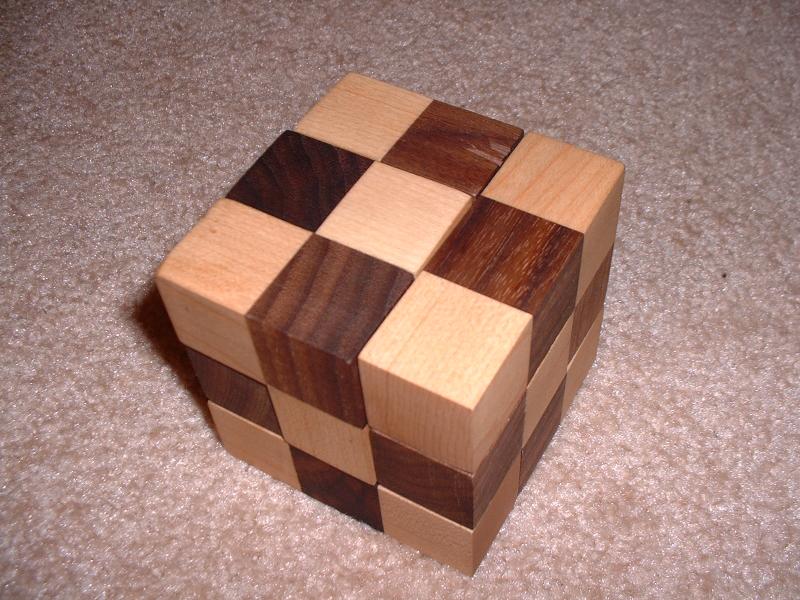
Soma Cubes, Assembled
According to Wikipedia, Hein invented these cubes while listening to a lecture on quantum mechanics by Heisenberg. I should have such a mind. Most of the Wiki article is beyond me; I can conjugate Latin verbs far more easily than I can comprehend mathematical stuff. But I remember my father’s sets, so I was reminded of them as I thought about puzzles.
Country store on dirt road. Sunday afternoon. July 1939. Gordonton, North Carolina. Kerosene pump on the right and gasoline pump on the left. Rough, unfinished timber posts have been used as supports for porch roof. Brother of store owner stands in doorway. Photo by Dorothea Lange. Found at /r/historyporn, posted by /u/texanwill.
One family took photos of what this area looks like now, you can see them at Panoramio; photos by coleimage. Below: Country Store No. 2.
I have reblogged this article from Business Insider for the benefit of those who can’t see the article with NoScript. Apparently this page embeds 16 tons worth of trackers and scripts. Note: There are more links in the original article which are worth following; I have included only two.
Researchers Who Provided Key Evidence For Gluten Sensitivity Have Now Thoroughly Shown That It Doesn’t Exist
by Jennifer Welsh
In one of the best examples of science working, a researcher who provided key evidence of (non-celiac disease) gluten sensitivity recently published follow-up papers that show the opposite.
The first follow-up paper came out last year in the journal Gastroenterology. Here’s the backstory that makes us cheer:
The study was a follow up on a 2011 experiment in the lab of Peter Gibson at Monash University. The scientifically sound — but small — study found that gluten-containing diets can cause gastrointestinal distress in people without celiac disease, a well-known autoimmune disorder triggered by gluten.
They called this non-celiac gluten sensitivity.
Gluten is a protein composite found in wheat, barley, and other grains. It gives bread its chewiness and is often used as a meat substitute. If you’ve ever had “wheat meat,” seitan, or mock duck at a Thai restaurant, that’s gluten.
Gluten is a big industry: 30% of people want to eat less gluten. Sales of gluten-free products are estimated to hit $15 billion by 2016.
Although experts estimate that only 1% of Americans — about 3 million people — suffer from celiac disease, 18% of adults now buy gluten-free foods.
Since gluten is a protein found in any normal diet, Gibson was unsatisfied with his finding. He wanted to find out why the gluten seemed to be causing this reaction and if there could be something else going on. He therefore went to a scientifically rigorous extreme for his next experiment, a level not usually expected in nutrition studies.
For a follow-up paper, 37 self-identified gluten-sensitive patients were tested. According toReal Clear Science’s Newton Blog, here’s how the experiment went:
Subjects would be provided with every single meal for the duration of the trial. Any and all potential dietary triggers for gastrointestinal symptoms would be removed, including lactose (from milk products), certain preservatives like benzoates, propionate, sulfites, and nitrites, and fermentable, poorly absorbed short-chain carbohydrates, also known asFODMAPs. And last, but not least, nine days worth of urine and fecal matter would be collected. With this new study, Gibson wasn’t messing around.
The subjects cycled through high-gluten, low-gluten, and no-gluten (placebo) diets, without knowing which diet plan they were on at any given time. In the end, all of the treatment diets — even the placebo diet — caused pain, bloating, nausea, and gas to a similar degree. It didn’t matter if the diet contained gluten. (Read more about the study.)
“In contrast to our first study … we could find absolutely no specific response to gluten,” Gibson wrote in the paper. A third, larger study published this month has confirmed the findings.
It seems to be a “nocebo” effect — the self-diagnosed gluten sensitive patients expected to feel worse on the study diets, so they did. They were also likely more attentive to their intestinal distress, since they had to monitor it for the study.
On top of that, these other potential dietary triggers — specifically the FODMAPS – could be causing what people have wrongly interpreted as gluten sensitivity. FODMAPS are frequently found in the same foods as gluten. That still doesn’t explain why people in the study negatively reacted to diets that were free of all dietary triggers.
You can go ahead and smell your bread and eat it too. Science. It works.
Bitches. [1] Note: While Celiac disease is a real and well-known condition, “gluten sensitivity” and eating gluten-free seems to be the latest fad, along with green coffee beans and garcinia cambogia
Colored School at Anthoston.
Census 27, enrollment 12, attendance 7. Teacher expects 19 to be enrolled after work is over. “Tobacco keeps them out and they are short of hands.” Ages of those present: 13 years = 1, 10 years = 2, 8 years = 2, 7 years = 1, 5 years = 1. Location: Henderson County, Kentucky
There appears to be no information regarding photographer or date, but it’s an intriguing photo.
I recently came across a fascinating article entitled “The Reykjavik Confessions: The mystery of why six people admitted roles in two murders – when they couldn’t remember anything about the crimes.” One of my facebook friends described this piece thusly:
“If you like Nordic noir, it doesn’t come much more Nordic or more noir than this. But it turns out to be a story of what interrogations can do to people, and why they may end up admitting to crimes they never committed.”
This article resonated strongly with me, due to two experiences in the days of my youth. I still think of them with discomfort.
When I first moved out West from the East Coast, I stayed with my grandmother before starting university. My family knew I was interested in collecting coins; at some point a keychain which featured a Morgan dollar went missing from an aunt’s house and I was immediately accused of having taken it. The pressure from family members was so intense that I, at the tender and callow age of 19 actually began to wonder if I had committed a crime and suppressed the memory. Despite my sincere protestations, my grandmother used every possible emotional club in her arsenal, and she had heavy weaponry, to get me to confess to having taken this trinket. Naturally, I knew nothing about it. Some time later, the item in question turned up in the pocket of a nail apron used by my uncle (who by this time had passed away.) My aunt was profuse in her apologies, but my grandmother never even mentioned it again, going to her grave with the idea that I was still somehow guilty of a crime that had never been committed; nary the hint of acknowledgement or apology.
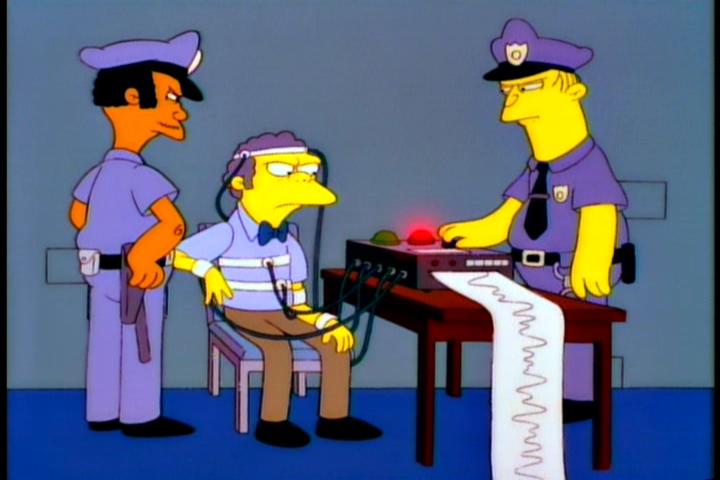
The second tale involved my work for a restaurant several years later. I was working for a concern run by a partnership of two gentlemen (term used very loosely, mind you.) Despite being in a management position I was never entrusted with any financial responsibility or authority, but at some point it was announced that some money had gone missing from a safe in the restaurant (and at no time was I ever privy to the combination thereof.) I was told that everyone on the staff was being asked to take a lie detector test at the local police station. Despite the fact that this was a blatant lie, as I found out later – I was the only one who ever had to go down – I remember the experience with such distaste that it has remained with me forever after. I was “interviewed” by a lieutenant of the local police force; I’m tempted to mention his name because he was an asshole, but he’s dead now and de mortuis nil nisi bonum and all that.
I got asked all sorts of embarrassing, probing questions, many of which had nothing to do with the event they were investigating. There is no more unsettling feeling than to sit and be told that you’re a criminal, and that they know you’re a criminal, and that they’re going to find the truth no matter what it takes… when you know for certain that you are innocent and uninvolved. At the end of the procedure, Lieutenant Douchebag told me that my results were “highly deceptive,” and I went away wondering if I was going to be thrown in the clink for something I had neither done nor even ever considered. But I got a small taste of what it must be like to be interrogated in this way; I cannot imagine the emotional distress felt by the people in the above-mentioned article. A lot of them were clearly petty criminals, but they didn’t deserve to have their lives scarred and/or ruined for something they never did.
The lie detector can be considered a modern variant of the old technique of trial by ordeal. A suspected witch was thrown into a raging river on the premise that if she floated she was harnessing demonic powers.
The takeaway for me is that it is far too easy to put people in a situation where they feel vulnerable and powerless, and hammer away at them until they begin to doubt things they know for certain and accept things that they know nothing about. I suspect that with training, one could inoculate oneself against such techniques to a certain extent, but really, what’s the payoff for the average person who will not find themselves in such a position? Whatever the case, it’s disturbing.
I’ve written about this bit of Internet stupidity before. It boggles my mind that scummy advertisers continue to use this, but it must generate revenue, or they wouldn’t do it.
Lower My Bills[1] is one of the worst offenders.
You see, I never encounter ads on my desktop machine; Ad Blocker Plus and a few other good extensions take care of that. My smartphone is not so lucky. Here’s an example; check out the ad with the little T-Rex running across it as an attention-getter below.
Now I don’t fall for such rubbish, but today I decided to jump down the rabbit hole just to see where it leads. I was taken to screen after screen requesting my personal information; the usual stuff about what cars I had, how I use them, and what kind of coverage I wanted. They also wanted my address, my phone number, my date of birth, my email address, and a whole bunch of other stuff. Naturally, as with Nigerian scammers, I provided bogus information for everything.
Finally, I got to the last page, where I was promised my free results, and – supposedly – the “ridiculously easy trick”.
Before we click, let’s look at that text disclaimer:
By clicking the button above you agree to be matched with up to 8 partners and/or providers from the LMB Partner Network and their agents and partners and for them and/or us to contact or market to you (including through automated and/or pre-recorded messages/means, e.g. automated telephone dialing systems and text messaging) about insurance information via telephone, mobile device (including MSM and MMS), and/or email, even if your telephone number or email address is on a corporate, state, or the National Do Not Call Registry, and you agree to our Terms of Use and Privacy Policy. You understand that your consent is not required as a condition to purchase a good or service.
Now that’s just scary. If you enter your real data, hoping to learn a “ridiculously easy trick” or even get quotes for low-cost insurance, this is the kind of marketing you will get by mail, by phone, by email, and on your cell phone:
That’s right. A virtual Niagara Falls [2] worth of spamvertising, and you’ve just given these putrescent scumballs your permission to do it.
That’s how Lower My Bills works: T’hey gather your personal information, and sell it to every single possible entity on earth that wants to spam you, who will in turn sell it to the rest of the universe. They offer no other goods or services, even if they claim to do so. This is the height of disreputable, dishonorable marketing, and their ads infest the net like a plague of locusts.
If that’s not scary enough, look at that last sentence:
You understand that your consent is not required as a condition to purchase a good or service.
This means that you have given them permission to sell you their and their partners’ excrement without your explicit agreement, thus opening the door to fraudulent charges on your credit card.
Now let’s see what all that PII got me:
Yup. Exactly nothing. They suggest a few providers, but no “ridiculously easy trick,” no promised quote, nothing. But they would have had all my information, and that information would result (usually within minutes) in a flood of calls, emails, texts, and other ongoing hqiz from people wanting to sell me everything under the sun.
Do yourself a favor. Any time you see that “one weird trick” or anything like it, realize that you’re dealing with a borderline criminal operation, and stay as far away from such drones and scumbags as you possibly can. If you see Lower My Bills, run like hell in the other direction. Oh, and spread the word, too; if you have vulnerable loved ones who are not terribly computer-savvy, make sure they understand this.
Despite our overwhelming workload at Columbus College of Art & Design we bring it upon ourselves to create a chalkboard every week. We have taken over the chalkboard on the third floor of Crane and every Monday a new board appears.
I happen to love the work above more than perhaps any, but that’s just a personal preference because I love Dr. Tyson. Everything they do is filled with awesome.












 Playing in the World Game
