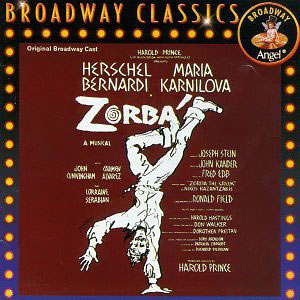
One of my all-time favorite albums – I deeply regret I was never able to see the original Broadway production. I could have, I was living in New York at the time, but it just didn’t happen.
I’ve long loved the songs in this wonderful and bittersweet story, but for some reason the lyrics to most of the songs never showed up on the Internet.
Here they are – my very best transcription. There are just a few blanks that I haven’t been able to figure out yet.
Music and lyrics Copyright Kander and Ebb
Life Is
Life is a glass of rum!
No!
Life is a sip of sage!
No!
Life is the taste of raki flowing warmly from the cup!
Shut up!
Life is a walnut leaf!
No!
Life is an olive tree!
No!
Life is a scented melon-breasted woman when her lips are red and full…
No!
Life is a barbered, planted orchard and two lovers passing by it!
Life is my fist in your face if you don’t keep quiet!
What did you say?
I said, “Life is my fist in your face if you don’t keep quiet!”
Oh? Oh? Oh! Oh!
Wait. Listen to me. I will tell you.
Life is what you do while you’re waiting to die,
Life is how the time goes by!
Life is where you wait while you’re waiting to leave,
Life is where where you grin and grieve!
Having if lucky, wanting if not,
Looking for the ruby underneath the rot,
Hungry for the pilaf in someone else’s pot,
But that’s the only choice you’ve got!
Life is where you stand just before you are flat!
Life is only that, mister,
Life is simply that, mister,
That and nothing more than that!
Life is what you feel,
‘Til you can’t feel at all,
Life is where you fly and fall!
Running for shelter, naked in the snow
Learning that the tear drops any where you go
Finding its the mud that makes the roses grow
That’s the only choice you know!
Wait! Once again…
Life is what you do while you’re waiting to die…
This is how the time goes by!
The First Time
I hear a bouzouki…
You can’t imagine how often I’ve heard a bouzouki,
But each time is the first time.
I sniff at a woman…
You can’t imagine how often I’ve sniffed at a woman,
But each time is the first time.
I pound on a table, I leap on a chair,
I crawl up a mountain, to breathe in the air,
By now I’ve stopped counting
How often I’ve been there,
But each time is the first time.
I look at a flower,
I stick my nose in, or stare at, or sleep on a flower,
But each time is the first time.
I soar like a seagull, I stamp like a bull,
I comb out my whiskers, so ladies can pull,
I chew on the mutton until my belly’s full,
But each time…
A hat, a dumbeg, a person, each time is new.
For instance, I came up and I talked to you.
Look how interesting I am!
(That’s true!)
Even if it’s not a long talk, even if you don’t talk the same language…
Do you want to hear a story?
(Well, I…)
Then I’ll tell you!
There was a night in Beirut
I never will forget
When I ran across the nicest man
I think I ever met
We were sitting drinking vodka
In this waterfront cafe;
I could tell he was a Turk,
But I liked him anyway!
Well, we had so much to drink
That we decided we should speak;
I’m not so good in Turkish,
He was even worse in Greek.
But we wanted to communicate,
And suddenly, by chance,
We hit upon a system,
And we both began to dance.
We couldn’t talk the language,
So we danced it all instead,
And the two of us could understand
What one another said.
So we had our conversation,
Which was crazy, I recall,
But it seemed it was the first time
I had ever talked at all!
Wait! You!
(Me?)
Show!
♬ Bouzouki music ♬
He says he’s from Ankara.
♬ Bouzouki music ♬
He says he has a wife and two small children.
♬ Bouzouki music ♬
He says he misses them very much!
♬ Bouzouki music ♬
So you see, he’s been away now for 18 months.
(No! 17!)
Say that again…
♬ Bouzouki music ♬
Seventeen…
(song continues…)
I walk with the Devil, he gives me a poke,
And all 10 commandments, go right up in smoke,
But each one I’ve broken, I feel that I broke for the first time!
The first time!
I talk to a stranger,
You can’t imagine how often I talk to a stranger,
But this time,
This time,
Is the first time!
House at the top of the hill
Zorba! Zorba!
There’s a house at the top of the hill
Where someone’s waiting for you.
There’s a room in the house at the top of the hill
Where someone’s waiting for you.
Waiting for you!
There’s a door to the room of the house at the top of the hill,
Where someone’s waiting for you.
Waiting for you!
There’s a woman at the door…
There’s a woman at the door…
There’s a woman at the door…
In a room in a house at the top of the hill,
Waiting for you!
Zorba!
And the roof is red!
And the woman is French!
And the walls are white!
And the woman is French!
And the steps run down!
And the woman is French!
And the well is cool!
And the woman is French!
At the house at the top of the hill!
Zorba!
And the ouzo’s weak!
And the veal is tough!
And the bed is hard!
And the sheet is rough!
And the bread is old!
And the wine is hot!
And the night is cold!
But the woman is not!
At the house at the top of the hill!
There’s a house at the top of the hill
Where someone’s waiting for you.
Waiting for you!
There’s a room in the house at the top of the hill
Where someone’s waiting for you.
Waiting for you!
There’s a door to the room of the house at the top of the hill,
Where someone’s waiting for you.
Waiting for you!
There’s a woman at the door…
There’s a woman at the door…
(Mme Hortense! Mme Hortense! People are here! Two men, coming up the hill!)
Zorba! Zorba!
There’s a house at the top of the hill
Where someone’s waiting for you.
Waiting for you…
Waiting for you!
No Boom Boom
Crete was in a state of revolution!
The fleets of four great powers anchored here…
Hmm… So, I also anchored here.
Four great powers!
Four admirals… ahh… you should have seen them!
There they were, my admirals, the image of romance,
From England, Russia, Italy, and France.
There they were, my brave quartet,
Dressed in their navy blues,
With wide, plumed hats, and golden braid,
And patent-leather shoes.
They were just about to fire… on Crete!
When on my knees, in my pink chemise,
I destructed them toute de suite!
By saying…
Please sir, little admiral, no Boom-boom!
Please sir, pretty admiral, no Boom-boom!
This evening when it’s dark, I’ll let you come to my room,
But first you have to promise, No Boom-boom!
Please sir, little admiral, no Boom-boom!
La la la la…
Please sir, little admiral, no Boom-boom!
La la la la…
This evening when it’s dark, I’d like to come to your room,
But first you have to promise, No Boom-boom!
And they listened to me!
Ah, we could see the Cretans through our binoculars…
They looked so tiny…
I seized the beard of the Italian admiral (I was more familiar with him)
I seized his beard and I said,
“My Canavaro, please don’t shoot the little people!”
Mmm… how nice he smelled…
How nice they all smelled…
My Frenchman smells of lemon, my Italian violet,
My English smell of something, I forget…
My Russian wore a musk they make from oily Georgian bark,
I learned each smell so I could tell tell between them in the dark!
They’d fill a bath with pink champagne, and throw me in the tub…
While two would drink, the other two would scrub!
We played that way until the day they set this island free,
And so my dear, if Crete’s still here, it’s all because of me!
It was I who kept the navy in tow!
But did your king ever say a thing? Or decorate me? No!
Please sir, little admiral, no Boom-boom!
That’s what I always used to say.
Please sir, pretty admiral, no Boom-boom!
I had a most convincing way.
This evening when it’s dark, I’ll let you come to my room,
But first you have to promise, No Boom-boom!
No boom-boom, hey boss! No boom-boom!
(Singing and laughing)
Please sir, little admiral, no Boom-boom!
Please sir, pretty admiral, no Boom-boom!
This evening when it’s dark, I’ll let you come to my room,
But first you have to promise,
Promise, promise, promise,
No Boom-boom!
No Boom-boom!
No boom, boom, boom!
The Butterfly
Not too fast, not too fast,
Let it grow, let it last,
Nature knows when and why…
The butterfly:
I remember one morning when I saw a cocoon in the bark of a tree,
I remember I marveled that imprisoned inside was a butterfly waiting to be free.
Not too fast, not too fast,
Let it grow, let it last,
Nature knows when and why…
Continue…
I was very impatient so I warmed the cocoon with the breath of my sighs,
And the butterfly trembled and began to emerge like a miracle right before my eyes.
Not too fast, not too fast,
Let it grow, let it last,
Nature knows when and why…
Sorry…
All at once I discovered that his delicate wings were all crumpled and torn,
When he still wasn’t ready I had made him be born.
I was stronger than nature and I had made him be born.
But the wonder of life had a definite plan,
So he died in my hand by the will, not of God, but of man.
Not too fast, not too fast…
Every man has a moment and I’m waiting for mine, when I’m finally free.
But I mustn’t be hurried.
Give me light…give me time.
Like the butterfly…
Like the butterfly…
Like the butterfly…
Like the butterfly…
Not too fast, not too fast,
Let it grow, let it last,
Nature knows when and why…
Think about the story of the butterfly,
Think about the story of the butterfly,
Think about the story of the butterfly,
Think about the story of the butterfly,
The butterfly…
Not too fast…
Goodbye, Canavaro
Goodbye, Canavaro!
Goodbye, Bouboulina!
Don’t forget me!
I won’t forget you!
Yes you will.
No I won’t.
Yes you will.
No I won’t!
Well, goodbye!
Wait, Canavaro!
What, Bouboulina?
A kiss! Of course! *smack*
Don’t forget me.
I won’t forget you!
How long will you be gone?
I’ll only be gone three days.
That’s time enough…
For what?
To forget me.
I won’t forget you.
Are you sure?
Yes I’m sure.
Very sure?
Very sure!
Well, we’ll see.
Wait, Canavaro!
What now, Bouboulina?
Will you bring me a present?
Yes, I’ll bring you a present.
You know, I’d like a ring.
I know you would… I’ll see.
No you won’t.
Yes I will.
No you won’t.
Yes I will!
Well… goodbye.
Adieu, Canavaro!
Adieu Bouboulina!
Don’t forget me!
I won’t forget you, I promise I won’t forget you,
I solemnly swear on my mother’s grave
I never, never, ever will forget you!
He’ll forget me.
No he won’t.
Yes he will.
No he won’t.
Yes he will. I know it’s true.
Why would he forget you?
Oh, I don’t know…
They always do.
But until they do… it’s very nice.
Grandpapa
A young man with no money is better than an old man with no money.
Goodbye, Grandpapa!
Grandpapa? Grandpapa? I’ll show you who’s Grandpapa!
Zorba! Zorba!
Listen! There are two Zorbas. The inner Zorba is as slender as a reed!
Look at that, look at that, poor old man is weak and fat!
He has thirty-two teeth!
Look at that, there’s no doubt, every tooth is falling out!
He wears a red carnation behind his ear!
Look at that, over there, golden beard but long white hair.
Asses hair!
This is the outside Zorba!
Look at that, Poor Zorba, old and feeble Grandpapa,
Weak and feeble Grandpapa.
Weak and feeble Grandpapa
Grandpapa, Grandpapa, Grandpapa, Grandpapa, Grandpapa,
Grandpapa, Grandpapa, Grandpapa, Grandpapa, Grandpapa!
(Zorba dances)
Only Love
To be loved again
To be not alone,
Oh, Mr. Niko,
Do you know what that means,
To have someone love you,
To open your heart, freely?
Love…
Give me love,
Only love…
What else is there?
Two eyes not seeing,
And two arms not sharing,
And two lips not feeling,
What good are they?
Doesn’t the night seem endless?
Doesn’t the day go slow?
Doesn’t the dark look friendless, and Oh!
What good is that?
So…
Give me love,
Only love…
That’s everything!
Two eyes start seeing,
And two arms start sharing,
And two lips start knowing how good it is!
To feel, to touch, to care!
For after all, after love, what else is there?
Niko! Niko!
There’s a girl at the bend of the road,
And she is waiting for you!
Waiting for you!
There’s a girl in a house at the bend of the road,
And she is waiting for you!
Waiting for you!
Niko!
There’s a girl in a room in a house at the bend of the road,
And she is waiting for you!
Waiting for you!
There’s a girl on a bed
There’s a girl on a bed
There’s a girl on a bed
In a room in a house at the bend of the road,
Waiting for you!
Niko!
But the night is warm and she needs no sheets,
So she kicks that sheet to the bottom of the bed,
To the bottom of the bed in the lonely room,
Of the house at the bend of the road.
Niko!
She will call your name, but when you won’t come,
She will sit and cry like a little girl,
Like a little girl on the empty bed
In the lonely room of the big old house,
The house at the bend of the road!
There’s a girl at the bend of the road,
And she is waiting for you!
Waiting for you!
There’s a girl in a house at the bend of the road,
And she is waiting for you!
Waiting for you!
There’s a girl in a room in a house at the bend of the road,
And she is waiting for you!
Waiting for you!
There’s a girl on the bed,
There’s a girl on the bed!
Who is it? Who is there?
It’s me, Niko!
Come in…
For after all, after love, what else is there?
Yassou!
For the servant of God, Alexis, and the servant of God, Hortense, now affianced together, we beg salvation, O Lord!
Dance Isaia
Dance Isaia
Isaia
Yassou! Yassou! Yassou! Yassou! Yassou!
A lily and a veil, to represent her purity,
A lily and a veil to be sure,
Ah! Ah!
Did you hear that? Did you hear that? I’m pure!
Yassou! Yassou! Yassou! Yassou! Yassou!
Some water from the well, to summon back his innocence,
The chalice and the water just for you!
Ah! Ah!
Canavaro! What? You’re my virgin too!
Yassou! Yassou! Yassou!
Wreaths of roses and cherries from the tree,
To show that she is married, she’s absolutely married,
She’s positively married,
She certainly is as married as she’ll ever be!
Yassou! Yassou! Yassou! Yassou! Yassou!
Confetti we can throw to represent our happiness,
Exchange the rings and drink the wine and then…
Dance Isaia
Dance Isaia
Isaia
Promise you will never part again!
Dance Isaia
Dance Isaia
Isaia
Canavaro? I promise!
Bouboulina? I promise!
Amen!
Yassou! Yassou! Yassou! Amen!
Yassou! Yassou! Yassou! Amen!
Come my sweet!
Let me give you the first respectable kiss you’ve ever had!
Amen!
Why Can’t I Speak?
Why can’t I Speak?
Why won’t the words come
Why do I stand here, trembling and silent?
Why can’t I speak?
Why am I frightened?
Why can’t I answer what he is asking?
Why can’t I Speak?
Why am I waiting?
Why don’t I say it?
Let out this feeling.
When we’re together, why won’t the words come?
Why can’t I Speak?
Excuse me for saying it, but it is wrong to keep your feelings locked up inside yourself.
Try to share your feelings freely. Share them with me!
Niko, I want you!
Niko I’ll say it: Niko, I feel like I’m living at last!
Niko I’ll be good to you,
Niko I’ll take care of you,
Niko [????]
Why can’t I speak?
Why won’t the words come
Why do I stand here, trembling and silent?
Why can’t I speak?
Why am I frightened?
Why can’t I answer what he is asking?
Why can’t I Speak?
Why am I waiting?
Why don’t I say it?
Let out this feeling.
Why can’t I speak?
Some day I know that we will be able to talk together!
Why?
I will be late for the Church.
The Crow
Soon we’ll here the crow whistle a low, beckoning note.
Then someone will turn, face to the wall, clutching her throat.
I want her watch!
I want her shoes!
I want her gown!
I want the ribbon!
Soon we’ll see the crow perch on the sill, stare at the door.
Then make up his wings, shadows that spill over the floor.
Crow, come from the clouds, black as the shroud she’s never worn,
Crow cackle and cry, what does it ????
Never was born!
Soon we’ll see the crow, circle and dive, flutter and climb,
Then, someone in bed, barely alive, knows it’s the time.
Look! Look!
Oh, Canavaro – how young I was, how beautiful, like a dove!
And you are beautiful still, my dove – and young!
So young!
My mother dressed me in a white organdy gown, and she said, “Ladies and Gentlemen, my beautiful daughter! It’s her birhtday, she’s 16 years old.”
And my mother said, “You will dance through life. You will dance all through life!”
My mother says that little girls are made of sugar.
Happy birthday! (Happy birthday!)
My mother says my life will be a wide, white ribbon.
Happy birthday! (Happy birthday!)
And all my tomorrows are waiting in a line
Shimmering, glimmering, soon to be mine.
My mother says, she looks at me and she remembers.
Happy birthday! (Happy birthday!)
She envies me the love I’m just about to see.
But she was yesterday (she was yesterday)
And I’m tomorrow (I’m tomorrow)
Happy birthday (Happy birthday)
To me!
La, la, la, la, la, la, la, la, la, la
Happy birthday! (Happy birthday!)
La, la, la, la, la, la, la, la, la, la
Happy birthday! (Happy birthday!)
And all my tomorrows are waiting in a line
Shimmering, glimmering, soon to be mine.
My mother says, she looks at me and she remembers.
Happy birthday! (Happy birthday!)
She envies me the love I’m just about to see.
But she was yesterday (she was yesterday)
And I’m tomorrow (I’m tomorrow)
Happy birthday (Happy birthday)
Happy birthday (Happy birthday)
Goodbye, Canavaro!
Goodbye, Bouboulina!
Don’t forget me…
I Am Free
I have nothing. I want nothing.
I am free!
I need nothing. I owe nothing!
I am free!
If my feet say, “Come this way!” I probably would,
But if they say, “Go that way!” that way is just as good.
I ask nothing.
I judge nothing.
I am free!
There is one Zorba, and that Zorba
I must be!
Heaven waits for other men, but not for me!
I fear nothing! I hope for nothing!
I am free!
Hey Boss, you wanna hear a story?
Yes.
You do? Then I’ll tell you.
One morning in Salonika, I never will forget,
I was passing by the oldest man I think I ever met.
He was kneeling in an orchard,
When he turned and looked at me,
And he said, “Come watch me, Sonny, as I plant this almond tree!”
I tell you, Boss, that fellow, he was over 95,
And I think he had a week, or maybe two to stay alive,
But he had to plant that almond tree, and when I asked him why,
He said, “I live every minute as if I would never die.”
Think of that, Boss! He lived as if he would never die.
I live as if I would die any minute!
For that reason… just that reason,
I am free!
I see somewhere, I go somewhere!
I am free!
Think of that whenever you remember me!
I fear nothing!
I hope for nothing!
I am free!
Dialog:
My boat doesn’t leave for an hour… I’ll walk a ways with you.
No, no, let’s do it quick, here and now,
Like men cut short smoking, wine, or a love affair.
Come! Embrace Zorba!
Life is what you do while you’re waiting to die,
Life is how the time goes by!
Having if lucky, wanting if not,
Looking for the ruby underneath the rot,
Hungry for the pilaf in someone else’s pot,
But that’s the only choice you’ve got!
Life is what you do while you’re waiting to die,
Life is how the time goes by!
This is how the time goes by!











 Playing in the World Game
