The HP-01 – the world’s first calculator watch (among others)

hp01-booklet-04

In 1977, Hewlett-Packard introduced the HP-01, the world’s first calculator watch. It was not only a marvel of miniaturization for its time, but also had some unique features:

  • It was HP’s first algebraic calculator (all previous units used reverse polish notation)
  • It included a stopwatch that permitted elapsed time to be multiplied or divided by a constant, and continuously displayed the results (Dynamic Rate Calculation)
  • Included a data type for time, date, and time interval, and the ability to perform mathematical operations on these data types.

At $650 for the basic model, it was expensive for its time and became a status symbol, however; one online commenter named MrG stated, “I used to work at the Corvallis HP plant, where the HP-01 was built. It was long out of production when I was there, but those who had one regarded it as a prestige item. There was sort of a standing joke that when people took it off their wrist, they walked leaning to the other side — it was kind of a hefty item.”

HP’s information site states, “The HP-01, code-named “Cricket,” was not a successful product for HP. It was too bulky and heavy, and HP sold it though upscale jewelry stores. But miniaturizing the math functions was quite an engineering feat, and when HP discontinued manufacturing the HP-01, its inner workings were destroyed so no one would copy the extraordinarily small package engineering. The HP Archives has a few of the remaining elements.”

xlg_hp_watch

It’s small wonder that these items when offered on eBay can fetch up to $5,000 – they are true museum pieces, representatives of the headlong technological rush towards smaller and faster.

I have a small collection of the watches I have owned over time, and one of my favorites is the CA-95, Casio’s calculator watch with multi-alarms, shown at left below. Click through to hear it play.

Watches

Before the advent of PDA’s and smartphones, a watch like this was one way a g33x0r could satisfy his itch for technology, and by the 80’s, Casio had refined the circuitry to a point where the DataBank watch on the right, which carried large numbers of memos, appointments, and phone numbers, as well as multiple stopwatches, timers, world time clocks, and alarms, sold for about $65.00. They still sell versions of this watch. You’ll notice that mine is still running – but sadly the case has broken and won’t hold a pin on one side, or I’d still be wearing it.

Sadly, the CA-95 was one of those transient items which came and went, much like their infrared remote watch:
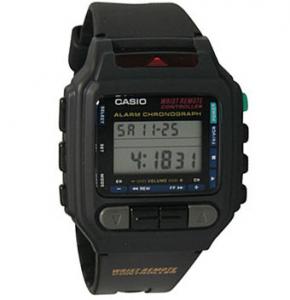
Casio Remote

I gave this watch to my younger son, and after he got tired of it I claimed it back. Now, of course, most of the remote codes it contained are out of date, but it’s biggest draw was being able to surreptitiously change the channels on annoying TV’s in public places.

But back to the CA-95: I bought mine in Hannover airport on my way home from CEBIT 1983. I loved this watch, as in addition to the various calculator and timer and stopwatch functions, it had four different musical alarms. One was “Scarborough Fair,” and the other was “The Syncopated Clock.” It had circuitry to give the alarm sounds pitch variations and reverb, and included fairly robust speaker in the back, such that the alarms sounded much better than your typical modulated computer beep. Despite the damage to the LCD, mine still works – sorta. They’re a bear to take apart and put back together again because of all those little buttons, but I loved it so much that I may take it up to CSS in Salt Lake and see if they can get it up and running again.

And, as a gratuitous lagniappe, I also have one of these:

TI-500_1

Texas Instruments TI-500.

The Old Wolf has spoken.

Mythbusters: Vaporizing a compact car

Found this GIF file the other day at a Russian picdump, and was pretty awestruck by what was going on:

carsmash

A single search brought up the breathtaking video of what happens when a rocket sled traveling close to 700 mph meets a stationary object.

In effect, the vehicle, the sled, the 1-inch-thick steel plate behind the car, and a lot of the dirt simply cease to exist as we know them.

When emergency crews reached the site of United Airlines flight 93, they said there was almost nothing to recover; these sort of forces help to understand why. What we think of as solid objects are pretty much just liquid and gas at those speeds.

It also crossed my mind that the rocket-sled incident in “Kingdom of the Crystal Skull” was pretty cheap compared to reality.

Scary.

The Old Wolf has spoken.
Children’s Poetry I Have Loved, Part 3

Antonio

by Laura E. Richards

(This one had me rolling on the floor every time I read it)

Antonio, Antonio
Was tired of living alonio.
He thought he would woo
Miss Lissamy Lu,
Miss Lissamy Lucy Molonio.

Antonio, Antonio,
Rode off on his polo-ponio.
He found the fair maid
In a bowery shade,
A-sitting and knitting alonio.

Antonio1

Antonio, Antonio,
Said, “If you will be my ownio,
I’ll love you true,
And I’ll buy for you
An icery creamery conio!”

Oh, Nonio, Antonio!
You’re far too bleak and bonio!
And all that I wish,
You singular fish,
Is that you will quickly begonio.”

Antonio, Antonio,
He uttered a dismal moanio;
Then he ran off and hid
(Or I’m told that he did)
In the Antecatarctical Zonio.

Antonio2

Children’s Poetry I have Loved, Part 2

The Tale of Custard the Dragon

by Ogden Nash
Silhouettes by Janet Laura Scott and Paula Rees Good
Published in 200 Best Poems for Boys and Girls, Whitman Publishing Company, 1938

Belinda lived in a little white house,
With a little black kitten and a little gray mouse,
And a little yellow dog and a little red wagon,
And a realio, trulio, little pet dragon.

Custard1

Now the name of the little black kitten was Ink,
And the little gray mouse, she called her Blink,
And the little yellow dog was sharp as Mustard,
But the dragon was a coward, and she called him Custard.

Custard the dragon had big sharp teeth,
And spikes on top of him and scales underneath,
Mouth like a fireplace, chimney for a nose,
And realio, trulio, daggers on his toes.

Belinda was as brave as a barrel full of bears,
And Ink and Blink chased lions down the stairs,
Mustard was as brave as a tiger in a rage,
But Custard cried for a nice safe cage.

Belinda tickled him, she tickled him unmerciful,
Ink, Blink and Mustard, they rudely called him Percival,
They all sat laughing in the little red wagon
At the realio, trulio, cowardly dragon.

Belinda giggled till she shook the house,
And Blink said Week!, which is giggling for a mouse,
Ink and Mustard rudely asked his age,
When Custard cried for a nice safe cage.

Custard2

Suddenly, suddenly they heard a nasty sound,
And Mustard growled, and they all looked around.
Meowch! cried Ink, and Ooh! cried Belinda,
For there was a pirate, climbing in the winda.

Pistol in his left hand, pistol in his right,
And he held in his teeth a cutlass bright,
His beard was black, one leg was wood;
It was clear that the pirate meant no good.

Belinda paled, and she cried, Help! Help!
But Mustard fled with a terrified yelp,
Ink trickled down to the bottom of the household,
And little mouse Blink strategically mouseholed.

But up jumped Custard, snorting like an engine,
Clashed his tail like irons in a dungeon,
With a clatter and a clank and a jangling squirm
He went at the pirate like a robin at a worm.

The pirate gaped at Belinda’s dragon,
And gulped some grog from his pocket flagon,
He fired two bullets but they didn’t hit,
And Custard gobbled him, every bit.

Custard3

Belinda embraced him, Mustard licked him,
No one mourned for his pirate victim
Ink and Blink in glee did gyrate
Around the dragon that ate the pyrate.

Belinda still lives in her little white house,
With her little black kitten and her little gray mouse,
And her little yellow dog and her little red wagon,
And her realio, trulio, little pet dragon.

Belinda is as brave as a barrel full of bears,
And Ink and Blink chase lions down the stairs,
Mustard is as brave as a tiger in a rage,
But Custard keeps crying for a nice safe cage.

Children’s Poetry I have Loved, Part 1

Posting Stevenson’s The Lamplighter reminded me that there are numerous other poems which stick in my memory from early childhood. When my mother passed away at the age of 94 in 2011, I found on her shelves a crumbling copy of Two Hundred Best Poems for Boys and Girls, compiled by Marjorie Barrows and published in 1930 and 1938. Printed on very non-durable paper, most of the book fell to dust when I tried to read it – but I immediately recognized it as a book that I loved from my earliest days. I was fortunately able to find an intact copy on Abebooks – it’s also yellowed and fragile, but complete. Just for fun, I thought I’d share some of my favorite youth poetry here, as the muse moves me, because it’s one thing that gave me a love of words and language from an early age.

Jonathan Bing’s Manners

Beatrice Curtis Brown

Jonathan Bing takes off his hat
Whenever he meets a Tabby-cat;
Jonathan Bing bows down to his toes
Whenver he passes a sheep he knows.
Oh, search from Paris to old Japan,
There’s none so courtly as Jonathan!

I’ve seen him murmer a “how-d’you-do”
To a tired forsaken dancing-shoe;
I’ve seen him lend his handkerchief
To a watering can that had come to grief;

I’ve seen him pat, without disdain,
An orphan goldfish who had a pain,
And he even lights a fire, I’m told,
To warm the air when the weather’s cold.

So what does it matter if people say
That he eats his peas in a vulgar way,
Or opens his mouth, to yawn, so wide
That twenty chickens could roost inside?
Oh, search from Paris to old Japan,
There’s none so courtly as Jonathan!

The Old Wolf has quoted.

How *not* to get a tattoo

A buddy of mine over at Facebook posted this picture which made me laugh out loud – really, I’ve sworn not to say “LoL” unless I really did:

Tat1

But that got me thinking, because so many people in this country (and probably others) get Chinese/Japanese characters tattooed in various places on their bodies, thinking their tats mean “bravery” or “samurai” or “golden lovebird” or “Tadgh Ó Suilleabhain”, only to find out when they bump into a native speaker that it really means something else again, or nothing at all.

An example from the wonderful website “Hanzi Smatter,” dedicated to identifying bad tats and what they mean (or don’t):

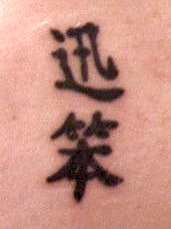
Fast Stupid

The customer wanted a tat that said “Fast and Furious”, but what they got was “Fast Foolish”

MChijj24Kdw

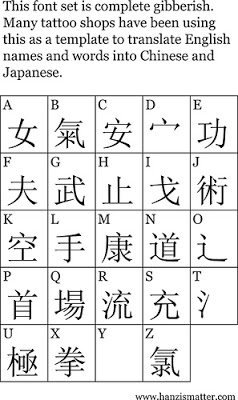
This one, on the other hand, is full of sound and fury, signifying nothing. It’s based on a gibberish asian font which was deciphered by Alan Siegrist, a professional Japanese-English translator and member of both Japan Association of Translators (JAT) and American Translators Association (ATA); with Alan’s help, tian (writer of Hanzi Smatter) compiled this chart, which has been widely circulated around tattoo parlors:

230620311_be32ad4912

(note this website, which is currently selling this chart along with some other character sheets for $64.99).

The very clever user DavidR created this website, where you can generate your own garbage tattoo text for your amusement. But for the love of Mogg’s holy grandfather, don’t use it! (Note: At this writing, only the “to nonsense” function works – the other direction throws a DB error.)

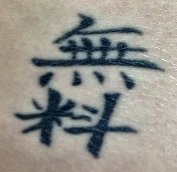
If you’re still not quite sure what’s going on, have a look at these pictures, which give you an idea of what a native speaker might see if they looked at your sic tat:

Tat2

This girl thought her tattoo says “Lord of the Dance”

Tat3

She was hoping for “Grace Under Pressure”

Tat4

“You mean, it doesn’t say ‘passion’?”

Tat5

“But you swore this meant ‘Hot Stuff’!”

So why does this happen with far-too-common frequency? First of all, we can’t heap coals on the head of the average tattoo artist, no more of whom are total idiots than you would find in the average business establishment (law firms excepted). The answer appears to lie in the fact that kanjis (or hanzi) look cool to many non-Asians, but take a gruntload of specialized education to understand properly – and that would hold true even if you didn’t speak the language but were simply trying to understand the general concept of ideographic writing, and what it would take to incorporate that into your artwork in a professional way. But the fact remains that when you extract the vast majority of well-meaning and honest tattoo artists out there,

  • Some of them are downright malicious, and think it’s funny to write “醜” (bad looking; shame; ugly; unclean) on some young lady’s arm;
  • Some of them have no more than a third-grade education to back up their admirable art skills, and just have no idea that the character chart they bought online is worth less than the powder to blow it to Hell with;
  • And some of them are incompetent and just draw crap, hoping the customer will never know the difference.

So what’s a body to do? Here are some helpful hints:

  • If you want a character tat, find someone you trust (and I mean, really trust, not your buddy who will draw dicks all over your face the next time you pass out at a party) who speaks the language, and let them help you design something that both looks good and means what you want it to mean.
  • Don’t trust a dictionary, either hardcopy or online. Dictionaries are only useful in direct proportion to your knowledge of the target language. That’s why

Free

is not a good thing to use if you want “freedom,” because it means “free”, as in “no charge” – it’s also poorly drawn.

  • Take your artwork to the tattoo artist of your choice, and have them design on paper what you’re going to have emblazoned on your body forever and ever worlds without end (remember these suckers are permanent unless you have more money than Donald Trump) and take that design back to your expert to make sure that a) it means what it’s supposed to mean, and b) it looks good. Doing this will mean working with a tattoo artist who doesn’t have severe ego issues and will be willing to work with you. Remember, it’s your money and your body, so you have the right to make sure you get what you expect.

The Old Wolf has spoken.