
A man opened his refrigerator to find a small rabbit on the shelf. “What are you doing in here?” asked the man. “Well,” replied the rabbit, “this is a Westinghouse, isn’t it? I’m westing…”
The Old Wolf ducks and runs.
A man opened his refrigerator to find a small rabbit on the shelf. “What are you doing in here?” asked the man. “Well,” replied the rabbit, “this is a Westinghouse, isn’t it? I’m westing…”
The Old Wolf ducks and runs.

Yes. I have used this.

Only a buck, sounds legit.
This appeared in my email today:

Sound too good to be true? Well, guess what.
From SFGate:
Q: I’ve been seeing TV commercials for Rabbit TV, a USB stick that supposedly provides free access to thousands of television stations worldwide over the Internet – including all the big networks, Disney and ESPN. Apparently when you plug it into an Internet-connected computer, a menu appears with links that take you directly to video streams. The Rabbit TV costs $10 a year. As a person who pays nearly $100 a month for satellite TV, I’m afraid this sounds too good to be true. Is Rabbit TV legit, or is it a scam?
A: It’s a big-time scam. All Rabbit TV does is point you to websites that have video. And, with rare exceptions for breaking news, the big U.S. networks don’t show live programming on the Internet. Ditto for ESPN, Disney and other top cable networks. With Rabbit TV, live streaming is limited to small local stations, religious and shopping channels. Repeat: There is nothing on Rabbit TV that you can’t get by entering a URL into your browser.
In fact, you can get the same experience that Rabbit TV provides by going to wwitv.com. That’s World Wide Internet Television, which, like Rabbit TV, has a clickable menu for accessing websites of global TV stations that show live and recorded programming.
This piece of junkvertising reminds me of the most deceptive advertisement I’ve ever seen.
Rabbit TV responds with the following text on their rebuttal website:
Q: Why would I use Rabbit TV when I can access most of the same stuff on my own?
A: Viewers want to spend time watching content, not searching for it.
Similar to the print publication TV Guide, who for years made you aware of what was going to be on your television set every week, Rabbit TV is simply more robust, interactive, and option-packed for the new age of TV, automatically gathering, categorizing, managing and organizing an overwhelming 2 million+ video updates daily. It also introduces you to loads of new content you’d never find on your own everyday, including massive worldwide options that aren’t even available through cable or satellite.
Rabbit TV does all the work, so you don’t have to.
If Rabbit TV were advertised as an information aggregator service, it would probably pass muster. Based on their spamvertising and their deceptive website (I don’t recommend clicking that link, but I provide it in the interest of full disclosure), however, they appear to offer one thing but in actuality offer something entirely different, and that’s where the problem lies.
The drones are still hoping that there’s a sucker born every minute; sadly, they’re right. No one is immune – all of us can be taken in by a slick operator if the conditions are right, because these slimeballs are very good at what they do. All we can do is educate ourselves and strengthen our resolve to be vigilant. And, of course, pass the word along.
I’ll stop (barely) short of calling it a scam myself because apparently there are some people who like this service; judge for yourself, but be careful out there.
The Old Wolf has spoken.
Every now and then something goes squirrely on a website that I’m viewing, so I fire up my other browsers to see if it’s a coding issue. Firefox and Chrome both have Adblock Plus installed, so I never see affiliate marketing or sponsored ads, but Internet Explorer is not so endowed. This morning I encountered this:

I have blogged in detail about pimsleurapproach.com (I recommend the original article), but their deceptive advertising campaign continues, so I felt moved to put up another warning.
Note: The same caveat applies here – I’m not talking about the Pimsleur method, currently owned by Simon and Schuster, which I happen to think is quite effective for obtaining some basic proficiency in a language; I’m talking about affiliate marketers like this outfit, whose slick website and deceptive marketing campaigns trick countless consumers into buying products they don’t want and never ordered.
Red Flags – if you see any of these marketing techniques, run the other way without looking back. Commercial concerns that use them have fewer scruples than a hungry weasel in a hen house.

This tactic screams “unethical.” Next to blinking text on a website (which you notice you almost never see any more) it’s one of the most hated advertising techniques out there, along with popups and popunders. If you see it, the company is saying to your face, “we don’t give a rat’s south-40 about you, we just want your money.”
There’s nothing wrong with the Pimsleur Method and the courses published by Simon and Schuster. I’ve used several of them successfully as a springboard into further study, and they can be fun and enjoyable, especially if you’re on the road. Many libraries have multiple copies which you can check out for free, and if you want the courses, go directly to Pimsleur’s website, or to Amazon where you can find many of these courses at a substantial discount. Just stay away from pimsleurapproach.com, unless you want to deal with a company whose principal goal is to separate you from your money at any cost.
The Old Wolf has spoken.

Advertising is insidious. For a perfect example, check the section on Salem cigarettes in this post. In the same way as my parents’ generation could not listen to the William Tell Overture without shouting “Hi-o Silver!”, I am unable to listen to the 1812 Overture by Tchaikovsky without thinking of Quaker Puffed Rice.

With thanks to Dave Berg
Sadly, no examples of the famous Quaker commercial appear to be extant on the internet. However, the ad featured music from the 1812 overture, of which some versions use actual cannon. The screen would be filled with images of puffed rice flying out of cannons as the music boomed in the background.

Here’s an older ad that highlighted the technique without the use of the music:
Just recently, I stumbled across this video of Lin Hai, an old vendor on the streets of China, using a rice cannon to create his own puffed rice and popcorn right on the street. It gives you an idea of how the Quaker product is made, something I had never really understood.
(Skip to 2:30 to watch the impressive part.)
Edit: I realized this discussion would be incomplete without showing what modern technology has done with this principle:
I saw one of these in operation at a local grocery store – the machine loads a scoop of rice into a press, and a few seconds later shoots out a perfectly-formed rice cake. Unfortunately, rice cakes still taste like styrofoam, but it was fun to watch.
Edit 2: For some odd reason, all the old Quaker commercials featuring the 1812 overture have been scrubbed from the Internet. I find this sad, and it’s not just this instance. A lot of the great old ads that had been captured are taken down by corporate attorneys in the name of “intellectual property protection” or some other nonsense. These ads belong to history and should be available to the public as a record of times and attitudes gone by, even if current marketings strategies have changed.
At one point there was an old commercial featuring the cast of “F Troop” singing about puffed wheat to the tune of the 1812 Overture, but it also has been scrubbed.
The Old Wolf has spoken.
Back in the 60’s, gas stations did interesting things to get your business. One such promotion was the Shell Mr. President’s game. A playing card is shown below:

Naturally, some coin were extremely rare – the ones required to finish a winning set – as illustrated by the blank spots above, and those coins also sometimes bore the motto “instant winner”.

These two samples are, of course, neither rare nor instant winners, but still an interesting little bit of cultural history.
Another incentive was this token, given out as a collector’s item:

Then there was Sunoco’s presidential collection:

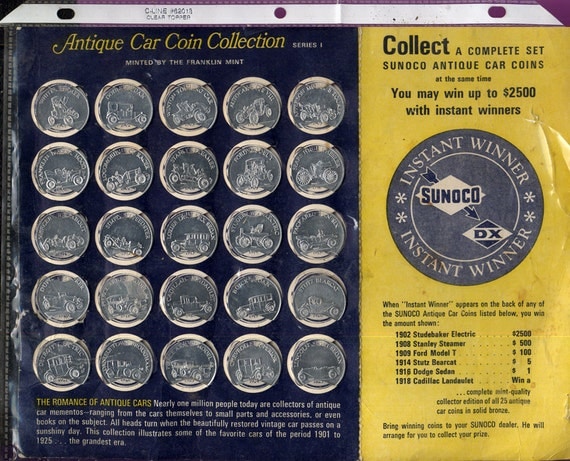
And their Antique Car collection:
In 1967, Union 76 in California begam the antenna topper craze with their orange balls:

Nowadays, it’s a rare thing for a gas station to offer any sort of incentive other than reward cards or fleet discounts.
Those were the days.
The Old Wolf has spoken.
Found a collection of these over at Pleated Jeans.

Yeah, I have a few of these lying around, and a machine that will read them.

Yes, I’m SHOUTING! Because it’s important.
How would you feel about a beautiful picture of your significant other being used as part of an ad campaign for Trojan condoms? For free, and without your permission? Which Facebook would have collected money for?
CNET.com is reporting today (along with Wired.com and other sources, that as of January 16th, they will now have the right to sell your photos without payment or notification. Oh, and there’s no way to opt out.
My first response was,

After thinking about it for 0.62 seconds, I was more like this:

From the CNET article:
“Instagram said today that it has the perpetual right to sell users’ photographs without payment or notification, a dramatic policy shift that quickly sparked a public outcry. The new intellectual property policy, which takes effect on January 16, comes three months after Facebook completed its acquisition of the popular photo-sharing site. Unless Instagram users delete their accounts before the January deadline, they cannot opt out.”
Fortunately, Wired gives instructions on how you can download your photos and delete your account. That massive sucking sound you hear? No, it’s not NAFTA – it’s the mad rush of users to clear out their pictures before every shot they ever took becomes free fodder for the largest stock photo database in the world.
Seriously. What ragskull in the corporate chain thought this up, what morons approved it, and who in their right mind thinks they can get away with it? I have never seen anything so egregiously arrogant in my life.
Edit: Here’s a photo of one of the potential ragskulls:

Kevin Systrom, Instagram’s CEO
Dear Kevin:

I have never used Instagram, but I wonder how long it will be before the people at Facebook decide to change their photo policies over on the main FB site? If they do, all my photos are coming down faster than a fly settles on a rotting mango.
The Old Wolf has spoken.
Actually, it’s bad news.
On November 1, the FTC announced it had shut down 5 companies that were participating in the “Rachel from Cardholder Services” scheme, but over the last 3 days I have been being called relentlessly by “Ann from Cardholder Services”; I have been receiving phone calls from 701-671-9224, which is apparently a new prefix for Pacific Telecom Communications Group.
This article from the Telecom Compliance News Press gives abundant information about the scam and, based on the area code and prefix that is calling you, places you can lodge a complaint. Here is the salient text from the article:
If you’ve received an unsolicited telemarketing call from Rachel at “Cardholder Services”, Tom with “Home Security”, or other robocall originating from a phone number listed below, it likely came from a telemarketer that has entered into a revenue sharing agreement with a public utility named Pacific Telecom Communications Group. Pacific Telecom is involved in a scheme whereby they profit from the millions of seemingly illegal unsolicited telemarketing sales calls made each week that are identified with their phone numbers, all in apparent violation of 16 C.F.R. §310.3(b) of the Federal Telemarketing Sales Rule. Pacific Telecom has a foreign “subsidiary” registered in Belize, which seemingly acts as a “shell” company to hide the identity of the individuals who initiate these outbound telemarketing calls and makes it difficult for regulators to investigate this activity. Our analysis of FTC consumer complaint data shows that Pacific Telecom phone numbers are the target of over 25% of consumer telemarketing complaints to the FTC. A staggering 208,362 complaints were filed with the FTC against Pacific Telecom phone numbers over a recent 3 month period alone. The mastermind behind these schemes appears to be an attorney in Portland Oregon named F Antone Accuardi. Although multiple State and Federal investigations are under way, so far Accuardi has not been brought to justice.The more people that complain, the more the authorities will be motivated to keep working on shutting these bottom-feeders down.
This has been an Old Wolf public service announcement.
 Playing in the World Game