Do as I say, not as I do

I’ve mentioned this before,[1] but today I happened across a great example of what not to do on a website, right after telling your readers that it’s nasty.

Irony


MarketingProfs apparently don’t take their own advice. If you’re a web developer, don’t do this. I’ll leave your website in about 0.67 seconds.

The Old Wolf has spoken.


[1] Be sure to read the followup to this article as well.

The Journey to Ethical Capitalism

A friend of mine posted the following image on Facebook, which got me thinking. And when I think, I have to write. Sorry.

To most of the world, the words America and Capitalism are synonymous. While we no longer look for Bolsheviks under our beds at night and the McCarthy era is thankfully over, there is still a cachet of disrepute about anything that seems remotely connected with the idea of socialism – one example that has long dwelt in my files is “The (Modern) Little Red Hen,”  originally Prepared by the Pennwalt Corporation and published March 1983:

Once upon a time there was a little red hen which scratched around the barnyard until she uncovered some grains of wheat. She called her neighbors and said, “If we plant this wheat, we shall have bread to eat. Who will help me plant it?”

“Not I,” said the cow.
“Not I,” said the duck.
“Not I,” said the pig.
“Not I,” said the goose.

“Then I will,” said the little red hen. And she did.

The wheat grew tall and ripened into golden grain.

“Who will help me reap my wheat?” asked the little red hen.

“Not I,” said the duck.
“Out of my classification,” said the pig.
“I’d lose my seniority,” said the cow.
“I’d lose my unemployment compensation,” said the goose.

“Then I will” said the little red hen. And she did.

At last it came time to bake the bread. “Who will help me bake the bread?” asked the little red hen.

“That would be overtime for me,” said the cow.
“I’d lose my welfare benefits,” said the pig.
“I’m a drop-out and never learned how,” said the duck.
“If I’m to be the only helper, that’s discrimination,” said the goose.

“Then I will,” said the little red hen. And she did.

She baked five loaves and held them up for her neighbors to see.

They all wanted some and, in fact, demanded a share. But the little red hen said, “No, I can eat the five loaves myself.”

“Excess profits!” cried the cow.
“Capitalistic leech!” screamed the duck.
“I demand equal rights!” yelled the goose.
And the pig just grunted.

And they painted “unfair” picket signs and marched around the little red hen, shouting obscenities.

When the government agent came, he said to the little red hen, “You must not be greedy.”

“But I earned the bread,” said the little red hen.

“Exactly,” said the agent. “That’s the wonderful free enterprise system! Anybody in the barnyard can earn as much as he wants. But under our modern government regulations, the productive workers must divide their product with the idle.”

And they lived happily ever after, including the little red hen, who smiled and clucked, “I am grateful. I am grateful.”

But her neighbors wondered why she never again baked any more bread.

Dr. Adrian Rogers, Southern Baptist pastor and conservative author, offered up this oft-quoted gem of wisdom:

“You cannot legislate the poor into freedom by legislating the wealthy out of freedom. What one person receives without working for, another person must work for without receiving. The government cannot give to anybody anything that the government does not first take from somebody else. When half of the people get the idea that they do not have to work because the other half is going to take care of them, and when the other half gets the idea that it does no good to work because somebody else is going to get what they work for, that my dear friend, is about the end of any nation. You cannot multiply wealth by dividing it.”

Rogers makes some valid points about taxation and how government is funded, but the quote most often appears in partisan screeds inveighing against the evils of forced income distribution (supposedly demanded by Democrats and other evil, liberal sectors of society.) But as convenient and gratifying as it may seem to take from the rich (who of course, have far more than they need) and to give to the poor (who are poor through no fault of their own, but rather because of the greed which festers in the corporate heart), taxing the pants off the 1% to give to the rest of us is not the idyllic answer that many would assume. A comprehensive solution is much more complex.

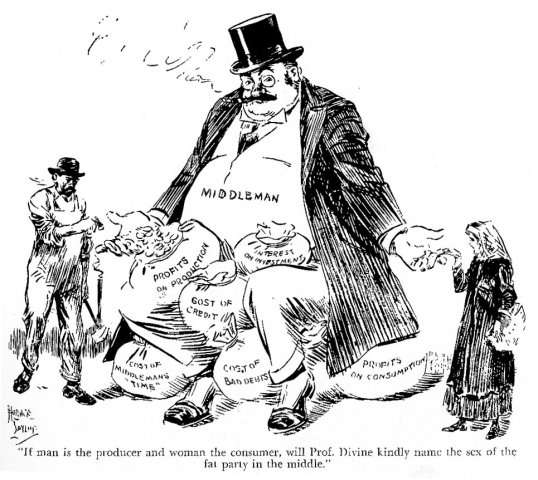
As the above cartoon illustrates, all is not well in the world’s greatest bastion of free enterprise. Despite quotes such as a recent one from Jon Voigt, to wit: “Capitalism is the only truth that keeps a nation healthy and fed,” as early as the end of the 19th century people were looking critically at the mechanisms we have developed to drive commerce and enterprise:
I heard the following story some time ago, and it’s always stayed with me.

The Fisherman

Author: Unknown

A boat docked in a tiny Mexican village. An American tourist complimented the Mexican fisherman on the quality of his fish and asked how long it took him to catch them. “Not very long,” answered the Mexican. “Why didn’t you stay out longer and catch more?” asked the American. The Mexican explained that his small catch was sufficient to meet his needs…and those of his family.

The American asked, “But what do you do with the rest of your time?” “I sleep late, fish a little, play with my children, and take a siesta with my wife. In the evenings, I go into the village to see my friends, have a few drinks, play the guitar, and sing a few songs … I have a full life.” The American interrupted, “I have an MBA from Harvard and I can help you! You should start by fishing longer every day. You can then sell the extra fish you catch. With the extra revenue, you can buy a bigger boat.”

“And after that?” asked the fisherman.

“With the extra money the larger boat will bring, you can buy a second one and a third one and so on until you have an entire fleet of trawlers. Instead of selling your fish to a middle man, you can then negotiate directly with the processing plants and maybe even open your own plant. You can then leave this little village and move to Mexico City, Los Angeles, or even New York City! From there you can direct your huge new enterprise.”

“How long would that take?” asked the fisherman. “Twenty, perhaps 25 years,” replied the American. “And after that?” the fisherman asked.

“Afterwards? That’s when it gets really interesting,” answered the American, laughing. “When your business gets really big, you can start selling stocks and make millions!”

“Millions? Really? And after that?”

“After that you’ll be able to retire, live in a tiny village near the coast, sleep late, play with your children, catch a few fish, take a siesta with your wife and spend your evenings drinking and enjoying your friends.”

  This is called “looking beyond the mark.”

In the headlong rush to profit from production, the corporate world somewhere lost sight of the fact that their producers were human beings who also needed to support themselves and their families:

Only one thing counted: the bottom line. MBA’s, CPA’s, and a whole plethora of alphabet-soup degrees became de rigeur in corporations, with the most successful being the ones who could trim the most fat from expenses, often at the expense of the very people who were creating the value.

For obvious reasons, these individuals often became the least popular in the company:

26174.strip

Scott Adams, Dilbert

Taken to its unpleasant but logical extreme, we end up with CEO’s and board members like this:
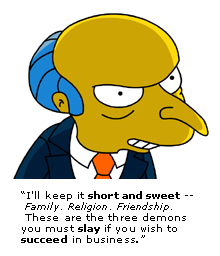
I once worked for a man who thought exactly like this. He came to our company from Hewlett Packard, and was probably the most evil individual I have ever had the misfortune of working for, a two-bit golf hustler who had parlayed his ability to manipulate people into a position of responsibility. [1] He used almost the same words when he told me he wanted me to spend less time with my church and my family, but I refused to kowtow and lick his boots. When, out of spite, he told me I needed to start working evenings and weekends, I told him, in so many words, to screw himself with a cactus. It was expensive for us, because the job had involved an overseas move, but it ended up costing the company because I sued their asses for breach of contract and they settled. Called my suit a “nuisance,” but they settled anyway. Although I have always tried to avoid Schadenfreude, I was quite gratified to hear that several months later, this bottom-feeder was terminated for malfeasance. And, it wasn’t too much later that the entire company went belly-up and was absorbed by a larger entity.

The news today is not good. The US has outsourced the majority of its well-paid manufacturing jobs to places like China and Pakistan and Madagascar. Few companies are hiring full-time employees; most are relying on temps or temp-to-hires, keeping hours below 30 hours a week to avoid having to provide benefits. For reasons incomprehensible companies still demand 110% effort and employee loyalty, even though they are not willing to reciprocate with job security or any sense of value toward their staff.

One of my favorite quotes from the Star Trek universe comes from  Jean-Luc Picard in “Star Trek – First Contact”:

The economics of the future is somewhat different. You see, money doesn’t exist in the 24th century… The acquisition of wealth is no longer the driving force in our lives. We work to better ourselves and the rest of Humanity.

In the framework of today’s economic environment, this dream seems about as attainable as replicators and holodecks – but there are some bright spots among the gloom, companies who are doing their best to buck the trend; companies like Costco have understood that treating their employees well is not an expense but rather an investment.

The creation of an economy based on the principle that people are more important than profits, while still recognizing that commerce is what drives the creation of wealth, is something that will require changes far beyond the confines of the boardroom. An excellent examination of how to work toward Ethical Capitalism is found at Common Dreams, which article I heartily recommend.

While the world of unbridled capitalism advances to the beat of “It’s not enough for me to win, everyone else has to lose,” other voices are becoming louder; the concept of degrowth [2] is looking more viable when compared to the alternative.

541869_273680836101555_1066674228_n

Glutting the smallest segment of society on the labors of the rest of us is a model that will ultimately implode under the weight of its own inequity; it cannot endure. As impossible as it might seem to restructure society in such a way that we build a world that works for everyone, with no one left out, it is morally imperative. As human beings we owe it to one another to give our fellow sojourners on this spaceship earth a fair shake. Any other course of action will have repercussions, even for the supposed “winners,” that will diminish us all.

In light of the above, I’d like to offer my own, slightly-modifed version of the first cartoon above:


The Old Wolf has spoken.


[1] If anything he said could be believed; in addition to his other scintillating qualities, he was without question a pathological liar.

[2] Degrowth … is a political, economic, and social movement based on ecological economics and anti-consumerist and anti-capitalist ideas. Degrowth thinkers and activists advocate for the downscaling of production and consumption—the contraction of economies—arguing that overconsumption lies at the root of long term environmental issues and social inequalities. Key to the concept of degrowth is that reducing consumption does not require individual martyring and a decrease in well-being. Rather, ‘degrowthists’ aim to maximize happiness and well-being through non-consumptive means—sharing work, consuming less, while devoting more time to art, music, family, culture and community. (Wikipedia)

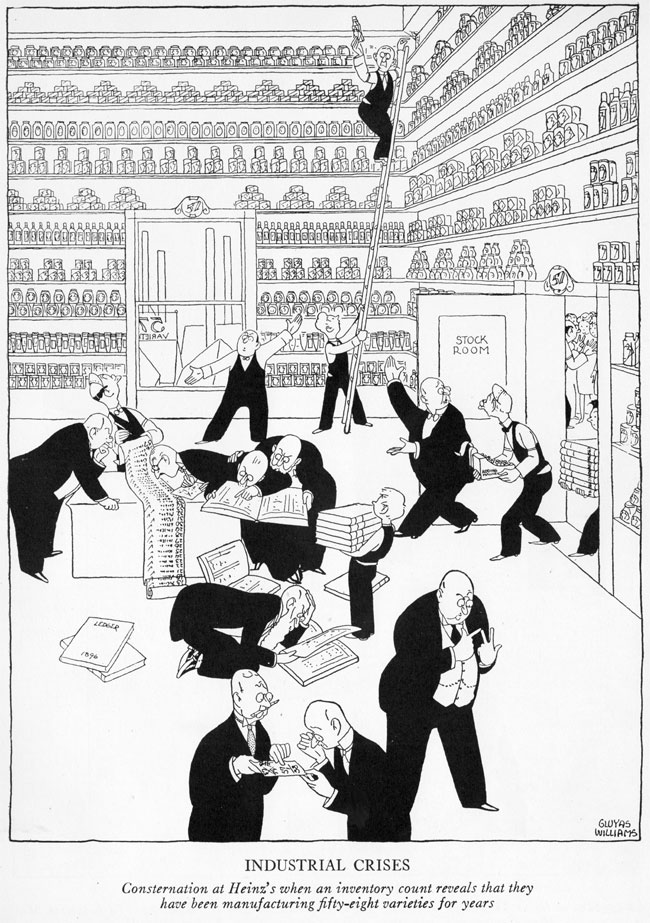
57 Varieties

JqXbIGe

Female worker bottling ketchup at the original Heinz factory circa 1897. Pittsburgh, PA.

I mentioned this image over at “Lost Cartoons,” but it’s appropriate to include here:

heinz57groot

A little history: 

Henry J. Heinz introduced the marketing slogan “57 Varieties” in 1896. He later claimed he was inspired by an advertisement he saw while riding an elevated train in New York City (a shoe store boasting “21 styles”). The reason for “57” is unclear. Heinz said he chose “5” because it was his lucky number and the number “7” was his wife’s lucky number. However Heinz also said the number “7” was selected specifically because of the “psychological influence of that figure and of its enduring significance to people of all ages”. Whatever the reasons, Heinz wanted the company to advertise the greatest number of choices of canned and bottled foods for sale. In fact by 1892, four years before the slogan was created, the Heinz company was already selling more than 60 products. (Wikipedia)
The Old Wolf has spoken.

Of course, for $2,000 we can…

Even before the reality of death, meaning specifically my own mortality, had become clear to me, I was aware that there was something not quite right in the funeral industry. I remember reading Art Spiegelman’s Maus during the 70’s, and this particular panel – a reproduction of his earlier work, “Prisoner on the Hell Planet,” always bothered me:

Prisoner

This is the funeral industry’s version of “would you like fries with that,” the upsell in a moment of vulnerability, in this case, grief instead of hunger. As a young man in those years, I recall going to the family’s traditional mortuary in town and considered making some pre-need arrangements after an uncle of mine passed away far too early; I got the grand tour, was shown all the luxurious options, carefully steered to expensive add-ons like hermetically sealed bronze caskets with foam-padded, velvet-lined eternal resting places, and effectively handled in the same way as a master car salesman would have done. Fortunately for me and unfortunately for the funeral home, I had the presence of mind to say I wanted to sleep on my decision before signing that carefully-prepared contract, and came to my senses before I went back.

It wasn’t too long after the rise of the internet that I discovered the benefit of ordering caskets online – even Costco sells caskets these days, and you can get a perfectly lovely one for less than, $1,000, a quarter of what the average funeral home would charge you for the same goods. Naturally a funeral director will try to dissuade you from this option, but in most states they are legally obligated to use a shipped casket if the client desires it. Beware, however, that if you choose this option, the company will try to make up their loss in other ways. As an additional reference, here’s a blog post from someone who had a satisfactory experience ordering online caskets twice.

As my mother entered her twilight years and, as an only child, it was clear that any arrangements would fall to me, I took another trip to the family mortuary to see about arrangements for her. Even with a cremation and interment of the cremains, the funeral home costs would have amounted to well over $6,000.00. To be fair, I must say that at no time did our funeral home act unprofessionally or with malice, but there was always that pressure to maximize the cost “out of respect for the dead.” Again fortunately, another option was open to me, which – in deference to mother’s wishes – I availed myself of. More on this later.

Over at reddit today, I found an amazing essay by an (obviously anonymous) funeral director who spilled his guts on on the entire industry’s shenanigans, and offered a plethora of resources and information for people looking to inform themselves. I quote it below, in toto because it’s worth the read. With thanks to redditor /u/arrghbrains, and only slightly bowdlerized for family friendliness:

Throwaway, obviously. I’m a funeral director. Our entire industry is basically a pyramid scheme. It blows my mind how blindly people accept that certain things “have to” be done to the body of their loved one. Think about that for a second: this is the last tangible remnant of someone you loved and you are now going to pay stranger thousands (oftentimes HUNDERDS of thousands) of dollars to (warning: graphic from here on out) systematically mutilate that body.

There is nothing dignified about having one’s mouth wired shut, eyelids forced closed by spiked plastic contact lenses, and ramming a trocar into the abdomen to puncture organs so that they can be suctioned out. After the embalming fluid is introduced, the anus and vagina are stuffed with cotton and other absorbent materials to prevent what we refer to as “purge.” This charming phenomenon can occur any time after death – yes, before or after embalming, at any stage of decomposition – when the fluid created by tissues breaking down is leaked through any nearby orifice, oftentimes the nether regions.

The process creates an enormous environmental problem; using toxic chemicals which are flushed into our sewers along with those pureed livers, hearts, spleens, pancreas’ which then also flow into our sewers. Oh, what’s that? I told you embalming is a legal requirement for public sanitation? That’s utter bullshit. If anything, it creates a sanitation problem if the cemetery you use is anywhere near a municipal water line, which most “commercial” cemeteries are.

In fact, in most states, the law only requires embalming if you are transporting a body across state lines or are not planning to inter for more than 72 hours and/or having a public viewing. It has not a single thing to do with public health. It’s a cash cow, plain and simple. It is barbaric, costly, and does not keep the body from deteriorating. But we’ll tell you just about anything you need to hear to get you to agree to it.

What I’m doing here is incredibly illegal and I know it, but on the slim-to-none-chance that you’re a sharp-minded consumer in the midst of your grief and call my state’s licensing board about it, all I have to do simply tell them you were mistaken. I’ve seen funeral directors force-feed families absolute horseshit – saying anything – to get them to sign a contract. Here’s a hint: don’t sign any pre-printed “form” contracts. Most of the contracts we use are super vague, so we can charge you for just about anything and justify it by pointing to your signature on the dotted line. It is in your best interest to only agree to specific itemized charges – i.e., have the hearse but no limousines. Or have hair/makeup done without any embalming. The law is very specific and on your side, but we count on your ignorance and vulnerability.

Even better, find a trusted friend or family member who is more emotionally stable right now and appoint them as your lawyer/detective. You know that bitchy sister-in-law everyone has who makes major holidays a nightmare? I can spot her a mile away and will do everything I can to keep her out of financial discussions – because I know she will take that obnoxious nagging and throw it at me for every single penny I’m trying to get out of your family. See my co-workers standing around looking somber and respectful? They’re not there to just have a presence of authority, they are studying you. They are watching the family dynamic and will report back to me with any potential angles I can play to manipulate your emotions, which family members are taking it the hardest and will therefore be the easiest prey, and their estimation of your financial well-being. If, by the way, you appear to be less affluent, I’ll tell you to take your business elsewhere. This is not a hospital and I don’t provide a service – this is a business. If you aren’t paying me (in full and up front, generally), all you’re getting is my sympathy.

Do yourself a favor and read the FTC Funeral Rule. It’s very clear and concise in stating what you as the consumer are required to do and what rights you have. Did you know the casket I’m selling you for $5000 is really just a nicely decorated plywood box? If you were smarter, you’d know you don’t have to buy that from me. In fact, the law requires me to allow you to “BYOB.” Costco and Wal-Mart sell very reasonably priced nice caskets on their websites. If you happen to be armed with that tidbit of information, I’ll try to make it a practical issue: it will be easier to use the caskets we already have here. Another line of crap. All of the caskets at the funeral home are demo models (and are actually nice napping spots on slow days). Anything you buy will be delivered to the funeral home via freight the next day, just like the Wal-Mart caskets.

Another well-worn sales tactic is to try to shame you into going along with the exorbitant cost, implying you didn’t really love grandma enough if you spend less than five figures with me. You should know, by the way, that everything you buy from me – a guestbook, prayer cards, even the damn obituary notices – is marked up at least200%. See the picture I’m painting here, kids? Smoke and mirrors. It hasn’t always been like this, but with the corporatization of the death care industry, the almighty dollar is the only consideration anymore.

Whew, this is getting to be a novel. Sorry, hang with me just a bit longer – we are getting to the major issue here.

Right now – literally right now, August 16, 2013 – the FTC is reviewing a merger between the two largest funeral service corporations in the United States: Stewart and SCI. Stewart has 500-ish locations while SCI has 2000+. This will create a mega-Decepticon-conglomerate that will control at least 40% of all funeral service business transactions in this country – and that, my friends, is what antitrust regulations refer to as a monopoly.

We are racing full speed ahead to the genesis of the McFuneralHome and nobody is doing anything about it. The reason? Misdirection. There’s no Stewart Funeral Home or SCI Mortuary in your hometown. They’re operating under the same names they always have, letting you believe that the good people of Bubba & Sons Memorial Chapels would never steer you wrong. Bubba’s been around for 50 years! Bubba’s handled your family’s funerals for generations! Let me tell you something: Bubba cashed out years ago and is pretty much a figurehead at this point. Check his website carefully: at the bottom, you’ll probably see a copyright for either “Dignity Memorials” (SCI) or “STEI” (Stewart).

Every single thing you’ve read in this thread about cutting corners, shoddy work, under-trained and under-paid employees, outsourcing certain processes, covering up mistakes… ALL OF IT HAPPENS IN THE FUNERAL INDUSTRY. Now, most of us are decent human beings and aren’t interested in getting freaky with dear old granny, but in terms of services performed and their actual value, you trust us WAY, WAY TOO MUCH.

You know how lousy the cell phone service provider market is right now and how worked up everyone gets about that? The funeral industry is worse.

And we should all be raising hell, because EVERY SINGLE ONE OF US is going to have to conduct business with the deathcare industry eventually — be an informed consumer and know who you’re really giving your money to.

I know I’ve hyperlinked this to death, but please read the last one from the Funeral Consumers Alliance on how horrifyingly out of control this situation has gotten:

“It’s alarming to think that a company with a long track record of abusing consumers at the worst times of their lives might get even bigger,” said Josh Slocum, FCA’s executive director. “For at least 15 years grieving families around the country have complained to us about the practices at SCI funeral homes and cemeteries. From lying about options in order to boost the funeral bill, to digging up graves to re-sell them to another unsuspecting family, to denying the legal rights of LGBT people to make funeral arrangements for their partners. You name it, we’ve heard it.”

Funeral Consumers Alliance reminds the Federal Trade Commission that funeral purchases are unlike any other in their potential to harm the customer. Families buying funeral and cemetery services are incredibly vulnerable and have been subject to deceitful and egregious conduct.

“This is not a run of the mill merger; this isn’t about whether a $20 retail product will cost consumers $5 more,” Slocum said. “We’re talking real money here. Funeral consumers often make great economic sacrifices to bury their loved ones. The average full-service funeral runs in excess of $7,000 and often for much more at SCI’s Dignity locations. Especially when it has faced less competition, SCI has increased prices and we can expect more of the same if this merger occurs. Given the lack of knowledge about funeral options and the stress of grief, we can’t just say a ‘rational consumer’ will vote with their dollars and choose another funeral home. That’s not how the unique funeral transaction works, and that reality is why the FTC specifically regulates funeral homes.”

It’s worth it to read this entire exposé, and follow the hyperlinks as well. Another good source of information is at Reader’s Digest, long an advocate of common sense for the consumer.; the original page is 404 but this information was extracted from the Wayback Machine:

  • Go ahead and plan your funeral, but think twice before paying in advance. You risk losing everything if the funeral home goes out of business. Instead, keep your money in a pay-on-death account at your bank.
  • If you or your spouse is an honorably discharged veteran, burial is free at a Veterans Affairs National Cemetery. This includes the grave, vault, opening and closing, marker, and setting fee. Many State Veterans Cemeteries offer free burial for veterans and, often, spouses.
  • You can buy caskets that are just as nice as the ones in my showroom for thousands of dollars less online from Walmart, Costco, or straight from a manufacturer.
  • On a budget or concerned about the environment? Consider a rental casket. The body stays inside the casket in a thick cardboard container, which is then removed for burial or cremation.
  • Running a funeral home without a refrigerated holding room is like running a restaurant without a walk-in cooler. But many funeral homes don’t offer one because they want you to pay for the more costly option: embalming. Most bodies can be presented very nicely without it if you have the viewing within a few days of death.
  • Some hard-sell phrases to be wary of: “Given your position in the community …,” “I’m sure you want what’s best for your mother,” and “Your mother had excellent taste. When she made arrangements for Aunt Nellie, this is what she chose.”
  • “Protective” caskets with a rubber gasket? They don’t stop decomposition. In fact, the moisture and gases they trap inside have caused caskets to explode.
  • If there’s no low-cost casket in the display room, ask to see one anyway. Some funeral homes hide them in the basement or the boiler room.
  • Ask the crematory to return the ashes in a plain metal or plastic container—not one stamped temporary container. That’s just a sleazy tactic to get you to purchase a more expensive urn.
  • Shop around. Prices at funeral homes vary wildly, with direct cremation costing $500 at one funeral home and $3,000 down the street. (Federal law requires that prices be provided over the phone.)
  • We remove pacemakers because the batteries damage our crematories.
  • If I try to sell you a package that I say will save you money, ask for the individual price list anyway. Our packages often include services you don’t want or need.
  • Yes, technically I am an undertaker or a mortician. But doesn’t funeral director have a nicer ring to it?
  • Sure, you can store ashes in an urn or scatter them somewhere special, but nowadays you can also have them crushed into a real diamond, integrated into an underwater coral reef, or blasted into space.
  • It’s usually less expensive if the body is not present for the funeral.
  • If the deceased’s favorite outfit is a size too small or a size too big, bring it to us anyway. Part of our job is making the clothes lie perfectly.
  • Never trust a funeral director who says, “This is the last thing you can do for your loved one.”
  • You don’t need to spend money to have a meaningful service. Consider a potluck at the widow’s home or an informal ceremony at a favorite park, and ask survivors to tell stories or read poetry.
  • Always bring another person when you meet with me, ideally someone who’s not as emotionally attached to the deceased.
  • It might be wise to check out just who owns your local funeral home. Corporate chains have bought out hundreds of family-owned funeral homes in recent years, but they often keep the original name, appearance, and even some employees after a buyout. The one thing they usually do change? The prices

As it turned out, before my mother passed away in her 90’s of old age and dementia, she was savvy enough to make some critical decisions about her wishes, which I followed. Her body was donated to a medical center, where it will be used to further knowledge; at no cost to us, the center will cremate her remains when they’re done, and bury them with dignity in a donor’s plot, as well as adding her name to a permanent memorial for those who have done this. We held a memorial service at a country club where one of the family was a member; total cost: under $1,000. Add to this an “in memoriam” headstone, and the total expenses for a wonderful and dignified send-off came in at under two grand.

There are alternatives these days, and many of them. A great list, with carefully-researched costs, pros, and cons, can be seen at AlterNet, but the executive summary is:

  1. Donate Your Whole Body to Science
  2. Donate Your Body to Help Catch the Bad Guys
  3. Donate Your Body to Be Displayed in the Body Worlds Exhibitions and Become an Anatomical Work of Art
  4. Dig Your Own Grave
  5. Green Burial in a Preserve
  6. If You Must Have a Coffin, Buy One Made of Cardboard or Make a ‘Quick Coffin’
  7. Cremation

My wife and I have seriously discussed option 2, specifically the Forensic Anthropology Center at the University of Tennessee at Knoxville, the oldest body farm in the country. The only cost incurred is that of transporting the body; even there, funeral homes will try to gouge you and insist that bodies must be embalmed for transport, but this is not the case – if you’re considering this option, talk to them directly and they will be able to provide the best information about how to get yourself or a loved one there at the least cost.

The Old Wolf has spoken.

Some things just deserve to be shared.

I found this by chance over on Reddit, serendipitously, without looking for it, in a random discussion about Portland, Oregon. There were a lot of humorous comments – the article had to do with a dispute between passengers and a cabdriver, but then the conversation drifted into the nature of Portland as a city.

And then this gem popped up, written by /u/fwaht. I’ve corrected one or two things for spelling and style, but it’s otherwise unedited. The added emphasis is mine.

The “Successful” Person

If you’re what society calls a “successful” person, then you’re probably making more than two standard deviations above the mean, and you probably have a family. And you’re probably working a 9-5 job, or something like it, where you spend roughly ⅓ of all the waking time you’ll ever have doing it. And your employer wants your best time, the time where you’re most energetic and willing to get things done. Your other time is probably spent in a lethargic daze staring at a television (and as you age it gets worse). And why are you watching television instead of doing something you can look back on in ten years be proud of? Because only unsocialized losers haven’t seen the latest episode of American Idol or the latest sports event.

The average company is not run as a meritocracy. If you were a boss, would you want to see the person that quietly does excellent work and all but ignores you and everyone else get the promotion? Or would you want your “friend,” the guy that talks with you about football and your kids and makes you happy, to get the promotion even though he doesn’t do such great work?

No, you need to play the game. Most every business is its own Machiavellian-themed nightmare or kingdom depending on the ease with which corruption and deception and social lubrication comes to your character (and if it doesn’t come to you easily, then you will fall behind those that are better at it).

And what do you win after having beat this game? Retirement? You mean 10-20 years of low-quality life where you have the freedom that you could have had all your life if you chosen a life of less responsibility, of placing less importance in what’s expected of you than trying to do what you’ve always really, really wanted to do. Did you need those new cars, that large house and expensive furniture, the expensive meals, and so on and on? No, they made you happy for a short while, but then you just slid back into normalcy – you were on a hedonistic treadmill. Here you are, 60 years old, with all sorts of aches and pains, and remembering the senility your parents drifted into around this age. Remembering how you wished they just died quickly while feeling your intelligence diminish every year as it has since you reached 50.

And on your deathbed, what are you going to look back on and be proud of? Your children? They will die soon, and so will their children. In a short while you’ll be long forgotten as they will, and any trace of your genetic legacy will have disappeared – you aren’t Genghis Khan. Nothing of you will remain. And why should you care about such a thing after you’re dead anyway?

The “successful” person has sculpted their future and life into a hell worse than the one given to Sisyphus, and yet as miserable and meaningless as they are, they still come to think they’re better than others somehow.

While this may sound a bit negative, it’s a very accurate distillation of business and working life, and a wakeup call to those who find themselves on the treadmill. This would be a good place to share another good tidbit I found while surfing around:

Dream

In the United States, it’s getting harder to build a successful business or enterprise on a shoestring; increasing regulation, coupled with the consolidation of wealth at the highest levels, has made it more challenging to get off the treadmill than it was for great-grandpa who started life manning a vegetable pushcart in Little Italy in 1900. Harder, but not impossible.

If a person is really interested in success that lasts, they won’t be able to measure it by the standards found in Corporate ‘Murica. From where I sit, true success can only be measured by the number of people one has served, and the level to which one has raised the human condition. Efforts of this nature will ripple through time, whereas the accumulation of stuff and the generation of progeny who will walk in the same corporate rut will, as fwaht has noted, be forgotten within a span of time so short as to be insignificant in social terms.

I am proud of my children – each of them is looking for ways to make a difference rather than to die with the most toys. It’s not easy, but keeping one’s eye fixed outside the societal box of corporate norms is the only way to ensure that one’s efforts count for something after our bodies have returned to dust.

The Old Wolf has spoken.

An Open Letter to Upworthy

Note: Read the article, but read the comments below as well. Upworthy really stepped up to the plate on this one.

Dear guys and gals at Upworthy,

A lot of the things you post on your website are really interesting. However, two points I would like to bring to your attention:

1) Cool it with the popups asking me if I want to create an account.

popup\

All up in my browser. This is ruddy annoying, and its only effect is to make me want to look elsewhere for my interesting news. As if that wasn’t bad enough, I get this before I can leave the page:

Popup2

It’s more Facebook’s fault than yours, but it irks me that you know who my friends are and who has liked your page, especially given my maxed-out privacy settings.

Don’t do this. It’s annoying and counterproductive.

2) I noticed that there’s absolutely no way to contact you with feedback, except a page on your Tumblr interface. And in order to leave a comment there, I have to subscribe and give you my email address. Screw whole bunches of that. Hence this open letter.

No love,

The Old Wolf

David Letterman’s Top Ten: Golden Corral Excuses.

AJD54226, Atlanta, GA, Georgia, Golden Corral, buffet, restaurant. Image shot 2007. Exact date unknown.

In light of the Golden Corral scandal,[1] David Letterman comes up with another unbeatable Top Ten list, this time dealing with company excuses for leaving meat out by the dumpster during a health inspection. In descending order:

10.  “You say dumpster, we say dining al fresco.”
9. “Cows are out in the sun all day, what’s the difference?”
8. “This is why we’re not the Platinum Corral”
7. “We’d store food in the kitchen, but that’s where we keep the trash”
6. “Relax — the rats are keeping an eye on it”
5. “Tired of being known as the ‘sanitary’ buffet place”
4. “The flies looked hungry”
3. “Judgment impaired after eating tainted meat”
2. “The deal was: we serve $4 steaks, you don’t ask any questions”
1. “Have you seen a corral?”

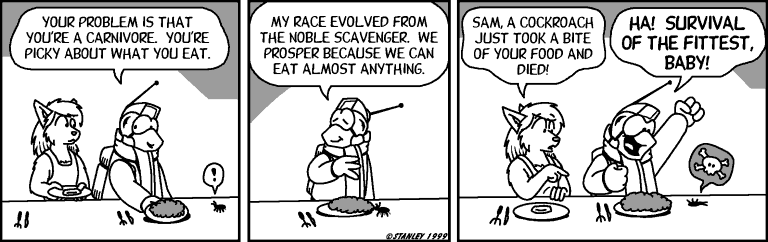
Every time I see a “Golden Corral,” I can’t help but think of another restaurant prominently featured in Mark Stanley’s science fiction webcomic, “Freefall.”

fv00217

fv00219

fv00222

Back to Letterman, I love these Top Ten lists… they’re not all home runs, but every now and then he comes up with an eternal classic. I think my favorite of all time is

Top Ten Stores That Won’t Do Much Business This Holiday Season
November 29, 1993

10. Price Gougers
9. Burt and Loni’s Cozy Couple Shop
8. Toys “R” Defective
7. Every Item $7500
6. Crap Mart
5. The Really, Really, Really Limited
4. Hefty Lefties: The Store for Left-Handed Fat Guys
3. Gap for Bastards
2. Joey Buttafuoco’s Auto Body Shop
1. Roseanne’s Secret

Largely thanks to Mark Stanley, I was never tempted to eat at the Golden Corral in the first place; after this latest misadventure, they’re off my dining list forever.

The Old Wolf has spoken.


[1] For those interested, the fallout:

“Golden Corral franchisee Eric Holm has said that the manager who made a “bad decision” when he placed the food outside has been fired. Additionally, the video sparked a state investigation by the Division of Hotels and Restaurants. The latter sent an inspector to the Golden Corral on Monday and the restaurant passed the inspection. There were a handful of violations found that must be corrected however, the inspection report shows.” (Daytona Beach News-Journal)

Note: The article referenced links to the original video, which has since been tagged “private”. Here is a news report on the even that contains some of the most critical footage:

Bad Company / Good Company

Bad Company

“Too big to fail” apparently means “continue to screw the consumer.” Despite a rash of revelations about how big banks, most notably Bank of America, have resorted to outright criminal behavior to squeeze money from consumers, their abominable tactics continue.

A small example:

Our mortgage is with BoA (not the original lender, but mortgages are still basically hot currency and almost all are sold to other servicers as soon as they are issued). We’ve had the mortgage since March of 2011, and have always been current with the payments. The loan is actually in the name of my now-deceased mother, because I had an employment gap and banks would not even look at us despite having sufficient income.

So this month it turns out that our payment was a bit late – teaching hours have been down this last month, and Social Security doesn’t kick in until August. This morning I got a call from Bank of America; it was a dun call, and they wanted to make sure I knew there was now a late fee due, and when would the payment be made? 4 days past the due date.

boa-billboard

Up yours, Bank of America.You don’t start dunning people if a payment is 4 days overdue. [1] It makes you look cheap, grasping, and insensitive. Oh wait, that’s what you are… my bad.

ShutTheHellUpSmall

Good Company

Tales like the above are all too common these days. Corporations are looking only at the bottom line, and they couldn’t care if they lose a significant percent of their customers to increase their bottom line (I’m looking at you, Netflix.) Customer service – this is an oxymoron these days, as the level of service at most companies is bare bones, outsourced to India or the Philippines, and you’re lucky if you can get anyone on the line that knows how to solve your problem, let alone give a rat’s south-40.

Happily, there are the exceptions.

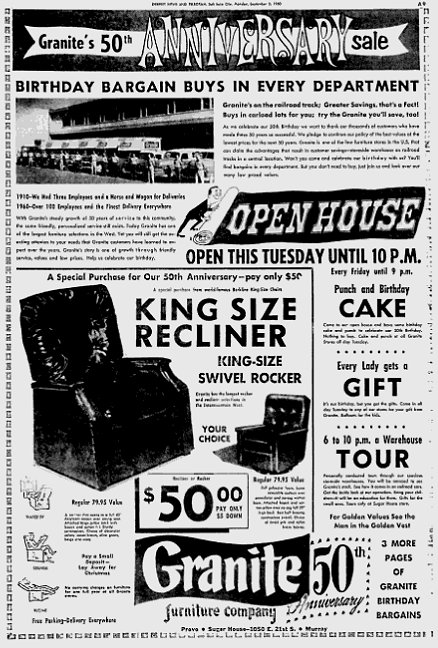
Back in 1996 we bought a living room set from the now-defunct Granite Furniture Company.

(♫ Granite’s on the railroad tracks,
Greater Savings, that’s a Fact
Buys in carload lots for you
Try the Granite, you’ll save too! ♫);

Granite


Granite Furniture Ad, Deseret News and Telegram, September 5, 1960

it’s a great set and has provided good wear for almost 20 years. Some years ago, however, one of my oldest son’s friends accidentally snapped off one of the recliner release handles on the sofa (you know who you are, Bing), and we’ve been unable to use that side of the couch as a recliner since then.

On a whim, I looked around inside and found a tag indicating that it had been made by Action Manufacturing, Inc. A bit of Googling let me to the Lane Furniture Company – apparently they either acquired them, or Action was always a subsidiary. Anyway, I dashed off a note to Lane from their website, describing the problem and giving the model and ID number of the piece. Less than a week later, I had confirmation from their service department that a new handle would be sent out to me… no cost, under warranty. I just about messed my britches in astonishment.

Today the parts arrived. Not one, but two handles… so I have a spare if another one ever breaks.

Lane-Furniture-Logo

A huge shout-out to Lane Furniture for making awesome furniture, and for standing behind it for so long. Thank you, from a very happy consumer.


[1] If any of you feel tempted to leave comments about how BoA is within their legal rights, I’ll just delete said comments, and say rude things about you behind your back. Times are tough, and we need more people like George Bailey, and far fewer like Henry F. Potter.

Message in a Bottle

Or a gravestone, as the case may be.

From the Oregonian, December 23, 2012

The letter came in a box of Halloween decorations purchased at Kmart, but for a year Julie Keith never knew. It gathered dust in her storage, a haunting plea for help hidden among artificial skeletons, tombstones and spider webs.

Keith, a 42-year-old vehicle donation manager at a southeast Portland Goodwill, at one point considered donating the unopened $29.99 Kmart graveyard kit. It was one of those accumulated items you never need and easily forget. But on a Sunday afternoon in October, Keith pulled the orange and black box from storage. She intended to decorate her home in Damascus for her daughter’s fifth birthday, just days before Halloween.

She ripped open the box and threw aside the cellophane.

That’s when Keith found it. Scribbled onto paper and folded into eighths, the letter was tucked between two Styrofoam headstones.

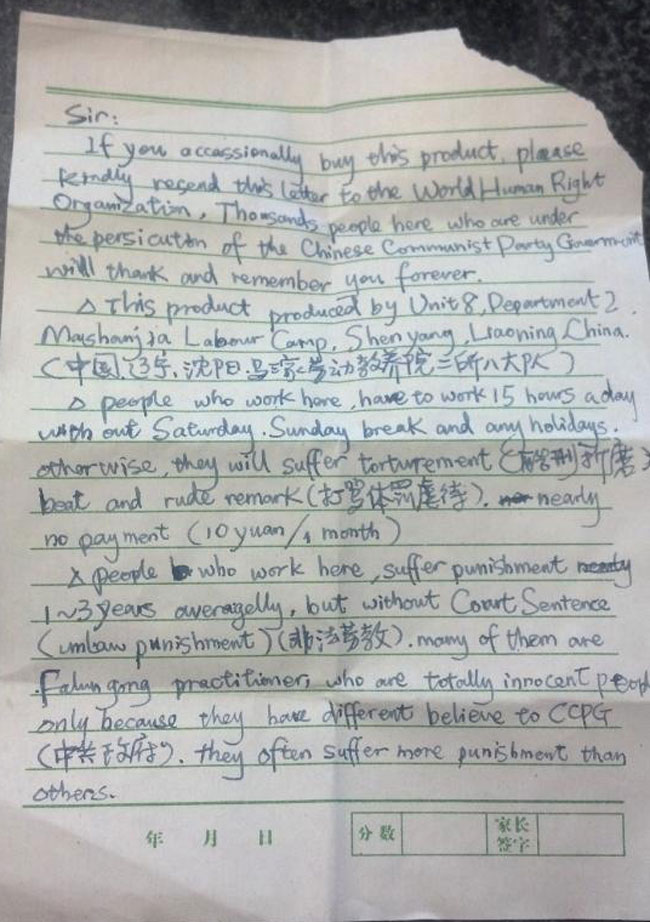
“Sir:

“If you occasionally buy this product, please kindly resend this letter to the World Human Right Organization. Thousands people here who are under the persicution of the Chinese Communist Party Government will thank and remember you forever.”

“People who work here have to work 15 hours a day without Saturday, Sunday break and any holidays. Otherwise, they will suffer torturement, beat and rude remark. Nearly no payment (10 yuan/1 month, or $1.61).”

“People who work here, suffer punishment 1-3 years averagely, but without Court Sentence (unlaw punishment). Many of them are Falun Gong practitioners, who are totally innocent people only because they have different believe to CCPG. They often suffer more punishment than others.”

The letter was not signed.

CHINALABOR-popup-v4

The graveyard kit, the letter read, was made in unit 8, department 2 of the Masanjia Labor Camp in Shenyang, China. Chinese characters broke up choppy English sentences.

JP-CHINALABOR-1-articleLarge

The administrative building of the Masanjia labor camp and other facilities in China.

Keith started doing homework and digging around, and the letter was widely published on the internet. Responses ranged from outraged to skeptical, including those who pointed out that her publication of this material put the writer at risk if he/she were real.

On June 11th, 2013, The New York Times published a follow-up article indicating that the writer had been found, and was no longer in the labor camp. It’s an interesting read and lends credence to the original story, although there has been no other independent confirmation from inside China.

It appears that many companies who import Chinese products have no policies that bar the use of forced labor.

Just something else to think about the next time you go shopping at a big box store and the label says “Made in China.”

assets-2012_The_letter_was_folded_into_eighths_and_hidden_amongst_the_the_Styrofoam_headstones_in_the_Totally_Ghoul_product__pictured_143698581

The Totally Ghoul product – the letter from China was found in a package like this.

The Old Wolf has spoken.