I swear on a stack of bibles (or The Origin of Species, whichever makes you feel more comfortable) that there was. I remember clearly eating at one, and being astonished at the size of their 5″ patty and huge buns. But the Internet is pretty sure that there was never one there, and will still respond with – what seems to me – inaccurate information. So in order to put that discrepancy to rest, I did a deep dive into the history, and this is what I came up with.
I first submitted the question to Perplexity – History of Whataburger in Salt Lake City? – and this was the result:
There is currently no evidence that Whataburger has ever operated in Salt Lake City or anywhere in Utah as of August 2025. While Whataburger has aggressively expanded in recent years—opening locations in new states like Nevada, the Carolinas, and others—none of the latest location lists or official press material mention Utah or Salt Lake City as a market served by the chain.
But there is a Facebook group called “If You Grew Up in Salt Lake, Then You Will Remember This,” and back on 23 January, 2022, Irene Vialpando asked the group whether they recalled the existence of a Whataburger on State Street around 800 South. Many people responded that they not only recalled the restaurant with its swivel chairs in the 1970s, but ate there, and also recalled the huge patties, and some even chimed in that they or members of their family used to work there. Still others were adamant that there was never any such outlet in Utah.
The responses from those who recalled a Whataburger were so encouraging that I decided to dig deeper. I asked Gemini the following question under the “research” tab:
I absolutely and without question recall the existence of a Whataburger outlet on State Street around 800 South in Salt Lake City in the 1970’s. I ate there, and I remember being gobsmacked by their 5″ patty, so this is not a false memory. Many other people at the Facebook group “If You Grew Up In Salt Lake, Then You Remember This” have clear recollections of this restaurant’s existing for a brief time. Problem is, when I submitted the question to Perplexity and Google and Wikipedia, the answer came back that no, Whataburger never had a presence in Utah. Can you help me reconcile the discrepancy? I know for a fact that one was there.
The response from Gemini was as follows:
Executive Summary
his report investigates the compelling recollection of a Whataburger outlet on State Street around 800 South in Salt Lake City during the 1970s, a memory that contradicts readily available online historical records. While mainstream digital sources generally indicate no Whataburger presence in Utah, a deeper examination of corporate expansion strategies and local fast-food history reveals a more nuanced picture. Evidence suggests a strong possibility of a short-lived Whataburger location in Utah during the specified period, operated by a now-defunct franchisee, Western World Foods Inc. The user’s vivid memory of a “5-inch patty” aligns precisely with Whataburger’s signature product. Alternatively, the memory of a large patty could be attributed to Red Barn, another chain present in Salt Lake City at the time, which offered a burger with a nearly identical patty size. Ultimately, the collective memory and specific product detail lend significant credence to a genuine, albeit brief, Whataburger appearance in Salt Lake City.
The User’s Vivid Recollection: A Personal Account
The core of this inquiry stems from a remarkably clear and persistent personal memory. The user explicitly recalls the presence of a Whataburger restaurant on State Street, specifically around 800 South, in Salt Lake City during the 1970s. This recollection is not merely a vague impression; it is anchored by a distinct sensory detail: the user remembers being “gobsmacked by their 5″ patty.” This specific, quantifiable characteristic serves as a critical identifier for the restaurant in question. The user’s emphatic statement, “this is not a false memory,” underscores the profound certainty associated with this experience.
Furthermore, this is not an isolated individual memory. The user notes that “Many other people at the Facebook group ‘If you grew up in Salt Lake, then you remember this’ have clear recollections of this restaurant’s existing for a brief time.” This collective memory, while not offering definitive documentary proof, indicates a shared experience within the local community that warrants thorough investigation. Online discussions from Salt Lake City forums further show individuals recalling “Whataburger” or “Eat-a-Burger” when discussing lost restaurants from the 1970s, suggesting a common thread in local historical memory. The convergence of these individual and collective memories, particularly around a specific product characteristic, provides a compelling starting point for reconciling the perceived historical discrepancy.
Whataburger’s Corporate History and Western Expansion (1970s)
To understand the potential for a Whataburger presence in Utah, it is essential to review the company’s historical growth and its product characteristics. Whataburger was founded in Corpus Christi, Texas, in 1950, with an ambitious goal: to serve a “better burger that took two hands to hold”. From its inception, the original Whataburger featured a quarter-pound patty served on a distinctive 5-inch bun. This particular dimension, the 5-inch bun, is a direct and precise match for the user’s specific memory of the patty size that left such a strong impression. This consistency in product design throughout Whataburger’s history is a strong indicator of brand identity, making the user’s specific memory a highly reliable detail for identifying the brand, rather than a generic “large burger” from another chain. The company’s commitment to this unique bun size from its earliest days means that if the user distinctly remembers a 5-inch patty, it strongly points towards a Whataburger experience.
Whataburger’s expansion beyond Texas began relatively early, with the first location outside its home state opening in Pensacola, Florida, in 1959. By 1963, the chain had grown to 26 restaurants, extending its reach to Florida, Tennessee, and Arizona. The 1970s marked a period of significant corporate growth, with the company introducing its first drive-thru in 1971 and celebrating the opening of its 100th restaurant in 1972. By the mid-1970s, Whataburger’s footprint had expanded to over 200 restaurants across 12 states.
The Western World Foods Inc. Franchise and Utah’s Connection
Despite the official corporate history often not explicitly listing Utah as a state with Whataburger locations during this period, a crucial detail emerges from the records of its franchising operations. In 1972, a Texas-based Whataburger franchisee, Western World Foods, initiated an ambitious plan to expand the Whataburger brand nationally. This expansion strategy specifically included the development of 14 new restaurants across four Western states: New Mexico, Arizona, Colorado, and Utah.
Further supporting this planned presence, by 1975, “Whataburger of Nevada” was incorporated, and David Hawley was appointed as the Vice President of Operations for both Nevada and Utah. This appointment strongly suggests that active steps were indeed being taken to establish Whataburger locations in Utah, mirroring the development of six Nevada locations that opened by January 1976 under the same franchisee.
The operational model of Western World Foods was distinct; while they licensed the Whataburger name, menu, and logo, they chose to build structures with a “protruding tower in the middle” instead of the classic A-frame design. However, Western World Foods’ ambitious venture proved to be short-lived. By September 1979, Whataburger of Nevada ceased advertising, and its stores, along with other Western World Foods locations, likely closed within a few months. Whataburger’s subsequent reduction in its West Coast presence was directly linked to the dissolution of Western World Foods, which Whataburger eventually purchased.
The existence of Western World Foods’ plans for Utah, coupled with the appointment of a Vice President specifically for Utah operations, strongly indicates that at least one Whataburger location could have opened in Salt Lake City, even if for a very brief period. The short lifespan and subsequent dissolution of Western World Foods provides a compelling explanation for why these locations might not appear in standard, long-term corporate histories or readily accessible online databases. The official Whataburger history, which outlines the company’s core corporate expansion, often omits details of short-lived or problematic franchise ventures. This explains why a user’s initial searches might yield results stating no Whataburger presence in Utah, even if a temporary one existed.
It is also important to differentiate the Texas-based Whataburger from an unrelated chain named “What-A-Burger,” founded in Virginia in 1957. Although both chains share similar names and were involved in trademark disputes in 1970 , the Virginia-based chain did not expand westward into Utah. The user’s specific memory of a 5-inch patty aligns with the Texas Whataburger’s signature product, making confusion with the Virginia chain highly unlikely.
Table 1: Whataburger’s Western US Expansion Initiatives (1970s)
State
Franchisee/Subsidiary
Key Dates/Details
Outcome/Notes
Colorado
Whataburger of Colorado Inc. (under Western World Foods Inc.)
Operated throughout 1970s; locations opened 1972-1975; likely closed late 70s/early 80s
Short-lived stint, difficult to research; some buildings still exist under different businesses.
Arizona
Western World Foods Inc.
Expanded to Arizona by 1963 (corporate); Western World Foods also had locations
Some Western World locations held onto by Whataburger after 1979.
New Mexico
Western World Foods Inc.
Part of 1972 expansion plans for 14 new restaurants
Some Western World locations held onto by Whataburger after 1979.
Nevada
Whataburger of Nevada (under Western World Foods Inc.)
Incorporated 1975; six locations opened by Jan 1976; stopped advertising Sept 1979
Short-lived; exit related to dissolution of Western World Foods. Buildings often repurposed.
Utah
Western World Foods Inc.
Included in 1972 plans for 14 new restaurants; David Hawley named VP of Operations for Nevada & Utah by 1975.
Strong indication of planned or short-lived presence, likely closed with Western World Foods in 1979.
California
Whataburger of California (under Western World Foods Inc.)
Presence from mid-70s (~1973) until 1987.
Short-lived stint, difficult to research.
This table directly addresses the primary discrepancy in the user’s query. It highlights that Utah was explicitly part of a significant, albeit ultimately unsuccessful, Western expansion initiative by a Whataburger franchisee. By placing Utah within the context of other Western states where Whataburger did have a presence, even if short-lived, it validates the possibility of a Utah location and provides an evidence-based counter-argument to the general online narrative. The table also implicitly sets the stage for understanding why such a presence might be difficult to trace: its short duration and the failure of the franchising entity.
Salt Lake City’s Fast-Food Landscape (1970s)
To provide comprehensive context and explore alternative explanations for the user’s memory, it is important to examine other prominent burger chains operating in Salt Lake City during the 1970s, particularly those known for offering larger patties.
Prominent Local Chains
Dee’s Drive-In: A long-standing fixture in Utah for nearly five decades, Dee’s Drive-In was a well-known local burger chain. It was eventually sold to Hardee’s in the late 1970s. While iconic for its “Dee’s Clowns” and family-friendly advertising , its standard burger patty size was typically 1/8 pound. This is significantly smaller than the 5-inch/quarter-pound patty described by the user, making Dee’s an unlikely candidate for the “gobsmacked by 5-inch patty” memory.
Crown Burger: Crown Burger opened its doors in Salt Lake City in 1978. It quickly gained fame for its signature “Crown Burger,” which features a quarter-pound hamburger patty generously topped with a thick mound of hot pastrami on a sesame seed bun. While the patty size (quarter-pound) is comparable to Whataburger’s, the distinctive addition of pastrami and the opening year (1978) might differentiate it from the user’s specific memory of a Whataburger experience earlier in the 1970s.
Eat-a-Burger: This restaurant is mentioned in Salt Lake City online discussions as a fondly remembered, now-defunct establishment. Eat-a-Burger was located at the intersection of Regent Street and 200 South. Although its specific patty dimensions are not detailed in the available information, it was generally known for serving “large” burgers. However, its documented location is not on State Street around 800 South, which is a key detail in the user’s memory.
Other Local Favorites: The 1970s Salt Lake City fast-food scene included other local burger joints such as Don’s, Arctic Circle (recognized for its fry sauce and crinkle fries), and JB’s Big Boy (known for its triple-decker burger). The Training Table, a regional chain founded in Utah in 1977, also specialized in “gourmet burgers”.
National Chains with Large Patties
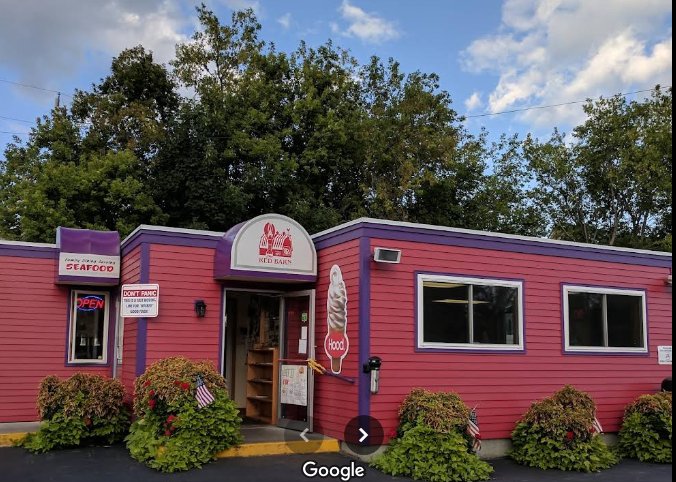
Red Barn: This national fast-food chain, established in 1961, had a significant presence across the country, boasting over 300 locations in 19 states by the 1970s. Red Barn was particularly known for its substantial burger offerings, including the “Big Barney” (comparable to a McDonald’s Big Mac) and the “Barnbuster” (similar in style to a Quarter Pounder or Burger King’s Whopper). Crucially, a 5.0 oz patty from Red Barn was specified as having “Patty Dimensions: 4 7/8 inches”. There was indeed at least one Red Barn location confirmed to be in Salt Lake City.
The patty dimensions of Red Barn’s “Barnbuster” (4 7/8 inches) are remarkably close to the user’s recollection of a “5-inch patty.” Given Red Barn’s confirmed presence in Salt Lake City and its reputation for large burgers, it presents a strong alternative explanation for the user’s memory if a Whataburger did not exist at the specified location. The memory of a distinctive large patty could easily be attributed to a well-known “big burger” chain, especially over the span of decades.
Salt Lake City Business Directories and Archives
To definitively confirm or refute the presence of a Whataburger or Red Barn at “State Street around 800 South,” a detailed examination of historical records would be necessary. Salt Lake City directories for the 1970s are available through the Utah City Directories Collection, including directories for South Salt Lake City. These valuable resources list residents, streets, businesses, and organizations, often including advertisements, and are designed to be searchable.
Additionally, the J. Willard Marriott Library at the University of Utah maintains the Utah Digital Newspapers (UDN) repository, which provides free access to over nine million pages from 400 newspapers published in Utah from 1850 to 2023. This extensive resource allows for searching historical newspaper content, which would be critical for finding advertisements or news articles about restaurant openings or closures on State Street around 800 South during the 1970s. The available information indicates that State Street around 800 South was indeed a commercial area with various tenants, including restaurants.
While these archives are excellent resources for historical research, the challenge lies in the potential for short-lived businesses, such as a Western World Foods Whataburger (if it opened), to have left minimal or no advertising footprint, or for their records to be obscure within the vastness of the archives. The absence of a listing in widely accessible digital archives does not definitively prove non-existence, especially for a brief operation. This highlights the inherent difficulty in definitively proving or disproving a short-lived historical business through common online searches, which is precisely why the user’s initial inquiries were inconclusive.
Table 2: Prominent Salt Lake City Burger Chains (1970s) with Patty Characteristics
Restaurant Name
Type (Local/National)
Key Burger/Patty Size
Known Locations (1970s)
Notes
Whataburger
National (via franchisee)
Quarter-pound patty on 5-inch bun
Planned for Utah (Western World Foods)
Strong match for patty/bun size memory; potential short-lived presence.
Dee’s Drive-In
Local
1/8 pound patty
Fixture throughout Utah
Patty size significantly smaller than user’s memory.
Very close match for patty size memory; known for large burgers.
Crown Burger
Local
Quarter-pound patty (with pastrami)
Opened 1978 in Salt Lake City (377 E 200 S)
Patty size matches, but opened late 70s and distinctive pastrami.
Eat-a-Burger
Local
“Large” burgers (specific size not found)
Regent Street and 200 South
Known for large burgers, but location not on State St.
JB’s Big Boy
National/Regional
“Big Boy” (triple-decker)
Present in Salt Lake City
Known for large, multi-patty burgers.
This table is essential for systematically evaluating alternative explanations for the user’s memory. By explicitly comparing patty and bun sizes across various burger chains known to be in Salt Lake City during the 1970s, it allows for a direct assessment of how well each chain aligns with the user’s specific recollection. This structured comparison immediately highlights that Dee’s Drive-In is an unlikely match due to its smaller patty size. Conversely, it identifies Red Barn as a very strong candidate for potential misattribution because its patty diameter (4 7/8 inches) is nearly identical to the 5-inch patty remembered by the user, and Red Barn had a confirmed presence in Salt Lake City. This comparison helps to narrow down the possibilities and provides a clear, data-driven framework for understanding how the user’s memory could be accurate in its sensory detail (large patty) but potentially misattributed in terms of the specific brand.
Reconciling Memory and Records: Analysis of Discrepancies
The conflict between the user’s strong personal memory and the lack of readily available online documentation poses a classic challenge in historical research. However, the collected information allows for a plausible reconciliation, suggesting that the user’s memory is likely accurate.
The Case for a Short-Lived Whataburger Presence
The most compelling evidence supporting the user’s memory stems from the documented expansion plans of Western World Foods, a Whataburger franchisee. Their 1972 initiative explicitly included plans for 14 new restaurants across New Mexico, Arizona, Colorado, and crucially, Utah. This is not a vague aspiration but a concrete business strategy. Furthermore, the appointment of David Hawley as Vice President of Operations for both Nevada and Utah by 1975 strongly indicates that tangible steps were being taken to establish Whataburger locations in Utah. The presence of a dedicated executive for Utah operations suggests more than just theoretical planning; it points to active development.
While specific addresses for Utah locations are not detailed in the available information, the rapid dissolution of Western World Foods in 1979 provides a clear and coherent explanation for why any Utah Whataburger that opened would have been very short-lived. A brief operational period, especially one ending in a franchise failure and subsequent corporate acquisition, would naturally lead to minimal or no permanent digital or easily accessible historical records. Businesses that operate for only a few years, particularly those whose parent franchising entities dissolve, often leave little to no lasting public footprint in broad historical databases. The user’s strong memory, corroborated by a local Facebook group, aligns perfectly with the idea of a real, but ephemeral, business presence. This situation illustrates that the absence of easily discoverable evidence does not equate to evidence of absence, particularly for short-lived ventures or those impacted by corporate restructuring.
Alternative Explanation: Misattribution to Red Barn
If, for any reason, a Whataburger location did not materialize at the specified address or was too fleeting to be widely remembered, the user’s vivid memory of the “5-inch patty” could plausibly be attributed to Red Barn. Red Barn was a national chain with a confirmed presence in Salt Lake City and offered a “Barnbuster” burger with a 4 7/8-inch patty. This dimension is remarkably close to a 5-inch patty, a difference that could easily be imperceptible or rounded up in a long-term memory. Red Barn was also known for its “large burgers” , making it a strong candidate for leaving the impression of a “gobsmacking” large patty.
Human memory, especially over several decades, can sometimes conflate details from similar experiences. The most salient feature for the user was the “5-inch patty.” While Whataburger indeed featured a 5-inch bun, Red Barn offered a patty of almost identical diameter. If a Red Barn was located on State Street around 800 South (a detail that would require further specific directory research to confirm), it is conceivable that the user experienced the impressive patty size at Red Barn but later associated it with the more widely known “Whataburger” name, especially if the latter was rumored or briefly planned for the area due to Western World Foods’ activities. This scenario demonstrates how a memory can be factually accurate in one detail (the size of the burger) but potentially misattributed in another (the specific brand), particularly when similar products exist and historical presence is ambiguous.
The Challenge of Verifying Specific Locations (State Street, 800 South)
To definitively confirm or refute the presence of either a Whataburger or a Red Barn at the precise location of “State Street around 800 South,” a more granular and dedicated search of 1970s Salt Lake City business directories and local newspaper archives would be necessary. These resources, which often contain specific business listings, advertisements, and news of openings or closures, would provide the most direct evidence. The available information confirms that State Street around 800 South was a commercial area with various tenants, including restaurants.
While general historical records confirm Whataburger’s plans for Utah and Red Barn’s presence in Salt Lake City, pinpointing a specific address like “State Street around 800 South” requires a level of detailed, local-level historical data that is not fully provided in the current information. The current findings confirm the possibility and likelihood of a Whataburger presence, and a strong alternative in Red Barn, but not absolute certainty for the exact address. This highlights the limitations of broad historical searches and the necessity for highly localized, detailed archival research to resolve such specific historical queries.
Conclusion and Key Takeaways
The user’s vivid and corroborated memory of a Whataburger outlet in Salt Lake City during the 1970s, characterized by its memorable 5-inch patty, is highly credible despite the absence of this information in common online historical searches.
The most probable explanation for this discrepancy lies in the documented, albeit short-lived, expansion efforts of Whataburger’s franchisee, Western World Foods Inc. In 1972, Western World Foods explicitly included Utah in its plans for 14 new restaurants across the Western United States, and by 1975, an executive was appointed with operational oversight for both Nevada and Utah. Whataburger’s signature product from its inception was indeed a quarter-pound patty on a 5-inch bun, designed to be held with two hands. This precise detail strongly supports the idea that the user genuinely encountered a Whataburger product. The subsequent dissolution of Western World Foods in 1979 provides a clear and compelling reason why any Whataburger locations opened in Utah would have been very brief and consequently left minimal or no readily accessible historical footprint in broader corporate records.
While a short-lived Whataburger presence is the most direct explanation, the possibility of misattribution to Red Barn cannot be entirely dismissed. Red Barn, a national chain with a confirmed presence in Salt Lake City , offered a “Barnbuster” burger with a 4 7/8-inch patty , a dimension remarkably close to the user’s recollection. If a Red Barn was located at the remembered address, it could account for the patty size memory. However, the user’s specific brand recall, further supported by others in a local social media group, leans towards a genuine Whataburger experience. Therefore, it is highly probable that the user’s memory is accurate regarding a short-lived Whataburger presence in Salt Lake City during the 1970s, likely operated by Western World Foods Inc. The perceived absence in common online historical records is best explained by the brief operational period and the subsequent failure and acquisition of the franchising entity
Key Takeaways
Memory vs. Digital Records: Personal and collective memories can contain accurate details about historical events, even when contradicted by easily accessible digital records. This is particularly true for short-lived business ventures, especially those that were part of unsuccessful franchise expansions, as they often leave minimal lasting digital footprints.
Franchise Complexity: Corporate histories often simplify or omit the intricate details of complex, short-lived, or unsuccessful franchise expansions. This simplification can lead to gaps in public knowledge and historical records, making it challenging to trace every aspect of a company’s past operations.
Salient Details as Memory Anchors: Specific and unique product features, such as a “5-inch patty,” can serve as powerful anchors for long-term memories. These distinct details can help individuals accurately recall a particular experience, even if the associated brand name might become slightly conflated or misremembered over the passage of time, especially when similar products existed in the market.
The Value of Local History: Reconciling such historical discrepancies often necessitates delving into granular local historical archives, such as city directories and local newspapers. These resources often contain more detailed and localized information than broader national databases, proving invaluable for verifying specific addresses and operational dates of businesses that may have had a limited or ephemeral presence.
TIL Whataburger in Texas and What-A-Burger in Virginia opened about the same time in 1950 but didn’t know of each other’s existence until 1970. They both sued the other, but the court ruled that customers were not likely to be confused about whether the burgers served came from Texas or Virginia. : r/ – Reddit, https://www.reddit.com/r/todayilearned/comments/8u200m/til_whataburger_in_texas_and_whataburger_in/
The first location was in the parking lot of the current 377 East 200 South location. It seated 75 people. John worked from 3 am to 5 pm doing all of the prep work for the homemade Onion Rings and Chili. Within 30 days, people were lined up like a train outside the front door, waiting to come in. The original building was torn down 1½ years later and the current building was built, seating 150 people. – Crown Burgers Salt Lake City Utah, https://www.crown-burgers.com/story.php
This is an impressively deep dive into the history of Salt Lake restaurants, and for me, the key takeaway is this:
Therefore, it is highly probable that the user’s memory is accurate regarding a short-lived Whataburger presence in Salt Lake City during the 1970s, likely operated by Western World Foods Inc.
I’m 74. My memory is clearly not what it was, but this I can tell you: I have never eaten at a Red Barn in my life, with the exception of a non-chain-related independent outlet up in Augusta, Maine.
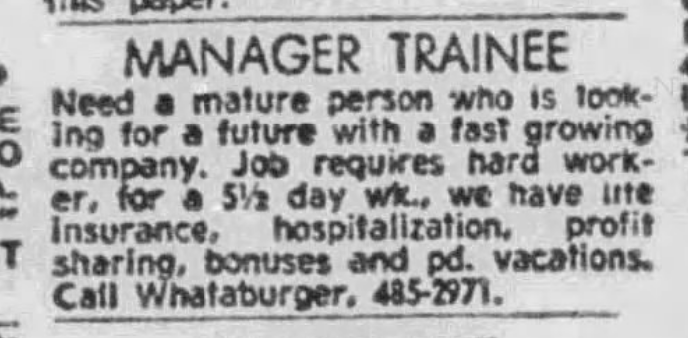
Last of all, and most important, this want ad appeared in the Salt Lake Tribune on The Salt Lake Tribune on Nov 29, 1973, Page 60:
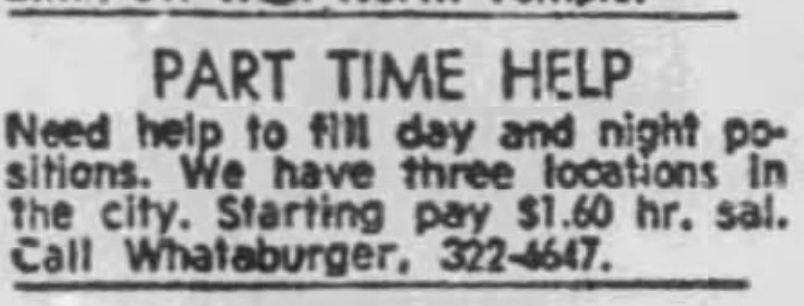
And on Fri, Nov 30, 1973, Page 61, the following ad was seen:
Three locations! And, if you have a subscription to Newspapers.com, you can see dozens of similar solicitations between 1973 and 1974.
As a result, I feel 100% confident, based on my recollections of Salt Lake in the ’70s and the results of Gemini’s search, that there was indeed at least one Whataburger in Salt Lake at one point, and most likely three, and that I and many other people enjoyed their brief existence.
Barking, unreasonable, terrible managers. Mind-clenching Corporate stupidity. Unpredictable schedules. Lazy or arrogant or brown-nosing co-workers. And, of course, the ubiquitous customers: arrogant, entitled, insouciant, demeaning, demanding, illogical customers… with the occasional gem of a human being hidden in the regular flow. All these are things that the average retail worker has to put up with on a daily basis.
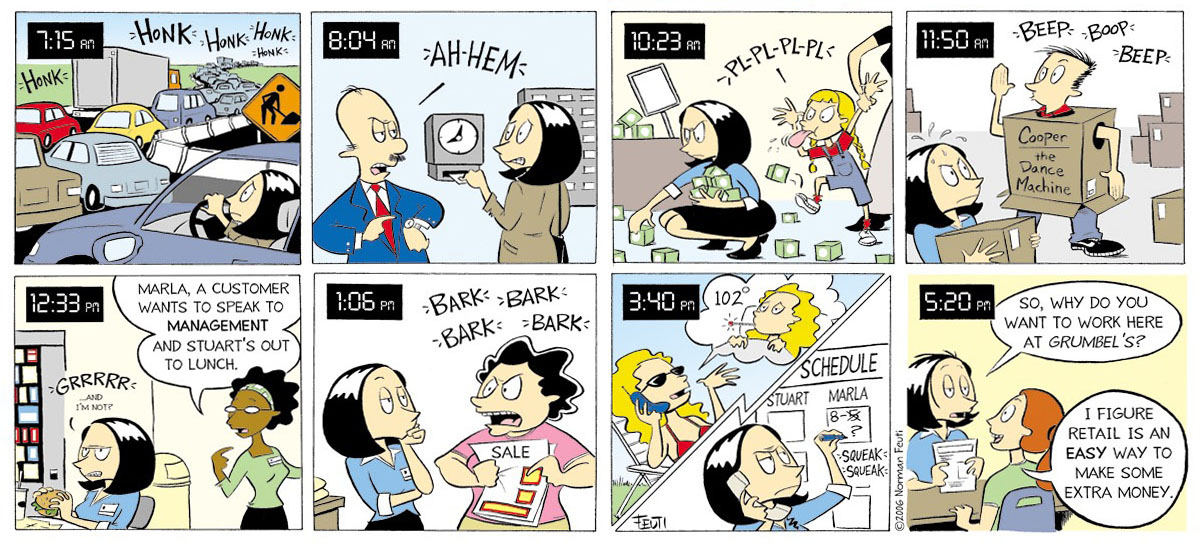
The worst and most outrage-generating stories can be found at Not Always Right, but there’s one place a retail worker should go – if you haven’t already – to smile, cringe, laugh, and find kindred spirits: Retail, by Norm Feuti.
Retail, Strip One, by Norm Feuti, January 1, 2006.
Anyone who has ever worked in retail or still does owes it to themselves to be familiar with this lovely, long-running comic strip. It sadly came to an end after 14 years when the artist wanted to move on to a different career in illustrating children’s books, but the entire thing is available online as an archive. I greedily devoured every one, because it so perfectly captures every aspect of the retail experience, from managers, to co-workers, to the most horrible customers… all of which have to be dealt with in a day’s work if you’re interested in keeping your job.
But it’s not just about the horrors; along the way you will get to know and fall in love with a delightful cast of characters who grow, and learn, and survive the journey. Of course there are the ones you love to hate, but that only adds Tabasco sauce to the chimichanga, as it were.
Only the first year was captured in hard copy, but if Norm were ever to think about publishing the other 13 years in dead-tree edition, I would be first in line to buy them.
There was also a companion volume, “Pretending you Care,” which included many strips from year one along with wonderful expositions about what it’s like to work in the retail world.
Both are available on Amazon, but neither one is cheap, sadly – I was fortunate to score a copy of each through AbeBooks, my go-to source for difficult-to-find books, at much more affordable prices. They occupy honored places on my bookshelf.
While I never actually worked a retail floor, I did work in pizza shops for 3 years, and spent 6 months in a customer-service chair for a software company – essentially the same as retail work without the face-to-face interactions with customers. It was, to be very honest, the most soul-sucking job I ever did in my entire career, and would never again repeat the experience even if I had to. Thank Ṣiva H. Viṣṇu for retirement.
That said, I undertand. And I have always done my best to be a bit extra kind and appreciative to those people on the floor or behind the register who serve my needs, who endure the daily horror, and who long for nothing more than the end of their shift.
To all retail or customer-service workers out there, thank you.
Attending a funeral yesterday brought this quote by Jean-Luc Picard (from Star Trek Generations) powerfully to mind, and made me ruminate once again about certain realities. The first of which is, “Tomorrow is never given.”
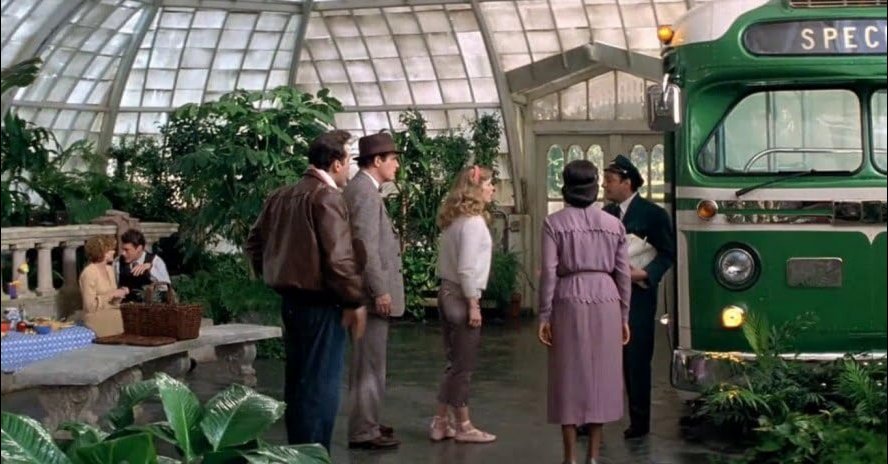
We never know when the bus will come to get us.¹
What is the measure of a person’s life? The funeral I attended was for a young husband and father, a well-beloved endodontist, who was taken too early in an automobile accident precipitated by a drunken driver. Many people turned out to send him off to his next life; many tears were shed, many good words spoken. He had a large family, his wife had a large family, and he will certainly be long remembered for his goodness.
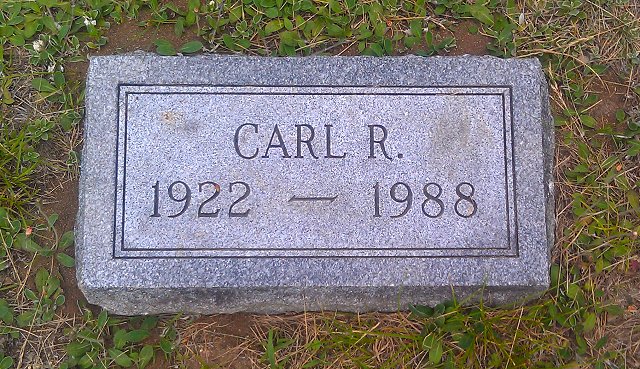
But as memories fade and those who knew the person also move ahead, all that remains of a person’s life is often a gravestone with two dates: birth, death, and that little dash in the middle, which stands for everything that person did, thought, and was during their walk on this green earth.
Linda Ellis wrote a famous poem, “The Dash,” which begins thusly:
I read of a man who stood to speak at the funeral of a friend. He referred to the dates on the tombstone from the beginning to the end.
He noted first came the date of the birth and spoke the following date with tears. But he said what mattered most of all was the dash between the years.
For that dash represents all the time that they spent life on Earth. And now only those who loved them know what that little line is worth.
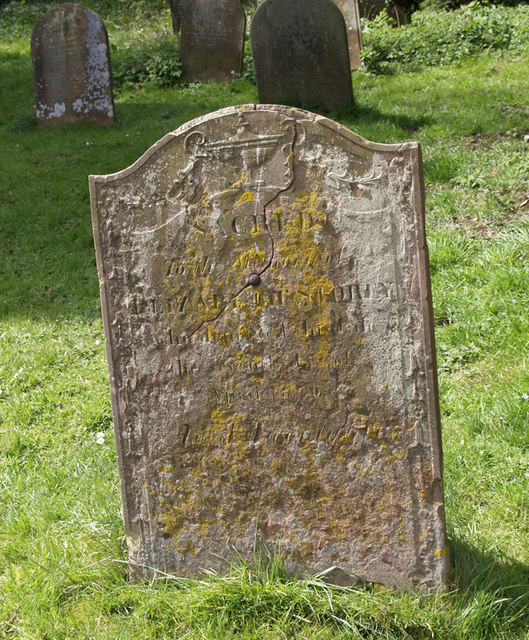
But nothing lasts forever, not even stone. The natural processes that can wear down mountains or create the grand canyon over the course of millions of years will inexorably erase even the most beautifully-carved memorials, and then there is nothing to mark that person’s passage through mortality.
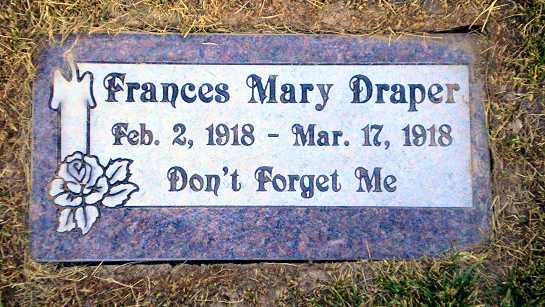
But I believe in giving everyone a shot at being remembered. My mother had a younger sister who lived less than two months. She was loved, and cherished, but for some unknown reason failed to thrive. She was buried in the same plot as her grandmother, with nothing there to indicate that she had even existed. While it’s the sad truth that countless individuals upon the earth have no graves or are buried in unmarked locations, I found myself in a position to do something for my little aunt, and had a marker prepared and set in the appropriate location.
Someday it, too, will be nothing but dust, but in the meantime those who wander Wasatch Lawn Memorial Park in Salt Lake City will be able to see and take note of her passage. And to me, that’s important.
As the title of this essay intimates, at some point – hopefully a while in the future yet – the bus will come for me. I wonder how I will be remembered? I’m an only child, and so is my wife. We have 7 kids between us, but only one remains active in our community of faith, and all are scattered around the country. It’s my intention to give my body to science² – I can see no point in paying thousands of dollars to have an old shell preserved when it might still do some good somewhere – so I don’t think I’ll have a grave anywhere, but I’d like to be memorialized in some way. A cenotaph³, perhaps? An entry over at FindAGrave? My Facebook site will hopefully be memorialized, but as we have seen, even the biggest entities don’t last forever. Even this blog, which contains many of my thoughts about the world around us, will someday go away, when the domain name is no longer renewed and WordPress is no longer paid.
Ultimately, all we are and all we did are known only to God, but our deeds in this life, like ripples in a pond, will continue to continue onwards in time through the effects of how we treated others, both for good and for ill. I can only hope that when the time comes for me to cross the river Styx and my heart is weighed against the feather of Ma’at, that I will not be found wanting.
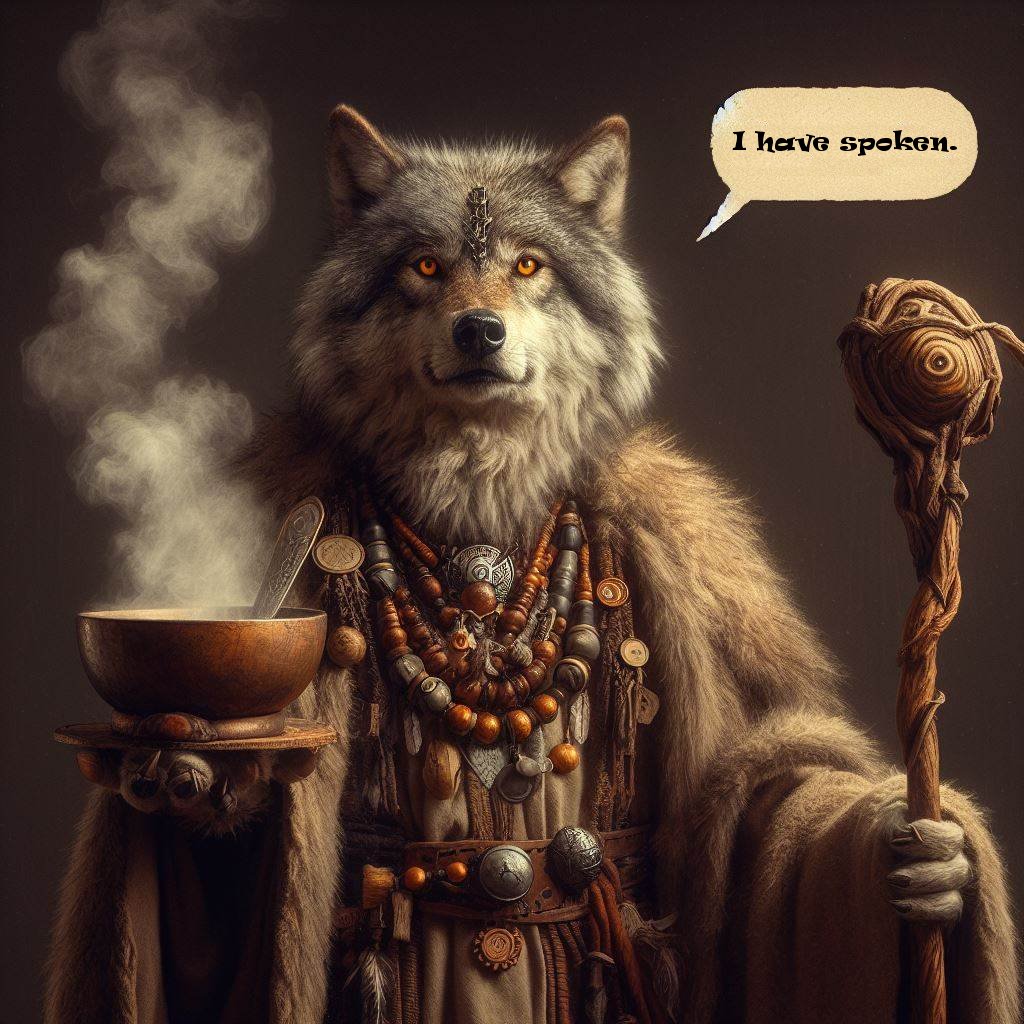
The Old Wolf has spoken.
Footnotes
¹This is a reference to a lovely and under-appreciated film starring a young Robert Downey, Jr., “Heart and Souls.”
² Unless this happens:
³A monument to someone whose remains are elsewhere
This is just what it says – a first-world rant. There are so many other problems in the world to worry about, but just this morning I encountered it again, and it made me realize that it’s been a burr under my saddle since the days of Windows 1.0 (and possibly even earlier, since DOS-based programs may have had earlier versions of the same thing.
So today, I just need to “reeeeee into the void,” as we say at Imgur, and then I can put the annoyance to bed and not think about it any longer.
I’m talking about the Progress Bar… you know, “a graphical user interface element that shows the progression of a task, such as a download, file transfer, or installation. It may also include a textual representation of the progress percentage.”
Like this:
Sometimes it even gives you the percent of the task completed as a number, and the better ones give you an idea of how much time is left for completion.
The idea of this is to show the user how much of the task has been done, so they have an idea of how long they have to wait, or whether they can do something else in the meantime, or go out for coffee, or whatever.
Sometimes, however, a process has several parts, and some designers like to show the completion of individual steps; there is debate out there among software designers as to whether it’s better to have one progress bar or two, like this:
Either way, really, is fine with me, as long as I have an idea of what the total job completion percentage is like.
But what really torques my cork is when a single progress bar goes all the way to the end, and then goes back to the beginning and repeats… over, and over, and over, and over again in the case of complex packages, giving the poor user absolutely no idea of when the flaming job will be done!
Initializing installation
Deleting Old Files
Extracting zip files
Installing…
Installing…
Installing…
Adding registry entries
Finishing up…
And that’s just an example. I’ve seen even more complex processes, with that blistering progress bar starting over each time, and no indication of how much is left to do!
(Image gacked from a Kaspersky website)
So the end of my rant is more of a plea than anything else: If you’re a software developer, please don’t do this! The best option is one progress bar, showing the percentage of the total job that’s complete, and (if possible), how much time is left for completion. Most users don’t care about how many steps there are, or what the installation is doing… they just want it done!
Thank you for coming to my TED talk. I will not be taking question.
This post is essentially copypasta from a comment I made over at Facebook, with a little embellishment.
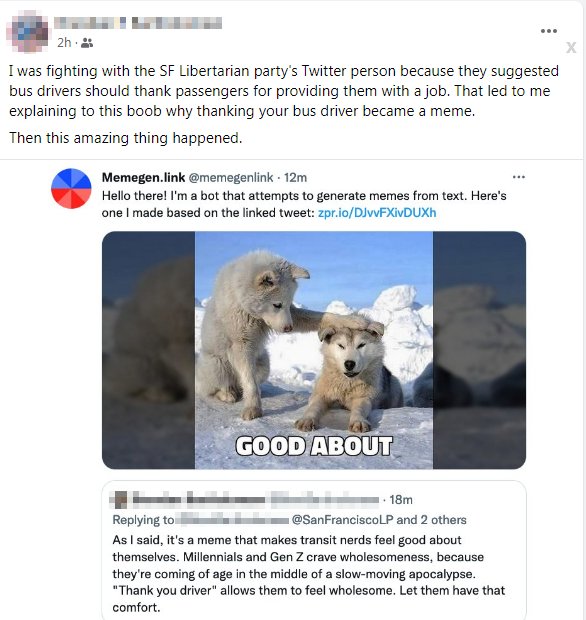
One of my friends is a bus driver in San Francisco, and he posted this little exchange:
And I thought this was very interesting, and I started thinking about it. (A dangerous pasttime.)
A lot of things have combined over the last decade, including the political Chernobyl of the Dildo Braggins-MAGA era, the pandemic, and my long-awaited retirement. All of these things, but most especially leaving the workforce, has made me keenly aware that just about everyone I interact with these days is serving me in some way. All of them are out there busting their chops to buy food and pay rent and afford daycare, and every person I encounter in public from the gal behind the car rental counter to the fella bagging my groceries is serving my needs. Me. If they weren’t there doing the wage-slave tango, I’d have more to do than I could handle, and a lot of stuff I needed simply wouldn’t get done, and a lot of stuff I wanted would simply not be available.
For a long time, even before this gentle epiphany, I have been in the habit of thanking service veterans for their sacrifices for our nation. Now, Jim Wright over at Stonekettle Station – a veteran himself – wrote an interesting essay on this subject, and while I understand and appreciate his point of view, I am grateful for their service. I lotteried out of the draft in 1972, and thus never had the obligation of either being shipped off to ‘Nam or joining the Navy; half of me is grateful, and the other half wistful that I didn’t have the chance of serving my country in that way. So when I see one of these hats or one like it,
I make sure to tell the wearer that I appreciate what they did for all of us.
By extension, I’ve made it a little personal habit to tell people I encounter in the course of the day, “… and thanks for being here for us.”¹ I don’t do it to feel wholesome, I do it because I mean it from the bottom of my heart. Oddly enough, most of them don’t know how to handle this and I get a lot of bluescreen moments. But I mean it sincerely and somehow it seems indecent not to say something. Perhaps, at the very least, it brings a bit of warmth to someone’s otherwise dreary or retail-hell day.
WAT‽
The Old Wolf has spoken.
Footnotes
¹ Yes, even cops. These folks usually get “Thanks for keeping us all safe.” While there are far too many problems with bad peace officers and bad police procedures in our nation, I don’t ascribe to the reddit/Imgur ACAB-echo chamber and I’d rather err on the side of decency than resentment.
Today Google honors International Women’s Day with one of their doodles.
I am 100% in favor of honoring the women of the world. And, I have some thoughts. Consider these remarks by Morgan Freeman on the occasion of Black History Month:
MIKE WALLACE: Black History Month, you find … MORGAN FREEMAN: Ridiculous. WALLACE: Why? FREEMAN: You’re going to relegate my history to a month? WALLACE: Come on. FREEMAN: What do you do with yours? Which month is White History Month? Come on, tell me. WALLACE: I’m Jewish. FREEMAN: OK. Which month is Jewish History Month? WALLACE: There isn’t one. FREEMAN: Why not? Do you want one? WALLACE: No, no. FREEMAN: I don’t either. I don’t want a Black History Month. Black history is American history. WALLACE: How are we going to get rid of racism until …? FREEMAN: Stop talking about it. I’m going to stop calling you a white man. And I’m going to ask you to stop calling me a black man. I know you as Mike Wallace. You know me as Morgan Freeman. You’re not going to say, “I know this white guy named Mike Wallace.” Hear what I’m saying?
2005 interview with Mike Wallace for television’s “60 Minutes” news magazine program
There has recently been an immensely favorable response to the Neflix series “The Handmaid’s Tale,” ¹ as well as rising awareness of the challenges still faced by women around the globe (astonishingly, in the 21st Century. Sadly, there are bastions of troglodicity (my own word) in my own country where people in power are bound and determined to keep women in a state of perpetual subjection and inferiority – notably the US Congress, SCOTUS, and legislatures in various “red” states around the nation, such as Texas, Alabama, Utah, and many others.
The Christian faith has a lot to do with it, especially religion of the evangelical sort:
“Wives, submit to your own husbands, as to the Lord. For the husband is the head of the wife as Christ is the head of the church, his body, and is himself its Saviour.”
Ephesians 5: 22-23
“Let a woman learn in silence with all submissiveness I permit no woman to teach or have authority over a man; rather, she is to remain silent.”
1 Timothy 2: 11-12
But even in non-Christian societies, the pervasive attitude that women are inferior beings has been present for millennia – the following passage from one of my favorite short stories, set in Brazil, lays it out pretty clearly.
Then [the tribal chief] went on to explain—it took all night—that the tictoc nut was not like other nuts. Everything, said the chief, everything could think a little. Even a leaf had sense enough to turn itself to the light. Even a rat. Even a woman. Sometimes, even a hard-shelled nut. Now when the world was made, the deuce of a long time ago, man having been created, there was a little intelligence left over for distribution. Woman got some. Rats got some. Leaves got some. Insects got some. In short, at last there was very little left. Then the tictoc bush spoke up and begged, “A little for us?”
“River of Riches” by Gerald Kersh, 1958
Fast forward to our day and age and country, and these attitudes have some direct consequences within individual families, and not just in the less-tangible global sense of economic and social inequality. In other countries it’s worse still; female children in Afghanistan and India, for example, are more likely to be abandoned, sex-selectively aborted or killed in instances of infanticide than are boys. Human trafficking, largely perpetrated upon women and female children, continues to be rampant. The evil is mind-clenching.
If we’re going to be fair about it, every other day should be International Women’s Day… plus February 29th when it rolls around because women slightly outnumber men on a global basis. But until the recognition which they deserve is granted them in the same sense that Morgan Freeman expressed, I give honor – every day – to all the women of the world², who not only bear and raise the next generation but who have made incalculable contributions to humanity since the dawn of time.
This little essay may do absolutely nothing to improve the situation, but I felt that for myself, it was important to mark the day with more than just a congratulatory message.
The Old Wolf has spoken.
Footnotes
¹ If you liked the series, read the books by Margaret Atwood, including The Testaments. They add a lot of things you’ll never see in the series and leave you with some reasons for optimism instead of bleak hopelessness.
² Cis-, trans-, or otherwise, in case you were wondering.
Cross-posted from Livejournal 5/3/2021, and edited slightly for current relevance
♫ For the easiest travel on earth, Take a Trailways, take a Trailways, For the easiest travel on earth, Take a Continental Trailways bus. ♫
♫ Go Greyhound, and leave the driving to us! ♫
A post in Teresa Burritt’s Frog Blog (an earlier version, now defunct, but the current one is still full of interesting things) included the following picture:
Like many of her posts, this got the old gears grinding and brought back many memories of cross-country bus travel, some pleasant and others… well, “interesting.”
Back in the 50’s, you could truck around for $99.00 for 99 days, unlimited travel to unlimited destinations, and break your journey anywhere; I suspect this is what the poster above referred to. Naturally, it was the 50’s, and the buses were notorious for intolerance and segregation¹ (see here for some of the details of that shameful situation), but also became a focal point for the civil-rights movement. For comparison, you can read the Trailways Wikipedia entry.
Back in the 60’s I took several trips by bus from New York to California and back; there’s no denying that it was challenging. Even as a relative youngster, sleeping on a bus is less than luxury. The seats didn’t recline much if at all, much like the cattle-class seats on a modern airliner. Stopping at all hours of the night at lonely, sometimes seedy cafés in Broken Clavicle, Iowa or Whistling Rock, Wyoming is not luxurious… and I will forever associate such places with the smell of Postum™ ². As I drink neither coffee nor tea, it was all I could get if I wanted something hot besides cocoa; like Sanka™, it came with a metal pot of hot water and little envelopes.
Sanka and Postum, as offered in restaurants
Sleeping on the bus was so challenging for me I would often resort to sleeping pills, but those made the night-time stops fairly grueling – staggering to the restroom while under the influence of those soporifics is unpleasant at best. Eventually I stopped using them and just toughed it out.
One upside was being able to watch the countryside go by without worrying about the stresses of driving, and another was the interesting people one could meet on the way. Yes, there were the “other” kind of people as well, along with the fat ladies puking in the aisle if they couldn’t make it to the onboard lavatory, but the really unpleasant incidents that one hears about were thankfully quite rare, and I never encountered one. While I never lost a bag during an actual trip, one box I shipped from New York to Pennsylvania via Greyhound arrived opened, damaged, with much missing, and full of gravel. I wish I could have been a fly on the wall to see what happened to that one.
I’ve checked – you can still travel by bus today, if you are hardy. But the advantages seem few, given the cost of other alternatives.
A round-trip fare from SLC to JFK would cost $499.00 at senior, economy rates, and take about 48 hours each way. Allow a bit for what passes for food and such along the route.
That compares to the lowest airfare of $353.00 for the same dates.
It would cost around $381.00 for gas in a 40mpg Prius at an average cost of $3.50 per gallon (which would take at least 8 days, coming and going, meaning additional lodging and food costs.)
Amtrak would cost $492.00 and take 61 hours, if one can get through without service disruptions.
At this point, the biggest advantage, shared with Amtrak, seems to be seeing a lot of countryside without having to do the driving yourself. The fact that Greyhound is still in business speaks to the fact that many people are willing to take this option – and naturally, there are other routes which may make taking the bus more advantageous.
The Old Wolf has spoken.
Footnotes
¹ John Howard Griffin’s experiences at a Greyhound Bus station in the South in 1960, as well as on the bus trip itself, recounted in Black Like Me, are chilling.
² Postum faded into history in 2007 but enough people clamored for it that it was successfully revived by Eliza’s Quest Food in 2013. There are recipes for home-made varieties, and one product, Ersatz™, claims to be a good Postum™ substitute. During the war, Ersatzkaffee was commonly given to Allied POW’s, and here we have an Ersatzersatzkaffee being marketed to those who crave it. The world is so full of a number of things. Now one can get things at the grocery store like Pero™, a European coffee substitute (known in Europe as Karo™) which is similar but much better-tasting, but rarely available in restaurants.
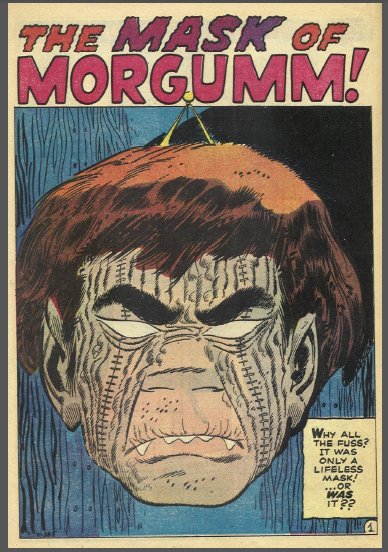
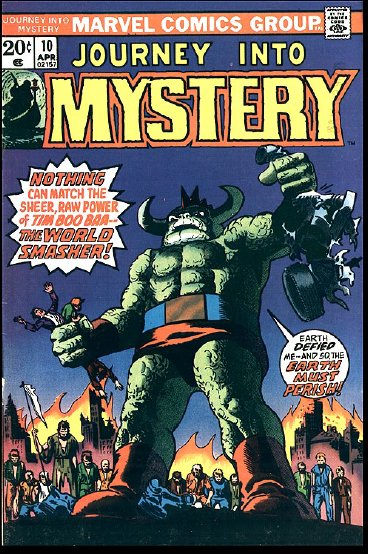
I loved comics as a kid. No shame, I learned a lot. Loved things like Strange Tales, Creepy, Weird Science, along with the standard DC and Marvel fare.¹ And over the years, some things just stuck in my mind. Tales like “Tim Boo Baa,” “The Mask of Morgumm,” or “The Lonesome Death of Jordy Verrill.” Thanks to the miracle of the Internet, I’ve been able to recover quite a few of these and revisit them in all their glory.
But there was one memory I was never able to recapture, although it popped into my mind frequently… until this week.
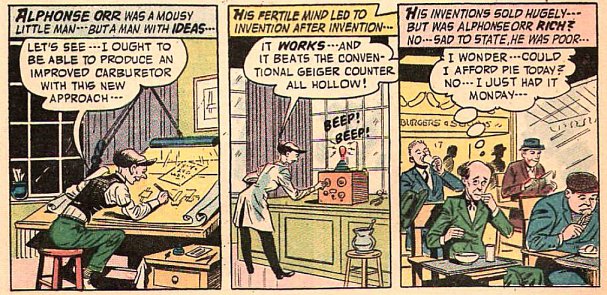
It was about this poor inventor, Alphonse Orr, who was taken advantage of by a hideous, bullying con-man of a boss. Finally his name popped up in a comic database, and I was able to score a copy of the issue that the story appeared in.
I was ten when this comic went on sale in 1961, and somehow that last panel, the image of this little man wondering if he could afford pie impacted me profoundly,² as did the idea of the injustice perpetrated upon him by his evil boss – and stuck in my mind for over half a century. Kids have an over-developed sense of injustice at that age, and I was no exception.³
So you’ll pardon me if I found the ending to the story immensely satisfying, and re-reading it after all these years I find that my feelings haven’t changed one whit.
You can read the entire story from “Forbidden Worlds, Issue #98 here as a pdf download.⁴
It’s nice to be able to put memories to rest.
The Old Wolf has spoken.
Notes:
¹ I could have put my kids through college if I had kept all the first editions I bought, but that’s another story.
² Never mind all the abject poverty and true starvation and famine in the world; at that age I was not aware of what was happening in third-world countries or even of food insecurity in America, but at that time the thought that Alphonse was so poor that he couldn’t afford pie deeply saddened me.
³ Those impressions have never left me. I have found that when it comes to the injustice and cruelty and stupidity of corporations, there’s always a relevant Dilbert.
Strips like this infuriate me. I’m not sure why I keep reading them.
⁴ Edit: If you do read this story, keep in mind that it’s the ’60s and that it’s fantasy; the Challenger Deep is 6.85 miles below the surface, whereas Edgar W. Simmons claims to have taken his new submersible 120 miles down. Just as a matter of curiosity, the pressure at that hypothetical depth would be 19,259.37 atmospheres, or 250,371 pounds per square inch, or roughly 42 Humvees stacked on your thumbnail. Science? We don’t need no steenkin’ science!
This was an odd one. It happened at a Naval Air Station, where people essentially carry weapons for a living. So that muddies the water a bit. And, it turns out that the perp was a Saudi national, and an aviation student to boot, which raises a *whole* lot of questions in my mind, but that’s a discussion for another day.
Before anything else, my heart is broken for those impacted; the victims, their families, and their loved ones. People die every day from all sorts of reasons – illness, unavoidable accidents, natural causes, even violence – but death by terrorism is especially hard on those left behind. And I make no apologies for calling it that. I am deeply sorry for your loss.
But now comes the summum bonum of this post: According to CBS News, ” The number of mass shootings across the U.S. thus far in 2019 has outpaced the number of days this year, according to a gun violence research group. Before this year has even ended, 2019 has already had more mass shootings than any year since the research group started keeping track.”
This doesn’t even take into account the little ones. Individual shootings by unbalanced or patently evil people. As of today, the total is 36,518. Now, in terms of national statistics, that’s only roughly 3/4 the number of deaths by suicide from any cause, according to the CDC, and almost the same number as automobile fatalities in 2018. So some might argue that in terms of overall numbers, it’s not a big deal.
But it is. It’s a big deal. It’s too many, and too horrible, and too traumatizing, and gun violence takes adults, and children, and breaks hearts and shatters families and reduces our safety (the NRA would argue the opposite) and the quality of our life.
So here’s the question, directed at those of my friends and associates who fall on the “cold, dead hands” side of the equation:
What are you going to do to stop this carnage. What are you doing right now to make sure that guns don’t get into the wrong hands, the hands of people who will use them to destroy the innocent?
I exhort you: don’t get me wrong. I support the 2nd Amendment as long as it remains part of the Constitution.
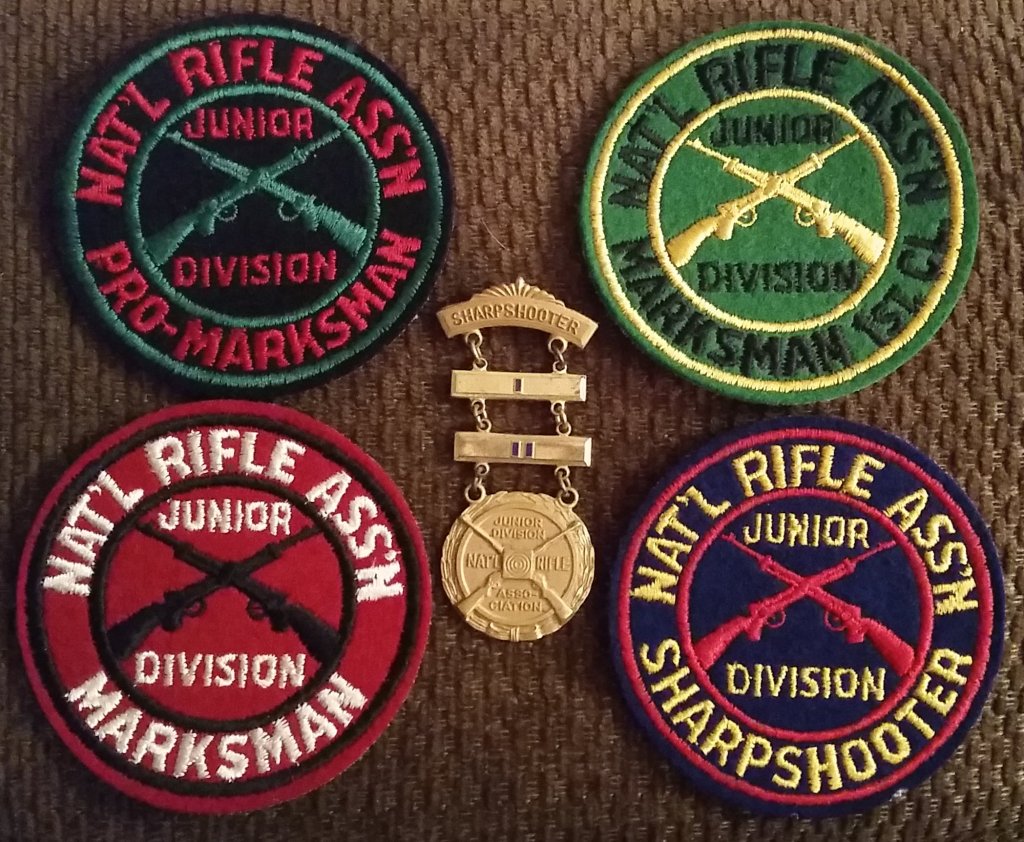
These are patches and such that I earned as a youth. I remain proud of them to this day. I learned gun safety and responsibility and enjoyed target shooting immensely. (Thanks, Hutch.) We own a 30-30. I’m not a “gun grabber,” as the NRA loves to pigeonhole people who advocate for gun control. But the situation today has far exceeded what I consider madness.
The courts have repeatedly ruled that you have the right to assemble an arsenal that would be the envy of a small nation. I think that if the Founders, in their wisdom, could see what that those 27 words had wrought in our day and age, they would weep in outrage and promptly need to go home and change their pants. But that’s my interpretation, and the wisdom of the 2nd is not what I’m discussing. It’s a fact, and we need to deal with things as they are.
I think our nation would be far safer if there were no guns in private hands, but if the right to bear arms is never going away, it needs to be tempered with a responsibility to bear arms safely, and I support treating guns in the same way we treat cars, none of which contravenes the wording of the 2nd Amendment:
Gun owners should be trained, licensed, and insured for each type of weapon owned.
All weapons should be annually registered, inspected, and taxed.
So what are your solutions? How will you preserve your rights and still stop the daily carnage? Change my mind.
Go.¹
¹ Note: I’m inviting comments for this post, despite the fact that it’s a divisive and often inflammatory issue. I have attempted to be as impartial and even-handed as possible in laying out my feelings. Comments that are ad-hominem attacks (i.e. “You gun-grabbing pussy!”) or not based on reason (“I disagree!”) will simply be deleted without ever being seen. I want to know how you would fix things, and preserving the status quo is not an option. So choose your words wisely.
One of my all-time favorite books has always been The Human Comedy by William Saroyan. It’s a lovely novel about good-hearted, hard-working people living in a terrible time of death, destruction, and fear – the days of World War II. It is also written in a simple, delicious style, reflective of a certain simple goodness that much of our society no longer seems to prize.
In the course of the story, Homer Macaulay, a 14-year-old boy whose father has died and whose brother Marcus is away at the war, takes a job at the local telegraph office. There he meets Mr. Spangler, the manager, and Willie Grogan, the old-time telegrapher.
The following excerpt from the novel has always moved me because of Saroyan’s writing, but now more than ever since as of today I am no longer sixty-seven years old, the same age as Willie.
Homer sings “Happy Birthday” to Mr. Grogan
Spangler asked suddenly, “You know where Chatterton’s Bakery is on Broadway? Here’s a quarter. Go get me two day-old pies — apple and cocoanut cream. Two for a quarter.”
“Yes, sir,” Homer said. He caught the quarter Spangler tossed to him and ran out of the office. Spangler looked after him, moving along into idle, pleasant, nostalgic dreaming. When he came out of the dream, he turned to the telegraph operator and said, “What do you think of him?”
“He’s a good boy,” Mr. Grogan said.
“I think he is,” Spangler said. “Comes from a good, poor family on Santa Clara Avenue. No father. Brother in the Army. Mother works in the packing-houses in the summer. Sister goes to State College. He’s a couple of years underage, that’s all.”
“I’m a couple overage,” Mr. Grogan said. “Well get along.”
Spangler got up from his desk. “If you want me,” he said, “I’ll be at Corbett’s. Share the pies between you—” He stopped and stared, dumbfounded, as Homer came running into the office with two wrapped-up pies.
“What’s your name again?” Spangler almost shouted at the boy.
“Homer Macauley,” Homer said.
The manager of the telegraph office put his arm around the new messenger. “All right, Homer Macauley,” he said. “You’re the boy this office needs on the night-shift. You’re probably the fastest-moving thing in the San Joaquin valley. You’re going to be a great man some day, too— if you live. So see that you live.” He turned and left the office while Homer tried to understand the meaning of what the man had said.
“All right, boy,” Mr. Grogan said, “the pies.”
Homer put the pies on the desk beside Mr. Grogan, who continued to talk. “Homer Macauley,” he said, “my name is William Grogan. I am called Willie, however, although I am sixty-seven years old. I am an old-time telegrapher, one of the last in the world. I am also night wire-chief of this office. I am also a man who has memories of many wondrous worlds gone by. I am also hungry. Let us feast together on these pies— the apple and the cocoanut cream. From now on, you and I are friends.”
“Yes, sir,” Homer said.
The old telegraph operator broke one of the pies into four parts, and they began to eat cocoanut cream.
“I shall, on occasion,” Mr. Grogan said, “ask you to run an errand for me, to join me in song, or to sit and talk to me. In the event of drunkenness, I shall expect of you a depth of understanding one may not expect from men past twelve. How old are you?’
“Fourteen,” Homer said, “but I guess I’ve got a pretty good understanding.”
“Very well,” Mr. Grogan said. “I’ll take your word for it. Every night in this office I shall count on you to see that I shall be able to perform my duties. A splash of cold water in the face if I do not respond when shaken— this is to be followed by a cup of hot black coffee from Corbett’s.”
“Yes, sir,” Homer said.
“On the street, however,” Mr. Grogan continued, “the procedure is quite another thing. If you behold me wrapped in the embrace of alcohol, greet me as you pass, but make no reference to my happiness. I am a sensitive man and prefer not to be the object of public solicitude.”
“Cold water and coffee in the office,” Homer said. “Greeting in the street. Yes, sir.”
Mr. Grogan went on, his mouth full of cocoanut cream. “Do you feel this world is going to be a better place after the War?”
Homer thought a moment and then said, “Yes, sir.”
“Do you like cocoanut cream?” Mr. Grogan said.
“Yes, sir,” Homer said.
The telegraph box rattled. Mr. Grogan answered the call and took his place at the typewriter, but went on talking. “I, too, am fond of cocoanut cream,” he said. “Also music, especially singing. I believe I overheard you say that once upon a time you sang at Sunday School. Please be good enough to sing one of the Sunday School songs while I type this message from Washington, D. C.”
Homer sang Rock of Ages while Mr. Grogan typed the telegram. It was addressed to Mrs. Rosa Sandoval, 1129 G Street, Ithaca, California, and in the telegram the War Department informed Mrs. Sandoval that her son, Juan Domingo Sandoval, had been killed in action.
Mr. Grogan handed the message to Homer. He then took a long drink from the bottle he kept in the drawer beside his chair. Homer folded the tele- gram, put it in an envelope, sealed the envelope, put the envelope in his cap and left the office. When the messenger was gone, the old telegraph operator lifted his voice, singing Rock of Ages. For once upon a time he too had been as young as any man.
Saroyan, William, The Human Comedy, Harcourt, Brace and Company (1943)
Willie is 67, and has lived a hard life. Alcoholism takes its toll. I don’t feel as old as Willie, but I haven’t lived through two world wars or known the privations of the Depression. But the number stuck in my mind, and brought back these recollections.
Age is a funny thing. It’s relative. When I first read The Human Comedy as a young man (one of the few books that has ever made me weep like a grade-schooler), sixty-seven seemed far, far away and ancient. Now that I’ve passed that mark, aside from the wear and tear that comes with an aging body I don’t feel as old as Willie – somehow I’m still around 24 inside. Or sometimes 15. Or sometimes five.
I remember that even as a child, I was amused by Gelett Burgess’ poem “Consideration” found in Goops and How To Be them:
When you’re old, and get to be Thirty-four or forty-three, Don’t you hope that you will see Children all respect you?
Will they, without being told, Wait on you, when you are old, Or be heedless, selfish, cold? I hope they’ll not neglect you!
But it’s important to remember that life expectancy has changed radically over the last century and a half.
Today, in 2019, the average human can expect to live to age 79.
in 1943 when The Human Comedy was published, the average US life expectancy for a male was 62.4, so Willie was well past the mark.
In 1900, when The Goops was written, the number was considerably lower: 46.3
And in 1853 when Herman Melville wrote “Bartleby the Scrivener,” lower still – around 38, so the narrator can be forgiven for calling himself “a rather elderly man,” ” somewhere not far from sixty.”
Much of the rising life expectancy can be attributed to advances in medical science, the eradication of many infectious diseases, and the judicious application of vaccines against diseases such as polio, smallpox, and the many childhood diseases that carried so many people away.
Public Service Announcement: Vaccines are generally safe and prevent far more suffering than they cause.
I’m to the point now where I can no longer count on the fingers of both hands the number of family members, friends and associates who have graduated from mortality at an age younger than I am today. We never know when our number will be called; like everyone else I will board the bus (“Heart and Souls” reference) when it comes for me, and while I hope for significantly more time here on earth I will be grateful for what I’ve been given. By the standards of days gone by, I’ve already beaten the odds by a mile.



















 Playing in the World Game