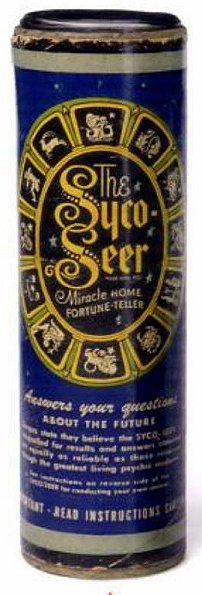
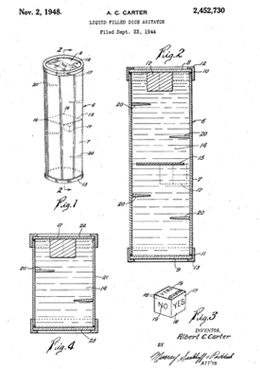
As a youngster I owned one of the ubiquitous Magic 8-Balls, and loved it. However, this novelty did not appear in its current form until 1950. Prior to that date, a number of precursors were on the market. Albert C. Carter invented the working guts, inspired by a “spirit writing” device used by his mother, Mary, a Cincinnati clairvoyant, and applied for a patent in 1944. Carter and his brother-in-law Abe Bookman formed Alabe (Al & Abe) Crafts along with store owner Max Levinson in 1946. The first device developed was called the Syco-Seer, a 7″ tube filled with dark liquid and divided into two compartments – each end held a die and a window, and each end would give different answers. The patent was assigned to Bookman and Levinson, but before the patent was granted in 1948, Carter died under somewhat mysterious circumstances – he lived a troubled life and lived his last years in flophouses, constantly broke; Bookman later said that he bought every idea Carter came up with, which kept him going until his death. “When he was sober, he was a genius,” Bookman said.
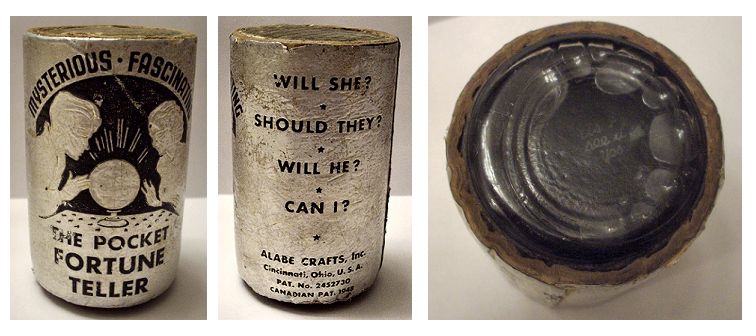
After Carter’s passing, Alabe Crafts made some improvements to the device, reducing it to a single-sided device, and sold it as Syco Slate: The Pocket Fortune Teller.
At some point it was marketed simply as The Pocket Fortune Teller, of one of which I happen to be the proud owner:
Later, Alabe changed the tube to a crystal ball; this did not help sales, but it did attract the attention of Brunswick Billiards, who produced promotional pieces in the form of a “Magic 8-Ball.” After Brunswick’s contract expired, the product continued to be marketed in that form, and is today sold by Mattel who move over a million units a year.
Q: Has the Old Wolf spoken? A: Signs point to Yes.
used to fly with United. A lot. This was back in the days when their on-time record was #1, and not in the crapper; before they broke guitars; when I had earned Premier Executive status and was upgraded on a regular basis; and when even coach flyers were treated like valuable customers. I remember flying as an unaccompanied minor in the 50’s and being very well taken care of by the flight attendants.
Sigh.
Those days are gone forever, I fear me.
But some memories will linger forever, and come roaring back in an instant, and that’s where Marcel Proust comes in. In Remembrance of Things Past, Proust was instantly transported back to a childhood memory by the taste of a madeleine[1] soaked in tea, an experience which was charmingly riffed on in Pixar’s “Ratatouille”, when Anton Ego’s heart suddenly grew three sizes, spurred by a sudden recollection of a comforting childhood gastronomic memory.
(Brilliantly played by Peter O’Toole)
The senses of taste and smell (inextricably related) are some of the most long-lasting and evocative in terms of memory. I’d be willing to bet almost all of us have had the experience of smelling or tasting something, and instantly being taken back in memory to the time and place where that smell or taste was experienced.
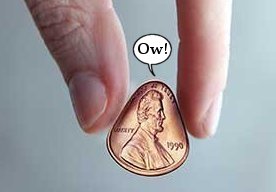
The Goodwoman of the House is a practical soul, and knows how to squeeze a penny so hard that Lincoln begs for mercy:
Some time ago, she bought a large bottle of hand soap to refill our pump dispensers at the sink. It happened to be almond scented. One whiff of that, and I was whisked aboard a United Airlines 777 headed for Frankfurt, because it’s the same scent as what one found in the jetliner lavatories. At the same time, my ears would fill with the strains of Gershwin, because United used Rhapsody in Blue as their theme music for almost the entire ten years when I was traveling around the world extensively.
This is the underpass between United’s terminals B and C at O’Hare Airport in Chicago. The psychedelic flashing Neon lights, the tinkling interpretation of Gershwin, and the repetitive nasal voice intoning “The moving walkway is ending… please look down” all come back when I wash my hands, and by the same token I can’t ever hear Rhapsody in Blue without thinking of United. It’s a curse, I suppose, but not the worst one I could have been afflicted with since I’m quite fond of Gershwin.
But I won’t fly United again until they get their act together; I’m not holding my breath.
The Old Wolf has Spoken.
1 If you’re interested in learning how to make Proust’s famous Madeleine’s, visit Cooking with the Old Wolf.
A post in Teresa Burritt’s Frog Blog (now sadly defunct) got me thinking about telephone operators.
Before the days of the internet, one of the earliest glurges I encountered – don’t ask me where – was “Information Please,” a heartwarming story of a telephone operator who befriended a young boy. Snopes.com has been unable to confirm or refute this story, so it remains out there as a tale one somehow wishes might be true.
In the days when Ma Bell had a virtual monopoly on the world of telecommunications, I am certain that this is just the image that AT&T would have liked to sear into the consciousness of every one of us. As it turns out, they tried.
The sentiment of the ad is so close to that of the story that I wonder if “Information Please” wasn’t going the rounds of the cork-board and water cooler network long before it showed up in the fax and internet world. What makes the ad of particular interest to me is the fact that the model is my mother, Margaret Draper.[1]
Before anyone gets the idea that life at home was like being raised by the Sally of the story, remember that the theatre is all about illusion. For most of my young life, Mom was single and trying to run a career as an actress, which meant that a lot of times I came home to a nanny or an empty house. There was, however, a telephone there – and in New York City, something called Artist’s Service. If Mom was away and I needed to contact her, I could dial SChuyler 4-5700 and be greeted by a pleasant voice who would get a message to her, or give me one that she had left. I only remember one individual’s name – Bill Butler – but I do remember that the folks there were invariably kind to a lonely young child, and it was nice to have a human on the other end of the line who cared. (Parenthetically, when I was really bored I could dial “MERMAID” – otherwise known as MElrose 2-6243 – and listen to “At the tone, the time will be… nine… forty-three… and ten seconds. *beep*” And yes, I did it more than once, for long spells of time.)
The Telephony Museum reports that “the first operators were boys, who turned out to be impatient and rude when dealing with phone customers. Their rudeness made them extinct within only a few years, replaced by females who were, ‘calm and gracious.'” In a nice summary of the history of telephone operators, the IEEE Global History Network reports that “the first female telephone operator was Emma McNutt, who was hired in New York City by a manager who happened to be a neighbor and who thought Emma was a “nice girl.” Little is known about Emma’s career, although she was in the vanguard of women who established telephone operator work as an almost exclusively female job.” Correspondingly, with the exception of Bill, every operator I ever dealt with in the 50’s and 60’s was female. However, that changed once again in the early 70’s, when AT&T responded to certain class-action lawsuits brought by both women and men, and in 1972 Rick Wehmhoefer became the first male operator in the Bell System.
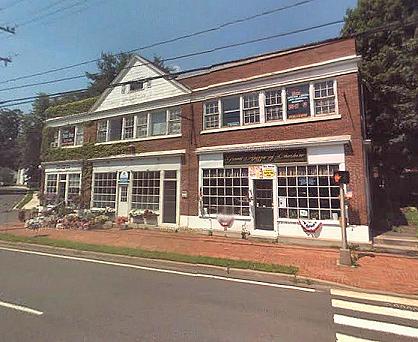
Most of my contact with operators in the 1960’s took place when making collect calls home from the Cheshire Spa, a local greasy spoon in Cheshire, Connecticut just across from the Academy campus on Main Street.
The Spa was in the far-right space, currently occupied by Grand A Pizza.
It was run by Pete Karavites, had pinball machines and a couple of dark phone booths in the back, and a persistent schoolboy rumor that all sorts of unsavory business went on in the back rooms.
I can still remember the “ding” sounds as I dropped coins into the old rotary-dial phones, or asking the operator to place a station-to-station collect call for me. When my mom picked up, the operator would say, “I have a collect call to anyone from so-and-so, will you accept the charges?”
Which reminds me of an amusing and true anecdote from my family’s history: At one point, my mother’s youngest brother was in the navy, and apparently he found himself for some reason in Tonopah, Nevada. Needing to call home, he placed a collect call in the above manner to his mother in Salt Lake. The operator announced, “I have a collect call from your son in Tonopah, Nevada, will you accept the charges?” Grandmother promptly replied, “I have no son in Tonopah, Nevada,” and hung up. My uncle Delbert was not deterred, and tried again, instructing the operator to make it a person-to-person call, more expensive but more explicit. This time, it was “I have a collect call for Frances Draper from Delbert Draper in Tonopah, Nevada, will you accept the charges?” Grandmother, exasperated, is said to have responded, “I know no Delbert Draper in Tonopah, Nevada,” and hung up again. How the story ended was never told me, but I chuckle at Granny’s inability to put two and two together.
In the 1980’s and later, before the wide advent of cell phones, the pressures of competition resulted in operators who seemed largely concerned with getting their average response time down to 5 seconds or less. Dealing with them was about as pleasant as going in for a colonoscopy. But clearly, it was not always that way – once again, from the IEEE site, “In the 1880s and 1890s women telephone operators often served the same small group of customers every day. This created an intimacy between client and customer as customers grew to recognize operators’ voices and know them as people. In many areas, operators could be counted on to have all sorts of information at hand, such as the names and addresses of local customers, the latest news, weather, and sports results, the correct time of day, and even gossip.” It seems that given the long history of telephony an the size of our country, a situation like one reported in “Information Please” is more likely than not, particularly in a smaller rural area.
Sadly, those days are gone forever. With most people abandoning land lines for cellular networks where operators are virtually unknown, finding a friendly voice to talk to for no good reason would be about as likely as finding an attorney with a conscience. [2] As a result, while I never met a “Sally,” I’m grateful to have experienced a time when you could dial “O” for operator, and find a human being on the other end of the line.
1 As an added bit of interest, Bill Gold of the Washington Post wrote the following article about this advertisement:
The District Line
by Bill Gold (The Washington Post – January 11, 1964)
Phone Company Adds Some New Lines
THE FIRST advertisement that hits your eye as you open the new issue of Life centers your attention on the face of a woman who is wearing a telephone headset. The woman has an appealing face. It’s not the Hollywood painted doll type of appeal, and you can see character in that face. Intelligence and understanding, too. There are a few lines in the brow, and just a hint of advancing years around the eyes and mouth. But it’s a good face, and the reader learns from the text that this is the face of a Bell System telephone operator who is always “close by if you need her, no matter what the hour.” It’s very comforting, very effective. But it’s disturbing, too. There’s something different here. This isn’t the bright-eyed girl of 19 we’re used to seeing in telephone ads. This isn’t the peaches-and-cream wholesome beauty to whom we’re accustomed; it’s a mature woman. And in the few seconds during which the reader studies her, he comes to the realization that one of the world’s largest corporations has made a deliberate change in its advertising policy. I was intrigued by my discovery, and immediately put in a phone call to a company spokesman. My questions were bucked along to headquarters in New York, and the answers came back promptly and frankly: the Bell System has indeed made a basic change in its advertising policy. Instead of the idealized beauties of the past, we’re now going to see more believable models. They’ll be “more realistic,” closer to the average, more readily identifiable with living, breathing human beings. Attractive young people are fun to have around, and they’re often useful, too. But any large company must also have its dedicated old-timers – the folks who know the importance of dependable service and who can give training and guidance to the youngsters who are just coming into the employe pipeline. So the Bell System has concluded that a more mature face in its ads will more truly depict the “average” employe. And because the emphasis in its ads will now shift from idealization to realism, the company hopes that the ads will be more believable, and therefore more effective. This promises to be a fascinating experiment, and it may have far-reaching consequences. Imagine the impact among professional models and advertising agencies. Think of the changes that may take place in TV commercials, in advertising generally, and in salesmanship itself, for that matter. Will the public be as mature as this new breed of model? Will people respond to this kind of soft-keyed approach? We’ll have to wait and see.
In a recent post, I referenced The Cooking of Vienna’s Empire by Time/Life. This picture always made me smile.
The caption reads, “Even in Vienna, the simplest food often tastes best. Witness this cabbie downing his sausage and beer with quiet satisfaction while waiting for a fare in front of St. Stephan’s Cathedral.”
If I know the Viennese, this guy was anything but quietly satisfied, and was probably griping to himself about the tourists, the government, the church tax, the weather, the beer, life, the universe, and everything. No, seriously – I love the Austrian people with all my heart, but the caption on the photo just doesn’t do reality justice.
But my goodness, that Würstel mit Senf (sausage with mustard) looks good. Hope he has a pile of Kren (fresh shredded horseradish) under his slice of bread… I can’t count how many times I’ve stopped at a sausage stand on the streets and snagged just what he’s having, or perhaps a Leberkäsesemmel – the Austrian version of a bologna sandwich, only 10 times better.
So many memories… I’ve shared a couple of them before, here and here, but there are so many it’s hard to choose from among them. I lived in Austria from February 1975 to December of 1976, and I’d go back in a heartbeat. So here are some of the more significant ones for me, in no particular chronological order.
Allerheiligen
Hallowe’en in Austria is a holy day, not one of ghosts and goblins. The evening before November 1, All Hallows Day, people make a pilgrimage to the cemetery and light candles for the souls of the dead. This was taken in Vienna’s Zentralfriedhof (Central Cemetery) on October 31, 1976.
And the following morning:
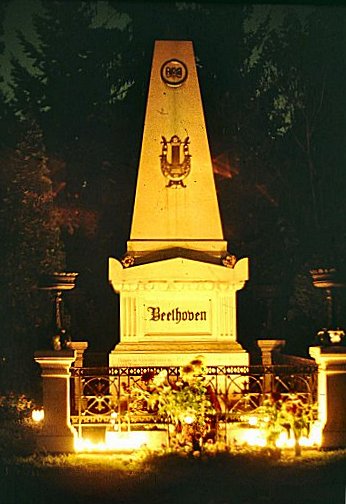
I love Beethoven’s music more than any other, and I was honored to be able to honor his memory at so many different sites.
The Beethoven Monument in Vienna
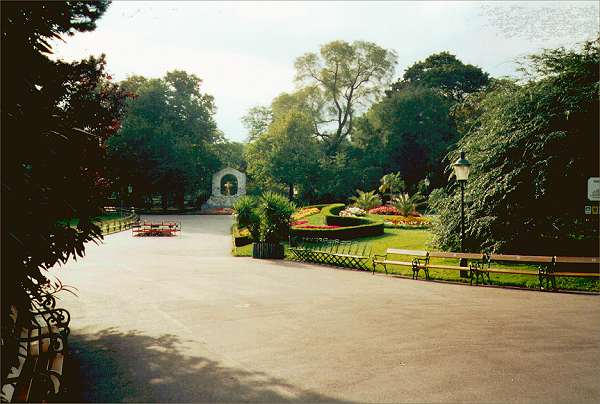
Vienna, of course, is the home of many famous musicians:
The Strauss Memorial in Vienna’s City Park
Hot chestnuts for sale beneath the old Stadtbahn (City Elevated Train) tracks. A wonderful thing, these… I remember them at Christmas time on the streets of New York in the 50’s. 12 chestnuts for about 60¢ – the exchange rate was about 15 Austrian Schillings to the dollar at the time.
One of the old Stadtbahn trains.
Tichy Ice Cream parlor on Reumannplatz 13 in the 11th Bezirk
Still there, still famous. Here you get gelato, not American style ice cream, in a whole symphony of flavors.
I laughed hard the first time I saw a police beetle. I didn’t laugh at all the first time one of them pulled in front of me flashing a sign, “Bitte Folgen” (please follow) and I collected a speeding ticket.
Stefansdom – St. Stephen’s Cathedral
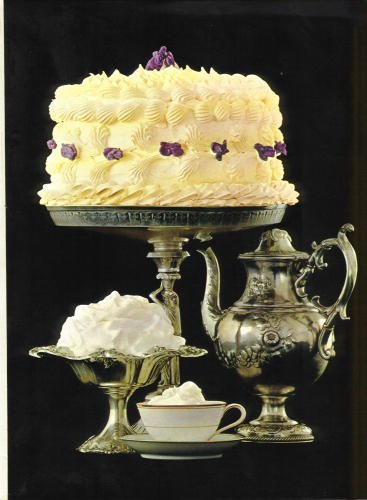
Sachertorte is the quintessential Austrian pastry. A sponge cake covered with apricot jam and chocolate, this cake is designed to be taken with schlagobers (whipped cream) and plenty of water. There are more Austrian pastries than you can shake a stick at, and you may like some of them more than this one – but it remains my favorite to this day.
I could go on. In fact, I will go on in another post. But now I want some Sachertorte, and I don’t have any. So I shall sit in the middle of the floor and cry.
Having recently posted about cigarette advertising, some of my readers pointed out that cigarettes were routinely hawked by doctors as being harmless at best, and actually good for you at worst. Here are some of the choicer examples, of which there are hundreds:
Even with all this historical nonsense, my head did a Linda Blair when I saw this picture over at Frog Blog:
I immediately went back to this Dilbert cartoon (click the link for the full-size version):
By the dessicated skull of Mogg’s grandmother – it’s like recommending arsenic to treat the symptoms of poisoning; apparently Dr. Batty (no offense intended to my dear friend in Dubbo) thinks the image of a 7-year-old puffing away on his death sticks would be fine. (“You don’t want to sell me death sticks. You want to go home and rethink your life.”)
Advertisements like this seem impossible in today’s world, but gullibility comes in many different forms. In the olden days, people believed just about anything they saw in print; authority and social validation are still powerful persuasion factors which can elicit the “click-whirr” response in a consumer’s brain. If you’re intersted in how marketers get your money, I recommend reading Cialdini’s Influence: The Psychology of Persuasion.)
Depending on a person’s level of awareness, however, the concept of “If you see it in the Weekly World News, it must be true” persists.
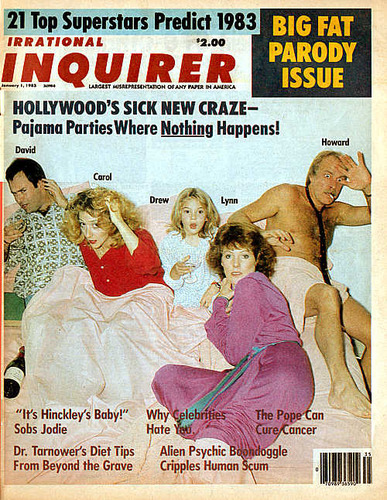
The parody issue of “The Irrational Inquirer,” published in 1983 by Larry Durocher and Tony Hendra, illustrates perfectly that most thinking people look at the supermarket tabloids with rolling eyes and shaking heads, but there is a segment of the population who buy these rags and actually believe what they contain, simply because it’s in print. “Alien Psychic Boondoggle Cripples Human Scum” is the best headline ever!
Pathetic… yet Americans alone are wasting billions of dollars annualy on bogus cures, nostrums, worthless weight loss products and other remedies, just because they find the information on the Internet.
The number of web pages like this which are out there number in the millions – because there’s money to be made from gullible people. Many of these deceptive ads claim that their products have been endorsed by Oprah Winfrey, Dr. Oz or others (again, using authority and social validation as marketing hooks) – but just like the snake-oil of old, it’s nothing but bald-face lies. For further reading, you might want to check out my previous post about the Açaí Berry.
Don’t get me wrong – there are countless products out there that do a body good – but my beef is with the deceptive marketing practices and false claims, particularly for products or systems (like tobacco) which science has shown to be harmful.
In closing, I recommend the following strategy for anyone who wishes to make wise purchasing decisions:
(Posted in its original form on Sep. 22nd, 2009 at my Livejournal)
For the longest time I’ve been fascinated with the concept of acorns for food.
The seed (haha!) must have been planted in my mind when I was very young; my cousins who lived in the country – I was a New York City boy – had this lumbering black dustmop named Puffy who would devour acorns that he was given. I thought this terribly funny, since they were so bitter (naturally, being kids, we tried them!) And of course, the archetypical squirrel is always burying acorns.
Years later, having become a gastronome of sorts, the advent of the internet revived my curiosity, and I determined to find some acorn flour at some online store and try making bread or pancakes or what not. Guess what? You can’t find acorn flour for sale. Acorn starch, yes – but that’s different. There is, however, no dearth of information out there on how the native Americans used to process acorns, and so I archived off a few pages and determined to make the experiment at some point.
In 2009, while on one of my rambles up in the foothills north of Salt Lake, I stumbled across several groves of scrub oak that were replete with ripe, brown acorns, and managed to gather about 3 pounds of them.
The trick when gathering acorns is to get them when they’re brown enough to be ripe, but before the acorn weevils have gotten into them. As a result, it’s recommended to gather about ⅓ more acorns than you think you’re going to need. So if you see an acorn that looks like this:
you know it’s already occupied, and you don’t want to bother cracking it. Unless, of course, you’re interested in what goes on in an acorn after it falls – there is a fascinating article in the June, 1989 issue of National Geographic entitled “Life in a Nutshell”, which I recommend to all budding entomologists. If, however, that’s not your bag, the normal reaction is going to be “Eww”. Just be aware that some acorns which look sound are going to be compromised anyway:
Depending on the damage, part of the nut can often be salvaged.
So get yourself a nutcracker [1] and go about shelling your acorns. Like chestnuts, acorns have an interior brown skin which sometimes must be scraped off, but most of the time it just pops off with the husk. Certain varieties – I gathered nuts from a number of different groves – have the membrane in between the two halves of the kernel, so that will have to be removed as well.
When you’re done, you’ll have a nice bunch of acorns to work with.
I would have had a few more, but I ended up hucking out about ⅕ of what I had gathered… I just got so tired of shelling them, and all I had left were the smaller ones (see Note 1 below).
Be aware that like apples, acorns will go brown in the air quickly, so you may look in your bowl and think that a lot of them were bad to start with. However, if you were careful, the brown spots are not bug damage but simple oxidation. And if you missed a spot or two, hey – extra protein.
The next step is leaching out the tannin. According to Peggy Spring, an education coordinator with the San Antonio Natural Area Parks, “the Texas oaks reported to have the sweetest taste include Emory oak (Q. emoryi), which is so mild it can be used without processing, white oak (Q. alba), plateau live oak (Q. fusiformis), bur oak (Q. macrocarpa), and chinkapin oak (Q. mulenbergii). The acorns of each of these oaks (mostly white oaks) mature in one year, which may account for their lower tannic acid content. Red oak acorns (like Texas Red Oak) take two years to mature.” How bitter are your acorns? Only one way to find out – taste ’em. Odds are, they’ll need to be leached. High concentrations of tannin can cause G.I. upset, kidney damage and cirrhosis of the liver, so it’s better to be safe than sorry.
There are many ways to leach out tannin, some more practical than others. The natives would often put their shelled nuts in a basket and let a swift-flowing river take care of the job for a couple of days. To me, this seems the most logical, but clean, swift-flowing rivers are hard to find for most people. Others suggest simply allowing the acorns to soak and replacing the water when it goes brown, until the acorns are no longer bitter.
I chose the 3-hour boil method. After the first boiling of 15 minutes, the water looked like this:
Pour off the water, refill, and continue.
After about 12 boilings, the water started to look not quite so muddy, so at that point I was done. The acorns tasted at this point like an artichoke heart, nutty with a sweet aftertaste.
Next, dry the acorns in a 200° oven for an hour. In they go:
And out they come.
At this point they’re no longer soggy, but still not totally dry. So I popped them into my food processor on pulse setting just until the acorns were crumbled, and put them back in the oven for another hour and a half.
Now what I had was dried acorn meal. Run this through my Magic Mill III:
… and the end result is about 2 cups of acorn flour, which you can use in your favorite recipe – for bread, or pancakes, or biscuits, or whatever floats your boat.
I chose a bread recipe that uses about 6½ cups of flour, resulting in a bread that was only partly acorns, but which still had a very nice flavor.
Here’s the recipe:
Acorn Bread
Scald: 1 C Milk
Add:
1 C Water
1 T Shortening or Lard
1 T Butter
2 T Sugar
1 T Salt
In a separate bowl, combine:
¼ C 105°-115° (F) Water
1 package active dry yeast
and let dissolve 3-5 minutes. Add the lukewarm milk mixture to the dissolved yeast.
Have ready:
6½ C Flour (white flour and acorn flour to taste)
Stir in 3 cups flour (use the acorn flour first), then work in remaining flour by kneading on a floured surface until smooth and elastic.
Place dough in greased bowl and cover, allow to rise in a warm place until double, at least 1 hour. Punch down, and if time permits, allow to double again. Turn out, divide into 2 loaves and let rest 5 minutes. Place in pans and again allow to rise until almost double in bulk.
Preheat oven to 450°. Bake loaves 10 minutes – reduce heat to 350° and bake 30 minutes longer. Test for doneness by turning out a loaf and thumping the bottom. If it sounds hollow, it’s done. If not, put it back in for a few more minutes. Remove loaves from pans at once and allow to cool on rack before storing.
Now, if I were to go about this again, I would do the following things differently:
Find bigger acorns. Scrub oak tasted fine, but the shelling took forever.
Use a pecan sheller, as mentioned in the note below.
Gather more acorns to start with, so I could get a decent amount of flour, some to use, and some to keep.
Use a different leaching method, probably just letting the nuts sit in cold water and changing it every now and then. It might take longer, but I think the nuts would retain more of their nutrition.
Use less acorn flour. It’s heavier than wheat flour, and has no gluten, so it can’t be used alone – there’s nothing to bind the bread.
Further thoughts
Besides the bread, a lot of benefits accrued to me during this exercise. The entire time that I was harvesting, shelling, leaching, grinding and making bread, I turned my mind to the original occupants of this continent. This was a labor-intensive process. If you were going to use acorns as a major food source for a community, you’d pretty much have to put the entire female population to work on the process. Given that 3 lbs of acorns resulted in about 8 ounces of flour, you’d need a lot of acorns, and a lot of hands to do the necessary work. Granted, these folks spent a good part of their day working on food production anyway, but it left me with a huge sense of respect for what was necessary.
The exercise also made me think about the history of our nation in general, with no small amount of sadness. A few weeks ago, prior to my Acorn Escapade, I re-watched “Dances with Wolves.” I recalled the Gary Larson cartoon on the subject:
So I hopped over to Rotten Tomatoes.com to see if there was really anyone who didn’t like the film. To my surprise, it only got a 78% positive rating. One review, which was pretty representative of the opposition, said: “The political correctness is so politically correct and sappy and sucky and conscience-appeasing and politically-pacifying and just generally brain-numbing…”. Well, all I can say is that after 400 years of being raped by the white man, the autochthones of this continent are entitled to a little political correctness. The attitude of our nation toward the native has been and continues to be, “Bohica!” [2]. Don’t believe me? Just take a drive through the four corners area and down into the Res, and you’ll see the results of the white man’s benevolence. And, I haven’t the slightest idea of how to go about making it right.
These thoughts brought to you by the humble Acorn.
belch
The Old Wolf has spoken.
1Acorns are soft-shell nuts. I recommend using a pecan sheller rather than a regular nutcracker.
These are available online at any number of places.
A recent article over at BBC explored the “then and now” of servants in the UK – who had them, how they lived, and what has become of the domestic landscape today.
The article pointed out that downstairs was a microcosm of upstairs, with domestics mirroring the social hierarchy of those whom they served.
According to Dr Lucy Delap, director of studies in history at Cambridge University, “There would be a strict order of coming in to eat and strict rules about where different ranks of servants sit, and you might also have rules such as no speaking unless you were addressed by one of the senior servants. The senior servants had a great deal of power, so the butler for example in some households would put down his knife and fork, and everyone else had to fit in whether you had finished or not. So servants had to learn to be fast eaters.”
Upon reading this, I had a flashback and had to hunt up my copy of The Cooking of Vienna’s Empire by Time/Life.
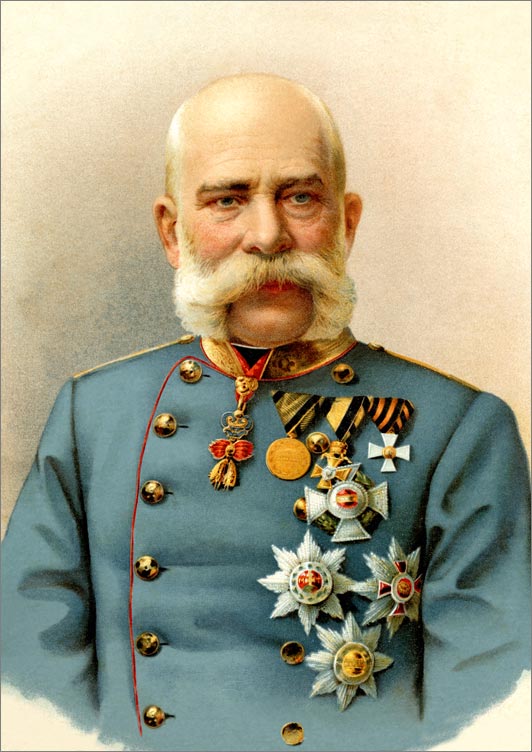
These are wonderful books, as much about the history and culture of the various regions they deal with as about the recipes. Having spent two years in Austria and much time working in the countries of the former Yugoslavia, this book is a treasured friend, and I recalled this paragraph about Emperor Franz Josef I:
“Since the Kaiser was up so early, everybody around him had to get up too, which was not pleasant for the young officers who had gone to bed perhaps only a couple of hours earlier. By noon, the guard officers were starved and praying they wouldn’t be asked to sit down at the Emperor’s table. It must have been an ordeal to do so. Court etiquette demanded that the Emperor be served first and that no one continue eating after His Majesty had put down his fork. Unfortunately the Kaiser ate very quickly. By the time the large silver platters got to the hungry young officers, the Emperor had put down his fork and knife, and the poor fellows had just one tantalizing look at the lovely dishes – or maybe even a brief taste of the excellent Kaiserschmarrn – before their plates were removed.”
The BBC article makes numerous references to one’s “station in life.”
In the America that I grew up in starting in the 50’s, the concept of class distinction was far from the minds of most people; the underlying ideal was that anyone can become anything, and all men are indeed created equal. Looking at today’s society, however, it would seem that in many ways, we are a nation of servants in the homes of the super-rich for whom we toil. Class distinctions exist in my country as truly as they existed in Victorian England – the only difference is that British society accepted such as the natural order of things, and to a certain extent still does, while we cling to a largely imaginary egalitarian view of society.
Before I go any further, I want to be clear that everything is relative; despite the fact that I belong to a large group of people for whom economic terror is a stark reality, a poor family in the favelas of Rio or anyone living on the streets of Mumbai would laugh in my face if I were to tell them that I was feeling endangered.
What’s more important is the underlying social phenomenon of what divides people into classes and why so many think that’s just fine.
The Us/Them Mentality
From where I sit, the concept of ingroup affiliation appears to lie at the root of most social conflicts. The Arbinger Institute has published two powerful treatises on the tendency of humans to betray their better nature, and the hoop-jumping and back-bending we go through to justify that betrayal. From a corporate standpoint, this tendency is analyzed in Leadership and Self-Deception, but on a personal level, The Anatomy of Peace takes a hard look at what keeps people apart, and what’s necessary to bring them together.
When we treat others like objects rather than people, it’s all the easier to put them beneath us: beneath our notice, beneath our dignity, and beneath our need to be involved in their lives. What I see in politics today is the wholesale write-off of entire segments of our population by both parties: they are draining our resources, they are controlling our lives, they are destroying the constitution, they… you get the picture. It’s always easier to blame an outgroup (i.e. the other side of the aisle, women, men, gays, evangelicals – in short, anyone who is not us) than it is to take personal responsibility for one’s choices in life. It’s comforting and it’s easy to see people as obstacles, vehicles or irrelevancies.
As discussed in a previous post, I quoted Carl Sagan’s analysis of the famous “Pale Blue Dot” photo, and I repeat a piece of that here: “The Earth is a very small stage in a vast cosmic arena. Think of the rivers of blood spilled by all those generals and emperors so that in glory and triumph they could become the momentary masters of a fraction of a dot. Think of the endless cruelties visited by the inhabitants of one corner of this pixel on the scarcely distinguishable inhabitants of some other corner. How frequent their misunderstandings, how eager they are to kill one another, how fervent their hatreds. Our posturings, our imagined self-importance, the delusion that we have some privileged position in the universe, are challenged by this point of pale light.” As humans, as members of the same race floating in the same raft on the same ocean, it would truly pay us to remember how insignificant we are in comparison with the mind-blowing vastness of the universe.
In every way possible, my 500-year plan is to promote the concept of a world that works for all humanity. The title of this blog reflects R. Buckminster Fuller’s dream of making the world work, “for 100% of humanity, in the shortest possible time, through spontaneous cooperation, without ecological offense or the disadvantage of anyone.” If we are ever to attain such a blessed state, we can not remain in the condition described by Lewis Thomas in The Lives of a Cell – “For total greed, rapacity, heartlessness, and irresponsibility there is nothing to match a nation. Nations, by law, are solitary, self-centered, withdrawn into themselves. There is no such thing as affection between nations, and certainly no nation ever loved another. They bawl insults from their doorsteps, defecate into whole oceans, snatch all the food, survive by detestation, take joy in the bad luck of others, celebrate the death of others, live for the death of others.” No, we must transcend that.
As individuals, families, groups, societies, and nations, we must overcome the urge to treat others as objects and tools and things to be used to achieve our own personal ends, but rather see one another as other people, with hopes, needs, cares, and fears as real to us as our own. I refuse to believe that such a world is an unreachable utopia, an impractical dream. As long as I have breath, I will work for it.
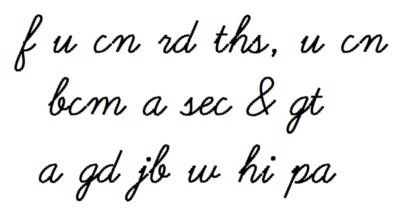
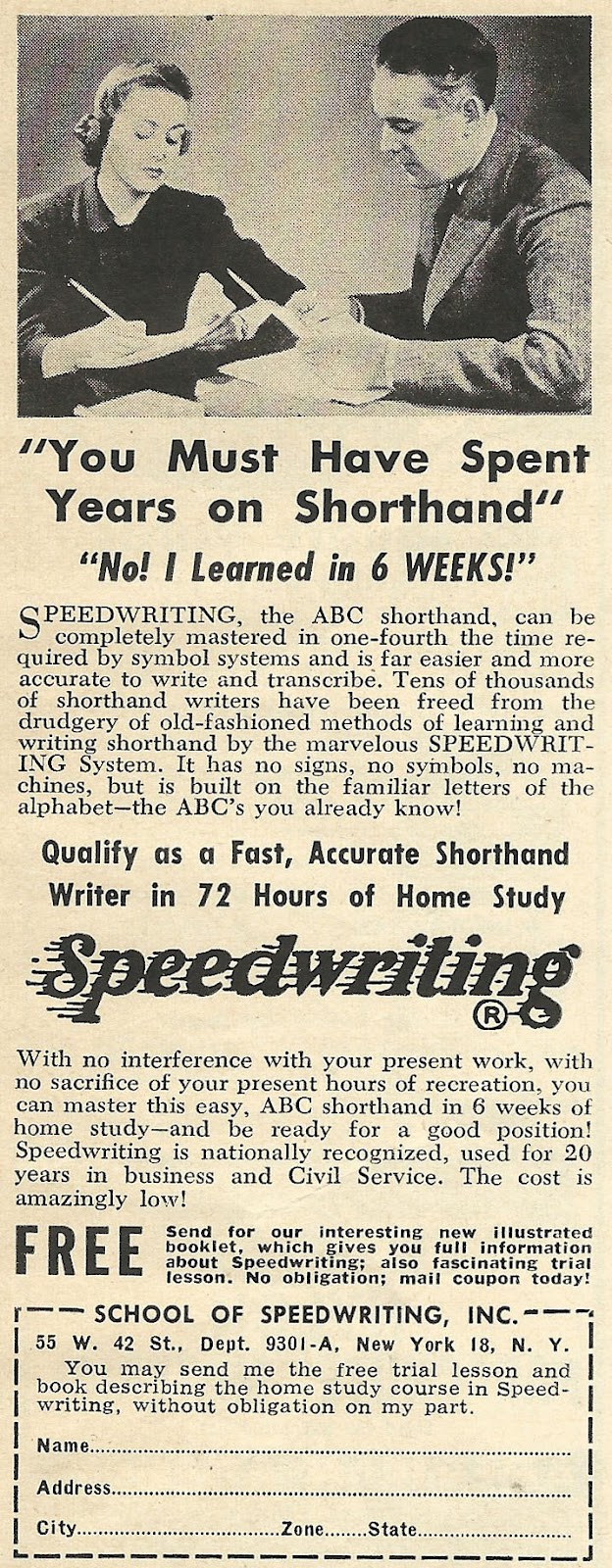
So intoned the billboards on the NYC subways for years. The School of Speedwriting wanted to make sure people knew that Gregg shorthand was not the only way to go, and while I never had the opportunity to learn either, it seems to make perfect sense to me. My ex was a whiz at shorthand, and she could take dictation like a court reporter – but all those squiggles! Worse than Arabic, if you ask me.
Of course, it’s based on being able to recognize words without the vowels. Since 2003, this has been going around the internet in various forms, the latest one with the header “Only Smart People Can Read This”:
It is doubtful that any real research has been done on this phenomenon at Cambridge, but the underlying principle makes sense – experienced readers don’t decode, but rather they read words as entire units. This is useful to understand as I teach Japanese students the mysteries of English spelling. They get so wrapped up in “i before e” that they forget to learn new words in the same way that they learn their own kanji – as units.
To the untrained eye, each of these Japanese characters looks very much the same, 人, 大, 木, 本, 天, 火, 米, 犬, 水, 氷, 入, yet a Japanese person recognizes each without even thinking of it – a single jot can make the difference between big and dog, or between person and enter.
We do the same thing ourselves – and when presented with a block of text with mixed up letters (or missing vowels), our minds do what they do best – they look for things that look close to something recognizable, and usually come up with an accurate match almost instantly, unless of course you booted up a Unix system running “Fortune” and got “f u cn rd ths, itn tyg h myxbl cd…” – the Semitic peoples (Jews and Arabs) have been doing this for thousands of years – like anything, you just get used to it.
Nowadays, young people use this to their advantage when sending txt msgs (text messages): R u there? K. ttyl. (Are you there? OK. Talk to you later.) If things keep going the way they are, we may all be doing speedwriting whether we like it or not.
Back in the day, tobacco companies could advertise, and advertise they did. Everywhere. Subways, buses, magazines, radio, television, courtesy packs on airplanes, you name it. The more powerful ads drove the more powerful brands. The Marlboro man was everywhere:
Rugged, strong, and healthy – notice the absence of the Surgeon General’s warning on this example from the 60’s.
But in those days, tobacco execs would go on national television and swear that tobacco wasn’t harmful, even to pregnant women (many of whom actually preferred smaller babies)…
… which babies were also used to hawk tobacco products.
Of course, now we know more than we did then:
But this is now, and that was then.
Two of the more popular cigarette campaigns actually capitalized on bad grammar:
This slogan was routinely held up by prescriptive grammarians as an example of abominable usage: “like,” they said, is a preposition governing nouns and noun phrases, and should never be used as a conjunction introducing an adverbial clause. “Winston tastes good as a cigarette should,” intoned the English teachers, was the only acceptable form. Naturally, the ad execs picked up on the furor and capitalized on it:
Not to be left out of the action, MAD magazine put this on the back of their January 1971 issue, which shows that many folks were quite aware of the dangers of smoking, thank you, even while the Tobacco execs were perjuring themselves on the national scene.
In fact, “In December 1952 [Reader’s Digest] published “Cancer by the Carton“, a series of articles that linked smoking with lung cancer. This first brought the dangers of smoking to public attention which, up to then, had ignored the health threats.” (Wikipedia) An interesting article summarizing the history of tobacco and health concerns can be found at CNN Interactive.
Popular stars shilled for tobacco on a regular basis – it seems so bizarre to watch Granny Clampett and Jane Hathaway discussing the merits of Winston, but it’s amusing to see how they worked the grammar issue in at the end in a Madison Avenue “double whammy”.
The Flintstones got into the act as well:
I confess with some shame that tobacco contributed to putting bread in my mouth for some time; mother functioned as a spokeswoman for Camel cigarettes for a year.
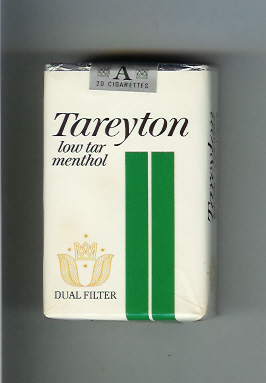
But when it came to using bad grammar, Winston was hardly the only offender – Tareyton’s campaign confused nominative and oblique to good effect in their highly successful slogan, “Us Tareyton smokers would rather fight than switch.”[1]
Despite the peccadillo – it seems that cigarette ads thrived on controversy – this particular advertising campaign was wildly successful in the 60’s, and pushed Tareyton’s popularity close to the top of the charts.
But not all products, even those from the makers of successful brands, were an instant hit.
Back in 1966, when I was 15, I was on one of my semi-regular visits to my mom’s brother in Salt Lake. We took a trip up to Idaho to see some additional relatives, and I remember spending some time in a tobacco warehouse, helping to run cartons of cigarettes through the tax-stamp machine. (Had the government gotten wind of our little diversion, the owner could have been shut down, but oversight was lax and attorneys less numerous in those days.) While I was working there that day, I noticed something unusual – a carton of Tennyson cigarettes, which I had never before heard of.
Now, the more astute among my readers will be asking themselves, “What does a 15-year-old know from tobacco?” As it happens, even at that tender age I was somewhat of a tobacco connoisseur. I had started smoking in high school, finding that it was a gateway to a certain level of acceptance, for as little as that was worth. And I parlayed my small bit of social coin into a minor fortune by becoming a user of odd and revolting brands.2 (In Connecticut, the legal age for tobacco was 16, but even before that I had no end of “friends” who would procure for me in exchange for a small consideration.)
Strong and with a different flavor than American standards.
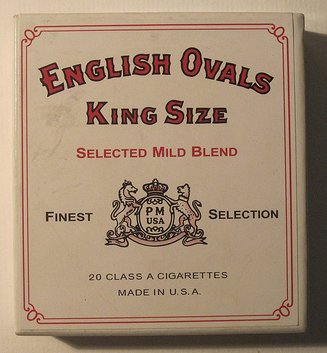
Oval cigarettes. Cute gimmick, but nothing special otherwise.
Absolutely foul. If I had these, I was guaranteed nobody would bum off me.
Tasted just about like smoking a cow pie. Or so I imagine.
Had kind of a fruity taste, unlike anything else I had ever smoked. Meh. However, Lark’s claim to fame was their commercial, the 1960’s version of Google Street View – the Lark truck would run around different places with a TV camera on the back, blaring the William Tell Overture, and asking people, “Show Us Your Lark Pack!” I saw this truck run down 1st Avenue in Manhattan one day; even if I had had a pack of Larks on me, I decided that discretion would have been the better part of fame, since I was still underage in New York.
[Edit: I had a copy of the commercial in question here, which I had posted at YouTube. Even though it was listed as public domain under a Creative Commons license, it appears that the brand is still owned by Trademarks LLC. The video was removed at YouTube, but for some odd reason still played here. In light of some communication with the above-mentioned company, I have removed the video. Unless it is taken down elsewhere, however, you can still see it here (3rd one on the list).
Now, since we’re on the subject of advertising in general as well, I nominate Salem cigarettes for the most insidious commercial ever devised. As a linguist who has studied close to 20 languages over the course of my life (although I don’t claim to speak them all), I can tell you that anything you produce will remain in your memory much longer than anything you hear. When learning a language, speaking is much more powerful than listening; they are different skills, yes, but the first cements things in your memory a lot longer than just hearing them, even multiple times. The following ad is much like getting up at 3:00 AM in the home of a musician, and playing only the first five notes of “Shave and a haircut” on the grand piano. It’s a guarantee that an irritated and foggy victim will stumble down the stairs to finish the “two bits” part before being able to go back to sleep.[3]
Unfortunately, despite these commercials being ancient, many of them have been taken down on copyright grounds. But go here and advance to 6:40, and you’ll get one of the ads that I’m referring to. Unless you are some kind of superhuman being, you will finish the line, and you will sing the brand name in your head. There is no escape.
There were others. I knew every brand on the market, and some that weren’t. I even rolled my own for a while, although not very skillfully, but when I couldn’t get these, I’d smoke anything I could get my hands on. My mother smoked Carltons (why bother, I wondered?) and when I’d cadge hers, I ripped the filter off; ultimately I settled on Luckies as my brand of choice. And of course, in the process, I became a 3-pack-a-day man by the time I was 18. The end of that story is that I quit, cold turkey, that year and never looked back – but my lungs paid a lifetime price.
So that brings us back to Tennyson, and by now I think you’ll understand why it caught my eye. A brand I didn’t know about? Intriguing! But in those days, there was no Internet, and such arcane knowledge was not to be found anywhere. Only later, thanks to the miracle of the Intertubez, was I able to dig up a bit of history, but even today what’s out there is pretty sparse.
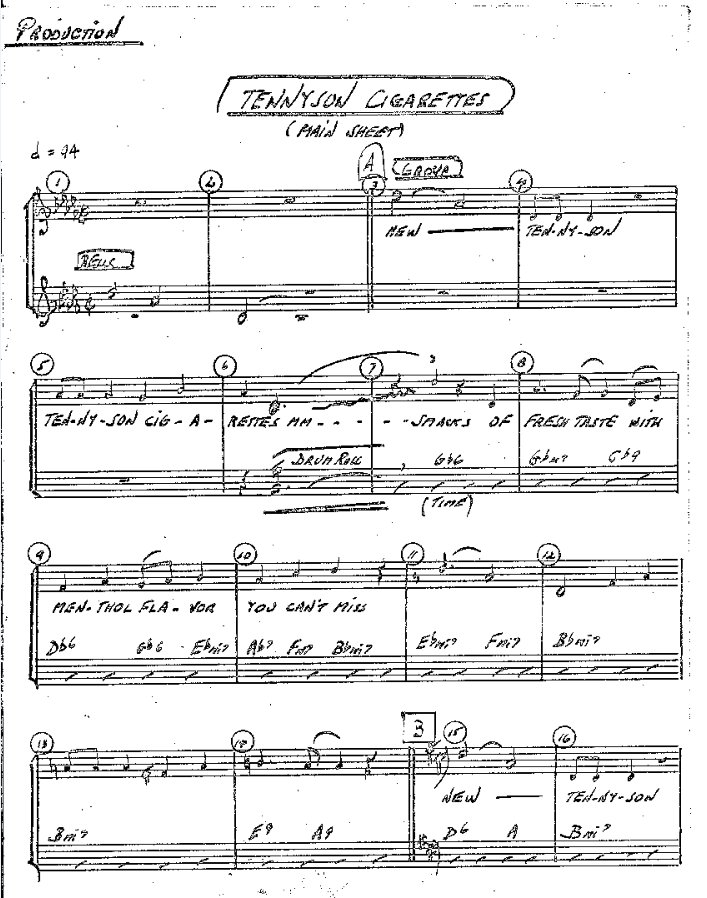
In 1966, Tennyson launched a fairly comprehensive media blitz to publicize their new brand. I’m not sure why Tareyton simply didn’t choose to introduce a menthol version of their already-famous brand.[4]
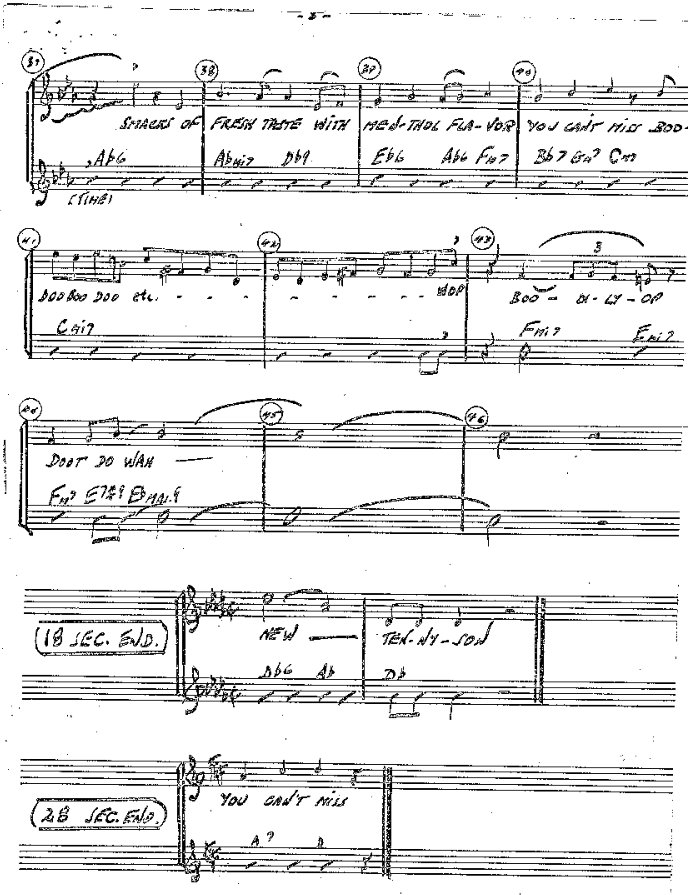
I even remember the jingle. I began to wonder later if I had imagined it, but fortunately the original sheet music which was submitted to the legal process was conserved:
So I’m not senile after all. I may be crazy, but that’s different. As a final bit of curiosity, I also found this:
Same package, same font, same look as Tareyton – but nary a whit of information to be found about what these are, or when or where they were sold. Possibly a European version of Tareyton? One clue:
This has been a bit of a ramble, but I got a good bunch of things out that I won’t have to worry about later (‘Now where did I archive that?’)
The Old Wolf has rambled.
1 In case you’re wondering, it should be “We Tareyton smokers.”
2 Plus ça change, plus ça reste la même chose. Visit The Old Wolf’s Banquet from Hell.
3 Brooke McEldowney, both a very gifted musician and a supremely talented artist who does the webcomics 9 Chickweed Lane and Pibgorn, riffed on this twice. In the first one, Edda and her mother Juliette engaged in this very exercise here; the second, where poor Seth is tormented by his ballet company, is here.
4 As it happens, such a thing exists, even though I only found out about it later as I was researching the topic. Never once did I see these in stores.
A post on George Takei’s Facebook feed displayed this photo of Earth and two other planets seen from the surface of Mars, purportedly taken from one of the rovers up there.
The one on Takei’s feed had an arrow pointing to the lower dot which said, “You are here.”
It’s a pretty picture, but my BS bells went off because there’s just something “off” about the photo, specifically those clouds and the fact that the three dots are the only things visible in the sky.
By the time I saw this, the post had gathered over 2,000 comments, and a brief perusal led me to this post over at Discover, which explains that the image is a computer-generated “planetarium” scene, as witnessed by the little “NE” in the lower left hand corner of the screen.
Sweetly enough, the article also posted this picture…
… which is a real picture, “the first image ever taken of Earth from the surface of a planet beyond the Moon. It was taken by the Mars Exploration Rover Spirit one hour before sunrise on the 63rd Martian day, or sol, of its mission. (March 8, 2004).” Found at NASA’s Flickr Feed, where you can read more information about the shot.
The tiny speck put me immediately in mind of the now-iconic photo of Earth taken by Voyager 1 as it was leaving the earth.
Astronomer Carl Sagan had requested NASA to point Voyager’s cameras back toward home, and this was the resulting image.
In his book Pale Blue Dot: A Vision of the Human Future in Space, astronomer Carl Sagan related his thoughts on a deeper meaning of the photograph:
From this distant vantage point, the Earth might not seem of any particular interest. But for us, it’s different. Consider again that dot. That’s here. That’s home. That’s us. On it everyone you love, everyone you know, everyone you ever heard of, every human being who ever was, lived out their lives. The aggregate of our joy and suffering, thousands of confident religions, ideologies, and economic doctrines, every hunter and forager, every hero and coward, every creator and destroyer of civilization, every king and peasant, every young couple in love, every mother and father, hopeful child, inventor and explorer, every teacher of morals, every corrupt politician, every “superstar,” every “supreme leader,” every saint and sinner in the history of our species lived there – on a mote of dust suspended in a sunbeam.
The Earth is a very small stage in a vast cosmic arena. Think of the rivers of blood spilled by all those generals and emperors so that in glory and triumph they could become the momentary masters of a fraction of a dot. Think of the endless cruelties visited by the inhabitants of one corner of this pixel on the scarcely distinguishable inhabitants of some other corner. How frequent their misunderstandings, how eager they are to kill one another, how fervent their hatreds. Our posturings, our imagined self-importance, the delusion that we have some privileged position in the universe, are challenged by this point of pale light. Our planet is a lonely speck in the great enveloping cosmic dark. In our obscurity – in all this vastness – there is no hint that help will come from elsewhere to save us from ourselves. The Earth is the only world known, so far, to harbor life. There is nowhere else, at least in the near future, to which our species could migrate. Visit, yes. Settle, not yet. Like it or not, for the moment, the Earth is where we make our stand. It has been said that astronomy is a humbling and character-building experience. There is perhaps no better demonstration of the folly of human conceits than this distant image of our tiny world. To me, it underscores our responsibility to deal more kindly with one another and to preserve and cherish the pale blue dot, the only home we’ve ever known.
—Carl Sagan, Pale Blue Dot: A Vision of the Human Future in Space, 1997 reprint, pp. xv–xvi
This quote, and much additional information about the photo and how it was taken, was found at Wikipedia. I had seen the picture and read the quote before, but it never ceases to move me.
Confession: I can’t do higher math.[1] I always wanted to be a doctor, but calculus put a rapid end to that dream, because you need calculus for the pre-med Chemistry degree and screw whole bunches of that, with apologies and honor and homage to my freshman chem teacher, Dr. Alex T. Rowland of Gettysburg College, a good man and a fine professor. But I’ve always loved science, and have stood in awe of the glory and majesty and miracle of the universe from its largest expanses to its smallest bits and pieces. I think I owe that love of science to the hours and hours my mother spent allowing me to roam the halls of the Hayden[2] Planetarium and the Museum of Natural History.
Publicity shots for “Pepper Young’s Wife”, TV-Radio Mirror, March 1957
I loved that rocket – it was in a darkened room, and each section was illuminated by a different color. The fuel chamber had a deep, red glow and I could stare at it for hours. This was one of my favorite books. Alas, my inability to comprehend the fine points of differentiation meant that I had to spend my life as a linguist and not as a scientist, but the love of understanding our world, from the quantum to the cosmic scale, never left me. All I can do is peep through the keyhole to where the big boys and girls are playing, and hope to understand as much as I can from there.
Years ago I happened across a copy of Powers of Ten, a companion volume to two films of the same name which were based on the book Cosmic View (1957) by Dutch educator Kees Boeke.
Later, this map of the known universe from National Geographic served to pretty much bork my mind out completely.
Trouble is, it doesn’t stop there.
I posted the above map earlier, along with a photo of Hubbles ultra-deep field image, and just recently came across this mind-bending video done by the folks at NASA/ESA:
The animations were based on the red-shift values of the various galaxies captured in the image. The thing is, that is by no means all of it – it’s only the part we were able to capture with our rather primitive (albeit wonderful) instruments.
So what is our place in the universe? Scientists will be grappling with that question for as long as man continues to be relevant. The president of my church, Thomas S. Monson, said in 2001, ” I acknowledge that I do not understand the processes of creation, but I accept the fact of it.” Taken in the context of the rest of his quotation, this has been interpreted by some to mean that we should reject science in favor of faith. I do not see it that way. The miracle of creation, in all its massive and miniscule glory, is before me, and I must accept the fact of it. But another fact remains: for all we know, we know virtually nothing. As tiny as the pale blue dot is in the immeasurably vast universe, so is all our scientific knowledge in the face of all there is to be known. I believe firmly that we do have a purpose and a place in all the vastness, and that purpose is to raise the human condition, to make life better in all possible ways for ourselves and for all whom we encounter. This is sufficient for me. In the words of Hillel, “the rest is commentary.”
And all this because of a single “fake” picture posted on George Takei’s Facebook feed. Thanks, George.
The Old Wolf has spoken.
1Just because I can’t do math doesn’t mean I can’t appreciate it.
A mathematical friend of mine assures me that this equation evaluates to ⅓. I couldn’t say for the two crore question, but I’ll never forget how to write it. See, it’s a limerick, and limericks I can remember. All of them. Darnit.
“Integral zee squared dee zee
From one to the cube root of three
Times the cosine
Of three π over nine
Equals log of the cube root of e.”
[2]With thanks for the correction to Haydn Rawlinson, who apparently knows not only how his own name is spelled but also the Planetarium’s.



 Sigh.
Sigh.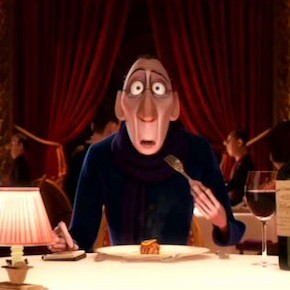


































 Playing in the World Game