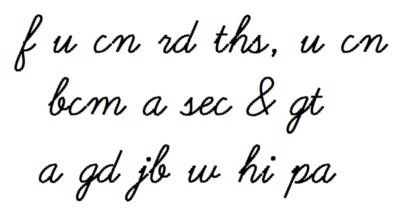
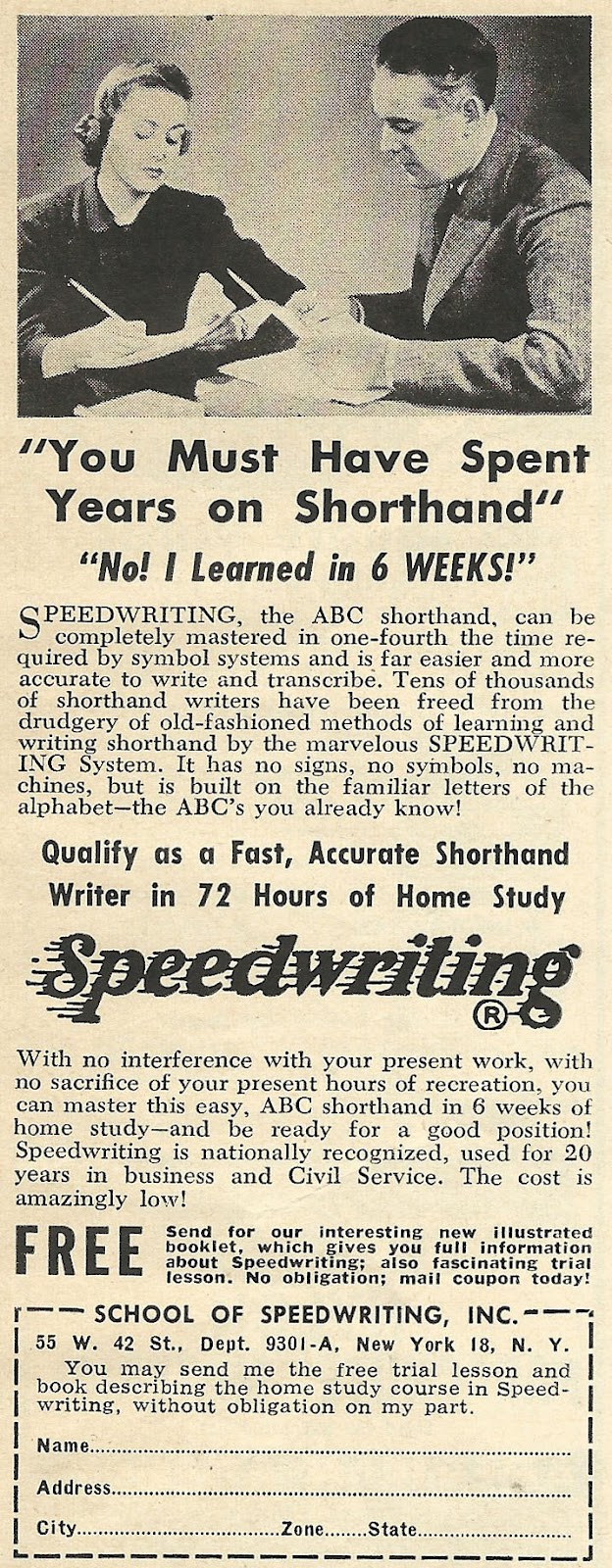
So intoned the billboards on the NYC subways for years. The School of Speedwriting wanted to make sure people knew that Gregg shorthand was not the only way to go, and while I never had the opportunity to learn either, it seems to make perfect sense to me. My ex was a whiz at shorthand, and she could take dictation like a court reporter – but all those squiggles! Worse than Arabic, if you ask me.
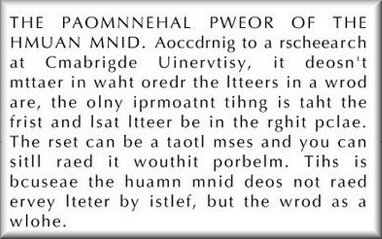
Of course, it’s based on being able to recognize words without the vowels. Since 2003, this has been going around the internet in various forms, the latest one with the header “Only Smart People Can Read This”:
It is doubtful that any real research has been done on this phenomenon at Cambridge, but the underlying principle makes sense – experienced readers don’t decode, but rather they read words as entire units. This is useful to understand as I teach Japanese students the mysteries of English spelling. They get so wrapped up in “i before e” that they forget to learn new words in the same way that they learn their own kanji – as units.
To the untrained eye, each of these Japanese characters looks very much the same, 人, 大, 木, 本, 天, 火, 米, 犬, 水, 氷, 入, yet a Japanese person recognizes each without even thinking of it – a single jot can make the difference between big and dog, or between person and enter.
We do the same thing ourselves – and when presented with a block of text with mixed up letters (or missing vowels), our minds do what they do best – they look for things that look close to something recognizable, and usually come up with an accurate match almost instantly, unless of course you booted up a Unix system running “Fortune” and got “f u cn rd ths, itn tyg h myxbl cd…” – the Semitic peoples (Jews and Arabs) have been doing this for thousands of years – like anything, you just get used to it.
Nowadays, young people use this to their advantage when sending txt msgs (text messages): R u there? K. ttyl. (Are you there? OK. Talk to you later.) If things keep going the way they are, we may all be doing speedwriting whether we like it or not.
Back in the day, tobacco companies could advertise, and advertise they did. Everywhere. Subways, buses, magazines, radio, television, courtesy packs on airplanes, you name it. The more powerful ads drove the more powerful brands. The Marlboro man was everywhere:
Rugged, strong, and healthy – notice the absence of the Surgeon General’s warning on this example from the 60’s.
But in those days, tobacco execs would go on national television and swear that tobacco wasn’t harmful, even to pregnant women (many of whom actually preferred smaller babies)…
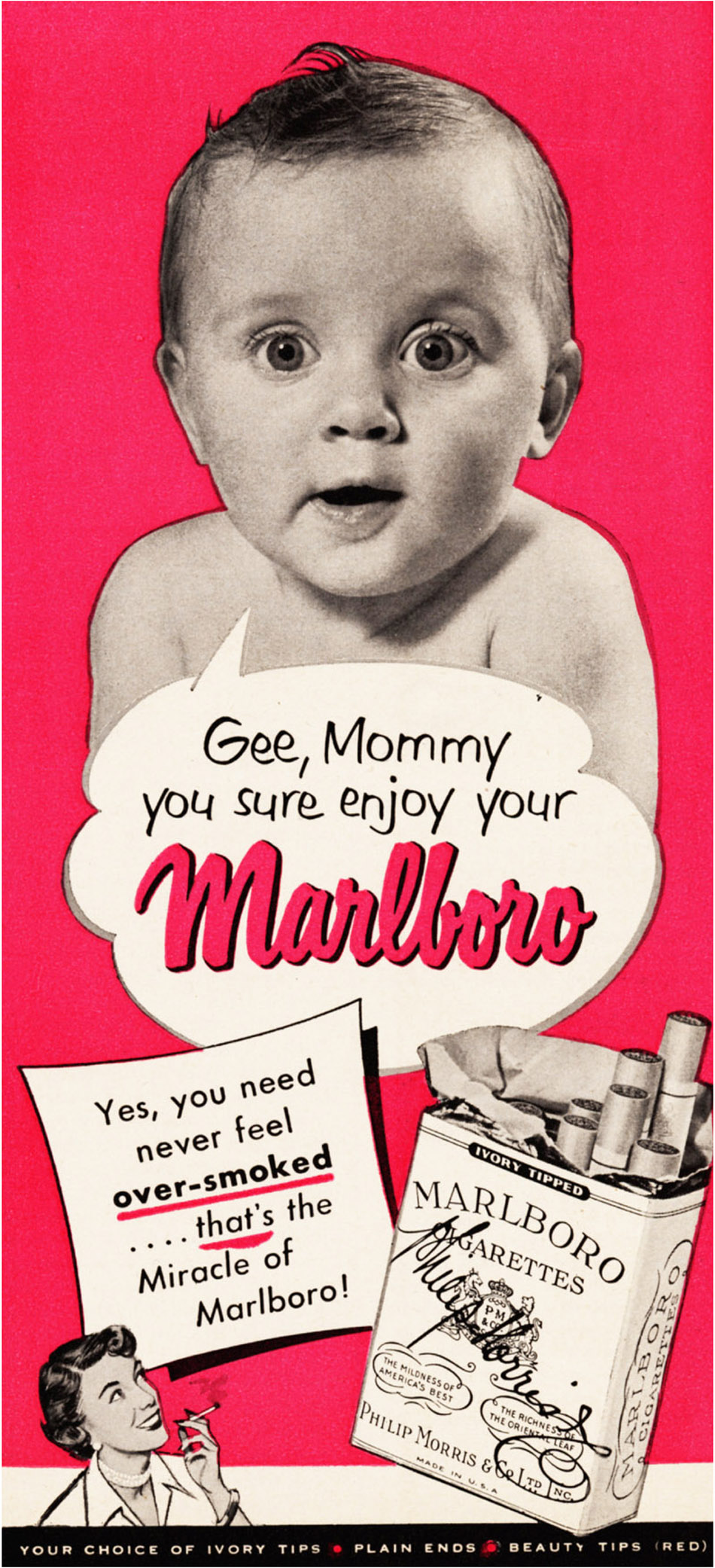
… which babies were also used to hawk tobacco products.
Of course, now we know more than we did then:
But this is now, and that was then.
Two of the more popular cigarette campaigns actually capitalized on bad grammar:
This slogan was routinely held up by prescriptive grammarians as an example of abominable usage: “like,” they said, is a preposition governing nouns and noun phrases, and should never be used as a conjunction introducing an adverbial clause. “Winston tastes good as a cigarette should,” intoned the English teachers, was the only acceptable form. Naturally, the ad execs picked up on the furor and capitalized on it:
Not to be left out of the action, MAD magazine put this on the back of their January 1971 issue, which shows that many folks were quite aware of the dangers of smoking, thank you, even while the Tobacco execs were perjuring themselves on the national scene.
In fact, “In December 1952 [Reader’s Digest] published “Cancer by the Carton“, a series of articles that linked smoking with lung cancer. This first brought the dangers of smoking to public attention which, up to then, had ignored the health threats.” (Wikipedia) An interesting article summarizing the history of tobacco and health concerns can be found at CNN Interactive.
Popular stars shilled for tobacco on a regular basis – it seems so bizarre to watch Granny Clampett and Jane Hathaway discussing the merits of Winston, but it’s amusing to see how they worked the grammar issue in at the end in a Madison Avenue “double whammy”.
The Flintstones got into the act as well:
I confess with some shame that tobacco contributed to putting bread in my mouth for some time; mother functioned as a spokeswoman for Camel cigarettes for a year.
But when it came to using bad grammar, Winston was hardly the only offender – Tareyton’s campaign confused nominative and oblique to good effect in their highly successful slogan, “Us Tareyton smokers would rather fight than switch.”[1]
Despite the peccadillo – it seems that cigarette ads thrived on controversy – this particular advertising campaign was wildly successful in the 60’s, and pushed Tareyton’s popularity close to the top of the charts.
But not all products, even those from the makers of successful brands, were an instant hit.
Back in 1966, when I was 15, I was on one of my semi-regular visits to my mom’s brother in Salt Lake. We took a trip up to Idaho to see some additional relatives, and I remember spending some time in a tobacco warehouse, helping to run cartons of cigarettes through the tax-stamp machine. (Had the government gotten wind of our little diversion, the owner could have been shut down, but oversight was lax and attorneys less numerous in those days.) While I was working there that day, I noticed something unusual – a carton of Tennyson cigarettes, which I had never before heard of.
Now, the more astute among my readers will be asking themselves, “What does a 15-year-old know from tobacco?” As it happens, even at that tender age I was somewhat of a tobacco connoisseur. I had started smoking in high school, finding that it was a gateway to a certain level of acceptance, for as little as that was worth. And I parlayed my small bit of social coin into a minor fortune by becoming a user of odd and revolting brands.2 (In Connecticut, the legal age for tobacco was 16, but even before that I had no end of “friends” who would procure for me in exchange for a small consideration.)
Strong and with a different flavor than American standards.
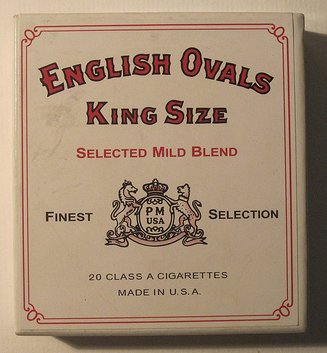
Oval cigarettes. Cute gimmick, but nothing special otherwise.
Absolutely foul. If I had these, I was guaranteed nobody would bum off me.
Tasted just about like smoking a cow pie. Or so I imagine.
Had kind of a fruity taste, unlike anything else I had ever smoked. Meh. However, Lark’s claim to fame was their commercial, the 1960’s version of Google Street View – the Lark truck would run around different places with a TV camera on the back, blaring the William Tell Overture, and asking people, “Show Us Your Lark Pack!” I saw this truck run down 1st Avenue in Manhattan one day; even if I had had a pack of Larks on me, I decided that discretion would have been the better part of fame, since I was still underage in New York.
[Edit: I had a copy of the commercial in question here, which I had posted at YouTube. Even though it was listed as public domain under a Creative Commons license, it appears that the brand is still owned by Trademarks LLC. The video was removed at YouTube, but for some odd reason still played here. In light of some communication with the above-mentioned company, I have removed the video. Unless it is taken down elsewhere, however, you can still see it here (3rd one on the list).
Now, since we’re on the subject of advertising in general as well, I nominate Salem cigarettes for the most insidious commercial ever devised. As a linguist who has studied close to 20 languages over the course of my life (although I don’t claim to speak them all), I can tell you that anything you produce will remain in your memory much longer than anything you hear. When learning a language, speaking is much more powerful than listening; they are different skills, yes, but the first cements things in your memory a lot longer than just hearing them, even multiple times. The following ad is much like getting up at 3:00 AM in the home of a musician, and playing only the first five notes of “Shave and a haircut” on the grand piano. It’s a guarantee that an irritated and foggy victim will stumble down the stairs to finish the “two bits” part before being able to go back to sleep.[3]
Unfortunately, despite these commercials being ancient, many of them have been taken down on copyright grounds. But go here and advance to 6:40, and you’ll get one of the ads that I’m referring to. Unless you are some kind of superhuman being, you will finish the line, and you will sing the brand name in your head. There is no escape.
There were others. I knew every brand on the market, and some that weren’t. I even rolled my own for a while, although not very skillfully, but when I couldn’t get these, I’d smoke anything I could get my hands on. My mother smoked Carltons (why bother, I wondered?) and when I’d cadge hers, I ripped the filter off; ultimately I settled on Luckies as my brand of choice. And of course, in the process, I became a 3-pack-a-day man by the time I was 18. The end of that story is that I quit, cold turkey, that year and never looked back – but my lungs paid a lifetime price.
So that brings us back to Tennyson, and by now I think you’ll understand why it caught my eye. A brand I didn’t know about? Intriguing! But in those days, there was no Internet, and such arcane knowledge was not to be found anywhere. Only later, thanks to the miracle of the Intertubez, was I able to dig up a bit of history, but even today what’s out there is pretty sparse.
In 1966, Tennyson launched a fairly comprehensive media blitz to publicize their new brand. I’m not sure why Tareyton simply didn’t choose to introduce a menthol version of their already-famous brand.[4]
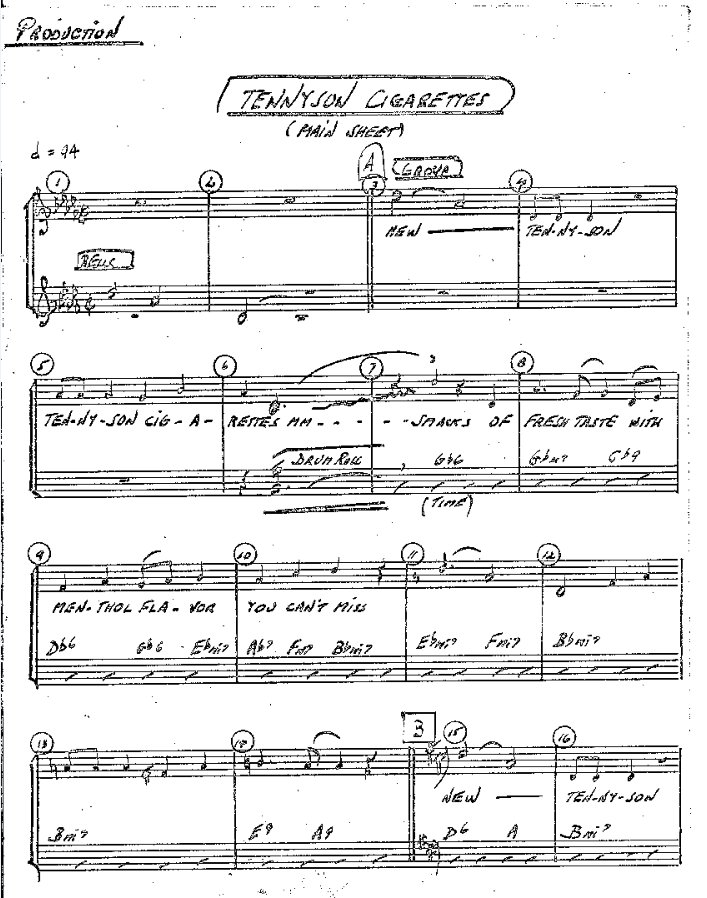
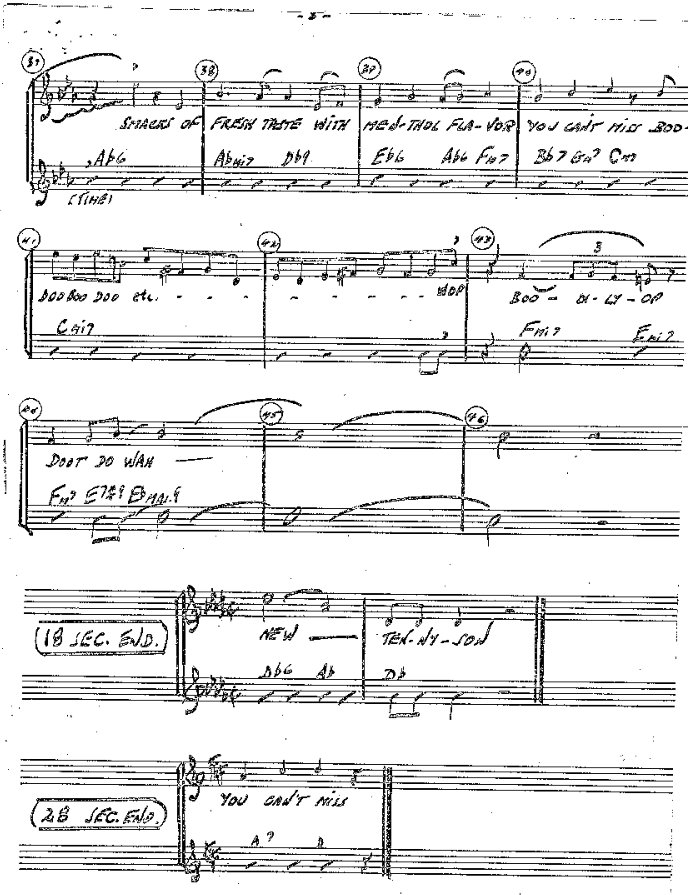
I even remember the jingle. I began to wonder later if I had imagined it, but fortunately the original sheet music which was submitted to the legal process was conserved:
So I’m not senile after all. I may be crazy, but that’s different. As a final bit of curiosity, I also found this:
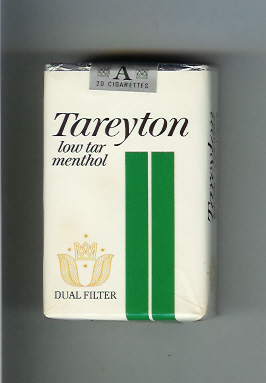
Same package, same font, same look as Tareyton – but nary a whit of information to be found about what these are, or when or where they were sold. Possibly a European version of Tareyton? One clue:
This has been a bit of a ramble, but I got a good bunch of things out that I won’t have to worry about later (‘Now where did I archive that?’)
The Old Wolf has rambled.
1 In case you’re wondering, it should be “We Tareyton smokers.”
2 Plus ça change, plus ça reste la même chose. Visit The Old Wolf’s Banquet from Hell.
3 Brooke McEldowney, both a very gifted musician and a supremely talented artist who does the webcomics 9 Chickweed Lane and Pibgorn, riffed on this twice. In the first one, Edda and her mother Juliette engaged in this very exercise here; the second, where poor Seth is tormented by his ballet company, is here.
4 As it happens, such a thing exists, even though I only found out about it later as I was researching the topic. Never once did I see these in stores.
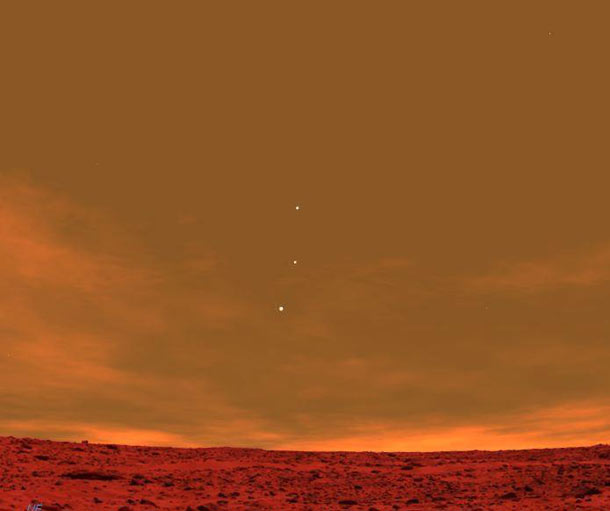
A post on George Takei’s Facebook feed displayed this photo of Earth and two other planets seen from the surface of Mars, purportedly taken from one of the rovers up there.
The one on Takei’s feed had an arrow pointing to the lower dot which said, “You are here.”
It’s a pretty picture, but my BS bells went off because there’s just something “off” about the photo, specifically those clouds and the fact that the three dots are the only things visible in the sky.
By the time I saw this, the post had gathered over 2,000 comments, and a brief perusal led me to this post over at Discover, which explains that the image is a computer-generated “planetarium” scene, as witnessed by the little “NE” in the lower left hand corner of the screen.
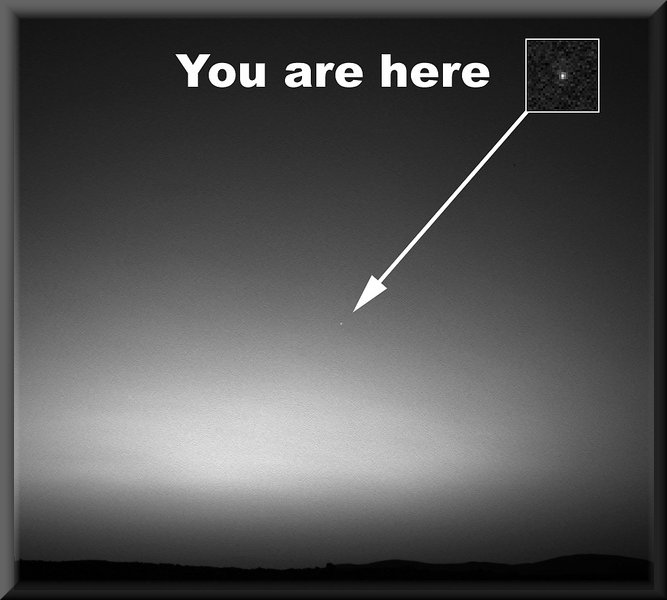
Sweetly enough, the article also posted this picture…
… which is a real picture, “the first image ever taken of Earth from the surface of a planet beyond the Moon. It was taken by the Mars Exploration Rover Spirit one hour before sunrise on the 63rd Martian day, or sol, of its mission. (March 8, 2004).” Found at NASA’s Flickr Feed, where you can read more information about the shot.
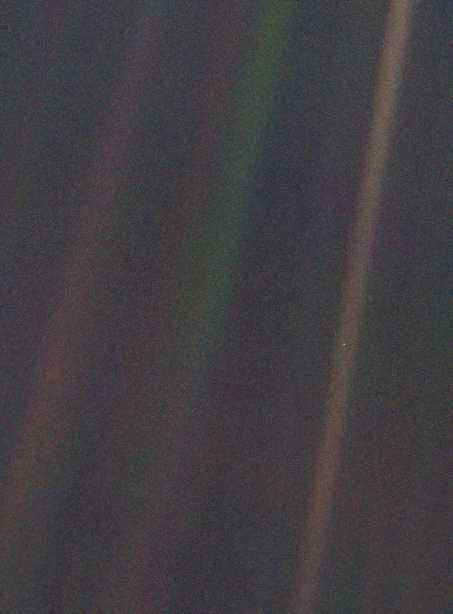
The tiny speck put me immediately in mind of the now-iconic photo of Earth taken by Voyager 1 as it was leaving the earth.
Astronomer Carl Sagan had requested NASA to point Voyager’s cameras back toward home, and this was the resulting image.
In his book Pale Blue Dot: A Vision of the Human Future in Space, astronomer Carl Sagan related his thoughts on a deeper meaning of the photograph:
From this distant vantage point, the Earth might not seem of any particular interest. But for us, it’s different. Consider again that dot. That’s here. That’s home. That’s us. On it everyone you love, everyone you know, everyone you ever heard of, every human being who ever was, lived out their lives. The aggregate of our joy and suffering, thousands of confident religions, ideologies, and economic doctrines, every hunter and forager, every hero and coward, every creator and destroyer of civilization, every king and peasant, every young couple in love, every mother and father, hopeful child, inventor and explorer, every teacher of morals, every corrupt politician, every “superstar,” every “supreme leader,” every saint and sinner in the history of our species lived there – on a mote of dust suspended in a sunbeam.
The Earth is a very small stage in a vast cosmic arena. Think of the rivers of blood spilled by all those generals and emperors so that in glory and triumph they could become the momentary masters of a fraction of a dot. Think of the endless cruelties visited by the inhabitants of one corner of this pixel on the scarcely distinguishable inhabitants of some other corner. How frequent their misunderstandings, how eager they are to kill one another, how fervent their hatreds. Our posturings, our imagined self-importance, the delusion that we have some privileged position in the universe, are challenged by this point of pale light. Our planet is a lonely speck in the great enveloping cosmic dark. In our obscurity – in all this vastness – there is no hint that help will come from elsewhere to save us from ourselves. The Earth is the only world known, so far, to harbor life. There is nowhere else, at least in the near future, to which our species could migrate. Visit, yes. Settle, not yet. Like it or not, for the moment, the Earth is where we make our stand. It has been said that astronomy is a humbling and character-building experience. There is perhaps no better demonstration of the folly of human conceits than this distant image of our tiny world. To me, it underscores our responsibility to deal more kindly with one another and to preserve and cherish the pale blue dot, the only home we’ve ever known.
—Carl Sagan, Pale Blue Dot: A Vision of the Human Future in Space, 1997 reprint, pp. xv–xvi
This quote, and much additional information about the photo and how it was taken, was found at Wikipedia. I had seen the picture and read the quote before, but it never ceases to move me.
Confession: I can’t do higher math.[1] I always wanted to be a doctor, but calculus put a rapid end to that dream, because you need calculus for the pre-med Chemistry degree and screw whole bunches of that, with apologies and honor and homage to my freshman chem teacher, Dr. Alex T. Rowland of Gettysburg College, a good man and a fine professor. But I’ve always loved science, and have stood in awe of the glory and majesty and miracle of the universe from its largest expanses to its smallest bits and pieces. I think I owe that love of science to the hours and hours my mother spent allowing me to roam the halls of the Hayden[2] Planetarium and the Museum of Natural History.
Publicity shots for “Pepper Young’s Wife”, TV-Radio Mirror, March 1957
I loved that rocket – it was in a darkened room, and each section was illuminated by a different color. The fuel chamber had a deep, red glow and I could stare at it for hours. This was one of my favorite books. Alas, my inability to comprehend the fine points of differentiation meant that I had to spend my life as a linguist and not as a scientist, but the love of understanding our world, from the quantum to the cosmic scale, never left me. All I can do is peep through the keyhole to where the big boys and girls are playing, and hope to understand as much as I can from there.
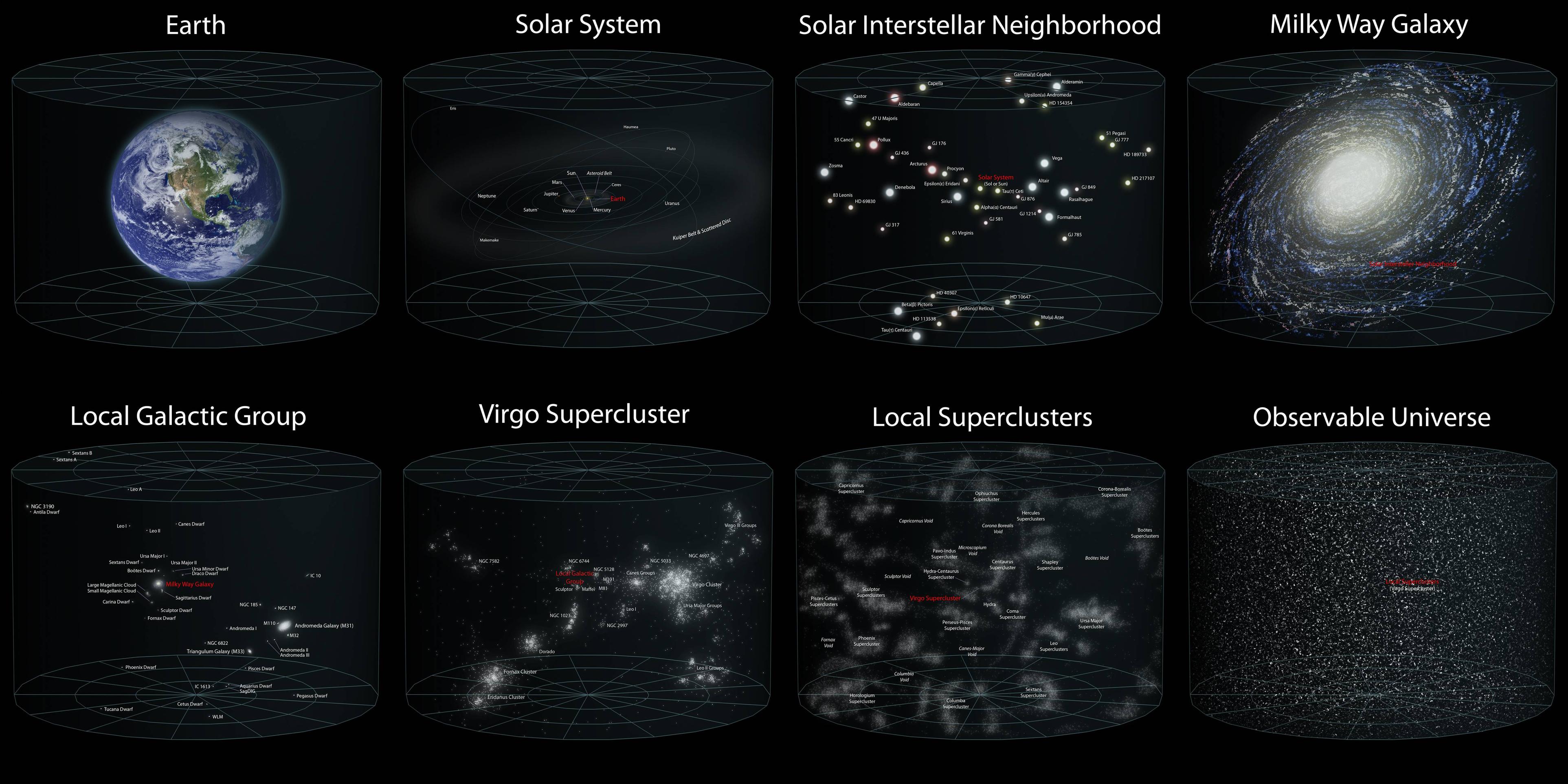
Years ago I happened across a copy of Powers of Ten, a companion volume to two films of the same name which were based on the book Cosmic View (1957) by Dutch educator Kees Boeke.
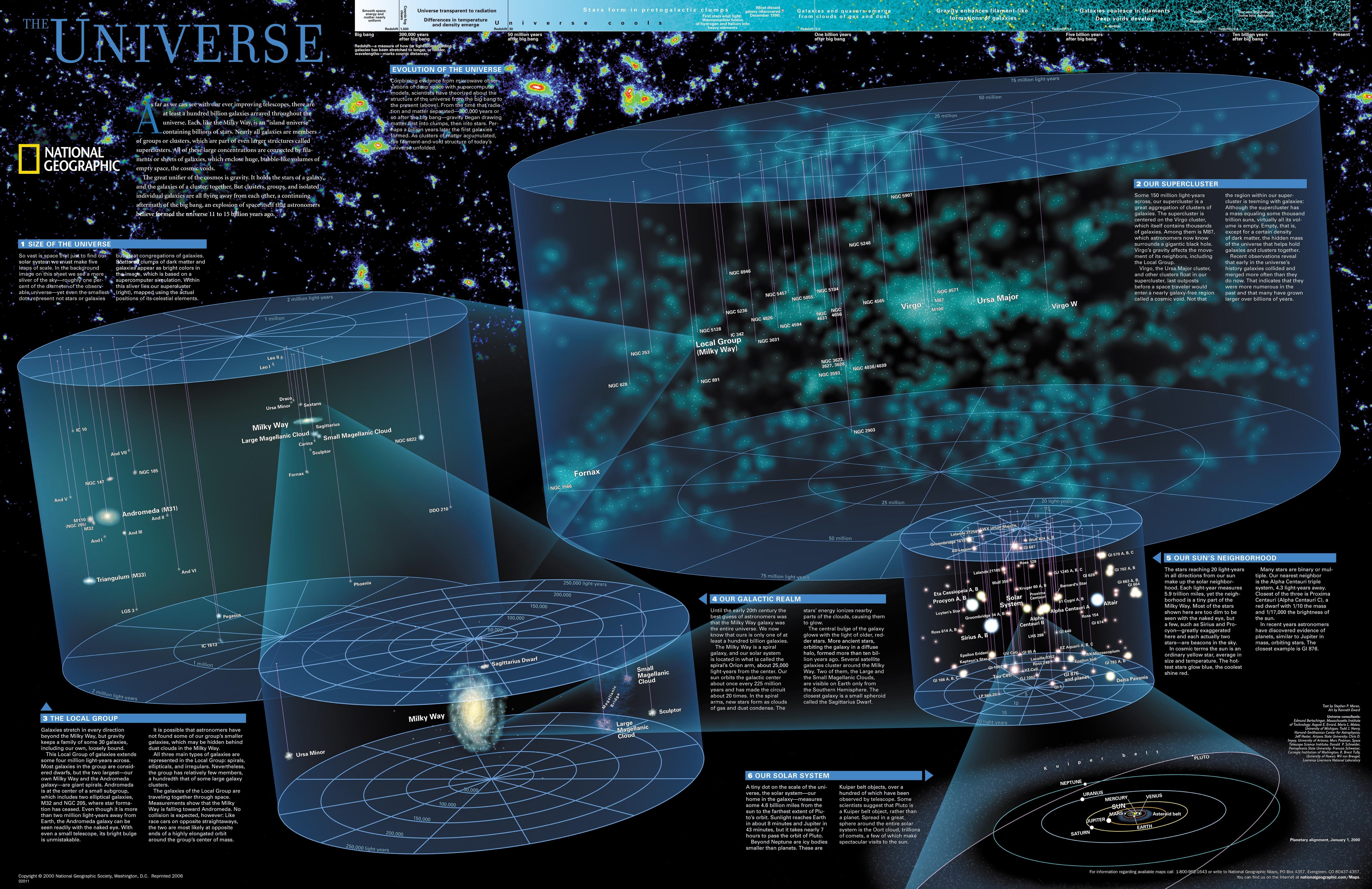
Later, this map of the known universe from National Geographic served to pretty much bork my mind out completely.
Trouble is, it doesn’t stop there.
I posted the above map earlier, along with a photo of Hubbles ultra-deep field image, and just recently came across this mind-bending video done by the folks at NASA/ESA:
The animations were based on the red-shift values of the various galaxies captured in the image. The thing is, that is by no means all of it – it’s only the part we were able to capture with our rather primitive (albeit wonderful) instruments.
So what is our place in the universe? Scientists will be grappling with that question for as long as man continues to be relevant. The president of my church, Thomas S. Monson, said in 2001, ” I acknowledge that I do not understand the processes of creation, but I accept the fact of it.” Taken in the context of the rest of his quotation, this has been interpreted by some to mean that we should reject science in favor of faith. I do not see it that way. The miracle of creation, in all its massive and miniscule glory, is before me, and I must accept the fact of it. But another fact remains: for all we know, we know virtually nothing. As tiny as the pale blue dot is in the immeasurably vast universe, so is all our scientific knowledge in the face of all there is to be known. I believe firmly that we do have a purpose and a place in all the vastness, and that purpose is to raise the human condition, to make life better in all possible ways for ourselves and for all whom we encounter. This is sufficient for me. In the words of Hillel, “the rest is commentary.”
And all this because of a single “fake” picture posted on George Takei’s Facebook feed. Thanks, George.
The Old Wolf has spoken.
1Just because I can’t do math doesn’t mean I can’t appreciate it.
A mathematical friend of mine assures me that this equation evaluates to ⅓. I couldn’t say for the two crore question, but I’ll never forget how to write it. See, it’s a limerick, and limericks I can remember. All of them. Darnit.
“Integral zee squared dee zee
From one to the cube root of three
Times the cosine
Of three π over nine
Equals log of the cube root of e.”
[2]With thanks for the correction to Haydn Rawlinson, who apparently knows not only how his own name is spelled but also the Planetarium’s.
Today, Reuters reported that the Taliban in Afghanistan is after Prince Harry, hoping to make political hay out of a high-profile target. The article states in part,
“(Reuters) – The Afghan Taliban said on Monday they were doing everything in their power to try to kidnap or kill Britain’s Prince Harry, who arrived in Afghanistan last week to fly attack helicopters. Queen Elizabeth’s grandson is in Afghanistan on a four-month tour, based in Camp Bastion in the volatile Helmand province, where he will be on the front line in the NATO-led war against Taliban insurgents. ‘We are using all our strength to get rid of him, either by killing or kidnapping,’ Zabihullah Mujahid, a Taliban spokesman, told Reuters by phone from an undisclosed location.”
Mr. Muhajid, you understand nothing of Islam. You understand nothing of jihad, which is personal struggle to make yourself more like the Allah you claim to worship, but whom you understand not at all. Tom Clancy said it far better than I ever could:
“Islam is not the enemy of our country or any other. Just as my family was once attacked by people calling themselves Catholics, so these people have twisted and defiled their own religious faith in the name of worldly power, and then hidden behind it like the cowards they are. What God thinks of that, I cannot say. I know that Islam, like Christianity and Judaism, teaches us about a God of love and mercy–and justice.”
Tom Clancy, Executive Orders
No one is fighting a war against Islam, except withing the confines of your own uneducated and deluded minds. You are wrong about the world, wrong about freedom, wrong about personal liberty, and wrong about your own faith.
If Allah exists in any form at all, he is not one of the Old Gods. He does not demand blood and sacrifice, or the suppression of other human beings – women, gays, Baha’is, Jews, or any other of his creations; he does not demand that unbelievers be subject to the Dhimmi tax, or beaten for your pleasure, or executed at your whim. Your guns do not make your right; your misguided mullahs and imams do not make you right; the destruction of priceless cultural treasures at the fatwa of one insane man do not make you right. You are wrong, and all the bullying thuggery in the world will not change that. You will no doubt consider this blasphemy and worthy of death, but I do not excuse my words. I am not a Muslim, but I tell you plainly that I understand your Allah far better than you ever will.
Humanity will survive your onslaught. Shari’a will not prevail. As our race gropes toward the stars, backward-thinking mobsters like yourself and those who follow you will fade into obscurity and irrelevance. The only hope you have for survival is to lay down your weapons of war and join those who seek to live in peace with their neighbors, who seek to build a better world for all people. Do this, and you will live. Do it not, and you and each of you relegate yourselves to the dustbin of history.
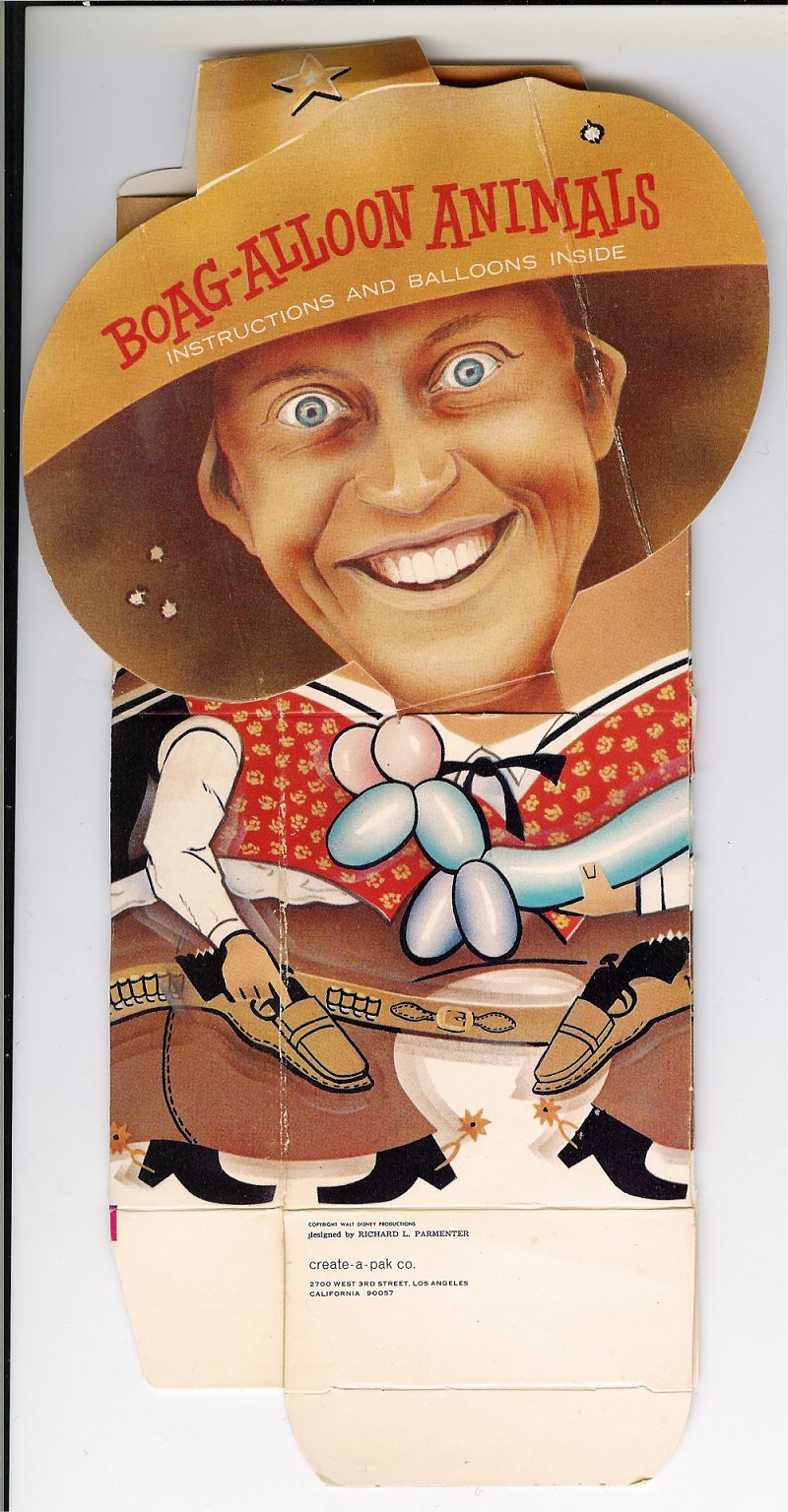
If you’re old enough and ever attended the Golden Horseshoe Revue at Disneyland, you may have been fortunate enough to get one of these boxes of balloons from the incomparable Wally Boag. Younger generations never knew him, although they might spot him as a character actor in some of Disney’s earlier comedies such as “The Absent Minded Professor” or “The Love Bug”, or knew his voice as “Jose” the parrot at the Enchanted Tiki Room. But Wally had a phenomenal career, and left an indelible mark on the essence of the Disney empire for decades. Wally passed away just over a year ago on June 3, 2011, and the world is poorer as a result.
My father was an actor, and had a longstanding relationship with the Boags through performance channels. As a result, I knew them since I was knee-high to a… well, my wife doesn’t like those things so I’ll say “to a gecko.” And my life was infinitely richer as a result. Wally was a great entertainer, a very funny man, and a dear friend.
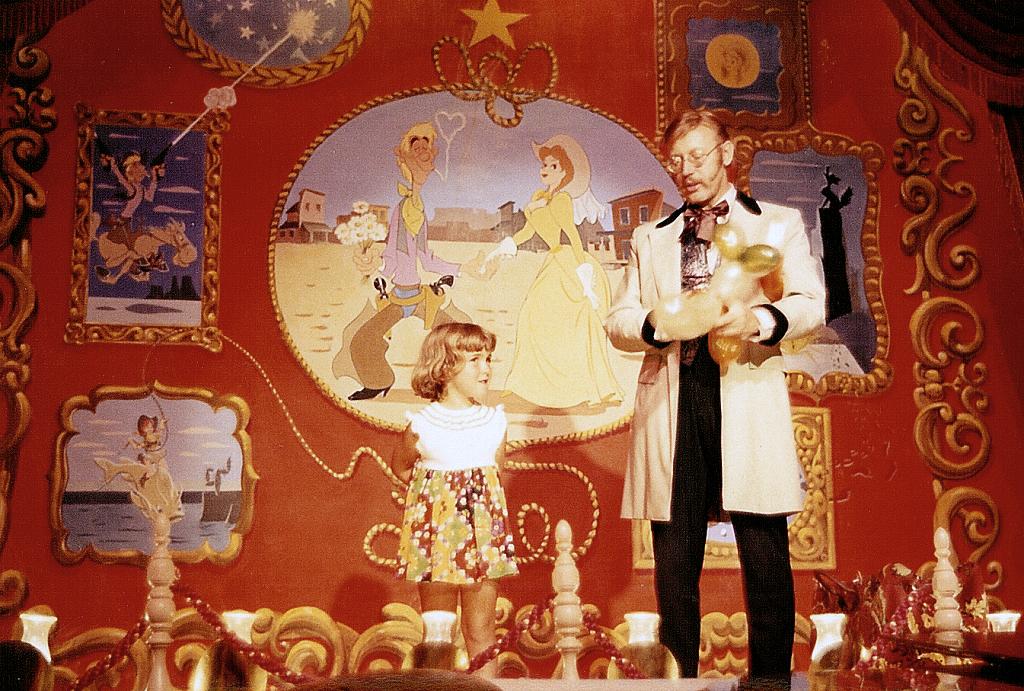
Wally’s balloon work was one of his trademarks, and he always had a youngster up on stage to help him with his routine. I took this in the early 70’s during one of my visits there.
Wally as Pecos Bill in the foreground, Betty Taylor as Sluefoot Sue in the background, flanked by Fulton Burley of the amazing eyebrows and lilting tenor. In a gentle coincidence, Betty passed away one day after Wally did.
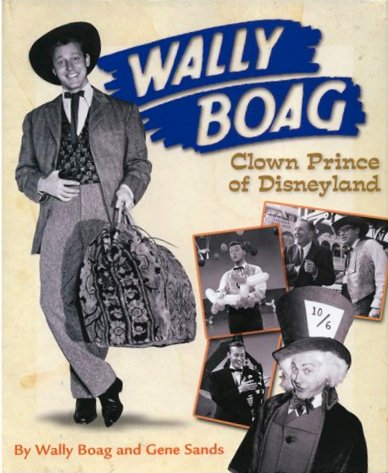
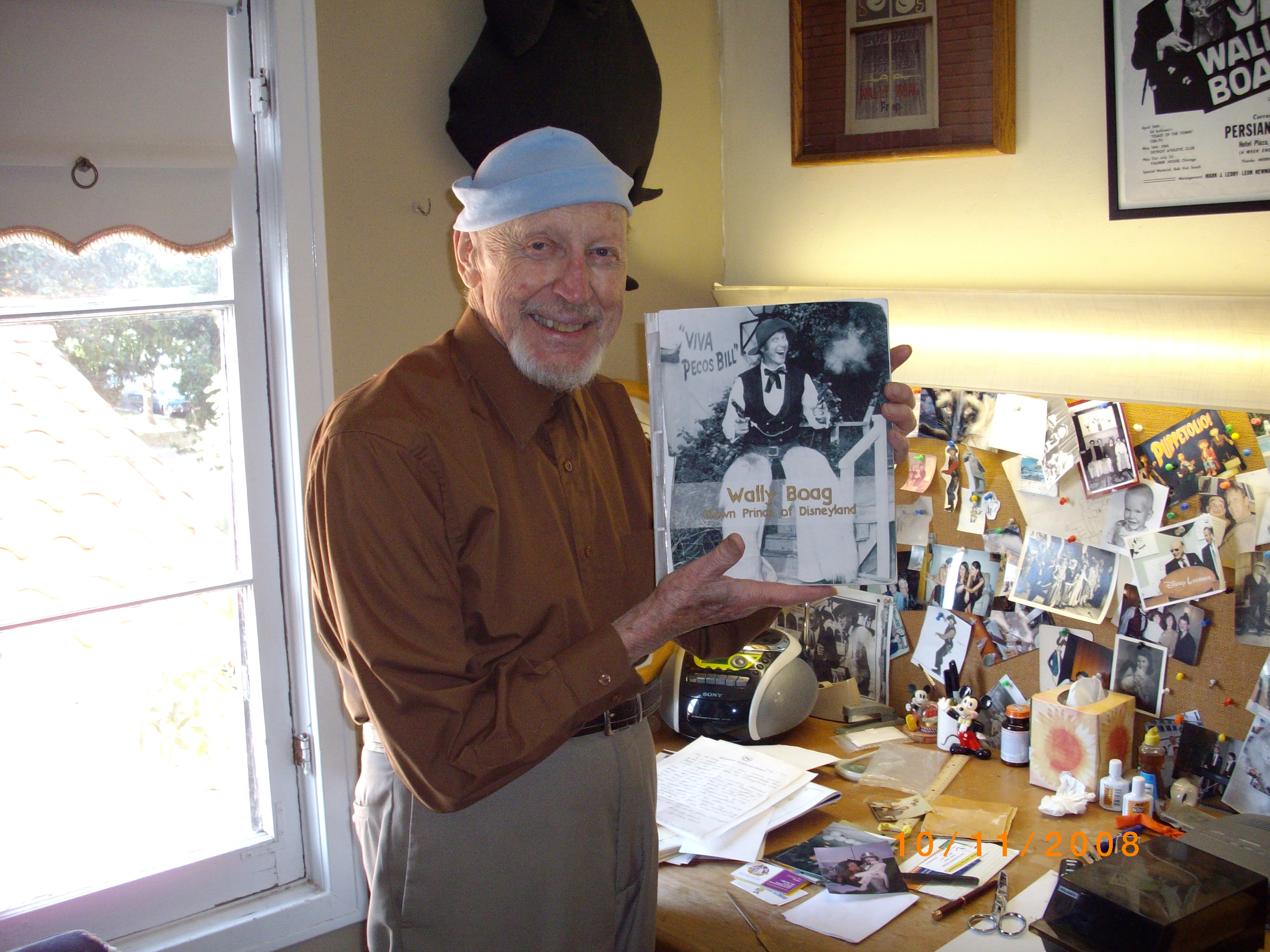
With the encouragement and massive assistance of his longtime friend Gene Sands, Wally was able to publish an autobiography a scant two years before he passed – it’s full of memorabilia and wonderful stories, and would be a graceful addition to the coffee table of anyone who remembers Wally fondly:
The book is only available at the Wally Boag Website; a review can be read at Yesterland. It’s unlikely that there will be another printing; my autographed copy is numbered 57 of 200, and I treasure it, treasure it, treasure it.
Wally was honored with a window above Main Street in Disneyland. In addition to voicing Jose the parrot, Wally had a large hand in writing the script for the Enchanted Tiki Room, which to this day remains one of my favorite attractions on the park. (Fulton Burley, mentioned above, voiced “Michael” the Irish parrot as well.)
A replica of the window graced a garden house at Wally’s longtime home in California.
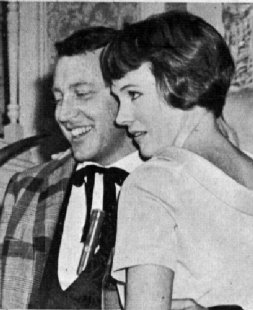
Julie Andrews had been a part of Wally’s “Starlight Roof” show in London at the age of 12, where she would sing “Polonaise” from Mignon. In 1963, Julie Andrews as at Disneyland prior to the release of The Sound of Music. She stopped by to visit with Wally at Disneyland; he brought her onstage during his show and they sang a duet together.
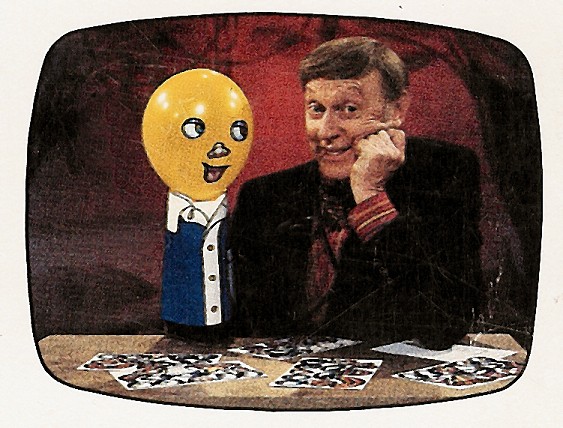
Wally was featured in a birthday party video which included balloons for kids to blow up and decorate.
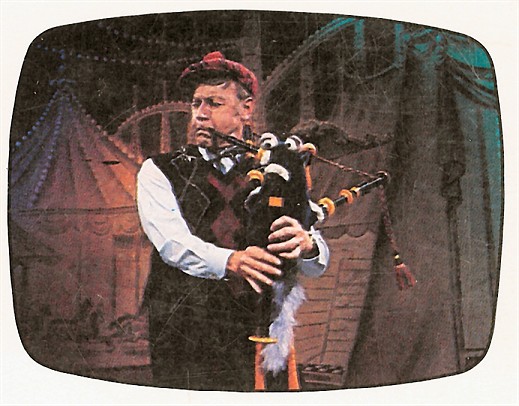
Wally as the Traveling Salesman at the Golden Horseshoe Revue
Wally as Pecos Bill
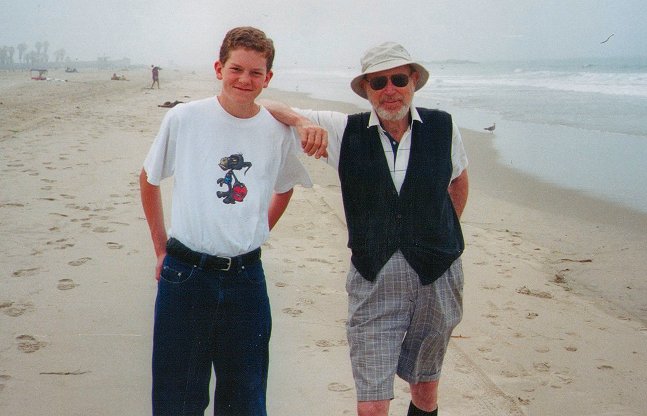
My youngest son MikeD with Wally on the beach near Santa Monica, around 1999 or so.
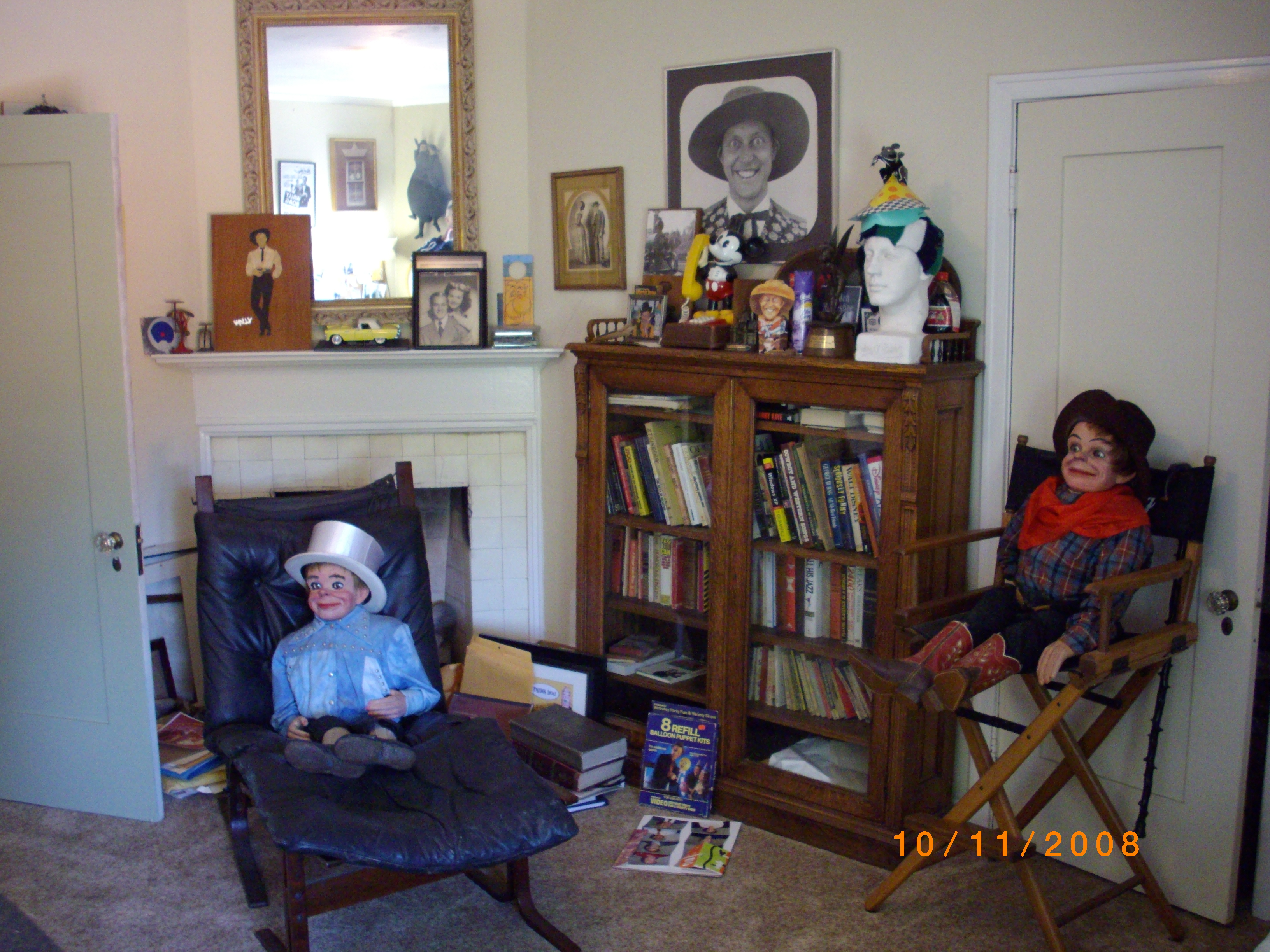
Wally’s Den
Wally at his desk in 2008, holding galley proofs for his autobiography.
Wally’s Wikipedia Page has a number of additional links about him and his career, for those inclined to learn more.
Time must march on, but I will miss this dear man terribly. I have been so honored to know him and his family, and my heart is lightened by the echoes of his life well-lived whenever I think of him.
Occasionally a troll pops up on a discussion board. These are individuals who write inflammatory or disparaging posts, hoping for a flurry of outraged responses which they can then refute with further insults. In troll-speak, they do it for the lulz, meaning “for the joy of disrupting another’s emotional equilibrium.”
Image Source: Unknown
From this article in Science Friday comes a summary of troll behavior:
‘Trolling can
be frustrated if users correctly interpret an intent to troll, but are not provoked into responding,
be thwarted, if users correctly interpret an intent to troll, but counter in such a way as to curtail or neutralize the success of the troller,
fail, if users do not correctly interpret an intent to troll and are not provoked by the troller, or,
succeed, if users are deceived into believing the troller’s pseudo-intention(s), and are provoked into responding sincerely.”
Wikipedia counsels, “Experienced participants in online forums know that the most effective way to discourage a troll is usually to ignore him or her, because responding tends to encourage trolls to continue disruptive posts.” This is usually summarized by forum participants as “Please do not feed the trolls”. If there are no lulz to be had, a troll has no reason for existence and will in general move on to what he or she considers greener pastures.
One forum I participated in fell victim to an especially egregious attack, which – sadly – resulted in the demise of that community’s incarnation (it subsequently went elsewhere, in a locale better protected from infiltration. In an astounding flurry of pseudo-creativity, the following piece of literary vandalism practically wrote itself, but I’m pleased with the outcome, because it served to get all my frustration with these sub-humans out of my head and down on “paper”, as it were.
The Cyber Troll
with the most profound apologies to J. R. R. Tolkien
Troll sat alone in his filthy home,
He had no reason outside to roam;
His pimply face was a sore disgrace
And friends were hard to come by.
Done by! Gum by!
In a filthy home he dwelt alone,
And friends were hard to come by.
He’d surf the net, always on the watch
For nasty pictures that would tickle his crotch
But the thing he loved best was to curse and swear
And act like a total retard¹.
Bombard! Blackguard!
He’d yank people’s chains for laughs and lulz
And act like a total retard!
‘Ha ha!’, said Troll, ‘I pwn your soul.
So why don’t you shut your old cake hole?
Your posts are lame and I take control
Of your blog, you stupid loser!
Boozer! Schmoozer!
I can drool and spit and you can’t do squat²
‘Cuz I’m safe from poor old loser!
But the folks whose paths he tends to cross
Have naught but contempt for this pile of dross
So they simply pretend that he isn’t there
And Troll gets all the madder.
Sadder! Adder!
When poor old Troll doesn’t get results
He just gets all the madder.
‘For a couple o’ pins’, says Troll, and grins,
‘I’ll swear so much you’ll think I’m twins.
I’ll make you see you’ve got nothing on me
And your base belong to me now!
Hee now! See now!
I’m king of the world, bow down to me,
All your base belong to me now!
But just as he thought his victim was caught,
He found his hands had hold of naught.
The blogs were locked, and Troll was shocked
That everyone ignored him!
Bored him! Floored him!
He’d been dismissed, and was mighty pissed
That everyone ignored him!
But blacker than coal is the heart of Troll
Whose life is as barren as the Kansas dust bowl.
He’ll just move on to greener fields
Where folks will rise to his baiting.
Hating! Grating!
Old Troll laughs, when he hears folks groan,
And he thinks he’s won with his baiting.
But the folks who win, to Troll’s chagrin
Are the ones who learn the rule herein;
Ignore the Troll with the heart of coal
And he’ll quickly travel elsewhere!
Nose hair! Hot air!
His world’s so sad, but we don’t care
As long as he’s flaming elsewhere!
——————–
The Old Wolf has spoken.
Footnotes:
¹ Yes, I’m aware this is no longer a term to be applied to people who are mentally challenged.
² While composing this, I thought of a better rhyme – but I strive to write family-friendly material.
Well, I agree. Our nation was built on equal opportunity (at least on paper), and that means equal responsibility. There’s a lot being tossed around these days about “forced redistribution of wealth,” and that’s an idea I can’t get behind. At the same time, I can’t deal with the concept of poor folk shouldering the lion’s share of our nation’s tax burden while massive corporations and the super-rich use tax shelters and loopholes to avoid paying effective tax rates at parity with the poor and (suffering!) middle-class.
Even a 3% gap in tax burden is unacceptable, given the top-heavy nature of the wealth pyramid. I suspect that the graph only depicts the tip of the iceberg as well, and doesn’t address corporations at all.
The Church of Jesus Christ of Latter-day Saints instituted the Law of Tithing in 1838 by revelation. However, even as late as 17 May 1899, members of that faith were observing the commandment sporadically or partially, and the Church was deeply in debt after resolving its difficulties with the government. On the latter date, President Lorenzo Snow announced to the Church at a conference in St. George, “The word of the Lord is: The time has now come for every Latter-day Saint … to do the will of the Lord and to pay his tithing in full. That is the word of the Lord to you, and it will be the word of the Lord to every settlement throughout the land of Zion”. From that day to this, worthy Mormons pay 10% of their increase to support the work of the Church. What their “increase” is (gross income, net income, 100 eggs, whatever) is left up to the conscience of the individual member, but the point is: If you make a dollar, you pay 10¢. If you make seven jillionteen dollars, you divide that by ten, and that’s your tithing. There are no deductions, no loopholes, nothing. Ten percent.
We need a similar system when it comes to income taxes. There are many who will claim that a flat tax is regressive and unduly burdens those of lesser means, but I don’t buy it. Each of us has the obligation to pay our fair share, and a flat tax system with equal sharing of the burden would result in far less resentment than a system where the poor are squeezed for every last dime and those who can afford high-priced lawyers, corporations included, pay little, or in some cases nothing.
‘
Compiled by CTJ (Citizens for Tax Justice); found here.
This level of disparity is mind-boggling, and even moreso that it continues to be permitted. Demanding that corporations and the wealthy pay a fair share of taxes is not “forced redistribution” of wealth – it’s just plain old human decency and common sense.
As I’ve said elsewhere, “trickle down” economics is insulting even at the semantic level. If our nation is going to regain any sense of the greatness it once had, and the equality of opportunity implied in “lifting a lamp beside the golden door,” the trickle must of necessity become a torrent.
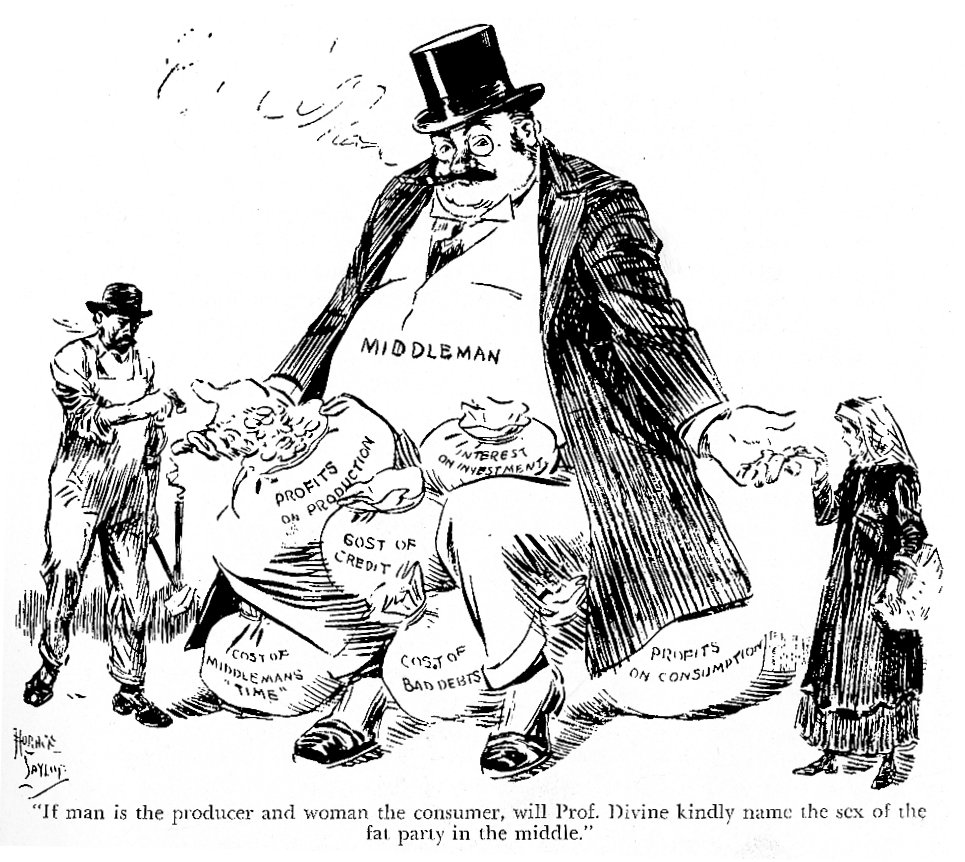
Sadly, the situation is not new – as the early 20th-century cartoon above shows, the wealthy have in effect been raping the vast majority of our population for centuries, and we deserve better.
Forced redistribution of wealth basically means, ‘I don’t have to do anything, I don’t have to be anything, I’m a human being. Now gimme half of what you’ve got.” That’s socialism at its worst, and it’s not what I’m advocating in the slightest. People prosper for all sorts of reasons. Some were born into wealth, others started businesses on a shoestring and built empires. But it’s important to remember that even the CEO’s who built their businesses didn’t do it alone: US Humorist Don Marquis (Archy and Mehitabel) once said,”When a man tells you that he got rich through hard work, ask him: ‘Whose?'”
Not all of us are cut out to build global business networks worth billions. Those who do, by dint of honest work and business savvy, should be entitled to enjoy the fruits of their labors. But the person who makes money honestly and holds on to it by dint of legal jiggery-pokery is no better than the thief who dips into the till – he or she is ripping off the entire nation, and it’s just plain not right.
I’m not an economist, but it would seem to me that a flat tax, with deductions for interest paid on a primary residence and charitable contributions, would be the fairest way to go. If you make a little, you pay a little. If you make a lot, you pay a lot. Eliminating all the loopholes and special circumstances would go a long way to establishing tax equity in our nation, and might just even be part of a solution for returning to the concept of a balanced budget, which at the moment looks as substantial as an opium dream. Such a plan might put a bunch of lawyers out of work, but you can’t make an omelet without breaking eggs.
Light shined into dark corners will make the cockroaches scurry for cover. Today we’re talking about Ketonic Labs Green Coffee Bean extract.
Executive Summary: This product is a fraud, this product is a scam, and this product is snake oil.
Here’s the spam email I got this morning:
The spam issue
In the first place, I shouldn’t be getting this junk because I’ve never done business with Ketonic Labs, Micronet Tech or Performemmbers.net. That’s the beauty of the toothless CAN-SPAM act passed by our amazing congressmen, it means that anyone “can spam” you by simply offering an unsubscribe link: thank you very little, you gutless cabrones. Comcast does a pretty good job keeping most spam out of my inbox, but image-based ads like this continue to slip through their filters.
The scam issue
Supplements are almost totally unregulated. You can claim that a product will give you wings and allow you to mate with sphinges (that’s plural for sphinx), as long as you tack on this little disclaimer: “These statements have not been evaluated by the FDA. This product is not intended to diagnose, treat, cure or prevent any disease.” The FDA will, in general, only come after companies whose ad copy actually does claim such things, despite the disclaimer, and they’ll only take the time to prosecute the biggest players because their resources are limited. But from where I sit, the email itself violates all the rules, and the web page is even worse.
Notice the almost-invisble “ADVERTORIAL” at the top of the page. I hate that word, for what it’s worth.
Melt away fat
Get high-school slim
Potent Fat Burner
Effective Appetite Suppressant
Works Quickly, Proven Results
Affordable Prices
Tremendous Weight loss results
Increase in Focus
Energy Throughout the day
No Crash
In short, these people, like hundreds of thousands of others, are dazzling you with weasel words and pseudo-scientific horsehockey, and it’s almost a guarantee that enough people in our country will believe it that they can recoup their costs and walk away with a tidy profit before moving on to another fraud. Make no mistake – they know they are shoveling out the barn- just have a look at this great disclaimer at the bottom of the page:
DISCLAIMER *THIS PAGE RECEIVES COMPENSATION FOR CLICKS ON OR PURCHASE OF PRODUCTS FEATURED ON THIS SITE. *The story depicted on this site and the person depicted in the story are not real. rather this story is based on the results that some people who have used these products have achieved. The results portrayed in the story and in the comments are illustrative and may not be the results that you achieve with these products. The depictions on this page are fictitious and indicitive [sic] of potential results. Actual results may vary.
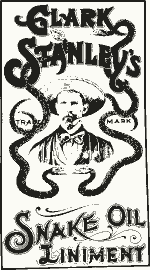
Of course, none of this is new. People have been hawking snake oil since the earliest days:
The less educated a population, the more likely you are to be able to sell them anything. You’d think as the availability of information increases, people would become more enlightened, but the general trend in my own experience is downward; mass media caters to the lowest common denominator and good information on the internet is covered with a layer of bovine ejecta worthy of the Augean stables. The older I get, the more cynical I become about sales and marketing in general, and that’s a problem because I have products of my own to sell, and it’s a constant battle to figure out how to carve out market sector without being a douchebag.
With thanks to B. Kliban
Here’s the product label:
So what is Ketonic selling you for $50.00 a bottle? Caffeine, which has long been combined in numerous diet pills and combined with other quack ingredients including PPA, ginseng, green tea extract and countless others. Double-blind, placebo-based trials, however, seem to indicate that caffeine is not effective as a weight-loss aid. But please, don’t confuse us with the facts – where there’s money to be made, the marketers will sell you all they can.
Conclusion
There are some solid principles for losing weight, but as I have said elsewhere, there is no magic bullet. Do yourself a favor and stay away from the snake oil.
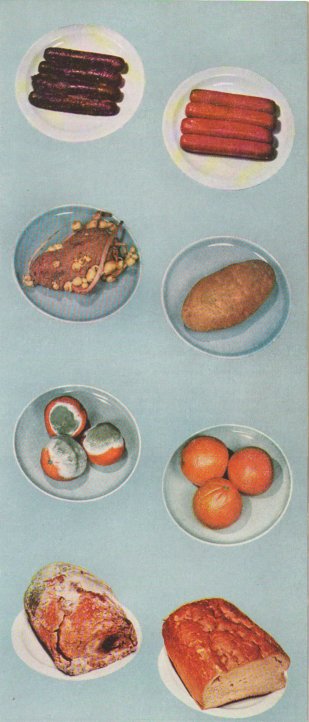
I’ve long had in my library a September 1958 National Geographic entitled “You and the Obedient Atom.” It’s an intriguing look at the scientific applications of nuclear radiation, and one of these has always intrigued me.
Using gamma rays to destroy micro-organisms that cause decay, the Army Quartermaster Corps preserves foods for weeks and months at room temperatures. When exposures are light, changes in taste are scarcely noticeable; gamma radiation does not linger.
Foods irradiated in Argonne’s pool (illustration not shown – Argonne National Laboratory near Chicago) and elsewhere were first fed to rats, without harmful effect. Later, military volunteers tried samples. Congressmen have eaten entire gamma-sterilized dinners.
Both samples of frankfurters were kept three months in air¬tight plastic wrappers. Irradiated meat on right looks as fresh as ever. A potato sprouts six months after harvesting; in its opposite, sprouting is delayed. Treated oranges stay fresh and juicy. Moldy bread contrasts with a two-month-old treated loaf. The Food and Drug Administration has not yet certified gamma-treated foods for the market.”
National Geographic, September, 1958
Wow. What a way to reduce spoilage. Yet despite the massive consumer push-back against GMO’s or “frankenfoods,” we hear almost nothing about irradiation today. Doing a bit of research, I came across
Apparently foods treated by radiation will display the “radura”
And yet despite the initial approval by the FDA of irradiated foods for certain applications and continuing research showing its safety, I have never once in my life seen the radura on any food label, anywhere.
“Irradiation has not been widely adopted due to an asserted negative public perception, the concerns expressed by some consumer groups and the reluctance of many food producers.[47]
Consumer organizations, environmentalist groups, and opponents to food irradiation refer to some studies suggesting that a large part of the public questions the safety of irradiated foods, and will not buy foods that have been irradiated.[48]
On the other hand, other studies indicate the number of consumers concerned about the safety of irradiated food has decreased in the last 10 years and continues to be less than the number of those concerned about pesticide residues, microbiological contamination, and other food related concerns. Such numbers are comparable to those of people with no concern about food additives and preservatives. Consumers, given a choice and access to irradiated products, appear ready to buy it in considerably large numbers”
Irradiation works by destroying DNA, preventing microorganisms from reproducing or creating toxic byproducts. Obviously people are going to have concerns about consuming modified (destroyed) DNA in the same way as they will about consuming transgenic foods, but that doesn’t mean the issues are the same. Still, given what we know about how prions work and the devastating effects of BSE, people are right to be concerned enough to do their homework.
Given the relative paucity of irradiated foods on the market, it’s probably safe to say you are not likely to encounter any, but I’m going to do a bit more digging. If it is safe, it could go a long way to reducing food waste, which at this point reaches a level of about 40% of all consumables in the US alone.
“As you can see, I have memorized this utterly useless piece of information long enough to pass a test question. I now intend to forget it forever. You’ve taught me nothing except how to cynically manipulate the system. Congratulations.” -Calvin (Bill Watterson)
When I was in high school, I remember thinking similar things on a regular basis. Why in the world do I need to know this? And to some extent, it’s true. While I can remember the quadratic equation, I have never once needed to determine the roots of ax2 + bx + c = 0.
Funny thing about that. It seems to be a more popular perception than I thought.
This philosophy taken to its logical conclusion is probably what led Isaac Asimov to say, “There is a cult of ignorance in the United States, and there always has been. The strain of anti-intellectualism has been a constant thread winding its way through our political and cultural life, nurtured by the false notion that democracy means that “my ignorance is just as good as your knowledge.” (Newsweek, 21 January 1980).
However, Munroe’s alt-text for the above cartoon is “The only things you HAVE to know are how to make enough of a living to stay alive and how to get your taxes done. All the fun parts of life are optional.” That’s just what I was incapable of getting my head around at the time: oftentimes the only purpose in learning is to teach us how to learn, and what a joy that is in itself.
When I was a kid, librarians were held in high esteem. If you couldn’t find something you wanted you went to the librarian, who either knew the answer immediately or knew exactly where to find it. They were the living Wikipedias of the era, and they understood the joy of learning.
“Were man to live coeval with the sun, the patriarch-pupil would be learning still.”
-Young, “Night Thoughts.”
There’s something to be said for a broad-based education in preparation for choosing a career, but better than teaching endless rafts of facts in preparation for the almighty standardized tests, schools ought to be teaching kids how to learn and how to think and how to question; minds that can do this are the fertile seedbeds of innovation and social justice.