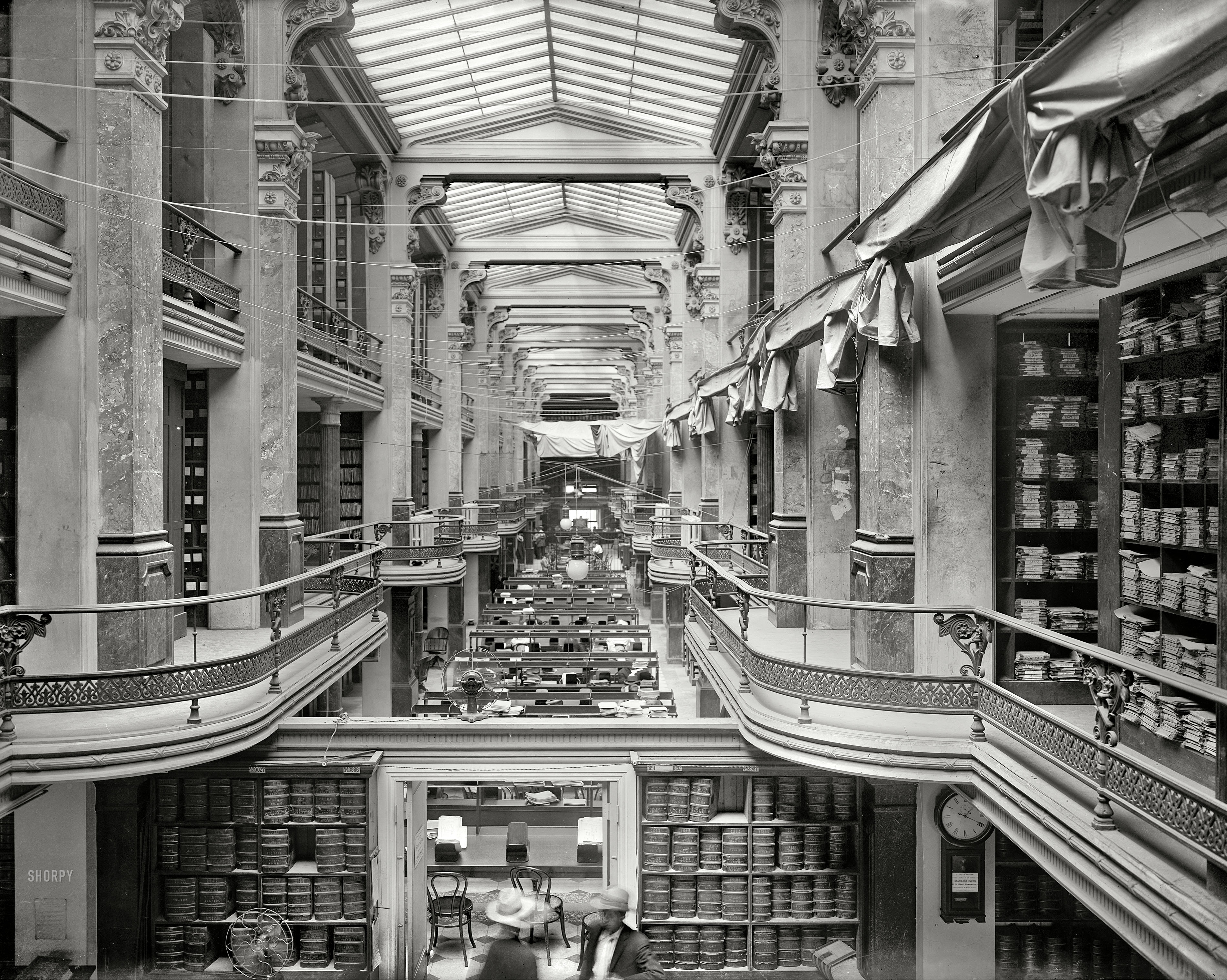
United States Patent Office, 1924.
Found at Shorpy.
Some time ago I posted about internet trolls, familiar to anyone who frequents forums and discussion groups. Indeed, one of the net’s most prolific and unsavory trolls was recently outed by Gawker (I’m not posting the link because it’s a pretty sordid story, but it’s out there if you’re interested.) Today I happened across a description of this kind of behavior from the early 19th century, which I thought was interesting – Trolling is not new, and apparently the only thing that has changed is the medium.
This litigious humour is bad enough: but there is one character still worse — that of a person who goes into company, not to contradict, but to talk at you. This is the greatest nuisance in civilised society. Such a person does not come armed to defend himself at all points, but to unsettle, if he can, and throw a slur on all your favourite opinions. If he has a notion that anyone in the room is fond of poetry, he immediately volunteers a contemptuous tirade against the idle jingle of verse. If he suspects you have a delight in pictures, he endeavours, not by fair argument, but by a side-wind, to put you out of conceit with so frivolous an art. If you have a taste for music, he does not think much good is to be done by this tickling of the ears. If you speak in praise of a comedy, he does not see the use of wit: if you say you have been to a tragedy, he shakes his head at this mockery of human misery, and thinks it ought to be prohibited. He tries to find out beforehand whatever it is that you take a particular pride or pleasure in, that he may annoy your self-love in the tenderest point (as if he were probing a wound) and make you dissatisfied with yourself and your pursuits for several days afterwards. A person might as well make a practice of throwing out scandalous aspersions against your dearest friends or nearest relations, by way of ingratiating himself into your favour. Such ill-timed impertinence is ‘villainous, and shows a pitiful ambition in the fool that uses it.’ – William Hazlitt, “On the Conversation of Authors,” 1820
Found at Futility Closet
The Old Wolf has spoken.

Click for full-size image. Found at Shorpy.
“Fraunce’s Tavern, Broad and Pearl Streets.” The building, which figured in the Revolutionary War, is said to be Manhattan’s oldest. [1] There are so many things to see in New York – this one probably never even got onto my radar during the 18 years I lived there.
This picture was taken the year my grandfather emigrated to New York from Italy.
The Old Wolf has spoken.
[1] Apparently this building, however, is not the original one that Washington knew, that having been destroyed in a fire with only one wall left standing. It has been rebuilt and remodeled several times – see the Wikipedia article.

Honeywell Round Thermostats ready for final checkout and packaging, Golden Valley. Found at the Minnesota Historical Society
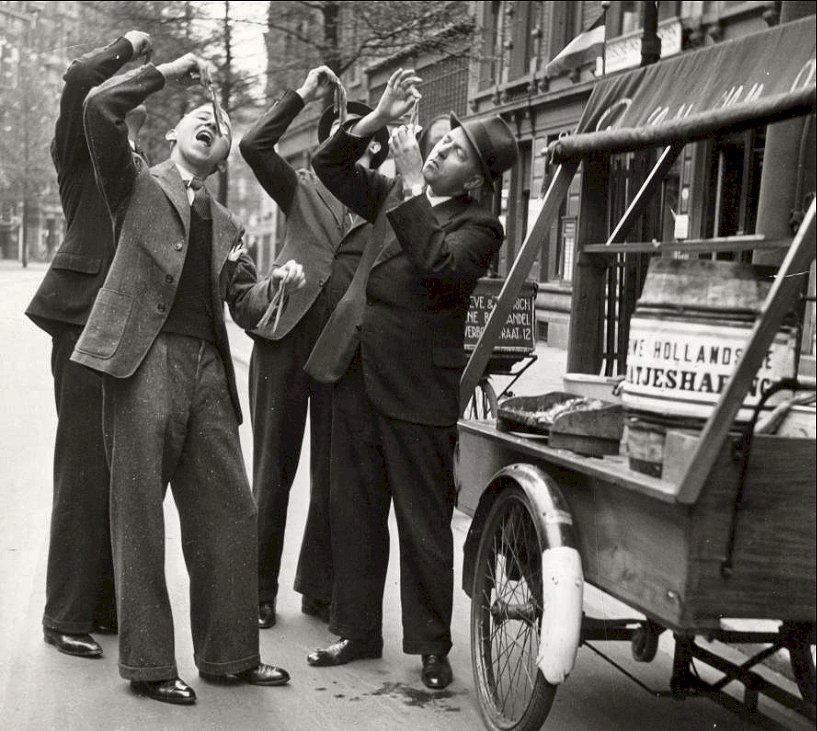
Eating herring the traditional Dutch way.
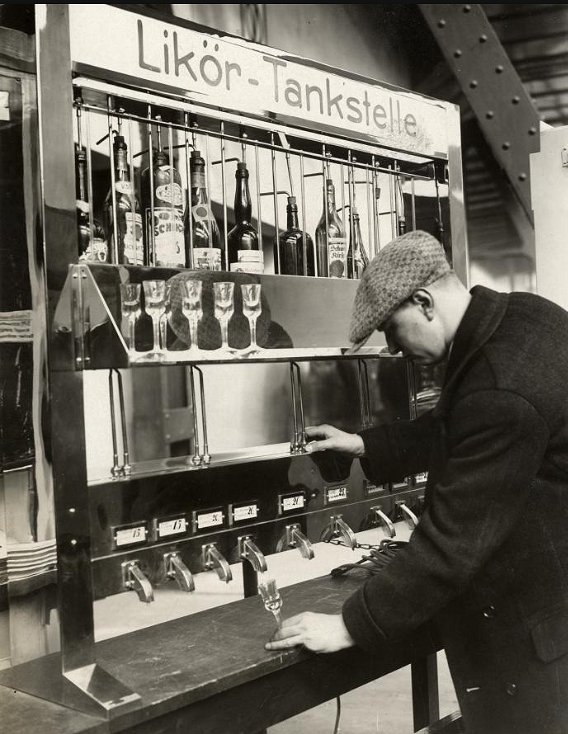
Liquor machine at the Leipziger Messe (Leipzig Trade Fair)

Wednesday July 27th, 1960. The first Irish Troops bound for the Congo marched through Dublin before boarding trucks at Broadstone which transported them to Baldonnell where U.S. Airforce Aircraft flew troops and equipment to the Congo. From “Under the Blue Flag” by Raymond Smyth. This photo and its description by a forumite known as D250 was found here.
Reblogged from Frog Blog because it deserves to be seen.
In 1942, Charles A. Ridley of the British Ministry of Information made a short propaganda film, “Lambeth Walk – Nazi Style”, which edited footage of Hitler and German soldiers from Leni Riefenstahl’s classic Triumph of the Will to make it appear as if they were marching and dancing to the song “The Lambeth Walk”. A member of the Nazi Party achieved attention in 1939 by declaring “The Lambeth Walk” (which was becoming popular in Berlin) to be “Jewish mischief and animalistic hopping” as part of a speech on how the “revolution of private life” was one of the next big tasks of National Socialism in Germany. The film so enraged Joseph Goebbels that reportedly he ran out of the screening room kicking chairs and screaming profanities. The propaganda film was distributed uncredited to newsreel companies, who would supply their own narration. This version is from the Universal Newsreel company: “The cleverest anti-Nazi propaganda yet! You will howl with glee when you see and hear what our London newsreel friends have cooked up for Hitler and his goose-stepping armies. The ‘Nasties’ skip and sway in tune to the Lambeth Walk!”
“Laughter is the greatest weapon we have and we, as humans, use it the least.” – Mark Twain
… I can see him in his small black suit,
Following behind the funeral procession
With his features fixed in a suitable expression. ♬
–That’s Your Funeral, Oliver, London and original Broadway productions
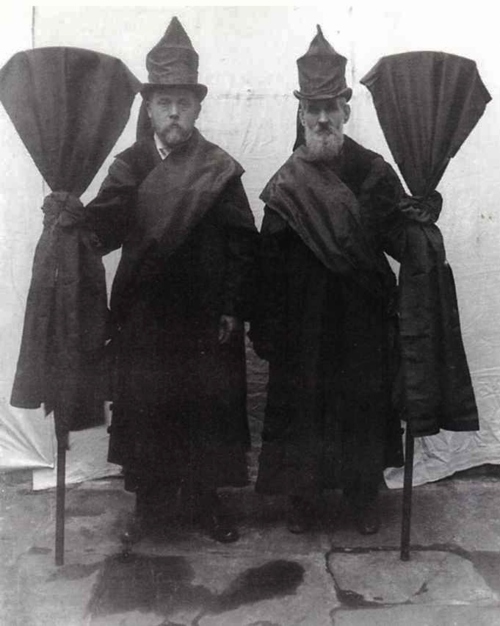
From about 1600 to 1914, there were two professions in Europe now almost totally forgotten. The mute is depicted in art quite frequently but in literature is probably best known from Dickens’ “Oliver Twist.” Oliver is working for Sowerberry’s when this conversation takes place: “There’s an expression of melancholy in his face, my dear … which is very interesting. He would make a delightful mute, my love”. The main purpose of a funeral mute was to stand around at funerals with a sad, pathetic face. A symbolic protector of the deceased, the mute would usually stand near the door of the home or church. In Victorian times, mutes would wear somber clothing including black cloaks, top hats with trailing hatbands, and gloves. (Wikipedia)

Found at Pu(re)blog. Also added this to my own reminiscence of Times Square.
 Playing in the World Game