The Story of Draper Hall at George Washington University

So it turns out that my uncle, Courtney Rogers Draper, had a building named after him for as long as it existed.

Courtney Rogers Draper 150 (2)

The Story of Draper Hall

In the GWU Mail Call, 2 July 1946
Volume 1, No. 3

If you will walk over about a block to 22nd and G streets, you wil notice a two-story barracks-like building that looks uncomfortably like an amputated part of an army camp.

Your first impression will be corrected swiftly, however, when you walk into the spacious inviting lobby, and watch the easy-going, friendly dormitory life that opens out upon it.

No, the Army flavor is all gone. It’s civilian life, and civilian life at its best.

Perhaps that is why it is called Draper Hall. You see, Courtney Rogers Draper typified in his life, as in his death, the finest in American life.

He was the son of a Salt Lake City lawyer, with three sisters, one employed in the office of Gen. Elbert D. Thomas of Utah, here in Washington, and a brother, attending the University of Utah. This was the institution Courtney attended before he came to Washington, and to GWU.

In Washington, he was secretary to Gen. Hugh S. Johnson, administrator of the NRA, and then served as an auditor in the General Accounting Office here.

While working, e received the Bachelor of Laws degree from George Washington Law School in 1937.

In April, 1936, he was appointed as a second lieutenant in the Officers Reserve Corps. Although instructed as an artillery officer, Lt. Draper was assigned as an assistant adjutant at the presidio in San Francisco, upon entering active duty in July, 1941.

In August he was sent to the Philippine Islands attached to the air force, and was at Clark Field at the outbreak of hostilities with Japan.

Captured at Mindanao, where he was in charge of defending forces, Lt. Draper rejected an opportunity to escape and remained behind to attend to the removal of nurses and other flying personnel. He learned the Japanese language and served as prisoners’ liaison officer at Mindanao until 1943 when he was transferred to Cabanatuan, and later to Bilibid.

Courtney Purple Heart

As the steel ring of MacArthur and Nimitz drew ever closer to the Philippines, he was placed aboard a Japanese ship bound for Japan. American fliers sank the vessel in the China Sea in December, 1944. He was 31.

Today, although he is not here to enjoy the fruits of his sacrifice, that spirit in Courtney Rogers Draper which made possible such things as low-cost veterans’ housing and the many other things he would have wanted to see in contemporary America — that spirit is exemplified in the cooperative attitude and the zest for life that you can see in the 126 young fellows who inhabit the 86 rooms of Draper Hall.

Along with Draper Hall itself, the University housing development includes another section of 48 rooms on H. St., as well as a family section, in which ten veterans’ families are living.

This was the first veterans’ housing development of any university in Washington, and its construction was due to the constant cooperation of University authorities with the federal agencies responsible for such developments.

The serious lack of furniture is helped being met by an anonymous gentleman from Virginia, whi is arranging to send up furniture from surplus government vessels.

Draper Hall was demolished in 1956 to make way for newer structures, but during its tenture it bore the name of an honored American soldier.
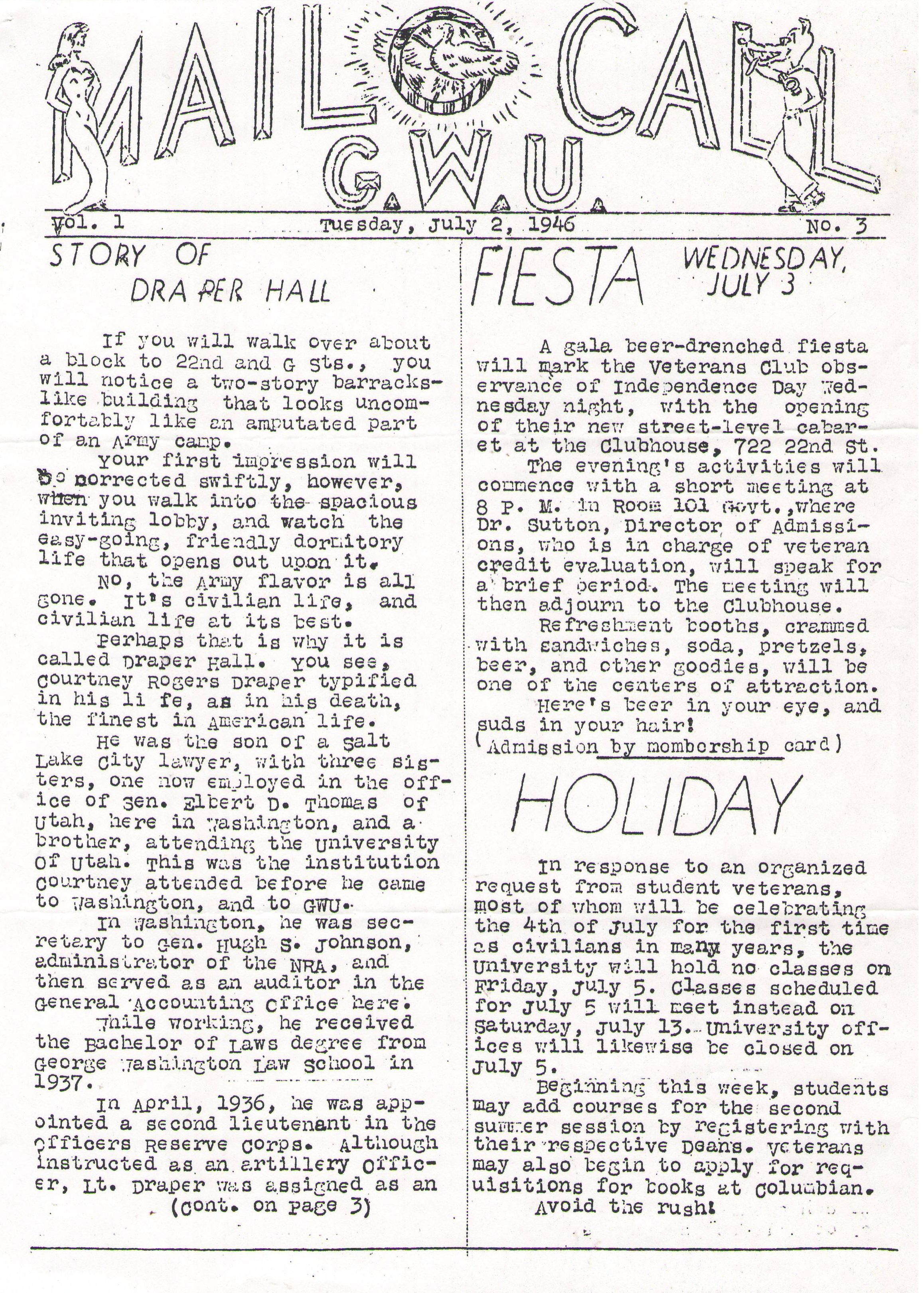
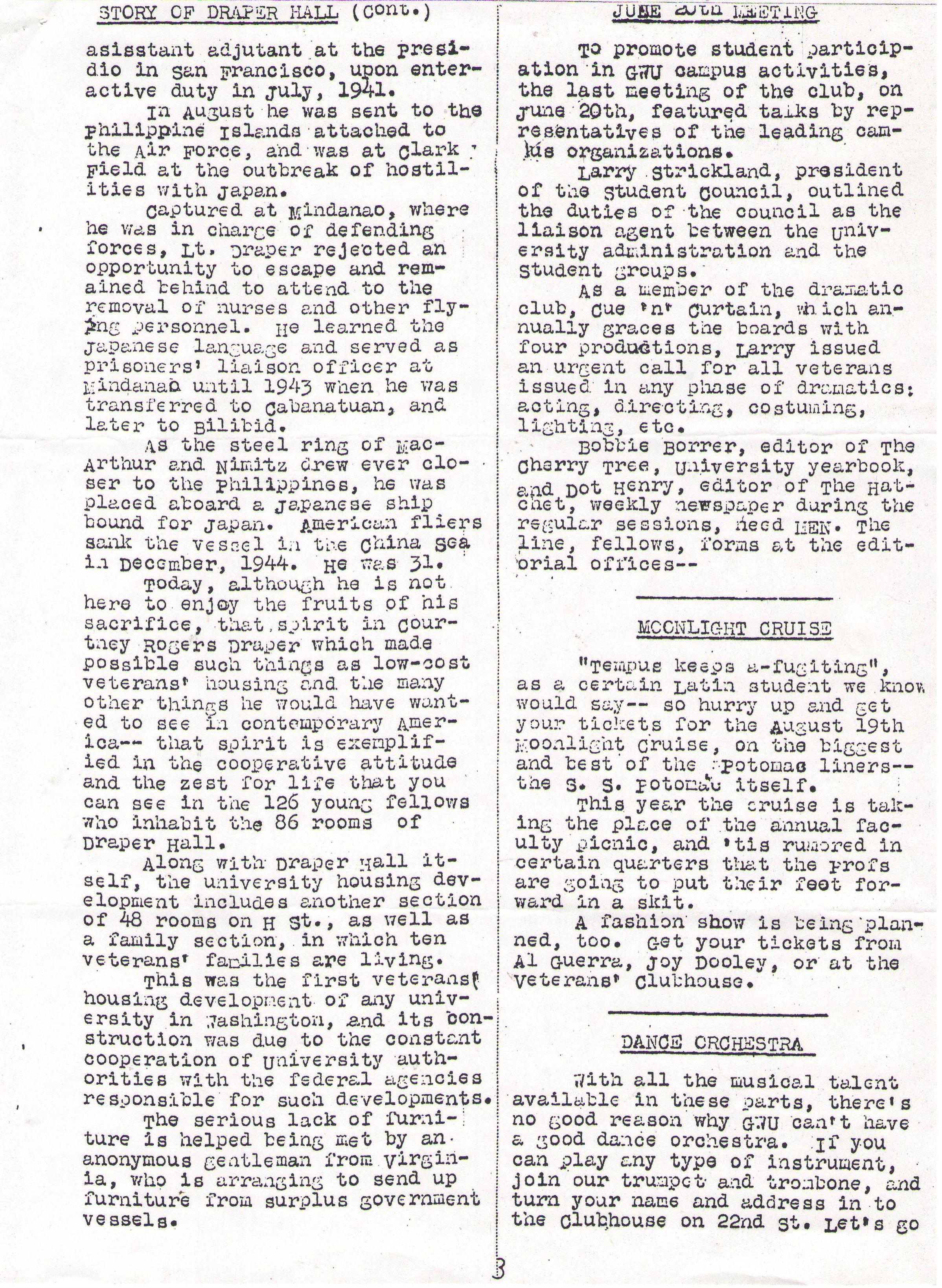
GWU Mail Call 1  GWU Mail Call 2

The GWU Mail Call from 2 July 1946

The Old Wolf has spoken.

1911 – Hot town, summer in the city

maxresdefault

Heat wave in New York. July 6, 1911. “Licking blocks of ice on a hot day.” 5×7 glass negative, George Grantham Bain Collection.

Found at Shorpy.

New York can get blistering hot when a heat wave rolls through. I experienced a number of days like this when I was growing up there. And I’m old enough to remember the ice man with his truck, and an electric crusher on the back so he could deliver chips as well as the blocks.

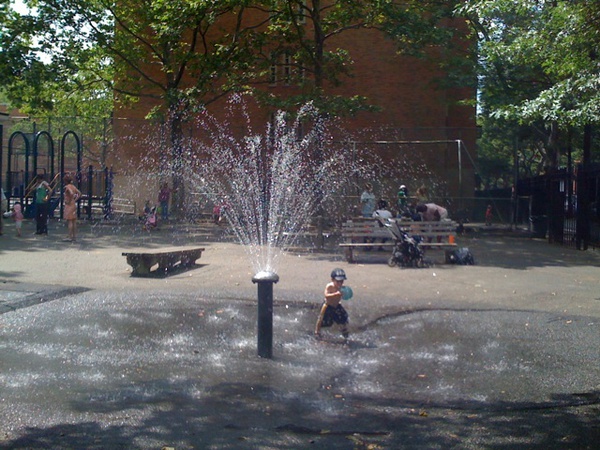
Our neighborhood didn’t get ice deliveries, those were mostly down in the village if I remember correctly. But I do recall that close to my home was a playground with one of these:

sprinklerball

It was a great way to cool off on a hot summer day. I’m glad there are still water attractions around to help kids stay cool in the summer heat.

The Old Wolf has spoken.

100 years of Fashion

Courtesy of MODE, a young lady gets dolled up in the fashions of 100 years’ time. The images of 1955 and 1965 seem frightfully familiar – I have visions of my mother in clothes like this, and I can imagine her in clothing of the previous decades as she set out from sleepy Salt Lake for the jungle of New York to pursue a career as an actress. She seems to have missed the signature looks of subsequent decades, having become by that time a woman “of a certain age.”

1915 1925 1935 1945 1955 1965 1975 1985 1995 2005 2015

The whole video is delightful:

The Old Wolf has spoken.
The Catacomb Saints: How many clickbait titles can you come up with?

From Wikipedia:

Catacomb saints are ancient Roman corpses that were exhumed from the catacombs of Rome, given fictitious names and sent abroad as relics of saints from the 16th century to the 19th century. They were typically lavishly decorated with gold and precious stones.

There’s no question the subject is of some interest to scholars and historians – I’ve seen a few of these in my peregrinations around the world.

5e6e225a-ba61-4cb1-a06e-1391ed1123f8

“Though selling the relics would have been considered simony, enterprising church officials still managed to raise funds while countering the iconoclasm by charging for transportation, decoration, induction and blessing.”

And keeping in mind that fundraising was foremost among church leaders then as now, it’s not surprising that so much effort was put into the preservation and illumination of these relics. Some of the bodies may have been of early Christian martyrs, but none were of any particular religious significance. Dressing them up and giving them the name of a saint, however, was the 16th-century equivalent of The National Enquirer or Buzzfeed.

These relics have been around for a long time, but when the Internet discovers something, it’s often presented as a “stunning new find” or some other silliness – anything to get eyeballs on ads, as you can see below.

Let’s look at the kinds of headlines one sees with a simple search for “Rome jeweled skeletons:”

  • These Skeletons Were Found In Roman Catacombs And You’ll Never Believe What They’re Wearing
  • Unbelievable Skeletons Unearthed From the Catacombs Of Rome
  • Meet the Fantastically Bejeweled Skeletons of Catholicism’s Forgotten Martyrs
  • Beauty from the crypt: Europe’s jeweled skeletons
  • 19 Bejeweled Skeletons That’ll Blow Your Mind
  • Incredible skeletal remains of Catholic saints still dripping in gems and jewellery discovered by ‘Indiana Bones’ explorer
  • Beauty Beyond the Grave: The Story Behind Europe’s Bejeweled Skeletons
  • Secrets of the Catholic Church: Unbelievable Jeweled Skeletons Discovered in the Catacombs of Rome
  • The ghastly glory of Europe’s jewel-encrusted relics
  • THE JEWEL-ENCRUSTED SKELETONS OF ROMAN MARTYRS
  • The Catacomb Saints – So-Called Saint Skeletons Dressed in Jewel-Encrusted Gold and Silver
  • Skeletons Unearthed From The Catacombs Of Rome Have Jeweled Beards
  • Bones with Bling: The Amazing Jewelled Skeletons of Europe

As mentioned above, many of the referenced articles try to make it appear as though these relics were just recently discovered.

Click through for a collection of these images.

PS: if you do this, screw you. (Text like this often appears when you copy and paste from a website):

Read more: http://www.dailymail.co.uk/news/article-2413688/Incredible-skeletal-remains-Catholic-saints-dripping-gems-jewellery-dug-Indiana-Bones-explorer.html#ixzz3cyd8uT2J
Follow us: @MailOnline on Twitter | DailyMail on Facebook

This is the 21st century equivalent of blinking text. It’s annoying, no soul in their right mind would ever incorporate it into a cross-post, and it’s a waste of everyone’s time.

The Old Wolf has spoken.
1935: Outside Water Supply in DC

DC

July 1935. “Outside water supply, Washington, D.C. Only source of water supply winter and summer for many houses in slum areas. In some places drainage is so poor that surplus water backs up in huge puddles.” These municipal water taps (or pumps — they have crank handles) appear in several photos from this series. I wonder if any survive. 35mm negative by Carl Mydans

Found at Shorpy

New York, 1905

1ww6eLj

WordPress is strange; I realized I had gotten the date wrong on this photo in my previous effort; I could update the post, but the URL stayed the same and included the wrong date, so I had to trash the original post and start again.

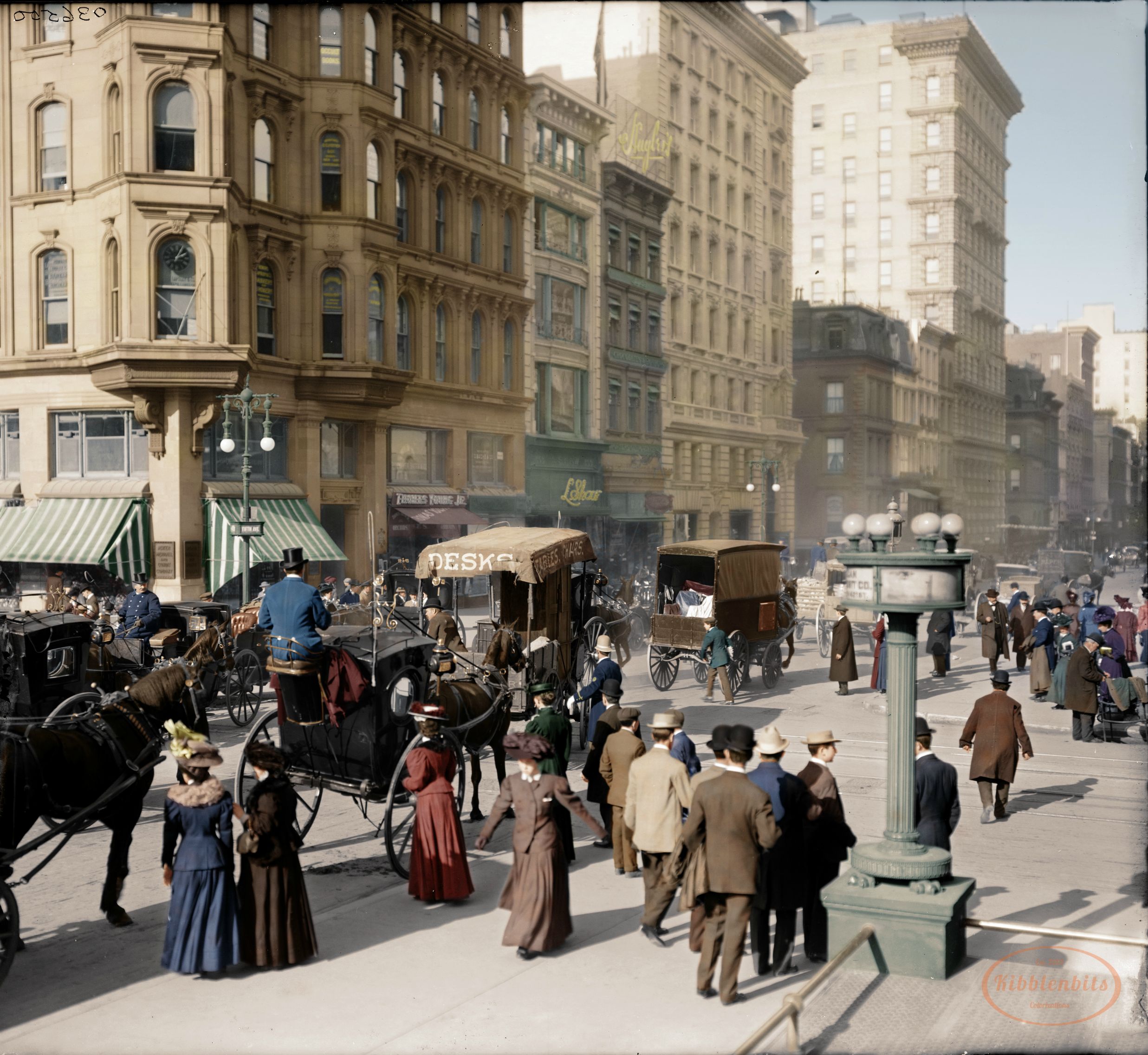
This photo was colorized by redditor /u/kibblenbits, one of the best colorizers out there. I love historical photos of New York – this one would have been taken 4 years before my father was born.

The Old Wolf has spoken.