Refugees and the bar fight: a brilliant analysis

Shamefully purloining this essay from Emlyn Pearce, because it deserves to be more widely understood.


So a lot of British people seem to be wondering why refugees don’t stay in their own countries and take up arms to defend themselves (“…like the British did during the Second World War!”). Don’t get me wrong, I find it quite endearing that your Average Joe thinks he and his mates from Tuesday night five-a-side could put together a viable army, but maybe joining a thirteen-year-old civil war is a bit more complicated than an Inbetweeners movie. Let me explain.

Have you ever been in a pub when a group of drunk guys starts going berserk, drinking everyone’s drinks and punching people in the face? The rest of the patrons come together, over-power and restrain the troublemakers; the police are called and they are taken away to face the music. That’s World War II: everyone in the pub is on the same side and there is a clear set of bad guys ruining the 1940s for everyone else (incidentally, there’s also a guy who offers to hold everyone’s coats and money when the fight breaks out, and when it stops he won’t give them back – that guy is Switzerland’s banks).

Now, consider Syria. You’re sitting in the pub with your family having Sunday lunch when suddenly you hear someone at the bar say they’ve been short changed. In response, the bar staff open fire with automatic weapons and kill sixteen people. You’re horrified – in all the years you’ve been coming to this pub, knowing they’ve been short changing people, you never imagined they’d do something like this. You manage to barricade yourself behind an upturned table in the corner, and just when you think things can’t get any worse, a bunch of thugs from the rough pub next door hear there’s some trouble and decide to use the opportunity to take over the pub and make it as lawless as the one they’ve come from (where people have been brawling non-stop for the best part of a decade). There are bullets flying past your little shelter and blood and bodies litter the floor.

Whose side do you join? The bar staff who started the whole thing by killing the people they were supposed to serve, or the thugs from next door who want to hold you all hostage and make you join a death cult? LESSON NUMBER ONE: NOT EVERY WAR HAS A SIDE WORTH JOINING.

So you start your own army, right? This is an excellent idea – well done for taking the initiative! But exactly how do you start an army anyway? First, you find some like-minded people. So you turn to the guy next to you who’s barricaded himself and his family under a table and ask if he has any weapons.
“I’ve got my car keys and a bottle opener from a Christmas cracker,” he says. “The thing is, I was only planning a pub lunch with my family, I didn’t realise we’d get caught up in a gun fight, otherwise I suppose I would have been training and stockpiling guns for years.”
LESSON NUMBER TWO: STARTING AN ARMY IS REALLY, REALLY HARD.

This is tricky. Very tricky. You decide to try and phone the other pubs in the area to ask for help, but they don’t know who you are, and ever since they helped a bunch of patrons in the 80s who ended up flying planes into pubs, they’re pretty reluctant to help random groups they’ve never heard of.

So you just sit it out and wait for everything to blow over, right? After all, you’ve heard of other pub fights where the bar staff were beaten in minutes (The Sphinx & Pharaoh, the Crazy Colonel), but it gradually becomes clear that this one won’t burn out so quickly. You could crawl out and grab a gun, but that leaves your family completely exposed with nobody to defend them. With every minute that passes, the situation gets more terrifying. Maybe you could chisel a pretty cool spear out of a table leg if you had a few weeks, but right now your children are screaming with terror, begging you to stop the banging and the sounds of people screaming, but you can’t. There’s nothing you can do.

Suddenly, across a sea of broken glass and empty shell cases, you see the door to the street swing open. There isn’t even time to think: you grab your children, the most precious things you have in the world, and you run for the exit.

You stumble into the street, where a crowd has gathered to gawp at the carnage through the windows. As you get to the exit they try to push you and your children back into the pub.
“Go back where you came from!” they say. “You’re one of those thugs from the rough pub and you want to bring your violence out here into the street! Shame on you for dragging your children through all that broken glass!”

You manage to get through the crowd to the Queen Elizabeth pub down the road, which you’ve heard is a really safe, family-friendly pub where the staff treat their patrons with respect. But when you get to the Queen Elizabeth, you’re told by a security guard that there’s nowhere to sit because there are too many people already, even though it’s clear that the only reason there’s nowhere to sit is that the people who own the pub haven’t provided enough chairs. There are also loads of coats that have been put on chairs by older people who want to supplement their wine consumption by making youngsters buy them a drink in exchange for somewhere to sit.
Finally, with the help of some sympathetic staff, you find a chair in the corner by the toilets, and you put the kids on the chair while you lean against the wall, exhausted. People start accusing you of ruining the pub for everyone else, even though they were short of chairs long before you arrived. That’s when some guy with a big sweaty face who’s never been in a pub shooting, never feared for his children’s lives, never even seen a gun or a hand grenade, comes up to you and asks why you’re not in the other pub sorting out the massacre you’ve just fled from.
And that’s when you finally break down and cry.

IN TODAY’S EPISODE WE LEARNT…
In Britain, we tend to think of every war as a two-sided battle between good and evil, with an established system on the side of good which is able to organise and direct an army. As a nation, we have no easy frame of reference for wars with many factions, or wars where the government is fighting the people, or civil wars where the enemy is present not just in the air, but on the ground too. Contrary to popular belief, Britain DID produce a flood of refugees during World War II: 3.5 million British refugees fled their homes, but because the war was an international war, with no successful invasion, no enemy boots on the ground and aerial bombardment focused on cities, the vast majority of those refugees went to the British countryside. Had the Germans invaded and started killing Britons on the ground, it’s likely we would have seen an even greater exodus to countries like Australia and Canada than the one we did see: not because fleeing from genocide is cowardly, but because self preservation is deeply ingrained in human nature. Risking your life by crossing a treacherous sea to escape a war that is not of your doing is infinitely more heroic than selling out your principles to fight for a mad dictator or a death cult; and unless you’ve ever fled a tangled civil war yourself, it might be wise to put a little less effort into judgement and a little more into understanding.


Here in the United States, we’re not facing the flood of refugees that Europe seeing, but the understanding is important anyway.

The Old Wolf has shared.

Poland House Antiques – A recommendation, with a caveat.

20151205_153905

Driving back from visiting the Shaker Christmas Fair at Sabbathday Lake in Maine today, we decided to stop in at the Poland House at 338 Main Street in Poland.

My senses were overwhelmed. I have never been in a more crammed, crowded, and fascinating panoply of home decor both old and new. Every single nook and cranny in that old home was stuffed to overflowing with things to look at and covet – one example below, which doesn’t do the place justice:

20151205_153335

I loved so many things, and wished I were richer than Crœsus so I could decorate my own home with some of these treasures.

20151205_153438

An adorable mini-nutcracker stand.

But beware: my enjoyment of the atmosphere was soured like vinegar added to milk – read below the review I posted at Yelp:

I was totally gobsmacked by the incredible selection of stuff (we came at Christmas time, the atmosphere was mind-blowing.) Much of it was new, but there were a lot of really, really cool antiques. As I was leaving I asked the proprietor if this was how it looked after the Christmas season, and he said, no, he takes it all down by himself and replaces it with the antique stuff.

Then he saw my phone out and asked, “You weren’t taking pictures, were you?” I said, “Yes, isn’t that all right?” He replied, “No. People who come in and take pictures without asking are beyond me.”

Fine, dingaling. You may think that owning a half-million-dollar house stuffed to the gills with millions of dollars worth of inventory makes you better than everyone else, but here’s a couple of tips:

  1. If you don’t want people taking pictures, post a sign on your door to that effect.
  2. If someone happens to be taking pictures, you could ask them politely not to – something like “I appreciate your coming in, but I’d prefer you not take pictures.”
  3. Don’t make people feel like an idiot. I was taking photos to show everyone what an amazing place you run. Instead, you get one measly star for being a turdcasket.

So if you like lots of amazing knickknacks and decorative stuff, by all means shop here. The prices are not too outrageous, some of them seemed quite reasonable. But be warned – the proprietor doesn’t give a rat’s south-40 for his clientele.

It’s clearly not just me: have a gander at this review left by another Yelper, Marie H, on September 7th:

Well I didn’t get very far although the shop looks interesting. I chose to take a bike ride and stopped there to look around. The guy was outside and never said hello, just” you’re not going to carry much with that!” Eying my bike. Against my better judgment I walked in the entryway and started looking. He said ” can’t be too healthy doing that on a day like this. ( he could use some pedaling). The atmosphere really felt hostile to me so I left. He said ” that it?”
Will never go in there again

Every moment is a choice, and every choice has prices and benefits. Treat people well, and they’ll come flocking to your door. Treat them like dirt, and they’ll never come back.

The Old Wolf has spoken.

Gender Bias in the Workplace – an evolving Metastudy

I’m sharing this because it needs to be shared. (The link to the relevant article is at the end.)

  • It’s intriguing and well-considered, and does its best to bring all variables under one umbrella
  • It makes nothing cast-in concrete, but rather presents a wide range of data, reaches certain conclusions, and keeps the door wide open for future modifications based on future data.
  • It shows that feminists today are both brilliantly right and stubbornly wrong, and suggests an alternative course of action for crossing the finish line.
  • It leaves out one glaring variable, although this is probably an oversight because it’s assumed to be obvious: This data is relevant only for America, and other countries’ mileage may vary – although similar meta-studies could be done by interested parties.
  • And, it’s by Scott Adams, the author of “Dilbert” – someone who is not a social scientist, but a man who seems keenly interested, at his core, in a world of fairness that works for everyone.

Here, from my own perspective, is the TL;DR for the entire post (but I highly recommend reading and considering the whole thing):

Feminism currently sends this message to young girls: The world is full of gender bias and male privilege. If you are born a woman, you are a second-class citizen. Adult women are failing to achieve equal pay with men.

Compare that to a message that is just as consistent with the available data but to me sounds more positive: Despite thousands of years of gender bias, women are succeeding in every field that interests them. The gender pay gap has shrunk to the point where we can not identify gender bias as a cause. You are all winners. And all paths are open.

Feminists, I think it is time to take a bow. You won. And the world is a far better place for your efforts. I think I can speak for all men who have mothers, sisters, female friends, female spouses, and female lovers when I say, “Thank you.”

But I also say maybe it is time to stop fighting the last war and adjust your strategy to reflect the reality in 2015.

Adams’ presentation is lay in nature but very unbiased in spirit. His conclusions and the presentation of the data used (summarized at the end of his article, by category) are out there for anyone to review and consider. He has attempted to consider all possible variables, and admits that there are many he hasn’t even touched. And everything he says strikes me as being supremely rational.

There will be feminists out there who snort derisively and dismiss this study because they are convinced that all men are worthless, evil piles of camel ejecta who must be punished, punished, punished! for centuries of patriarchal oppression. These do no good for themselves or for a push toward human equality, and can be safely dismissed.

There will be scientists out there who snort derisively and dismiss this study because it was done by someone unqualified – such is the bane of the ivory tower. Let them do their own studies and come up with something better. That’s how science – even social science – is supposed to work. But I tell you this – I’ve never seen a more honest attempt to be comprehensive and complete and fair.

☛ Now, go and read. ☚

The Old Wolf has spoken.

Twisting reason – the false logic of desperate atheists and insecure believers

This image recently popped up on my Facebook feed, and I found it disturbing.

11044560_10153100276521605_6200623964597898679_n

Accompanying the image was the exposition,

“He either exists but can’t, in which case he’s not omnipotent, or he exists but won’t, in which case he’s not benevolent, or he plain and simply doesn’t exist.”

I’ve seen that before elsewhere; there’s a fallacy in there, one which many atheists seem to miss. I am reminded of a young Corrie Ten Boom, who asked her father what “sexsin” was. The father kindly asked her to carry his suitcase; upon trying, she found it far too heavy. He explained to her that like suitcases, some knowledge was too heavy for a child to carry, and asked her to trust him with it until she was older. She was satisfied.

Humanists who are bound and determined to disprove the existence of God, and show by demonstration that people of faith are fools, or benighted, or willfully stupid, often do so by attempting to shove God into a human box, as if they in their wisdom understand all there is to know about the human experience. They smugly postulate that if they would do X and God doesn’t, therefore God does not exist. I recall another recently-posted quote from Tracie Harris:

“You either have a God who sends child rapists to rape children or you have a God who simply watches it and says, ‘When you’re done, I’m going to punish you.’ If I could stop a person from raping a child, I would. That’s the difference between me and your God.”

Now this particular quote was directed at a degraded evangelical turd who put out there that raped children are “evil” and hence deserving of whatever they get; it’s easy to understand why in the heat of outrage over such an ignorant premise that someone might say something of that nature. But the quote annoyed me because it sets up the same false dichotomy – that God is somehow equal to humans and subject to the same rules and logic as humans are.

The picture itself is a perfect example of this compulsion by the atheist community to belittle people of faith at every turn. Showing the amazing and impressive ability of technology to improve the lives of people and raise the human conditon is a wonderful thing. Turning around and attaching a cheap shot at people of faith detracts from the message.

The same argument can be applied to people of faith, and most particularly evangelical Christians who condemn every unbeliever and agnostic (as well as the rest of the believing community who don’t happen to believe in exactly their version of whatever) to an eternal Hell, as though they had the authority to do so.

Oh & that’s why science has cured cancer right? I (along with a few other friends) prayed over someone who had pollups (sic) & the next week (without any medication) his pollups were gone.. I don’t see science doing that. The only reason some science works is because God wills it to. Science can’t heal a broken heart, nor can it comfort those who need comfort or save your soul or give you eternal life. When you die, you call out to science… & see where you end up. Until then I’ll be praying for all of you who are unsaved.

This quote is filled with so much wrong that I don’t know where to begin, so I’ll just let it speak for itself.

Now, the picture above was posted by an intelligent and respected friend. He, and everyone else, is free in this world to believe in something metaphysical or not.But in the name of whatever you consider holy, be it some deity or the amazing power and creativity and goodness that can be found in humanity, stop taking pot shots at each other. It helps nothing, it convinces nobody, and it just ends up polluting the social environment and making everyone who does so look petty and vindictive.

Mohandas Gandhi is reputed to have said, “Be the change that you wish to see in the world.” This is good advice, regardless of which side of the theological issue you happen to fall on.

The Old Wolf has spoken.2


1 Oh, wait, I’m forgetting about people who flog and decapitate unbelievers. Well, in most places in the civilized world, then.

2 I hate theological/political/scientific debates. As a result, I have disabled comments for this post. If you have a position to espouse, post it in your own blog. If it has merit, if it lifts me and inspires me to do better and help others and raise the human condition even more, I’ll consider it.

Why I love reddit

Yes, it can be a tar pit of trolls and Not Safe For Work posts, but if you arrange your settings to filter out the garbage, it’s also an amazing community.

Example 1:

  1. User /u/thespite posts a clever way to send a holiday greeting using Google Maps. You can try the Holiday Message yourself.
  2. User /u/benlaor tries it, and discovers a picture of his beloved dog of blessed memory. He wrote: “Thank you, thank you, thank you for this. You don’t understand what happened because of this video.I have never looked at my house on street view before (strange, huh?). This was the first time. The images for Israel are a few years old, probably around 5 years in most cases.

    At the end of the video it lets you just look around freely. I look around my house, look over at my parking stop, and there he was. Lazying about in the sun was my plump little fatass of a dog, who was my favorite thing in the world until he died a few years ago. I have almost no pictures of him due to my not backing anything up and my HDD being destroyed in a power surge.”

  3. User /u/jangoo identifies the location.
  4. User /u/thespite extracts a high-res image
  5. User /u/fatty_tines creates a lovely color drawing of the dog.
    tS2shSI
  6. Tears all around.

Example 2:

  1. User /u/LE_POOR_MERIT has a teenaged son who does an awesome drawing entitled “Who Dares Summon Chrismotron?”
    egQ6lO5
    ©2014 “Unknown ben LE_POOR_MERIT”
  2. User /u/pohjankonna, a freelance artist from Finland, does an amazing digital rendering of the drawing
    Chrismotron
    ©2014 Pekka Veikkolainen
    and makes this offer: “You have of course the permission to print & frame it, after all I took the original without asking first! I do have a slightly larger version that I can send you. Better yet, I could also send you the original Photoshop file with all the different layers on it, if your son would be interested in deconstructing the painting to see what it’s actually made of (kind of a step-by-step view to creating a digital painting).”
  3. Tears all around.
  4. For those interested, a wallpaper version.

Keep in mind these people don’t know each other from Adam’s off ox. They’re just regular people being awesome to one another for no good reason, which is what the best of humanity is all about. Also, these are only two recent examples; similar things happen all the time on reddit. It always lifts my spirits to read about one.

The Old Wolf has spoken.

A gift from God


I consider all food a gift from God, but when you go into your garden and pick things you’ve grown yourself, it seems an occasion for extra gratitude: free food from the ground.

20140826_102216-1

20140913_192837


Those of my friends and family who are of the atheist/agnostic tradition look at such things as an outgrowth of evolution, which is fine; on one level, that’s correct. But seeing such bounty merely in such terms leaves me with a sense of emptiness, of incompleteness. If there’s nothing but random chance and selective breeding and survival of the fittest, then there’s no one to thank for these gifts.

One take on gratitude was famously given by “Charlie Anderson” in the movie Shenandoah, played by James Stewart:

“Lord, we cleared this land. We plowed it, sowed it, and harvest it. We cook the harvest. It wouldn’t be here and we wouldn’t be eating it if we hadn’t done it all ourselves. We worked dog-bone hard for every crumb and morsel, but we thank you Lord just the same for the food we’re about to eat, amen.”

It is certain, we wouldn’t have food in the stores if it weren’t for the backbreaking and often poorly-compensated work of farmers and laborers, but if it weren’t for the sun and the rain and the soil and the seeds and the wind and the pollinators, there would be nothing at all. So I often remember to thank the Lord for the work of everyone along the supply chain that brought dinner to my table, but recognize Him as the ultimate source of all goodness.

That’s just how I roll.

The Old Wolf has spoken.

A World of Villages

31uefwI

“Dusk”: Iran – Photo by Mohammadreza Momeni. Found at 500px.

fuWZV

This appears to be another view of the village above.

i21_RTR2MADH

A view of Palangan village in Kurdistan province, about 660 km (412 miles) southwest of Tehran, on May 11, 2011. Iranian Shi’ite and Sunni Kurds live in harmony with each other in Palangan, although Sunni is the religion of the majority of the people. (Reuters/Morteza Nikoubazl) Found at The Atlantic (that article is worth a look).

jvIV2jch

Masouleh Village in Alborz mountains, Gilan Province (Northern Iran). Found at reddit.


3pDZ5lD


Mountain village in Tibet

People live in amazing ways and in amazing places. To those of us accustomed to our own comfortable dwellings, it may seem mind-boggling. To them it’s just another Wednesday.

The title of this post was taken from this book, written by a man with whom I attended elementary school back in the Pleistocene era. A review from Library Journal:

The commonly heard phrase that a writer has “put a lot of himself into the book” is especially apt for describing Schwartz’s six-year journey through Africa and Asia. In that time Schwartz managed to get into the most obscure places imaginable and amazingly get out alive and intact. During much of his odyssey he had little or no money, so he slept on sand, floors, or in parking lots and ate whatever portion of the lo cal fare the natives whose languages he seldom understood tossed his way. The most wonderful thing about the book is the innocence Schwartz preserves despite the dangers. However the locals react to him, Schwartz makes the best of it and continues with his careful observations. He has written a really memorable book about them and himself. Laurence Hull, Stanly Cty. P.L., Albemarle, N.C.
Copyright 1986 Reed Business Information, Inc.

The Old Wolf has spoken.

The Journey to Ethical Capitalism

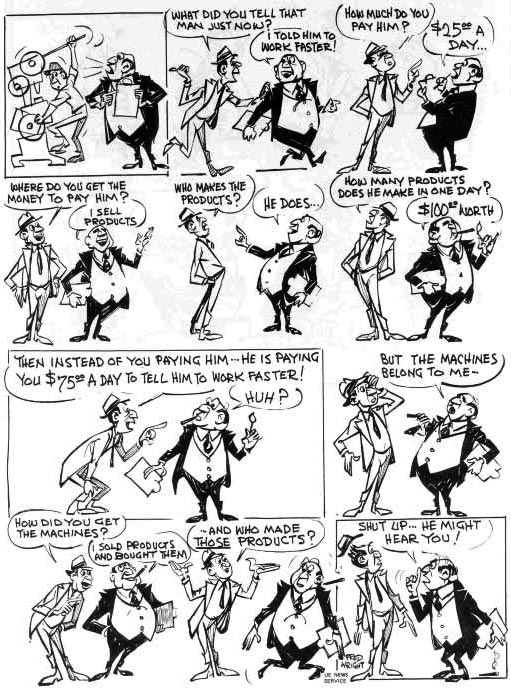
A friend of mine posted the following image on Facebook, which got me thinking. And when I think, I have to write. Sorry.

To most of the world, the words America and Capitalism are synonymous. While we no longer look for Bolsheviks under our beds at night and the McCarthy era is thankfully over, there is still a cachet of disrepute about anything that seems remotely connected with the idea of socialism – one example that has long dwelt in my files is “The (Modern) Little Red Hen,”  originally Prepared by the Pennwalt Corporation and published March 1983:

Once upon a time there was a little red hen which scratched around the barnyard until she uncovered some grains of wheat. She called her neighbors and said, “If we plant this wheat, we shall have bread to eat. Who will help me plant it?”

“Not I,” said the cow.
“Not I,” said the duck.
“Not I,” said the pig.
“Not I,” said the goose.

“Then I will,” said the little red hen. And she did.

The wheat grew tall and ripened into golden grain.

“Who will help me reap my wheat?” asked the little red hen.

“Not I,” said the duck.
“Out of my classification,” said the pig.
“I’d lose my seniority,” said the cow.
“I’d lose my unemployment compensation,” said the goose.

“Then I will” said the little red hen. And she did.

At last it came time to bake the bread. “Who will help me bake the bread?” asked the little red hen.

“That would be overtime for me,” said the cow.
“I’d lose my welfare benefits,” said the pig.
“I’m a drop-out and never learned how,” said the duck.
“If I’m to be the only helper, that’s discrimination,” said the goose.

“Then I will,” said the little red hen. And she did.

She baked five loaves and held them up for her neighbors to see.

They all wanted some and, in fact, demanded a share. But the little red hen said, “No, I can eat the five loaves myself.”

“Excess profits!” cried the cow.
“Capitalistic leech!” screamed the duck.
“I demand equal rights!” yelled the goose.
And the pig just grunted.

And they painted “unfair” picket signs and marched around the little red hen, shouting obscenities.

When the government agent came, he said to the little red hen, “You must not be greedy.”

“But I earned the bread,” said the little red hen.

“Exactly,” said the agent. “That’s the wonderful free enterprise system! Anybody in the barnyard can earn as much as he wants. But under our modern government regulations, the productive workers must divide their product with the idle.”

And they lived happily ever after, including the little red hen, who smiled and clucked, “I am grateful. I am grateful.”

But her neighbors wondered why she never again baked any more bread.

Dr. Adrian Rogers, Southern Baptist pastor and conservative author, offered up this oft-quoted gem of wisdom:

“You cannot legislate the poor into freedom by legislating the wealthy out of freedom. What one person receives without working for, another person must work for without receiving. The government cannot give to anybody anything that the government does not first take from somebody else. When half of the people get the idea that they do not have to work because the other half is going to take care of them, and when the other half gets the idea that it does no good to work because somebody else is going to get what they work for, that my dear friend, is about the end of any nation. You cannot multiply wealth by dividing it.”

Rogers makes some valid points about taxation and how government is funded, but the quote most often appears in partisan screeds inveighing against the evils of forced income distribution (supposedly demanded by Democrats and other evil, liberal sectors of society.) But as convenient and gratifying as it may seem to take from the rich (who of course, have far more than they need) and to give to the poor (who are poor through no fault of their own, but rather because of the greed which festers in the corporate heart), taxing the pants off the 1% to give to the rest of us is not the idyllic answer that many would assume. A comprehensive solution is much more complex.

As the above cartoon illustrates, all is not well in the world’s greatest bastion of free enterprise. Despite quotes such as a recent one from Jon Voigt, to wit: “Capitalism is the only truth that keeps a nation healthy and fed,” as early as the end of the 19th century people were looking critically at the mechanisms we have developed to drive commerce and enterprise:

I heard the following story some time ago, and it’s always stayed with me.

The Fisherman

Author: Unknown

A boat docked in a tiny Mexican village. An American tourist complimented the Mexican fisherman on the quality of his fish and asked how long it took him to catch them. “Not very long,” answered the Mexican. “Why didn’t you stay out longer and catch more?” asked the American. The Mexican explained that his small catch was sufficient to meet his needs…and those of his family.

The American asked, “But what do you do with the rest of your time?” “I sleep late, fish a little, play with my children, and take a siesta with my wife. In the evenings, I go into the village to see my friends, have a few drinks, play the guitar, and sing a few songs … I have a full life.” The American interrupted, “I have an MBA from Harvard and I can help you! You should start by fishing longer every day. You can then sell the extra fish you catch. With the extra revenue, you can buy a bigger boat.”

“And after that?” asked the fisherman.

“With the extra money the larger boat will bring, you can buy a second one and a third one and so on until you have an entire fleet of trawlers. Instead of selling your fish to a middle man, you can then negotiate directly with the processing plants and maybe even open your own plant. You can then leave this little village and move to Mexico City, Los Angeles, or even New York City! From there you can direct your huge new enterprise.”

“How long would that take?” asked the fisherman. “Twenty, perhaps 25 years,” replied the American. “And after that?” the fisherman asked.

“Afterwards? That’s when it gets really interesting,” answered the American, laughing. “When your business gets really big, you can start selling stocks and make millions!”

“Millions? Really? And after that?”

“After that you’ll be able to retire, live in a tiny village near the coast, sleep late, play with your children, catch a few fish, take a siesta with your wife and spend your evenings drinking and enjoying your friends.”

  This is called “looking beyond the mark.”

In the headlong rush to profit from production, the corporate world somewhere lost sight of the fact that their producers were human beings who also needed to support themselves and their families:

Only one thing counted: the bottom line. MBA’s, CPA’s, and a whole plethora of alphabet-soup degrees became de rigeur in corporations, with the most successful being the ones who could trim the most fat from expenses, often at the expense of the very people who were creating the value.

For obvious reasons, these individuals often became the least popular in the company:

26174.strip

Scott Adams, Dilbert

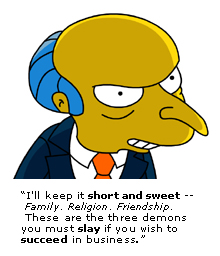
Taken to its unpleasant but logical extreme, we end up with CEO’s and board members like this:

I once worked for a man who thought exactly like this. He came to our company from Hewlett Packard, and was probably the most evil individual I have ever had the misfortune of working for, a two-bit golf hustler who had parlayed his ability to manipulate people into a position of responsibility. [1] He used almost the same words when he told me he wanted me to spend less time with my church and my family, but I refused to kowtow and lick his boots. When, out of spite, he told me I needed to start working evenings and weekends, I told him, in so many words, to screw himself with a cactus. It was expensive for us, because the job had involved an overseas move, but it ended up costing the company because I sued their asses for breach of contract and they settled. Called my suit a “nuisance,” but they settled anyway. Although I have always tried to avoid Schadenfreude, I was quite gratified to hear that several months later, this bottom-feeder was terminated for malfeasance. And, it wasn’t too much later that the entire company went belly-up and was absorbed by a larger entity.

The news today is not good. The US has outsourced the majority of its well-paid manufacturing jobs to places like China and Pakistan and Madagascar. Few companies are hiring full-time employees; most are relying on temps or temp-to-hires, keeping hours below 30 hours a week to avoid having to provide benefits. For reasons incomprehensible companies still demand 110% effort and employee loyalty, even though they are not willing to reciprocate with job security or any sense of value toward their staff.

One of my favorite quotes from the Star Trek universe comes from  Jean-Luc Picard in “Star Trek – First Contact”:

The economics of the future is somewhat different. You see, money doesn’t exist in the 24th century… The acquisition of wealth is no longer the driving force in our lives. We work to better ourselves and the rest of Humanity.

In the framework of today’s economic environment, this dream seems about as attainable as replicators and holodecks – but there are some bright spots among the gloom, companies who are doing their best to buck the trend; companies like Costco have understood that treating their employees well is not an expense but rather an investment.

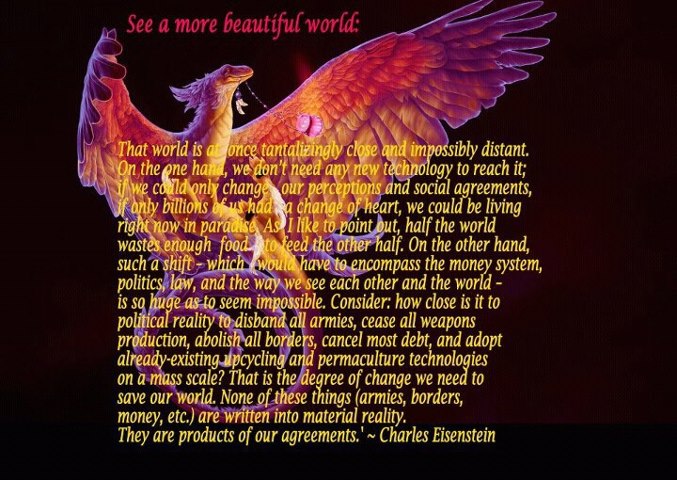
The creation of an economy based on the principle that people are more important than profits, while still recognizing that commerce is what drives the creation of wealth, is something that will require changes far beyond the confines of the boardroom. An excellent examination of how to work toward Ethical Capitalism is found at Common Dreams, which article I heartily recommend.

While the world of unbridled capitalism advances to the beat of “It’s not enough for me to win, everyone else has to lose,” other voices are becoming louder; the concept of degrowth [2] is looking more viable when compared to the alternative.

541869_273680836101555_1066674228_n

Glutting the smallest segment of society on the labors of the rest of us is a model that will ultimately implode under the weight of its own inequity; it cannot endure. As impossible as it might seem to restructure society in such a way that we build a world that works for everyone, with no one left out, it is morally imperative. As human beings we owe it to one another to give our fellow sojourners on this spaceship earth a fair shake. Any other course of action will have repercussions, even for the supposed “winners,” that will diminish us all.

In light of the above, I’d like to offer my own, slightly-modifed version of the first cartoon above:


The Old Wolf has spoken.


[1] If anything he said could be believed; in addition to his other scintillating qualities, he was without question a pathological liar.

[2] Degrowth … is a political, economic, and social movement based on ecological economics and anti-consumerist and anti-capitalist ideas. Degrowth thinkers and activists advocate for the downscaling of production and consumption—the contraction of economies—arguing that overconsumption lies at the root of long term environmental issues and social inequalities. Key to the concept of degrowth is that reducing consumption does not require individual martyring and a decrease in well-being. Rather, ‘degrowthists’ aim to maximize happiness and well-being through non-consumptive means—sharing work, consuming less, while devoting more time to art, music, family, culture and community. (Wikipedia)

♫ We’re merely soldiers in petticoats…

n9M1xcr

… dauntless crusaders for women’s votes! ♫

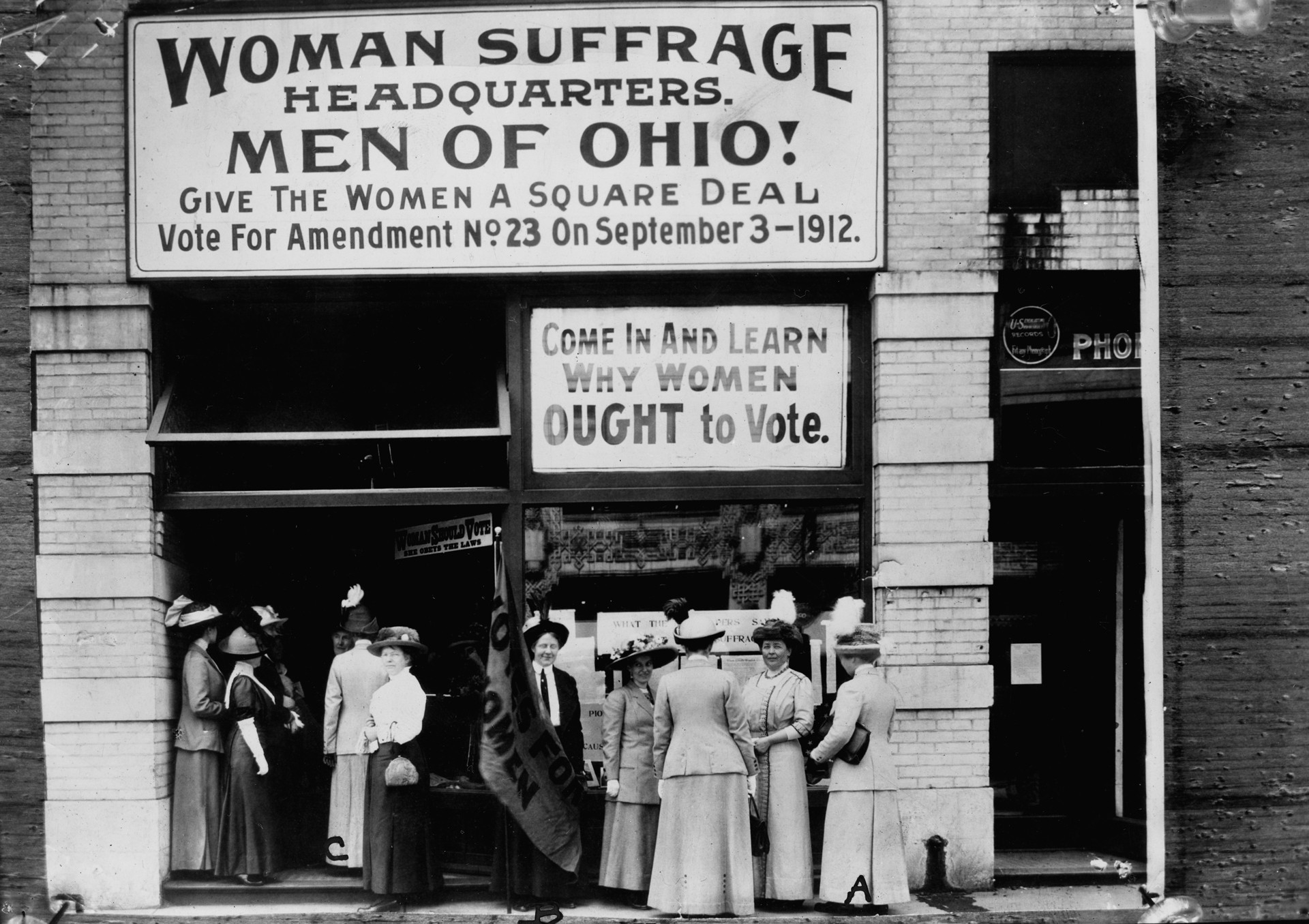
Woman Suffrage Headquarters, Ohio 1912. The 1912 measure failed, 57% to 43%. It was eventually passed in 1919. (Found at reddit.)

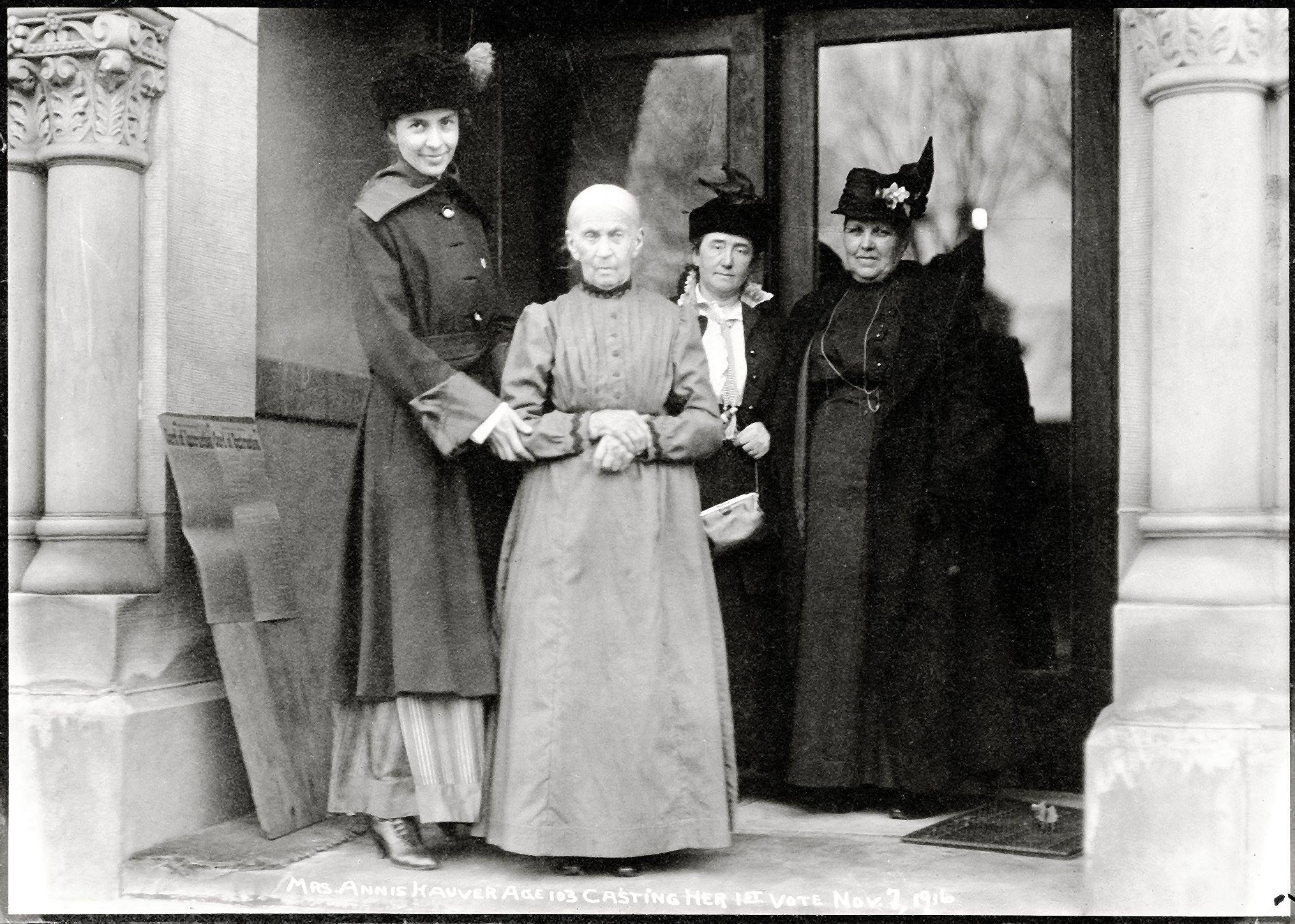
Some states, however, granted women suffrage earlier. Here’s an amazing image, shared by redditor /u/MerIinsBeard and originally posted by his 92-year-old grandmother, shows his great-great-grandmother accompanying her 103-year-old friend to vote for the very first time.

pa8diAF

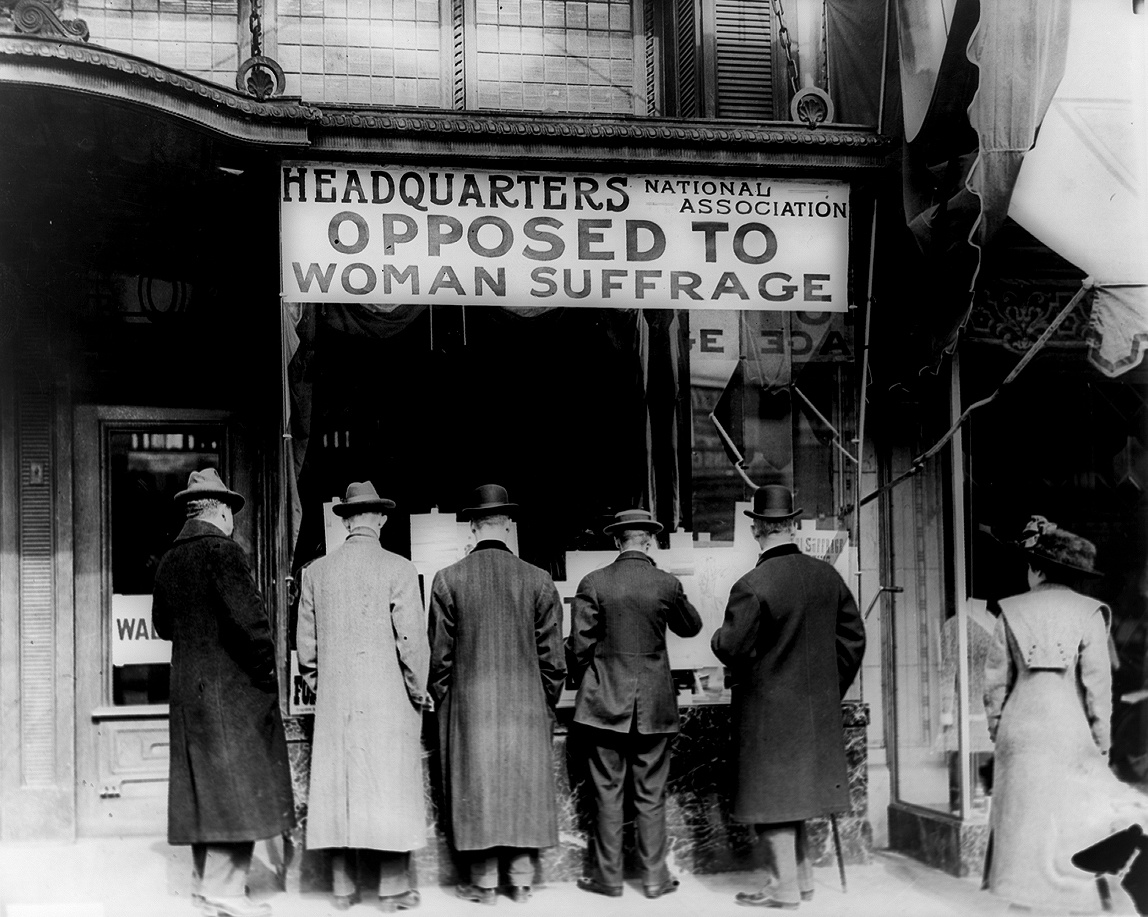
Of course, there was opposition:

National_Association_Against_Woman_Suffrage

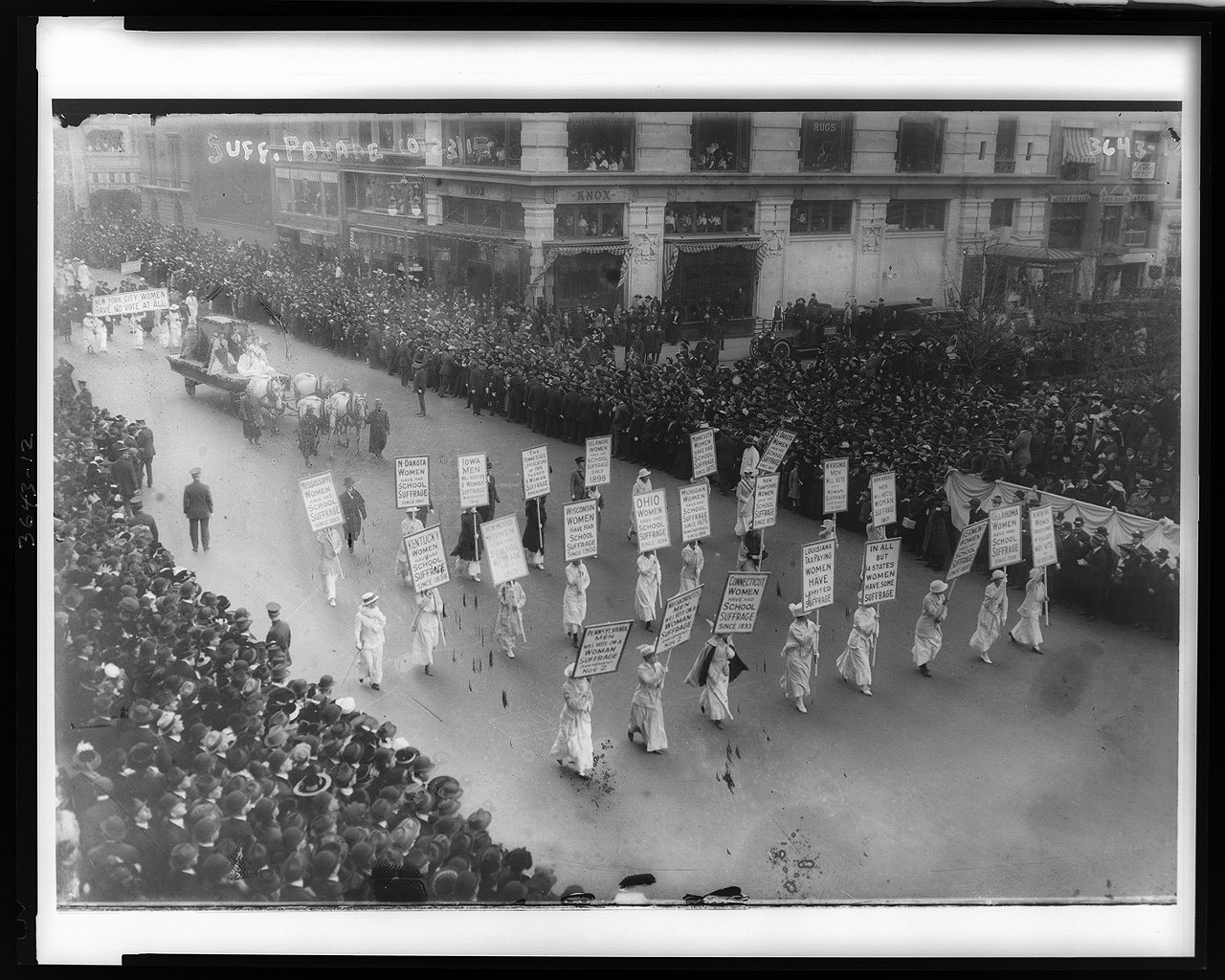
But the suffragettes soldiered on:

new_york_suffrage_parade

Suffragette parade, 10/23/1915

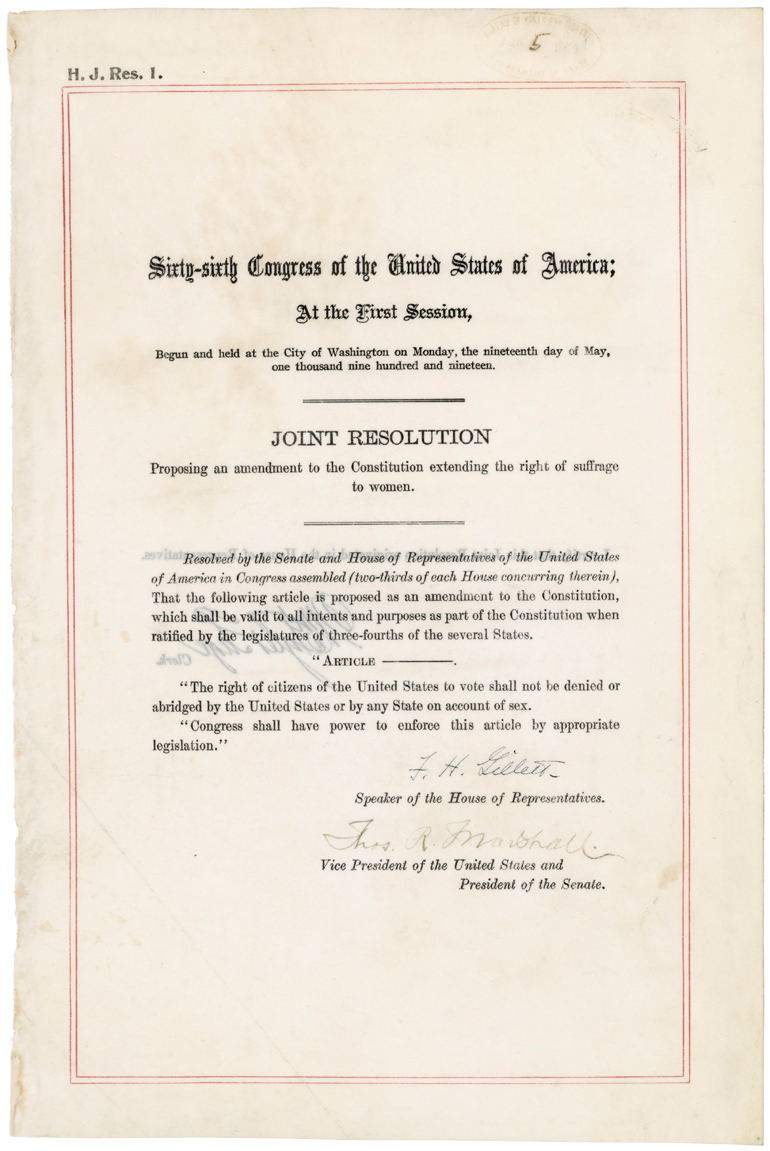
… until their efforts were rewarded.

19th.tif EEOC.tif

19th Amendment to the United States Constitution

A huge step for women, a giant leap for humanity. Yet there are still so many steps to take…

The Old Wolf has spoken.

Be of Good Cheer.

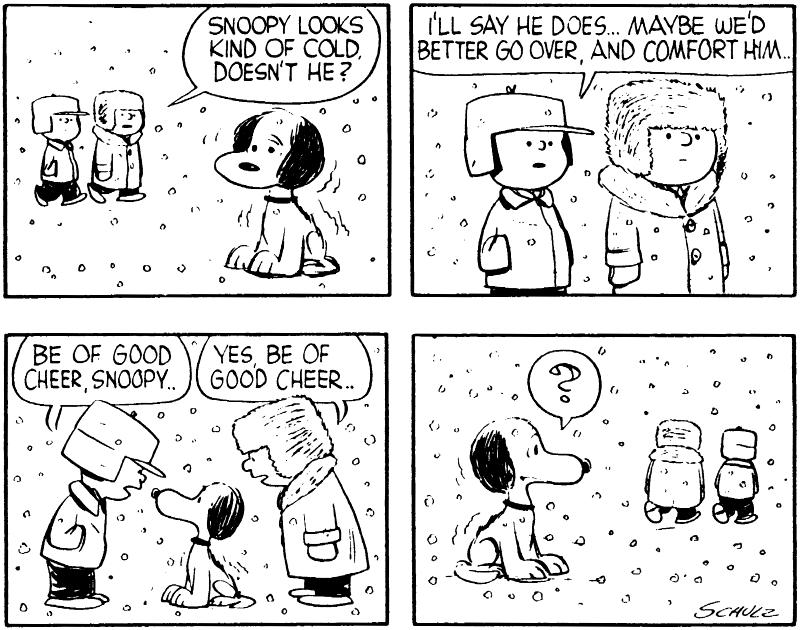
I grew up reading Peanuts™. In fact, I learned to read with Peanuts™. They may have used Dick and Jane in school, but at home, I read the delightful work of Charles M. Schulz. I even remember encoutering the strip below, and thinking about it at a tender age.

peanuts

Schulz had a habit of working a bit of theology into his strips, especially with Linus, and especially around Christmastime, but later in life as I became more acquainted with Scripture, I immediately thought of this strip when I read:

“And one of you say unto them, Depart in peace, be ye warmed and filled; notwithstanding ye give them not those things which are needful to the body; what doth it profit?” (James 2:16. King James Version)

In modern English, that translates as:

“If you say to that person, “God be with you! I hope you stay warm and get plenty to eat,” but you do not give what that person needs, your words are worth nothing.” (New Century Version)

Pat Bagley is a cartoonist for the Deseret News, and he has done much humor orbiting around the faith of his fathers, specifically the Church of Jesus Christ of Latter-day Saints. We have this program called “Home Teaching,” in which members of the congregation visit others to make sure all is well, to bring words of comfort and inspiration, and to take care of needs that are not being met.

The cartoon below echoes the same sentiment expressed in the work by Schulz above:

HomeTeachingBagley

The sad part is, I’ve seen this happen. When you’re in charge of a family’s welfare, it behooves you to find out if there is anything amiss that the community can help with. But when needs are screaming at you with the force of a turbocharged bugle, and you “make that visit” to check off your list and bump your statistics, brother or sister, you’re missing the point.

We’re supposed to help one another. In fact, that help is often coming and going.

A story:

In 1980, my young family moved to Olympia, Washington to take a job after my research staff position at a university was eliminated due to lack of funding. Shame, too, because it was a wonderful project. But at the time, IT jobs were hot in the Pacific northwest, so up we went to work for the State of Washington. The money was good, but only just barely – we had bought a home and were renting it to university students, and had to find a place to rent while we were there. The student’s rent didn’t cover the mortgage, so in effect we were paying two house payments, and things were tight, I mean, tight. We wuz po.

We knew we were stretched, but we didn’t feel poor – we had our year’s supply of food with us (that’s one of the self-reliance programs of the Church), and by scrimping here and there – mixing milk half and half with powdered, walking the two miles to work to save the quarter for bus fare, making pies out of the blackberries that grew abundantly in our backyard and everywhere else, we made it through. And when two years later we moved back home and were able to move into our house, things got a lot better.

But in the meantime, we were very tight on cash.

Around Thanksgiving time, it’s common for congregations to pitch in together and pool food for gift boxes for needy families. We raided our abundant food storage and took a box over to the chapel to add to the effort; and the day before Thanksgiving, we returned from doing errands to find a box on our own doorstep. It was an odd feeling; we were almost insulted, as we didn’t consider ourselves “needy;” but in retrospect, we were – and once we had gotten over the initial discomfort, the gift was most welcome. A turkey with all the trimmings, which is something we might have done without.

I’ve learned along the way that it’s often much harder to receive than to give. But it gets easier, especially when I think about the fact that someone (like myself) who receives help today might just be giving it tomorrow, or next year.,

The painting by David Linn, “The Ascent,” is a marvelous metaphor for life:

Helping Each Other

There’s no getting around it: Life is tough. It’s a lot less tough for the 1%, but even having more money than God is no guarantee that things might not go sideways in other areas of one’s life, as many a celebrity, politician, or CEO have shown us in recent years. When we band together as a team, as communities, as nations, as a species, and reach out to those struggling – only to have those people pass us on the way and offer us a helping hand further along the path – we all win. We all rise. We all walk into the light of a better world, a world that works for everyone, with no one left out.

I’ve been able to help a lot of folks along the way, and I’ve been the recipient of a lot of help as well. There’s no shame in it. It adds to our humanity, which – in the end – is all we come with , and all we can really call our own.

Reach and take my hand, and pull me up – so that I can do the same for others. In the meantime, be of good cheer.

The Old Wolf has spoken.