Sharing a wonderful blog: Bad Postcards

tumblr_mxq6rvREmE1qbyf2jo1_1280

EXTRATERRESTRIAL SPACESHIP

Actual photograph of a Flying Saucer taken June 16, 1963 near Albuquerque, New Mexico. Learn about people from other planets! Subscribe to: UFO INTERNATIONAL. Six issues $3.00. Single copy—50 cents. Published by: AMALGAMATED FLYING SAUCER CLUBS OF AMERICA, INC. (AFSCA)…Los Angeles, California.


Discovered this lovely website through Glaserei and had to share it. So many wonderful, awful postcards… a glimpse into America’s cultural past.

Click through for hundreds more bad postcards.

The Old Wolf has spoken.

LDS Humor: Correlations’s Review of ‘Twas the Night Before Christmas

This piece was originally published in “The Seventh East Press,” a newspaper dedicated to Latter-day Saints who didn’t take themselves too seriously. It is one of the funniest things I have ever seen published there, and at this season of joy and gladness, deserves to be seen. Naturally, Mormons will be most familiar with all of the references, but members of other faiths who think their Church bureaucracies can be a bit heavy-handed at times may appreciate the sentiment. Only one bit of PII[1] has been deleted for the sake of propriety.


15 December 1981

The Seventh East Press

CORRELATION’S REVIEW OF
‘TWAS THE NIGHT BEFORE CHRISTMAS’

Several years ago this review was read at the Church office building Christmas party. It has circulated privately since then.

TO: Director or the Correlation Committee
FROM: Correlation Review Committee

The Correlation Review Committees have reviewed the attached document titled “Twas the Night Before Christmas,” and have found several significant problems as follows:

‘TWAS THE NIGHT BEFORE CHRISTMAS, WHEN ALL THROUGH THE HOUSE, NOT A CREATURE WAS STIRRING, NOT EVEN A MOUSE.
‘Twas is an outdated and unacceptable contraction. We suggest — it was. Also, because the idea of stirring one’s form comes from the same word root as the idea of stirring one’s soup, it might be confusing to the reader and we suggest using the word — moving. In addi­tion, we have noticed that a mouse will generally scurry, nibble, dart or quiver, but, almost never, stirs. Also, we think it would be much better to call the house, the home.

THE STOCKINGS WERE HUNG BY THE CHIMNEY WITH CARE, IN HOPES THAT ST. NICHOLAS SOON WOULD BE THERE.
Perhaps the writer should know that unless everyone went outside into the snowy night and hung the stockings (some were probably just plain old socks), it is more likely that they were hung in front of the fireplace than by the chimney. We think it would be well to take note that in some of the developing areas of the Church, people do not have socks, stock­ings, or chimneys. Moreover, the Church does not recognize the canonization of other chur­ches. We feel this man should be called Brother Nicholas — or perhaps, in case be isn’t a member, we should play it safe and call him Mr. Nicholas.

THE CHILDREN WERE NESTLED ALL SNUG IN THEIR BEDS, WHILE VISIONS OF SUGARPLUMS DANCED THROUGH THEIR HEADS.
We must be very careful with the use of the word visions. It might be better to use the word non-revelation dreams. We also suggest that “sugarplums” is a rather archaic term. Wouldn’t Tootsie Rolls or Sugar Daddies be more relevant to today’s youth. In any case, shouldn’t sugar plums be two words instead of one?

MAMA IN HER KERCHIEF, AND I IN MY CAP, HAD JUST SETTLED OUR BRAINS FOR A LONG WINTER’S NAP.
The very idea of a long winter’s nap is contradictory. Webster says a nap is a short snooze, taken usually during the daytime. This really must be changed. We would also like to point out that few really wear headgear to bed anymore.

WHEN OUT ON THE LAWN THERE AROSE SUCH A CLATTER, I SPRANG FROM MY BED TO SEE WHAT WAS THE MATTER.
Around the Wasatch front, you would not have to spring from your bed to see what was the matter. Any clatter at night on the lawn means you are getting T.P.’d. Incidentally, spring­ing from bed by our more senior members could he hazardous to their health. By the way, how do you clatter on a snow-covered lawn?

AWAY TO THE WINDOW I FLEW LIKE A FLASH, TORE OPEN THE SHUTTERS AND THREW UP THE SASH. THE MOON ON THE BREAST OF THE NEW FALLEN SNOW GAVE THE LUSTER OF MIDDAY TO OBJECTS BELOW.
We wonder whether throwing up the sash might he rather indelicate wording, especially after a large Christmas Eve dinner. We would also like to suggest that the writer say, “The moon on the chest of the new fallen snow.”

WHEN WHAT TO MY WONDERING EYES SHOULD APPEAR, DUT A MINIATURE SLEIGH, AND EIGHT TINY REINDEER. WITH A LITTLE OLD DRIVER SO LIVELY AND QUICK, I KNEW IN A MOMENT IT MUST BE ST. NICK.
We would like to commend the author for breaking the stereotype that our “more mature” people cannot he lively and quick.

MORE RAPID THAN EAGLES HIS COURSERS THEY CAME, AND HE WHISTLED AND SHOUTED, AND CALLED THEM BE NAME. NOW DASHER! NOW DANCER! NOW PRANCER AND VIXEN! ON COMET! ON CUPID! ON DONNER AND BLITZEN!
We commend the writer for broadening the cultural base of this document by including the German names Donner and Blitzen. We wonder if this could he broadened further. Perhaps-Now Fifi! Now Cheri! Now Jose and Maria! On Chocho and Tojo! On Donner and Blitzen! We also question all this whistling and shouting in the middle of the night by a senior citizen.

TO THE TOP OF THE PORCH! TO THE TOP OF THE WALL! NOW DASH A WAY! DASH AWAY! DASH AWAY, ALL! AS DRY LEAVES THAT BEFORE THE WILD HURRICANE FLY, WHEN THEY MEET WITH AN OBSTACLE, MOUNT TO THE SKY.
We have noted that throughout this document the author has used rather long, complicated, turned-around sentences. This could he confusing to many of our readers. We suggest he write on a lower reading level, perhaps by using short, straightforward sentences such as “Just like dry leaves blow before the wind?”

SO UP TO THE HOUSETOP THE COURSERS THEY FLEW, WITH A SLEIGH FULL OF TOYS AND ST. NICHOLAS TOO. AND THEN IN A TWINKLING I HEARD ON THE ROOF, THE PRANCING AND PAWING OF EACH LITTLE HOOF. AS I DREW IN MY HEAD, AND WAS TURNING AROUND, DOWN THE CHIMNEY ST. NICHOLAS CAME WITH A BOUND.
Win the reader understand what coursers are? (Could he confused with cursers, after all the shouting and whistling). Also – the cavorting around on peoples’ roof tops sets a very bad ex­ample for our youth (who don’t need any new ideas). Also, the chimney trip is a bit much – ­wouldn’t it be better to just have Mr. Nicholas use the front door?

HE WAS DRESSED ALL IN FUR.
We wonder if he shouldn’t he dressed in cotton or polyester after what was said about killing animals in a recent conference. Perhaps it could he said that he was “dressed in a nice Swedish knit.”

FROM HIS HEAD TO HIS FOOT, AND HIS CLOTHES WERE ALL TARNISHED WITH ASHES AND SOOT.
Perhaps polyester would not be good here because of the problems with ashes and soot. If I were his wife I would get him a pair of OSH KOSH overalls. (Of course the use of the front door would eliminate this whole ashes and soot problem.)

A BUNDLE OF TOYS HE HAD FLUNG ON HIS BACK, AND HE LOOKED LIKE A PEDDLER JUST OPENING HIS PACK. HIS EYES – HOW THEY TWINKLED, HIS DIMPLES, HOW MERRY!  HIS CHEEKS WERE LIKE ROSES, HIS NOSE LIKE A CHERRY!
This somewhat extravagant description of Mr. Nicholas makes him sound like an edible, electrical, floral, centerpiece. We suggest that the writer tell it like it is.

HIS DROLL LITTLE MOUTH WAS DRAWN UP LIKE A BOW, AND THE BEARD OF HIS CHIN WAS AS WHITE AS THE SNOW.
Knowing what the current BYU and missionary standards are, we are very surprised that you would allow Mr. Nicholas to be wearing a beard. If he must have hair on his face, it should be a mustache trimmed well above the corners of his mouth.

THE STUMP OF HIS PIPE HE HELD TIGHT IN HIS TEETH, AND THE SMOKE IT ENCIRCLED HIS HEAD LIKE A WREATH. HE HAD A WIDE FACE-
We were more than a little taken back by this flagrant disregard of the 89th section of the Doctrine & Covenants. There could even be legal implications regarding his smoking in public places.

AND A ROUND LITTLE BELLY THAT SHOOK WHEN HE LAUGHED LIKE A BOWLFUL OF JELLY. HE WAS CHUBBY AND PLUMP, A RIGHT JOLLY OLD ELF, AND I LAUGHED WHEN I SAW HIM IN SPITE OF MYSELF.
It is in questionable taste to describe this senior citizen as being so fat, but then to have the narrator laugh at him seems to me to be carrying things too far. It would be better to say, “I smiled when I saw how well he was doing in spite of his handicap.”

A WINK OF HIS EYE AND A TWIST OF HIS HEAD SOON GAVE ME TO KNOW I HAD NOTHING TO DREAD. HE SPOKE NOT A WORD BUT WENT STRAIGHT TO HIS WORK AND FILLED ALL THE STOCKINGS, THEN TURNED WITH A JERK.
We appreciated this fine example of bard work and industry, in the true tradition of deseret. However, we decry his reference to his associate as a jerk.

 AND LAYING A FINGER ASIDE OF HIS NOSE, AND GIVING A NOD, UP THE CHIMNEY HE ROSE.
See our previous comment about using the door. Also, be careful where you have him put his finger.

HE SPRANG TO HIS SLEIGH, TO HIS TEAM GAVE A WHISTLE, AND AWAY THEY ALL FLEW LIKE THE DOWN OF A THISTLE.
Again, he careful of the dangerous springing. Also, if he were to give every member of the team a whistle, they might make a horrible amount of noise. In addition, after checking with the International Mission, we would like to inform the writer that reindeer have no pockets in which to put those whistles. Also, would the increasing urban membership of the Church understand the image of “down of a thistle?”     ‘

BUT I HEARD HIM EXCLAIM, ERE HE DROVE OUT OF SIGHT, HAPPY CHRISTMAS TO ALL, AND TO ALL A GOOD NIGHT.
We feel it would be better to stay with the traditional form of “Merry Christmas.”

Although the document has some major problems, we feel there is enough of worth to justify revising. In the spirit of reduction and simplification, however, we also recommend that the number of lines he cut in half.

IT WAS THE NIGHT BEFORE CHRISTMAS

(Revised)

It was the night before Christmas and in our home, no animals were moving about. Even the mice were still.

Some preparations were made in anticipation of a visit from Mr. Nicholas.

While the children were sleeping soundly, they were thinking about Tootsie Rolls and Sugar Daddies.

My wife and I had just gone to bed.

We heard a noise out on the front lawn and assumed that we were being T.P.’ed.

I walked to the window and pulled back the curtain.

The moon was shining brightly on the chest of the new fallen snow.

Then I saw a tiny sleigh being pulled by eight reindeer.

The little old driver was 50 lively and quick that I knew it must be Mr. Nicholas.

He came very fast. He addressed the reindeer by name:

“Now Fifi! Now Cheri! Now Jose and Maria!

On Chocho and Tojo! On Donner and Blitzen!”        ‘

Just like a snowball striking a brick wall, they came to a stop in front of our home. Soon I heard Mr. Nicholas at my front door.

He was dressed in a nice Swedish knit suit. He had a briefcase full of packages.

He was smiling pleasantly.

He was clean-shaven and his breath smelled of spearmint chewing gum.

He was a bit overweight, but I smiled when I saw how well he was doing in spite of his han­dicap.

He wasted no time with words, but went straight to his work of putting the packages where they would be found.

Then he went out the front door and got in his sleigh.

As he was driving off, I heard him say, “Merry Christmas!”


The Old Wolf has spoken.

[1] Personally Identifiable Information – Census workers will know just what I mean.

Celebrities as Classic Paintings, Annotated

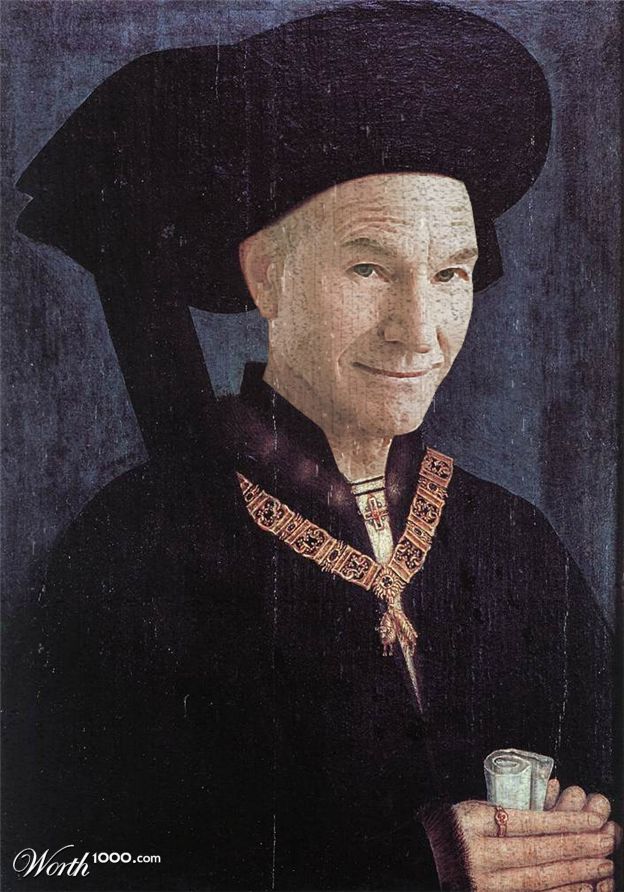
Recently over at reddit a list of photos appeared showing modern-day celebrities photoshopped onto classic paintings. The list appeared over at Imgur, but without any annotation. Various redditors chimed in and were able to provide a key, but I found these interesting enough that I thought I would present the list here, with some supplementary information which came to mind as I discussed the images with my wife. I have tried, wherever possible, to find the original painting, and provide links to the subjects depicted and the artists of the original works.

These photoshopped versions are found at worth1000.com, and a quick search over there will turn up the creators of these clever derivative images, as well as many other similar efforts.

v6ZJAxm

Sir Patrick Stewart

419px-Philip_the_good

The original painting, Philip the Good. This is a copy of an original which is thought to be lost, by Rogier van der Weden. This particular painting for Picard seems poignantly apt, in my opinion. Picard’s character was both written and interpreted as a flawed (as are we all) individual doing his utmost to make a positive difference in the universe.

For obvious reasons, this is an image heavy post; much more can be seen after the jump.

Continue reading

A few definitions for your Jewish culinary art knowledge

Shared with me by my colleague Miguel Ring around 15 years ago. Time to let it re-surface.

Latkes: A pancake‑like structure not to be confused with anything the House of Pancakes would put out. In a latka, the oil is in the pancake.  It is made with potatoes, onions, eggs and matzo meal. Latkas can be eaten with apple sauce but NEVER with maple syrup. There is a rumor that in the time of the Maccabees they lit a latka by mistake and it burned for eight days. What is certain is you will have heartburn for the same amount of time.

Matzoh: The Egyptians’ revenge for leaving slavery. It consists of a simple mix of flour and water ‑ no eggs or flavor at all. When made well, it could actually taste like cardboard. Its redeeming value is that it does fill you up and stays with you for a long time. However, it is recommended that  you eat a few prunes soon after.

Kasha Varnishkes: One of the little‑known delicacies which is even more difficult to pronounce than to cook. It has nothing to do with Varnish, but is basically a mixture of buckwheat and bow‑tie macaroni (noodles). Why a bow‑tie? Many sages discussed this and agreed that some Jewish mother decided that “You can’t come to the table without a tie” or, God forbid “An elbow on my table?”

Blintzes: Not to be confused with the German war machine. Can you imagine the N.J. Post 1939 headlines: “Germans drop tons of cheese and blueberry blintzes over Poland ‑ shortage of sour cream expected.”

Kishka: You know from Haggis? Well, this ain’t it . In the old days they would take an intestine and stuff it. Today we use parchment paper or plastic. And what do you stuff it with? Carrots, celery, onions, flour, and spices. But the trick is not to cook it alone but to add it to the cholent (see below) and let it cook for 24 hours until there is no chance whatsoever that there is any nutritional value left.

Kreplach: It sounds worse than it tastes. There is a rabbinical debate on its origins: One Rabbi claims it began when a fortune cookie fell into his chicken soup. The other claims it started in an Italian restaurant.  Either way it can be soft, hard, or soggy and the amount of meat inside depends on whether it is your mother or your mother‑in‑law who cooked it.

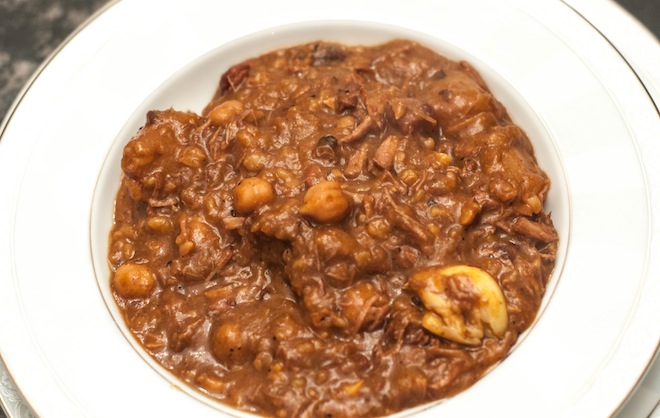
Cholent: This combination of noxious gases had been the secret weapon of Jews for centuries. The unique combination of beans, barley, potatoes, and bones or meat is meant to stick to your ribs and anything else it comes into contact with. At a fancy Mexican restaurant (kosher of course) I once heard this comment from a youngster who had just had his first  taste of Mexican fried beans: “What! Do they serve leftover cholent here too?!” My wife once tried something unusual for guests: She made cholent burgers for Sunday night supper. The guests never came back.

Cholent-1

Cholent

Gefilte Fish: A few years ago, I had problems with my filter in my fish pond and a few of them got rather stuck and mangled. My son (5  years old) looked at them and commented “Is that why we call it ‘GeFiltered Fish’?”  Originally, it was a carp stuffed with a minced fish and vegetable mixture. Today it usually comprises of small fish balls eaten with horse radish (“chrain”) [1] which is judged on its relative strength in bringing tears to your eyes at 100 paces.

Bagels: How can we finish without the quintessential Jewish Food, the  bagel? Like most foods, there are legends surrounding the bagel although I don’t know any. There have been persistent rumors that the inventors of the bagel were the Norwegians who couldn’t get anyone to buy smoked lox.  Think about it:  Can you picture yourself eating lox on white bread?  Rye?  A cracker?? Naaa.  They looked for something hard and almost indigestible which could take the spread of cream cheese and which doesn’t take up too much room on the plate. And why the hole? The truth is that many philosophers believe the hole is the essence and the dough is only there for emphasis.

The Old Wolf has spoken, but do you ever write me? No, that’s fine, I’ll just sit here in the kitchen slaving, if you come and find me dead someday it will only be what you deserve…


[1] Linguistic note: the German word for horseradish is “Meerrettich” but in Austria it’s known as “Kren”.

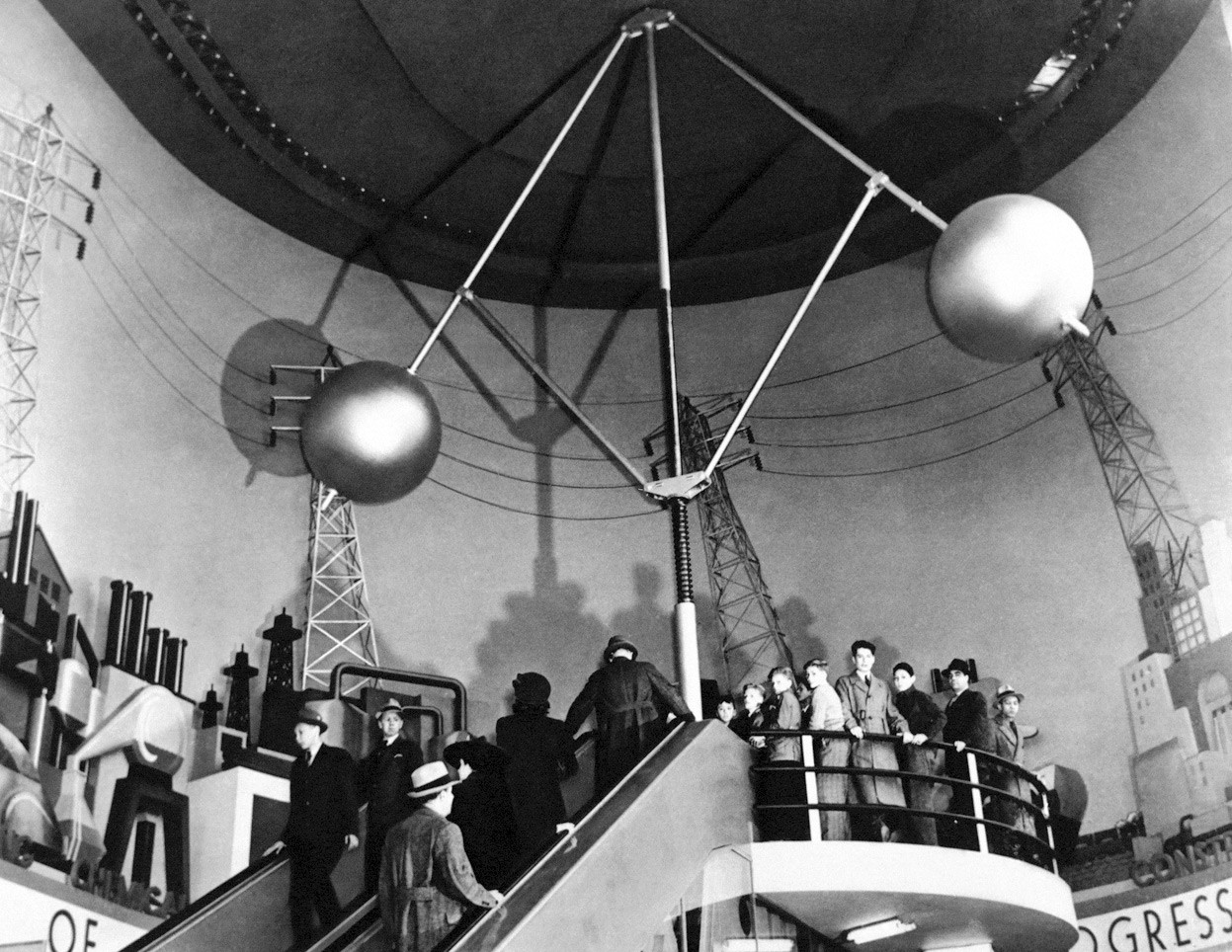
“Moving Stairs”: World’s Fair, 1939

WElDPAm

Visitors to the Hall of Power at the New York World’s Fair of 1939 ride the novel “moving stairs.”

The longest escalator in the world is found in the St. Petersburg Metro system, up to 433 feet (132 meters) long.

escalators metro

Some folks are still not clear on the concept:

escalator-gym

Only in America

il_570xN.317740446

Advicing good

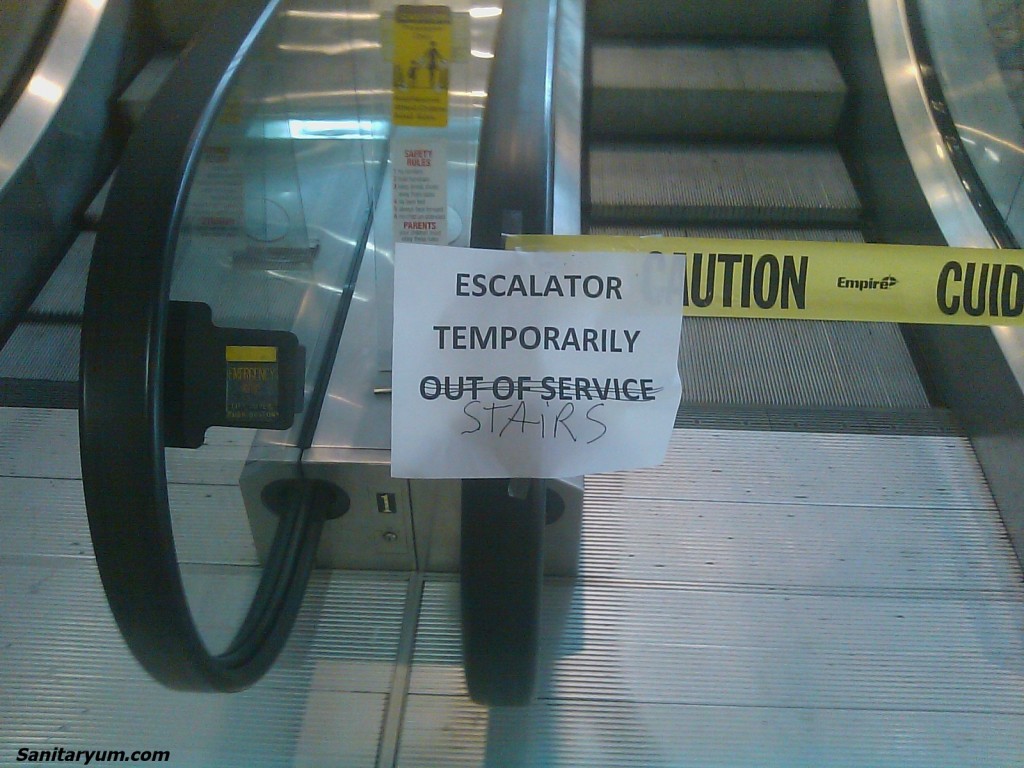
Escalator-Temporarily-Stairs-1024x768

Inconceivable!

auto-escalator-fail-307449

I’m tempted to shout ‘Merica! but this is obviously somewhere in Asia

a.aaa-Funny-Escalator-Sign

Guerrilla art

Garden State Plaza

There we go: ‘Merica! At the Westfield Garden State Plaza in Paramus, NJ.

The Old Wolf has spoken.

Sausages, Laws, and Quotations

Wolfsburg, VW Autowerk, Metzgerei

Sausage Production for the VW Cafeteria, Wolfsburg, 25 January 1973. Found at /r/historyporn

Otto von Bismarck once said, “Whoever loves the law and sausages should never watch either being made.” Wait, no he didn’t. The original quote is “Laws, like sausages, cease to inspire respect in proportion as we know how they are made,” and is attributed to John Godfrey Saxe, University Chronicle. University of Michigan (27 March 1869) 
Everett Dirksen probably never said “A billion here, a billion there, and pretty soon it adds up to real money.”
Bill Cosby never wrote the “I’m 73 and I’m Tired” article. He even wrote a rebuttal on his website.
Winston Churchill is reputed to have said, “You make a living by what you get; you make a life by what you give.” According to The Churchill Centre And Museum at the War Rooms London, what Churchill actually said in Scotland, 1908, is:
“What is the use of living, if it be not to strive for noble causes and to make this muddled world a better place for those who will live in it after we are gone? How else can we put ourselves in harmonious relation with the great verities and consolations of the infinite and the eternal? And I avow my faith that we are marching towards better days. Humanity will not be cast down. We are going on swinging bravely forward along the grand high road and already behind the distant mountains is the promise of the sun.”
And that’s a much better quote, really, than the original.
“There’s no such thing as a free lunch” is often attributed to economist Milton Friedman, who used it as the title of a 1975 book. However, sci-fi buffs will recognize TANSTAAFL (“There ain’t no such thing as a free lunch”) from Heinlein’s 1966 novel, “The Moon Is a Harsh Mistress,” and a still earlier occurrence appears  in the title of a 1949 book by Pierre Dos Utt, “Tanstaafl: A Plan for a New Economic World Order.” [1]
Most of us will remember the party game called “Telephone” or “Chinese Whispers,” depending on which part of the world you live in. People sit in a circle and the first person whispers a message into the ear of the next person. Repetition is not allowed, and the second person must pass the message on. The result is usually incomprehensible or hilarious – “I love Marty Blotz” can come out the other end as “Boiled aardvark kidneys are tasty.”

It used to be that the power of the press belonged to the person that owned one. (There’s another quote for which it’s difficult to pin down the original source, or if it was even said.) With the internet being available to much of the world’s population, anyone can publish anything with or without attribution, which is why so many things get forwarded, re-forwarded, massaged, edited, re-worked, and falsely attributed these days. One of my friends is struggling with countering their 9-year-old’s assertion that “if you see it on the internet, it has to be true,” and in my experience there are reams of adults who apparently believe the same thing, based on the kinds of things I see on Facebook or my inbox.

James Sullivan wrote at Finding Dulcinea, in an article entitled “Misquotes: Searching for Authenticity Online:”

The Internet is fertile ground for the proliferation of misquotes. Pithy quotes find their way into Facebook profiles and Twitter posts, where they multiply across the Web unencumbered by citations and original context. With online sharing an elaborate, electronic game of telephone, genuine quotes get warped in the retelling, leaving end-readers with misquoted material void of context. Surprisingly, the media is often just as guilty as the average Web user.

I highly recommend this article if you care about  your sources – the end of the article gives some excellent ways of verifying whether a quote has been properly attributed or not.

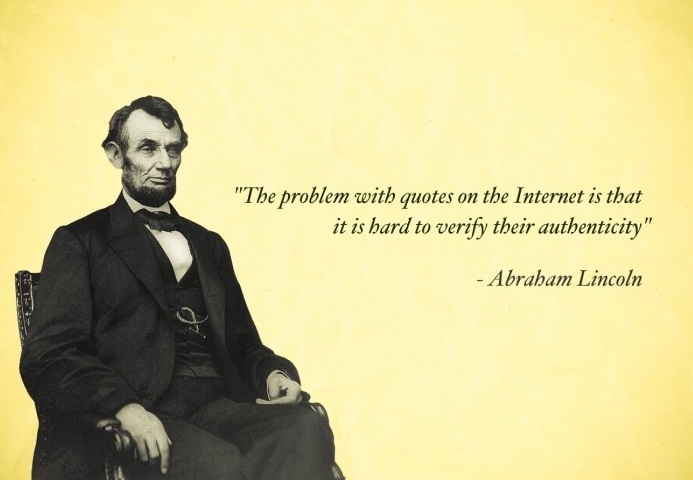
Even if you care, it’s possible to make mistakes – as a famous statesman once pointed out,

Lincoln-Internet-Quotes


The Old Wolf has spoken (and you can quote me on that.)


[1] New York Times, “Quote… Misquote

Political Speechmaking Done Right

… and wrong.

If you’re running for President, don’t plagiarize Wikipedia.

From Newser:

(NEWSER) – If you already thought it was weird that Rand Paul went on a rant about eugenics during a speech in Virginia yesterday, well, the story just got even weirder. Rachel Maddow pointed out last night that parts of the speech were lifted from Wikipedia, Mediaite reports. Specifically, the Wikipedia entry about 1997 sci-fi movieGattaca. Go ahead and compare:

  • Paul: “In the movie Gattaca, in the not-too-distant future, eugenics is common. And DNA plays the primary role in determining your social class. … Due to frequent screenings, Vincent faces genetic discrimination and prejudice. The only way to achieve his dream of being an astronaut is he has to become what’s called a ‘borrowed ladder.’ … He assumes the identity of a Jerome Morrow, a world-class swimming star with a genetic profile said to be secondary to none, but he’s been paralyzed in a car accident. … Jerome buys his identity, uses his DNA—his blood, his hair, his tissue, his urine—to pass the screenings.”
  • Wikipedia: “In the not-too-distant future, liberal eugenics is common and DNA plays the primary role in determining social class. … Due to frequent screening, Vincent faces genetic discrimination and prejudice. The only way he can achieve his dream of becoming an astronaut is to become a ‘borrowed ladder.’ … [Vincent] assumes the identity of Jerome Eugene Morrow, a former swimming star with a genetic profile ‘second to none,’ who had been injured in a car accident, leaving him paralyzed. … Vincent ‘buys’ Jerome’s identity and uses his ‘valid’ DNA in blood, hair, tissue, and urine samples to pass screening.”

“Gattaca was a weird topic for a speech in a governor’s race to begin with,” Maddow said, “but what’s weirder is trying to be a candidate for president, which Rand Paul is trying to do, and thinking that you’re going to get away with lifting your speeches from Wikipedia while you’re doing that.”

For Mr. Paul and all other future presidential candidates, I recommend the following speech, written by  Norton Mockridge, entitled “What’d He Say? What’d He Say?” It’s guaranteed to generate interminable applause, and send your listeners home wiping away tears of gratitude. They may even go out and buy a kitten.

Distinguished guests, ladies and gentlemen, my colleagues and comrades. It is indeed an honor and a rare privilege to address you on this memorable occasion. First, I would like to congratulate heartily each one of your assembled here on the attainment of the objectives for which you have worked so hard.

In this connection, I might add that a very strange thing happened to me on the way to this function, which reminds me at this point of a story. The disturbing feature of all this is, despite all the bitter lessons, we know better.

As that great statesman once said, I need hardly remind this audience without fear of successful contradiction that we hand down to posterity as a matter of policy a few words about your splendid hospitality and this great nation of ours. We view with alarm but under our present wise leadership, and, some may be surprised, for above and beyond we begin to see the sun breaking through. We are counting on your continued support because, as you so well know, money must be forthcoming to our way of life.

As we travel the long road ahead down to the grass roots of America, there are those extremists whose voices cry out in the night. In this worthy cause we must not forsake by rather, with wisdom, recall that there are those who say that tomorrow may be too late. Make no mistake—-in our overall approach no one will dispute this fact—-it is a sobering thought. It is perhaps more than coincidence, and honest demands, whether we desire it or not. that we face up to the issues.

This observation has led me to one conclusion. We demand adequate funds. The world looks to us for leadership and we point with pride in considering the credit side of the ledger.

Keeping always abreast of the times , the record shows that we are a young nation. It is gratifying to hear, like all good Americans and these are simple, hard facts. We have no illusions. This is no dream, but a challenge. History teaches us that the period of greatest crises lies before us, and especially disillusioning has been our experience in this worthy cause. Yet, we must not falter. Where then shall we turn? In our judgement we do not wish to confuse the issue. The primary ain has always been to understand the problems better. I do not pretend to know the answers There are unmistakable sign, I submit to you, and in such view we areperhaps more to be applauded than condemned, as the world may one day see.

Another and wiser man has said it far better, for therein lies the common denominator of a people who will never give up. We should then, pause and reflect. It was gratifying to hear in our over-all approach , and as a matter of fact it is this very spirit of unselshishness which is beyond peradventure of a doubt. Whoever would challenge this words of our founding fathers? I say to you, let’s look at th e record as set forth by them.


Of this we can be assured—as those who have gone before us—-and these splendid men and women in this room whose very presence tonight testifies. With heartfelt thanks, and with undying determination as in the immortal words first uttered by my illustrious colleagues, we hear the hallowed voices—–Blue and Grey—-who made it the great common hertigage of the melting pot, sealed with blood in the spirit of those dauntless pioneers, and in this tradition we must and we will —under God. It has been a distinct honor and privilege, and in conclusion let me reiterate once again what words cannot express.

On that note may I leave you with this parting thought which I know will be taken in the spirit in which it is offered for the die is cast before the bar of justice and world opinion.

The Old Wolf has spoken (but not as well as Norton Mockridge.)

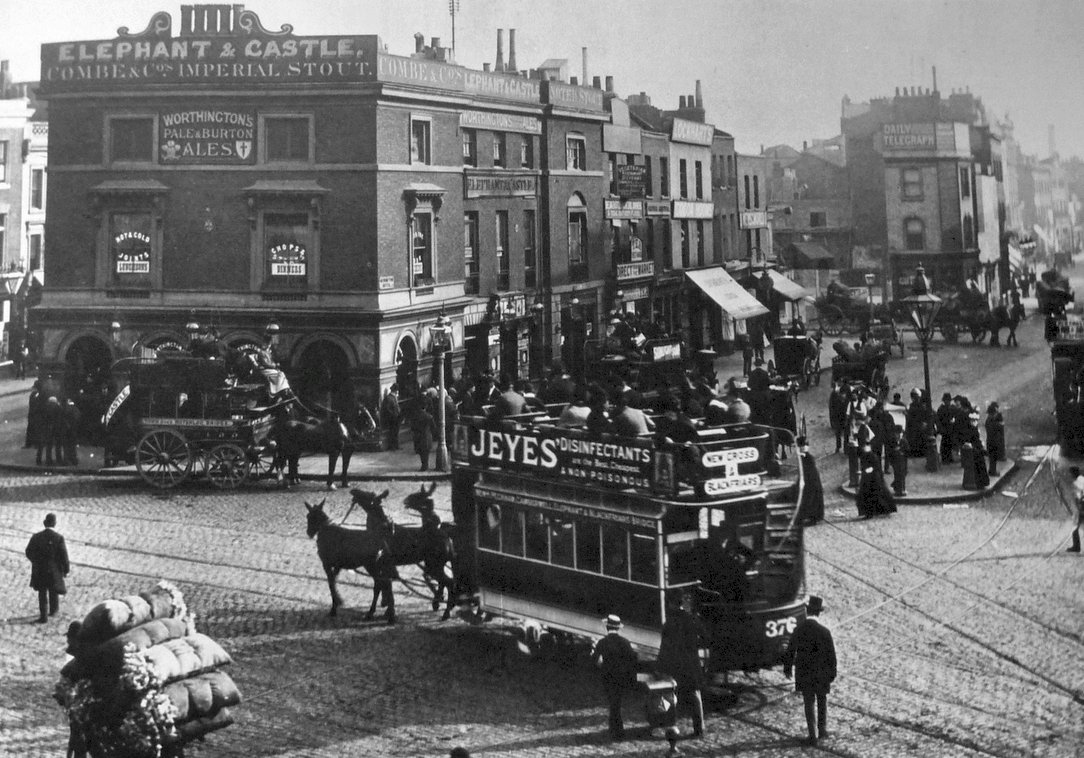
The Aleph and Tentacles, London, 1890

aleph


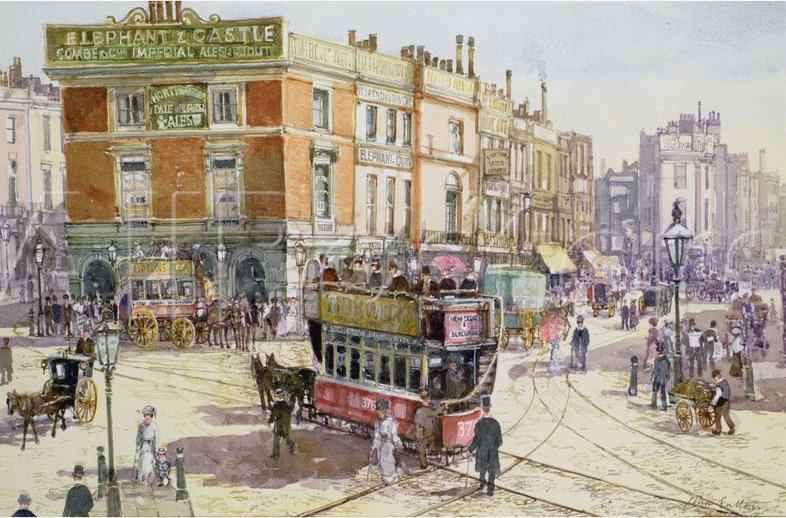
Elephant and Castle is a major road junction in Central London, England, in the London Borough of Southwark and the name of the surrounding area, largely superseding Newington. This photo of the eponymous pub was taken in 1890. The photo was used by artist John Sutton to produce a watercolor:

Elephant Sutton


The area has had a rather checkered history in terms of prosperity, and is currently the subject of a master-planned redevelopment budgeted at £1.5 billion.

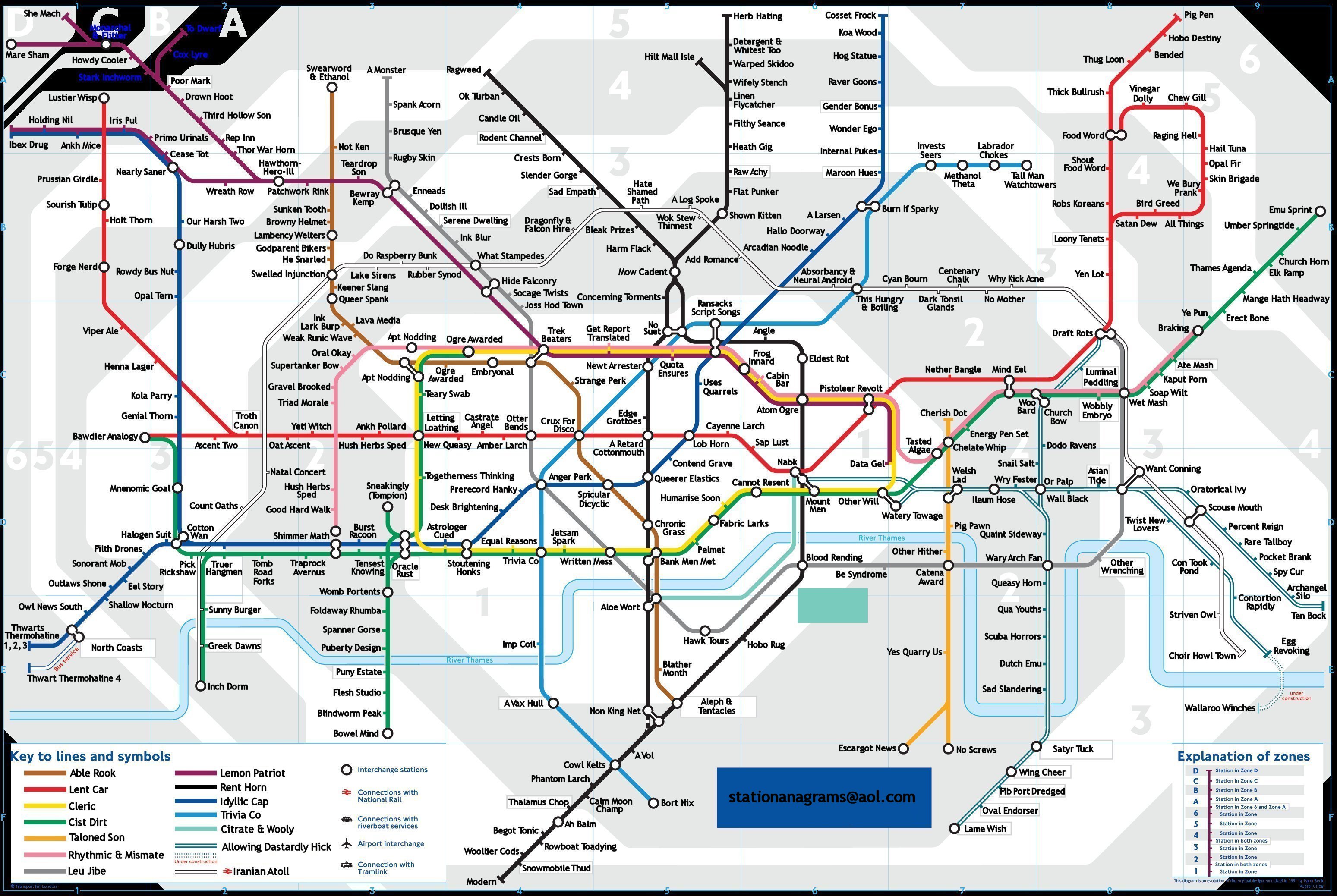
As for the strange title of this post, feast your eyes on this brilliant map of the London underground, with every station turned into an anagram. I assume no responsibility for soiled screens or ruined keyboards; put down your Guinness before you have a look.

anagrammap

The Old Wolf has spoken.

They should have hired a cat long ago

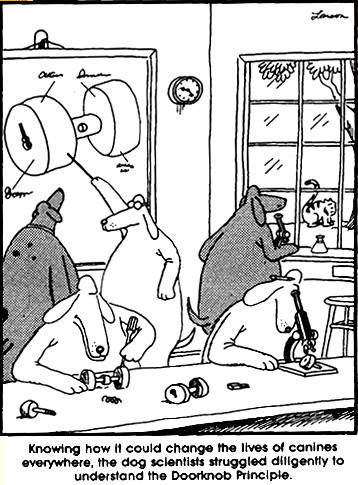
Along with all his other glorious insanity, Gary Larson created this gem:

Gary Larson - The Far Side

Gary Larson – The Far Side

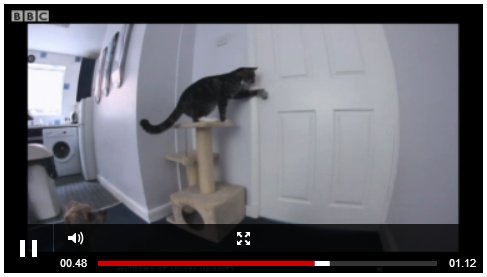
The dog looking out the window had the answer right under his nose, but he failed to make the critical connection:

cat

Over at the BBC, you can watch Dexter help his friend Gizmo overcome the obstacle. Apparently this is not an isolated incident; Dexter the cat and his dog pal Gizmo were shut in the kitchen at owner Matt Hurst’s home in Sheffield every morning when he left for work. After finding them in the rest of the house for three days running, a confused Mr Hurst set up a camera to find out how they were making their escape. Click through for the full story and video.

Thanks to my friend Billy O’Shea for pointing out this lovely story.

The Old Wolf has spoken.