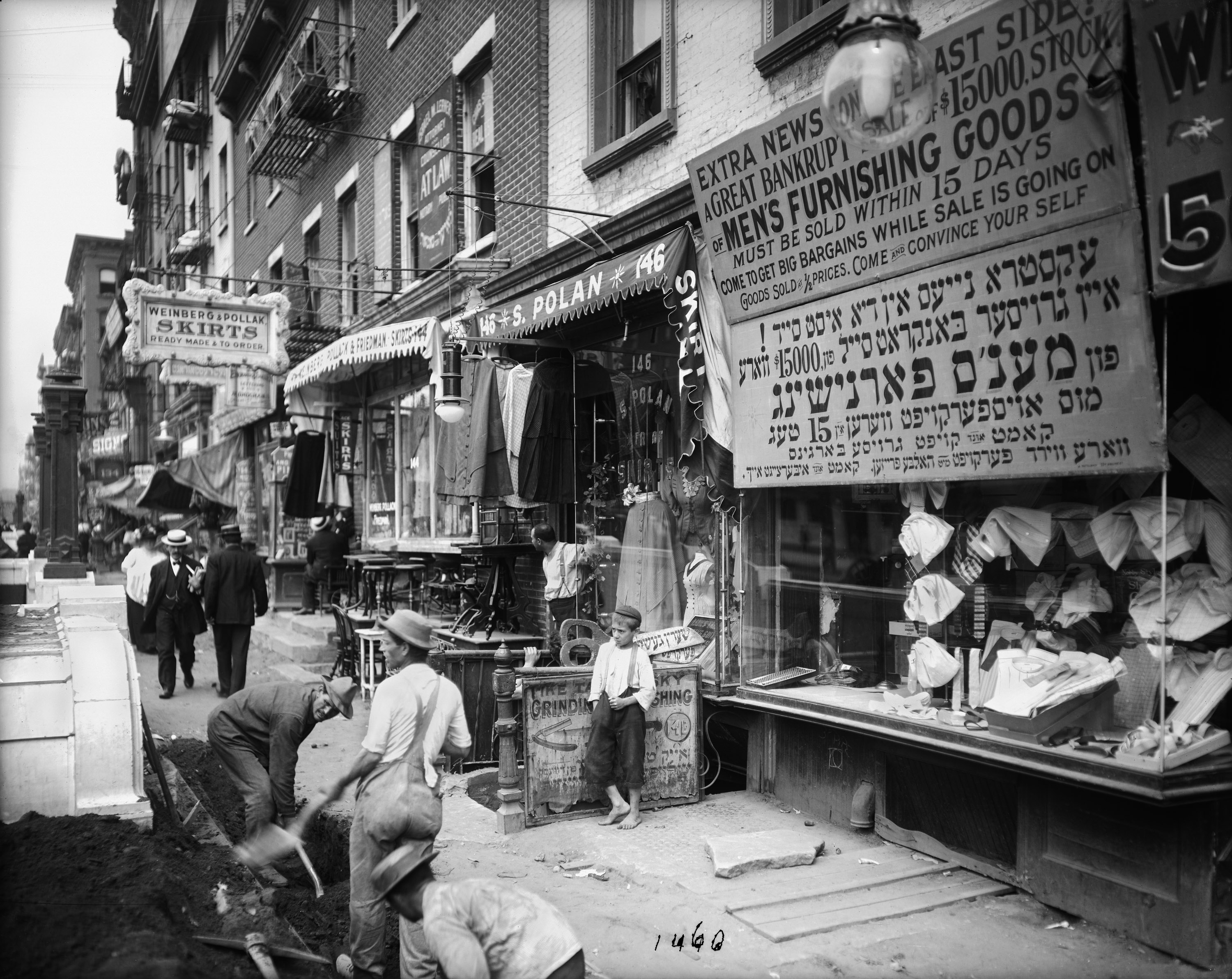
I love this photo, titled “Workers dig along Delancey Street, 1908.” It was taken a year before my father was born, and reflects a New York of which I only experienced whispers as I was growing up there in the 50s and 60s. But there were still hints and shadows, so the picture calls to me.
I love the fact that the Yiddish of New York was so heavily influenced by English that the sign is almost a direct transliteration of the English text, with little bits of German/Hebrew thrown in.
With all its incredible history, warts and all, I ❤ NY. I wish only that I could afford to live there in the style to which I have become accustomed (meaning, comfortable and safe.)
The things we learn. Seriously. It appears that Sir Anthony Hopkins was a musician and composer before he was an actor; his piece “And the Waltz Goes On” was composed in November of 1964, but was never performed until Hopkins took the bull by the horns and sent it to André Riu, who loved it. The waltz was performed by Riu and his orchestra for the first time in Schloß Belvedere in Vienna, with Hopkins in attendance. The video below is a performance by Riu in Maastricht; it’s wonderful to watch the audience’s reaction, along with Sir Anthony’s, as he listens to his composition.
You can also watch a lovely 2011 interview with Hopkins by Richard Wilkins on the Today Show, in which Sir Anthony discusses his life, his music, and the collaboration with Riu, and we see extracts from that first performance in Vienna.
I was thoroughly delighted to learn of this little bit of ephemera, and I love waltz music anyway, so it was a double win.
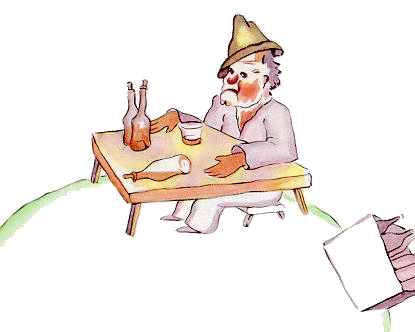
“That’s the problem with drinking, I thought, as I poured myself a drink. If something bad happens you drink in an attempt to forget; if something good happens you drink in order to celebrate; and if nothing happens you drink to make something happen.”
– What are you doing there?
– I’m drinking.
– Why are you drinking?
– To forget.
– To forget what?
– To forget that I’m ashamed.
– Ashamed of what?
– Ashamed of drinking!
Antoine de Saint-Exupéry, The Little Prince
❦
I’m a drinker with a writing problem. I only drink on two occasions—when I’m thirsty and when I’m not.
After celebrating a bit too enthusiastically, a gentleman staggered out of a bar and began weaving down the street toward home. Ahead of him two nuns approached, and being solicitous of his impaired condition, discreetly parted to let him walk between them.
In a moment the fellow stopped, scratched his head, and said to himself, “Now how did she do that?”
❦
AN ABERDEEN PROVERB.
“Dinna spend money on drink, but aye keep a corkscrew.”
❦
A friend who’s in liquor production,
Has a still of astounding construction,
The alcohol boils,
Through old magnet coils,
He says that it’s proof by induction.
❦
David Letterman’s Top Ten Least Popular Alcoholic Beverages
=========================================
10. Really, Really, Really, Really Old Milwaukee
9. D Train Scotch
8. Amaretto Di Gotti
7. Orville Redenbacher’s Butter Flavored Vodka
6. McBourbon
5. Dinty Moore’s Pork N’ Booze
4. Ernest, Julio, Tom and Roseanne Gallo
3. Dr. Scholl’s Medicated Tequila
2. Seagrams 7, Mets 0
1. Chivas Regis
❦
“There’a a phrase, “the elephant in the living room”, which purports to describe what it’s like to live with a drug addict, an alcoholic, an abuser. People outside such relationships will sometimes ask, “How could you let such a business go on for so many years? Didn’t you see the elephant in the living room?” And it’s so hard for anyone living in a more normal situation to understand the answer that comes closest to the truth; “I’m sorry, but it was there when I moved in. I didn’t know it was an elephant; I thought it was part of the furniture.” There comes an aha-moment for some folks – the lucky ones – when they suddenly recognize the difference.”
― Stephen King
❦
I’ve been mostly teetotal all my life, and fully so since 1969. My Italian relatives would give me a little wine cut with water at dinner, because that’s what was done. When I got really sick at home, mother would make me a toddy with milk, honey, and a half-jigger of brandy. I feel just great, mommy! And one time – once only – in college, I got falling-down drunk at a party up the canyon, and the next morning had the mother of all five-alarm hangovers, one which made the following seem like a romp in the park on a spring day:
Dixon was alive again. Consciousness was upon him before he could get out of the way; not for him the slow, gracious wandering from the halls of sleep, but a summary, forcible ejection. He lay sprawled, too wicked to move, spewed up like a broken spider-crab on the tarry shingle of the morning. The light did him harm, but not as much as looking at things did; he resolved, having done it once, never to move his eyeballs again. A dusty thudding in his head made the scene before him beat like a pulse. His mouth had been used as a latrine by some small creature of the night, and then as its mausoleum. During the night, too, he’d somehow been on a cross-country run and then been expertly beaten up by secret police. He felt bad.
From Kingsley Amis, Lucky Jim.
It was at that point that I decided that alcohol was not my preferred vehicle for having a good time. Bill Cosby dealt with that particular subject expertly here:
Now in some ways, this is a pity. There are some lovely wines and liqueurs out there – I remember fondly some Lambruscos and Irish coffees and some of Uncle Carlo’s home-made wine and those aforementioned hot-toddies, to name a few. It’s a shame that synthehol isn’t a thing. On the other hand, there are some truly hellish concoctions out there as well.
History has shown how well prohibition worked – for good or ill, alcohol will always be a part of human society – but for all the humor and enjoyment humans can find in responsible drinking, the social costs of alcohol abuse are staggering. Despite unflagging efforts by organizations such as MADD, penalties for impaired driving in this country are a joke – killing while drunk behind the wheel is often punished with a slap on the wrist, while repeat offenders manage to avoid serious consequences again and again. This must stop; if we are to consider ourselves a civilized species, the social right to a “good time” ends where people and property are negatively impacted.
I got sober. I stopped killing myself with alcohol. I began to think: ‘Wait a minute – if I can stop doing this, what are the possibilities?’ And slowly it dawned on me that it was maybe worth the risk. Craig Ferguson
In modern English, “grabbing the brass ring” or getting a “shot at the brass ring” means to go for the gold, or to strive for the best possible reward. The phrase has been found in dictionaries as early as the late 19th century.
Coney Island, 1958, photo by Harold Feinstein
The phrase originated with carousels in the late 1800’s; according to Wikipedia:
“A brass ring is a small grabbable ring that a dispenser presents to a carousel rider during the course of a ride. Usually there are a large number of iron rings and one brass one, or just a few. It takes some dexterity to grab a ring from the dispenser as the carousel rotates. The iron rings can be tossed at a target as an amusement. Typically, getting the brass ring gets the rider some sort of prize when presented to the operator. The prize often is a free repeat ride.”
I grew up in New York in the 50s, and the first carousel in Central Park was opened in 1871. The current one, the Friedsam Memorial Carousel, was installed in 1950, but I don’t ever recall a brass-ring device; if they ever had one, it must have been removed earlier before its relocation from Coney Island.
It’s a great analogy for life. To get that brass ring, you have to stretch, to reach out, to take a risk. Those who sit on the inside, or who watch that little dispenser go by ever turn without reaching for it, will never know what it means to succeed, or even to fail while trying.
Finding our dreams in life is often difficult because we’re too busy living our fears, but one thing is certain: reaching for the stars will always get us farther than sitting in the mud.
A lot has been written, both in print media and on the internet, about the importance of being different, or simply being yourself. My first encounter with this philosophy came in high school and we were studying Walden, hence the world view of Henry David Thoreau. He stated famously,
“If a man does not keep pace with his companions, perhaps it is because he hears a different drummer. Let him step to the music which he hears, however measured or far away.”
I agreed with it then, and I agree with it now. It’s far more important, in my way of thinking, to find happiness and fulfillment in life by following one’s heart and one’s dreams than to march in lockstep with the rest of the crowd for the sake of comfort and security. Unfortunately, most of the business and corporate world worships conformity. The image below graced the front of Scott Adams’ Dogbert’s Top Secret Management Handbook.
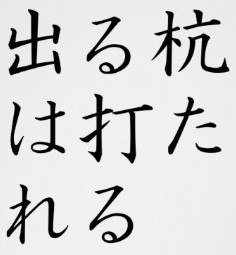
For most businesses and large corporations, the working philosophy is “don’t make waves, don’t be different, or (as they say in Japan) “the nail that sticks up gets hammered down.”
“Deru kui wa utareru” – found at Nichiren Buddhist. “Japan is a country that typically prides itself on conformity, and sees anyone who is outspoken and holds different views to popular opinion as a potential threat to the rest of the group. This lone voice must be knocked back into line. It doesn’t even matter if the difference is the teaching of a great philosophy or something that can be harmful to society, as long as you are different from the mainstream, you must be put in your place.”
Indeed, other thinkers have an entirely different take on originality; In his 1999 novel Invisible Monsters, Chuck Palahniuk wrote: “Nothing of me is original. I am the combined effort of everybody I’ve ever known.” Palahniuk is certainly correct in positing that we are all heavily influenced by our environments and whatever we have incorporated into our encyclopedic knowledge of our surroundings, but I disagree that originality is a scarce commodity. Much of it is simply drowned out in the vast sea of conformity that surrounds us. And like any other skill, the art of thinking creatively can be taught, and learned, and practiced, and developed.
A good example of thinking “outside the box” is the classic nine-dot puzzle.
‘
The challenge is to link all 9 dots using four straight lines or fewer, without lifting the pen and without tracing the same line more than once. Like “Columbus’ egg,” the solution is easy when you know how, but many people will struggle with the puzzle because they can’t get their minds outside the borders created by the dots.
The traditional solution (although there are others) is below:
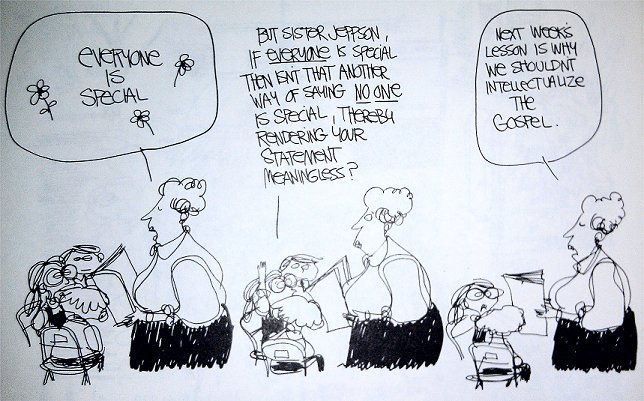
Other organizations, among whom are found religions, are also opposed to the concept of free thought. The cartoon below by Calvin Grondahl describes almost exactly my mother’s experience in Sunday School as a young girl:
As a result of this and some other similar experiences, she never darkened a church door again.
The good news is that even in the corporate world, there are those who promote, foster, and encourage difference. Apple Computer is one of these. I remember well the 1984 advert which launched the Macintosh line:
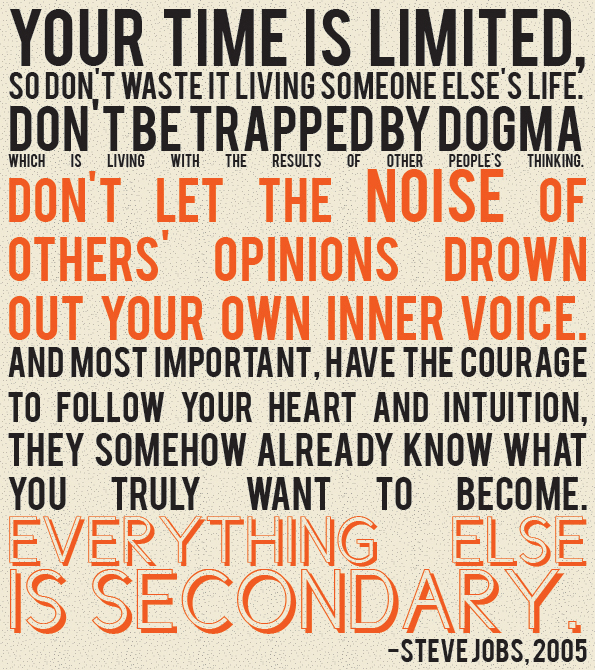
Apple’s philosophy has continued to celebrate difference – the following dictum is often attributed directly to Steve Jobs, but was in fact written by Rob Siltanen with participation of Lee Clow, and used in a couple of different advertising campaigns:
The Crazy Ones
Here’s to the crazy ones. The misfits. The rebels. The troublemakers. The round pegs in the square holes.
The ones who see things differently. They’re not fond of rules. And they have no respect for the status quo. You can quote them, disagree with them, glorify or vilify them.
But the only thing you can’t do is ignore them. Because they change things. They invent. They imagine. They heal. They explore. They create. They inspire. They push the human race forward.
Maybe they have to be crazy.
How else can you stare at an empty canvas and see a work of art? Or sit in silence and hear a song that’s never been written? Or gaze at a red planet and see a laboratory on wheels?
We make tools for these kinds of people.
While some see them as the crazy ones, we see genius. Because the people who are crazy enough to think they can change the world, are the ones who do.
To me this makes a lot of sense. One of my Facebook friends posted this today, which got me thinking down these lines in the first place:
Another one which I saw earlier and saved off is below:
Naturally, we’re not talking about real mental illness here, which is no laughing matter, and which continues to get short shrift in social and health circles – but rather the simple joy of being oneself, regardless of what the world around you happens to think. Dr. Seuss had it right,
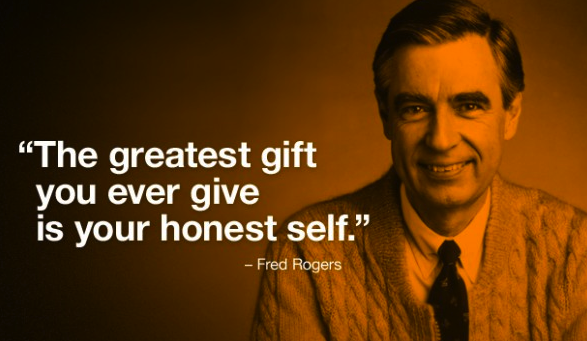
and Fred Rogers spent a lifetime encouraging children to celebrate their uniqueness:
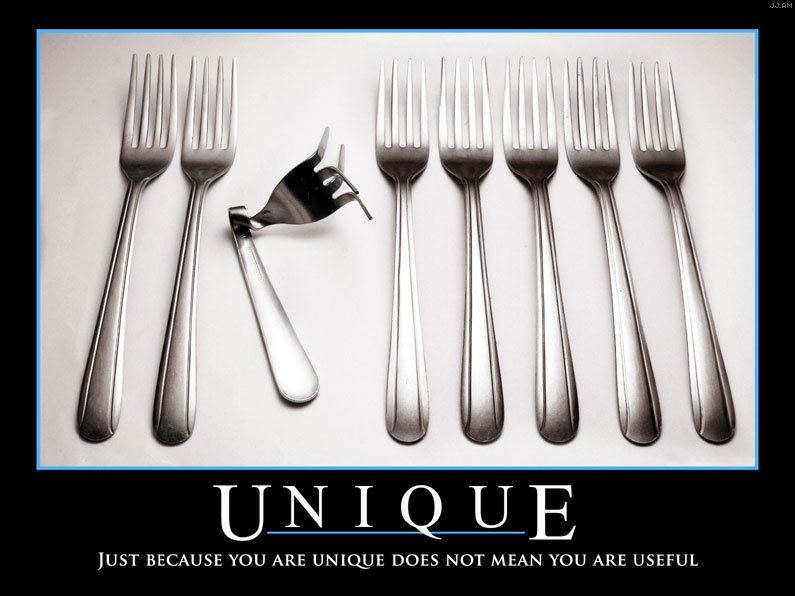
Naturally, for every good philosophy there will always be caveats:
This notwithstanding, the purpose of our existence is to find joy. It is my firm conviction that Tony Gaskins was right when he said,
“If you don’t build your dream someone will hire you to help build theirs.”
Given the emphasis on conformity, and the difficulty in breaking out of society’s molds and expectations, it should be a given that it’s not easy. But I know for a fact that it’s worth it. I have never been happier than when I was being my own vision of who I should be, rather than trying to shove myself into someone else’s mold.
Fell down this rabbit hole today and wanted to share, for no good reason. I love Girotto’s work, and this particular exercise is intriguing.
“Without bothering Jung and its “Puer aeternus” or Pascoli with its “Little Boy”, we can certainly agree that, somewhere inside each of us, there’s a young core, instinctive, creative but also innocent and naïve. What would happen if this intimate essence would be completely revealed?”
Have a look at the full exhibition and enjoy as much as I did.
Young children and babies are, with some unfortunate exceptions, almost universally cute and appealing. According to Jeffrey Kurland, associate professor of biological anthropology and human development, “we are inherently attracted to a specific set of characteristics, including large, symmetrical heads, large eyes, small mouths, and small noses.” But why do almost all humans find this particular set of features so appealing? Kurland’s answer: Evolution. Click through for the full article.
Whatever the case, those features have been admirably co-opted and sugar-coated by the ultimate wizards of cuteness, the Disney corporation; feast your eyes on this:
I was talking to the Goodwoman of the House the other day and mentioned that Rapunzel was probably the most archetypically attractive princess they’ve ever constructed; comparing her features to Girotto’s manipulation above, it’s easy to see why. Once again, “large, symmetrical head, perpetually large Bambi eyes, small mouth, and small nose,” combined with other unmistakable traits usually associated with youth and beauty. In essence, she has all the cuteness of a baby blended with the body of a youthful goddess… how could she not be universally lovable, unless you have an allergy to saccharine?
Erlandson sitting on a natural chair crafted out of trees.
Swedish-American farmer Axel Erlandson had a way of coaxing trees to do the most astonishing things, was highly secretive about his methods, and took his secrets to the grave. His trees were originally exhibited at his Tree Circus, and many were moved to Gilroy Gardens where they can be seen today.
The “two-leg tree”
Needle-and-thread tree
The Basket Tree
The Cube Tree
Hook and Eye
Another Cube Tree
Squared Circle
Knot
It’s a shame these techniques were lost. It would have been wonderful had Erlandson been able to pass his work down to the next generation. But as long as his trees live, others will be able to marvel at his skill.
Just got back from a little junket to California to see an aunt who’s almost 100, and some other friends and relatives as well. One of the things we saw while we were in Riverside, where one of my cousins graciously put us up (and put up with us) for a few days was the Mission Inn, an amazing hotel which made me think of my earlier visits to the Hotel Del in Coronado.
This enterprise began as an adobe cottage called the “Glenwood Hotel,” built by civil engineer Christopher Columbus Miller in 1876, and like the Winchester Mystery House (but a lot more sanely) has just continued to grow. We only saw a fraction of it, but what I saw was impressive. There are multiple wings with multiple flavors – Spanish, Oriental, etc.
Here are a few photos:
Special chair built for President Howard Taft for a conference. Taft’s portrait hangs in the background. He later is said to have remarked “I’m big,but I’m not that big.”
The Steinway Centennial Grand Piano. This piano was crafted as the company’s gift to the USA for the 1876 Centennial celebration. During a national tour, it was somehow “misplaced” – how one misplaces a grand piano is beyond me – but was rediscovered to be the one and only when it was undergoing restoration in the 1980s. Exactly how and when it came to the Mission Inn is unknown, but at the time of its disappearance the hotel was still a simple adobe cottage.
Herculean painting of the California Alps.
Campanero, or bell wall, built in 1903 and modeled after the belfry at Mission San Gabriel. Stairs on the right used to lead to the rooftop gardens of the original adobe building, which was later demolished in 1948 to make room for a swimming pool.
Another view of the campanero.
Restored cannon
The Nanjing bell, an imperial temple bell from the Manchu Temple in Nanjing, China. 3500 lbs, cast between 1875 and 1908. More information is readable on the plaque.
The other side of the campanero.
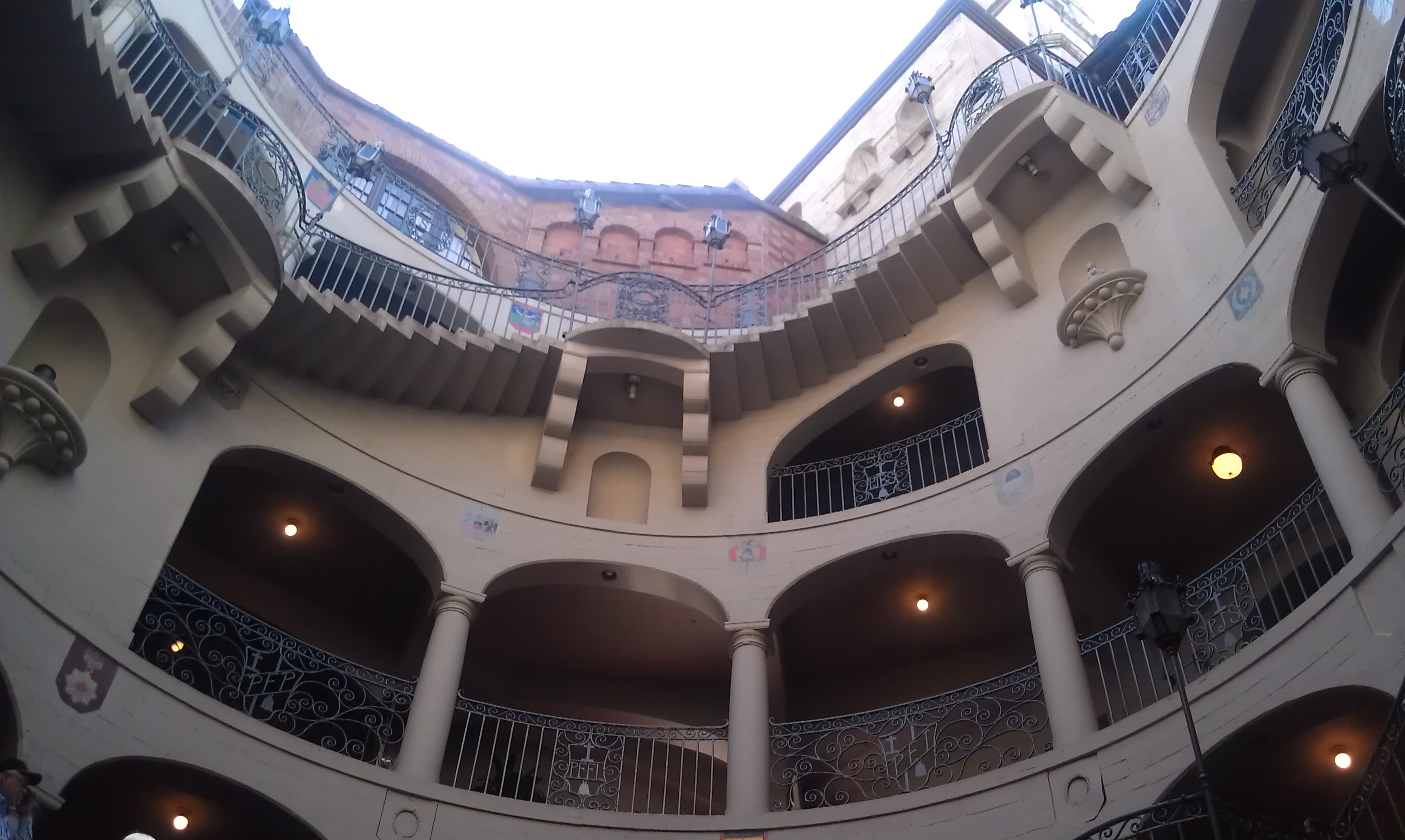
The internal rotunda. Normally accessible only by guided tour, we happened to be present when someone came out and we slipped in.
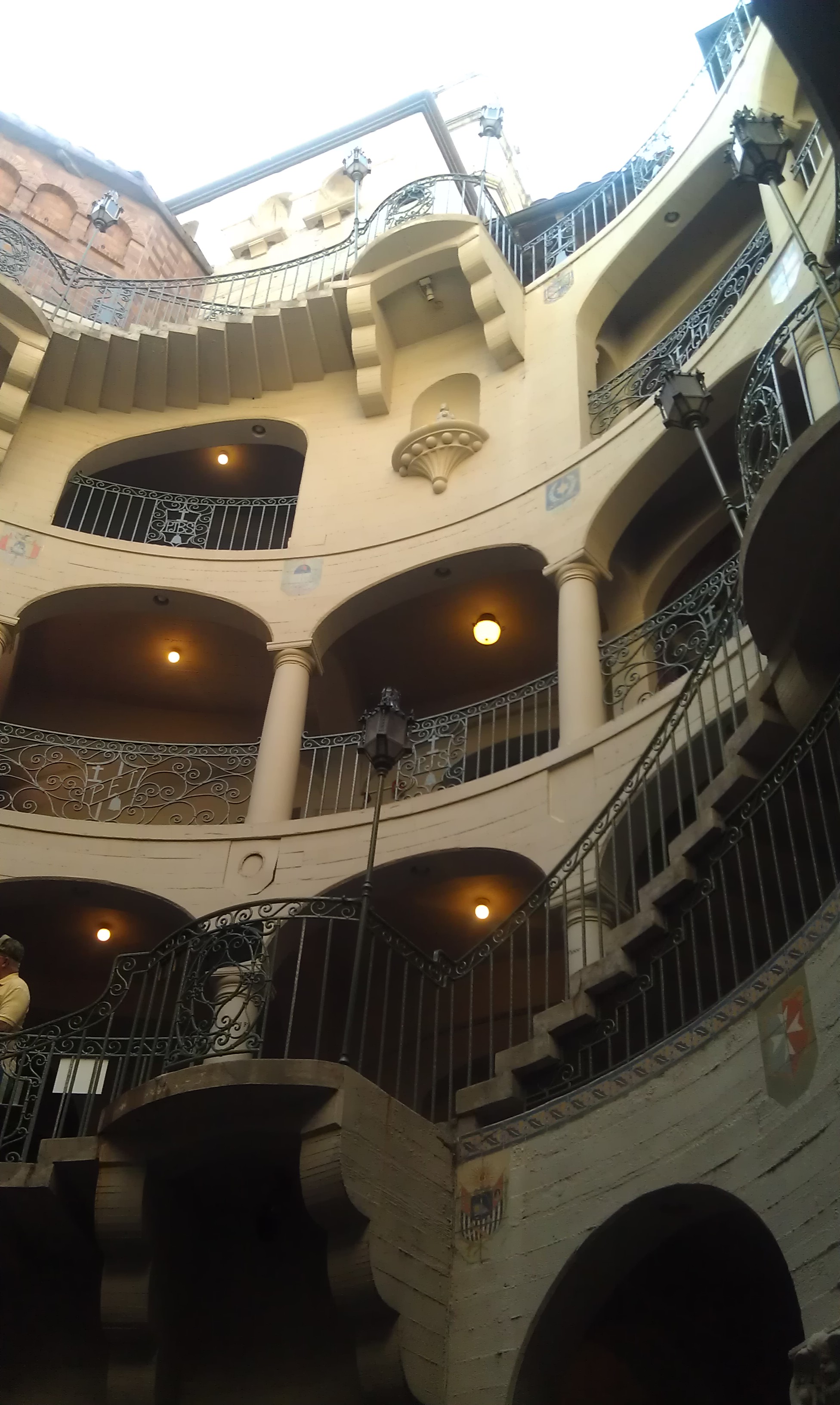
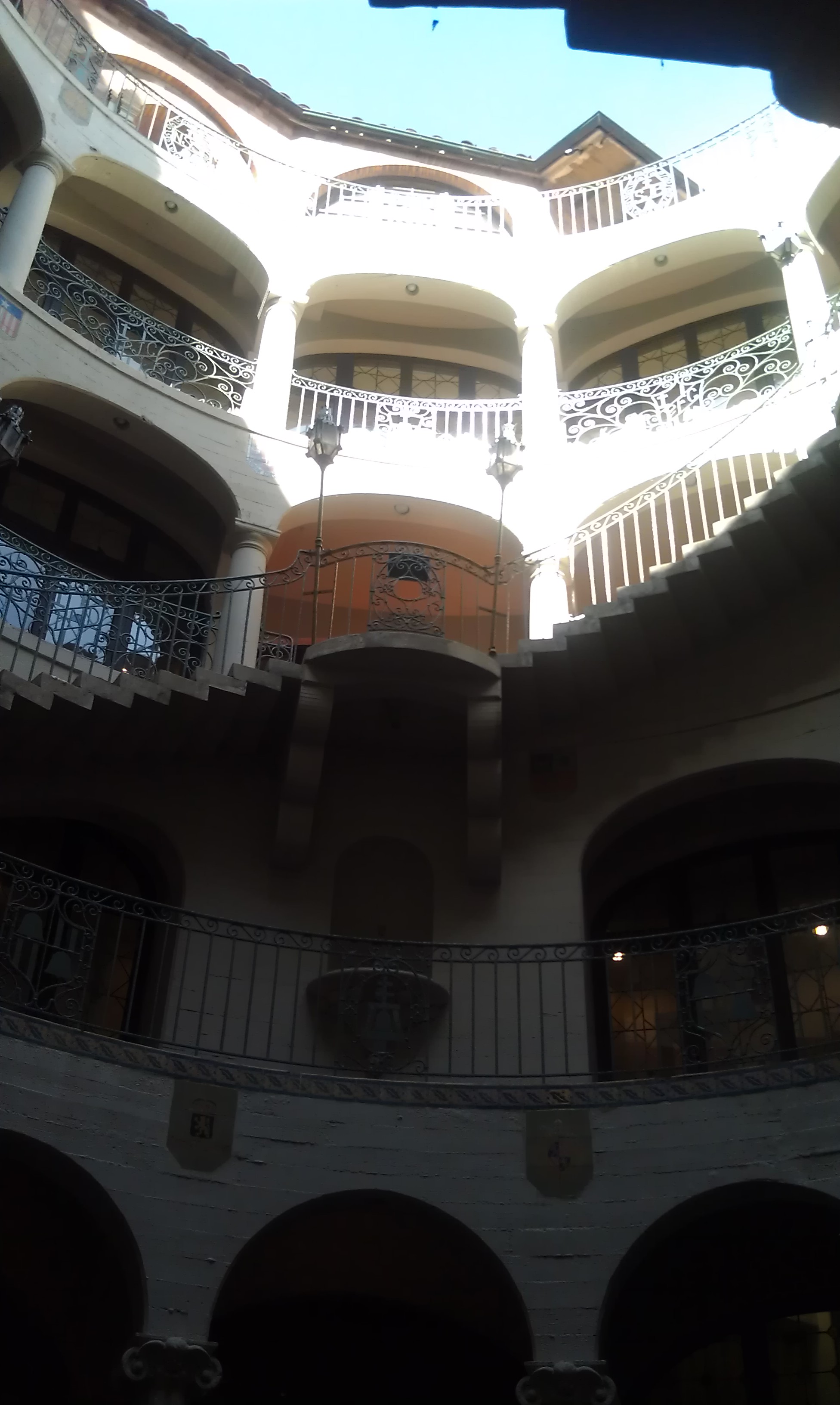
The rotunda, looking up. The stairs are structurally out of code, and are usable only by tours. There is a wonderful old elevator that ascends to each floor.
Tiled fountain at the bottom of the rotunda.
The goodwoman of the house, taking a photo of me as I take one of her.
The sky.
Another view of the rotunda.
An iron spiral fire escape in the bowels of the hotel.
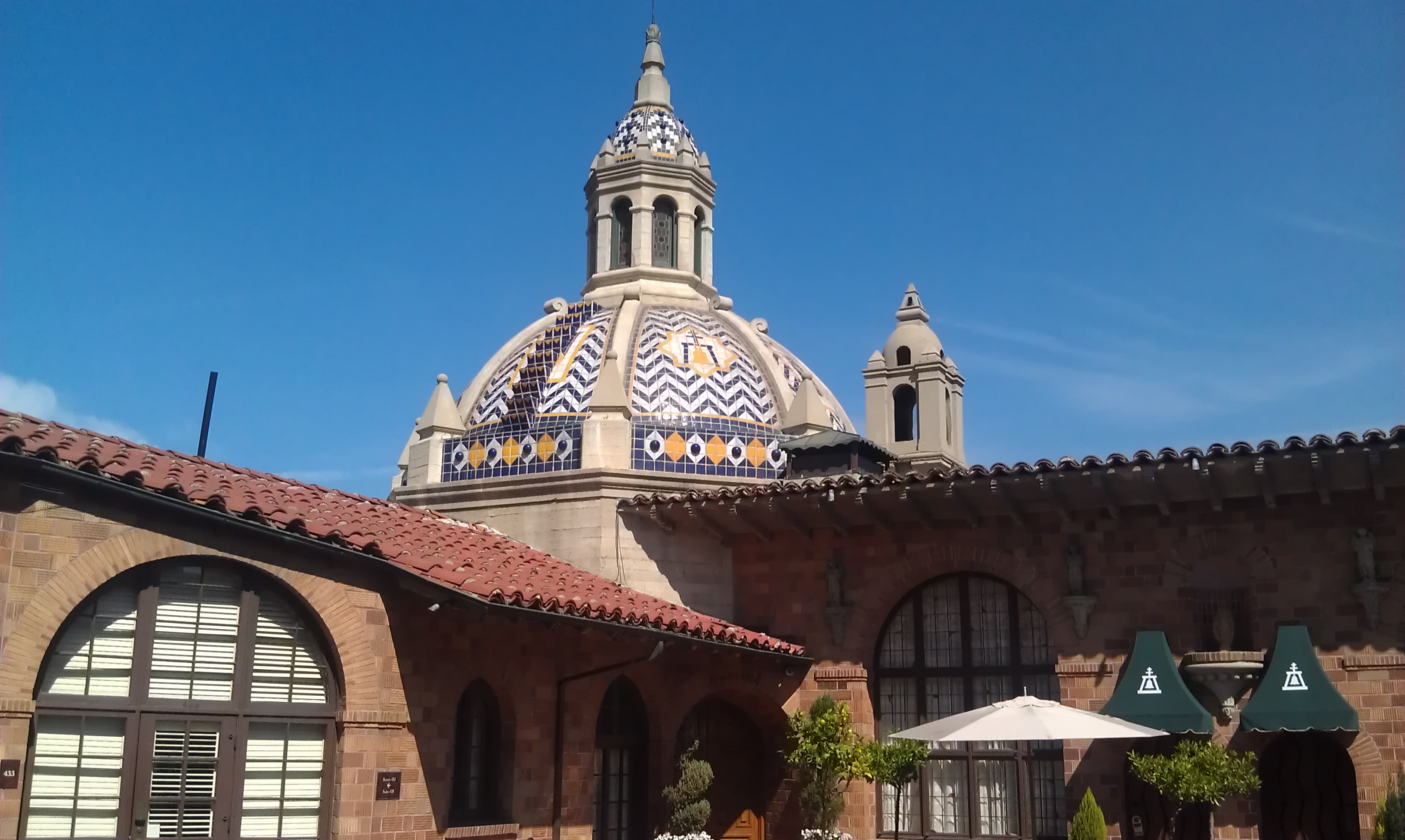
Tiled dome visible from the top level of the rotunda.
Another view
This old building on the left is also part of the Inn’s property, but has yet to be restored.
There’s so much more… I’d love to stay there some time, if I could only win the lottery or something. In the meantime, it’s nice to just stroll the grounds and the lobby.
Today is John Steinbeck’s 112th birthday – or would have been, if he weren’t dead. But some pictures that ran across my Facebook feed this morning seemed somehow relevant.
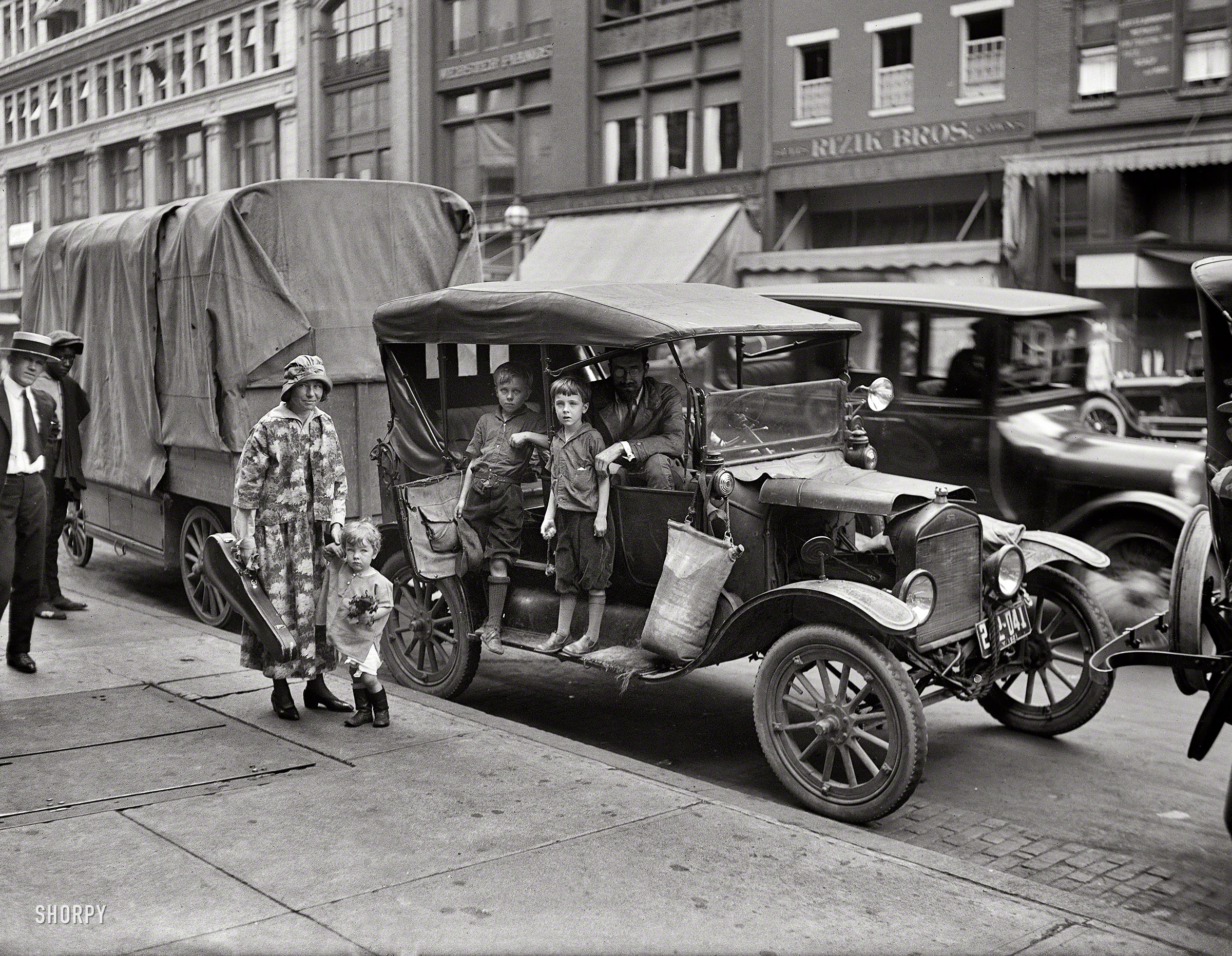
May 1921. Washington, D.C. “Professor Charles Seeger, a composer, is a brother of Alan Seeger, the war poet. His wife is a distinguished violinist.” Little Pete Seeger, 2 years old, and family along with their camping rig. Harris & Ewing Collection glass negative.
The Seeger family More on this intriguing bit of ephemera was written about in the Washington Post (text and image found at Shorpy):
Washington Post, May 22, 1921.
TRAVEL AND LIVE IN AN AUTOMOBILE
Charles Seeger, Wife and Three Sons See World While Living Outdoors
LIKE WANDERING MINSTRELS
Mrs. Seeger Famed as Violinist. Husband Professor of Music In California.
Bound for wherever they happen to stop, paying no attention to daylight saving or other forms of time, and spreading music wherever they go, Mr. and Mrs. Charles Seeger, once of the University of California and now “wandering minstrels” of the world at large, are encamped at Rock Creek park, their home an itinerant Ford and a home-made trailer. They are accompanied by their three little boys.
Mr. and Mrs. Seeger, the latter known in musical circles as Constance Edson Seeger, are taking the boys to museums and places of interest wherever they stop, and the two [older] boys are learning to play the violin.
Their Profession in Music.
“We are trying to solve the problem of educating three boys, and at the same time lead a worth-while outdoor life,” said Mr. Seeger yesterday. Mr. Seeger says that they got the idea while they were at the University of California, where he was head of the music department for seven years after graduating from Harvard and studying music in Europe and where Mrs. Seeger gave violin recitals following her graduation from the New York Institute of Musical Art and a course at the Conservatory of Paris.
The Seegers came here from Richmond and to that city from Pinehurst, N.C., where they spent some time. In addition to the three boys, Charles, 8; John, 6, and Peter, not yet 2 [actually, he had just turned 2], they have taken with them Miss Marion Brown, whom they picked up at Pinehurst and who tutors the children and cares for them while their parents are giving concerts.
The Seeger “home” is a house of five and a half feet in width by fourteen feet in length, and contains all the comforts of home, including a sewing machine, a portable organ and games for the boys. It even has a front porch, which slides under the trailer while traveling.
Going to New England.
The Seegers spent the winter at Pinehurst and are now en route to the New England States for the summer, expecting to go back South when the winter approaches again. Increasing rents make no difference in their lives, as a camping place is always available.
Mr. Seeger is the brother of the famous war poet Alan Seeger, whose “I Have a Rendezvous With Death,” written shortly before he died, has become immortal.
Mr. and Mrs. Seeger gave a concert lecture at the Corcoran Art Gallery last night.
May 23, 1921. Washington, D.C. “Professor Charles Louis Seeger and family.” Charles Seeger, wife Constance Edson Seeger and their 2-year-old son Pete, of future folkie fame. National Photo Co. Collection glass negative.
Another image of the itinerant Seegers. These images have nothing directly to do with Steinbeck, but there’s a distinctly “Grapes of Wrath” feel about their living style in these pictures. They weren’t destitute like the Joads, but my mind couldn’t help but make the connection. There is part of me that would love to be able to live on the road… as long as I had a comfortable motor home with some bookshelf space and the funds to support such a lifestyle.
As a follow-up to my post on strange ways of making music, I share with you an astonishing performance of the Mario theme (it seems to be a very popular demonstration piece) on an odd Chinese instrument called the Sheng, one of the oldest Chinese instruments known. It has an odd quality that combines a wind instrument with a steel drum. The thing I love best about this performance is the incorporation of some of the game’s sound effects into the piece.
If you want to hear a young lady really get down on the sheng in a more traditional setting, have a listen here:
For what it’s worth, some more Mario follows:
There is more of interest in the world than I could possibly learn in a thousand lifetimes.

























 Playing in the World Game