A lot of questions; a lot of answers

Yesterday’s XKCD provided readers with a plethora of questions scavenged from Google auto-complete suggestions. Some of them are really good questions, others are pretty mind-boggling in their obtuseness or obscurity. Click the image for a full-size rendition:

questions_large

Not content to leave things at that, redditor /u/GeeJo took it upon him/herself to answer every one of these, which was a massive undertaking and made for an enjoyable read. Starred answers indicate researched questions, non-starred answers are GeeJo-isms. My hat is off to this individual.

Block One

Why do whales jump*? No-one knows exactly, though it’s theorised that socialising is part of it, as its a far more common behaviour in pods than with lone whales.

Why are witches green? There are theories floating around tht it’s to link them with death/putrefaction or plants/herbs. Personally, I think it’s mostly because of the popularity of the film version of The Wizard of Oz, where the green skin was chosen partly to indicate she’s a bad guy in a kid’s fantasy world, and partly because it helped demonstrate their new Technicolour technology.

Why are there mirrors above beds? Ask your parents when you’re older. Or don’t, since you’ll probably work it out by yourself by then. If you mean on the wall behind beds, I’ve never really seen this as common, but mirrors help to give the impression that the room is larger than it actually is.

Lots, lots more after the jump.

Continue reading

Could you direct me to Poo-yallup?

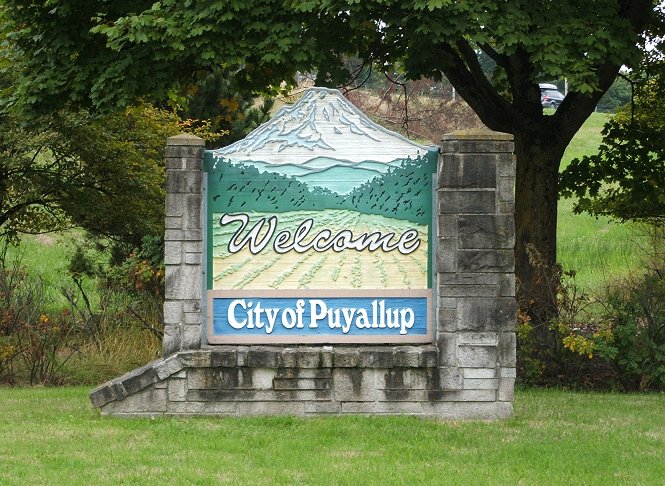
Puyallup

“Then said they unto him, Say now Shibboleth: and he said Sibboleth: for he could not frame to pronounce it right. Then they took him, and slew him at the passages of Jordan: and there fell at that time of the Ephraimites forty and two thousand.” (Judges 12:6)

That particular biblical verse gave rise to the general concept of a shibboleth, a word, sound, or custom that a person unfamiliar with its significance may not pronounce or perform correctly relative to those who are familiar with it. (Wikipedia)

Ever since ancient times, pronunciation has been a pretty accurate way of determining whether a person is a local or not. During World War II, the Dutch used Scheveningen to weed out German infiltrators, and Americans in the Pacific used lollapalooza to challenge unknown persons, knowing that the Japanese have a difficult time with the sounds of L and R.

Quincy_Market_and_Faneuil_Hall,_Boston,_Mass._U.S.A,_by_Keystone_View_Company

Quincy Market and Fanueil Hall, Boston

A Bostonian doesn’t need to be a Henry Higgins to know that someone who speaks of “fan-you-ale” Hall isn’t a local. Bostonians pronounce it “fan’l” or “fany’l” (/ˈfænəl/ or /ˈfænjəl/, if you are familiar with IPA). Of course, Bostonians have a strange way of speaking altogether, but we won’t hold that against them.

When we moved to the Pacific Northwest back in 1980, we encountered a whole ‘notha set of odd pronunciations than the ones we had learned as Utahns (more about that in a bit.) See, the name of that town up there is “pyoo-ALLUP” (/pjuːˈæləp/). “Pend Oreille” County kept the French pronunciation – it’s closer to “ponderAY” than “pen-DOR-ial,” which I have heard more than once. But strange pronunciations of local names are found all over – Natchitoches, Louisiana is pronounced “NAK-i-tesh” (/ˈnækɨtəʃ/) instead of “natchi-TOE-chez”.

Since I’m basically a Utah boy at this point (although my heart is still rooted firmly in Manhattan Island), we’ve gotten used to our own share of odd place names:

  • Tooele – Not “TOOL-y”, but “too-ILL-a” (/tuːˈɪlə/)
  • Hurricane – This is pronounced “HER-kin” by the locals, to rhyme with “Laverkin.”
  • Mantua – Unlike the city in Italy, this is pronounced “MAN-away” (/ˈmænəweɪ/)

A delightful tribute to some of the odd names found in Utah is below – a buddy of mine in Australia, although he has never set foot in America, can recite this almost by heart.

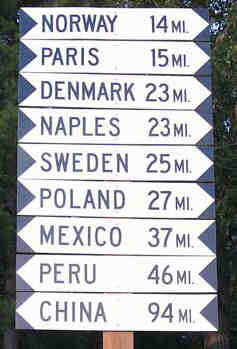
Thanks to Phantomdiver, a list of Virginia place names, prompted by the pronunciation of McGaheysville (mi-GACK’-eez-vill), and here’s an article about place names in Maine.

roadsign

Apparently “Calais,” not on the list above, is pronounced like those hard spots that develop on your hands and feet (“callus”).

Click through for a much larger list of place names in the USA that have counter-intuitive pronunciations; there is also a list which covers other countries as well.

The Old Wolf has spoken.

So let it be written!

Writing has been around for a long, long time. The earliest proto-writing systems are estimated at around 7,000 BC, and today there are over 30 writing systems in common use, and a number of others that are used in specialty situations.

The map below, found at Wikimedia, shows the world’s main writing systems and their geographical distribution.

WritingSystemsOfTheWorld

Only current writing systems are mentioned on the map above – there have been many, many more throughout history, each a subject of much study and fascination to those who enjoy such things.
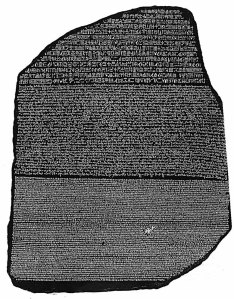
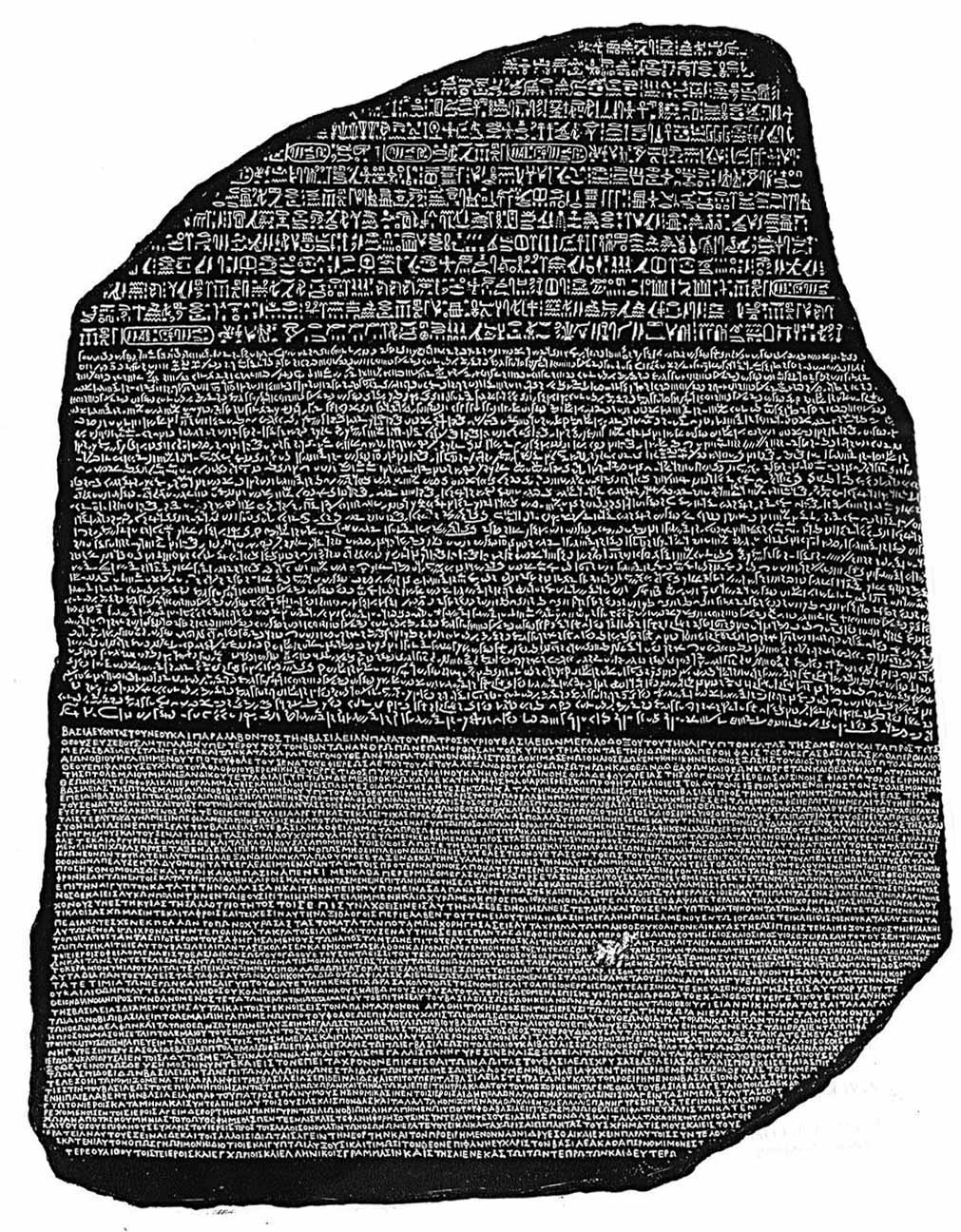
rosetta-stone  Rosetta_Stone

No story is better known than the decipherment of the Rosetta Stone. While  Jean-François Champollion made the most significant breakthrough regarding the transliteration of Egyptian hieroglyphics, the stone had been studied by numerous other scholars since its discovery in 1799.
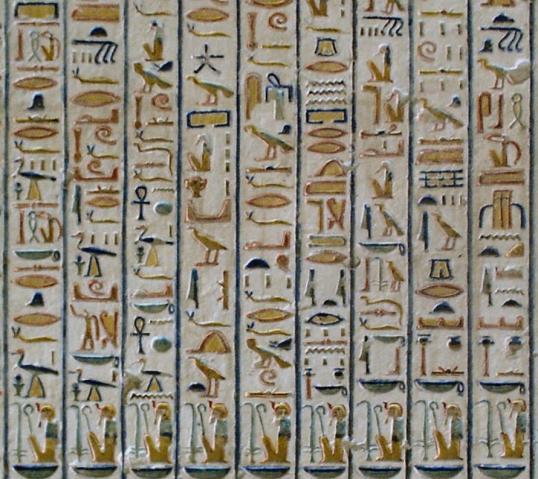
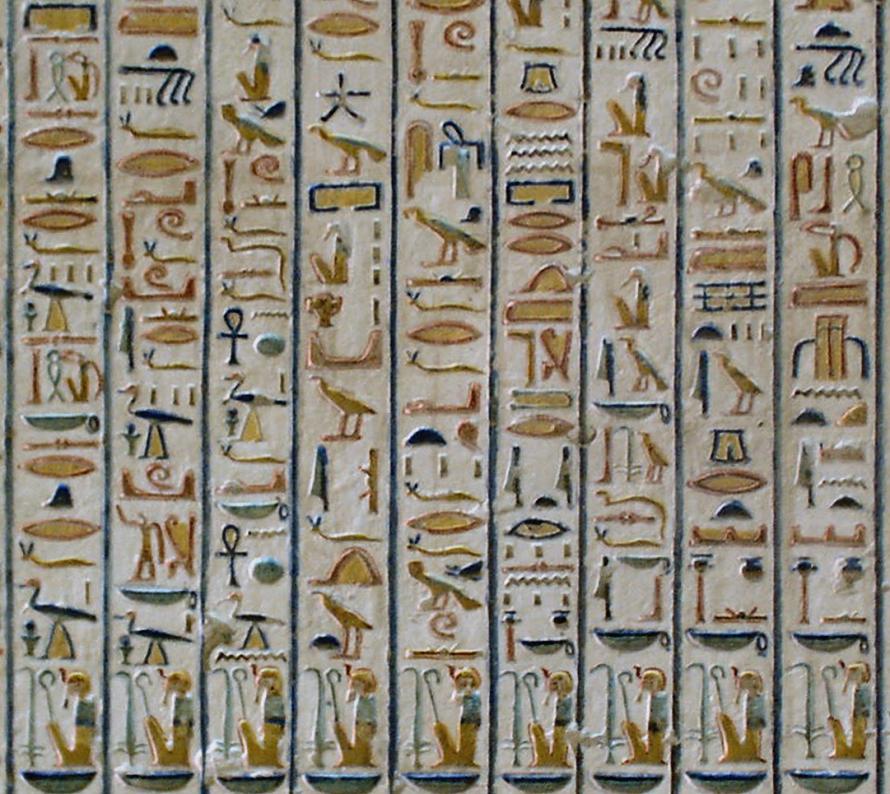
hieroglyphs01

Heiroglyphics from Luxor, Egypt

As the second image of the stone above shows, the thing is massive – I saw it on display at the British Museum in the 90’s at which time it was just sitting out there for all the world to see behind some velvet ropes. I’m sure the curators would have been dismayed to see me reach out and touch it, but it’s not often one gets a chance to surreptitiously connect on a physical level with such a famous artifact; now it’s much better protected. [1]

A few thoughts on some of the writing systems in use today, and some others gone by:

Ideographic Script

My previous post about the hazards of translation makes reference to ideographic writing; despite the challenges, character scripts are intriguing and rich in both history and cultural significance. Let’s look at an example of how this writing system works, taking Mandarin Chinese as  an example:

The word for “sun” in Mandarin, is written 日. In fact, it used to be written Sun, which looks pretty much like the sun.

Early Chinese people wrote the word for “moon” as  Moon – looks pretty logical, doesn’t it? That changed over time to月. Put those two together and you have the word for “bright”: 明. The Chinese word for “man” looks just like a man walking: 人. The word “big” (大) is just like a fisherman saying, “You should have seen the one that got away – it was this big!” The word for “heaven” (天) can be remembered easily if you think “man, no matter how big, is still under heaven.” A Chinese tree is written木, and if you put a picture of the sun rising behind a tree, you have the word for East: 東 , which was later simplified to become东. As you can see, it’s not that scary. Naturally, many characters are more complicated than these, but every character has a story. [2]

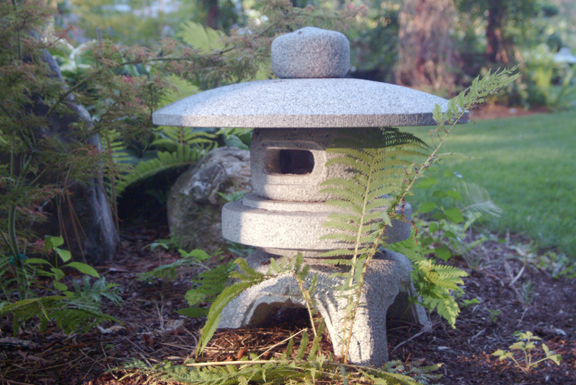
The Japanese borrowed many characters from the Chinese, but changed their pronunciation and meaning based on their own language. As a result, most Japanese characters have at least two pronunciations – one based on the original Chinese, and one more specific to the Japanese language; for example, the character for “east” (東) is pronounced “higashi”, but in compounds it is pronounced “tō”, as in 東京 (tōkyō, or “eastern capital”). Notice that second character – it looks a lot like the standard stone lanterns one sees all over Japan, and which came to symbolize the main city of a region as these lanterns often stood outside the gates.

stone lantern-11

I have previously mentioned the story of the Hitachi logo which gives a bit of a feel for how these characters can be used in a creative manner. The possibilities are endless.

Arabic

The Arabic alphabet has 28 letters. Each letter, however, has four forms, depending on where it is found in a word—At the beginning, in the middle, at the end, or all by itself. These are called initial, medial, final, and standalone/isolate. Arabic is written from right to left, and is written without most of the vowels, although the vowels are added with diacritics (accent marks) for learners and in sacred texts.

arabic

Beginning language learners often ask, “how in the world can you read a language without vowels?” Well, the bottom line is that you get used to it. Even English has had experience with such things – have a look at “f u cn rd ths.” As people learn to read, at some point in their development they stop “decoding” (reading and sounding out each letter/sign individually and take in words as discrete units. Even a word like “antidisestablishmentarianism” will be read by an educated English speaker as a single word rather than a collection of letters, which shows how orientals can look at a character like “biáng” ( Biáng.svg) and instantly know what it means, despite the fact that it has 58 strokes. [3]

Arabic writing plays a critical rôle in Islamic society, as Islam forbids the use of “graven images” – hence mosques are decorated not with pictures, but rather with words… words represented beautiful calligraphy.

sultan-ahmed-mosque-in-istanbul-turkey-calligraphy

Some less-used but still current scripts include:

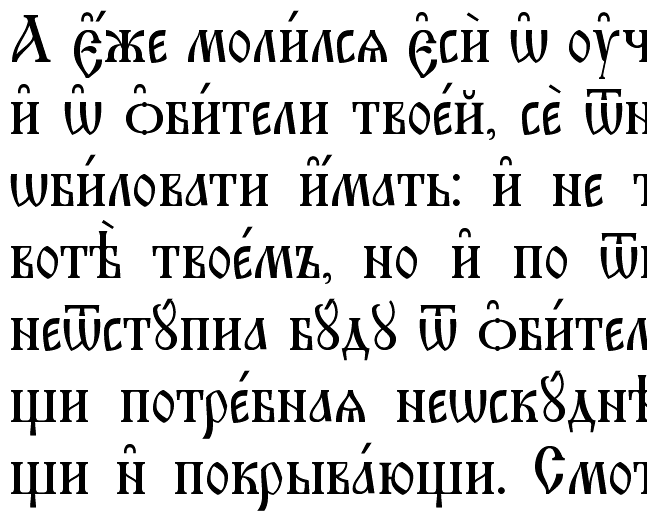
STAROSTA

Old Church Slavonic

65873-004-5FA32723

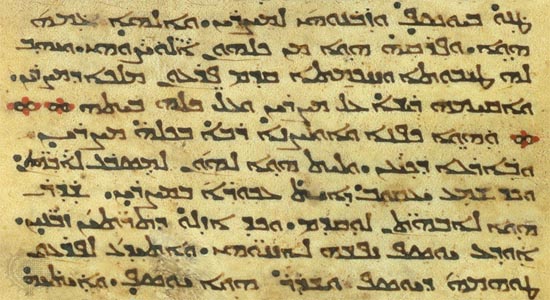
Syriac

langfams_coptic

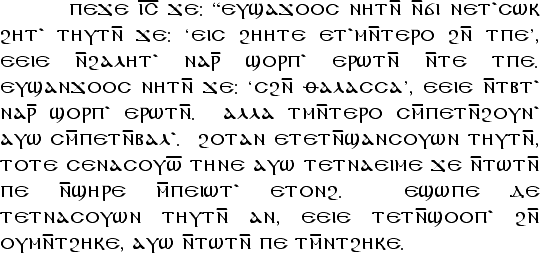
Coptic

takri4

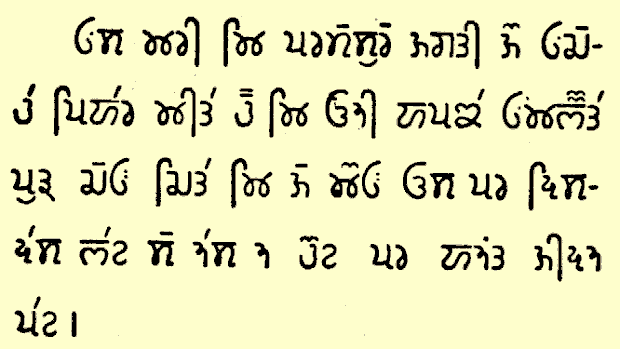
Takri (Tankri)

Ancient Scripts no longer used
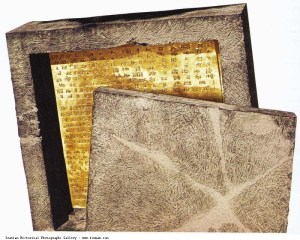
Cuneiform_Gold_Plate_Perspolis

One of four Cuneiform Gold Plate in Perspolis that were buried under foundation columns.

In addition to Egyptian heiroglyphics, there were many scripts used by ancient peoples, including cuneiform, Linear A, Linear B, and a host of others. A wonderful reference can be fount at ancientscripts.com.

In addition, there is an entire raft of scripts that have yet to be deciphered – a good summation is found at Omniglot.

As you can imagine, The History of Writing is a broad enough subject to keep countless professors and graduate students published until the end of time.

The Old Wolf has spoken.


[1] I’m reminded of the scene in Star Trek: First Contact where Picard caresses Cochrane’s original warp vessel; as he explained to Data, “For humans, touch can connect you to an object in a very personal way. It makes it seem more real.” I agree completely.

[2] The love of people for things Asian has caused more than a bit of embarrassment in modern society – for some examples, have a look at my previous post “How Not to Get a Tattoo.”

[3]  The Chinese character for “biáng” is one of the most complex Chinese characters in contemporary usage, although the character is not found in modern dictionaries or even in the Kangxi dictionary. The character is composed of 言 (speak; 7 strokes) in the middle flanked by 幺 (tiny; 2×3 strokes) on both sides. Below it, 馬 (horse; 10 strokes) is similarly flanked by 長 (grow; 2×8 strokes). This central block itself is surrounded by 月 (moon; 4 strokes) to the left, 心 (heart; 4 strokes) below, 刂 (knife; 2 strokes) on the right, and 八 (eight; 2 strokes) above. These in turn are surrounded by a second layer of characters, namely 宀 (roof; 3 strokes) on the top and 辶 (walk; 4 strokes) curving around the left and bottom.

500px-Biáng.svg

Bite the Wax Tadpole: The Risky Business of Translation

Cross-posted from LiveJournal.

Before you jump down my throat with both feet, let me assure you that I’m fully aware Coca-Cola™ never used the title of this essay as the name of their product in China. That little legend arose as eager shopkeepers devised phonetic representations for a new product without regard to meaning, and before Coke™ had settled on an official translation. “Bite the Wax Tadpole” was only one of many such renderings that arose.

Having disposed of that matter, translators and interpreters walk a fine line.

A success can mean acclaim and bringing pleasure to thousands of people, in the case of a well-received literary translation, such as Howard Scott’s translation of The Euguelion.

A mis-step can result in anything from simple pwnage to an international incident.

For no reason other than feeling contrary today, I thought I’d pull together some of the more notable failures in the world of translation – some traditional, others inspired by the ease of access to quick (and very often, dirty, in the classical sense) translation via the web.

First, the urban legend category.

  • The Chevrolet Nova sold quite well in its target markets, Mexico and Venezuela, despite being able to wring the meaning “doesn’t run” (no va) out of the name.
  • American Airlines never had a “Fly in Leather” campaign, which reputedly was translated to “vuela en cuero”, which is only one letter away from “fly naked” (en cueros).
  • I suspect that most of the lists of supposed translation bloopers from hotels and shops around the world have some basis in fact, but the large body of them are unverifiable, and these are forwarded with so many reputed sources that they have long since passed into the realm of probable fiction. A couple of classics: “The flattening of underwear with pleasure is the job of the chambermaid. To get it done, turn her on.” “The lift is being fixed for the next day. During that time we regret that you will be unbearable.”

Some real examples

55312_600

I love this one.

The Chinese characters say “Restaurant”, but what they really wanted to call it is unknown. Whoever was assigned to do the translation turned to an online translator which failed, and served up what you see here. Not knowing English, the translator blithely copied what he or she assumed meant “Garden of Delights” or whatever, and the world was given something else to laugh at.

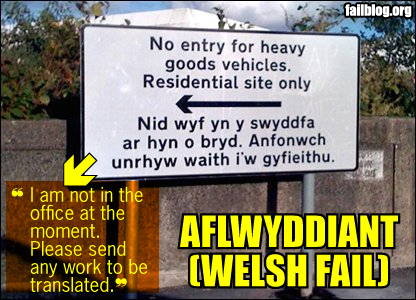
The Chinese, however, are not the only ones to suffer from this syndrome

55597_600

The picture is self-explanatory. Once again, some bureaucrat assumed that what showed up in his or her inbox was the requested translation, and having no knowledge whatever of Welsh, this was the result. This sign, however, was quickly removed.

Alas, the sword has two edges. Have a look at a cartoon published a year ago by a dear friend of mine – with no disrespect intended!:

CarryOn20080820[1]

Instead of an anatomical impossibility, what the irate Kuchiku is screaming at her monitor is “Information Not Found!”; as the artist couldn’t read Chinese, she assumed that her Google Translate search was returning an actual value rather than an error message. A more detailed writeup of this particular incident is here.

Here’s an unsettling one, found recently at Failblog.org

lightswitch-fail[1]

By the sacred skull of Mogg’s grandmother, turn it off!

Before even perusing the comments at that entry, I began following the logic that led to this strange error. Surprisingly, it’s not as counter-intuitive as you might suppose, given the complexities of the Chinese language.

“Nightlight” is correctly translated as 夜灯:

夜 ye4 “night”
灯 deng1 “light”

Some translations add 小 xiao3 “small”.

I figured the other switch, beginning as it did with 天 tian1 “heavenly”, was supposed to be the overhead light, and it turns out I was correct. The Chinese word for “ceiling” is 天花板, or “overhead flower plank”.

Ceiling
天 tian1 Heavenly (by extension, overhead)
花 hua1 Flower
板 ban3 Plank

Now, the word for “lantern” is a delightful 花灯 “flower light”, which makes perfect sense.

Lantern
花 hua1 flower
灯 deng1 light

Thus by extension, a ceiling light, or overhead light, becomes 天花灯 “overhead lantern”

Ceiling (overhead) light
天 tian1 heavenly, above, overhead
花 hua1 flower
灯 deng1 light

The problem arose because for some unknown reason, “Smallpox” was designated as 天花 or “heavenly flower”

Smallpox
天 tian1 heavenly
花 hua1 flower

From here it’s easy to see how someone using either an online translator or even a regular dictionary, and without a good knowledge of english, could parse the word incorrectly and come up with “Smallpox light”

The net is full of such delights:

Endless other examples can be seen at Engrish.com.

Translation and interpretation are true art forms. While the modern tools available to us have their use, there is no danger that the language professionals who dedicate a great deal of time to receiving the necessary education and experience for their craft will be out of a job any time soon – at least not as long as there are those who care about getting it right.

As for me, I don’t think I’ll be staying at the smallpox hotel anytime soon.

The Old Wolf has spoken.

Skinny Townhouse, $3¼ million.

8 feet four inches wide at its widest spot, the narrowest townhouse in New York has sold for 3.25 million dollars.

Bedford

990 square feet is described by the New York Post as “underfed,” but I compare that to my first home in south Provo, Utah, which had 800 square feet finished. Yes, there was an unfinished basement of the same size, but we didn’t use it for much except storing a few things.

This particular home was built in 1873, and has housed such famous individuals as Edna St. Vincent Millay, who wrote “Ballad of the Harp-Weaver,” there in 1923-24.

945612-0-20130815132426

Edna St. Vincent Millay and husband Eugen Jan Boissevain in front of the townhouse.

I seriously don’t understand the economics of New York City, even though I grew up there. Who’s got the money to rent this place for $14,000 a month? The 1%, I guess.

Intersting piece of New York trivia, at any rate. See the Post article linked above for more interesting bits and pieces about this little home.

The Old Wolf has spoken.

Come knock me up tomorrow morning, I’ll give ye sixpence!

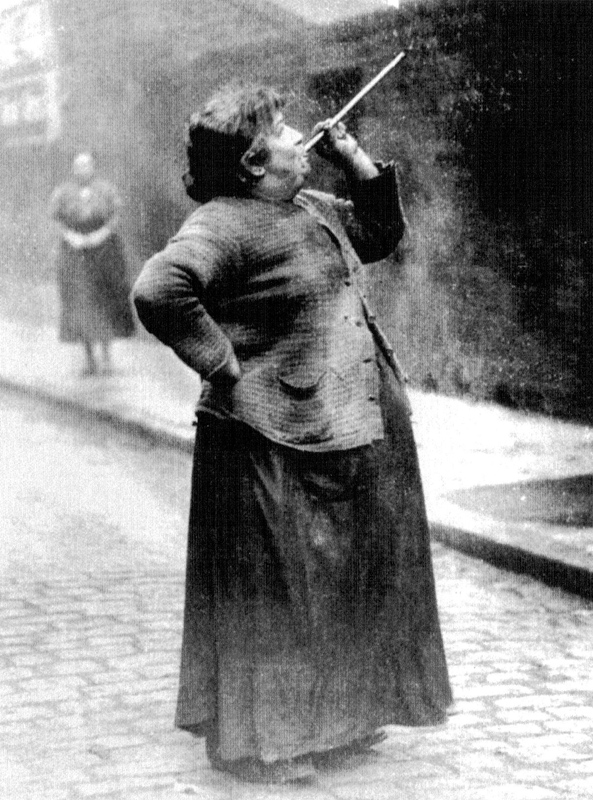
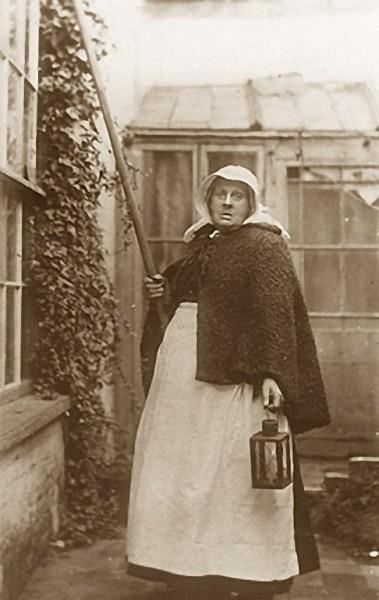
Sounds terrible, right? Not over in the UK. “A knocker-up (sometimes known as a knocker-upper) was a profession in England and Ireland that started during and lasted well into the Industrial Revolution and at least as late as the 1920s, before alarm clocks were affordable or reliable. A knocker-up’s job was to rouse sleeping people so they could get to work on time.” (Wikipedia)

Knocker-up

Knocker-up using a bamboo pole to rap at an upper window

Mary Smith of Limehouse Fields

Mary Smith of Limehouse Fields, who was known for using a pea shooter.

breakfast-s-ready

Caroline Jane (Granny) Cousins – you can read much about her at Dorset Ancestors.

The Old Wolf has spoken.

Their likes shall not be there again

A small tribute to the Waterford Crystal Factory in Kilbarry, Ireland, which I filmed during a family visit in August of 1998. The factory closed under unfavorable circumstances on 30 January 2009; workers staged a two-month sit-in to protest the closing, which only ended in March of that year when they accepted a payout of €10m, but many had worked there all their lives. A PBS Documentary chronicled their last fight.

The cinematography here is not the best, but I’m pleased with the video; the music seems to say just the right thing.

Tá an Sean-fhaolchú labhairthe.


A profession you probably didn’t even know existed…

… and which doesn’t exist any more.

1360_10151738932328851_754066375_n

The “Kargadoor” (lit. “Cart-Move-Onward”) would help pushcarts over Amsterdam’s many humpback bridges (photo 1922).

I spotted this photo over at Reddit, posted by /u/lordsleepyhead, and found it intriguing.

Thanks to a friend, I found some further information over at De Jordaan (translation is mine)

High bridges were a source of income for the Kargadoor; these were men who pulled heavy hand carts over a bridge with a rope and hook. Their tool was a long rope with a hook on it. These cart pullers generally had a leather patch on their shoulder to keep from getting hurt by abrasion.
What’s more, this Kargadoor was in turn a source of income for the landlord of the slijterij de Grote Slok (Big Gulp Liquor Store) on the corner.
One of the bridges over the Prinsengracht was the domain of Kiki the Kargadoor. He would leave his permanent home when he had gathered six or seven cents; Kiki would disappear to spend his money on drink, all the while keeping the bridge in sight.
He was a bandy-legged little man who could swear like a champion; children always considered him to be a good language teacher.
Kiki was born in 1865 and had a home in the Boomstraat. He passed away at the Municipal Nursing Facility at the Roerstraat in 1940.

Hoist a glass to Kiki, the Kargadoor!

A60Mf133

The caption on the sign reads, “Today Kiki is 75. He’s been a Kargadoor for 50 years.”

The Old Wolf has spoken.