“The tiny Brittany town of Plougrescant’s claim to fame is a puzzling little house situated between two granite rocks by the sea.
The residence, Castel Meur, was built in 1861 with a specific goal in mind — to ward off the destructive heavy winds and storms the area is often troubled by.
After a postcard of the property created to boost local tourism caused such a stir with tourists that the private residence suffered damage, visitors can now only admire its unique form from a distance.”
Oskar Sala (1910-2002) was a German composer. Paul Hindemith, Sala’s composition professor at the Berlin Academy of Music, introduced his student in 1930 to the engineer Friedrich Trautwein. Together they developed the Trautonium, one of the first electronic instruments. Its development paralleled the thermin and was a precursor to the synthesizer, resulting in a device that lets you mimic not only traditional musical instruments, but can produce voices, animal sounds and synthesized sounds (subharmonics).
In this video, Oskar Sala gives a demonstration of the Trautonium in the Hague. The body of the instrument is similar to that of a pipe organ, having two ‘manuals’ that are played with the fingers, although the normal configuration of black and white keys is missing. Mr. Zaun, a German, gives an introduction, and Sala is accompanied by a pianist as he plays the Trautonium.
Note: This post was originally entitled “Words and expressions that we wish English had.” Other such articles describe “untranslatable words.” Since an English gloss is provided for each term, I don’t find them untranslatable – they just carry a lot of meaning in a single lexeme, and there may not be an individual single word in other languages that carries the same signatum.
While these two are not gazing at each other, the essence of mamihlapinatapei, which I posted about earlier, is captured here.
This list of words for which there is no English equivalent popped up on the internet over at TheWeek a couple of days ago, and I’ve seen it referenced by more than one friend on Facebook:
1. Shemomedjamo (Georgian)
You know when you’re really full, but your meal is just so delicious, you can’t stop eating it? The Georgians feel your pain. This word means, “I accidentally ate the whole thing.”
2. Pelinti (Buli, Ghana)
Your friend bites into a piece of piping hot pizza, then opens his mouth and sort of tilts his head around while making an “aaaarrrahh” noise. The Ghanaians have a word for that. More specifically, it means “to move hot food around in your mouth.”
3. Layogenic (Tagalog)
Remember in Clueless when Cher describes someone as “a full-on Monet… from far away, it’s OK, but up close it’s a big old mess”? That’s exactly what this word means.
4. Rhwe (Tsonga, South Africa)
College kids, relax. There’s actually a word for “to sleep on the floor without a mat, while drunk and naked.”
5. Zeg (Georgian)
It means “the day after tomorrow.” Seriously, why don’t we have a word for that in English?
6. Pålegg (Norwegian)
Sandwich Artists unite! The Norwegians have a non-specific descriptor for anything — ham, cheese, jam, Nutella, mustard, herring, pickles, Doritos, you name it — you might consider putting into a sandwich.
7. Lagom (Swedish)
Maybe Goldilocks was Swedish? This slippery little word is hard to define, but means something like, “Not too much, and not too little, but juuuuust right.”
8. Tartle (Scots)
The nearly onomatopoeic word for that panicky hesitation just before you have to introduce someone whose name you can’t quite remember.
9. Koi No Yokan (Japanese)
The sense upon first meeting a person that the two of you are going to fall in love.
10. Mamihlapinatapei (Yaghan language of Tierra del Fuego)
This word captures that special look shared between two people, when both are wishing that the other would do something that they both want, but neither want to do.
11. Fremdschämen (German); also Myötähäpeä (Finnish)
The kinder, gentler cousins of Schadenfreude, both these words mean something akin to “vicarious embarrassment.” Or, in other words, that-feeling-you-get-when-you-watch-Meet the Parents.
12. Cafuné (Brazilian Portuguese)
Leave it to the Brazilians to come up with a word for “tenderly running your fingers through your lover’s hair.”
13. Greng-jai (Thai)
That feeling you get when you don’t want someone to do something for you because it would be a pain for them.
14. Kaelling (Danish)
You know that woman who stands on her doorstep (or in line at the supermarket, or at the park, or in a restaurant) cursing at her children? The Danes know her, too.
Such lists are quite common around the net, and I thought I’d add a few which I’ve gathered along the way.
German has quite a collection of these gems:
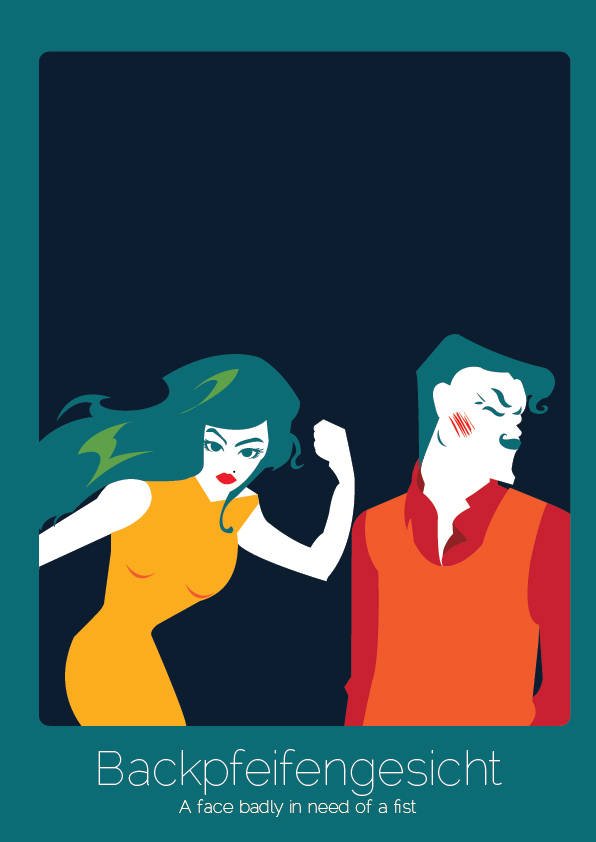
Backpfeifengesicht: A face badly in need of a fist.
(For more lovely illustrations of some of these terms, head over to Anjana Iyer’s “Found in Translation” page.)
Buchtrauer: the period of mourning that follows the ending of a beloved book. [Note: I made this word up recently, as I finished Lord of the Rings for the nth time. Others may have come up with it independently, but I claim it as my own.]
Drachenfutter: Peace offerings for wives from guilty husbands. Lit. “Dragon fodder”
Erklärungsnot: The feeling of discomfort brought on by the inability to come up with a satisfactory explanation.
Fernweh: A feeling of homesickness for a place you have never visited.
Fisselig: Flustered to the point of incompetence – a temporary state of inexactitude and sloppiness that is elicited by another person’s nagging.
Fremdschämen – agony over someone elses misfortune.
Futterneid: The feeling you get when you order something at a restaurant and you envy what someone else has ordered.
Gardinenpredigt: A verbal diatribe along the lines of “Why can’t you get off your lazy butt and get a job, oh my blessed mother was right, I could have married that fine doctor next door but no, …”. Lit. “Curtain Sermon”
Gretchenfrage (German)– A question asked for the purpose of finding out someone’s real intentions.
With thanks to Jenner. I sent this strip to my wife when I was interested in ramping up our relationship.
Gemütlichkeit: A German word which describes, according to Wikipedia, “a space or state of warmth, friendliness, and good cheer. Other qualities include coziness, peace of mind, belonging, well being, and social acceptance.” Imagine sitting in front of a warm fire on a frosty night, with a good book in one hand and a glass of your favorite beverage at your side…
Korinthenkacker: a person overly concerned with trivial details. Lit. “Currant crapper”
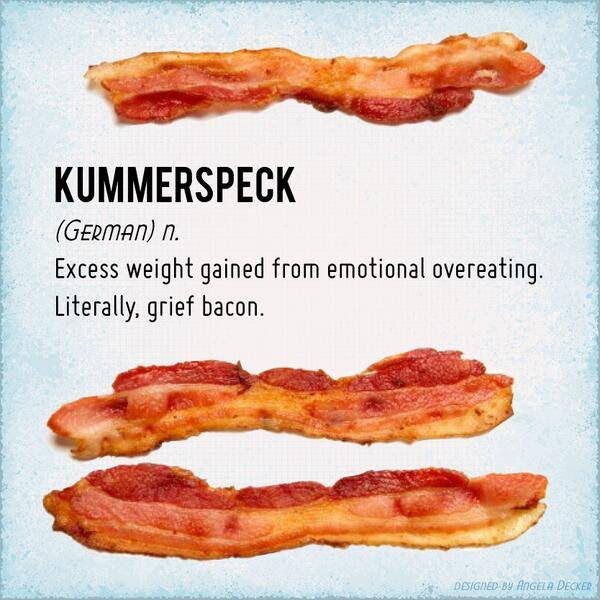
Kummerspeck: Excess weight gained from emotional overeating. Lit. “Worry bacon”. The bacon part refers not to what we eat, but to the excess pounds we put on as a result.
Luftmensch: (air person) A dreamer
Luftschloß: A castle in the air, an unattainable dream.
Neidbau: A building (often of little or no value to the proprietor) constructed with the sole purpose of harassing or inconveniencing his neighbor in some way.
Radfahrer: One who flatters superiors and browbeats subordinates
Ruinenlust: The delight that comes when contemplating ruins.
Schadenfreude: joy that one feels as a result of some one else’s misfortune.
A bad pun
Scheibenkleister: “Glazing compound,” the putty used to hold window panes in place. Used as a euphemism for “Scheiße,” which is considered very vulgar in German.
Scheißbedauern: The disappointment one feels when things turn out not nearly so badly as one had hoped (Lit. “shit regret”).
Schnapsidee (German) – Ludicrous ideas and plans conceived while drunk.
Sehnsucht: “life-longings”, an intense desire for alternative states and realisations of life, even if they are unattainable.
Seriensehnsucht: That horrible yearlong wait for the next season of a show you’ve just binged. I made this word up as well. If anyone else did simultaneously, that’s great. It’s still mine.
Torschlusspanik: the fear of diminishing opportunities as one ages. This word is most frequently applied to women who race the ‘biological clock’ to wed and bear children. Lit. “Gate Closing Panic”
Waldeinsamkeit: The feeling of being alone in the woods.
Weltschmerz: A gloomy, romanticized, world-weary sadness, experienced most often by privileged youth.
Zechpreller: Someone who leaves without paying the bill.
Here is another collection of such words; some are taken from They Have a Word for It[1]; others come from The Meaning of Tingo[2]; still others are from In Other Words[3]; some were collected by Dr. Tim Lomas; and others again are from Mogg knows where.
Ahorita (Spanish): Right this second, or now, or later, or perhaps never.
ʻAkihi (Hawaiʻian): Getting directions from someone and wandering off without paying the least attention to them. This is probably why Moses was stuck in the desert for 40 years.
Alamnaka (Ulwa, Nicaragua): to find one’s niche or meet a kindred soul.
Ariga-meiwaku (Japanese): An act someone does for you that you didn’t want them to do and tried to prevent them doing, but they went ahead anyway, determined to do you a favor, and then things went wrong and caused you a lot of trouble, yet in the end social conventions required you to express gratitude.
Aşermek (Turkish): Craving certain foods while pregnant.
Attaccabottoni (Italian): A doleful bore who buttonholes people and tells sad, pointless tales.
Aware (Japanese): The feelings engendered by ephemeral beauty.
Bakku-shan (Japanese): Seeing a woman who looks attractive from behind, but not from the front.
Baraka (Arabic): A git of spiritual energy hat can be used for mundane purposes
Bifler (French): To slap someone in the face with your penis.
Birilulo (Kiriwina, New Guinea): Comparing yams to settle disputes.
Boketto (ぼけっと) (Japanese): Gazing vacantly into the distance without thinking. The French expression for this is “dans la lune” (in the moon); my elementary school French teacher, Mme. Hopstein, would tell me I was doing this all the time. Which was true.
Bonga (Santali): Spirit of a place that must be dealt with
Cavoli riscaldati (Italian) – When you attempt to start up a failed relationship or love affair. Literally, ‘reheated cabbage.’
Cibi cere (Italian): Pronunciation of CBCR, acronym for “cresci bene che ripasso,” which means “if you look like that when you grow up, I’ll come calling.”
Commuovere (Italian): To be moved to tears in a heartwarming way. (See Buchtrauer)
Conmoción (Spanish): Emotion held in common by a group or gathering
Cúbóg (Irish) – a collection of Easter eggs.
Culaccino (Italian): The mark left on a table by a cold glass.
Dadirri (Australian aboriginal) term – a deep, spiritual act of reflective and respectful listening.
Dépaysment (French): The feeling that comes from not being in your home country
Desbundar (Portuguese) – letting it all hang out and losing your inhibitions while having fun.
Desenrascanço (Portuguese slang) – to artfully disentangle oneself from a troublesome situation. The improvisation of haphazard but completely sound solutions or plans at the last minute.
Duende (Spanish) – The mysterious power of art to deeply move a person.
Epibreren (Dutch): A Dutch verb which was coined in 1954 by Simon Carmiggelt . It means to do unspecified work that looks very grand, but which means nothing at all. Office workers and interns do a lot of this.
From Scott Adams’ “Dilbert”
Estrenar (Spanish): To wear a dress for the first time, or to try something for the first time, like a meal, skydiving, etc.
Fargin (Yiddish): To take sincere pleasure in the successes of others.
Farpotshket (Yiddish): Something that is all fouled up, especially as the result of an attempt to fix it.
Forelsket (Norwegian) – That intoxicatingly euphoric feeling you experience when you’re first falling in love.
Friluftsliv (Norwegian) – Essentially the joy of outdoor living, exploring and appreciating nature.
Friolero (Spanish) – Someone especially susceptible to cold temperatures.
Fucha (Polish): To use company time and resources for personal ends.
Gadrii Nombor Shulen Jongu (Tibetan) – Giving an answer that is unrelated to the question. Lit. – “Giving a green answer to a blue question.”
Gattara (Italian) – the Italian version of the “crazy cat lady,” an older lonely woman who devotes herself to caring for stray cats.
Gezelligheid (Dutch) – A cozy, friendly, pleasant atmosphere. Similar to German “Gemütlichkeit” or Danish “hygge.”
Gigil (Tagalog): When something is so cute you have to pinch it.
Gigil!
Glas wen (Welsh): Literally, a “blue smile” – a smile that is insincere or mocking. My favorite example of this comes from one of my beloved children’s books:
“Then Henry B. Swap said, ‘The job isn’t finished because Mary Anne isn’t out of the cellar, so Mike Mulligan won’t get paid.’ And he smiled again in a rather mean way.” (Burton, Virginia Lee, Mike Mulligan and his Steam Shovel)
Gobemouche (French) – Literally, “someone who swallows flies,” a credulous or gullible person.
Goya (Urdu): The suspension of disbelief that can occur when listening to good storytellling.
Gökotta (Swedish): Otta is Swedish for “early morning,” and “gök” means “chirp.” A Gökotta is a “chirp morning,” or a dawn picnic or outing to hear the birds sing.
Grilagem (Brazilian Portuguese) The old practice of putting a cricket in a box of newly faked documents, until the moving insect’s excrement makes the papers look old and genuine.[4]
Guanxi (Mandarin): This is one of the essential ways of getting things done in traditional Chinese society. To build up good guanxi, you do things for people such as give them gifts, take them to dinner, or grant favors. Conversely, you can also “use up” your guanxi with someone by calling in favors owed. Once a favor is done, an unspoken obligation exists. Maybe because of this, people often try to refuse gifts, because, sooner or later, they may have to repay the debt. However the bond of guanxi is rarely acquitted, because once the relationship exists, it sets up an endless process that can last a lifetime.
Gümüşservi (Turkish): Moonlight shining on the water
Moonlight on the water – Freedom, NH.
Hanyauku (Rukwangali) – The act of walking on tiptoes across warm sand.
Hart ducha (Polish): Self-mastery in the face of internal and external forces
Hikikomori (Japanese) – A teenager or 20-something who has withdrawn from social life, often obsessed with TV and video games. (Note that this is often the definition applied incorrectly to the Japanese term otaku, which indicates someone passionately devoted to some aspect of society such as anime or manga. They may use geekspeak, but they have no problem communicating with others, especially those who share their passion.)
Hiraeth (Welsh) – A homesickness for a home to which you cannot return, a home which maybe never was; the nostalgia, the yearning, the grief for the lost places of your past. See Saudade.
Hygge (Danish) – the Danish equivalent of the German “Gemütlichkeit” (see above), but which permeates all aspect of Danish life and which contributes to the country’s status as one of the happiest in the world.
Hózh’q (Navajo): The beauty of life, as seen and created by a person
Iktsuarpok (Inuit): To go outside to check if an expected visitor has arrived, over and over again.
Ilunga (Tshiluba): From the south-eastern Democratic Republic of the Congo, this word has been chosen by numerous translators as the world’s most untranslatable word. It means a person who is ready to forgive any abuse the first time it occurs, to tolerate it the second time, but to neither forgive nor tolerate a third offense.
Istiqâra (Arabic): A request for spiritual or practical assistance in the form of a dream
Jayus (Indonesian): A joke so poorly told and so unfunny that one cannot help but laugh.
Jeruhuk (Malay) The act of stumbling into a hole that is concealed by long grass.
Jijivisha (Hindi) – The strong desire to live and thrive.
Jugaad (Hindi) – This means “an innovative fix” or a “repair derived from ingenuity,” as seen in images all over the internet. Just Google for “There, I fixed it.”
Kaizen (Japanese) – used exclusively in business, the Japanese concept of continuous improvement involving input and suggestions from all levels, from the CEO to the janitors.
kalsarikännit: (Finnish): The picture below says it all.
Kilig (Tagalog) – The stupid-silly rush you feel immediately after something good happens, especially when it comes to love.
Kolleh (Yiddish): A beautiful bride
Komorebi (Japanese): The sunlight filtering through the leaves of trees.
Koro (Chinese): The hysterical belief that one’s penis is shrinking.
Koshatnik (Russian): A dealer in stolen cats.
Kuchisabishii (Japanese): When you’re not hungry, but you eat because your mouth is lonely.
Kula (Trobriand Islands): Sacred, endless process of gift giving
Kyoikumama (Japanese): This word refers to a mother who relentlessly pushes her children toward academic achievement.
Land nám (Icelandic): The sanctification of new land by mythologizing it
Layogenic (Tagalog): When someone looks attractive from far away, but, oh, they’re getting closer, oh, never mind.
Lieko (Finnish): The submerged trunk of a tree.
Linslus (Swedish): One who wants to be on camera all the time.
Linti (Farsi) – One who whiles away his or her life under a tree.
Masa bodoa (Javanese): Sociopolitically passive and unaware.
Maya (Sanskrit): The mistaken belief that a symbol is the same as the reality that it represents
Mbuki-mvuki (Bantu): To shuck off one’s clothes in order to dance.
Mencomot (Indonesian): Stealing insignificant items just for the fun of it.
Mencolek (Indonesian): Tapping someone on the opposite shoulder to get them to look in the wrong direction.
Meraki (Greek) – Doing something with soul, creativity, or love.
Mokita (New Guinean): Truth everybody knows but nobody speaks.
Mudita (Pāli and Sanskrit: मुदिता)– The joy one feels for the joy of others, essentially the opposite of envy or Schadenfreude (see above)
Mångata (Swedish): The roadlike reflection of the moon on the water (See Gümüşservi)
Nadi (Balinese): To temporarily inhabit another dimension
Nakhes (Yiddish): A mixture of pleasure and pride, particularly the kind that a parent receives from a child.
Natsukashii (Japanese) – a nostalgic longing for the past, with happiness for the fond memory, yet sadness that it is no longer.
Nemawashi (Japanese): Informal feeling-out and consensus gathering
Olfrygt (Viking Danish) The fear of a lack of ale, i.e. when you are out of town and have no idea where to find beer.
Ondinnonk (Iroquoian): The soul’s innermost benevolent desires.
Onsra (Boro language of India)– That bittersweet feeling of loving for the last time — in other words, that feeling you get when you know a love won’t last.
Oodal (Tamil) – The fake-sulking you do after getting into a lovers’ tiff, usually over something inconsequential.
Orenda (Huron) – the power of the human will to change the world in the face of powerful forces such as fate.
Ostranenie (Russian): Art as defamiliarization; making familiar perceptions seem strange
Outwaaien (Dutch) – Walking in the wind to clear your mind.
Paasa (Tagalog) – A person who leads someone on (intentionally or not). Appearing as if they are genuinely interested romantically when they aren’t.
Panapo’o (Hawai’ian): The act of scratching your head to help you remember something.
Papakata (Cook Islands Maori) – To have one leg shorter than the other. As in the wicked duke of Coffin Castle, but never describe him that way unless you wish to be slit from your guggle to your zatch and be fed to the geese. You must always say that one of his legs is longer than the other.
Pesamenteiro (Portuguese): one who joins groups of mourners at the home of a dead person, apparently to offer condolences but in reality is just there for the refreshments.
Pilkunnussija (Finnish): We call these “grammar Nazis” – the people who will sacrifice everything good about their lives – popularity, mental health, or social acceptance – in order to find and correct someone else’s grammar or punctuation errors. The Finnish word is very rude, and refers to having illicit carnal knowledge of commas.
Pisan zapra (Malay): The time needed to eat a banana.
Plunderbund (Dutch): Group of alliance of financial or poltical interests that exploits the public
Pochemuchka: A person who asks too many questions. College lecture rooms and Hell are both full of these. A three-hour meeting that runs overtime attracts these individuals in the same way a six-week-old wildebeest carcass attracts vultures.
Potlach (Haida): The ceremonial act of gaining social respect by giving away wealth
Prozvonit (Czech, Slovak): To call a mobile phone only to have it ring once so that the other person would call back, allowing the caller not to spend money on minutes.
Putaria (Portuguese): A crazy sex event, also used referring to politics.
Radioukacz (Polish)- Telegraphist on the Soviet side of the iron curtain, working for the resistance movement.
Rasa (Sanskrit): The mood or sentiment that is evoked be a work of art
Razbliuto (Russian): The feeling a person retains for someone he or she once loved.
Retrouvailles (French): The happiness of meeting again after a long time.
Sabi (Japanese): Beautiful patina
Sabsung (Thai): To slake an emotional or spiritual thirst to be revitalized
Saudade (Portuguese): a deep emotional state of nostalgic longing for an absent something or someone that one loves. It often carries a repressed knowledge that the object of longing will never return. A stronger form of saudade may be felt towards people and things whose whereabouts are unknown, such as a lost lover, or a family member who has gone missing.
Seigneur-terraces (French): People who sit at coffee shop tables for long periods of time but spend little money.
Sgriob (Gaelic) The itchiness that oversomes the upper lip just before taking a sip of whiskey. In more common usage, a scratch or a scrape, but this one has become entirely specialized.
Shibui (Japanese): Beauty of aging
Shih (Chinese): An insightful, elegant kind of knowledge
Shinrin-yoku (Japanese): “forest bathing.” Taking joy in healing forest walks and communion with nature.
Shitta (Farsi): Leftovers from dinner that will be eaten for breakfast.
Shlimazel: (Yiddish) – from German “schlimm” (bad) and Hebrew “mazel” (luck, fortune) – a perpetually unlucky person.
Sitike (Apache): In‑laws who are formally committed to help during crises.
Slampadato (Italian): Being addicted to the infrared glow of tanning salons
Soare cu dinti (Romanian): Literally, “sun with teeth.” Weather that looks beautiful through the window but which is in truth cold enough to freeze the nuts off a brass bridge.
Sobremesa (Spanish): The time spent after lunch or dinner, talking to the people with whom you shared the meal.
Sukha (Sanskrit) – genuine lasting happiness independent of circumstances.
Ta (Chinese): To understand things and thus take them lightly
taarradhin (Arabic): Arabic has no word for “compromise” in the sense of reaching an arrangement via struggle and disagreement. But a much happier concept, taarradhin, exists in Arabic. It implies a happy solution for everyone, a win/win situation. It’s a way of resolving a problem without anyone losing face.
tasleek (Arabic): Common in Saudi Arabia – to nod along and pretend you care what another person is saying.
tatemae (Japanese): Tatemae is what is expected by society and required according to one’s position and circumstances, and these may or may not match one’s private views, or honne. Honne may be contrary to what is expected by society or what is required according to one’s position and circumstances, and they are often kept hidden, except with one’s closest friends. (Wikipedia)
Tarab (Arabic) – a musically induced state of ecstasy or enchantment.
Tingo (Pascuense , Easter Island): The act of taking objects one desires from the house of a friend by gradually borrowing all of them.
Tretår (Swedish) A second refill (patår) on a cup of coffee (tår), hence a “threefill”
Toska (Russian): “No single word in English renders all the shades of toska. At its deepest and most painful, it is a sensation of great spiritual anguish, often without any specific cause. At less morbid levels it is a dull ache of the soul, a longing with nothing to long for, a sick pining, a vague restlessness, mental throes, yearning. In particular cases it may be the desire for somebody of something specific, nostalgia, love-sickness. At the lowest level it grades into ennui, boredom.” –Vladimir Nabokov
Tsujigiri (Japanese): To test a new sword casually on a passerby. This was described in James Clavell’s Shogun, when a samurai tested out Blackthorne’s new katana on an oil seller. See the Wikipedia entry for more history. A modern version of tsujigiri is reflected in my favorite Charles Addams cartoon of all time:
The caption reads, “Death ray, Fiddlesticks! Why, it doesn’t even slow them up!”
Tsundoku (Japanese) – The act of leaving a book unread after buying it, typically piling it up with other such unread books. Guilty as charged, but then again one can never have enough books.
Tuqburni (Arabic) – The literal translation is “You bury me,” referring to a love so deep you can’t imagine living life without your partner.
Ubuntu (Nguni Bantu) connectedness. “I am because we are”; a philosophy of humanity.
Uitwaaien (Dutch) – The invigorating feeling of taking a walk in the wind.
Utepils (Norwegian) – To sit outside on a sunny day enjoying a beer.
Verschlimmbessern (German) – the act of making something worse in a failed attempt to improve a situation.
Viraag (Hindi) – The emotional pain of being separated from a loved one.
Voorpret (Dutch) – That feeling of excitement you get even before an event actually takes place.
Vybafnout (Czech): To jump out and say “boo”
Wabi (Japanese): A flawed detail that creates an elegant whole.
Wabi-sabi (Japanese): Finding beauty in imperfections, an acceptance of the cycle of life and death.
Waq’f (Arabic): Property given to God
Won (Korean): Unwillingness to let go of an illusion
Ya’aburnee (Arabic): Literally, “You bury me,” a phrase indicating that you love someone so much that you wish to die before them that they might have long life. Written and pronounced differently depending on the dialect, it can appear as “يعبرني” with ayin or “يقبرني” with qaf, but most Americans would have to get by with the glottal stop represented by the apostrophe /yaʔaburni/ or with a ‘k’ /yakaburni/.
Yaourter (French): Literally, “to yogurt,” referring to the practice of singing along to a song for which you know neither the lyrics nor the language.
Ygen (Japanese): An awareness of the universe that trigers feelings too deep and mysterious for words
Yoin (Japanese): Experiential reverberation that continues to move one long after the initial external stimulus has ceased.
Yoko meshi (Japanese): Literally, “horizontal rice,” or a “sideways meal.” Japanese writing is typically top-to-bottom, thus this term defines the stress experienced when speaking a foreign language.
Yuan bei (Chinese) – a sense of complete and perfect accomplishment.
Yūgen (Japanese): A profound awareness of the universe which evokes feelings that are inexplicably deep and too mysterious for words. This is what I imagine Carl Sagan was trying to teach people to feel,
Zalatwic (Polish): Using acquaintances to accomplish things unofficially.
Zanshin (Japanese): A state of relaxed mental alertness in the face of danger
Zapoi (Russian): Several days of continuous drunkenness during which one withdraws from society.
Zeg (Georgian) It means “the day after tomorrow.” Seriously, why don’t we have a word for that in English?
As an addendum, for more interesting feelings that can’t be described in a single word (except made-up ones) I recommend perusing The Dictionary of Obscure Sorrows. An example:
Anecdoche: n. – a conversation in which everyone is talking but nobody is listening, simply overlaying disconnected words like a game of Scrabble, with each player borrowing bits of other anecdotes as a way to increase their own score, until we all run out of things to say.
[1] Rheingold, Howard, They Have a Word for It, (Los Angeles: Jeremy P. Tarcher, 1988).
[2] Jacot de Boinod, Adam, The Meaning of Tingo, (New York: Penguin Press, 2006).
[3] Christopher J. Moore, In Other Words (London, Elwin Street Limited, 2004)
[4] Wonder if Mark Hoffman knew about this technique?
Gregory Ciotti explains the science of productivity and the Zeigarnik Effect – read his full post here.
This effect was well-known long before the advent of electronic distractors such as Facebook and Twitter – in 1900, Gelett Burgess described me to a “T” in his book, Goops and How to Be Them:
PERSEVERANCE
Tony started bright and early, clearing up his room,
Soon he found he had to stop and make a little broom;
So then he went into the yard to get a little stick,
But the garden needed weeding, so he set about it, quick!
Then he found his wagon he intended to repair,
So he went into the cellar for the hammer that was there;
He’d just begun to build a box, when it was time for dinner;
And that’s why Tony’s father called his son a “good beginner.
In his powerful book When Good Intentions Run Smack Into Reality, the late Brian Klemmer described four different ways of approaching problems:
With the star representing a given goal and the rectangle a given obstacle,
No. 4 thinkers have no goals at all
No. 3 thinkers focus on too many things at… hey, squirrel! (This is my home quadrant. I’m very happy here, thank you, but I am practicing my No. 1 skills.)
No. 2 thinkers focus on the problems, and
No. 1 thinkers set their sights on a goal and persevere until they have attained it.
I do best when I make and prioritize to-do lists and stick to them. The old saw “if you fail to plan, you plan to fail” I have heard often enough to make me want to slap every HR manager ever minted, but there’s truth in it.
A buddy of mine over at Facebook posted this picture which made me laugh out loud – really, I’ve sworn not to say “LoL” unless I really did:
But that got me thinking, because so many people in this country (and probably others) get Chinese/Japanese characters tattooed in various places on their bodies, thinking their tats mean “bravery” or “samurai” or “golden lovebird” or “Tadgh Ó Suilleabhain”, only to find out when they bump into a native speaker that it really means something else again, or nothing at all.
An example from the wonderful website “Hanzi Smatter,” dedicated to identifying bad tats and what they mean (or don’t):
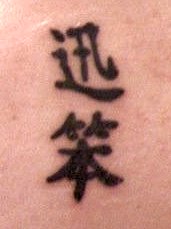
The customer wanted a tat that said “Fast and Furious”, but what they got was “Fast Foolish”
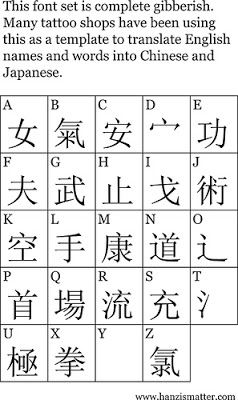
This one, on the other hand, is full of sound and fury, signifying nothing. It’s based on a gibberish asian font which was deciphered by Alan Siegrist, a professional Japanese-English translator and member of both Japan Association of Translators (JAT) and American Translators Association (ATA); with Alan’s help, tian (writer of Hanzi Smatter) compiled this chart, which has been widely circulated around tattoo parlors:
(note this website, which is currently selling this chart along with some other character sheets for $64.99).
The very clever user DavidR created this website, where you can generate your own garbage tattoo text for your amusement. But for the love of Mogg’s holy grandfather, don’t use it! (Note: At this writing, only the “to nonsense” function works – the other direction throws a DB error.)
If you’re still not quite sure what’s going on, have a look at these pictures, which give you an idea of what a native speaker might see if they looked at your sic tat:
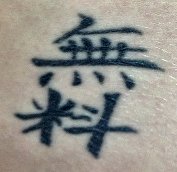
This girl thought her tattoo says “Lord of the Dance”
She was hoping for “Grace Under Pressure”
“You mean, it doesn’t say ‘passion’?”
“But you swore this meant ‘Hot Stuff’!”
So why does this happen with far-too-common frequency? First of all, we can’t heap coals on the head of the average tattoo artist, no more of whom are total idiots than you would find in the average business establishment (law firms excepted). The answer appears to lie in the fact that kanjis (or hanzi) look cool to many non-Asians, but take a gruntload of specialized education to understand properly – and that would hold true even if you didn’t speak the language but were simply trying to understand the general concept of ideographic writing, and what it would take to incorporate that into your artwork in a professional way. But the fact remains that when you extract the vast majority of well-meaning and honest tattoo artists out there,
Some of them are downright malicious, and think it’s funny to write “醜” (bad looking; shame; ugly; unclean) on some young lady’s arm;
Some of them have no more than a third-grade education to back up their admirable art skills, and just have no idea that the character chart they bought online is worth less than the powder to blow it to Hell with;
And some of them are incompetent and just draw crap, hoping the customer will never know the difference.
So what’s a body to do? Here are some helpful hints:
If you want a character tat, find someone you trust (and I mean, really trust, not your buddy who will draw dicks all over your face the next time you pass out at a party) who speaks the language, and let them help you design something that both looks good and means what you want it to mean.
Don’t trust a dictionary, either hardcopy or online. Dictionaries are only useful in direct proportion to your knowledge of the target language. That’s why
is not a good thing to use if you want “freedom,” because it means “free”, as in “no charge” – it’s also poorly drawn.
Take your artwork to the tattoo artist of your choice, and have them design on paper what you’re going to have emblazoned on your body forever and ever worlds without end (remember these suckers are permanent unless you have more money than Donald Trump) and take that design back to your expert to make sure that a) it means what it’s supposed to mean, and b) it looks good. Doing this will mean working with a tattoo artist who doesn’t have severe ego issues and will be willing to work with you. Remember, it’s your money and your body, so you have the right to make sure you get what you expect.
Pursuant to my previous post about hyperinflation and thinking of Greek lepta, I remembered that I had this list of units and fractions tucked away, and decided to share it for no good reason. Many of these currencies are historically obsolete, having been revalued multiple times or abandoned, but it’s interesting to see what was used.
Afghanistan 1 afghani = 100 pul
Albania 1 lek = 100 qindar (plural=qindarka)
Algeria 1 dinar = 100 centimes (santimat)
Andorra 1 diner = 100 centims
Angola 1 kwanza = 100 lwei
Argentina 1 peso = 100 centavos [still valid?]
Armenia 1 dram = 100 lum
Aruba 1 florin = 100 cents
Australia 1 dollar = 100 cents
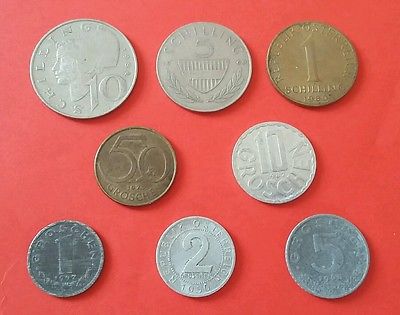
Austria 1 Schilling = 100 Groschen
In Villach in 1975 there was a dry-goods store that had a once-a-year “1-groschen sale” – for a 1-groschen coin, you could get a yard of cloth. By this time, the 1-groschen coin was rare enough that the store came out ahead.
Azerbaijan 1 manat = 100 qapik
Bahamas 1 dollar = 100 cents
Bahrain 1 dinar = 1000 fils
Bangladesh 1 taka = 100 poisha
Barbados 1 dollar = 100 cents
Belarus 1 rubel = 100 kapeek
Belgium 1 franc = 100 centimes
Belize 1 dollar = 100 cents
Benin CFA franc
Bermuda 1 dollar = 100 cents
Bhutan 1 ngultrum = 100 chhertum
Bolivia 1 boliviano = 100 centavos
Botswana 1 thebe = 100 pula
Bosnia-Herzegovina Dinar/Deutsche Mark [?]
Brazil 1 real = 100 centavos [still valid?]
British Virgin Islands 1 dollar = 100 cents
Brunei 1 dollar = 100 sen
Bulgaria 1 lev (plural leva) = 100 stotinki (singular: stotinka)
Burundi CFA franc
Cambodia 1 riel = 100 sen [still valid?]
Cameroon CFA franc
Canada 1 dollar = 100 cents
Cape Verde 1 escudo = 100 centavos
Cayman Islands 1 dollar = 100 cents
Central African Republic CFA franc
Chad CFA franc
Chile 1 peso = 100 centavos
China (PRC) 1 yuan = 10 jiao = 100 fen
China (Taiwan) 1 New Taiwan Dollar (yuan) = 10 chiao = 100 cents (fen)
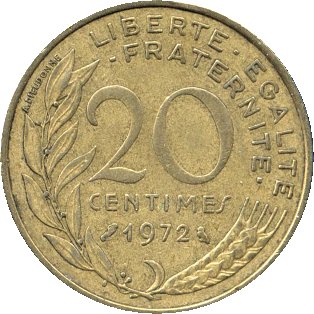
In France, there were about 5 Francs to a dollar for the longest time. This 20-centime piece would have been worth about a nickel.
French Polynesia CFP franc
Gabon CFA franc
Gambia 1 dalasi = 100 bututs
Georgia Lari
Germany 1 Mark = 100 Pfennig
Ghana 1 cedi = 100 pesewas
Gibraltar 1 pound = 100 pence
Great Britain 1 pound = 100 pence
Not to mention quids, bobs, mags, tanners, joeys, threepenny bits, florins, half-crowns, and all the rest of that nightmarish system. That’ll be two and six ha’penny, thanks.
Greece 1 drachma = 100 lepta (singular: lepton)
Guatemala 1 quetzal = 100 centavos
Guernsey 1 pound = 100 pence
Guinea franc guineen
Guinea-Bissau 1 peso = 100 centavos
Guyana 1 dollar = 100 cents
Haiti 1 gourde = 100 centimes
Honduras 1 lempira = 100 centavos
Hong Kong 1 dollar = 100 cents
Hungary 1 forint = 100 filler
Iceland 1 krona (pl. kronur) = 100 aurar (singular: eyrir)
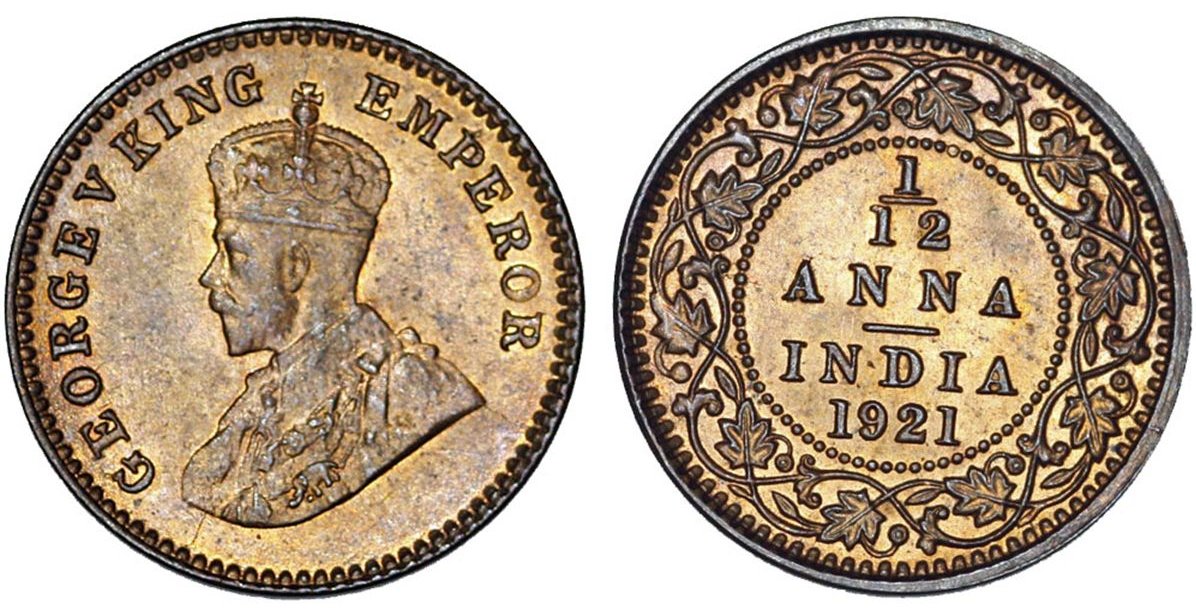
India 1 rupee = 100 paisa
1 rupee had 16 annas, an anna had 4 pice, and 1 paise had 3 pies. This little coin was therefore worth 1 pie, or 1/192 of a rupee.
Indonesia Rupiah
Iran Rial
Iraq 1 dinar = 1000 fils
Ireland 1 punt = 100 pence
Isle of Man 1 pound = 100 pence
Israel 1 sheqel (plural: sheqalim) = 100 agorot (singular: agora)
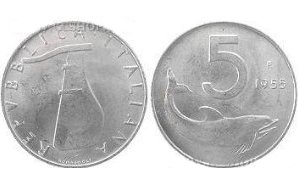
Italy Lira
The 5-lira coin was still in use in Naples in 1970. It was becoming more scarce, and the 10-lira coin was most commonly seen, but they were still around. In those days, a “normale” (standard shot of espresso) cost 50 lire or about 8 cents, so collect 10 of these and you could get a cup of coffee.
Jamaica 1 dollar = 100 cents
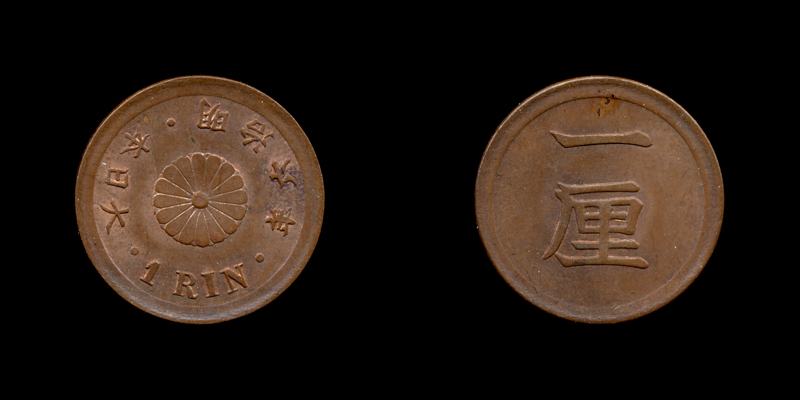
Japan 1 Yen = 100 Sen = 1000 Rin
Japan 1-sen coin, 1944
Japanese 1-Rin coin
The rin was discontinued after 1892, and the sen was demonetized in 1953.
Switzerland 1 franc = 100 rappen or 100 centimes or 100 centesimi
Syria 1 pound (lirah) = 100 piastres (qirsh)
Tajikistan Manat [?]
Tanzania 1 shilingi = 100 senti
Thailand 1 baht = 100 satang
Tonga 1 pa’anga = 100 seniti
Trinidad & Tobago 1 dollar = 100 cents
Tunisia 1 dinar = 1000 millim
Turkey 1 lira = 100 kurus
Turkmenistan 1 manat = 100 tennesi
Tuvalu 1 dollar = 100 cents
Uganda 1 shilling = 100 cents
Ukraine Karbovanetz (coupons)
United Arab Emirates 1 dinar = 100 fils
USA 1 dollar = 100 cents
Uruguay 1 peso = 100 centesimos
Uzbekistan 1 sum = 100 tiyin
With 1000 Uzbeki som being worth $0.60 (as of 2013), the 1-tiyin coin was reported to be the “most worthless coin in the world,” with a value of 1/1999¢. Given constant fluctuations in world currencies, and constant devaluations, this honor will probably not last.
Vanuatu Vatu
Vatican City Lira
Venezuela 1 bolivar = 100 centimos
Vietnam Dong
West African States [currency union of former French colonies] CFA franc
Western Samoa 1 tala = 100 sene
Yemen ? [since reunification in 1990??]
Yugoslavia Dinar/Deutsche Mark [since 1994]
Former Yugoslavia – 1 Dinar, 1963. The earlier dinar was equal to 100 para.
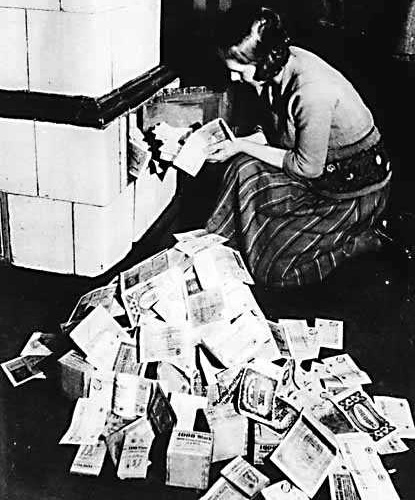
When I was little, my mother (who served as a Red Cross worker during World War II) used to tell me stories of people in Weimar Germany taking wheelbarrows full of money to the store to buy a loaf of bread. “Haha,” I thought, “that’s a good one,” being too young to really get the concept.
German woman burning banknotes, which burned longer than the wood that they would buy.
Then I grew up and traveled to Serbia, where I discovered that hyperinflation is not relegated to the furnaces of history.
This is the 500 billion Dinar note that was printed at the end of Serbia’s period of hyperinflation (I also have a 50,000,000,000 Dinar note as well) and I thought these were quite unique. [1] Until I heard about what happened in Zimbabwe.
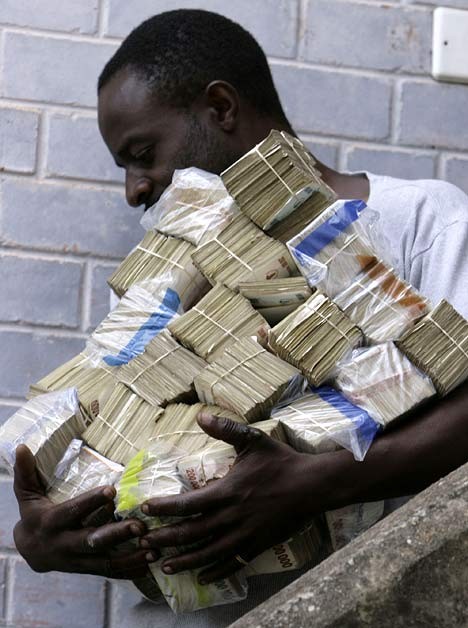
Off to buy a pack of gum
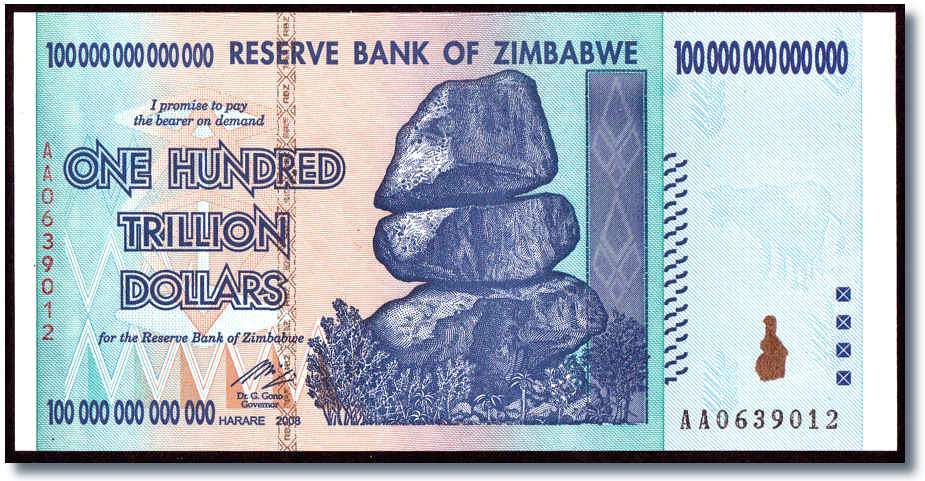
Even this didn’t help the situation; From Wikipedia, “The Zimbabwean dollar is no longer in active use after it was officially suspended by the government due to hyperinflation. The United States dollar ($), South African rand (R), Botswana pula (P), Pound sterling (£) and Euro (€) are now used instead. The United States dollar has been adopted as the official currency for all government transactions.”
But none of these monsters can touch what happened in Hungary in 1946:
This is the 100 quintillion pengő note, the largest banknote ever issued for public circulation. That’s 100,000,000,000,000,000,000, or 1020 pengő, which is a lot of pengő no matter how you slice them.
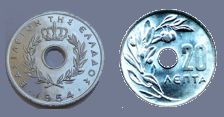
One rather interesting side-effect of inflation in Greece (before they gave up the Drachma in favor of the Euro) was that 5, 10 and 20 lepta coins became so worthless that it was cheaper to use them as washers than to go to the store and buy them.
Prices keep going up here in the USA in the early years of the 21st century, but I’m grateful we’ve never experienced this sort of madness here. Well, almost never.
Just enough for 3 gallons of gas. [2]
The Old Wolf has spoken.
[1] This one is still unique to me, because I have one.
[2] The $100,000 dollar note was never circulated – it was used only for transactions between Federal Reserve banks.
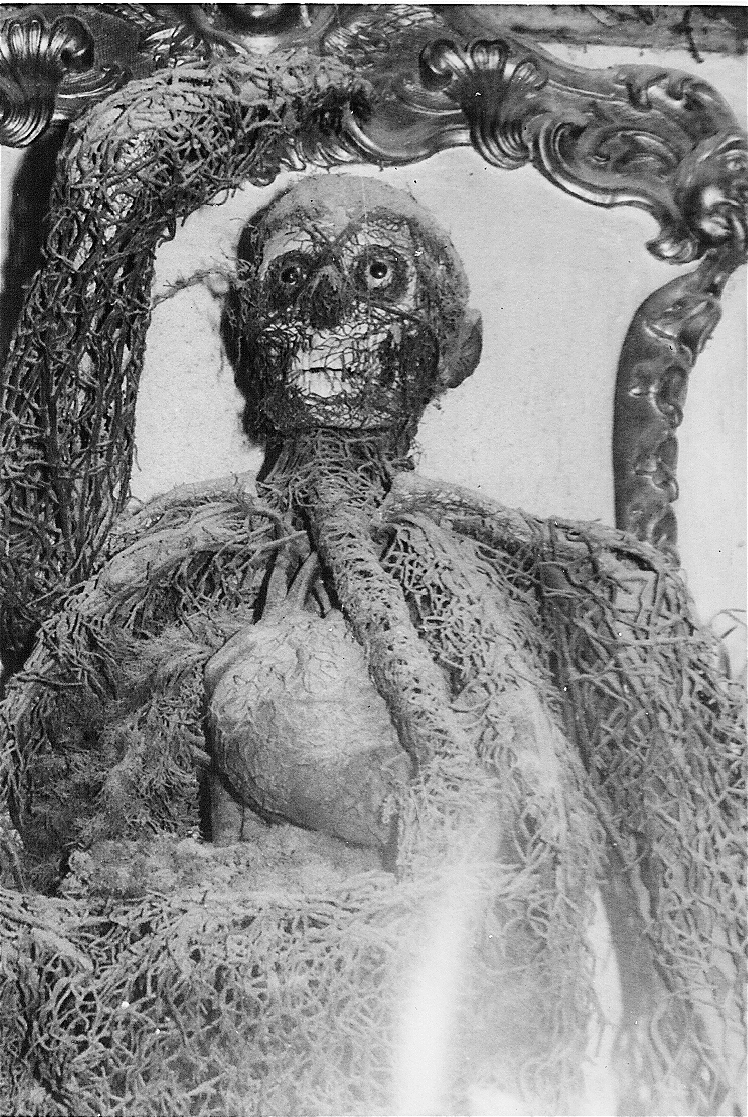
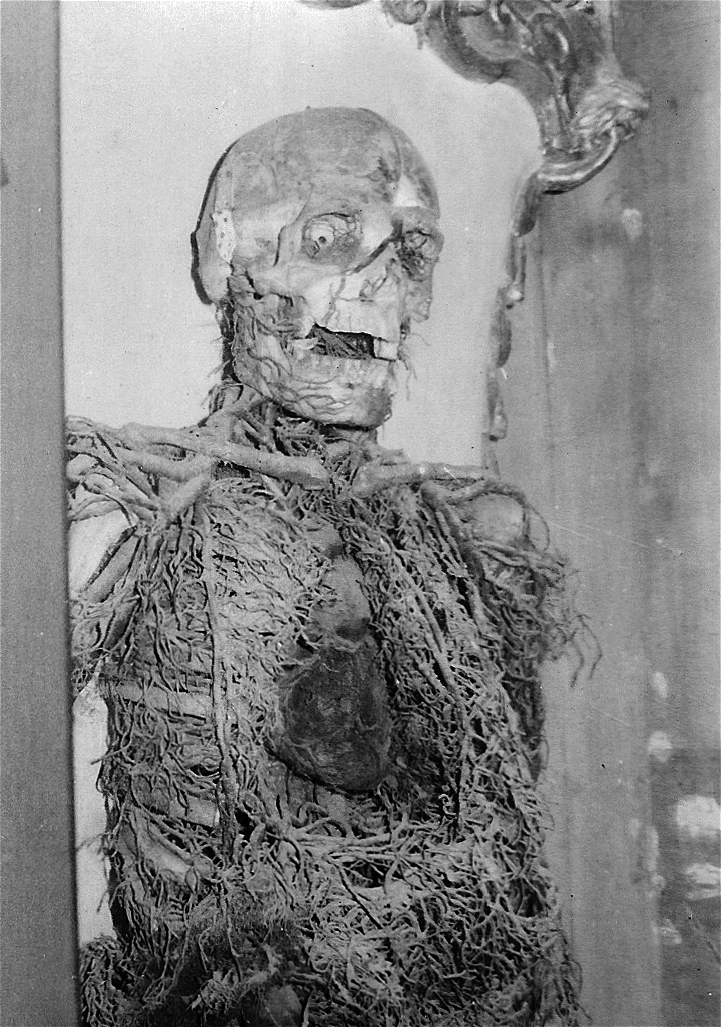
While living in Naples, Italy for 14 months or so back in 1970, I took the opportunity to visit the Sansevero chapel. There on display are two intriguing anatomical models, which were represented at the time as being the earliest known examples of plastination, popularized by the Body Worlds exhibits.
These “anatomical models” (macchine anatomiche) were thought to be examples of the process of “human metallization” (metallizzazione umana) as implemented by anatomist Giuseppe Salerno ca. 1760 from a commission by Raimondo di Sangro. The exhibit consists of a mature male and a pregnant woman. Their skeletons are encased in the hardened arteries and veins which are colored red and blue respectively. Previously, historians have surmised that the corpses could have been created by injecting the hardening substances directly into the veins of living subjects.[4] However, recent analysis shows no evidence of techniques involving injection. Analysis of the “blood vessels” indicate they are constructed of beeswax, iron wire, and silk.
Whatever the case, these models were amazingly detailed, and even the manufacture of them at the time would have been a master undertaking.
Color photo of the female model from the official website of the Sansevero Chapel Museum.
If you’re ever in Naples, this museum is worth a visit – if only to see the Veiled Christ of Giuseppe Sanmartino, but if you do go, be sure to check out the anatomical machines – they’re brilliantly executed and would have taken forever to make.
Seconds before being delivered by Cæsarean section, Nevaeh (that’s “heaven” spelled backwards) Atkins reaches out and grabs the delivering phyician’s finger. Photo taken by dad Randy Atkins, posted by mom Alicia.









































 Playing in the World Game