Bite the Wax Tadpole: The Risky Business of Translation

Cross-posted from LiveJournal.

Before you jump down my throat with both feet, let me assure you that I’m fully aware Coca-Cola™ never used the title of this essay as the name of their product in China. That little legend arose as eager shopkeepers devised phonetic representations for a new product without regard to meaning, and before Coke™ had settled on an official translation. “Bite the Wax Tadpole” was only one of many such renderings that arose.

Having disposed of that matter, translators and interpreters walk a fine line.

A success can mean acclaim and bringing pleasure to thousands of people, in the case of a well-received literary translation, such as Howard Scott’s translation of The Euguelion.

A mis-step can result in anything from simple pwnage to an international incident.

For no reason other than feeling contrary today, I thought I’d pull together some of the more notable failures in the world of translation – some traditional, others inspired by the ease of access to quick (and very often, dirty, in the classical sense) translation via the web.

First, the urban legend category.

  • The Chevrolet Nova sold quite well in its target markets, Mexico and Venezuela, despite being able to wring the meaning “doesn’t run” (no va) out of the name.
  • American Airlines never had a “Fly in Leather” campaign, which reputedly was translated to “vuela en cuero”, which is only one letter away from “fly naked” (en cueros).
  • I suspect that most of the lists of supposed translation bloopers from hotels and shops around the world have some basis in fact, but the large body of them are unverifiable, and these are forwarded with so many reputed sources that they have long since passed into the realm of probable fiction. A couple of classics: “The flattening of underwear with pleasure is the job of the chambermaid. To get it done, turn her on.” “The lift is being fixed for the next day. During that time we regret that you will be unbearable.”

Some real examples

55312_600

I love this one.

The Chinese characters say “Restaurant”, but what they really wanted to call it is unknown. Whoever was assigned to do the translation turned to an online translator which failed, and served up what you see here. Not knowing English, the translator blithely copied what he or she assumed meant “Garden of Delights” or whatever, and the world was given something else to laugh at.

The Chinese, however, are not the only ones to suffer from this syndrome

55597_600

The picture is self-explanatory. Once again, some bureaucrat assumed that what showed up in his or her inbox was the requested translation, and having no knowledge whatever of Welsh, this was the result. This sign, however, was quickly removed.

Alas, the sword has two edges. Have a look at a cartoon published a year ago by a dear friend of mine – with no disrespect intended!:

CarryOn20080820[1]

Instead of an anatomical impossibility, what the irate Kuchiku is screaming at her monitor is “Information Not Found!”; as the artist couldn’t read Chinese, she assumed that her Google Translate search was returning an actual value rather than an error message. A more detailed writeup of this particular incident is here.

Here’s an unsettling one, found recently at Failblog.org

lightswitch-fail[1]

By the sacred skull of Mogg’s grandmother, turn it off!

Before even perusing the comments at that entry, I began following the logic that led to this strange error. Surprisingly, it’s not as counter-intuitive as you might suppose, given the complexities of the Chinese language.

“Nightlight” is correctly translated as 夜灯:

夜 ye4 “night”
灯 deng1 “light”

Some translations add 小 xiao3 “small”.

I figured the other switch, beginning as it did with 天 tian1 “heavenly”, was supposed to be the overhead light, and it turns out I was correct. The Chinese word for “ceiling” is 天花板, or “overhead flower plank”.

Ceiling
天 tian1 Heavenly (by extension, overhead)
花 hua1 Flower
板 ban3 Plank

Now, the word for “lantern” is a delightful 花灯 “flower light”, which makes perfect sense.

Lantern
花 hua1 flower
灯 deng1 light

Thus by extension, a ceiling light, or overhead light, becomes 天花灯 “overhead lantern”

Ceiling (overhead) light
天 tian1 heavenly, above, overhead
花 hua1 flower
灯 deng1 light

The problem arose because for some unknown reason, “Smallpox” was designated as 天花 or “heavenly flower”

Smallpox
天 tian1 heavenly
花 hua1 flower

From here it’s easy to see how someone using either an online translator or even a regular dictionary, and without a good knowledge of english, could parse the word incorrectly and come up with “Smallpox light”

The net is full of such delights:

Endless other examples can be seen at Engrish.com.

Translation and interpretation are true art forms. While the modern tools available to us have their use, there is no danger that the language professionals who dedicate a great deal of time to receiving the necessary education and experience for their craft will be out of a job any time soon – at least not as long as there are those who care about getting it right.

As for me, I don’t think I’ll be staying at the smallpox hotel anytime soon.

The Old Wolf has spoken.

No, we haven’t “broken English.”

A recent article over at The Guardian asks the question, “Have we literally broken the English language?”

The gripe stems from the fact that the word “literally,” meaning (and only meaning, dammit, if you listen to the prescriptivists) “to the letter, in a literal way or sense,” has now been updated with an additional definition. According to the Oxford English Dictionary, it can now be “‘used for emphasis rather than being actually true.” Google’s added definition states that literally can be used “to acknowledge that something is not literally true but is used for emphasis or to express strong feeling”.

Randall Munroe riffed on this some time ago in his wonderful XKCD:

literally

Cushlamochree, people – get a grip.

One of the first things I learned when I started studying historical linguistics is that language is about as fixed as the clouds of Jupiter. A course in Romance Philology, taught by the illustrious Madame A.M.L Barnett, had me watching the exquisite steps from Vulgar Latin into French, Italian, Portuguese, Spanish, Romanian, Catalan, and Romansch [1] over the course of 800 years; it was intriguing to be able to chart the transformation of Vulgar Latin blastemare[2] into the Italian bestemmiare or the French blâmer (whence we get our word “blame”).

Let’s look at some examples from more recent history, and our own language:

  • Meat used to mean food in general; now it simply refers to the flesh of animals.
  • Meet used to mean “appropriate,” whereas now it means “to encounter.”
  • Corn used to refer to all kinds of grain, whereas now it means that great stuff we eat at picnics on the 4th of July. Amaizing, isn’t it? [3]
  • Actual meant “pertaining to an action;” it now means “real” or “genuine.”
  • Awful used to mean “full of awe” i.e. something wonderful, delightful, amazing, instead of “horrible” or “terrible.”
  • Besom, meaning “a broom,” is only encountered in very old texts like the Bible and rare literary references.

And on and on. In fact, have a look at the original text of Chaucer’s Canterbury Tales:

Middle English (late 1300’s) Modern English
This carpenter out of his slomber sterte,
And herde oon crien ‘water’ as he were wood,
And thoughte, “Allas, now comth Nowelis flood!”
He sit hym up withouten wordes mo,
And with his ax he smoot the corde atwo,
And doun gooth al; he foond neither to selle,
Ne breed ne ale, til he cam to the celle
Upon the floor, and ther aswowne he lay.
This carpenter out of his sleep did start,
Hearing that “Water!” cried as madman would,
And thought, “Alas, now comes down Noel’s flood!”
He struggled up without another word
And with his axe he cut in two the cord,
And down went all; he did not stop to trade
In bread or ale till he’d the journey made,
And there upon the floor he swooning lay.

If that doesn’t do it for you, let’s look at Beowulf:

Old English (8th-11th Century) Modern English
Ðá wæs on burgum Béowulf Scyldinga
léof léodcyning longe þráge
folcum gefraége — fæder ellor hwearf
aldor of earde — oþ þæt him eft onwóc
héah Healfdene héold þenden lifde
gamol ond gúðréouw glæde Scyldingas·
ðaém féower bearn forðgerímed
in worold wócun weoroda raéswan:
Heorogár ond Hróðgár ond Hálga til·
hýrde ic þæt Ýrse wæs Onelan cwén
Heaðo-Scilfingas healsgebedda.
Then was in boroughs, Beowulf the Scylding (Beaw),
beloved king of the people a long age
famed among the folk — his father having gone elsewhere,
elder on earth — until unto him in turn was born
high Half-Dane, he ruled so long as he lived
old and battle-fierce, the glad Scyldings;
to him four sons in succession
woke in the world, the leader of the legions:
Heorogar and Hrothgar and good Halga;
I heard that Yrse was Onela’s queen,
the War-Scylfing’s belovèd embraced in bed.

Yes, it’s English – even though some of the letters have long since fallen out of use. Anyone not familiar with the history of language would swear that this was another language altogether… which, in a sense, it was.

The bottom line is that usage drives language, not rules. Scream all you want about the Oxford Comma [4], in as little as 100 years, people may not even know that it ever existed; in 400 years, English as it is spoken today may no longer even be recognizable.

Having used and worked with and studied multiple languages over the course of a career, it’s my own feeling that folks who get their knickers in a twist about  how language should be used are basically holding up their hand to try to change the mighty Amazon in its course; “As well you might have piled dry leaves to stop Euroclydon!” [5] Language is going to change, whether you like it or not, whether you want it or not, and whether you complain about it or not.

That’s not to say that there is no need for rules or style – I cringe when I see people mistake “lose” and “loose,” or mix up “there,” “they’re,” and “their.” But these rules are in place for the sake of meaning and clarity, enforced largely by academics and journalists and publishers for their rarified purposes; authors regularly violate every conceivable regulation if it suits their good pleasure (have a look at e.e. cummings or James Joyce if you don’t believe me.)

In the end, then, the claim that adding a dictionary meaning for the “misuse” of a word is tantamount to “breaking English” is  folly, and naught more than clickbait. Sadly, about 99% of the Internet is made of such nonsense.

The Old Wolf has spoken.


[1] And that list is by no means complete.

[2] Itself from the Late Latin blasphemare, which is visible as the ancestor of blaspheme, blasphemy

[3] Valid for Americans only. Other varieties of English still use this meaning, and refer to the stuff on the cob as maize.

[4] That’s for you, Melissa

[5] The Life and Teachings of Jesus and His Apostles, Church Educational System Manual

Eurolingua Salad

A few days ago I had a delightful meetup with several fellow Esperantists. Esperanto was devised by the Polish doctor and linguist Ludwig Lazarus Zamenhof in the 1870’s and 1880’s in the hopes of creating an international language that would be easy for anyone to learn, thus fostering peace and international cooperation. It is, to date, the most successful of all constructed international auxiliary languages.

I fell under the spell of Esperanto in the mid-70’s. While wandering the streets of Villach, Austria, I entered the Kongresshaus and found an International Esperanto Conference in full swing. I picked up a pamphlet or two and discovered (with English, French, German and Italian under my belt) that I could read Esperanto with almost no problem. I was enchanted. Although I never really became fluent in speaking, I can read and write with fair proficiency.

During the course of the gathering, I mentioned this article which I collected years ago – it’s not an official artificial language, but rather a humorous piece which should be readable by just about any European, or other linguist/polyglot worth his or her salt.

Edit: 7/17/2025

Some other links about Europanto:

 https://www.theneweuropean.eu/nordinary/how-do-you-say-i-love-you-in-europanto

https://www.worldwidewords.org/tp-eur2.htm

https://archive.ph/CdLc6


Here is a text written in a language which is not taught in any university, but which lends itself well to use on the European continent.

A certain Diego Marani, translator for the European Council, created Europanto, an authentic mixture more or less proportional to all the languages of the community, which has become very successful, even to being published in a Belgian magazine…

As in Bruxelles diem, good lecture und bueno weekend for tu und mein fratello…


Qui ist inspector Cabillot ?

Inspector Cabillot ist le true fonctionner der UEEU wie lutte contra der insjustice y der mal, por der ideal van una Europa unita y democratica in ein world de pax, where se parle eine sola langue, der Europanto.

Cabillot und el misterio der exotische Pralinas

Erat una fria morning de Octubre und ein low fox noyabat las benches der park. Algunos laborantes magrebinos collectabant der litter singing melanconic tunes. Aan el 200th floor des Euro Tower el Chef Inspector General del Service des Bizarre Dingen, Mr What, frapped sur the tabula y said: “Dit is kein blague. Appel rapid Cabillot!”.

Inspector Cabillot put sein rhubarbre lollipop en el tiroir, raccroched der telefon und got aan el cuirassed elevator fur emergence case.

‑ Usted me demanded, Mr. What ?

‑ Ja. Ik hay ein delicaaat mission voor vous. Als you sabez, der UEEU send plenty aid to trio mundo countries y sobre all, butter, second hand velos, italian bien, english wine, old stamps und used tyres. Well, some de esto aid jamas arriva a destinatie. There must est un hole quelquewhere en Sud Amerika, mas exactly, in der Petite Guyane Luxembourgeoise. La is tambien ein kliniek por invalidos funcionarios die is un bit suspecta. Ich want dat Usted va alla ut give un colpo de eye. Usted wil make semblant ein invalido fonctionnaire to be. Sergent Otto Oliveira of de Europese Polizei will mit vous in touch resteren.

‑ Ouivohl, Mr. What.

‑ Il is surtodo el butter que svanish… et we hebben kein indices. Bonne luck, Inspector!

Inspector Cabillot got back dans son oficina por make los bagaages.

‑ Wat bring man en der Petite Guyane Luxembourgeoise, Otto? Asked el aan su beste collaborador.

‑ Sabe niet… maybe ein fishing baton, ein warmawater bouteille, somechose to lire or una hermosa girl… a less que dat kan man op place trovar…

Inspector Cabillot put en la valisa der draft directive van de UEEU on Bolts, Clous und Staples, quelque ananas lollipop (exotische flavour), sein flowered bermudas, ein straw chapeau y ein vocabulair Guyanish ‑ Europanto.

Der dia after, Inspector Cabillot atterred at Paramarange, capital der la Petite Guyane Luxembourgeoise mit the mismo aereo que transportabat el europese aid. Paramarange is ein city maritima, mit viel mundo et un grote harbour.

La erste cosa que Cabillot remarqued was dat presque todos los Paramarangos estaban fat como porcadillos. Partout was plein van pralinas reklames und in aile boutiks erat full van pralinas of todos types.

‑ Man like aqui chocolats un lot! esclamed Cabillot aan el taxista.

‑ Certenly sur ! We tenemos ici los meliores chocolates der monde! People komen out van Switzerland fur nuestros chocolates to kopen. Where va Usted ?

‑ Aan la kliniek Hemelpax.

‑ Oh, est vous ein van aquellos very muchos enerved people ?

‑ Not vraiement…

Parte zwei

La klinika erat un basse edifizio blanco mit verde fenestras and lindo jardino florido. Aan la entry was Dr. Hookers, el director des klinika, expectante.

“Mr. cabillot, Ich suppose … “

“Le same, Herr doctor!”

“Bienkomen en Hemelpax! Se fasse comfortable en my oficio, bitte! Frau Hassenpain, prepare please de room 23!

” Dr. Hookers fermed de porta und sitted in sua fauteuil.

“Dear Menheer Cabillot, vous will vedere que hier sta man in pax und Brussel will presto become eine far away memoria for usted! Ich sais que usted esse nicht eine grave case. Una belangrijkissima cosa: remenbere de never prononze ici de mot ‘Communautes economiques europeennes’ of ‘Union europeenne’.

There ist ici people que quando this entende jump en l’aere like uno emflammado und commencia te pleure, te hurle, te sich arrache los cabillos van der tete. Ici man sobreall must dormiren. In der postmeridio est quelqunas activitades distractiva como de promenada nel park or una pied‑balle partida, fur exemplo, la Commission contra el reste del mundo. El sunday postmeridio ist la projectio del film (siempre lo meme, para not emoxionar too mucho los esprits) ‘Gone with de invaliditeit’. Ik espero dat usted wil aqui happy esse. Du kan maintenante un look autour della cite habe. Aqui se mange at sept ‘o cloque. Hasta la vue, Mr. Cabillot!”

El doctor se leved und accompanied Cabillot aan la door. En sortendo, Cabillot remarqued Frau Hassenpain qui espiabat uit den fenestra.

Paramarange ist una very folle cite y der pueblo est calientissimo. Everyrodo mange pralinas non‑stop und wenn mange overdose commenza a danzer la Tarabomba qui ist eine tipik bal, very desfrenado und decambolante. Le long des stradas erat pienty van ‘tarabombos’ (los ballerines de Tarabomba) dechainados qui ballabant under el heat der sol. In eine cafe on der plaza, Cabillot tasted quelqunas pralinas and aan lui tambien le came envie de danzar one poco.

Quella tarde, en el restorant de la klinika, Cabillot mangesd echet paramarangas specialitades

Moules au chocolat* Emince de mouette au cacao avec pralines frites Salade aux quatre chocolats Chocolat chaud (cuvee 1978).

“Un bit van butter ?” demander Frau Hassenpain en serving el dish. “Nein, gracias, ich like le butter niks” responded Cabillot. But Frau Hassenpain let le butter sobre la tabla. “Strange Frau” pensed Cabillot. Entorno de lui los autros pazientos des klinika mangiabant silentes, mit les eyes ekarkillados. Aquella noche, Cabillot dormed mal und dreamed grosse waitresses que danzabant la Tarabomba en topless sur la playa.

Le morgen, Cabillot se leved et se promened eine peu in der klinika. Parfois le parebat de sentir uno sound, like moteurs tournant. El monted todos los floors, mais es impossible was naar de caves te descendre. De porta was zu. Por el breakfasto, el decided de mange leger : only uno the al chocolate. “Sommige butter?” demanded Frau Hassenpain.

“Le said deja que no! Ich like el butter niks!” responded brutalmente Cabillot. Todo el dag Cabillot permaned en la terrazze de la klinika, chassando las mouches und lisando el jourpaper de Paramarange, “Una Van Deze Soirs”. El went dormir early, mit uno grosse mal au belly. But , dat nacht tambien el dormed not. Il y was eine bruit, eine mysterioso bruit que lo deranged. Descendendo en le hall om eine the chocolats te drinken, Cabillot antended eine cri. El ran to la kitchen. Sur le floor stabat Frau Hassenpain, mit eine knife enfonced in de poitrine y der bouche full van chocolat.

* In alles gut restorantes, ist la karte toujours in Franzose gewritten.

World’s Top Languages

The other day I posted about being able to talk to most of the world’s people by learning 20 languages out of the over 7,000 currently existing ones. I forgot to post this infographic, so I’ll just add it here as an addendum, because I found it interesting, and it’s actually the thing that got me thinking about the subject.

182727_617345131626380_582618989_n


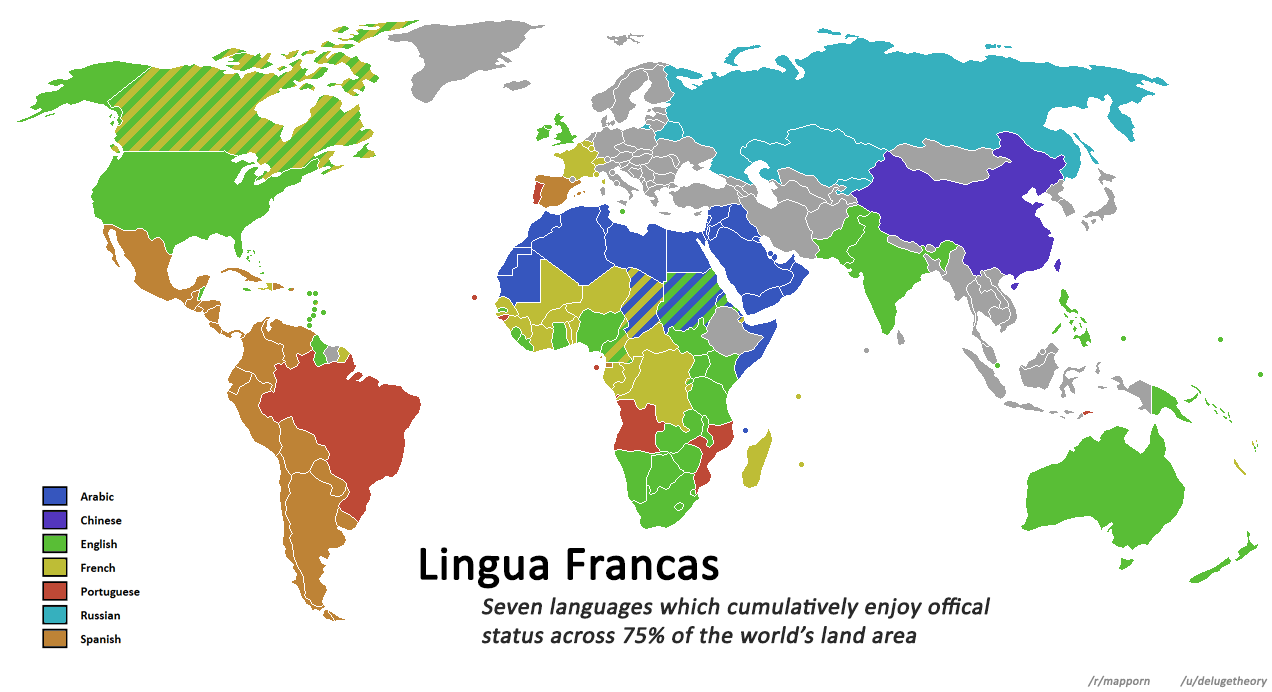
In addition, here’s a map showing how linguae francae, or “portmanteau languages”, are distributed across the globe; one can see the broad reach of the top seven.

tumblr_moodwegXI01rasnq9o1_1280

The Old Wolf had forgotten.

7 billion people, 20 languages (more or less)

In 1982, Charles Berlitz, one of the post popular linguists and language pedagogues of recent times (although perhaps not the most rigorously scholastic), made the following observation. The numbers and order of languages have shifted somewhat over the last 30 years, but the idea remains the same.

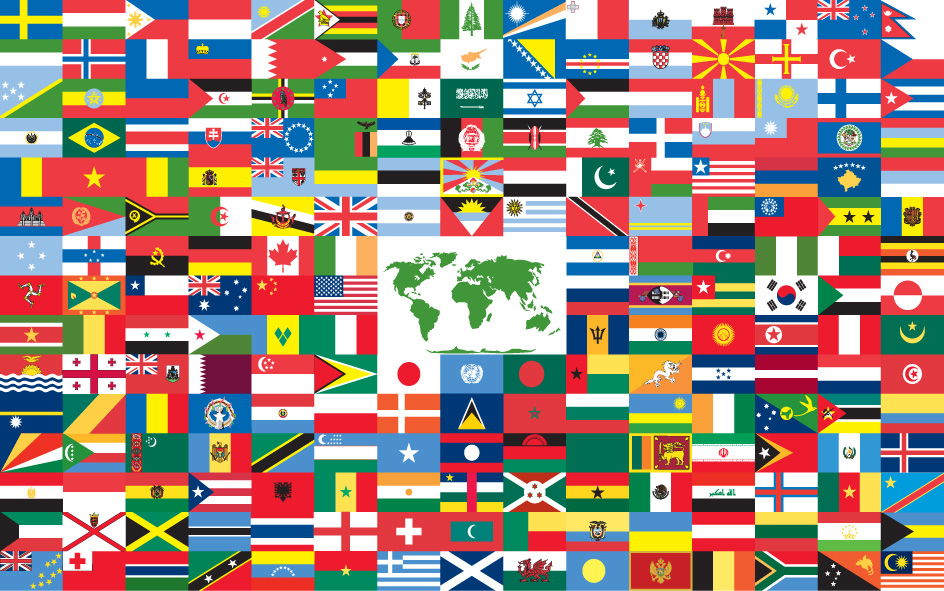
The_world_flag_2006

“Among the several thousand world languages, only 101 count over 1 million speakers. Of these, the fourteen most important in number of speakers are, in approximate order,

  • Chinese
  • English
  • Hindi/Urdu
  • Russian
  • Spanish
  • Japanese
  • German
  • Indonesian
  • Portuguese
  • French
  • Arabic
  • Bengali
  • Malay
  • Italian

All of these have over 50 million speakers, including dialects. [Chinese has the most native speakers, but English is more widely spoken worldwide.]

Since most of the world’s population speaks, or is familiar with one of the 14 languages listed above, with one of three other widely-spoken languages – Dutch, Greek, or Swahili – or with a language in either the Scandinavian or Turkic, or Slavic group, it is possible for an individual with the time and inclination to be able to communicate with a great majority of the inhabitants of this planet by learning to speak these 20 languages.”[1]

Wikipedia gives some alternate figures, but the general principle still holds: most of the world’s people speak one of the languages listed above as a first, second, or third language. When one considers that according to the Ethnologue, there are  7,105 known and documented languages on the earth, this makes the challenge of basic communication substantially simpler.

I have experienced this phenomenon myself as I’ve taken trips around the world. Before I had learned Spanish, I was able to hold bilingual conversations using Italian, and got about 65% comprehension. I’ve used German to get by in Bulgaria, and once again Italian in Albania. I have communicated with Russians in Croatian, and also (to my shame) with Slovenians, whose language eludes me despite rubbing shoulders with it for years. All of this, of course, ignoring English, which is used well and widely by so many people. I know Norwegians and Swedes and Finns and Danes and Dutchmen who speak better English than I do, whereas all I can do is look at the ground shamefully, scuff my feet, and mumble “lutefisk” and “Scheveningen.” Well, not quite that bad, but you get the idea.

With the advent of the Internet, the penetration of English is increasing as well, and many countries are beginning to encourage the study of Chinese instead of more traditional languages like French, given the growing presence of China in global trade. I’m up at odd hours of the night (like right now) teaching English to people in Japan, Korea, and China via Skype. For better or for worse, English is on the road to becoming the Esperanto Dr. Zamenhof hoped for, even though it’s devilishly complex and irregular. [2]

Sadly, the number of languages in the world is diminishing almost daily. The list of endangered tongues in Europe alone is astonishing; languages like Ume Saami in Sweden or Tsakonian in Greece could be gone within my lifetime. Given the massive growth of English and Chinese, as well as the predominance of the above-mentioned languages or language families, this might seem to be less than critical. However, Stephen R. Anderson of the Linguistic Society of America wrote, “When a language dies, a world dies with it, in the sense that a community’s connection with its past, its traditions and its base of specific knowledge are all typically lost as the vehicle linking people to that knowledge is abandoned.”[3]

You can’t really study a language without becoming involved with the cultures and histories of the peoples that speak it. I’ve been a linguist for a long time, and I never stop being curious about new languages, new words, and all the associated things that come with them. While my study of Irish Gaelic (or gaeilge) may not do much to save the endangered language over the long run, it’s taught me more about Ireland and its people than I could have ever hoped to learn otherwise.

If you’re reading this blog, you’re either blessed to speak English as a native tongue, or you’ve put in the hours and become fluent, and my hat’s off to you. But I encourage everyone to learn at least one additional language (for what it’s worth, the more you learn, the easier it gets) to broaden your horizons and increase your awareness of the world.

The Old Wolf has spoken.

[Edit: Click through for two additional charts which shine further light upon the subject.]


[1] Berlitz, Charles, Native Tongues, Grosset and Dunlap, 1982, p. 6

[2] If you’re not familiar with Gerard Nolst Trenité’s “The Chaos,” give it a read. Try saying it out loud. I dare you.

[3] “How Many Languages Are There In the World?”, Linguistic Society of America, 5/2004 PDF File

Donnerwetter! Making fun of German once again.

Yesterday I posted about Germany’s longest official word having been stricken from the dictionary because it’s no longer needed. Today we will descend to sophomoric levels to explore the same noun-compounding phenomenon.

Put away your Dudens and your Langenscheidts and your reference books; this is nothing but silly fun. From various unknown sources across the years:

German Lesson #7

Dog:                                              Barkenpantensniffer
Dog Catcher:                               Barkenpantensniffersnatcher
Dog Catcher’s Truck:                 Barkenpantensniffersnatcherwagen
Garage for Truck:                      Barkenpantensniffensnatcherwagenhaus
Truck Repairman:                      Barkenpantensniffensnatcherwagenmechanikerwerker
Mechanic’s Union:                       Barkenpantensniffensnatcherwagenmechanikerwerkerfeatherbeddengefixengruppe

Doctor:                                         Chestergethumpenpulsentooker
Nurse:                                           Chestergethumpenpulsentookerhelper
Hypodermic Needle:                    Chestergethumpenpulsentookerhelperhurtensticker
Backside:                                      Chestergethumpenpulsentookerhelperhurtenstickerstabbenplatz

Piano:                                           Plinkenplankenplunkenbox
Pianist:                                          Plinkenplankenplunkenboxgepounder
Piano Stool:                                  Plinkenplankenplunkenboxgepounderspinnenseat
Piano Recital:                               Plinkenplankenplunkenboxgepounderoffengeshowenspelle
Fathers at the Recital:                 Plinkenplankenplunkenboxgepounderoffengeshowenspellensnoozengruppe
Mothers at the Recital:                Plinkenplankenplunkenboxgepounderoffengeshowenspellensnoozengruppenuppenwakers

Automobile:                                 Honkenbrakenscreecher
Gasoline:                                      Honkenbrakenscreecherzoomerjuicen
Driver:                                          Honkenbrakenscreecherguidenschtunker
Auto Mechanic:                           Honkenbrakenscreecherknockengepinger‑           sputtergefixer
Repair Bill:                                   Bankenrollergebustenuptottenliste

Propeller:                                     Der airfloggen fann
Self starter:                                  Der airfloggenfann flinger
Control column:                          Das pushenpullen schtik
Rudder pedals:                            Der tailschwingen works
Pilot:                                             Der tailschwingen pushenpullen werker
Student pilot:                               Der dummkoff lernen fliegen
Forced landing:                           Trieen gobackonner ground mitout kraschen
First solo:                                      Trieen gobackonner ground mitout kraschen alone
Precautionary landing:               Looken virst den kraschen
Crosswind landing:                     Trieen gobackonner ground mitout kraschen sidevays
Parachute jump:                          Trieen gobackonner ground mitout der fliegenwagon
Weather radar:                            Das olektroniken stormengeschniffer
Warhead:                                     Das Lautenboomer
Atomic warhead:                         Das eargeschplittene Lautenboomer
Hydrogen warhead:                    Das eargeschplittene Lautenboomer mit grossem Holengraund und alles kaputt!

These remind me of Fraulein Bo-peepen And More Tales Mein Grossfader Told by Dave Morrah:

61oi5li0fxL._SL1024_

An extract from the book:

Fraulein Bo-Peepen
Ben losen der sheepen
Und puzzlen mit der gelooken.
Later der sheepen
Ben homen gecreepen
Mit tailers behinder geshooken.

Nowhere near as scholarly an approach as John Hulme’s Mörder Guss Reims – the Gustav Leberwurst Manuscript, which I mentioned here, but in 1953, so close to the end of the second world war, it struck a popular chord with Americans, who were still getting a kick out of mocking the Germans as late as 1971 when Hogan’s Heroes went off the air.

tumblr_ltt1vawN8k1qh2d7uo1_250

Schulz! Where is Colonel Hogan?

Nowadays we’ve become so much more sophisticated:

Toht

“Your fire is dying…”

Der Old Wolf has gespoken.

Donnerwetter! German’s longest word stricken

If you’ve ever read Mark Twain’s A Tramp Abroad, you have probably encountered Appendix D: The Awful German Language. Therein, Twain waxes eloquent about the vagaries of the Teutonic tongue and mentions the habit of the German language to smash nouns together into long, unreadable strings. He mentions “Generalstaatsverordnetenversammlungen” (legislator meetings) and “Waffenstillstandsunterhandlungen” (cease-fire negotiations.) He does not mention “Donaudampfschifffahrtsgesellschaftskapitaenswitwe” (the widow of a captain of the Danube Steamship Voyage Company), and I have seen longer versions having to do with the cleaning lady of the captain’s cabin, but this one is somewhat sniffed at by German purists.

enhanced-buzz-15726-1363114236-3


“Hardwood floor sander rental”

Now it appears that the longest official word in the German dictionary has been stricken, because it’s no longer needed.

the Rindfleischetikettierungsüberwachungsaufgabenübertragungsgesetz, or “law delegating beef label monitoring,”  was introduced by Germany in 1999 as part of measures against mad cow disease. But the DPA news agency reported today the law was removed from the books last week because European Union regulations have changed. Just to show you how these monsters are cobbled together:

  • Rind (cow)
  • Fleisch (flesh) [Rindfleisch -> “beef”]
  • Etikettierung (labeling)
  • Überwachung (monitoring)
  • Aufgabe (task)
  • Übertragung (delegation)
  • Gesetz (law)

The additional letters between the nouns are there to make things flow smoothly, in the same way as we take “girls” and “baseball” and “team” and come up with “girls’ baseball team.” And that’s really all they are doing – they just happen to cram everything together into one word.

German has other peculiarities, among which are the maddening tendency to throw all their verbs to the end of a very long clause or sentence. I’m currently reading The Lord of the Rings (Der Herr der Ringe) in German; I can’t wait to get to Volume 3 to find out what happens, because that’s where all the verbs are. [1]

But with the “Längsthauptwortsabschaffung” (longest noun elimination, and I just made that up) having been performed, what’s left as the longest official word? That honor falls to Kraftfahrzeughaftpflichtversicherung (automobile liability insurance)

For what it’s worth, “The Awful German Language” was not Twain’s only foray into German philology. In A Connecticut Yankee in King Arthur’s Court, he came up with Constantinopolitanischerdudelsackpfeifenmachersgesellschafft (İstanbul bagpipe maker company, and remember it’s İstanbul, not Constantinople), which my Teutonically-enabled friends will be quick to point out is improperly formed, but it makes a heck of a magic word. But this segues into the fact that when it comes to smashing words together, the Germans are rank amateurs when compared to Turkish.

turkish-flag-300x225

Avrupalılaştırılamayabilenlerdenmısınız? is a complete sentence, a question which means “Are you one of those who is not easily able to be Europeanized?”

Here’s how it’s formed:

  • Avrupa: Europe
  • Avrupa-lı: European
  • Avrupa-lı-laş-mak: become European
  • Avrupa-lı-laş-tır‑mak: to make European (mak is an infinitive ending)
  • Avrupa-lı-laş-tır‑ı‑l‑mak: (reflexive) to be made European (‑l‑ is a linking consonant)
  • Avrupa-lı-laş-tir‑ıl‑abil‑mek: to be capable of being Europeanized (‑mek is again the infinitive ending, changed as a result of vowel harmony)
  • Avrupa-lı-laş-tır‑ıl‑ama‑mak: not to be capable of being Europeanized
  • Avrupa-lı-laş-tır‑ıl‑ama‑y‑abil‑mek: this time the ‑abil is probability: that there is a probability that one may  not be capable of being Europeanized
  • Avrupa-lı-laş-tır‑ıl‑ama‑y‑abil‑en: the one that may not be capable of being Europeanized
  • Avrupa-lı-laş-tır‑ıl‑ama‑y‑abil‑en‑ler: the ones…..(‑ler, ‑lar is the plural suffix)
  • Avrupa-lı-laş-tır‑ıl‑ama‑y‑abil‑en‑ler‑den: of or from the ones who may not be capable of being Europeanized
  • mı? ‑ question tag (legally, this should be written separately, but it is a very common mistake not to).
  • mısınız? ‑ are you (formal or plural)

To be fair, this is a rather contrived sentence, but it’s legal and grammatical and shows how Turkish agglutination works. Pope John XXIII is reported to have said, at one point during his ten years in İstanbul as Papal Nuncio, “I am fond of the Turks…  It is my special intention, as an exercise in mortification, to learn the Turkish language.” Mortification is right.

I spent about 10 years associating with Turks, the Turkish language, and Turkey, and I would like to go on record as saying that John had the right idea. They’re lovely people, with a beautiful country and a hellish but intriguing language. I keep chipping away at Turkish, and perhaps in one or two more lifetimes I’ll be able to say more than “Günaydın, nasılsınız?”. As Robert Sheckley’s character said in “Shall we have a little talk?“, “Stop agglutinating, dammit!”

Given the events taking place in Turkey at this very moment, I pause to wish the good people of this land every good thing, and the right to freedom and self-determination.

The Old Wolf has spoken.


[1] Just kidding. All the verbs are in the appendices.

Macaronics (The Legs of the Romans are Bony)

Anyone who has spent any serious time studying Latin has probably felt the need for something more powerful than Tylenol™ to quiet the throbbing in his or her head. In the absence of Oxycontin™, humor has long been a good substitute for mitigating the effects of “bonus, bona, bonum, boni, bonæ, boni…”

Here a random collection of humorous tidbits regarding the vagaries of classical Latin (and other languages). Macaronics are, properly, text which uses multiple languages, and often bilingual puns.


LatinBumper

While not macaronics proper, it’s still a great Latin joke: It reads (liberally translated), “If you can read this bumper sticker, you’re well-educated and TOO DAMN CLOSE!”

——-

What is this that roareth thus?
Can it be a Motor Bus?
Yes, the smell and hideous hum
Indicat Motorem Bum!
Implet in the Corn and High
Terror me Motoris Bi:
Bo Motori clamitabo
Ne Motore caedar a Bo—
Dative be or Ablative
So thou only let us live:—
Whither shall thy victims flee?
Spare us, spare us, Motor Be!
Thus I sang; and still anigh
Came in hordes Motores Bi,
Et complebat omne forum
Copia Motorum Borum.
How shall wretches live like us
Cincti Bis Motoribus?
Domine, defende nos
Contra hos Motores Bos!
Alfred Dennis Godley

The above poem pokes fun at the difficulty of Latin declensions, and inflects the words “motor” and “bus” as though they were classical Latin nouns (which, in a certain sense, they are.)

——

Latin verbs are memorized with their principal parts:

  • 1st person singular, present indicative
  • infinitive
  • 1st person singular, perfect indicative
  • and past participle.

Most Latin verbs are regular:

amo, amare, amavi, amatus (to love)
salto, saltare, saltavi, saltatus (to dance)

Some, however, are devilishly irregular:

sum, esse, fui, futurus (to be)
ferro, ferre, tuli, latus (to carry) – did you know transfer and translate are basically the same word, meaning “carry across”?

Students, in apparent desperation at having to learn these niceties, came up with

flunko, flunkere, faculty, bouncem

to which I add my own sophomoric creation:

farto, fartere, pui, flatus

I’m quite proud of it, actually. And thanks to reader bman:

spitto, spittere, achtui, splattus

old_wolf_rofl

——-

As the title of this article indicates, “leges romanorum boni sunt” (the laws of the Romans are good,) but obviously this sounds like something much sillier.

——-

A bad Latin joke:

A professor of Latin at Yale, (sounds like a limerick in the offing, doesn’t it?) having ordered a meal at a fine New Haven restaurant, decided that he would like some wine with his dinner. So he summoned the wine steward and asked for a bottle of hock. Feeling clever, he added, “hic, haec, hoc.”

“Very good, sir,” replied the wine steward, and left.

Twenty minutes later, no wine. The learned man summoned the steward again, and asked, “Didn’t I order a bottle of hock?”

“You did indeed, sir,” replied the steward, “but then you declined it.”

——

Found on the wall at Pompeii:[1]

Civili derego
Fortibus in ero
Demes nobus, demes trux
Vadis inem, causan dux

——-

Dicora, dicora, doggium!
Ascendit mus horologium.
Insonuit ora,
Descendit mus,
Dicora, dicora, doggium!

HickoryDickoryWEB

——-

Parvus Jacobus Horner
Sedebat in corner
Edens a Christmas Pie
Infuerit thumb,
Extraherit plum,
Clamans, “Quid sharp puer am I!”

——-

Mollis abuti
Has an acuti;
No lasso finis
Molly divinis.

——-

Macaronics are not restricted to Latin, but rather are more properly any sort of bilingual wordplay. As a teenager playing with calligraphy, I did this for my father, who long treasured it:

Pas de Lieu Rhone Que Nous

It’s no more Provençal than I am Abkhazian, but it makes for a funny sign, and good advice in any age.

——-

The above sign leads me to one of the greatest collections of macaronics ever, Mots d’Heures: Gousses, Rames by Louis d’Antin van Rooten. This is a collection of (purportedly) classical French poetry with illuminating notes. However, if one reads them aloud, they become heavily-accented modern Mother Goose rhymes. One of my favorite examples:

Jacques s’apprête
Coulis de nos fête.[a]
Et soif que dites nos lignes.[b]
Et ne sauve bédouine tempo[c] y aussi,
Telle y que de plat terre, cligne.[d]

Notes:

a. Coulis, a sort of strained broth. Jacques was either a sauce chef or an invalid.
b. Jacques was also an alcoholic, since his thirst is beyond description.
c. He was fond of Arab music.
d. He believed the earth was flat. The last word of the line, meaning “wink,” is obviously a stage direction. Poor Jacques, whoever he was, was obviously considered a fool.

——-

A similar work was created for German by John Hulme: Mörder Guss Reims – the Gustav Leberwurst Manuscript. A sample:

Um die Dumm’ die Saturn Aval;
Um die Dumm’ die Ader Grät fahl.
Alter ging’s Ohr säss und Alter ging’s mähen.
Kuh den “putt” um Dieter Gitter er gähn’.

——-

If you are familiar with both classical Greek and French, you might be both delighted and scandalized by

οὐκ ἔλαβον πόλιν, ἀλλά γάρ ἐλπίς έφὲ κακά .[2]

Supposedly from a text by Xenophon – I have not been able to source it definitively – the sentence means “They did not capture the city, since they didn’t have a hope of taking it.” It’s pronounced “Ouk élabon polin, alla gar elpis éphè kaka.”

In French, however, it sounds like something quite different, the kind of thing schoolchildren would laugh up their sleeves about: “Où qu’est la bonne Pauline? À la gare, elle pisse et fait caca.” Google Translate will help you out if you’re really curious.

Vetus lupus locutus est.[3]


[1]Not really. I don’t think the Pompeiians would have resonated with

See, Willy, there they go
Forty buses, in a row
Dem is no bus, dem is trucks!
What is in ’em? Cows and ducks.

[2] If any classical Greek scholar would care to correct this – I know it’s not perfect – I welcome your input.

[3] Resistance is futile.

The Birth of a Prescriptive Grammarian

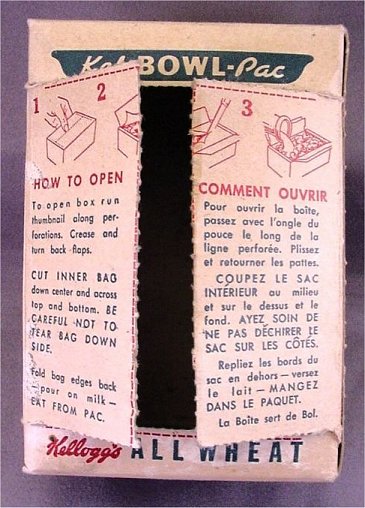
Remember these? It was a clever marketing ploy by Kellogg’s to increase sales. In effect, the idea was good – but unless the package was opened with surgical precision using razor-sharp instruments, you usually ended up with a leaky carton and milk all over everything but the cereal. Others have blogged eloquently about the phenomenon, so I won’t go into the relative merits and drawbacks of the concept (the patent on the Kel-Bowl-Pac was cancelled in 2003, by the way, so it’s up for grabs if you want to use it.)

Kel-Bowl-Pac 2

When I saw this picture the other day, it brought back a memory that, in retrospect, makes perfect sense.

Kel-Bowl-Pac

I couldn’t have been more than 7 or 8 when I realized that the instructions on this box irritated me; it was the seminal moment. “Pac” is not how “pack” is spelled, morons. Also, you’re missing the definite article: “the”. The sentence should read, “Eat from the pack.” (Attention! Notice that the French translation doesn’t say “Mangez dans paq.”) I was convinced that “Kel-Bowl-Pac” itself was an abomination: they should have called it the “Kellog’s Bowl Pack.”

Yes, yes, it’s all rather irrelevant. It’s Madison Avenue. They did it to save space. Yadda yadda. But looking back, I realize that language was important to me, even at that tender age, and continues to be so. I remember being disturbed every time I read that on one of their little boxes;  I’m still embarrassed when I make a grammatical mistake through fatigue or haste, because split infinitives, dangling participles, and misplaced or misused apostrophe’s (sic) task me[1]. I feel like taking in my sign, that’s all.

The Old Wolf has spoken. Hopefully without any errors.


[1] Despite the “sic”, I’m sure someone is going to write me to point out that I misused the apostrophe here. It’s called satire for the sake of emphasis, bitches. By the way, does anal-retentive have a hyphen?